Available online throug
ISSN 2229 – 5046
EDGE h - DOMINATION IN HYPERGRAPH
D. K. THAKKAR*
1, V. R. DAVE
21
Department of Mathematics, Saurashtra University, Rajkot – 360 005, India.
2
Shree M. & N. Virani Science College, Kalavad Road, Rajkot – 360 005, India.
(Received On: 07-07-17; Revised & Accepted On: 01-08-17)
ABSTRACT
I
n this paper we introduce a new concept called edge h – domination in hypergraphs. Every edge h – dominating set is an edge dominating set but converse is not true. We characterize minimal edge h – dominating set in hypergraphs. It is also proved that the edge h – domination number does not decrease when a vertex is removed from the hypergraph and the subhypergraph obtained by removing the vertex from the hypergraph is considered. We also prove corresponding results for the partial subhypergraph obtained by removing a vertex from the hypergraph.Keywords: Hypergraph, Edge h - Dominating Set in Hypergraph, Minimal Edge h - Dominating Set, Minimum Edge
h - Dominating Set, Edge h - Domination Number, Edge Dominating Set, Edge Domination Number, Sub Hypergraph, Partial Sub Hypergraph.
AMS Subject Classification (2010): 05C15, 05C69, 05C65.
1. INTRODUCTION
The concept of edge domination in hypergraphs was studied in [7, 8, 9]. This concept was defined using the adjacency relation among the edges of a hypergraph. In this paper we introduce a new concept called edge h – domination in hypergraphs. This concept is stronger than the edge domination in hypergraphs. Here also we define the concept of minimal edge h – dominating set in hypergraphs & provides a characterization of these sets. We observe that in a hypergraph without isolated edges the complement of a minimal edge h – dominating set is an edge dominating set.
We also consider sub hypergraphs & partial sub hypergraphs obtained by removing a vertex from the hypergraph. In fact we observe the effect of removing a vertex on the edge h – domination number of a hypergraph.
2. PRELIMINARIES
Definition 2.1 Hypergraph: [4] A hypergraph 𝐺 is an ordered pair (𝑉(𝐺), 𝐸(𝐺)) where 𝑉(𝐺) is a non-empty finite set &𝐸(𝐺) is a family of non-empty subsets of 𝑉(𝐺)∋ their union = 𝑉(𝐺). the elements of 𝑉(𝐺) are called vertices & the members of 𝐸(𝐺) are called edges of the hypergraph 𝐺.
We make the following assumption about the hypergraph. (1) Any two distinct edges intersect in at most one vertex.
(2) If e1 and e2 are distinct edges with | e1 |, | e2 | > 1 then e1 ⊈e2 & e2 ⊈e1
Definition 2.2 Edge Degree [4]: Let G be a hypergraph & v ∈V(G) then the edge degree of v = dE(v) = the number of edges containing the vertex v. The minimum edge degree among all the vertices of G is denoted as δE(G) and the maximum edge degree is denoted as ∆E(G).
Definition 2.3 Dominating Set in Hypergraph [1]: Let G be a hypergraph & 𝑆 ⊆ 𝑉(𝐺) then S is said to be a
dominating set of G if for every 𝑣 ∈ 𝑉(𝐺) – 𝑆 there is 𝑢 ∈ 𝑆 ∋ u and v are adjacent vertices.
A dominating set with minimum cardinality is called minimum dominating set and cardinality of such a set is called
domination number of G and it is denoted as γ (𝐺).
Corresponding Author: D. K. Thakkar*
1,
Definition 2.4 Edge Dominating Set: [7] Let G be a hypergraph & 𝑆 ⊆ 𝐸(𝐺) then S is said to be an edge dominating set of G if for every 𝑒 ∈ 𝐸(𝐺) – 𝑆 there is some f in S ∋ e and f are adjacent edges.
An edge dominating set with minimum cardinality is called a minimum edge dominating set and cardinality of such a set is called edge domination number of G and it is denoted as γE(G).
Definition 2.5 Minimal Edge Dominating Set: [7] Let G be a hypergraph & 𝐹 ⊆ 𝐸(𝐺) then F is said to be a minimal edge dominating set if (1) F is an edge dominating set (2) No proper subset of F is an edge dominating set of G.
Definition 2.6 Sub hypergraph and Partial sub hypergraph: [3] Let G be a hypergraph &𝑣 ∈ 𝑉(𝐺). Consider the subset 𝑉(𝐺) – {𝑣} 𝑜𝑓 𝑉(𝐺). This set will induce two types of hypergraphs from G.
(1) First type of hypergraph: Here the vertex set = 𝑉(𝐺)– {𝑣} and the edge set= { 𝑒
′
/ 𝑒′
= 𝑒 – {𝑣}𝑓𝑜𝑟 𝑠𝑜𝑚𝑒 𝑒
∈
𝐸(𝐺) }. This hypergraph is called the sub hypergraph of G & it is denoted as 𝐺 – {𝑣}.(2) Second type of hypergraph: Here also the vertex set = 𝑉(𝐺) – {𝑣} and edges in this hypergraph are those edges of G which do not contain the vertex v.This hypergraph is called the partial sub hypergraph of G.
Definition 2.7 Edge Neighbourhood: [3] Let G be a hypergraph & e be any edge of G then
Open edge neighbourhood of e = 𝑁(𝑒) = { 𝑓 ∈ 𝐸(𝐺) / 𝑓 𝑖𝑠 𝑎𝑑𝑗𝑎𝑐𝑒𝑛𝑡 𝑡𝑜 𝑒 }.
Close edge neighbourhood of e= 𝑁[𝑒] = 𝑁(𝑒)∪ {𝑒}.
Definition 2.8 Private Neighbourhood of an edge: [3] Let G be a hypergraph. F be a set of edges & e ∈ F, then the
private neighbourhood of e with respect to set F = Prn[e, F] = { f ∈ E(G) / N[f] ∩ F = {e}}
Here we are introducing a new concept called edge h – domination in hypergraph.
Definition 2.9 Edge h – Dominating Set: Let G be a hypergraph. A collection F of edges of G is called an edge h – dominating set of G if
(1) All isolated edges of G are in F.
(2) If f is not an isolated edge & f
∉
F then there is a vertex x in f∋
edge degree of x≥
2 & all the edges containing x except f are in F.An edge h – dominating set with minimum cardinality is called a minimum edge h – dominating set of G & its cardinality is called edge h – domination number of G & it is denoted as γℎ′(G).
3. MAIN RESULTS
Proposition 3.1: Let G be a hypergraph. Then every edge h – dominating set is an edge dominating set of G.
Proof: Suppose F is an edge h – dominating set of G. Let h be any edge of G which is not in F. Since F is an edge h – dominating set, there is some x in h ∋ edge degree of x ≥ 2 & all the edges containing x are in F.
Thus, there is an edge containing x ∋ this edge lies in F & it is adjacent to h.
∴ F is an edge dominating set.
Example 3.2:
Figure-1
Let F = {e1} then F is an edge dominating set which is not an edge h – dominating set.
Example 3.3: Suppose e is an edge of a hypergraph G ∋ edge degree of x ≥ 2 for every x in e. For every x in e, select one edge ex containing x, ex ≠ e.
Let F = E(G) – {ex} ∋ x ∈ e. Then obviously F is an edge h – dominating set of G.
Remark 3.4: An Upper Bound for Edge h – Domination Number of a Hypergraph:
(1) Let G be a hypergraph &e be an edge of G
∋
|e| = rank of G & edge degree of x≥
2, for every x in e. Let m = |E(G)|. From the above example we observe thatγ
ℎ
′(G)
≤
|F| = m – rank of G.(2) Let G be a hypergraph with
δ
E(G)≥
2 & suppose v is a vertex of G such that edge degree of v =∆
E(G). Let T = {e∈
E(G)∋
v∈
e} then |T| =∆
E(G). Let F = E(G) – T then F is an edge h – dominating set of G.∴γ
ℎ′(G)≤
|F| = |E(G)| - |T| = m -∆
E(G). Thus,
γ
ℎ′(G)≤
m -∆
E(G).Example 3.5: Consider the finite projective plane with r2 – r + 1 vertices & r2 – r + 1 edges (r ≥ 2). Here, rank of G = r ∴γℎ′(G) ≤ (r2 – r + 1) – r = r2 –2r + l
∴γℎ′(G) ≤ r2 –2r + 1
Definition 3.6 Minimal Edge h – Dominating Set: Let G be a hypergraph & F be an edge h – dominating set of G. Then F is said to be a Minimal Edge h – Dominating Set if for every edge e ∈ F, F – {e} is not an edge h – dominating set of G.
Now, we prove a necessary & sufficient condition under which an edge h – dominating set is a minimal edge h – dominating set.
Theorem 3.7: Let G be a hypergraph & F be an edge h – dominating set of G. Then F is a minimal edge h – dominating set iff for every e ∈ F one of the following conditions is satisfied.
(1) e is an isolated edge in G.
(2) e is not an isolated edge of G & for every x in e with edge degree of x
≥
2 there is an edge ex≠
e containing x∋
ex∉
F.(3) There is an edge f in E(G) – F
∋
f∩
e = {x} for some x in e & for all edges h containing x except f , h∈
F & for all y in f with edge degree of y≥
2 & y≠
x there is an edge hy≠
f containing y∋
hy∉
F.Proof: Suppose F is a minimal edge h – dominating set of G. Let e ∈ F.
If e is an isolated edge of G then (1) is satisfied.
Suppose e is not an isolated edge of G.
Now, F1 = F – {e} is not an edge h – dominating set of G. Therefore, there is an edge f which is not in F1& which is also not an isolated edge of G ∋ for every x ∈ f, with edge degree of x ≥ 2 there is an edge hx containing x & hx ≠ f ∋ hx∉ F1.
Case-1: f = e
Then for every x in e with edge degree of x ≥ 2, there is an edge hx containing x ∋ hx ≠ e &hx ∉ F1. This means that hx ∉ F. (Thus (2) is proved.)
Case-2: f ≠ e Then f ∉F.
(a) For each x in f there is an edge hx
′
containing x∋
hx′≠
f &hx′∉
F1.(b) There is a vertex x0 in f
∋
edge degree of x0≥
2 & for all edges hx0 containing x0with hx0≠
f, hx0∈
F.From (a) & (b) it is clear that e is the edge which contains x0 ∋ e ∉ F1 although e ∈ F.
Thus, x0 ∈ e ∩ f. From (b) it is clear that x0∈ f & all the edges hx0 with hx0≠f, hx0∈ F. Again F1 is not an edge h – dominating set of G. From (b) again for all y in f with y ≠ x0, with edge degree of y ≥ 2 there is an edge hy
Conversely suppose the one of the given three conditions is satisfied.
Let e ∈ F. First suppose that e is an isolated edge in G. Obviously F – {e} is not an edge h – dominating set of G.
Suppose (2) is satisfied. Consider F1 = F – {e} then e ∉ F1&∀ x in e with edge degree of x ≥ 2 there is an edge hx containing x ∋ hx ≠ e &hx ∉ F1. This proves that F1 is not an edge h – dominating set of G.
Suppose (3) is satisfied. Let F1 = F – {e} then it can be seen that F1 is not an edge h – dominating set of G.
Thus, from all the three cases above it follows that F is a minimal edge h – dominating set of G.
Example 3.8:
Figure-2
Consider the hypergraph mentioned above with vertices {1, 2, ….. , 9} & edge set E(G) = {e1, e2, e3, e4}. Let F = {e1} then F is a minimum edge h – dominating set of G. Also consider the set F1 = {e2, e3, e4}. Then F1 is a minimal edge h – dominating set of G which is not a minimum set.
Now, we prove the following theorem.
Theorem 3.9: Let G be a hypergraph which does not have any isolated edge. If F is a minimal edge h – dominating set of G then E(G) – F is an edge dominating set of G.
Proof: Let h ∈ F. Now, h is not an isolated edge of G. Suppose condition (2) of above theorem is satisfied then for every x in h with edge degree of x ≥ 2, there is an edge hx containing x ∋ hx ≠ h &hx ∈ E(G) – F. (Since h is not an isolated edge there is some x in h with edge degree of x ≥ 2) Thus hx is adjacent to h &hx ∈ E(G) – F.
Suppose condition (3) is satisfied. Then there is an edge f in E(G) – F ∋f∩ h = {x} for some x ∈ h. Thus h is adjacent to f for some f ∈ E(G) – F.
Thus, in all the cases we get an edge f in E(G) – F which is adjacent to f. Thus, E(G) – F is an edge dominating set of G.
Remark 3.10: Note that for any hypergraph G, γ′(G) ≤γℎ′(G).
Corollary 3.11: Let G be a hypergraph without isolated edges then γ′(G) + γℎ′(G) ≤ m. Where m = the number of edges of G.
Proof: Let F be a minimum edge h – dominating set of G then F is also a minimal edge h – dominating set of G.
Therefore, by above theorem E(G) – F is an edge dominating set of G.
Then γ′(G) ≤ |E(G)| - F = m - γℎ′(G)
∴γ′(G) + γℎ′(G) ≤ m.
Corollary 3.12: Let G be a hypergraph without isolated edges. If γ′(G) = 𝑚
2 then γℎ′(G) =𝑚2 .
Proof: Suppose γ′(G) = 𝑚
If γℎ′(G) >𝑚
2 then it follows that γ′(G) + γℎ′(G) > m. This contradicts the above corollary. ∴γℎ′(G) = 𝑚
2 .
Example 3.13:
Figure-3
Consider the hypergraph whose vertices are {0, 1, 2, 3, 4} & edges are E(G) = {e1, e2}. Where e1 = {1, 0, 2} & e2 = {3, 0, 4} then {e1} is a minimum edge dominating set as well as minimum edge h - dominating set of G.
∴γ′(G) = 1 &γℎ′(G) = 1
Remark 3.14: we may note that it is not true in general that γ′(G) = 𝑚
2 if γℎ′(G) = 𝑚2 .
Example 3.15:
Figure-4
Consider the hypergraph with vertices {1, 2, ….. , 6}& edge set E(G) = {e1, e2, e3, e4, e5, e6}.
Here, γ′(G) = 2 &γℎ′(G) = 3 = 6/2.
4. VERTEX REMOVAL & SUBHYPERGRAPH
Now, we consider the operation of removing a vertex from the hypergraph & we consider the resulting subhypergraph.
We make an attempt to observe the effect of this operation on edge h – domination number of a hypergraph.
Let G be a hypergraph, v ∈ V(G) be ∋ {v} is not an edge of G. Now, we will consider the subhypergraph G – v whose vertex set is V(G) – {v} & edges are obtained by removing v from every edge of G.
First we prove that the edge h – domination number of a hypergraph does not increase when a vertex is removed from the hypergraph.
Proposition 4.1: Let G be a hypergraph & v ∈V(G) be ∋ {v} is not an edge of G then γℎ′(G) ≤γℎ′(G - v).
Proof: Let F be a minimum edge h – dominating set of G – v.
Let F1 = {e ∈E(G) ∋ e – {v}= e′∈ F} then F1 is a set of edges of G.
Let h be any edge of G ∋ h ∉ F. Let h′ = h – {v} then h′ is an edge of G – v & h′∉ F. Since F is an edge h – dominating set of G – v there is a vertex x in h′∋ all the edges (in G - v) containing x (except h′) are in F. Obviously, all the edges (in G) containing x (except h) are in F1. Thus, F1 is an edge h – dominating set of G.
∴γℎ′(G) ≤γ ℎ
Now, we prove a necessary & sufficient condition under which the edge h – domination number increases when a vertex is removed from the hypergraph.
Theorem 4.2: Let G be a hypergraph & v ∈ V(G) be ∋ {v} is not an edge of G then γℎ′(G - v) >γℎ′(G) iff for every minimum edge h – dominating set F of G there is an edge g not in F ∋ v ∈ g & v is the only vertex of g ∋ all the edges containing v except g are in F.
Proof: First suppose that γℎ′(G - v) >γℎ′(G). Let F be any minimum edge h - dominating set of G. Let F1 = {e′∋e∈ F} then |F1| = |F| <γℎ′(G - v) & therefore, F1 cannot be an edge h – dominating set of G.
∴ There is an edge g′ of G – v ∋ g′∉ F1& for every x in G′ there is an edge hx′ containing x∋hx′∉ F1.
Let g be the edge of G ∋g – {v} = g′. If v ∉ g then g = g′& since F is an edge h - dominating set of G there is a vertex x0 in g = g′∋ all the edges of G containing x0 (except g) are in F but then it implies that all the edges of G – v containing x0 (except g′) are in F1, which contradicts the previous statement.
∴v∈ g.
Since F is an edge h - dominating set of G there is a vertex y in g ∋ all the edges of G containing y (except g) are in F. This y must be equal to v because otherwise there is a contradiction.
Conversely suppose the condition is satisfied.
Let T be any set of edges of G – v ∋ |T| ≤γℎ′(G). Let S = {e ∈E(G) ∋ e – {v}∈ T} then S is a set of edges ∋ |S| ≤γℎ′(G).
Case-1: |T| = γℎ′(G). Then |S| = γℎ′(G).
If T is an edge h – dominating set of G – v then for every edge h′ of G – v which is not in T there is a vertex x in h′∋ edge degree of x ≥ 2 &all the edges of G - v (except h′) containing x are in T.
Let h be the edge of G ∋ h – {v} = h′ then x ∈ h, x ≠ v & all the edges of G (except h) are in S. This contradicts the condition given in the statement.
∴ Any set T of edges of G – v with |T| = γℎ′(G) cannot be an edge h – dominating set of G - v.
Case-2: |T| <γℎ′(G).
Let S be as above. If T is an edge h – dominating set of G – v then S is an edge h – dominating set of G with |S| <γℎ′(G). This is again a contradiction. Thus here also T is not an edge h – dominating set of G - v.
Thus, we have proved that if T is a set of edges of G – v with |T| ≤γℎ′(G) then T cannot be an edge h – dominating set of G - v.
Thus, γℎ′(G - v) >γℎ′(G)
Example 4.3:
Consider the hypergraph with vertices {1, 2, ….. , 9} & edge set E(G) = {e1, e2, e3, e4}. Now, consider the subhypergraph G – {1} whose edges are e1 = {4, 7} & e2 = {2, 3}, e3 = {4, 5, 6} & e4 = {7, 8, 9} then γℎ′(G) = 1 &γℎ′ (G – {1}) = 2.
∴γℎ′(G - v) >γ ℎ ′(G)
Example 4.4:
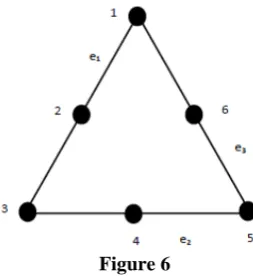
Figure 6
Consider the hypergraph with vertices {1, 2, ….. , 6} & edge set E(G) = {e1, e2, e3}. Now, consider the subhypergraph G – {1} whose edges are e1 = {2, 3} & e2 = {3, 4, 5}, e3 = {5, 6} then γℎ′(G) = 1 = γℎ′(G – {1}).
∴γℎ′(G - v) = γ ℎ ′(G)
Let G be a hypergraph & v be a vertex of G ∋ {v} is not an edge of G. Now, we consider the partial subhypergraph G – v.
Example 4.5:
Figure 7
Consider the hypergraph with vertices {1, 2, ….. , 7} & edge set E(G) = {e1, e2, e3}.
Here, γℎ′(G) = 1 &γℎ′(G – {4}) = 2. ∴γℎ′(G - v) > γ
ℎ ′(G)
Example 4.6:
Consider the hypergraph with vertices {1, 2, ….. , 6} & edge set E(G) = {e1, e2, e3}.
Here, γℎ′(G) = 1 & γℎ′(G – {2}) = 1. ∴γℎ′(G - v) = γ
ℎ ′(G)
Example 4.7:
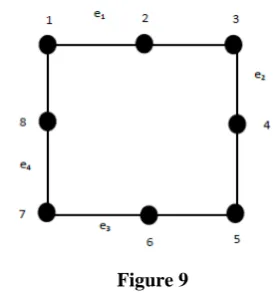
Figure 9
Consider the hypergraph with vertices {1, 2, ….. , 8} & edge set E(G) = {e1, e2, e3, e4}.
Here, γℎ′(G) = 2 & γℎ′(G – {2}) = 1. ∴γℎ′(G - v) < γ
ℎ ′(G)
Definition 4.8 Edge h – Domination of Two Sets: Let G be a hypergraph & F& T be two sets of edges of G then we say that F h – dominates T if for every f in T, one of the following two conditions is satisfied.
(1) f∈F
(2) If f ∉F then ∃ a vertex x of f with edge degree of x ≥ 2, all the edges containing x except f are in F.
Notation 4.9: If v is a vertex of hypergraph G then Ne(v) = {f ∈ E(G) ∋ v ∈ f}
Theorem 4.10: Let G be a hypergraph & v ∈V(G) be ∋ {v} is not an edge of G then γℎ′(G - v) > γℎ′(G) iff the following two conditions are satisfied.
(1) If F is any minimum edge h – dominating set of G then there is an edge f containing v
∋
f∈
F.(2) There is no subset F of E(G) – Ne(v)
∋
F does not edge h – dominates Ne(v), |F|≤γ
ℎ′(G) & F is an edge h -dominating set of G – v.Proof: Suppose γℎ′(G - v) > γℎ′(G).
Suppose there is a minimum set F ∋ no edge containing v belongs to F. Then F is a set of edges of G – v. Let h be any edge of G – v ∋ h ∉ F. Then h cannot be an isolated edge of G.
∴ There is a vertex x in h ∋edge degree of x ≥ 2 & all the edges of G containing x (except h) are in F. None of these edges contains v because F does not contain any edge which contains v. Therefore, these are the edges of G – v. Thus, all the edges of G – v containing x (except h) are in F. Thus, F is an edge h – dominating set of G – v.
∴γℎ′(G - v) ≤ |F| = γ ℎ
′(G) which contradicts the assumption that γ ℎ
′(G - v) > γ ℎ
′(G). Hence, condition (1) holds.
(2) Suppose there is a minimum edge h – dominating set F of G – v ∋ F ⊆ E(G) – Ne(v), F does not edge h – dominates Ne(v) & |F| ≤γℎ′(G).
∴γℎ′(G - v) ≤γ ℎ
′(G) Which is a contradiction. Hence, condition (2) holds.
Conversely suppose condition (1) & (2) holds.
First suppose that γℎ′(G - v) = γℎ′(G).
Let F be a minimum edge h – dominating set of G – v. First suppose that F is also an edge h – dominating set of G then
F is also a minimum edge h – dominating set of G because |F| = γℎ′(G - v) = γℎ′(G). Thus, F is a minimum edge h - dominating set of G not containing any edge which contains v. This contradicts condition (1). Therefore, F is not an
edge h – dominating set of G.
It is obvious that v ∈ f & therefore, f ∈ Ne(v) & also this implies that F does not edge h – dominates Ne(v).
∴ F is a minimum edge h – dominating set of G – v ∋ |F| ≤γℎ′(G), F ⊆E(G) – Ne(v) & F does not edge h – dominates Ne(v). This contradicts condition (2).
∴ We conclude that γℎ′(G - v) = γℎ′(G) is not possible.
Now, suppose that γℎ′(G - v) <γℎ′(G).
Let F be a minimum edge h – dominating set of G – v. Then F cannot be an edge h – dominating set of G. By the arguments similar to the arguments given in the above case we deduce that γℎ′(G - v) <γℎ′(G) is also not possible. Hence, γℎ′(G - v) > γℎ′(G).
Now, we prove a necessary & sufficient condition under which the edge h – domination number decreases when a vertex is removed from the hypergraph.
Theorem 4.11: Let G be a hypergraph with δE(G) ≥ 3 & v ∈ V(G) be ∋ {v} is not an edge of G then γℎ′(G - v) <γℎ′(G) iff there is a minimum edge h – dominating set F of G & edges {e1, e2, …..., ej}(j ≥ 1) containing v ∋∀ i in 1, 2, ….., j & for every vertex x in ei there is an edge hx containing x with hx≠ei ∋ hx∉ F.
Proof: Suppose there is a minimum edge h – dominating set F of G which satisfies the condition stated in the theorem. Let F1 = F – all the edges containing v then |F1| < |F|
If h is any edge of G – v & h ∉ F1 then h is an edge of G & h ∉ F. Since F is an edge h – dominating set of G & h ∉ F there is a vertex x in h ∋ all the edges containing x (except h) are in F. Therefore, all the edges of G - v containing x (except h) are in F1. Thus F1 is an edge h – dominating set of G – v.
Thus, γℎ′(G - v) ≤ |F1| < |F| = γℎ′(G).
Conversely suppose γℎ′(G - v) < γℎ′(G)
Let F1 be any minimum edge h – dominating set of G – v then F1 cannot be an edge h – dominating set of G because |F1| <γℎ′(G).
∴ There is an edge e of G ∋ e ∉ F1&∀ x in e there is an edge hx containing x ∋hx ≠ e hx ∉ F1. Obviously e must contain v. Let {e1, e2, …...,ej} be the set of all such edges of G containing v.
Let F = F1∪ {e1, e2, …...,ej} then F is a minimum edge h – dominating set of G satisfying the required property.
REFERENCES
1. Acharya B., Domination in Hypergraphs, AKCE J. Graphs. Combin., 4, NO. 2(2007) 111 – 126
2. Behr A., Camarinopoulos L., On the domination of hypergraphs by their edges, Discrete Mathematics, 187(1998), 31 - 38
3. Berge C., Graphs and Hypergraphs, North-Holland, Amsterdam (1973)
4. Berge C., Hypergraphs, North – Holland Mathematical Library, New York, Volume – 45 (1989)
5. Haynes T., Hedetniemi S. and Slater P., Domination in Graphs Advanced Topics, Marcel Dekker, Inc., New York, (1998).
6. Haynes T., Hedetniemi S. and Slater P., Fundamental of Domination in Graphs, Marcel Dekker, Inc., New York, (1998)
7. Thakkar D. and Dave V., Edge Domination in Hypergraph, Communicated for publication.
8. Thakkar D. and Dave V., More about Edge Domination in Hypergraph, Communicated for publication.
9. Thakkar D. and Dave V., Regarding Edge Domination in Hypergraph, IJMTT, Volume 44 NO. 3(2017), 108 -114
Source of support: Nil, Conflict of interest: None Declared.