ISSN-L: 2501 - 1235 Available on-line at: www.oapub.org/edu
doi: 10.5281/zenodo.3786160 Volume 6 │ Issue 4 │ 2020
COMPARISON OF SIMPLE CHOICE VISUAL REACTION
TIME BETWEEN ATHLETE AND SEDENTARY
UNIVERSITY WOMEN STUDENTS
Md. Hamidur Rahman1, Shaybal Chanda1i,
Md. Nasim Reza2 1Assistant Professor,
Department of Physical Education and Sports Science, Faculty of Health Science, Jashore University of Science and Technology, Bangladesh
2Associate Professor, Dr.,
Department of Physical Education and Sports Science, Faculty of Health Science, Jashore University of Science and Technology, Bangladesh
Abstract:
The purpose of this study was to compare the university women athletes and sedentary women students in respect of simple choice visual reaction time (SCVRT) of hands.
Method: 40 university women students were randomly selected as subject and each group consisted of 20 students, and age ranged between 17 to 25 years. SCVRT of the subjects were tested of both the hands using the subject’s index figure. Reaction Time
(RT) was measured five times of both the hands of the subjects and the first two digits of milliseconds of average of five trials were considered as the experimented RT data for the study. Audio-Visual Reaction (AVR) Timer machine was used to collect RT data. Result:
Paired sample t-test of strong and weak hands of athletes and sedentary women university students together shows that strong hand mean = 18.28 ms, SD = 1.71 ms, and weak hand mean = 21.08 ms and SD = 2.17 ms, t(0.05)(39) = -8.84 and p = 0.00. Further, an
independent sample t-test of both the hands between athletes and sedentary women students show that in the strong hand athletes mean = 17.95 ms and SD = 1.96 ms, and sedentary mean = 18.60 ms and SD = 1.39 ms, t(0.05)(38)= -1.21 and p = 0.23. Whereas, in the
weak hand athletes mean = 20.70 ms and SD = 2.56 ms, and sedentary mean = 21.45 ms and SD = 1.67 ms; t(0.05)(38)= -1.10 and p = 0.28. Conclusion: It is concluded that among the
university athletes and sedentary women students’ strong hand is faster than that of their
weak hand in terms of simple choice visual reaction time, and athletes and sedentary
women students’ strong and weak hand quickness is almost the same in the population. However, women athletes maintain little superiority over sedentary women students based on SCVRT quickness in both cases of strong and weak hand in the sample.
Keywords: simple choice visual reaction time, women athlete, sedentary women, university student
1. Introduction
The reaction is a determined controlled response to an outside stimulus. A definite period between the application of an outside stimulus and right motor response to the stimulus is known as reaction time (RT). It describes the time gap connecting the appearance of stimulus and the emergence of correct voluntary reply in a body (Batra et al., 2014; Grrishma et al., 2013). Visual Reaction Time comprised of four phases is the start of eye movements, eye movement time, decision time and muscle contraction time (Murphey et al., 1992). Further, it may be broken up into three components. The first component is perception time, the time for the application and observation of stimulus. The second component is decision time, which indicates the time for providing an appropriate response to the stimulus. The third component is motor time that is the time for the fulfillment of the signal received (Yuhas, 2012).
RT also can be classified into three types such as (a) simple reaction time: one stimulus and one response are present in it, (b) recognition reaction time: in it, some stimuli are to response and rest other to ignore, (c) choice reaction time: multiple responses are required against multiple stimuli (Luce, 2008; Keramati et al., 2011). Physiological and pharmacological factors are responsible to alter the reaction time (Mohan et al., 1984; Malathi et al., 1990). Several factors come on RT such as stimulation, age, sex, left v/s right limb, practice, tiredness, hunger, interruption of concentration, personality type, penalty, anxiety, work-out, and brainpower of the individual (Bamne et al., 2011). RT is an indicator of quickness of the body that is a significant aspect in the capacity for physical workout and not merely indispensable for sporting activities but also indispensable for the physical activities of daily-today-life (Ishijima et al., 1998).
The process of identifying one visual stimulus with one response and measuring the required time is defined as a simple choice visual reaction time (Solanki et al., 2012). RT is an assessment of how rapidly a person can respond to a specific stimulus. In sports, the RT is the capacity to respond rapidly with appropriate posture and control to a stimulus i.e. sound or light (Reza et al., 2018). In everyday life, visual RT plays many vital roles and decides the watchfulness of an individual. Quickness in RT is as important as
ounces’ force-generating activities in a-lot-of sports and daily life activities (Yeung et al., 1999).
present study would be meaningful and worthy to compare and investigate simple choice visual reaction time (SCVRT) of the university women athletes and sedentary women students on the basis of strong (Dominant) and weak (Non-dominant) hand.
1.1 Purpose of the Study
The present study attempts to reveal the Simple Choice Visual Reaction Time (SCVRT) differences between sedentary and athlete female students of the university based on strong (Dominant) and weak (Non-dominant) hand.
2. Materials and Methods
A total number of 40 university women students were randomly selected as the subject for the present study, where 20 were women athletes and rest 20 were sedentary women students. The age of the subjects ranged from 17 to 25 years. The location of the study was Jashore University of Science and Technology, Jashore, Bangladesh. SCVRT of the subjects was tested for both the hands- strong and weak using the subjects’ index figure.
SCVRT was measured five times for both hands of each subject and the average was considered as the tested RT. First two digits of the mean values of calculated milliseconds saved as data for the study. SCVRT was measured in a quiet room. The tests were conducted in a comfortable chair sitting condition. The visual reaction time was measured by reaction time instrument i.e. “Audio-Visual Reaction (AVR) Timer” by
Medisystems, ISO 9001:2015 (QMS). Visual reaction time was recorded form illuminated light, which served as the stimulus. As soon as the stimulus was perceived by the subject, she responded by pressing the concerned response switch. The AVR timer display indicated the response time in milliseconds.
2.1 Mean Age of the Subjects
Table 1: Age of the Subjects
Subjects Mean
(Years)
SD (Years)
Athletes Women 21:9 1:10
Sedentary Women 20:2 1:00
2.2 Statistical Tools
The researchers used the Shapiro-Wilk test to check the normality of the gathered data. Mean and SD have been tested as the measure of central tendency and variability respectively. Paired and independent sample t-test was employed to test the statistical
3. Analysis of Data
Table 2: Paired Sample t-test of Simple Choice Visual Reaction Time (SCVRT) between Strong and Weak Hand of Athletes and Sedentary Women Students
Parameter Descriptive Inferential: Paired Sample t-test
Mean (ms) SD (ms) t df Sig. (2-tailed)
Pair 1 Strong Hand Weak Hand
18.28 1.71
- 8.84 39 0.00
21.08 2.17
*Required value for being significant at df 39 and at α = 0.05 level is t (39) = 2.0227
Table 2 confirms paired sample t-test of SCVRT between the strong and weak hand of both the groups together athletes and sedentary women students that strong hand mean = 18.28 ms with SD = 1.71 ms, and weak hand mean = 21.08 ms with SD = 2.17 ms, t(0.05)(39)=
-8.84 and p = 0.00, (2-tailed) at α = 0.05. A statistically significant difference in SCVRT has been observed between the strong and weak hands of university women students with
the strong hand’s superiority in quickness.
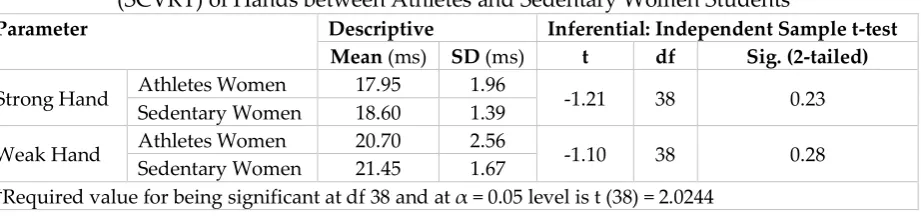
Table 3: Independent Sample t-test of Simple Choice Visual Reaction Time (SCVRT) of Hands between Athletes and Sedentary Women Students
Parameter Descriptive Inferential: Independent Sample t-test
Mean (ms) SD (ms) t df Sig. (2-tailed)
Strong Hand Athletes Women 17.95 1.96 -1.21 38 0.23 Sedentary Women 18.60 1.39
Weak Hand Athletes Women 20.70 2.56 -1.10 38 0.28 Sedentary Women 21.45 1.67
*Required value for being significant at df 38 and at α = 0.05 level is t (38) = 2.0244
Table 3 of independent sample t-test of SCVRT of hands between athletes and sedentary women students shows that in the strong hand women athlete mean = 17.95 ms and SD = 1.96 ms, and sedentary women mean = 18.60 ms and SD = 1.39 ms, t(0.05)(38) = -1.21 and
p = 0.23, (2-tailed). Whereas, in the weak hand women athlete mean = 20.70 ms and SD = 2.56 ms, and sedentary women mean = 21.45 ms and SD = 1.67 ms; t(0.05)(38) = -1.10 and p=
0.28, (2-tailed). In both the cases of strong and weak hand comparison based on athlete and sedentary women athlete, it was calculated that t value is less than the table value of t, and the significant value was found p > 0.05. However, in terms of mean value, athletes took the upper hand over the sedentary group, but not found any significant statistical difference between them.
4. Result and Discussion
responses to simultaneous stimuli in single responses and paired responses test, and this finding is consonance to the finding of the present study. Further, the result of the investigation of Badau et al. (2018) supports the present finding, as they noticed that hand laterality and type of participated sport are the determinant factors for the RT of the right and left hand. On the contrary, Nisiyama & Ribeiro-do-Valle (2013) noticed in their study that there is no difference in RT between hands, which contradicts the finding of the present study. Moreover, Nisiyama & Ribeiro-do-Valle’s findings also disagree with the
well-established theory that the left hemisphere is more competent for motor control than that of the right hemisphere of the brain and left hemisphere is responsible for the control of the right side of the body (Hemispheres, 2019). Nevertheless, the discovery of this study complies with the established physiological fact because usually, the right side of the individual is the stronger side; besides, all the subjects in this study were right-handed.
Table 3 of independent sample t-test of SCVRT of hands between athletes and sedentary women students revealed that athlete women students are faster in SCVRT for both the hands then the sedentary women students found in the sample but did not stand true for the same on the population. Jain et al. (2015, p. 127), regularity in workout leads to better RT than those who lead a sedentary lifestyle, and it is consonance to the present study outcome. Further, an investigational study conducted by Dube, et al. (2015) suggests that dominant and non-dominant limbs of Badminton players were faster in RT compared to the people who do not participate in any sports activity also support the findings of the conducted study. Physiological identical facts of hand laterality due to brain hemisphere physiology, which has been discussed in the preceded paragraph, also comply with the present findings. The same research with a larger sample size may provide a better and precise outlook on the population.
5. Conclusion
Investigators concluded that among the university women athletes and sedentary
women students, strong hand’s simple choice visual reaction time is faster than the weak
hand. Between the university athletes and sedentary women students, athletes are faster in simple choice visual reaction time in both strong and weak hands in the sample, but identical in the population.
Funding
There was no such financial grant from any organization.
Acknowledgment
References
Badau, D., Baydil, B., & Badau, A. (2018). Differences among Three Measures of Reaction Time Based on Hand Laterality in Individual Sports. Sports (Basel, Switzerland), 6(2). https://doi.org/10.3390/sports6020045
Bamne, S. N., Fadia, A. D., & Jadhav, A. V. (2011). Effect of colour and gender on human reaction time. Indian Journal of Physiology and Pharmacology, 55(4), 388–389.
Batra, A., Vyas, S., Gupta, J., Gupta, K., & Hada, R. (2014). A Comparative Study Between Young and Elderly Indian Males on Audio-Visual Reaction Time. Ind. J. Sci. Res.
and Tech., 2(1), 25–29.
Dube, S. P., Mungal, S. U., & Kulkarni, M. B. (2015). Simple Visual Reaction Time in Badminton Players: A Comparative Study. National Journal of Physiology, Pharmacy
& Pharmacology, 5(1), 18–20. https://doi.org/10.5455/njppp.2015.5.080720141
Grrishma, B., Gaur, G. S., Velkumary, S., Gurunandan, U., Dutt, A., & Dinesh, T. (2013). Comparison of Hand and Foot Reaction Times among Females-A Methodological Study Using Recognition Auditory Reaction Time. International Journal of Current
Research, 5(12), 4272–4274.
Hemispheres. (2019, September 24). Hemispheres | Left & Right Hemispheres Roles, Facts &
Information. Brain Made Simple.
https://brainmadesimple.com/left-and-right-hemispheres/
Ishijima, T., Hirai, T., Koshino, H., Konishi, Y., & Yokoyama, Y. (1998). The relationship between occlusal support and physical exercise ability. Journal of Oral
Rehabilitation, 25(6), 468–471.
Jain, A., Bansal, R., Kumar, A., & Singh, K. (2015). A comparative study of visual and auditory reaction times on the basis of gender and physical activity levels of medical first year students. International Journal of Applied and Basic Medical
Research, 5(2), 124–127. https://doi.org/10.4103/2229-516X.157168
Keramati, M., Dezfouli, A., & Piray, P. (2011). Speed/Accuracy Trade-Off between the Habitual and the Goal-Directed Processes. PLoS Computational Biology, 7(5), e1002055. https://doi.org/10.1371/journal.pcbi.1002055
Kerr, M., Mingay, R., & Elithorn, A. (1963). Cerebral Dominance in Reaction Time Responses. British Journal of Psychology, 54(4), 325–336. https://doi.org/10.1111/j.2044-8295.1963.tb00887.x
Luce, R. D. (2008). Response Times: Their Role in Inferring Elementary Mental Organization.
Oxford University Press.
https://www.oxfordscholarship.com/view/10.1093/acprof:oso/9780195070019.001. 0001/acprof-9780195070019
Malathi, A., Parulkar, V. G., Dhavale, H. S., & Pinto, C. (1990). A preliminary study of reaction time in schizophrenics. Indian Journal of Physiology and Pharmacology, 34(1), 54–56.
Murphey, M., Tennant, L. K., & Singer, R. N. (Eds.). (1992). Handbook of Research on Sport
Psychology. Macmillan USA.
Nisiyama, M., & Ribeiro-do-Valle, L. E. (2013). Relative performance of the two hands in simple and choice reaction time tasks. Brazilian Journal of Medical and Biological
Research, 47(1), 80–89. https://doi.org/10.1590/1414-431X20132932
Reza, M. N., Chanda, S., & Rahman, M. H. (2018). A Comparative Study of Visual Choice Reaction Time of University Soccer and Basketball Players. American Journal of
Sports Science, 6(4), 130. https://doi.org/10.11648/j.ajss.20180604.11
Solanki, J., Joshi, N., Shah, C., Mehta, H. B., & Gokhle, P. A. (2012). A study of correlation between auditory and visual reaction time in healthy adults. International Journal
of Medicine and Public Health, 2(2).
Yeung, S. S., Au, A. L., & Chow, C. C. (1999). Effects of fatigue on the temporal neuromuscular control of vastus medialis muscle in humans. European Journal of
Applied Physiology and Occupational Physiology, 80(4), 379–385.
https://doi.org/10.1007/s004210050607
Creative Commons licensing terms