Available online at:
www.ijamee.info
RESEARCH ARTICLE
Assessing the Impact of Corporate Social Responsibility (CSR),
Corporate Reputation, and Customer Loyalty: The Case of
Pepsi-Cola Philippines, Inc.
Revenio Jalagat, Jr.¹*, Van Dalluay
1, Perfecto Aquino, Jr.
2¹Al-Zahra College for Women, Sultanate of Oman. ³American University of Dubai, United Arab Emirates.
Abstract
The objective of this study is to assess the impact of corporate social responsibility (CSR), corporate reputation and customer loyalty. To achieve company’s corporate reputation, the CSR served as the main driver that also relates with customer loyalty. Basically, the descriptive research design was employed and to determine the sample size, the researchers utilized the simple random sampling with 175 respondents but only 166 questionnaires were retrieved. Purely questionnaires were used as instruments consisting of two part survey indicating questions by use of the Likert 4-scale model related to corporate reputation and customer loyalty. In analyzing the data, the two-tailed t-test for paired data were utilized
to address the assumptions that: Hₒ1: There is no significant difference between CSR and corporate
reputation before and after CSR orientation; Hₒ2: There is no significant difference between CSR and
customer loyalty. The analysis of the data revealed that there is significant difference between CSR and corporate reputation; and the same results for CSR and customer loyalty. These results further indicate that CSR has contributed significant impact on both corporate reputation and customer loyalty and that is, more CSR activities would mean increased company reputation and customer loyalty when the results
showed that p-values are higher than the alpha values:Hₒ1 = p-value(1.431)>0.05; Hₒ2 =
p-value(1.11)>0.05. Based on these findings, it is recommended that management should give emphasis on corporate reputation and adopt reputation management. Moreover, the company is also encouraged to ensure that CSR activities will be sustainable and needs employee commitment.
Keywords: Corporate Social Responsibility, Customer’s Loyalty, Corporate Reputation.
Introduction
In any business, a customer is considered an integral part of company’s success and is regarded as the lifeblood of organizations [20]. This affirms the fact that customers are vital assets to many organizations and without them, businesses cannot operate and succeed. According to Bateman and Snell [1], company’s survival is mainly determined by the number of customers patronizing its products and services. Although not many studies focus on corporate reputation, Harrison [8] strongly stressed out that, putting greater emphasis on building company reputation can encourage more customers and subsequently build long-term relationships with them. As evidence, service companies engage in professional services consider reputation as the limelight of their success such as
Engineering and Consultancy, Medical Profession, Lawyering, Accountancy, etc. to
attract clients. Moreover, businesses strive to maintain their good name and reputation to increase their sales and profitability. This is because customers value reputation as one of the key preferences for good and quality service.
benefits and opportunities that CSR can offer in return,as it is more evident in medium and large scale companies worldwide.
One of the key factors in establishing and maintaining corporate reputation is the implementation of Corporate Social Responsibility (CSR) that compel companies to address their obligations to the community, society and the general public [2].Recently, businesses perspective have changed from product-centered approach on doing business to a company that is sensitive to the needs of the customers through faithful adherence to social responsibilities. This is the same case to Pepsi-Cola Philippines Inc., the exclusive bottler of PepsiCo beverages in the Philippines with its 66 years of operation. One of its CSR program is centered on the activity called “Talino” or Knowledge that empowers children to be healthy enough to go to school. It was established in September 2013 in partnership with the Kabisig ng Lahi, the National Competitive Council, and the Department of Education where they launched the school-based supplemental feeding program dubbed as PEPSIGLA.
Research Objectives
The aim of this study is to determine the impact of CSR in relation to corporate reputation and customer loyalty. It also assess whether CSR activities can help augment company profits, encourage customers to patronize the products and services, promote positive reputation and develop opportunities for raising the standard of living for the communities they served.
The main problem of this paper is to determine the relationship between corporate reputation and customer loyalty as perceived by the 4th year students of Laguna University utilizing CSR activities as driver of corporate reputation. In order to measure the degree of relationship between these three variables, the researchers will assess whether the CSR activities of Pepsi-Cola in terms of social measures has contributed to the reputation of the company and the customer’s level of loyalty. This study will be limited on the non-financial benefits of CSR activities which is directly related to the program called PEPSIGLA and purposely
intended to the student respondents. The purpose of carrying this study to the chosen organization, Pepsi-Cola Inc. is driven by the fact that the company is one of the large bottler companies in the Philippines where CSR is largely expected and the company itself has gained wider popularity with the customers at all ages. However, due to time constraints the researchers have limited its respondents to the 4th year Business students of Laguna University.
Research Hypothesis
This study is focused on determining the impact of CSR to corporate reputation and customer loyalty. Specifically, to achieve the objective of the study the following hypotheses can be drawn:
Hₒ1: There is no significant difference on the student’s perception on corporate reputation before and after receiving information about Pepsi Cola’s CSR.
Hₒ2: There is no significant difference on the student’s perception on customer loyalty before and after receiving information about Coca Cola’s CSR.
Literature Review
CSR and its ImportanceMany authors defined CSR differently, however; some authors expressly defined CSR as an effective means of managing the business and its activities in a way that it will contribute to an overall impact to the society through economic, environmental and social actions [16,21]. In other words, it is the company’s commitment to share portion of its profits to the society while the stakeholders also demand for it [4]. Such benefits can create a competitive advantage in the market [19].
There are four hierarchy of the term CSR also known as the Pyramid of Social Responsibility namely: economic responsibility, legal responsibility, ethical responsibility and philanthropic responsibility. Legal and ethical responsibilities are considered for the purpose of this study as it highlights sustainable development and sustainability [15, 28].
which consequently lead to the pattern of self-concept theory. In other words, they prefer or patronize products and services from corporations that possess positive corporate reputation than those that do not have. One of the ways to address this gap is to enhance the image through implementation of CSR activities that promotes the company’s self-image.
Various authors stressed the relationship between corporate reputation and customer loyalty as directly correlated and it encompasses different theories including but not limited to the following: social responsibility theory, enlightened self-interest theory, consumerism, social value orientation and the theory of extant social contracts. As applied to the study, the consumerism theory served as the basis for the development of the hypothesis relating the positive impact of corporate reputation on the ethical consumption and customer loyalty. Based on this theory, patronizing company’s products and services heavily rests on the consumers’ perception of what they think are acceptable and ethical rules and standards [6]. It is supported by another theory related to enlightened self-interest theory that takes into consideration any CSR activities are beneficial in long-term rather than short-term endeavors [24].
According to by Oosterhout and Heugensm [17], businesses primarily perform philanthropic responsibilities like charitable activities because they want to establish long-term relationships with the customers through goodwill and customer loyalty.
Another theory that relates to the concept of CSR is the social value orientation theory which states that, customers and individuals vary in their preferences to certain behaviors [6]. To achieve this, management should make sure that their actions will match with the acceptable standard of behavior by customers to encourage customer loyalty. A growing number of large and multi-national corporations have integrated their CSR activities as an integral part of corporate strategy [21]. For example, a study conducted in 2007 by Hewitt revealed that, out of 2,007 of companies classified under top performers
claimed that they have CSR strategy in place [7]. So, it is therefore practical to state that, CSR that used to be an option for businesses for last decades have now become a necessity [13, 16]. Furthermore, stakeholders require the corporations to be responsive the needs and expected to be flexible in the aspect of responsible citizenship and socially responsible.
According to the survey conducted by the Reputation Institute [22] in 2010, about 8 out of 10 business executives affirmed that the stakeholders are expecting and demanding companies to implement and practice the concept of CSR for the benefits of all concerned beneficiaries. These companies also believed that large portion of the budget should be invested to CSR program and activities in return for long-term benefits that may include: company long-term sustainability, increased profitability, long-term return on investments, reduced operating costs, increased commitment and employee participation, enhanced capacity to innovate, improve company-customer relationships, sensitivity to the customer’s needs, and develop a higher pedigree of brand value and reputation [5,10,15].
CSR and Corporate Reputation
Corporate reputation can be perceived and define in many ways. According to Walsh et al. [26] and Lai et al. [12], corporate reputation is defined as the mental associations or impressions to any organizations as perceived by the stakeholders. It also relates to the company’s ability to meet the needs of the stakeholders thereby developing the concept of goodwill and customer loyalty. Another author defined corporate reputation as a concept that “embodies the image and values of a company” [27].
individually and in groups, it is regarded as multi-stakeholder concept [9].
Recent studies revealed the significant relationship between CSR and corporate reputation which justify that CSR is a strong driver of corporate reputation [29]. It is validated further in the study of Tencati, Perrini and Pogutz [25] concluding that, CSR contributes significantly to corporate trust and reputation that enhanced better relationship between the companies and its stakeholders. It should be viewed as a strategic investment as a form of reputation building [12]. In a survey to most American Companies, 80% of the CEOs confirmed that CSR enhanced company reputation and the primary consideration of reputation management platforms for international firms. Few studies also affirm these results citing that, there is positive relationship CSR and positive or reputation [13].
CSR, Corporate Reputation and
Customer Loyalty
The relationship between brand, service, dealer and repeat patronage defines the so called customer loyalty [16]. When customers are loyal to the company, it would mean customers are likely to make repeat purchases, encourage others by word of mouth, and establish long-term relationship and sustainable development [28]. As such it enables companies to achieve long-term success and competitive advantage by saving costs on customer retention [11, 16].
Recent trends consider CSR as part of customer’s decision to buy and according to Yuen [28], about 70% of the respondents in his study examine the level of CSR implemented by company as basis of their loyalty. Having a good corporate reputation cannot be quantified however, it is considered as valuable asset because of its financial and non-financial benefits [3,26]. Specifically, several assumptions dictate that customer loyalty increases as a result of strong reputation and determining the corporate’s reputation is positively link with CSR [21].
Furthermore, evidence showed that customers are more aware how the company behaves because of the availability of vast
information they can get from internet and websites [29].
Several studies revealed the positive impacts between corporate reputation and customer loyalty.
This is because companies have difficulty to acquire new customers than to retain old and loyal customers which is possible with the company’s excellent reputation [29]. More researches assert that customers are more motivated to tell about their experiences with the product and loyal to companies when these companies have shown environmental-friendly practices and conduct ethically in their business operation [12, 14, 23, 26]. Also, good corporate image increased sales and market share, brand equity as well as customer loyalty. A similar study concluded that maintaining a good reputation would mean sustainable customer loyalty [2, 28]. However, few studies contradict the positive relationship between reputation and customer loyalty indicating that its impact is more contingent on brand equity and sales.
For example, the study of Page and Fearn [18] confirmed that customers do not usually consider company’s reputation when buying but more on the brand equity and sales. Lastly, to build a strong corporate reputation lies in the company’s implementation of CSR which in turn enhanced customer loyalty and reputation [19, 21].
Research Methodologies
This research study utilized the descriptive research design. Furthermore, the sample was taken through simple random sampling with 175 business students in their 4th year level at Laguna University, Philippines. Out if the 175 respondents, only 166 questionnaires were retrieved. The main objective is to determine the relationship between the two variables: corporate reputation and customer loyalty through an evaluation of the company’s CSR.
into two parts and contain 18 questions based on 4-point Likert Scale. The first partcontains questions regarding customer loyalty and the second part presents questions on the students’ perception on Pepsi-Cola’s corporate reputation. The data were analyzed using the t-test and the procedure is to conduct pre-test and post-test to the same respondents. The pre-test were employed before the respondents are oriented about Pepsi-Cola’s CSR while post-test were conducted to the same respondents after the orientation.
Data Presentation and Analysis
This section provides analysis of the data collected from the respondents. The statistical tool used in the analysis is the t-test for paired data and three variables are being analyzed. The CSR is the independent variable while both the corporate reputation and customer loyalty are the dependent variables. The first table computes the two-tailed t-test for determining the significant difference between CSR and corporate reputation after two test were conducted and the mean scores were tabulated. The second table analyzed data between the CSR and customer loyalty.
The test was conducted at alpha = 0.05 and at confidence interval of 95%.
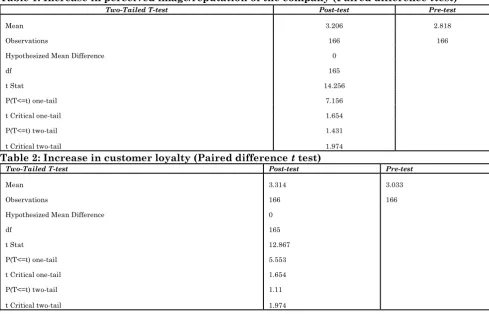
Table 1 shows the results of the test conducted to determine the significant difference between CSR and corporate reputation. Further, it depicts that the p-value of the two-tailed t-test is 1.431 which is more than the alpha value of 0.05 (p>.05). This means that the null hypothesis is rejected and it is therefore valid to say that there is significant difference between CSR and corporate reputation such that the CSR activities employed by Pepsi-Cola Inc. significantly impacts the corporate reputation as perceived to be increased. It confirms to various studies conducted that CSR activities positively impacts corporate reputation. Specifically, the CSR activities indeed increased the students’ perception on Pepsi-Cola’s good reputation.
Table 2 presents the results by analyzing the significant difference between CSR and customer loyalty. Furthermore, it reveals that similar to the results in table 1
Table 1: Increase in perceived image/reputation of the company (Paired difference ttest)
Two-Tailed T-test Post-test Pre-test
Mean 3.206 2.818
Observations 166 166
Hypothesized Mean Difference 0
df 165
t Stat 14.256
P(T<=t) one-tail 7.156
t Critical one-tail 1.654
P(T<=t) two-tail 1.431
t Critical two-tail 1.974
Table 2: Increase in customer loyalty (Paired difference t test)
Two-Tailed T-test Post-test Pre-test
Mean 3.314 3.033
Observations 166 166
Hypothesized Mean Difference 0
df 165
t Stat 12.867
P(T<=t) one-tail 5.553
t Critical one-tail 1.654
P(T<=t) two-tail 1.11
the computed p-value under the two-tailed t-testis 1.11 more than the alpha value of 0.05 (p>0.05) which can be interpreted that there is significant difference between CSR and customer loyalty perceived to be in an increasing trend. Therefore, CSR activities contribute significant impact on customer loyalty which can also safely be assumed that more CSR activities would mean increased customer loyalty.
Moreover, in testing whether both the increases in corporate reputation and customer loyalty were significant, the t-value was first derived. The computed t-value was 14.256 and for corporate reputation, it was 12.867 which are more than the t-values under two-tailed test (See Tables 1 and 2). The degrees of freedom ordf used was 165, which was the size of the sample deducted by 1. It reaffirms the decision that the null hypotheses are rejected.
The outcome of this study coincide with the findings of other similar studies wherein a positive corporate reputation can affect the response of consumers by strengthening their loyalty towards the products of a company [12, 14, 23, 26, 27, 28, 29]. This would not have been possible if it weren’t for the CSR of a company, since contributing to the welfare of society and the environment leads to a good corporate reputation [5].
Conclusion and Recommendations
This study is aimed at assessing the impact of CSR in the case of Pepsi-Cola Inc. on the company’s reputation and customer loyalty. The outcome of the study clearly revealed that there is significant difference between CSR to both corporate reputation and customer loyalty. Therefore the null hypotheses that assumed that there is no significant difference between CSR to both corporate reputation and customer loyalty are rejected. Considering that, CSR had been a contested topic especially in large-scale companies, the importance of CSR has become undeniably an urgent concern that when companies should take into serious emphasis would enhanced not only their reputation but also build confidence that customers will patronize the products and services offered by the company that will be
evidenced by their loyalty. This finding is consistent with the study of [19,21] that strong corporate reputation lies in the company’s implementation of CSR which in turn enhanced customer loyalty and reputation. While there may be other factors that provide impact on corporate reputation and customer loyalty, it is proven however from this study that CSR is one of those factors. The same findings relates to Page and Fearn [18] stating that, consumers are not attracted on corporate behavior but rather the corporate reputation. Good reputation means sustainable competitive advantage.
In conclusion, company’s efforts to inform the customers about CSR activities would enhance their views and perceptions of the company that eventually build customer’s trust and loyalty regardless of whether the corporate reputation and the products and services offered. In other words, the better the reputation the more loyalty is expected from customers.
Based on these findings, some recommendations can be offered. Firstly, companies should consider giving priority on implementing reputation management. To have outstanding reputation will enhance sustainable competitive advantage as well as long-term seller-buyer relationships. In addition, CSR should be sustainable activity and employees should be committed to implement the activities and should incorporate the CSR to the company’s strategic objectives hence, it should be institutionalize. And, the company should try to embark into CSR activities that are more than worth with the current program by intensifying its budget on this area.
References
1. Bateman, R. S., & Snell, S. A. (2007). Management: Leading & collaborating in a competitive world (7th ed.). New York: McGraw Hill/Irwin.
2. Basu, K., & Mueller, M. (2009).CSR innovation and corporate reputation: A Cross-cultural perspective summary. Retrieved August 3, 2016, from
3. http://www.sbs.ox.ac.uk/centres/reputation/Documents/B asu%20Mueller%20CCR%20research%20proposalAug%2 009Final.pdf
4. Brady, A. & Honey, G. (2007).Corporate Reputation: Perspectives of Measuring and Managing a Principal Risk. UK: The Chartered Institute of Management Accountants.
5. Cooper, H., Miller, D., &Merrilees, B. (2009).Corporate branding: Toward integrating corporate social responsibility and corporate sustainability. Retrieved
August 4, 2016, from
http://www.duplication.net.au/ANZMAC09/papers/ANZ MAC2009-133.pdf
6. Dentchev, N. A. (2004). Corporate social performance as a business strategy. Journal of Business Ethics, 55(1): 397-412.
7. Du, S., Bhattacharya, C. B., &Sen, S. (2010). Maximizing business returns to corporate social responsibility (CSR): The role of CSR communication. International Journal of Management Reviews, 12(1): 8-19.
8. Guarnieri, R., & Kao, T. (2008). Leadership and CSR – A perfect match: How top companies for leaders utilize CSR as a competitive advantage. People & Strategy, 31(3):34-41.
9. Harrison, K. (n.d.). Why a good corporate reputation is important to your organization. Retrieved August 23,
2011, from
http://www.cuttingedgepr.com/articles/corprep_importan t.asp.
10. Hillenbrand, C. & Money, K. (2007). Corporate responsibility and corporate reputation: Two separate concepts or two sides of the same coin? Corporate Reputation Review, 10(1):261-277.
11. Iwu-Egwuonwu, R. (2011). Corporate Reputation & Firm Performance: Empirical Literature Evidence. International Journal Of Business & Management, 6(4): 197-206.
12. Kuusik, A. (2007). Affecting customer loyalty: Do different factors have various influences in different loyalty levels? Estonia: Tartu University Press. Retrieved September 3, 2016, from www.mtk.ut.ee/orb.aw/class=file/action=preview/id=3021 37/febawb58.pdf
13. Lai, C., Chiu, C., Yang, C., &Pai, D. (2010). The effects of corporate social responsibility on brand performance: The mediating effect of industrial brand equity and corporate reputation. Journal of Business Ethics, 95(3): 457-469.
14. Lee, Y. T. (2010). The missing link between corporate social responsibility and competitiveness: Two cases in South Korea. Chang-Jo-WaHyeok-Ssin, 3(2): 55-84.
15. Marin, L., Ruiz, S., & Rubio, A. (2009).The role of identity salience in the effects of corporate social responsibility on consumer behavior.Journal of Business Ethics, 84(1): 65-78.
16. Marquina, P. (2007). Measuring the impact of corporate social responsibility on consumer behavior: The case of Peruvian consumers (Doctoral dissertation). Retrieved
July 7, 2016, from
http://www.revistaleadership.com/cladea/doctoral/coloqui o_V/Marquina.pdf
17. Onlaor, W., &Rotchanakitumnuai, S. (2010).Enhancing customer loyalty towards corporate social responsibility of Thai mobile service.Engineering and Technology, 66(1): 1574-1578.
18. Oosterhout, J., &Heugens, P. (2009). Extant social contracts in global business regulation: Outline of a research agenda. Journal of Business ethics, 88(1): 729-740.
19. Page, G., &Fearn, H. (2005). Corporate reputation: What do consumers really care about?.Journal of Advertising Research, 45(3): 305-313.
20. Piercy, N. F., & Lane, N. (2009). Corporate social responsibility: impacts on strategic marketing and customer value. Marketing Review, 9(4): 335-360.
21. Pitner, S. (2009). What is the social responsibility theory? Retrieved August 22, 2016, from http://suzannepitner.suite101.com/what-is-the-social-responsibility-theory-a118662
22. Pohle, G., &Hittner, J. (2008).Attaining sustainable growth through corporate social responsibility. Retrieved August 22, 2016, from http://www-
935.ibm.com/services/us/gbs/bus/pdf/gbe03019-usen02.pdf
23. Reputation Institute. (2010). Why CSR matters to corporate reputation, 2(1): 4-10.
24. Senthikumar, N., Ananth, A., &Arulraj, A. (2011).Impact of corporate social responsibility on customer satisfaction in banking service. African Journal of Business Management, 5(7): 3028-3039.
25. Steenbergen, J. B. (n.d.).Enlightened self-interest. Retrieved August 22, 2011, from http://learningtogive.org/papers/paper23.html
26. Tencati, A., Perrini, F., &Pogutz, S. (2004).New tools to foster corporate socially responsible behavior, 53, 173-190.
27. Walsh, G., Mitchell, V., Jackson, P. R., & Beatty, S. E. (2009). Examining the Antecedents and
28. Consequences of Corporate Reputation: A Customer Perspective. British Journal of Management, 20(2): 187-203.
29. Weiwei, T. (2007). Impact of corporate image and corporate reputation on customer loyalty: A review. Management Science and Engineering, 1(2): 57-62. 30. Yuen, K. T. (2007). The effect of customer trust on
customer loyalty and repurchase intention: The moderating influence of perceived CSR (Undergraduate dissertation). Retrieved from Hong Kong Baptist University Theses database. (UMI No. 04006429) 31. Zhang, Y. (2009). A study of corporate reputation's