International Journal of Advances in Management and Economics Available online at: www.managementjournal.info
RESEARCH ARTICLE
The Use of Social Networks to Sell Products in the City of Bacabal / MA
Fernando Silva Lima
1*, Brenda Letícia de Sousa Alves
2, Lauriane Lima de
Sousa
2, Lucas Lima Costa
2, Maria Juciele Sousa Silva
21Professor and researcher, Federal Institute of Education, Science and Technology of Maranhão / Bacabal
Campus, Bacabal-Maranhão, Brazil.
2Researcher, Federal Institute of Education, Science and Technology of Maranhão / Bacabal Campus,
Bacabal-Maranhão, Brazil.
*Corresponding Author: Fernando Silva Lima
Abstract
The social network has been a tool used in the business environment as companies use to advertise the products or services. Therefore, this study aimed to analyze how Bacabal companies use social networks to sell products. The specific objectives are: to describe the strengths and weaknesses to disseminate the products in the social networks and to know the advantages in the dissemination of the products in the social networks. This work is a case study and in this research was applied a questionnaire intended for the manager of the account in the social network and another for the manager of the marketing department of each company. In this sense, it was observed that the great majority of the stores use the social network due to the easy handling in the dissemination of the products. One can consider that the social network allows increasing the sales of its products.
Keywords:Entrepreneurship, Innovation, Social network, Small business.
Introduction
According to Drucker [1] innovation is understood as the use of new technological and market knowledge to develop new services to be offered to consumers. For innovation is the process of creating something new and destroying what is becoming obsolete. But for innovation to take place, a significant impact on the company's revenue must be made, so there must be an increase in company profits from this innovation.
The term innovation is quite broad, because there are innumerable types of innovation, for example, in the technological, financial, food. The innovation brings success and success for a company that means an increase in sales, in the number of clients and access to new markets, among other benefits.
New businesses are initiated when individuals perceive opportunities and mobilize themselves to obtain the necessary resources to implement them Jarillo [2]. Shane, Venkataraman [3] .Gartner [4] and Vasconcelos [5]
Innovations are gaining more and more space in society, in companies is also no different, in a market context, innovation means to produce and market goods and services in order to meet and satisfy customers.
With this, social networks appear as a tool of great importance for companies, so entrepreneurs aim to profit through this technological tool. Innovation is directly linked to creativity, with entrepreneurs investing in it as a way to reach a particular audience, and facilitating customer access can represent a significant number of profits. "It is necessary to unite productive reasoning and innovative action, resulting in competitive advantage".
Faced with an innovative world, companies seek change, because if new technologies and demands of society are not adequate, they can cause significant losses in them, and so it is necessary to seek new knowledge, to innovate, since capitalism and innovation are Tools that move society. Social networks as fruits of technology and innovation are gaining more and more space in companies because, to some degree, facilitate the work of disseminating the product, service or the image of the company itself, and is therefore called as a new tool for business marketing.
According to Souza "The concept of network is today a reference for companies adapted to new forms of economic organization, but also as a model of social relationship ... based on cooperation, reciprocity and shared values. Currently, the sociological aspect is the most striking distinguishing factor of the
networks perspective within the
organizational studies ".
As the network structure favors cooperation between people, according to Porter, the information strategies of organizational networks are impacting on the productivity and scale of innovation and even on the formation of new businesses. In this way, one obtains the best use of human
capacities: intelligence, creativity,
motivation and information [7].
For Grandori and Soda [4] social networks are characterized by informality among participants. They can be symmetrical, without the centralization of a power, in which everyone has the same capacity of influence. Because of this informality and decentralization of power, how to know if employees are working correctly with the social network?
It is then that organizational learning is inserted "which has as its main objective to result in innovation, in which people continuously improve their abilities by working together in research or in more complex matters, in order to raise awareness for profound personal modifications ... Tomaél; Alcará; Di Chiara [8].
Therefore, it is important to have knowledge about organizational learning in order to correctly manage a social network, and if the employee is not endowed with this
knowledge, it is up to the company to pass it on because learning companies are "organizations that have within them the embryo of learning and of innovation "ESTEVES [9].
The research problem is based on the point of view of Junqueira [10] social networks have been growing a lot in recent years and have become an important communication tool since it provides interactivity with a large audience and in real time.
The ability to connect with thousands of people from different profiles, age groups, lifestyles, attracts not only individuals but also organizations. Organizations perceiving this great influence are using this tool to promote their brand, products and services directly through the networks and social
media, thus creating a greater
rapprochement with their clients.
It is understood that one of the strengths of the use of social networks is connectivity with clients in real time, because, in this way the entrepreneur can maintain an open channel with its clientele, however, also considers the main weak point is inefficiency of the control of the Companies in the
entertainment channel that involves
employees and other people so it is asked: how important is social networking in the positive and negative context for a company?
This study is essential, because it understands that part of the companies considered small and medium sized located in the municipality of Bacabal are seeking the virtual environment as a way to offer the products. The study had as general objective to analyze how the companies from Bacau use social networks to promote their products.
Specifically, this study aimed to describe the strengths and weaknesses to disseminate the products in social networks and to know the advantages in publicizing the products in social networks [11].
Material and Methods
as descriptive, of a qualitative and quantitative nature.
In the research, the following data collection techniques were used: interview with the social network account manager. And in this script they were asked about the creation of this communication channel; how the products were disclosed before the social network; what was the purpose of the dissemination of the products in the social network; what advantages the company expects by advertising its product on the social network.
The managers of the marketing departments of each company were also interviewed. To that end, they asked about the strengths and weaknesses perceived in the dissemination of the products in the social network. It is understood that this research meets the precepts of Yin [12], which defines case study as an empirical research that investigates a contemporary phenomenon, in this case, the use of social networks in the organizational context.
It had as an analysis the 10 (ten) companies of the municipality of Bacabal that use Facebook and Instagram as a way of publicizing their products. The observation unit was the commercial managers of Bacabal's clothing retailers. According to Malhotra[13] the non-probabilistic sample can be collected by accessibility, when there is an opportunity or the aid by the company studied in making the Research internally.
Results and Discussion
In the retail companies of women's and men's, adult and children's clothing, the commercial manager of each store and the person responsible for the dissemination of the products in the social networks were interviewed. In total there were 10 (ten) small and medium sized stores interviewed.
In the interview with nine people from each company who planned the social network said that the creation of this communication channel was to connect directly with customers and that 50% of these have always used social networks. Regarding the purpose of the dissemination of the products in the social network among 10 companies, seven said that they were to reach a larger audience; two affirm that it intends only to divulge the store and the product and that only one individual believes that thus an increase in sales.
Regarding the advantages of advertising products on social networks, 90% of the companies said that this means of publicity provides an increase of customers, of profits and thus approaching them, in addition, it is fast and easy to handle. On the other hand, 10% of the companies did not answer this question. Initially, it sought to analyze data from the interview with the commercial manager of the bacabalense stores according to Fig.1.
Figure 1: Age of business managers
According to the survey the age of commercial managers corresponds to the following percentage (50%) are aged between 20 to 30 years, (40%) 31 to 40 years, (10%) between 41 to 50 years. Through these
results, he realizes that most of these
professionals are quite young. The
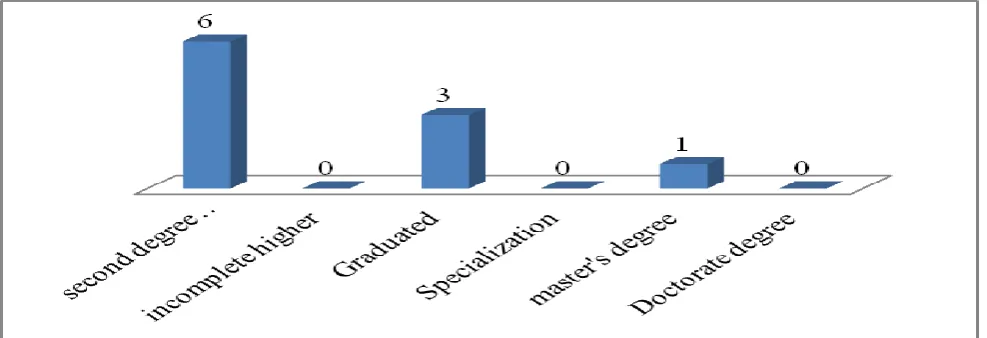
Figure 2: Training Of Business Managers
The training of commercial managers corresponds to (60%) I have completed the 2nd degree, (30%) with the full superior and (10%) with the master's degree in his
academic life. In graph 3, the main results are presented in strengths and weaknesses to divulge the products in the social networks.
Figure 3: The strengths and weaknesses in the disclosure of the products in the social network
From the analysis of this graphic it is noticed that the great majority of the stores describes the social network, how easy to handle it and efficient in divulging its product, therefore, reaches a certain public of fast way, and increasingly approaches the client Hegel III and Armstrong report that if you do not convert your customers into virtual communities, someone else will do it for you.
However, Nanni and Cañete say that companies that have adopted the social network as a strategy to communicate with their customers are growing more than those that do not yet use this tool [11].
It can be said strategically that the lack of perception regarding the weak point is
justified by the increase in the demand for products available in social networks and therefore, companies post the goods on a daily basis, and thus are able to keep
connected with their customers-
Interchanges and most of them say "customers buy more products released on social networks" said the interviewees.
Conclusion
In order to evaluate how Bacabal companies use social networks, it was necessary to search 10 companies that use the Internet as a way to offer the products and in this show that most companies that use this medium to promote believe in the possibility of improving the sales, therefore, the social network is a very efficient way to contact the customer immediately.
Based on the analysis of this may consider that most managers understand that the
uses of social networks in short are of great advantages, as was verified from the interpretation of data collected and exposed in the charts.
Finally, it can be seen that managers note that there are no weaknesses in disclosure through the use of social network, therefore, believes that it is satisfactory to use this method in order to maximize profits, to bring the customer closer to the store and to make their own disclosure without That there is a need to pay extra for it.
References
1. Drucker PF (1994) The new productivity challenge. Harvard Business Review, Boston, 69. (6):69-79. 2. Jarillo JC (1989) Entrepreneurship and growth:
the strategic use of external resources, Journal of Business Venturing, New York, 4 (2):133-147. 3. Shane Scott, Venkataraman S (2001) The promise
of entrepreneurship as a field of SOUZA, Flávia Ivar de. Social Networks and the impacts of this innovation in organizations: A case study of the cooperative network "business community of the commercial area of the Algar group companies. Masters dissertation. 101 f. University FUMEC. Belo Horizonte, Minas Gerais. 2012. Theory development. Entrepreneurship: Theory & Practice, Waco, 25(4):27-39.
4. Grandori A, Soda GA (2005) network approach to organization design. Bocconi: University Milan. 5. Vasconcelos, Geraldo. Social Insertion and
Resources. A Comparative Case Study of the Creation and Development of New Business. In: Proceedings of the XXIX Congress National Meeting of Post-Graduation in Administration. 2005 Brasília-DF.
6. Schumpeter JA (1984) Capitalism Socialism and Democracy. Rio de Janeiro: Zahar.
7. Souza Fi De (2012) Social networks and the impacts of this innovation in organizations: a case study of the corporate network "Business Community" of the commercial area of the companies of the Algar Group. 2012. 101 sheets. Dissertation (Master in Administration) - Faculdade FUMEC, Belo Horizonte.
8. Tomaél, Maria Inês, Alcará, Adriana Rosecler, Chiara, Ivone Guerreiro di (2016) From social networks to innovation. Article. Ci. Inf., Brasília, v. 34, n. 2, p. 93-104, May / Aug. 2005. Available at <www.scielo.br/pdf/ci/v34n2/28559>. Accessed on May 18.
9. Esteves Gag (2016) Administration, organizational models and continuous learning as a fact that manages the competitiveness of projects and products. FABAVI in Revista, Vitoria, 1(1):2002. 10. Junqueira FC (2016) et al The use of social
networks to strengthen organizations. In: Symposium of excellence in management and technology, 1., 2014, Rio de Janeiro. Annals. Rio de
Janeiro - RJ, 2014. Available at
<www.aedb.br/seget/arquivos/artigos14/22020181.p df>. Accessed on September 5.
11. Nanni HC (2016) CAÑETE KVS The Importance of Social Networks as a Competitive Advantage in Corporate Business. In. Brazilian Virtual Congress of Administration, 1. 2010, Annals. Available at <www.convibra.com.br/upload/paper/adm/adm_982 .pdf>. Accessed on September 5.
12. Yin RK (2010) Research methodology. 4. ed. São Paulo: Bookman.
13. Malhotra NK (2001) Marketing research: an applied guideline. Porto Alegre: Bookman.
14. Gartner William B (1999) is there an elephant in entrepreneurship? Blind assumptions in HEGELL III, John; Armstrong, Arthur G. Net Gain. Competitive Advantage on the Internet. Publisher Campus.
15. The Academy of Management Review, Mississippi State, 25(1):217-26, Jan, 2000.
16. Souza JV DE (2008) Improvement and validation of technique of classification of positions profile with system of graphic analysis. 2008. 81 sheets. Dissertation (Master in Technology Development) - Institute of Engineering of Paraná (IEP), Curitiba. 17. Grandori A, SODA G (1995) Inter-Firm Networks:
Antecedents, Mechanisms and Forms.