365
© 2018 by the Serbian Biological Society How to cite this article: Saghravanian SJ, Fereidoni M, Asadollahi A. The effect of Ferula szowitsiana extract on chemical pain in male wistar rats. Arch Biol Sci. 2018;70(2):365-9.
The effect of Ferula szowitsiana extract on chemical pain in male Wistar rats
Seyed Javad Saghravanian, Masoud Fereidoni* and Ali Asadollahi
Rayan Center for Neuroscience and Behavior, Department of Biology, Faculty of Science, Ferdowsi University of Mashhad, Mashhad, Iran.
*Corresponding author: [email protected]
Received: March 26, 2017; Revised: May 19, 2017; Accepted: June 2, 2017; Published online: December 21, 2017
Abstract: Investigations on the use of medicinal plants are appealing to researchers. In Iranian traditional medicine, Ferula szowitsiana is used as an analgesic. This study investigates the effect of the extract of aerial parts of Ferula szowitsiana on an experimental model of chemical pain induced by subplantar injection of formalin. The Ferula szowitsiana hydroalcoholic extract was prepared with ethanol, Tween 80 and saline at a ratio of 8:1:1 serving as a solvent. Wistar Rats in the weight range of 200-250 g were divided into 10 groups randomly (n=7) according to treatment applied as follows: control; solvent (intraperitoneal, i.p.); solvent (intrathecal, i.t.); extract (50, 100, 200, 400 mg/kg i.p.); extract (80 µg/10 µL i.t); naloxone (2 mg/kg i.p.); extract (400 mg/kg) and naloxone (i.p.). To study the chemical pain, subplantar administration of formalin was performed in all groups. The results showed that the extract could reduce chemical pain in the neurogenic and inflammatory phase dose dependently as compared to the control group. The magnitude of the response after intrathecal administration of a dose of 80 µg/10µL was comparable to that observed with 400 mg/kg of extract administered via the intraperitoneal route. The administration of naloxone as an opioid receptor antagonist reversed the analgesic effect of the extract completely. According to the results, it seems that at least a significant part of the analgesic effect of Ferula szowitsiana extract is exerted through its effect on the central nervous system, and the analgesic effect of the extract in acute and inflammatory chemical pain is due to its effect on the opioid system.
Key words: Ferula szowitsiana; chemical pain; formalin test; naloxone; opioid system
INTRODUCTION
Pain is one of the unpleasant feelings and emotional experiences accompanied by real or potential tissue damage [1]. This is one of the most critical sensations that results in awareness of danger, physical damage or illness. Pain can arise from chemical, physical or thermal stimuli [2]. Chemical pain in the test after sub-plantar injection of formalin can be observed in two consecutive stages. The acute stage (neurogenic pain) occurs at the very beginning, with predominantly Aδ and C fibers being involved, and it then quickly sub-sides. After a short pause (inter-phase), the tonic phase (inflammatory pain phase) begins. The pain signal re-lated to this stage is mainly transmitted by C fibers and to a lesser extent by Aδ fibers. In this stage, the pain increases with a mild slope and then decreases gradu-ally. This phase is mostly due to inflammatory agents released from damaged tissue [3]. The introduction of new analgesic drugs with fewer side effects is
impor-tant for researchers [4]. Ferula szowitsiana is one of the natural analgesic plants used in Iranian traditional medicine [5]. About 86% of the plant’s ingredients are monoterpenes such as α pinene, β pinene, limonene, caryophyllene and myrcene [4, 6]. These compounds, with effects on opioid, cannabinoid and adenosine re-ceptors, can block the pain sensation [7-9]. The search for new pain-blockers with the fewest possible side ef-fects is a big part of drug economy. Thus, we studied the analgesic effect of Ferula szowitsiana extract.
MATERIALS AND METHODS
Animals
of international scientific ethics and the protection of laboratory animals [10]. Male Wistar rats (200-250 g) were used. Animals were kept in the animal house in the Department of Biology at the FUM under a 12-h light/dark cycle at 22±2°C, in plexiglass cages with ac-cess to food and water ad libitum. The rats were ran-domly divided into ten groups (n=7) according to the treatment applied as follows: control (received no treat-ment); solvent (i.p.); solvent (i.t.); extract (50, 100, 200, 400 mg/kg i.p.); extract (80 µg/10 µL i.t); naloxone (2 mg/kg i.p.); extract (400 mg/kg) and naloxone (2 mg/ kg i.p.). For evaluating pain, 30 min after i.p. and 5 min after i.t. administration of extract or solvent, formalin was injected into the subplantar and animal behavior was monitored for 60 min. In the group that received naloxone (an opioid receptor antagonist), 20 min after extract administration, naloxone was injected, followed 10 min later by a subplantar injection of formalin, and pain behavior was monitored for 60 min.
Plant extraction
Ferula szowitsiana were collected from the Sarakhs area in Khorasan Razavi province, and submitted to the herbarium of the Botanical Institute of FUM, with the voucher number 37837. Stems and leaves were dried. Fifty g of the dried plant were crushed and mac-erated in 70% ethanol and keep for 24 h in the dark. The obtained solution was filtered after 24 h. Ethanol, Tween 80 and saline at a ratio of 8:1:1, respectively, served as an extract solvent [11].
Formalin test
In order to assess the analgesic effects of tonic pain during which tissue damage occurs, the formalin test was used. In this test, 0.05 mL diluted formalin (2.5%) was injected into the paw subcutaneously (s.c.). After formalin injection, the animal was placed in an ob-servation box and behavior were recorded for 60 min. Animal behavior was followed at 15 s, then every 5 min, and averaged in the report as follows: when the animal does not behave = 0; toe on the floor or limp =1; the foot is absolutely on top = 2; licking or bit-ing its leg = 3. This test consists of two pain response phases. In the first phase (neurogenic pain), the ani-mal’s pain lasts about 5 min; in the second phase (in-flammatory pain), pain is much more severe and lasts
about 40 min. Between the two phases there is a 5 min interval when the pain is relieved [12, 13].
Intrathecal (i.t.) administration
The animals were anesthetized by an i.p. injection of ketamine (100 mg/kg) and xylazine (20 mg/kg). The animals were fixed in a stereotaxic apparatus for per-forming the surgery. A PE10 tube (total size 11 cm) was placed in the subarachnoid space below the atlas vertebra to the lumbar spinal cord area (8 cm of PE10 tube). The remaining 3 cm of the tube was used for drug administration. One week after recovery, when no motor deficits were observed in animals, the drug was injected i.t. at the desired volume [14]. In this study, for i.t. administration, 80 µg of the extract dissolved in 10 µL of the solvent was considered as an equal concentra-tion to 400 mg/kg dose of the extract for 0.2 g tissue of the lumbar segment of the rat spinal cord.
Statistical analysis
The data were averaged and presented as means±SEM, then analyzed by one-way ANOVA, followed by the Newman-Keuls test to compare the averages (p<0.05), by Graph Pad Prism 5.
RESULTS
Comparing the results of the formalin test between the control and intraperitoneal (i.p.) and intrathecal (i.t.) administrations of different solvent groups did not show significant differences (Fig. 1). Therefore,
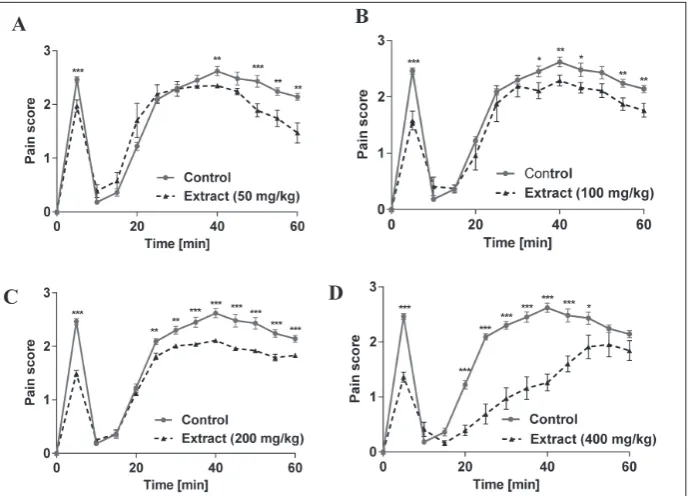
the surgical procedures for i.t. injection did not have any negative side effects. Doses of 50, 100, 200 and 400 mg/kg (i.p.) of the plant extract were compared with the control group in order to investigate the effects of extract in the formalin test. The results showed that the degree of chemical pain in both neurogenic and inflammatory pain compared to the control group was reduced significantly (p<0.01 ** and p<0.001***, respectively; Fig. 2). Also, i.t. administration of the
extract (80 µg/10 µL) reduced the chemical pain in both neurogenic and inflammatory pain (p<0.01**,
p<0.001***, respectively; Fig. 3) when compared to the control group. Comparison between the two routes of extract administration (400 mg/kg i.p. and 80 µg/10 µL i.t.) in Fig. 3 does not show significant differences between them in the neurogenic and at all moments of inflammatory pain phases, except at 50 and 55 min (Fig. 3). As shown in Fig. 4, the administration of
nal-Fig. 2. Comparison of the result of the formalin test between control and groups that were admin-istered the extract (50, 100, 200, 400 mg/kg i.p.): A – control vs. 50 mg/kg. B – control vs. 100 mg/ kg. C – control vs. 200 mg/kg. D – control vs. 400 mg/kg. (P<0.01** and P<0.001*** compared to the control group). Data are presented as the means±SEM (n=7).
Fig. 3. Comparison of the results of the formalin test between the control and two routes of extract administration (400 mg/kg i.p., 80 µg/10µL i.t,) group. P<0.01**, P<0.001*** compared to the control group; P<0.05# compared to the i.p. administrated group. Data are presented as means±SEM (n=7).
oxone (2 mg/kg, i.p.) diminished the interphase inter-val between neurogenic and inflammatory pain phases in comparison with the control group (p<0.001***). To investigate the mechanism of extract function and its relationship with the opioid pathway, the most ef-fective dose of the extract (400 mg/kg i.p.) was used in combination with naloxone and the results were compared with extract administration alone. An i.p. administration of naloxone reversed the analgesic ef-fect of the extract (Fig. 4).
DISCUSSION
Many factors at the peripheral and central levels can be involved in pain transmission and are in turn suit-able targets for pain therapy. According to the results of formalin tests, the Ferula szowitsiana extract dose-dependently reduced pain behavior during chemical pain. Phytochemical studies of Ferula szowitsiana
specified that this plant contains compounds such as α pinene, β pinene, caryophyllene, limonene and myrcene [6]. On the other hand, several studies have determined that these compounds can decrease pain through various mechanisms, including opioid, can-nabinoid and adenosine systems [15, 16]. Therefore, this extract could reduce pain due to its ingredients. In order to investigate whether the pain reduction effect of the extract is mediated through peripheral or cen-tral nervous systems, the extract was administered at a concentration of 80 µg/10µL (the concentration with the most effective dose) via the i.t. route. The absence of significant differences between the two routes of administration (400 mg/kg i.p. and 80 µg/10 µL i.t.) in pain reduction suggests that the effect of Ferula szow-itsiana extract on pain relief is because of its impact on the CNS. To identify the mechanism of extract action, naloxone was used as an opioid receptor antagonist. First, i.p. administration of naloxone resulted in the omission of the interphase interval observed in the control group, which is a reflection of the role of the opioid system in the interval phase and probably due to recall of endogenous opioids. Second, the coadmin-istration of naloxone and the plant extract eliminated the analgesic effect of the extract in both acute and almost all inflammatory phases. This suggests that the analgesic effect of the extract on acute and in-flammatory chemical pain was probably due to the effect on the opioid system (mostly µ opioid receptors)
that are widely distributed in the dorsal horn of the spinal cord. When opioid agonists are administered systemically, a part of their effects is caused by the release of endogenous opioids, so that the systemic administration of exogenous opioids primarily acts on the μ receptors, which then leads to the release of endogenous opioids that at a later stage impact κ and δ receptors that also produce an analgesic effect [17]. According to previous findings, α and β-pinene have an analgesic effect through μ-opioid receptor activa-tion [15]. On the other hand, myrcene could recall endogenous opioids and produce an analgesic effect [18]. Other studies have suggested that cannabinoid receptors type 2 (CB2) cause the release of the en-dogenous opioid β-endorphin that in turn can affect μ-opioid receptors and lead to anti-inflammatory and analgesic effects [19]. Therefore, caryophyllene as a CB2 receptor agonist [20] can enhance the effects of plant extracts through activation of the cannabinoid receptor. Another terpene, limonene, as an adenos-ine A2a receptors agonist, can reduce pain [21]. A2a receptor activation can suppress NMDA receptors, resulting in postsynaptic inhibition in the CNS and blockage of pain transmission messages [22].
In summary, these results show that the mecha-nism of extract action was probably through the CNS and that it impacted the opioid system. However, the exact mechanisms of action of Ferula szowitsiana ex-tract in reducing chemical pain need further inves-tigation.
Funding: This research was supported by the Ferdowsi University of Mashhad, Mashhad, Iran (Grant No. 3/30780).
Author contributions: Seyed Javad Saghravanian performed the experiments and wrote the manuscript. Masoud Fereidoni con-ceived, designed and supervised the project, wrote the manuscript and provided the financial project grant from Ferdowsi University of Mashhad. Ali Asadollahi assisted in advising the project. Conflict of interest disclosure: The authors declare that they have no conflict of interest.
REFERENCES
1. Fields HL. Pain: an unpleasant topic. Pain. 1999;Suppl6:S61-9. 2. Gaskin DJ, Richard P. The economic costs of pain in the
United States. J Pain. 2012;13(8):715-24.
4. Habibi Z, Aghaie HR, Ghahremanzadeh R, Masoudi S,
Rustai-yan A. Composition of the Essential Oils of Ferula
szowitsi-ana DC, Artedia squamata L. and Rhabdosciadium petiolare
Boiss. & Hausskn.ex Boiss. Three Umbelliferae Herbs Grow-ing Wild in Iran. J Essent Oil Res. 2006;18(5):503-5. 5. Sharififar F, Koohpayeh A, Motaghi MM, Amirkhosravi A,
Puormohseni Nasab E, Khodashenas M. Study the ethno-botany of medicinal plants in Sirjan, Kerman province, Iran. J Herb Drugs. 2010;1(3):19-28.
6. Dehghan G, Solaimanian R, Shahverdi AR, Amin G, Abdol-lahi M, Shafiee A. Chemical composition and antimicrobial activity of essential oil of Ferula szovitsiana D.C. Flavour Fra-grance J. 2007;22(3):224-7.
7. do Vale TG, Furtado EC, Santos JG Jr, Viana GS. Central effects of citral, myrcene and limonene, constituents of essential oil chemotypes from Lippia alba (Mill.) n.e. Brown. Phytomedicine. 2002;9(8):709-14.
8. Klauke AL, Racz I, Pradier B, Markert A, Zimmer AM, Gertsch J, Zimmer A. The cannabinoid CB(2) receptor-selec-tive phytocannabinoid beta-caryophyllene exerts analgesic effects in mouse models of inflammatory and neuropathic pain. Eur Neuropsychopharmacol. 2014;24(4):608-20. 9. Park HM, Lee JH, Yaoyao J, Jun HJ, Lee SJ. Limonene, a
natu-ral cyclic terpene, is an agonistic ligand for adenosine A(2A) receptors. Biochem Biophys Res Commun. 2011;404(1):345-8. 10. Zimmermann M. Ethical guidelines for investigations of exper-imental pain in conscious animals. Pain. 1983;16(2):109-10. 11. Urushidani T, Forte JG, Sachs G. Mechanisms and
conse-quences of proton transport: Springer Science & Business Media; 2012.
12. Wheeler-Aceto H, Cowan A. Standardization of the rat paw formalin test for the evaluation of analgesics. Psychopharma-cology. 1991;104(1):35-44.
13. Alizadeh Z, Fereidoni M, Behnam-Rassouli M, Hosseini S. Role of C-fibers in pain and morphine induced analgesia/ hyperalgesia in rats. Iran J Neurol. 2014;13(1):19.
14. Yaksh TL, Rudy TA. Chronic catheterization of the spinal subarachnoid space. Physiol Behav. 1976;17(6):1031-6. 15. Liapi C, Anifantis G, Chinou I, Kourounakis AP,
Theo-dosopoulos S, Galanopoulou P. Antinociceptive proper-ties of 1, 8-cineole and β-pinene, from the essential oil of
Eucalyptus camaldulensis leaves, in rodents. Planta Med. 2007;73(12):1247-54.
16. Him A, Ozbek H, Turel I, Oner AC. Antinociceptive activ-ity of alpha-pinene and fenchone. Pharmacol Online. 2008;3:363-9.
17. Katzung BG. Basic & clinical pharmacology. New York, USA: Lange Medical Books/McGraw-Hill; 2004.
18. Rao V, Menezes A, Viana G. Effect of myrcene on nociception in mice. J Pharm Pharmacol. 1990;42(12):877-8.
19. Ibrahim MM, Porreca F, Lai J, Albrecht PJ, Rice FL, Khodo-rova A, Davar G, Makriyannis A, Vanderah TW, Mata HP, Malan TP Jr. CB2 cannabinoid receptor activation produces antinociception by stimulating peripheral release of endog-enous opioids. Proc Natl Acad Sci U S A. 2005;102(8):3093-8. 20. Paula-Freire L, Andersen M, Gama V, Molska G, Car-lini E. The oral administration of trans-caryophyllene attenuates acute and chronic pain in mice. Phytomedicine. 2014;21(3):356-62.
21. Essawy S, Elbaz A. Role of adenosine receptors in the anti-nociceptive effects of allopurinol in mice. Analgesia. 2013;10:100.