Eutrema giganteum (Brassicaceae), a new species
from Sichuan, southwest China
Guoqian Hao1,*, Changbing Zhang2,*, Ihsan A. Al-Shehbaz3, Xinyi Guo4,
Hao Bi4, Junyin Wang1, Jianquan Liu4
1 Biodiversity Institute of Mount Emei, Mount Emei Scenic Area Management Committee, Leshan 614000, P. R. China 2 Sichuan Academy of Grassland Sciences, Chengdu 610065, P. R. China 3 Missouri Botanical Garden, P.O. Box 299, St. Louis, MO 63166-0299, U.S.A. 4 MOE Key Laboratory for Bio-Resources and Eco-Environment, College of Life Science, Sichuan University, Chengdu 610065, P. R. China
Corresponding author:Jianquan Liu ([email protected])
Academic editor:K. Marhold | Received 19 February 2017 | Accepted 5 June 2017 | Published 29 June 2017
Citation: Hao G, Zhang C, Al-Shehbaz IA, Guo X, Bi H, Wang J, Liu J (2017) Eutrema giganteum (Brassicaceae), a new species from Sichuan, southwest China. PhytoKeys 82: 15–26. https://doi.org/10.3897/phytokeys.82.12329
Abstract
Eutrema giganteum (Brassicaceae), a new species from Hengduan Mountains in Sichuan Province, south-west China, is described, and its relationships to the closely related E. yunnanense is discussed based on morphological, cytological, and molecular data. It is similar morphologically to E. yunnanense but is read-ily distinguished by having robust (vs. slender), erect (vs. decumbent), and branched (vs. mostly simple), and rather tall stems (60–110 cm vs. 20–60 cm); curved (vs. straight), smooth (vs. torulose), and shorter fruit (5–8 mm vs. 8–15 mm); and fewer ovules per ovary (1–4 vs. 6–10). All examined individuals from different populations of E. giganteum clustered into a single clade sister to E. yunnanense in phylogenetic analyses using the combined nuclear ITS and plastid DNA datasets. Our cytological studies revealed that the chromosome number of E. giganteum is 2n = 44, with a genome size of 1160 (±8) Mb, while that of E. yunnanense is 2n = 28, with a genome size of 718 (±15) Mb. Multiple lines of evidence support the recognition of E. giganteum as a distinct species well differentiated from E. yunnanense.
Keywords
Brassicaceae, Cruciferae, Eutrema giganteum, new species, Eutrema yunnanense, molecular phylogeny
* These authors contributed equally to the work
http://phytokeys.pensoft.net
Copyright Guoqian Hao et al. This is an open access article distributed under the terms of the Creative Commons Attribution License (CC BY 4.0), which permits unrestricted use, distribution, and reproduction in any medium, provided the original author and source are credited.
Introduction
Eutrema R.Br. (Brassicaceae) is an important genus that includes the model plant for salt-tolerance E. salsugineum (Pall.) Al-Shehbaz & Warwick and the economic wasabi plant E. japonicum (Miq.) Koidz. This genus was expanded to comprise 26 species (Al-Shehbaz and Warwick 2005; Warwick et al. 2006) with 16 transferred from four previously genera, Taphrospermum C.A.Mey., Thellungiella O.E.Schulz, Neomartinella Pilger, and Platycraspedum O.E.Schulz (Al-Shehbaz and Warwick 2005; Warwick et al. 2006). Since then, several new species were described (Ning et al. 2005; Al-Shehbaz 2007; Gan and Li 2014; Xiao et al. 2015; Hao et al. 2015, 2016).
During botanical expeditions to Hengduan Mountains in southwest China from 2013 to 2016, we discovered three populations of Eutrema that were strikingly unusual in ha-ving large size, big cordate leaves, and stout, erect and branched stems. Only E. yunnanense Franch. has such similar big cordate leaves (10–20×10–16 cm), but its stems are slender, decumbent, and rarely branched. Therefore, it was immediately suspected these popula-tions may represent an undescribed new species. In order to further test this hypothesis, morphological, molecular, and cytological studies are presented here on those two species and two related species E. japonicum and E. thibeticum Franch. were conducted with herein.
Material and methods
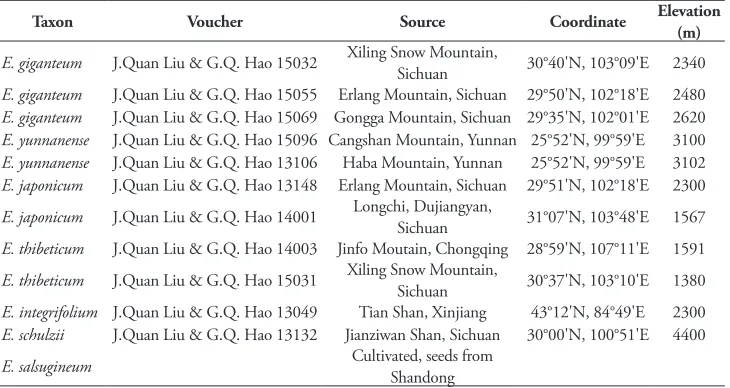
For morphological comparisons and taxonomical treatments, we examined more than ten living individuals from each population of Eutrema giganteum (three popu-lations) and E. yunnanense (two popupopu-lations), and photos of all herbarium specimens of E. yunnanense preserved in the Chinese Virtual Herbarium (http://www.cvh.org. cn/). We followed Hu et al. (2015) and Hao et al. (2015, 2016) in examining genetic differences between two morphological groups, and three individuals were studied from each population. In order to determine the systematic position of E. giganteum, we further sampled two populations each for E. japonicum and E. thibeticum because they were phylogenetically related to E. yunnanense. We sampled one individual each of E. schulzii Al-Shehbaz & Warwick, E. heterophyllum (W.W. Sm,) H. Hara, E. verti-cillatum (Jeffrey & W.W. Sm.) Al-Shehbaz & Warwick, E. integrifolium (DC.) Bunge, E. altaicum (C.A. Mey.) Al-Shehbaz & Warwick, and E. salsugineum as ingroups. We chose one sample of Chalcanthus renifolius (Boiss. & Hohen.) Boiss. as the outgroup. The distribution of sampled populations listed in Table 1. Voucher specimens were deposited in the Sichuan University Herbarium (SZ).
Table 1. The sources of materials used for molecular analyses.
Taxon Voucher Source Coordinate Elevation (m)
E. giganteum J.Quan Liu & G.Q. Hao 15032 Xiling Snow Mountain, Sichuan 30°40'N, 103°09'E 2340 E. giganteum J.Quan Liu & G.Q. Hao 15055 Erlang Mountain, Sichuan 29°50'N, 102°18'E 2480 E. giganteum J.Quan Liu & G.Q. Hao 15069 Gongga Mountain, Sichuan 29°35'N, 102°01'E 2620 E. yunnanense J.Quan Liu & G.Q. Hao 15096 Cangshan Mountain, Yunnan 25°52'N, 99°59'E 3100 E. yunnanense J.Quan Liu & G.Q. Hao 13106 Haba Mountain, Yunnan 25°52'N, 99°59'E 3102 E. japonicum J.Quan Liu & G.Q. Hao 13148 Erlang Mountain, Sichuan 29°51'N, 102°18'E 2300 E. japonicum J.Quan Liu & G.Q. Hao 14001 Longchi, Dujiangyan, Sichuan 31°07'N, 103°48'E 1567 E. thibeticum J.Quan Liu & G.Q. Hao 14003 Jinfo Moutain, Chongqing 28°59'N, 107°11'E 1591 E. thibeticum J.Quan Liu & G.Q. Hao 15031 Xiling Snow Mountain, Sichuan 30°37'N, 103°10'E 1380 E. integrifolium J.Quan Liu & G.Q. Hao 13049 Tian Shan, Xinjiang 43°12'N, 84°49'E 2300 E. schulzii J.Quan Liu & G.Q. Hao 13132 Jianziwan Shan, Sichuan 30°00'N, 100°51'E 4400 E. salsugineum Cultivated, seeds from Shandong
*All vouchers were housed in the Sichuan University Herbarium (SZ).
Results
Morphological comparison and geographical distribution
Our study of herbarium specimens and living plants demonstrated that Eutrema gi-ganteum is a morphologically distinctive species. As shown in Fig. 1, it is a glabrous herbaceous perennial, the tallest in the genus, with robust, erect or ascending stems 60–110(–140) cm and alternate branches. Each branch is divaricate-ascending or al-most perpendicular to stem and originates from the axil of cauline leaf. The fruits are narrowly oblong, 5–8 × 2–3 mm and curved, but not torulose.
Eutrema giganteum is most similar to E. yunnanense, but it is readily distinguished from the latter by having stout (vs. slender), erect (vs. decumbent), and branched (vs. rarely branched) stems (60–110 cm vs. 20–60 cm; curved (vs. straight), smooth (vs. torulose), and shorter (5–8 mm vs. 8–15 mm) fruit, and fewer ovules per ovary (1–4 vs. 6–10). Young plants of E. giganteum are also somewhat similar to E. japonicum. However, they differ in having cordate to reniform (vs. ovate to ovate-cordate) leaf blade. The cultivated plants of E. japonicum have stems and fruits similar to those of E. yunnanense. The leaves of E. thibeticum are similar to those of E. yunnanense and E. giganteum. However, E. thibeticum is comparatively weak and small (20–30 cm tall with basal leaves 2–4 cm).
According to specimen records and field investigation, Eutrema giganteum is cur-rently known only from Hengduan Mountains in western Sichuan at elevation be-tween 2300 and 2900 m (Fig. 2), while E. yunnanense may occurs in the southern part of Hengduan Mountain, Yunnan province, at elevation between 2500 and 3200 m. Zhou et al. (2001) reported that E. yunnanense is widely distributed in other provinces of China (for example, Anhui, Gansu, Hebei, Hubei, Hunan, Jiangsu and Zhejiang) at elevation between 400 and 3500 m. Phylogenetic and taxonomic relationships be-tween populations of these provinces and those from Yunnan await future studies.
Genetic relationship of Eutrema giganteum with E. yunnanense, E. japonicum and
E. thibeticum
Figure 1.Eutrema giganteum G.Q. Hao, Al-Shehbaz & J. Quan Liu. sp. nov. A–B Habit C Leaves
D Inflorescence E Flowers F Fruit.
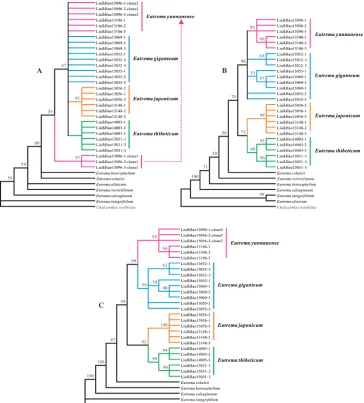
and E. verticillatum, the P value rose to 1.000, indicating that there is no significant incongruence between nrDNA and cpDNA datasets. We therefore combined them for further analyses. In the MP analyses of the combined dataset, all E. giganteum individuals formed a single cluster, sister to the cluster comprising E. yunnanense individuals with medium supports (50%–90%). The clade comprising both of them was sister to the clade formed by both E. japonicum and E. thibeticum with a high support (94%) (Fig. 3). ML analyses produced similar tree topologies to MP trees but the supports were higher than MP analyses (Fig. 4).
Chromosome number and genome size
Figure 2. Geographical distribution of Eutrema giganteum (P1–P4) and Eutrema yunnanense (P5, P6). P1 = Population from Xiling Snow Mountain, Sichuan; P2 = Specimens record from Baoxing County, Sichuan; P3 = Population from Erlang Mountain, Sihuan; P4 = Population from Gongga Mountain, Sichuan; P5 = Population from Haba Mountain, Yunnan; P6 = Population from Cangshan Mountain, Yunnan,
was determined as 2n = 44 (Fig. 5), while that of E. yunnanense was 2n = 28, as the same as counted by Du and Gu (2004). Genome size of E. giganteum was determined as 1160 (±8) Mb while that of E. yunnanense was 718 (±15) Mb.
Discussion
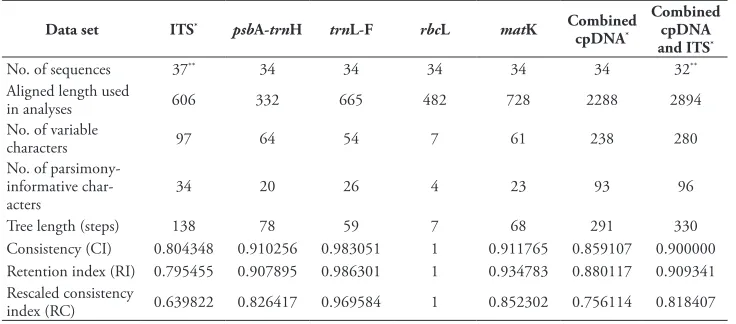
Table 2. Tree statistics for analyses of the seven data sets.
Data set ITS* psbA-trnH trnL-F rbcL matK Combined
cpDNA*
Combined cpDNA and ITS*
No. of sequences 37** 34 34 34 34 34 32**
Aligned length used
in analyses 606 332 665 482 728 2288 2894
No. of variable
characters 97 64 54 7 61 238 280
No. of parsimony-informative
char-acters 34 20 26 4 23 93 96
Tree length (steps) 138 78 59 7 68 291 330
Consistency (CI) 0.804348 0.910256 0.983051 1 0.911765 0.859107 0.900000 Retention index (RI) 0.795455 0.907895 0.986301 1 0.934783 0.880117 0.909341 Rescaled consistency
index (RC) 0.639822 0.826417 0.969584 1 0.852302 0.756114 0.818407
*gaps were coded and included;
**the cloned sequences were included
E. giganteum is 2n = 44, whereas E. yunnanense has the number of 2n = 28. Consistent with the difference of the chromosome number, we also found that the genome size of E. giganteum is almost 1.5 times larger than that of E. yunnanense. These chromo-somal and genomic differences are likely to lead to the obvious reproductive isolations between E. giganteum and E. yunnanense. In addition, our unpublished data suggested that some populations of E. thibeticum have the chromosome number of 2n = 16. Both E. giganteum and E. thibeticum are co-distributed in the Hengduan Mountains in west-ern Sichuan where the former occurs at the high elevation while the latter at the low elevation. It seems likely that E. giganteum (2n = 44) originated from a hybridization between E. thibeticum (2n = 16) and E. yunnanense (2n = 28) although further mo-lecular evidence and experimental hybridization are needed. Overall, all available lines of evidence suggest that E. giganteum should be recognized as a distinct new species.
Taxonomic treatment
Eutrema giganteum G.Q. Hao, Al-Shehbaz & J. Quan Liu, sp. nov.
urn:lsid:ipni.org:names:77163811-1
巨型山嵛菜
Type. China. Sichuan: Dayi County, Xiling Snow Mountain, Heishuihe Giant Panda Nature Reserve, 30˚40'22"N, 103˚9'47"E, 2340 m, 6 July 2015, J.Quan Liu & G. Q. Hao 2015032-1 (Holotype, SZ)., J.Quan Liu & G. Q. Hao 2015032-2 (Isotype, SZ), J.Quan Liu & G. Q. Hao 2015032-3 (Isotype, SZ). Figure 1.
Figure 3. The strict consensus tree constructed based on nrITS data (A), four cpDNA regions (B) and the combined nrITS and cpDNAs dataset (C). Bootstrap support values are given above branches receiv-ing > 50% bootstrap support A The 100% strict consensus tree of 667 most maximum parsimony trees based on the analysis of nrITS data B The 100% strict consensus tree of 8 trees based on the analysis of 4 cpDNA regions C The 100% strict consensus tree of 225 trees based on analysis of combined nrITS and 4 cpDNA regions.
Figure 4. The Maximum likelihood tree based on analysis of the combined nrITS and four cpDNA data-set regions datadata-set. Bootstrap support values are given above branches receiving > 50% bootstrap support.
Figure 5. Photomicrographs of mitotic chromosomes of Eutrema giganteum. A population from Xiling Snow Mountain B population from Erlang Mountain.
2.2) cm. Sepals ovate or oblong, 1.5–2 × ca. 1 mm, deciduous; petals white, oblong-spatulate, 3.5–5(–7) × 1.5–2 mm, apex obtuse to rounded; claw present; filaments white, 3–4.5 mm; ovules 1–4 per ovary. Fruit dehiscent silicles, narrowly oblong, 5–8 × 2–3 mm, curved, not torulose; valves with an obscure midvein; gynophore ab-sent or obsolete, septum complete. Seeds oblong, 2.5–3.5 × 1.5–2.0 mm.
Phenology.Flowering: April–July; fruiting: May–August.
Distribution and habitat. Eutrema giganteum is currently known from Heng-duan Mountains in western Sichuan, China, including Xiling Snow Mountain, Jiajin Mountain, Erlang Mountain, and Gongga Mountain (Fig. 2). It grows in shady, hu-mid forests at elevation of 2200–2900 m.
Additional specimens examined (paratype). China: Sichuan: Baoxing County, 1954, Z. P. Song 38379 (KUN); Baoxing County, Puxi Gou, April 1959, 2700 m, Si-chuan Economic Plant Investigation Team 00324 (CDBI); Luding County, Dawanzi, 2300 m, 2 May 1980, Q. Q. Wang 22061 (CDBI); Dayi County, Heishuihe Nature Re-serve, 2900 m, 6 June 2007, D. H. Zhu, Z. B. Feng, C. Zhang & F. Wang 20070659 (PE).
Acknowledgements
This research was supported by grants from National Natural Science Foundation of China (31590821) and Sichuan Province Youth Science and Technology Innovation Team (2014TD003).
References
Al-Shehbaz IA, Warwick SI (2005) A synopsis of Eutrema (Brassicaceae). Harvard Papers in
Bota-ny 10: 129–135. https://doi.org/10.3100/1043-4534(2005)10[129:ASOEB]2.0.CO;2
Al-Shehbaz IA (2007) Two new species of Draba and Eutrema (Brassicaceae) from
Si-chuan, China. Harvard Papers in Botany 11: 277–279. https://doi.org/10.3100/1043-4534(2007)11[277:TNSODA]2.0.CO;2
Cunningham CW (1997) Can three incongruence tests predict when data should be com-bined? Molecular Biology and Evolution 14: 733–740. https://doi.org/10.1093/oxford-journals.molbev.a025813
de Queiroz K (1998) The general lineage concept of species, species criteria, and the process of specia-tion, a conceptual unification and terminological recommendations. In: Howard DJ, Berlocher SH (Eds) Endless Forms, Species and Speciation. Oxford University Press, Oxford, 57–75. de Queiroz K (2007) Species concepts and species delimitation. Systematic Biology 56: 879–886.
https://doi.org/10.1080/10635150701701083
Du N, Gu ZJ (2004) A comparative karyological study of the cultured Eutrema wasabi and its
three related wild species. Acta Botanica Yunnanica 6: 645–650.
Felsenstein J (1985) Confidence limits on phylogenies, an approach using the bootstrap. Evolu-tion 39: 783–791. https://doi.org/10.1111/j.1558-5646.1985.tb00420.x
Fujita MK, Leaché AD, Burbrink FT, McGuire JA, Moritz C (2012) Coalescent-based species delimitation in an integrative taxonomy. Trends in Ecology and Evolution 27: 480–488. https://doi.org/10.1016/j.tree.2012.04.012
Gan QL, Li XW (2014) A new species of Eutrema (Brassicaceae) from central China. Novon
23: 162–164. https://doi.org/10.3417/2011045
Hendrixson BE, DeRussy BM, Hamilton CA, Bond JE (2013) An exploration of species boundaries in turret-building tarantulas of the Mojave Desert (Araneae, Mygalomorphae, Theraphosidae, Aphonopelma). Molecular Phylogenetics and Evolution 66: 327–340. https://doi.org/10.1016/j.ympev.2012.10.004
Hao GQ, Al-Shehbaz IA, Wang Q, Liang QL, Liu JQ (2015) Eutrema racemosum (Eutremeae,
Brassicaceae), a new tetraploid species from southwest China. Phytotaxa 224: 185–195. https://doi.org/10.11646/phytotaxa.224.2.5
Hao GQ, Al-Shehbaz I A, Liang QL, Liu JQ (2016) Eutrema tianshanense (Brassicaceae), a
new species from Tian Shan Mountains of central Asia. Phytotaxa 286: 23–31. https://doi. org/10.11646/phytotaxa.286.1.3
Hu H, Al-Shehbaz IA, Sun Y S, Hao G Q, Wang Q, Liu J Q (2015) Species delimitation in
Orychophragmus (Brassicaceae) based on chloroplast and nuclear DNA barcodes. Taxon 64:
714–726. https://doi.org/10.12705/644.4
Liu JQ (2016) ‘The integrative species concept'and ‘species on the speciation way’. Biodiversity Science 24: 1004–1008. https://doi.org/10.17520/biods.2016222
McKay BD, Mays HL, Wu Y, Li H, Yao CT, Nishiumi I, Zou F (2013) An empirical comparison of character-based and coalescent-based approaches to species delimitation in a young avian complex. Molecular Ecology 22: 4943–4957. https://doi.org/10.1111/mec.12446
Ning ZL, Wu JQ, Zhao ZE, Hu XW (2006) A new species of Neomartinella (Cruciferae) in the
Three-Gorge Reservoir Area, China. Wuhan Botanical Research 24: 47–48.
Simmons MP, Ochoterena H, Carr TG (2001) Incorporation, relative homoplasy, and effect of gap characters in sequence-based phylogenetic analyses. Systematic Biology 50: 454–462. https://doi.org/10.1080/106351501300318049
Su X, Wu GL, Li LL, Liu JQ (2015) Species delimitation in plants using the Qinghai–Tibet
Plateau endemic Orinus (Poaceae: Tridentinae) as an example. Annals of Botany 116(1):
35–48. https://doi.org/10.1093/aob/mcv062
Stamatakis A (2006) RAxML-VI-HPC, maximum likelihood-based phylogenetic analyses with thousands of taxa and mixed models. Bioinformatics 22: 2688–2690. https://doi. org/10.1093/bioinformatics/btl446
Stockman AK, Bond JE (2007) Delimiting cohesion species, extreme population structuring and the role of ecological interchangeability. Molecular Ecology 16: 3374–3392. https:// doi.org/10.1111/j.1365-294X.2007.03389.x
Swofford DL (2003) PAUP*, phylogenetic analyses using parsimony (*and other methods), Version 4. Sunderland, MA, USA, Sinauer Associates.
maximum parsimony methods. Molecular Biology and Evolution 28: 2731–2739. https:// doi.org/10.1093/molbev/msr121
Thompson JD, Gibson TJ, Plewniak F, Jeanmougin F, Higgins DG (1997) The CLUSTAL_X windows interface, flexible strategies for multiple sequence alignment aided by quality analysis tools. Nucleic Acidsr Rsearch, 25: 4876–4882. https://doi.org/10.1093/nar/25.24.4876 Warwick SI, Al-Shehbaz IA (2006) Brassicaceae: chromosome number index and database
on CD-Rom. Plant Systematics and Evolution 259: 237–248. https://doi.org/10.1007/ s00606-006-0421-1
Warwick SI, Al-Shehbaz IA, Sauder CA (2006) Phylogenetic position of Arabis arenicola and
generic limits of Aphragmus and Eutrema (Brassicaceae) based on sequences of nuclear
ribosomal DNA. Botany 84: 269–281.
Wheeler Q, Meier R (2000) Species Concepts and Phylogenetic Theory: A Debate. Columbia University Press, New York.
Xiao Y, Li C, Hsieh TY, Tian DK, Zhou JJ, Zhang DG, Chen GX (2015) Eutrema bulbiferum
(Brassicaceae), a new species with bulbils from Hunan, China. Phytotaxa 219: 233–242. https://doi.org/10.11646/phytotaxa.219.3.3
Young ND, Healy J (2003) GapCoder automates the use of indel characters in phylogenetic analysis. BMC Bioinformatics 4: 6. https://doi.org/10.1186/1471-2105-4-6