A new species of
Amphitecna
(Bignoniaceae)
endemic to Chiapas, Mexico
Andres Ernesto Ortiz-Rodriguez1, Carlos Manuel Burelo Ramos2,
Héctor Gomez-Dominguez3
1 Instituto de Ecología, A.C., Departamento de Biología Evolutiva, Xalapa, Veracruz, México 2 Herbario UJAT, División Académica de Ciencias Biológicas, Universidad Juárez, Autónoma de Tabasco, Villahermosa Tabasco, México 3 Herbario Eizi Matuda (HEM) Facultad de Ciencias Biológicas, Universidad de Ciencias y Artes de Chiapas, Tuxtla Gutiérrez, Chiapas, México
Corresponding author: Andres Ernesto Ortiz-Rodriguez ([email protected])
Academic editor:Alan Paton | Received 12 March 2016 | Accepted 27 May 2016 | Published 15 June 2016
Citation: Ortiz-Rodriguez AE, Ramos CMB, Gomez-Dominguez H (2016) A new species of Amphitecna (Bignoniaceae) endemic to Chiapas, Mexico. PhytoKeys 65: 15–23. doi: 10.3897/phytokeys.65.8454
Abstract
Amphitecna loreae Ortiz-Rodr. & Burelo, sp. nov. (Bignoniaceae), a new species endemic to the karst rainforest in southern Mexico, is described and illustrated. The new species differs from the other species of Amphitecna by the combination of cauliflorous inflorescences, larger flowers, buds rounded at apex, and globose-ellipsoid rather than acuminate fruits. A key to the Mexican species of Amphitecna is presented.
Keywords
Crescentieae, karst forest, zona sujeta a protección ecológica “La Pera”
Introduction
Bignoniaceae (calabash tree family) includes about 82 genera and approximately 900 species of trees, shrubs and woody vines distributed mainly in tropical areas around the world (Lohmann and Ulloa 2006). The most recent tribal classification of Bignoni-aceae (Fischer et al. 2004), recognizes seven tribes: Bignonieae, Coleeae, Crescentieae, Eccremocarpeae, Oroxyleae, Tecomeae, and Tourrettieae. However, phylogenetic analysis based on molecular characters (Olmstead et al. 2009) shows that many of http://phytokeys.pensoft.net
Copyright Andres Ernesto Ortiz-Rodriguez et al. This is an open access article distributed under the terms of the Creative Commons Attribution License (CC BY 4.0), which permits unrestricted use, distribution, and reproduction in any medium, provided the original author and source are credited.
the above tribes, as traditionally had been recognized, do not represent monophyletic groups. Based on this phylogenetic hypothesis (Olmstead et al. 2009), the 82 genera of Bignoniaceae can be organized in the tribes Bignonieae, Catalpeae, Jacarandeae, Oroxyleae, Tecomeae, and Tourrettieae. In addition, a strongly supported clade in-formally named Crescentiina is recognized (Olmstead et al. 2009, Collevatti and Dor-nelas 2016).
The Crescentiina clade contains approximately 34 genera and 300 species, and it is formed by two subclades corresponding to the Tabebuia alliance and the Paleotropical clade (a group of genera traditionally assigned to Tecomeae and Coleeae) (Olmstead et al. 2009). The Tabebuia alliance, is a lineage endemic to the Neotropics and consists of 14 genera and 147 species of trees and shrubs, from which stands a small clade of three genera traditionally assigned to the tribe Crescentieae, Amphitecna, Crecentia,
and Parmentiera, which together comprise nearly 36 species of trees distributed in
Central America, northern Colombia and the Greater Antilles (Gentry 1980, Grose and Olmstead 2007a).
The genus Amphitecna is easily differentiated from Crecentia and Parmentiera by the combination of simple, alternate leaves and the greenish flowers with the lobes of the petals fused (Gentry 1980). The genus comprises about 20 species (Grose and Olmstead 2007b), most of them known to be restricted to a few localities. In Mexico, the genus Amphitecna is particularly diverse and consists of roughly 10 species, all of them having their southernmost distribution in Guatemala and Belize.
During the course of several botanical explorations in southern Mexico, a species
of Amphitecna with a unique combination of features differing from all other members
of the genus was collected in a karst forest of Chiapas. In this paper, this interesting species is described and illustrated and its affinities with other species of Amphitecna
are discussed. Furthermore a key to Mexican species of Amphitecna is presented.
Materials and methods
In order to confirm the status of this new species we visited and reviewed the speci-mens of Amphitecna deposited in herbaria XAL, HEM and CHIP (Thiers 2016). Also, we consulted the digitized type specimens available at JSTOR Global Plants (http:// plants.jstor.org/). The putative new species was recognized using the unique combina-tion of features criteria (Donoghue 1985) through comparisons with morphologically similar species and literature review (Gentry 1980). Finally, description of the species was elaborated following terminology presented in Hickey (1973).
We assessed the conservation status by calculating the extent of occurrence (EOO) and the area of occupancy (AOO) using the GeoCAT tool (Bachman et al. 2011) and applying the IUCN Red List Categories and criteria (IUCN 2001).
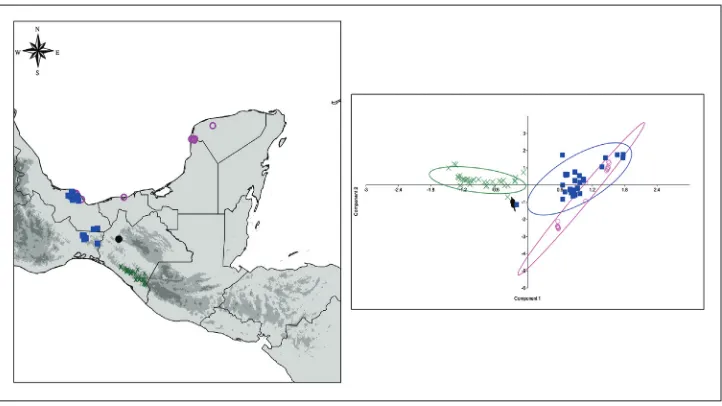
http://www.gbif.org/spe-cies/4003073), supplemented with records from field collection and with information available in the herbarium specimens. Then climate layers were obtained at a 30 arc-sec (c. 1 km2) resolution from the WorldClim database (Hijmans et al. 2005) and for all occurrence records, we extracted data from 19 climatic variables using ArcView v3.2 (ESRI, Redlands, CA, USA). Using these data, we performed a principal components analysis (PCA) using a correlation matrix with PAST ver. 3.06 (Hammer et al. 2001) to explore patterns of climatic differentiation between species.
Taxonomic treatment
Amphitecna loreae Ortiz-Rodr. & Burelo, sp. nov. urn:lsid:ipni.org:names:77155494-1
Figures 1, 3
Type. Mexico. Chiapas, Municipio de Berriozábal, zona sujeta a protección ecológica “La Pera”, predio “Peña Flor” camino Berriozábal- Vista Hermosa-El Cairo, km. 12 desvío al Pozo Turipache, 1068 m, 16°51'50.6"N, 93°19'51.7"W, 05 March 2012 (fl,
fr) Ortiz-Rodríguez A. E 0178 (holotype HEM; isotypes: UJAT, XAL).
Diagnosis. Amphitecna loreae is distinguishable from the other species of
Am-phitecna by a combination of its cauliflorous inflorescences, large flowers, buds
round-ed at apex, and broadly elliptical to spherical rather than acuminate fruits. Amphitecna
tuxtlensis, A. montana and A. latifolia, also distributed in Mexico, have affinities with
A. loreae and share the cauliflorous inflorescences and leaves less than 50 cm long.
However, A. tuxtlensis differs in having the flower buds pointed at the apex and fruits elliptic, acute to acuminate at apex, and A. montana differs in having larger leaves, long pedicellate flowers and elliptical fruits shortly pointed at the tip, while A. latifolia
differs in having obovate to widely elliptic leaves, rounded to mucronate at apex with poorly defined petioles (Figure 1).
Description. Trees, 15–25 m and 15–50 cm DBH, the secondary branches terete.
Leaves, alternate-verticillate, clustered near the apex of the branches, olive-green when
dry, glabrous, 10–20 cm long, 2–5 cm wide, oblanceolate to narrowly elliptic, acumi-nate, subcoriaceous, acute to attenuate basis, midrib slightly raised on the upper sur-face, prominent on the lower surface; secondary veins 11–14 on a side, slightly raised above, prominent below; petiole short, to 2 cm long, merging with attenuate leaf base.
Inflorescences, groups of two or three flowers, with an unpleasant odor, which are borne
Figure 1.Amphitecna loreae sp. nov. A cauliflorous flowers with trilabiate calyx. B broadly elliptical to spherical fruits C corolla D buds rounded at apex. Photographs by Andres E. Ortiz-Rodriguez (A and C) and Marcos Escobar (B and D).
mm long, the filaments 18–30 mm long; the staminode, when present, less than 20 mm long, inserted 10–20 mm from base of the tube, sometimes well developed (with one or two small thecae) to give the impression of being a fifth stamen; ovary, up to 3 mm long and 2.5 mm wide, broadly elliptical, glandular-papillose; pistil 40–60 mm long with the stigma bifurcate; disc annular-pulvinate, about 6 mm in diameter; flow-ers are often found with signs of herbivory, in which the ovule and disc are not present.
Fruits broadly elliptical to spherical, 70–100 mm long, 60–80 mm wide.
Habitat and ecology.The species is only known from Chiapas, Mexico. It is a rare species at the type locality in the ecological reserve La Pera. The species inhabits the karst areas, mainly in the tropical rainforest. It is a canopy tree and coexists with spe-cies of Quercus lancifolia Schltdl. & Cham., Q. corrugata Hook., Calatola costaricensis
Standl., Spathacanthus hahnianus Baill, and Quararibea funebris (La Llave) Vischer.
Phenology. Mature flowers and fruits were collected in March and April; buds, ripe and immature fruits were observed in the same months.
Etymology. The specific epithet honors Francisco Lorea Hernández, in recogni-tion of his many important contriburecogni-tions to our knowledge of the Mexican flora.
Figure 2. Distribution range and climatic preferences of Amphitecna loreae and related species. Am-phitecna latifolia (purple circles) Amphitecna montana (green cross), Amphitecna loreae (black dots) and
Amphitecna tuxtlensis (blue squares). In colours similar to those of the species the 95% confidence ellipses produced by PCA analysis.
established by the IUCN, it is possible to tentatively determine that the species is Criti-cally Endangered [CR B1ab (iii)]. Although the only known population of the species is located within a protected natural area, A. loreae appears to be rare ecologically and only eight individuals in one hectare of sampling were recorded (Escobar-Castellanos 2016). The Area of occupancy (AOO) is 12,000 km² and the Extent of occurrence (EOO) is 0.763 km², suggesting a very restricted overall distribution. Furthermore, the tropical rain forest in this region of Chiapas is seriously fragmented and only small remnants persist.
Additional specimens examined. Mexico. Chiapas, Berriozabal: Rancho “El Re-tiro”, atrás de el rancho “El Zapote”. 13 km al N de Berriozábal camino a Joaquín Miguel Gutiérrez, 16°52'09.2"N, 93°19'26.4"W, 1114 m., 04 May 2014, M. A.
Es-cobar Castellanos 586 (HEM); same locality, M. A. Escobar Castellanos 675 (HEM);
zona sujeta a protección ecológica “La Pera”, predio “Peña Flor” camino Berri-ozábal- Vista Hermosa-El Cairo, km. 12 desvío al Pozo Turipache, 16°51'50.6"N, 93°19'51.7"W,1100 m, 16 May 2015, Y. Licona-Vera 190 (XAL).
Discussion. Amphitecna loreae sp. nov. has a combination of characters that clearly separate it from other species of Amphitecna : its strictly cauliflorous inflorescences dis-tinguish it from those species with terminal inflorescences (Amphitecna apiculata A.H. Gentry, Amphitecna breedlovei A.H. Gentry, Amphitecna donnell-smithii (Sprague) L.O. Williams, Amphitecna isthmica (A.H. Gentry) A.H. Gentry, Amphitecna molinae
L.O. Williams and Amphitecna steyermarkii (A.H. Gentry) A.H. Gentry).
Figure 3. Leaf variation in Amphitecna loreae and related species. AAmphitecna tuxtlensis (H. Gomez 3710 HEM) B Amphitecna montana (N. Martinez 927 HEM) C Amphitecna loreae (M. Escobar 586
HEM) and DAmphitecna latifolia (E. Ucan E 251 XAL).
disjunct populations in Veracruz, one in the area of the Los Tuxtlas and another in the Uxpanapa-Chimalpas region, where it inhabits the tropical rainforest. Amphitecna
montana is distributed along the Sierra Madre de Chiapas and inhabits the cloud forest
above 1200 m. Amphitecna latifolia is distributed intermittently in areas near to the Atlantic coast of Mexico, where it inhabits mainly in riparian vegetation and man-grove associations. In contrast, A. loreae is endemic to Chiapas and it is known only from a single locality at the municipality of Berriozabal, Chiapas. The species grows on a karstic zone at approximately 900–1,150 m and it inhabits the tropical rainforest (Table 1).
Key to the Mexican species of Amphitecna (modified from Gentry 1980)
1 Terminal inflorescences ...2
– Cauliflorous inflorescences (borne on leafless portions of old branches and along the main trunk) ...5
2 Calyx spathaceous with a sharp acumen ...A. steyermarkii – Calyx bilabiate or trilabiate ...3
4 Leaves membranaceous; corolla less than 3 cm long ...A. donnell-smithii – Leaves chartaceous to coriaceous; corolla more than 3 cm long ...A. breedlovei 5 Leaves mostly 50–100 cm long, clustered near tip of twigs; small trees, 2–7
m, simple or few branched stem...6
– Leaves less than 40 cm long, alternate; medium and large sized trees,10–25 m, branched ...7
6 Corolla less than 2 cm wide at the mouth of tube; pedicels to 4 cm long ... ...A. macrophylla – Corolla more than 2 cm wide at the mouth of tube; pedicels to 1 cm long ... ...A. regalis 7 Fruits ovoid to narrowly oblong-ellipsoid, apiculate at apex ...8
– Fruits ellipsoid to spherical, rounded at apex or very inconspicuously apicu-late ...9
8 Secondary venation impressed below leaves and conspicuously whitish-margined; petiole poorly demarcated, to 1 cm long; flower buds rounded to shortly pointed ...A. silvicola – Secondary venation prominent below leaves; and not whitish-margined; peti-ole 1–2 cm long; flower buds pointed ...A. tuxtlensis
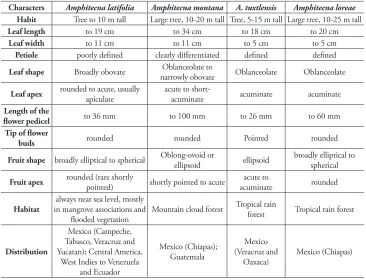
Table 1. Comparison of diagnostic morphological characters of Amphitecna loreae with its close relatives.
Characters Amphitecna latifolia Amphitecna montana A. tuxtlensis Amphitecna loreae Habit Tree to 10 m tall Large tree, 10-20 m tall Tree, 5-15 m tall Large tree, 10-25 m tall
Leaf length to 19 cm to 34 cm to 18 cm to 20 cm
Leaf width to 11 cm to 11 cm to 5 cm to 5 cm
Petiole poorly defined clearly differentiated defined defined
Leaf shape Broadly obovate narrowly obovateOblanceolate to Oblanceolate Oblanceolate
Leaf apex rounded to acute, usually
apiculate acute to short-acuminate acuminate acuminate
Length of the
flower pedicel to 36 mm to 100 mm to 26 mm to 60 mm
Tip of flower
buds rounded rounded Pointed rounded
Fruit shape broadly elliptical to spherical Oblong-ovoid or ellipsoid ellipsoid broadly elliptical to spherical
Fruit apex rounded (rare shortly
pointed) shortly pointed to acute acuminateacute to rounded
Habitat in mangrove associations and always near sea level, mostly
flooded vegetation Mountain cloud forest
Tropical rain
forest Tropical rain forest
Distribution
Mexico (Campeche, Tabasco, Veracruz and Yucatan); Central America,
West Indies to Venezuela and Ecuador
Mexico (Chiapas); Guatemala
Mexico (Veracruz and
9 Trees to 10 m tall; leaves obovate to wide elliptic, rounded to mucronate at apex with poorly defined petioles; restricted to coastal ecosystems...A. latifolia – Large trees, to 25 m tall; leaves oblanceolate to narrowly obovate, acute to acumi-nate at apex with defined petioles; tropical rain forest or cloud forest ...10
10 Leaves, 34 ×11 cm; petiole to 4 cm long; pedicels to 10 cm long; forests above 1200 m ...A. montana – Leaves, 20 ×5 cm; petiole short, less than 2 cm; pedicels to 6 cm long; forests
below 1000 m ...A. loreae
Acknowledgements
We extend our sincere gratitude to Yuyini Licona Vera, Miguel Ángel Pérez Farrera and Ruben Martínez Camilo for support during the preparation of the manuscript, Luiz Henrique Fonseca, Lulu Rico Arce and Alan Paton for reviewing and providing many useful comments on the manuscript, and particularly to Marcos Escobar for providing the excellent pictures of A. loreae.
References
Bachman S, Moat J, Hill AW, de Torre J, Scott B (2011) Supporting Red List threat assess-ments with GeoCAT: geospatial conservation assessment tool. ZooKeys 150: 117–126. doi: 10.3897/zookeys.150.2109
Collevatti RG, Dornelas MC (2016) Clues to the evolution of genome size and chromosome number in Tabebuia alliance (Bignoniaceae). Plant Systematic and Evolution 302: 601–607. doi: 10.1007/s00606-016-1280-z
Donoghue M (1985) A critique of the biological species concept and recommendations for a phylogenetic alternative. The Briologist 88: 172–181. doi: 10.2307/3243026
Escobar-Castellanos M (2016) Estructura, diversidad y composición florística del bosque tropi-cal perennifolio de la zona sujeta a conservación ecológica La Pera, Berriozabal, Chiapas. Bachelor’s Thesis, Universidad de Ciencias y Artes de Chiapas, Mexico.
Fischer E, Theisen I, Lohmann LG (2004) Bignoniaceae. In: Kadereit JW (Ed.) The Families and Genera of Vascular Plants – Lamiales (vol. 7). Springer-Verlag, Berlin, 9–38. doi: 10.1007/978-3-642-18617-2_2
Gentry AH (1980) Bignoniaceae (Part I) – Tribes Crescentieae and Tourrettieae. Flora Neo-tropica Monograph 25: 1–131.
GBIF (2016) Global Biodiversity Information Facility. http://www.gbif.org/species [accessed 06.05.2016]
Grose SO, Olmstead RG (2007b) Taxonomic revisions in the polyphyletic genus Tabebuia s. l. (Bignoniaceae). Systematic Botany 32: 660–670. doi: 10.1600/036364407782250652 Hammer Ø, Harper DAT, Ryan PD (2001) PAST: paleontological statistics software package
for education and data analysis. Palaeontologia Electronica 4: 1–9.
Hickey LJ (1973) Classification of the architecture of dicotyledonous leaves. American Journal of Botany 60: 17−33. doi: 10.2307/2441319
Hijmans RJ, Cameron SE, Parra JL, Jones PG, Jarvis A (2005) Very high resolution interpo-lated climate surfaces fro global land areas. International Journal of Climatology 25(15): 1965–78. doi: 10.1002/joc.1276
IUCN (2001) IUCN Red List Categories and Criteria (Version 3.1). IUCN Species Survival Commission, Gland, Switzerland and Cambridge. http://www.iucnredlist.org/info/cat-egories_criteria2001
Lohmann LG, Ulloa C (2006 onwards) Bignoniaceae in iPlants prototype Checklist. http:// www.iplants.org/ [accessed 03.05.2016]
Olmstead RG, Zjhra ML, Lohmann LG, Grose SO, Eckert AJ (2009) A molecular phylogeny and classification of Bignoniaceae. American Journal of Botany 96(9): 1731–1743. doi: 10.3732/ajb.0900004