PLEASE CITE AS: Ammert, N., Edling, S., Löfström, J., & Sharp, H. (2017). Bridging historical and moral consciousness:
Promises and challenges. Historical Encounters: A journal of historical consciousness, historical cultures, and history education, 4(1), 1-13.
ISSN 2203 7543 | © Author | This work is licensed under https://creativecommons.org/licenses/by/3.0/ Publication Date: 18 January 2017 | Available Online: http://hej.hermes-history.net
Bridging historical and moral consciousness: Promises and challenges
Niklas Ammert
Linnaeus University, Sweden
Silvia Edling
Gavle University, Sweden
Jan Löfström
University of Helsinki, Finland
Heather Sharp
University of Newcastle, Australia
ABSTRACT: This special issue is the result of the workshop, Towards an integrated theory of
historical and moral consciousness, supported by Riksbankens Jubileumsfond (The Swedish Foundation for Humanities and Social Sciences) and Suomen kasvatuksen ja koulutuksen historian seura (The Finnish Society for the History of Education) and held at the University of Helsinki, in 2015. History teaching and social studies education are increasingly expected to develop, among other things, students’ historical consciousness. This goal is highly relevant for students’ ability to deal constructively with controversial issues of history which is an important civic competence in the situation where in many societies’ political arguments concerning, for example, citizenship rights, ethnic and cultural diversity, and democracy are only too often fuelled by simplistic narratives of historical change and continuity. However, there is a blank spot in the existing research on historical consciousness in that intersections between historical and moral consciousness remain very much unexplored. This special issue seeks to identify promising theoretical and conceptual points of convergence for future interdisciplinary studies of historical and moral consciousness. Contributors are from the fields of history, educational research, social psychology, and philosophy.
KEYWORDS: historical consciousness, moral consciousness, controversial history, history teaching, moral dilemmas, intersection.
Background: controversial histories, conflicting politics
The idea of arranging an exploratory workshop on this topic originated in the discovery that there is a blank spot in the research on historical consciousness and that this lacuna has relevance for the contemporary political and social concerns. In many societies there are currently intense debates, even violent clashes, around the issues of cultural and ethnic diversity, citizenship, migration, integration, identity and social inequality. Much of this political and social turbulence can be traced back to the economic, demographic and ecological dimensions of globalisation. Traditional lifestyles have been shattered, and those who find themselves on the losing side in the globalisation game, or feel that their previously comfortable position is turning insecure, easily respond to the new situation with fear and anxiety, even aggression. In times of uncertainty, frustration and despair fundamentalism and authoritarianism are welcomed by many who yearn for a return to seemingly clear-cut, closed cultural communities and social categories (see, for example, Castles, 2000; Delanty, Wodak, & Jones (eds), 2008; Guibernau, 2007; Milanovic, 2016). These tendencies have a close relation to past events and therefore plead to be understood in relation to history (Pinar, 2012).
The diversity of historical narratives, interpretations of the social world, and foundations for societal values in many Western societies has grown as a result of increased cultural heterogeneity and the new social movements that since the 1960’s challenged previously hegemonic values and norms and demanded for a recognition of ‘subaltern voices’ (see, for example, Gayatri Spivak’s seminal text, Can the subaltern speak?, 1988). Canonic interpretations of national histories have become under scrutiny, though in some cases there has been renewed demand for them, too (see, for example, Grever & Stuurman (eds), 2007; Symcox & Wilschut (eds), 2009; Taylor & Guyver, 2011). Increased plurality of historical narratives is a positive development in that it suggests that the diversity of collective memories in society is accepted as legitimate more readily than before. However it follows from this that one also has to be prepared to confront and debate historical narratives that fly at the face of basic principles of democracy, equality and universal human rights.
After the 1980s we have witnessed a moral turn in the study of history in that issues of justice and ethics are recognized as pertinent to historians’ work. As George Cotkin (2008, p. 312) has pointed out, “historians are presently treading upon a landscape full of moral topics.” Historians are asked to serve as arbiters in not only historical but also legal and, implicitly, moral issues which is not a role they readily find appropriate for themselves (see, for example, Rousso, 2003). Particularly questions of making reparation to victims of historical injustices has been a topic of much public debate and political negotiations to such an extent that the turn of the millennium has been called The age of apology, with reference to the numerous demands made to governments and other organisations for reparation for past injustices (Gibney et al. (eds), 2008; Torpey, 2006). Questions of history and moral in/justice are heavily loaded largely, but not only, because the issue at stake is who is included in, or excluded from, the community whose memories of the past are recognised as part of a wider national or global narrative of history. Additionally, seemingly well-intentioned historical apologies may have exclusionary effects (Löfström, 2011). As the 20th century amply shows, narratives of historical trauma have great potential to fuel enmities between countries and within societies, and the last 15 years witness that history continues to be mobilised for a wide variety of political ‘uses and abuses’ (see, for example, Macmillan, 2010; Taylor & Guyver (eds, 2011).
History teaching for conflict resolution and reconciliation
History and Ourselves, in the US. These initiatives are based on the notion that – as Robert Selman and Dennis Barr (2009) put it in the context of Facing History and Ourselves – a study of ethical violations in history may teach students to create “ethical relationships for themselves” in the future. They seek to enhance students’ commitment to democratic values and human rights and thus contribute to preventing such violations in the future. In the Council of Europe recommendation on History teaching in 21st century Europe, in 2001, it was declared that, among other things, History teaching should:
play a vital role in the promotion of fundamental values, such as tolerance, mutual understanding, human rights and democracy [and help develop pupils’] intellectual ability to analyse and interpret information critically and responsibly, through dialogue, through the search for historical evidence and through open debate based on multiperspectivity, especially on controversial and sensitive issues. (Council of Europe, 2001)
In some countries the current curricula mandate that History/Social Studies teaching in school should develop young citizens’ competence to assess historical interpretations from multiple perspectives, to judge critically public uses of history, and to use historical understanding for supporting democratic values and human rights. It is, however, another issue how intensively such directions are implemented (see, for example, Stradling, 2011; Ecker, 2013).
There are also numerous academic books that discuss the issues of why, and how to teach controversial history (Baildon et al., 2013; Berg et al., 2003; Foster, 2014; Maitles & Cowan, 2011), but they are not entirely satisfactory as they mostly focus on how to make students adjudicate between conflicting arguments and contradictory evidence, as if in a debate between professional historians. That is a useful civic competence and certainly essential when historical controversies are being negotiated. Historians Without Borders, based in Finland, was launched as an international network in 2016, for the purpose of “further[ing] public discussion about history and to promote the use of historical knowledge for peace-building and conflict-resolution” (2016, n.p.). Left at that, however, the task is reduced to an intellectual weighing of whether historical facts are being ‘abused’ and how conflicting interpretations and memories can be shared, compared and perhaps reconciled. It leaves out the emotive elements which are of utmost importance in history-related controversies (Long & Brecke, 2003). Moreover, it mostly fails to address the complexity of intertwined narrative threads that connect the past, the present, and the future in people’s minds and make intelligible to them who they are, what they want, and what their world is like. This brings us to the relationship between historical and moral consciousness.
Historical consciousness and moral consciousness
There is a large body of theoretical and empirical research on the nature and development of historical consciousness and how to cultivate it in school history teaching. Contributions to this wide field do not always share the same understanding of the content of the concept which, however, need not be regarded as a problem but simply as a reminder of differences in the traditions of History education and history theory, most notably between the German-speaking and the English-speaking world (for different notions of historical consciousness see von Borries, 1995; Lee, 2004; Seixas, 2004; Rüsen, 1989, 2004; Straub (ed.), 2005; and Wilschut, 2012). There is also a large body of research on topics that in the workshop in Helsinki were put under the umbrella term moral consciousness. They include moral consciousness (Kohlberg, 1984), moral judgment (Rest, 1979; Lind, 2008), moral reasoning (Bucciarelli et al., 2008; Myyry, 2003), moral thinking (Thoma et al., 2013), moral sensitivity (Tirri & Nokelainen, 2011), moral motivation (Myyry, 2003), and moral emotions (Malti & Keller, 2010). The term moral consciousness as such has also been used by Jürgen Habermas (1990) in his discussion on Lawrence Kohlberg, and by Hans-Jürgen Pandel (1987) as synonymous to sensitivity regarding temporality of moral values and norms.
Coming back to the rationale of the workshop and the special issue, we find that what is missing in earlier studies of historical and moral consciousness is an attempt to construct theoretical and conceptual bridges between those two fields. As Rüsen (2004) wrote already over a decade ago, the relation between historical and moral consciousness remains next to unexplored and untheorised.
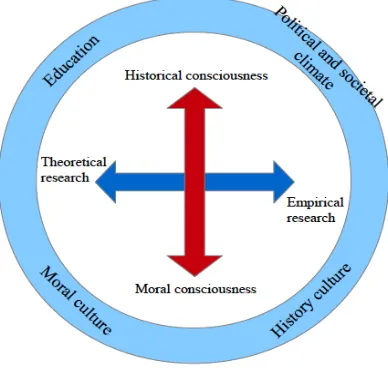
Inspired by the discussions in the workshop, the figure below attempts to visualise in a preliminary fashion the key concepts in the field and how they could be located in relation to each other (Figure 1).
Figure 1: Starting points for a study of historical and moral consciousness
historical consciousness and moral consciousness. This special issue will not be able to provide a definitive definition or understanding of the intersection between historical consciousness and moral consciousness, but it aims to provide some guidelines and, importantly, inspiration for future work in this field.
Let us now look briefly also at the elements in the figure that make the frame for historical and moral consciousness and need to be taken into account when designing future research. To be clear, the figure is meant to serve as a heuristic device, not as an end product of a concluded research project.
Outlining the context for the study of historical and moral consciousness
Formal education is an arena where historical and moral consciousness are expected to be cultivated along the lines stipulated in the curriculum, but in school as well as elsewhere people also learn – and even more – in informal education. Our historical knowledge and skills of historical reasoning may partly derive from the history class and also our historical consciousness can be nourished with processes that take place in the history class. Yet at least equally important is the role of history culture (Germ. Geschichtskultur) or, as Jorma Kalela (2012, p. xii) has put it, “history-in-society”, that is consumed in everyday life and that abounds in narratives with historical contents, ranging from family traditions to state propaganda and guided tourism (Zander, 2014; Kalela, 2012). These narratives are material for the ever on-going process of citizens making sense of the trajectory of their temporal self and the society they inhabit.
For the purposes of this paper we suggest that likewise one could speak of moral culture (in contrast with history culture), in reference to the discernable prevalent patterns of how people in a given society respond to moral concerns in ways that are taken as ‘moral’. This is not to suggest that in society there is only one form of the moral life but possibly a plurality of them (see Tester, 1997). Moral culture in this sense could be seen as something that partly derives from moral instruction but also from narratives and practices with implicit moral content that abound in everyday encounters, media messages and, for example, the hidden curriculum of school (see, for example, Jackson, Boostrom, & Hansen, 1993). The philosophical aspect of moral consciousness is also important to consider in order to avoid an indoctrination of the kind that pushes bounded moral values, or morality, onto students.
Figure 1 singles out political and societal climate in order to remind us of what Fernand Braudel called history of events, ‘history of short duration’ (courte durèe). These are more short-term phenomena of societal and political life that may be reflected in how, for example, historical and moral issues are framed, verbalised and negotiated in a particular time and space. The effect of this is like noise in radio transmission and needs to be considered when designing empirical research on historical and moral consciousness and analysing data from it.
The figure is a deliberately slim model in that it intentionally leaves out of the picture, for the time being, questions of the innate capacity of the humans of having empathy, compassion and altruism. In a sense this capacity is one part of a history of very long duration, namely evolutionary development, and as such it could well be taken into account in our crude model with its dimension of temporal change. For the purposes of theorising on intersections of historical and moral consciousness and how their developments may interconnect, work by researchers like Steven Pinker (2011), for example, is extremely relevant.
The present-day concerns and moral dilemmas inform how the past and its moral dilemmas are perceived, and this feeds also to expectations about the future and its moral dilemmas (Ammert, 2013a). Thus, education of historically informed and morally engaged citizens would greatly benefit from understanding how people interrelate the past, the present and the future, how they handle complex moral dilemmas, and, very importantly, how they ponder on implications of historical moral dilemmas for the present and the future. These processes entail mobilising resources of historical and moral consciousness, and the crucial point is how the two resources interact and possibly support or obstruct each other. In educational contexts it is also relevant to ask how historical and moral consciousness could be developed and how their development and levels of sophistication can be assessed or ‘measured’. This is a complex issue and a formidable theoretical and methodological challenge. There is, for example, the risk that measuring instruments fail to do justice to the “ambiguities, ambivalences and contradictions inherent in concrete forms of historical [and moral, we add] consciousness,” as Carlos Kölbl and Lisa Konrad (2015, p. 26) point out (see also more generally Ercikan & Seixas (eds) 2015, part I).
Experts in History and Social Studies education were well-represented in the workshop in Helsinki, 2015, and the same is true in this special issue. It may be a reflection of the recognition that History/Social Studies educators in particular are expected to cultivate young citizens’ and their history teachers’ ability to reflect on historical problems and moral dilemmas and that, consequently, many History/Social Studies educators in universities are engaged in doing research on these themes. For example, the editors of this special issue have researched historical consciousness in school textbooks and the place of ethical values in historical thinking and in history teaching (see, for example, Ammert, 2008, 2013a, 2013b), adolescents’ perceptions of the meanings and justification of historical reparations as a reflection of their historical consciousness, and the public uses of historical reparations (see, for example, Löfström, 2011, 2014), adolescents’ responses to issues of violence and responsibility, the place of social and historical controversies and moral dilemmas in the guidelines mandated by core curricula (see, for example, Edling, 2009, 2012, 2016; Edling & Frelin, 2013), and the question of representing sensitive pasts in the History curriculum(see, for example, Sharp, 2011). One particular theme which has been studied extensively by History educators and which has a close connection with historical and also moral consciousness is historical empathy and how to develop it (see, for example, Brooks, 2009; Davis, Yeager, & Foster (eds), 2001; as an example of a social psychological approach to the concept of empathy see Myyry, Juujärvi, & Pesso, 2010).
which also has a role in how students reason about historical questions, including dilemmas with moral content (see, for example, Radinsky et al., 2015; Reisman, 2015).
The agenda and the contributions of the special issue
This special issue aims to help identify promising points of convergence between studies of historical and moral consciousness. The visualisation in figure 1 is meant to capture our preliminary understanding of the field, and we hope that in the future there will be more sophisticated and empirically substantiated theoretical models of the intersections of historical and moral consciousness and the reciprocal dynamics between the two.
The contributions that follow range from empirical to more theoretical explorations. Their conceptual and terminological solutions vary to an extent as they reflect the variety of disciplinary perspectives among the authors.
In the article Moral and historical consciousness Guðmundur Heiðar Frímannsson discusses moral development as part of the moral growth of a person. A crucial question is, what does moral development consist of? Frimanssson ponders the question from an Aristotelian, a Kohlbergian, and an ethics of care perspective. He proceeds to discuss whether historical and moral consciousness are related and how. Frimannsson sets the hypothesis that the link between them may be that one part of understanding historical events is to understand their significance, and significance here comes partly from the moral relevance of the events for us. If this is true, then historical understanding is, in part, understanding the moral importance of the past. Moral and historical consciousness are necessarily linked to each other and cannot exist separately.
The article Narrative multiplicity and double standards: The complexity of ‘historical apologies’ and consequences for historical thinking and learning, by Andreas Körber, starts from the contention that recognizing temporal changes in norms and values when writing history is a standard approach in historiography. Yet recognizing such differences between the past and the present norms and values is only part of the solution to the problem of interrelating a temporal dimension with other, for example normative, dimensions of human orientation. Körber argues that there would need to be a concept of how to integrate normative standards in historical meaning-making in a reflective way. Drawing from Jörn Rüsen, Jacques Lacan and Harald Welzer he elaborates a matrix for addressing the temporal dimension of values in both synthetic and analytical operations of historical thinking.
In her article, Historical and moral consciousness in the light of ethics of dissensus: One approach to handle plurality in education, Silvia Edling starts from the observation that today many societies face increased intolerance towards and violence against those considered to be foreigners. Parallel to these trends, many societies are, in a higher degree than before, influenced by simplistic populist rhetoric that is based on a binary logic of black and white and conjoins elements from conservative, nationalist, and neo-liberal discourses. Violence is a multifaceted phenomenon, and Edling brings to attention the consequences of othering as embodied manifestation in everyday life. From this way of reasoning, one aspect of violence is created in the collision between the Other we encounter and the Other that is within ourselves. The article explores the relationship between history/time and ethical responsibility by drawing on the work of Ewa Ziarek, and asks how the descriptions between historical and moral consciousness in education can be grasped so that it does not overlook the presence of the embodied Other?
result from analysing shared material from the perspectives of History education and social psychology. The material used in the article comes from a study of what Finnish adolescents’ reasoning about historical responsibility and reparations can tell of their historical consciousness. The authors engage in a dialogue on what questions the material raises in a social-psychological study of morality, and what might be the intersections between a study of historical and moral consciousness in this concrete case.
In his article, ‘Patterns of reasoning: A tentative model to analyse historical and moral consciousness among 9th grade students’, Niklas Ammert propounds that students find ethical and moral issues particularly interesting when interpreting history. History can offer references to contemporary moral judgments, and simultaneously moral values also provide contexts through which students can connect with the past. How interrelations between the past and the present are conceived interacts with students’ questions and interpretations concerning moral issues. In the article Ammert reports his study where Swedish 9th grade students discussed an excerpt from Christopher Browning’s book, Ordinary Men: Reserve Police Battalion 101 and the Final Solution in Poland (1993). The students’ answers are analysed in a theoretical model that combines aspects of historical consciousness and moral reasoning. The objective is to look for potential patterns of interrelations and how they are manifested. The conclusions should be seen as a step towards founding a model to how historical consciousness and moral consciousness as theoretical concepts are interrelated.
In Fredrik Alvén’s contribution, Teaching democratic citizens via their historical consciousness: A contradictory mission, the starting point is, that an expectation of History teaching in Sweden is to educate citizens who endorse the values in the chapter Fundamental values and tasks of the school, within the national curriculum. This is to be done by developing students’ historical consciousness. Yet that can be managed in different ways which may be in conflict. Alvén analyzes the dilemma in history teaching by comparing the objectives of citizenship education in the national curriculum and the theoretical construction of how to develop students’ historical consciousness as it is described in the History syllabus. The article gives a tentative suggestion for how to resolve the dilemma following from tensions in the curriculum.
References
Ammert, N. (2008). Det osamtidigas samtidighet: Historiemedvetande i svenska historieläroböcker under hundra år. Lund & Uppsala: Sisyfos förlag.
Ammert, N. (2013a). Historia som kunskap. Innehåll, mening och värden i möten med historia. Lund: Nordic Academic Press.
Ammert, N. (2013b). Ethical values and history: A mutual relationship? International Journal of Historical Learning, Teaching and research, 12(1), 5-15.
Baildon, M., Song, L., Lim, I.M., Inanc, G. & Jaffar, J. (eds) (2013). Controversial history education in Asian contexts. London: Routledge.
Berg, W., Graeffe, L., & Holden, C. (2003). Teaching controversial issues. A European perspective. London: CICE Publications.
Brooks, S. (2009). Historical empathy in the Social Studies classroom: A review of the literature. Journal of Social Studies Research, 33:2, 213–234.
Castles, S. (2000). Ethnicity and globalization: From migrant worker to transnational citizen. London: Sage.
Chinnery, A. (2013). Caring for the past: On relationality and historical consciousness. Ethics and Education, 8(3), 253–262.
Cotkin, G. (2008). History’s moral turn. Journal of the History of Ideas, 69(2), 293-315. Council of Europe (2001). Recommendation Rec (2001)15: On history teaching in
twenty-first-century Europe. Strasbourg: Council of Europe.
Davis, O.L., Yeager, E. & Foster, S. (eds) (2001). Historical empathy and perspective taking in the social studies. Lanham, MD: Rowman & Littlefield.
Delanty, G., Wodak, R. & Jones, P. (eds) (2008). Identity, belonging and migration.
Liverpool: Liverpool University Press.
Ecker, A. (ed.) (2013). Civic and History Teachers’ Education in Europe. A comparative study on concepts, structures and standards of initial teacher education, assessment and tutorial structures for the subjects ‘History’‚ ‘Civic/Citizenship education’, ‘Social/ Cultural Studies’ and ‘Politics’. Strasbourg: Council of Europe Publishing.
Edling, S. (2009). Ruptured narratives: An analysis of the contradictions within young people’s responses to issues of personal responsibility and social violence within an educational context. Uppsala: Uppsala Universitet.
Edling, S. (2012). The paradox of meaning well while causing harm: a discussion about the limits of tolerance within democratic societies. Journal of Moral Education, 41(4), 457-471.
Edling, S. (2016). Demokratidilemman i läraruppådraget. Att främja lika villkor. Stockholm: Liber.
Edling, S. & Frelin, A. (2013). Doing good? Interpreting teachers’ given and felt
responsibilities for pupils’ well-being in an age of measurement. Teachers and Teaching: Theory and Practice, 19(4), 419-432.
Ercikan, K. & Seixas, P. (eds) (2015). New directions in assessing historical thinking. New York: Routledge.
Foster, S. (2014). Teaching controversial issues in the classroom: The exciting potential of disciplinary history. In Baildon, M., Kah Seng, L., Lim, I., Inanc, G. & Jaffar, J. (eds.)
Controversial history education in Asian contexts (pp. 19-38). London: Routledge. Gibney, M., Howard-Hassman, R., Coicaud, J.-M. & Steiner, N. (eds) (2008). The age of
apology. Facing up to the past. Philadelphia: University of Pennsylvania Press. Grever, M. & Stuurman, S. (eds) (2007). Beyond the canon. History for the twenty-first
century. New York: Palgrave Macmillan.
Guibernau, M. (2007). The identity of nations. London: Polity.
Habermas, J. (1990) Moral consciousness and communicative action. Transl. C. Lenhardt & S.W. Nicholsen. Cambridge, Mass: MIT Press.
Historians without borders (2016). (http://www.historianswithoutborders.fi/en/about-us/). Jackson, P., Boostrom, R. &, Hansen, D. (1993). The moral life of schools. San Francisco,
Kalela, J. (2012). Making history: The historian and uses of the past. Basingstoke: Palgrave Macmillan.
Kohlberg, L. (1984). Psychology of moral development: The nature and validity of moral stages. San Francisco: Harper & Row.
Kölbl, C. & Konrad, L. (2015). Historical consciousness in Germany: Concept,
implementation, assessment. In K. Ercikan & P. Seixas (eds) (2015). New directions in assessing historical thinking (pp. 17-28). New York: Routledge.
Lee, P. (2004). “Walking backwards into tomorrow”: Historical consciousness and understanding history. International Journal of Historical Learning Teaching and Research, 4(1), 69-114.
Lind, G (2008). The meaning and measurement of moral judgment competence: A dual-aspect model. In D. Fasko and W. Willis (eds.), Contemporary philosophical and
psychological perspectives on moral development and education (pp. 185-220). Creskill: Hampton Press.
Löfström, J. (2011). Historical apologies as acts of symbolic inclusion – and exclusion? Reflections on institutional apologies as politics of cultural citizenship. Citizenship Studies, 15(1), 93–108.
Löfström, J. (2014). How Finnish upper secondary students conceive transgenerational
responsibility and historical reparations: implications for the history curriculum. Journal of Curriculum Studies, 46(4), 515–539.
Long, W. & Brecke, P. (2003). War and reconciliation: Reason and emotion in conflict resolution. Cambridge, Mass: MIT Press.
Macmillan, M. (2010). The uses and abuses of history. London: Profile Books.
Maitles, H. & Cowan, P. (2011). Teaching controversial issues in the classroom: Key issues and debates. London: Continuum.
Malti, T. & Keller, M. (2010). Development of moral emotions in cultural context. In W. Arsenio & E. Lemerise (eds) Emotions, aggression, and moral development. Washington: American Psychological Association.
Milanovic, B. (2016). Global inequality. A new approach for the age of globalization. Cambridge, Mass.: Belknap Press.
Myyry. L. (2003). Components of morality: A professional ethics perspective on moral motivation, moral sensitivity, moral reasoning and related constructs among university students. University of Helsinki.
Myyry, L., Juujärvi, S. & Pesso, K. (2010). Empathy, perspective taking and personal values as predictors of moral schemas. Journal of Moral Education, 39(2), 213-233.
Pandel, H.J. (1987). Dimensionen des Geschichtsbewusstseins: Ein versuch, seine struktur für empirie und pragmatik diskutierbar zu machen. Geschichtsdidaktik: Probleme, Projekte, Perspektiven, 12(2), 130–142.
Pinar, W. (2012). What is curriculum theory (2nd ed). Mahwah: Lawrence Erlbaum Associates.
Radinsky, J., Goldman, S., & Pellegrino, J. (2015). Historical thinking: In search of conceptual and practical guidance for the design and use of assessments of student
competence. In K. Ercikan & P. Seixas (eds) (2015). New directions in assessing historical thinking (pp. 132-141). New York: Routledge.
Reisman, A. (2015). The difficulty of assessing disciplinary historical reading. In K. Ercikan & P. Seixas (eds) (2015). New directions in assessing historical thinking (pp. 29-39). New York: Routledge.
Rest, J. (1979). Development in judging moral issues. Minneapolis: University of Minnesota Press.
Rousso, H. (2003). Justice, history and memory in France: Reflections on the Papon trial. In J. Torpey (ed.), Politics and the past. On repairing historical injustices (pp. 277-293).
Lanham, MD: Rowman & Littlefield.
Rüsen, J. (1989). The development of narrative competence in historical learning: An
ontogenetic hypothesis concerning moral consciousness. History and Memory, 1(2), 35-59. Rüsen, J. (2004). Historical consciousness: Narrative structure, moral function and
ontogenetic development. In, P. Seixas (ed.), Theorizing historical consciousness (pp. 63-85). Toronto: University of Toronto Press.
Seixas, P. (ed.) (2004). Theorizing historical consciousness. Toronto: University of Toronto Press.
Selman, R. & Barr, D. (2009). Can adolescents learn to create ethical relationships for themselves in the future by reflecting on ethical violations faced by others in the past? In M. Martens et al. (eds.), Interpersonal understanding in historical context (pp. 19-42). Rotterdam: Sense Publishers.
Sharp, H. (2011). Constructing history: Selective representations of Indigenous Australians and British heritages in Queensland History curriculum. (PhD thesis).Retrieved from: https://eprints.usq.edu.au/19635/
Spivak, G. (1988). Can the subaltern speak? In, C. Nelson and L. Grossberg (eds.), Marxism and the interpretation of culture (pp. 66-111). University of Illinois Press: Urbana.
Stradling. R. (2011). The scope for a wider and deeper European perspective in the teaching of 20th century history in secondary schools. MitOst: Symposium on “1989: a Turning Point in Perceptions of 20th century dictatorships and their representation in schools”. May 26-28, 2011, Berlin.
Straub, J. (ed) (2005). Narration, identity and historical consciousness. Oxford, UK: Berghahn Books.
Symcox, L. & Wilschut, A. (eds) (2009). National history standards. The problem of the canon and the future of teaching history. Charlotte NC: Information Age Publishing. Taylor, T. & Guyver, R. (eds) (2011). History wars and the classroom: Global perspectives.
Charlotte NC: Information Age Publishing. Tester, K. (1997). Moral culture. London: Sage.
Tirri, K. & Nokelainen, P. (eds) (2011). Measuring multiple intelligences and moral sensitivities in education. Rotterdam: Sense Publishers.
Torpey, J. (2006). Making whole what has been smashed: On reparations politics. Cambridge MA: Harvard University Press.
von Borries, B. (1995). Exploring the construction of historical meaning: Cross-cultural studies of historical consciousness among adolescents. In W. Bos & R. Lehmann (eds)
Reflections on educational achievement (pp. 25-29). New York: Waxmann Münster. Wilschut, A. (2012). Images of time: The role of historical consciousness of time in teaching
history. Charlotte, NC: Information Age Publishing.
Zander, U. (2014). Historiekulturella manifestationer: Historia i ord, bilder och musik. In K.-G. Karlsson & U. Zander (eds), Historien är närvarande: Historiedidaktik som teori och tillämpning (pp. 175-197). Lund: Studentlitteratur.
Acknowledgements
We thank Arto Anttila for technical assistance in preparing the figure.
About the Authors
Niklas Ammert is an Associate Professor and Senior Lecturer of History with Educational Science at Linnaeus University in southern Sweden. Currently he serves as Pro Dean of the Faculty of Arts and Humanities. Ammert teaches History for teacher education students and at the Cultural Heritage Program. Ammert’s research mainly focuses on history teaching, history education and the uses of history – how individuals and groups encounter, communicate, interpret and use history at school, in higher education, in politics and in other cultural and societal contexts. His latest international publications include: History as Knowledge: Ethical Values and Meaning in Encounters with History, Frankfurt am Main: Peter Lang Publishing 2015, On Genocide and the Holocaust in Swedish History Teaching, Historical Encounters: A journal of historical consciousness, historical cultures and history education, 2015.
Author Email: [email protected]
Silvia Edling is a History Teacherand has a PhD in Curriculum Studies. She currently works as a Senior Lecturer/Associate Professor at the University of Gävle in Sweden. Her research is primarily directed upon exploring ethical aspects of democracy in education including
ambitions to secure everyone’s equal value and hence to contest different forms of violence and oppressive structures in society. In recent years Edling has come to be interested in teachers’ possibilities to peruse democratic aspirations within the environments established at higher education. Subsequently, she shifts focus from young people’s ethical experiences to possibilities of teacher professionalism and critical thinking that includes a desire to
Jan Löfström is a Lecturer in History and Social Studies Education at the Unversity of Helsinki, and Docent in Social and Historical education at the University of Turku. His research interests include historical consciousness, politics of historical reparations, historical anthropology, and epistemology of social studies. He is editor of a number of books on history and social studies education and of the interdisciplinary collection of articles Can history be repaired? On repairing and forgiving historical injustices [in Finnish, Gaudeamus Helsinki University Press, 2012].
Author Email: [email protected]
Heather Sharp is a Lecturer and First Year Support Convenor at the School of Education, convenor of the History Network for Teachers and Researchers (HNTR) and the Special Issues Editor of Historical Encounters Journal. Her current research investigates historical representations in school curriculum primarily to do with national histories, particularly textbooks and also examines the written and visual texts in picture books that deal with conflict. After working as a secondary school teacher (English and History) for a number of years, Heather began her University career in 2006. She has taught and coordinated Education courses in the areas of: transformative pedagogies, philosophies of education, History
curriculum and pedagogies, literacies, education as a professional career, assessment, and professional experience. Most recently, she was awarded a competitive residency Fellowship to the prestigous Georg Eckert Institute in Braunschweig, Germany.