WATER COMPLEXES WITH AMMONIA AND CARBON
DIOXIDE IN POTASSIUM BROMIDE MATRIX
I. I. Grinvald,
[a]*I. Yu. Kalagaev,
[a]A. N. Petukhov,
[a]I. V. Vorotyntsev,
[a]V. M.
Vorotyntsev,
[a]A. V. Vorotyntsev,
[a]I. A. Spirin
[a]and R. A. Kapustin
[a]Keywords: Water intermediates, ammonia, carbon dioxide, hydrogen bond, FTIR spectroscopy, DFT calculation.
In this work a new experimental approach to reveal and study the water intermediates with the gas species in condensed phase at ambient temperature by IR spectral technique is presented. It has been established that the complexes between water molecule and ammonia as well as carbon dioxide in KBr matrix can be formed. Ab initio calculations in terms of density functional theory (DFT) at B3LYP/6-311++G(2d,2p) level allowed us to conclude that this binding is accompanied by the hydrogen atom transfer from water to partner molecule.
* Corresponding Authors
Fax and phone: +7 (831) 436 0351 E-Mail: [email protected]
[a] Nizhny Novgorod State Technical University, 24 Minin street, 603950 Nizhny Novgorod, Russian Federation.
Introduction
The hydration of ammonia and carbon dioxide plays a crucial role in many important processes passing in atmosphere and water resources, as well as on the earth surface and in its crust.1,2 Besides, this phenomenon can be
considered as an appropriate model for the nature of the ice formation on the planets and satellites.3-6 The problem of
water association with gases arises also in the producing of high purity materials. 7-11
The IR spectroscopy is a classical experimental method using for the study of the unstable water clusters.12,13
However the IR measurements of samples, containing water mixtures is very difficult and similar data have been obtained in the matrixes of noble gases at low temperatures.
14-19 However, most important processes with the
participation of a water molecule take place at ambient temperatures.20
In earlier work IR technique has been used to detect and study unstable water intermediates at ambient conditions. The fixation of reactive particles in the KBr matrix was taken as a base.21
We have modified this method and extended it on the water associates.22,23 Unlike the neutral matrix material, KBr
matter can be an active component supporting the interactions in the system. This feature is provided by the ability of KBr powder to hold water as well as other gas or liquid species.22,23 Besides this matrix is a very suitable
material for IR experiments, because KBr is transparent in a broad IR range.12
In this work we have presented the IR spectral manifestation of water intermediates formation with ammonia and carbon dioxide and their transformations in KBr matrix as well as tried to demonstrate the role of potassium bromide in the mechanism of interaction by DFT method.
Experimental and theoretical techniques
Materials
The purity of ammonia and carbon dioxide was no less than 99.999% and was controlled by gas chromatography with a thermal conductivity detector and identification of the main impurities by a conjugate mass selective detector. For this procedure we have used gas chromatograph “Tswet – 800” (Tswet.ru, Russia) with a flow inlet system and in situ analysis as well as chromato-mass spectrometer GCMS - QP2010 Plus (Shimadzu, Japan) with a vacuum sample inlet system of “Valco Instruments Co. Inc.” In situ analysis was conducted on a column of 5 m long filled Chromaton N-AW-HMDS (0.16 ÷ 0.20 mm) with 15 % of applied liquid phase E-301. Separation of components was carried out by chromato-mass spectrometry on a capillary column Agilent CP7434 stabilized trifluoropropylmethylpolysiloxane phase at 323 K. Processing of the results was made in “GCMS Real Time Analysis”. For the identification of the main impurities the library of mass spectra NIST-11 was used.
Water was deionized (Resistivity 18.2 MΩ•cm at 25°C) by passing through a Millipore Direct-Q system (Millipore, MA, USA).
Samples preparation
The preparation of potassium bromide matrix for the IR study was fully described in our previous papers.22,23 Briefly,
on the first step the KBr powder is saturated by gas (ammonia or carbon dioxide) during two – three hours in a reactor designed for these experiments23 either together with
the water vapour, or by the gas passed through water layer. After that so treated KBr powder is pressed and the obtained pellet is placed in FTIR spectrometer.
FTIR measurements
ratio of components and have selected the optimal composition for each sample.
Spectra were recorded on a IRAffinity-1 (Shimadzu Co. Inc.) FTIR spectrometer in the range 4000-500 cm-1 with a
resolution of 2 cm-1 and a scan number of 40. All other
parameters have corresponded to the ones established by the producer. The accuracy of measurement of wave numbers was controlled by the spectrum of polystyrene, being ±0.2 cm-1.
DFT calculations
Ab initio calculation was carried out in terms of DFT, realized in the computer program GAUSSIAN 09, revision E.01.24 The geometry, energetic, electronic and
spectroscopic characteristics were calculated by the B3LYP
functional and the basis set 6-311++G(2d,2p).
Results and discussion
IR study of ammonia-water system
In high frequencies region, a new band at 3240 cm-1 was
observed (in figure1a, this band is labelled by an asterisk).
Figure 1a. FTIR spectra of KBr pellets for water-ammonia system saturated by water vapour (a), by ammonia gas (b) and by a mixture of components (c) in a high frequencies region.
For heavy water the band at 2460 cm-1 was found (Figure
1b). Since the isotopic shift (νH/νD = 1.32) agrees well with
the expected value, we have assigned these bands to the OH stretching of bonded water in a complex with ammonia molecule.
In the 1800-1200 cm-1 region we have seen a new band at
1495 cm-1 (Figure 2a), whereas for the heavy water a new
band at 1078 cm-1 was observed (Figure 2b).
The isotopic shift of mentioned band (νH/νD =1.39)
correlates well with the theoretically predicted value for the XH stretching (X is O or N atom).
Figure 1b. FTIR spectra of KBr pellets for heavy water-ammonia system saturated by water vapour (a), by ammonia gas (b) and by a mix of components (c) in a high frequencies region.
Figure 2a. FTIR spectra of KBr pellets for water-ammonia system in a middle frequencies range saturated by water vapour (a), by ammonia gas (b) and by a mixture of components (c).
Figure 2b. FTIR spectra of KBr pellets for heavy water-ammonia system in a middle frequencies range saturated by water vapour (a), by ammonia gas (b) and by a mixture of components (c).
The band at 1495 cm-1 locates in the same spectral range,
where the NH stretching of ammonium salts locates.12
hydrogen atom transfer from water to ammonia molecule and formation of (NH4)+ fragment.
IR Study of Carbon Dioxide-Water System
In the case of carbon dioxide-water system in OH stretching region two new bands at 3120 and 2925 cm-1 (in
Figure 3a, these are labelled by an asterisks) were observed.
Figure 3a. FTIR spectra of KBr pellets for water-carbon dioxide system in a high frequencies range saturated by water vapour (a), by carbon dioxide gas (b) and by a mixture of thecomponents (c).
For the mixture of carbon dioxide with the heavy water a new band at 2455 cm-1 was found (in Figure 3b, it is labelled
by an asterisk). Therefore, the mentioned bands correspond to water OH stretching in intermediate with carbon dioxide.
Figure 3b. The FTIR spectra of KBr pellets for heavy water-carbon dioxide system in a high frequencies range saturated by water vapour (a), by carbon dioxide gas (b) and by a mix of components (c).
Besides in the 2600-2000 cm-1 region two new bands at
2140 and 2108 cm-1 were found (in figure 3b, these are
labelled by asterisks). For sample containing heavy water there is no sufficient shift and can be assigned to CO stretching in complex.
The carbon dioxide can form two shapes of water intermediates with O (water)-C (carbon dioxide) and H (water)-O (carbon dioxide) binding.15 Therefore, the
appearance of two new bands in high frequencies region may be relate to the existence of both shapes of water-carbon dioxide intermediates.
In the middle IR region two overlapping bands at 1395 and 1380 cm-1 were revealed. These bands don’t have
isotopic shift for heavy water mixture (Figure 4). If to account that the stretching vibrations of carbonates locate in this range,12 the mentioned bands can be assigned to CO
stretching of CO32- anion, arising owing to the
transformation of initial water complex in the stable structure (H2CO3).
Figure 4. FTIR spectra of KBr pellets for water-carbon dioxide system in a middle frequencies range saturated by water vapour (a), by carbon dioxide gas (b) and by a mixture of the components (c).
DFT study of ammonia-water system
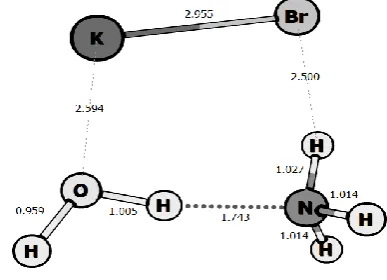
For this system, the ab initio calculation predicts the optimized geometry of complex with one water molecule. For the other variants of a cluster structure the set of calculated frequencies contained the negative values and therefore were excluded from the consideration. This geometry is shown in figure 5. The distances KBr-H2O =
2.59Ǻ and KBr-NH3 = 2.63Ǻ are considerably longer than
the distance NH3-H2O = 1.74Ǻ. The calculation gives the
frequency of OH-stretching about 3030 cm-1. The big shift
of this mode relatively free water OH stretching is caused by the strong interaction between H-atom of water and N-atom of ammonia molecule in the complex.
Figure 5. Calculated optimized geometry of the (H2O/NH3/KBr)
Therefore this interaction can lead to the hydrogen atom transfer from water to ammonia. The computation shows that the transfer about 0.05 Ǻ of water H-atom to NH3
fragment in complex has energetic barrier less than 8 kJ/mol. However OH-stretching frequency shifts at this transformation from 3030 up to 1698 cm-1, i.e. to the range,
in which the new IR bands were observed.
DFT study of carbon dioxide-water System
In this case the calculation gives another mechanism of complex formation in comparison to
ammonia-water system.
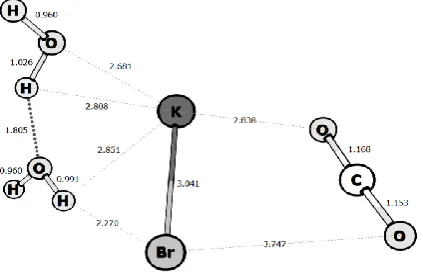
The obtained structure of water complex with carbon dioxide includes two water molecules. Unlike the previous system, the water and gas components locate on the different sides from KBr centres (Figure 6).
Figure 6. Calculated optimized geometry of the (2H2O/CO2/KBr)
system.
The calculation predicts the hydrogen atom transfer between two water molecules in this cluster. Therefore, it is reasonable to assume that the oxygen atom of carbon dioxide on the first step is protonated by H+ of the
hydronium ion leading to the formation of (CO2H)+
fragment. Then the OH- group from water cluster transfers
to (CO2H)+ and as a result the H2CO3·H2O complex is
formed.
On a whole, the DFT data agree with the effects observed in the IR spectra. The appearance of new bands is the manifestation of water binding with ammonia or carbon dioxide molecules accompanied by the hydrogen atom transfer.
Conclusions
The presented data demonstrate that the suggested method using the KBr matrix technique gives the opportunity to investigate the unstable water intermediates at ambient conditions.
The KBr matrix is not neutral in formation of water complexes. Its role is to hold the components as well as to facilitate the molecular transformation
.
Acknowledgements
We acknowledge support by the Russian Foundation of Basic research, grant No. 14-08-00898-a.
References
1Sadlej, J., Makarewicz, J., Chalasinski, G., J. Chem. Phys., 1998, 109, 3919. https://doi.org/10.1063/1.476991
2Korhonen, P., Kulmala, M., Laaksonen, A., Viisanen, Y.,
McGrow R., Seinfeld, J. H., J. Geophys. Res., 1999, 104, 26349.
3Atreya, S. K., Mahaffy, P. R., Niemann, H. B., Wong M. H.,
Owen, T. C., Planet. Space Sci., 2003, 51, 105.
https://doi.org/10.1016/S0032-0633(02)00144-7
4Bockelee-Morvan, D., Crovisier, J., Mumma M., Weaver, H., Comets II, Eds. Festou, M. C., Keller, H. U., Weaver, H. A., Univ. Arizona. Press, 2011, 391.
5Moore, M. H., Ferrante, R. F., Hudson. R. L., Stone, J.N., Icarus, 2007, 190, 260. https://doi.org/10.1016/j.icarus.2007.02.020 6Mitri, G., Showman, A., Lunine J., Lopes, R., Icarus, 2008, 196,
216. https://doi.org/10.1016/j.icarus.2008.02.024
7Petukhov, A. N., Shablykin, D. N., Vorotyntsev, A. V.,
Vorotyntsev, I. V., Vorotyntsev, V. M., Fluid Phase Equlibria, 2015, 406, 163.
https://doi.org/10.1016/j.fluid.2015.07.034
8Vorotyntsev, I. V., Drozdov, P. N., Mochalov, G. M., Smirnova,
N. N., Suvorov, S. S., Russ. J. Phys. Chem. A., 2006, 80, 2020. https://doi.org/10.1134/S0036024406120259
9Devyatych, G. G., Sennikov, P. G., Yan’kov, S. V., Russ. Chem. Rev., 1986, 55, 1233.
10Vorotyntsev, I. V., Drozdov, P. N., Shablykin, D. N.
Gamajunova, T. V., Desalination, 2006, 200, 379-380.
https://doi.org/10.1016/j.desal.2006.03.382
11Vorotyntsev, I. V., Kozyrev, I. V. Shablykin, D. N., Inorg. Mater., 2012, 48, 267.
https://doi.org/10.1134/S0020168512030193
12Nakamoto, K., Infrared and Raman Spectra of Inorganic and Coordination Compounds, Part A: Theory and Applications in Inorganic Chemistry, J. Wiley & Sons, New York, 2009.
13Zundel, G., Hydration and intermolecular interaction. Infrared Investigations with Polyelectrolyte Membranes, Academic Press, New York and London, 1969.
14Zhang, X., Sander, S. P., J. Phys. Chem. A, 2011, 115, 9854. https://doi.org/10.1021/jp203739v
15Tso, T. L., Lee, E. K. C., J. Chem. Phys., 1985, 89, 1612. https://doi.org/10.1021/j100255a014
16Sadlej, J., Moszynski, R., Dobrowolski, J. Cz., Mazurek, A. P., J. Phys. Chem. A., 1999, 103, 8528.
https://doi.org/10.1021/jp991581l
17Bertie J. E., Shehata, M. R., J. Chem. Phys., 1984, 81, 27. https://doi.org/10.1063/1.447381
18Zheng, W., Jewitt, D., Kaiser, R., J. Suppl. Ser., 2009, 181, 53. https://doi.org/10.1088/0067-0049/181/1/53
19Engdahl, A., Nelander, B., J. Chem. Phys., 1989, 91, 6604. https://doi.org/10.1063/1.457379
20Jamroz, M. J., Dobrowolski, J. Cz., Borowiak, M. A., J. Vib. Spectrosc., 2000, 22, 157.
22Vorotyntsev, I. V., Grinvald, I. I., Kalagaev, I. Yu., Petukhova,
N .A., Petukhov, A. N., Petroleum Chem., 2013, 53, 564.
https://doi.org/10.1134/S096554411308015X
23Vorotyntsev, I. V., Grinvald, I. I., Kalagaev, I. Yu., Petukhov,
A. N., Sutyagina, E. A., Vorotyntsev, A. V., Derbisher, E. V., Petukhova, N. A., Vorotyntsev, V. M., Russ. J. Phys.
Chem. A, 2014, 88, 625.
https://doi.org/10.1134/S003602441404030X
24Frisch, M. J., Trucks, G. W., Schlegel, H. B., Scuseria, G. E.,
Robb, M. A., Cheeseman, J. R., Scalmani, G., Barone, V., Mennucci, B., Petersson, G. A., Nakatsuji, H., Caricato, M., Hratchian, X. Li, H. P., Izmaylov, A. F., Bloino, J., Zheng, R., Sonnenberg, G., Hada, J. L., Ehara, M., Toyota, K., Fukuda, R., Hasegawa, J., Ishida, M., Nakajima, T., Honda, Y., Kitao, O., Nakai, H., Vreven, T., Montgomery, J. A. Jr., Peralta, J. E., Ogliaro, F., Bearpark, M., Heyd, J. J., Brothers, E., Kudin, K. N., Staroverov, V. N., Kobayashi, R., Normand, J., Raghavachari, K., Rendell, A., Burant, J. C., Iyengar, S. S.,
Tomasi, J., Cossi, M., Rega, N., Millam, J. M., Klene, M., Knox, J. E., Cross, J. B., Bakken, V., Adamo, C., Jaramillo, J., Gomperts, R., Stratmann, R. E., Yazyev, O., Austin, A. J., Cammi, R., Pomelli, C., Ochterski, J. W., Martin, R. L., Morokuma, K., Zakrzewski, V. G., Voth, G. A., Salvador, P., Dannenberg, J. J., Dapprich, S., Daniels, A. D., Farkas, Ö., Foresman, J. B., Ortiz, J. V., Cioslowski, J., Fox, D. J., Gaussian 09, Revision E.01, Gaussian, Inc., 2009.