Electronic Communications of the EASST
Volume 10 (2008)
Proceedings of the
Seventh International Workshop on
Graph Transformation and Visual Modeling Techniques
(GT-VMT 2008)
Ambiguity Resolution for Sketched Diagrams by Syntax Analysis Based
on Graph Grammars
Florian Brieler and Mark Minas
14 pages
Guest Editors: Claudia Ermel, Reiko Heckel, Juan de Lara
Managing Editors: Tiziana Margaria, Julia Padberg, Gabriele Taentzer
Ambiguity Resolution for Sketched Diagrams by Syntax Analysis
Based on Graph Grammars
Florian Brieler†and Mark Minas†
†Institute for Software Technology
Computer Science Department Universit¨at der Bundeswehr M¨unchen
85577 Neubiberg, Germany
{florian.brieler|mark.minas}@unibw.de
Abstract: Sketching, i.e., drawing diagrams by hand and directly on the screen, is gaining popularity, as it is a comfortable and natural way to create and edit diagrams. Hand drawing is inherently imprecise, and often sloppy. As a consequence, when processing hand drawn diagrams with a computer, ambiguities arise: it is not always clear what part of the drawing is meant to represent what component. Resolution of these ambiguities is the main issue of sketching. Ambiguity can only be solved by exploring the context of ambiguous components. This paper describes ambigu-ity resolution by syntax analysis in DIAGEN, a generic framework for generating diagram editors. Such editors support free-hand editing (which is closely related to sketching), and allow for analyzing the created diagrams based on a hypergraph grammar. Our approach adds support for sketching to the generated editors. In order to resolve the ambiguities in sketched diagrams, DIAGEN’s diagram analysis based
on graph parsing is used. The necessary modifications to DIAGEN and its graph parser in particular are discussed.
Keywords:Sketching, Ambiguity Resolution, Hypergraph, Parser
1
Introduction
Nowadays diagram languages like the UML are very popular, and there is a lot of work going on to model applications and systems (or, at least, part of them) using diagram languages, instead of coding them traditionally with textual languages. Diagrams are more expressive in terms of exposing structure and coherence of the modeled system; the used diagram language can be domain-dependent, thus better focusing on the problem in question; and diagrams are – for some problems – much more suited, e.g., for expressing graph-like structures like Petri nets or class diagrams.
Tool support for processing of diagrams has evolved in the last years, with many approaches available, e.g.,Fujaba[FNTZ00],AToM3[LV02], DIAMETA[Min06] and DIAGEN [Min02]. Among these, the specification of syntax and semantics of a diagram language is either given by metamodels or by graph grammars.
Ambiguity Resolution for Sketched Diagrams by Syntax Analysis
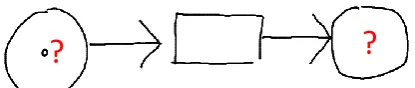
?
?
Figure 1: A simple Petri net with two ambiguities, indicated by question marks.
by one or more mouse clicks. Instead, sketching, i.e., drawing diagrams by hand on the screen, is similar to pen and paper and is much more natural, because it does not require complex user interfaces.
This paper is concerned with ambiguity resolution, which is the main issue of sketching. Am-biguities arise because drawing by hand is inherently imprecise and sloppy. Fig. 1 shows a practical example of a simple Petri net, which is also used as running example in this paper. Places and tokens are drawn as circles, transitions are drawn as rectangles. The two question marks indicate ambiguities. On the left it is unclear for the two circles whether they represent places or tokens. The component on the right could be a circle or a very deformed rectangle; possible interpretations are place, token, or transition, resp. By looking at the context of the ambiguous components, it becomes obvious that we have a place containing a token on the left (a place containing a place is not meaningful, and so is a token containing another component), and another place on the right (as the arrow connects a transition and a place, but not a transition and a token or another transition). Apparently, context of an ambiguous component has to be exploited to decide for the correct interpretation. This requires diagram analysis.
In [BM08] we present a comprehensive approach to sketching enabled diagram editors, in-cluding user interface, recognition of components in the drawing, support for text, and basic ideas for diagram analysis. There are many approaches to sketching, but most of them do not exploit the power of grammar-based approaches for ambiguity resolution. For diagram analysis we have decided for DIAGEN,
• because it supportsfree-hand editing, which is the basis of sketching,
• because it uses graph grammars for its visual language parser, which are very powerful for ambiguity resolution (discussed in this paper),
• and because DIAGENis generic (it can be customized to any diagram language by a spec-ification of the language). The approach in [BM08] is designed to be generic as well.
In the present paper we describe in detail how we employ DIAGEN for diagram analysis in order to resolve ambiguities. The main idea is that for each component it must be decided which of its possible interpretations fits best to the other components.
2
Hypergraph Grammars and Parsing in D
IAG
ENAdiagramis a set of diagramcomponents. Each component has one or moreattachment areas, i.e., areas where the component can be related to other components. Relationships between attachment areas depend on spatial placement. A relation is detected if two attachment areas overlap or are close to each other (since sketching is imprecise, it is not meaningful to require precise spatial placement of components). For example, places and transitions in Petri nets have one attachment area each (their full shape). Arrows have two attachment areas (their head and their tail), and can be related to places and transitions if its head or tail is close. There may be relations which are not required for a diagram type, e.g., overlapping arrow heads in Petri nets.
DIAGEN[Min02] is a generic editor generator that generates diagram editors from language-dependent specifications. Each specification describes one diagram language, and defines aspects like diagram components and attachments areas, desired relationships, reduction rules, grammar rules, and attributes for parsing (see below). Hypergraphs are used as internal models required for diagram processing. Each component is represented as a single hyperedge visiting as many unique nodes as the component has attachment areas. If a component visits more than one node, its tentacles (connecting an edge with its visited nodes) are numbered in order to be identifiable. Hyperedges are labeled; the label depends on the type of the respective diagram component. For Petri nets, we have four different types of components: places, transitions, arrows and tokens. Hence, hyperedges are labeled withc_place,c_trans,c_token, orc_arrow, resp. We call such hyperedgescomponent edgesin the following. Additional information about a com-ponent is stored in attributes of the representing comcom-ponent edge, for example, the position and radius of a place. Relationships between diagram components are binary hyperedges visiting the two nodes representing the related attachment areas. For Petri nets, we have a relationship that relates an arrow head or tail to a transition (at_trans), a relationship that relates an arrow head or tail to a place (at_place), a relationship that relates overlapping places or transitions (touch), and a relationship that relates a token to the place it is contained in (inside). Hyper-edges representing relationships are calledrelation edges.
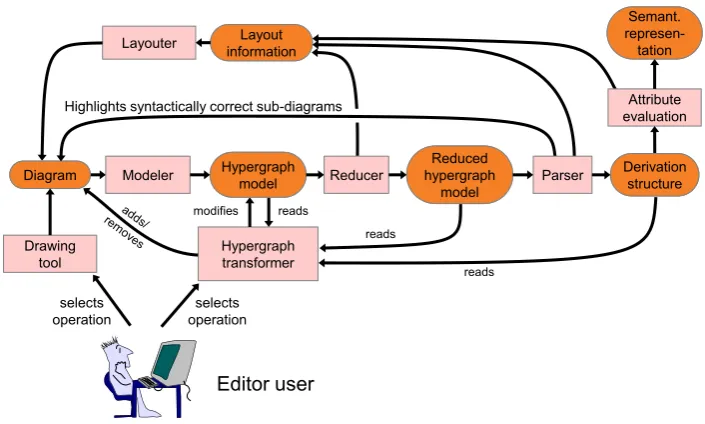
The overall system architecture of a diagram editor generated by DIAGENis shown in Fig.2. Rounded boxes depict data structures, rectangles depict processing units. The figure shows an editor without sketching support, calledregular editor in the following. Thelayouter and the
transformerare not relevant for this paper. Also, we neglectattribute evaluationas the final step of processing a diagram.
Thedrawing toolprovides the user with a GUI, it is the actual diagram editor. As mentioned before, a hyperedge is created for each component placed on the canvas by the user. We change this behavior for sketching and create a hyperedge for each component that can be recognized in the hand-drawn diagram. Therefore we have replaced the original DIAGENeditor by another editor that allows for drawing by hand. The process of recognition of components from the hand drawing is described in [BM08]. Result of the recognition is a set of components. How
these components were drawn is neither relevant nor visible to the approach shown here, but completely handled by the recognition process.
Ambiguity Resolution for Sketched Diagrams by Syntax Analysis Layout information Layout information Layouter Hypergraph transformer modifies reads reads selects operation reads
DiaGen: Editor Architecture
DiaGen: Editor Architecture
Hypergraph Hypergraph
model
Modeler hypergraphReducedReduced
model Reducer Diagram Diagram Drawing tool Editor user selects operation Semant. Semant. represen-tation Attribute evaluation Highlights syntactically correct sub-diagrams
Parser Derivation structure Derivation
structure
Figure 2: Architecture of a diagram editor generated with DIAGEN.
placement of the components. The result of the modeler is a hypergraph (thehypergraph model, or HM) containing all component edges and all respective relation edges. In case of
ambigu-ity, a component edge is created for each possible interpretation of the ambiguous component. Such component edges are independent from each other, although they were recognized from the same strokes in the hand drawing. No information is stored that these edges actually repre-sent the same component. For Petri nets, it is clear that only one of these edges can be valid at the same time, but for other diagram languages the situation may be different. The mechanisms of the subsequent reducer and parser are employed accordingly to account for such component edges.
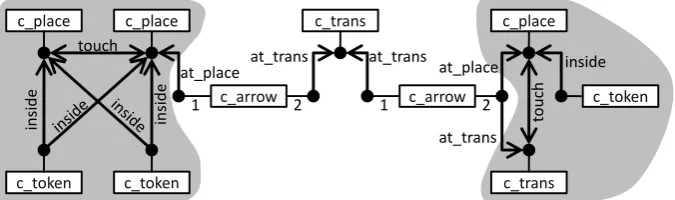
The HMfor the Petri net shown in Fig.1is depicted in Fig.3. Relation edges are shown as arrows. Astouchis a symmetric relation, each of the respective arrows has two arrow heads. The two ambiguities identified in the drawing are highlighted in gray: for each of the two circles on the left in Fig. 1, two component edges are created (c_placeand c_token). For the single component on the right, three component edges are created. The only non-ambiguous components are the two arrows and the transition in the center. Because all component edges are independent of each other, each of the threec_token-edges in Fig.3is also related to that c_place-edge which represents the same circle in the drawing (the two vertically displayed inside-relations on the left, and theinside-relation on the right).
Even thec_token-edge representing the large circle is identified to beinsidethec_place -edge representing the small circle, because their attachment areas overlap, hence an inside relationship can be found (the nameinsideis misleading in this case). Furthermore, all iden-tified places and tokens in in this example overlap and have their full shapes as attachment areas, so the distance of the respective attachment areas is always 0. The same is true for thetouch -relation between thec_placeand thec_transon the right.
c_place c_place
c_token c_token
c_trans c_place
c_trans c_arrow
1 2 1 c_arrow 2 c_token
touch
touch
in
si
d
e
ins
ide
inside at_trans at_trans
at_place
at_trans at_place
Figure 3: Hypergraph model of the Petri net shown in Fig.1. Ambiguities are highlighted.
rating depends on the complexity of the component, and on the precision of how it has been drawn. Components being more complex, or being drawn more precisely, gain a higher rating. For relationships, the rating depends on the distance of the two respective attachment areas. A smaller distance means a higher rating. Each component edge and relation edge contains the rating of the represented component or relation in an attribute. The rating will be used by the parser.
Next, thereducerapplies a set of reduction rules, i.e., graph transformation rules, to the HM. Such rules consist of an LHSand an RHS, each are hypergraphs. The result of the reducer is the
reduced hypergraph model(RHM). In the first place, the RHM is newly created and therefore
empty. Then, for each match of the LHSof a reduction rule in the HM, a respective match for the RHSof the matched rule is added to the RHM. The HMis not changed by the reducer.
The reducer serves two tasks: first, the RHMusually contains less hyperedges than the HM; as
the RHMis the input for the parser, a smaller model containing less edges improves processing time. Second, invalid configurations which may occur in the HMdue to misplaced components are not transformed, i.e., they do not occur in the RHM. Application of reduction rules can be
restricted by conditions, and by negative application conditions (NACs).
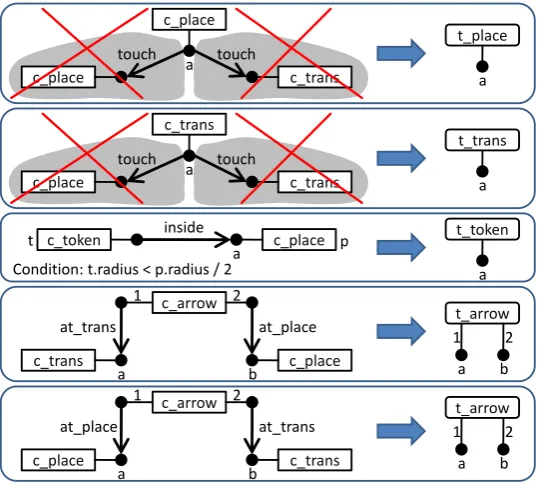
The reduction rules for Petri nets are shown in Fig.4. Corresponding nodes on the LHSand the RHSare labeled with the same letter. NACs are highlighted in gray and crossed out. The two
upper rules transform places and transitions, as long as these do not overlap with any other place or transition. The third rule transforms tokens inside places, ignoring tokens not inside places. Here, a condition is applied: a token is only reduced if its radius is smaller than half the radius of the containing place. The last two rules transform arrows between places and transitions. As arrows have two attachment areas (head and tail), the attachment areas are distinguished by numbers. Note that there are no reduction rules for arrows between two places or between two transitions, as Petri nets do not allow such arrows.
Fig.5shows the RHMcreated by the modified reducer. The original reducer for regular editors would not produce the subgraphs highlighted in gray, due to the NACs. Except for the transition in the center, no transition or place would be reduced, as each of them touches another place or transition because of ambiguous interpretation of the corresponding components. Of the three tokens, only one would be reduced (the one that actuallyisa token), the other two would not, due to the condition in the third rule.
Ambiguity Resolution for Sketched Diagrams by Syntax Analysis a c_place t_place a a c_trans c_place touch touch t_token a c_place c_token inside c_arrow t_arrow a a c_place c_trans b at_trans at_place b 1 2 c_arrow a c_trans c_place b at_place at_trans 1 2 c_trans t_trans a a c_trans c_place touch touch 1 2 t_arrow a b 1 2 t p
Condition: t.radius < p.radius / 2
Figure 4: Reduction rules for the language of Petri nets.
t_token t_arrow 1 2 t_trans t_arrow 1 2
t_place exclude t_place t_place exclude t_trans
Figure 5: Reduced hypergraph model of the hypergraph model shown in Fig.3.
case, the original reducer is too strict and discards almost all ambiguous components. We rather have to postpone ambiguity resolution to the parser, i.e., the RHMmust contain complete infor-mation, even on the ambiguous components. Therefore, the highlighted subgraphs are added to the RHMin Fig.5, together with the information about which componentsexcludeeach other. This information is based on the NACs. Note that the conditions (like the one for tokens) are not affected, and have to be met anyway.
Finally, theparseruses the hyperedges from the RHMas terminal edges and attempts to de-duce the start symbol in a bottom up fashion. The production rules for Petri nets are shown in Fig.6. Terminals from the RHMare depicted as rounded rectangles with a white background, while nonterminals have a gray background. There are two types of production rules unique in DIAGEN. The one areset productionsand the other areembedding productions.
Place
a
::= t_place
a
t_place
a t_token
Trans
a
::= t_trans
a
Transitions ::= Places ::=
Net ::= Places Transitions
Place
a
Trans
b
Place
a
Trans
b t_arrow
1 2
Trans
a
::=
Place
b
Trans
a
Place
b t_arrow
1 2
embed ::=embed
Place Trans
Figure 6: Production rules for the language of Petri nets.
use recursive productions like Places ::= Place | Places Place . However, that would require the parser to deduce any possible subset of all places, and in any possible order, which leads to a combinatorial explosion. The two set productions for Petri nets express that Transitionsis a nonterminal edge representing the non-empty set of allTransedges, and Placesis a nonterminal edge representing the non-empty set of all Placeedges. The start symbol for Petri nets isNet. The shown grammar therefore accepts a diagram as a correct Petri net if it contains at least one place and one transition (a modified grammar could also accept Petri nets without places or transitions).
Embedding productionsare the other kind of production rule unique to DIAGEN. For effi-ciency reasons, the used graph grammar is context-free. Embedding productions are used to embed (nonterminal or terminal) edges into a context which has been derived by context-free productions. An example are arrows in Petri nets. With embedding productions they can be added to a derivation tree, resulting in adirect acyclic graph (DAG) as derivation structure. In the following we will always use the termDAG, not distinguishing between a DAG and a tree. Embedding productions consist of the same graphs on the LHSand the RHS, but with one addi-tional edge on the RHS(the edge that is embedded). The two productions at the bottom of Fig.6
are the two embedding productions required for Petri nets.
The parser must use the exclusion information provided by the reducer in order to deduce only those start symbols which do not contain terminal edges excluding each other in their DAG. This is described in Sec.4, but first, it is explained how the reducer can use the NACs to collect the necessary information for the exclusion of components.
Ambiguity Resolution for Sketched Diagrams by Syntax Analysis
3
Sketching-related Modifications to the Reducer
We require the reducer to apply the reduction rules even if they are prohibited by matched NACs, and create an exclusion relationexcludefor the hyperedges in the RHM, i.e., the terminal edges for the subsequent parsing step. The simple example of Petri nets discussed in the previous section only shows terminal edges which mutually exclude each other. The general case is more sophisticated, as shown in the following. Such complicated situations occur when a NAC consists of more than only a single component hyperedge.
In the following we call hyperedges simplyedges, and edges from the RHMterminal edgesor simplyterminals. Amatchof some pattern graphPin a host graphHis an occurrence ofPinH. We regard a (sub)graph as set of edges. For a terminalt, wheretis in the occurrence of the RHS
of some reduction ruler, we denote bymodel(t)the corresponding occurrence of the LHSofr, and bynacs(t)a set of all matches for NACs that would have prohibited the creation oft. In the following, we omit all relation edges innacs(t)and keep only the component edges, as relation edges completely depend on component edges. We can then define a relationexcludebetween a set of terminalsT and a single terminalt:
T exclude t:⇔ ∃N∈nacs(t):N⊆ [ t0∈T
model(t0)
T excludestif the union of allmodel(t0),t0∈T contains all edges from a NACN in the NACs fromt,N∈nac(t). For example, letmpbe a component edge representing a place, andmt be a
component edge representing a transition, and both components overlap, i.e., they exclude each other (apart from the token, this is the case for the right of Fig.3). Then, the reducer creates two terminals,tpandtt, with
model(tp) ={mp},nacs(tp) ={N1},N1={mt} model(tt) ={mt},nacs(tt) ={N2},N2={mp}
Now the set with the single terminaltt excludestp, becausemodel(tt)contains all edges inN1,
which is a NAC innacs(tp). By analogy,{tp}excludestt. If we had included the relation edges
innacs(tp)andnacs(tt), both exclusions would not hold, as the relation edges do not occur in model(tt)andmodel(tp).
A slight modification of this example shows that the exclude relation is not symmetric in general. We change the reduction rule for places, so that a place has no NACs, i.e., it can overlap with any other component (the rule for transitions is not changed). We get
model(tp) ={mp},nacs(tp) =∅
model(tt) ={mt},nacs(tt) ={N2},N2={mp}
Here,{tt}still excludestp, but not the other way around. In the following we assume the original
reduction rule for places as shown in Fig.4.
For the general case, a NAC contains more than one component edge. LetNbe a match of a NAC. By applying several reduction rules, different terminals can be reduced from the edges in
Based on the ratings for component edges and relation edges, a rating can be computed for a terminaltby adding up all ratings from all edges inmodel(t). The next section describes how the parser exploits theexcluderelation when deducing the start symbol, and how ratings are used.
4
Sketching-related Modifications to the Parser
The central data structure for the parser is the derivation DAG. Each DAG has a uniqueroot: it is the node which has no incoming edges. Leavesof a DAG have no outgoing edges. All leaves represent terminals, all other nodes represent nonterminals. Unless embedding productions are used, each node has a unique parent, except for the root. Each parent node is the LHS match of a production rule, and its children are the respective match for the RHSof that rule. Nodes representing embedded edges can have more than one parent; all parents of such a node represent the context of the respective embedded edge.
The general idea for the parser is to avoid deduction of nonterminals from a set of terminalsT
where some terminal inT is excluded by other terminals inT. For this purpose we will define a symmetric relationconflict; if two nonterminalsconflictwith each other, they must not occur in the same derivation DAG.
Letnt be a nonterminal. Byterm(nt) we denote the set of all terminals used to deduce nt, i.e., the set of all leaves in the DAG withnt as root1. DIAGEN applies a production rule (pro-duction, for short) if three conditions hold: (i) a matchMfor the RHSmust be found, (ii) for all nonterminalsnt inMallterm(nt) must be pairwise disjoint, and (iii) the condition defined for the production must hold. We leave (i)-(iii) unchanged, but add a fourth condition which regards theexcluderelation created by the reducer. We will see in the following that this fourth condition depends on the type of the production. AChomsky Normal Form can be computed for each hypergraph grammar (apart from the set productions and the embedding productions). Consequently, four different types of production rules have to be distinguished:
• terminal productionswith exactly one terminal on the RHS.
• nonterminal productionswith exactly two nonterminals on the RHS.
• embedding productionswith nonterminals on both sides.
• set productionswith an arbitrary number of nonterminals on the RHS.
Terminal productions may always be applied, no conflicts may arise here. For nonterminal productionswe first consider a setT of terminals. We callT conflictingif there exists a subset
E⊂T and a single terminalt∈T\E whereE excludest. Then, two nonterminalsnt1andnt2
may be used on the RHSof a production rule if the union of their terminals,term(nt1)∪term(nt2),
is not conflicting. This also implies that bothterm(nt1) andterm(nt2)are not conflicting. We
define the symmetric relationconflictbetween two nonterminals.(nt1,nt2)∈conflictif and only ifterm(nt1)∪term(nt2)is conflicting. Then,nt1andnt2can be used on the RHSof a nonterminal
production if they are notconflicting, i.e.,(nt1,nt2)∈/conflict.
Ambiguity Resolution for Sketched Diagrams by Syntax Analysis
Embedding productionsare treated differently than the other types of productions. First, the DIAGENparser identifies each match for the context of each embedding production. This is only possible if no edges of a match conflict with each other. Then, for each derivation DAG with the start symbol as root, each of the previously identified matches is checked whether all of its edges are contained in the DAG, i.e., are (direct or indirect) children of the root. Finally, for all such matches, the additional edge of the RHSof the production is embedded, i.e. added to the DAG. The edges of a match can only be contained in the DAG if none of these edges conflicts with any other edge from the DAG. Therefore, the only condition that must be checked before an edge may be embedded is whether it conflicts with the root of the DAG. If there is no conflict, there can also be no conflict with any other edge in the DAG.
The fourth type of production rule are the set productions. Basically, set productions can be seen as nonterminal productions with not exactly two, but one or more edges in the match of its RHS. However, the production may be applied even if nonterminals in this match are conflicting. In this case, the problem is to decide which of the conflicting edges should be omitted, because this decision may have consequences on subsequent applications of production rules and contexts for embedding productions. The former happens if the nonterminal that has not been omitted conflicts with another nonterminal in a subsequent production rule. The latter happens if the omitted nonterminal was part of a match for a context of an embedding production. Consequently, we must defer the decision, as we cannot make it when applying a set production. We temporarily ignore all conflicts, and do not omit any of the nonterminals on the RHSmatch. When the start symbol is reached, there can be no further productions, and we can finally decide which nonterminals to omit.
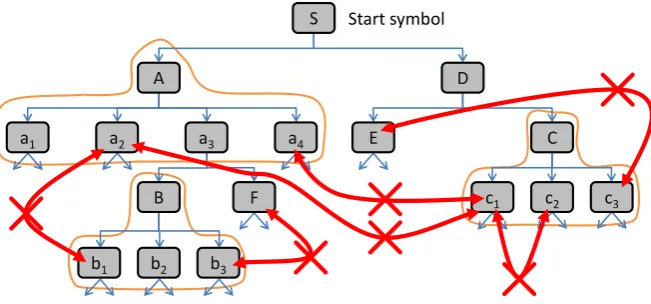
The nonterminal matching the LHSof a set production may be used in the match of a RHSof another set production itself, either directly, or as a node contained in the DAG of a nonterminal in this match. This can lead to a complex structure. An example is depicted in Fig. 7, where the top part of a derivation DAG can be seen. As before, nonterminals are depicted as rounded rectangles with a gray background. The thin arrows indicate parent-child relationship. The subtrees of nonterminals with two outgoing arrows not ending in other nonterminals are of no interest in this example. Embedding productions are not shown.A,BandCare nodes in the DAG indicating applications of set productions. The fat arrows, marked with crosses, depict conflicts between nonterminals.
When applying the nonterminal production a3→BF we can immediately discard b3, as it
conflicts withF. The production cannot be applied otherwise. The same is true for production
D→EC andc3. The following cases are more difficult. When applying set production A→
a1a2a3a4, we cannot decide fora2or forb1, as we do not know about possible later consequences.
There is a conflict betweena2andc1. The problem is that we do not know yet thatAandCwill be used in the same DAG. Finally, when applyingS→AD, we can decide fora2orb1, fora2or
c1, forc1orc2, and fora4orc1, as we know that there will be no further productions.
a1 a2 a3 a4 A
Start symbol
S
B
b1 b2 b3 F
D
E C
c1 c2 c3
Figure 7: Top part of an exemplary derivation DAG with three set productions and rootS. Con-flicts between nonterminals are depicted by fat red arrows marked with crosses.
better the result is, i.e., the higher the final rating for the start symbol (which is decreased by every nonterminal omitted), the better the ambiguity resolution is, because a higher rating means more components, more complex components and more drawing precision.
The basic idea for the heuristic is to prefer nonterminals (i) with a high rating, (ii) with few conflicts, (iii) whose conflicting nodes have low ratings, and (iv) which are part of many matches of contexts for embedding productions. A ratio is calculated for each nonterminalnt. Let embed(nt) be the set of all embedded edges where nt is one edge of the match of their context; the ratioris calculated as
r(nt) =rating(nt) +∑{rating(e)|e∈embed(nt)}
∑{rating(c)|(nt,c)∈conflict}
The heuristic then works as follows: as long as there are conflicts, the nonterminal with the lowest ratio is omitted, and the ratios of its conflicting nonterminals are increased accordingly. If the start symbol cannot be deduced any more, because the last nonterminal of a set production is omitted, backtracking is applied and the next nonterminal is tried. We found that this very simple approach works well in practical cases, producing meaningful results quickly.
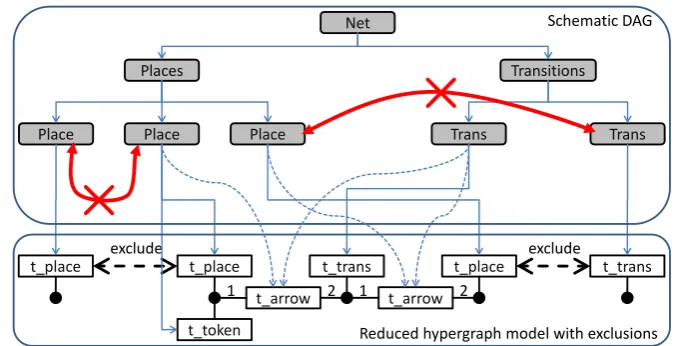
Therewith it is explained how the symmetric conflict relation must be exploited to generate derivation DAGs which are correct, i.e., which do not use terminals that must not occur in the same DAG due to theexcluderelation introduced in the previous section. The ambiguities shown in the introductory example in Fig.1 now can be solved in the desired manner. The RHMand a schematic representation of its DAG is shown in Fig. 8. The thin dashed arrows depict the matches for the contexts for the two arrows. Note that, due to the CNF, the one nonterminal Placecannot be the parent of the two terminalst_placeandt_token. However, for the sake of clarity, we do not show the correct representation, which requires artificially generated nonterminal symbols.
Ambiguity Resolution for Sketched Diagrams by Syntax Analysis
Net
Transitions Places
Place Place Place
t_token
t_arrow
1 2
t_trans
t_arrow
1 2
t_place exclude t_place t_place exclude t_trans
Trans Trans
Reduced hypergraph model with exclusions Schematic DAG
Figure 8: Reduced hypergraph model as shown in Fig.5, and a schematic representation of the corresponding derivation DAG.
there may be a number of correct derivation DAGs. We then choose the one with the highest rated start symbol.
5
Related Work
Using context allows the machine to automatically decide for an interpretation in case of am-biguity. The alternative is to have the user explicitly make a choice. This is called media-tion[MHA00]. Various strategies are conceivable, e.g., providing the user with a list of possible interpretations and let him decide, or requiring the user to redraw an ambiguous symbol. Espe-cially the latter is limited in applicability. In our case, places and tokens in Petri nets are both drawn as a circle (cf. Fig.1). Redrawing this circle obviously cannot resolve this ambiguity. Providing a list would help here, but is very uncomfortable for the user.
Some approaches decide for a possible interpretation without explicit user interaction, but neglect context information for this decision. For example, LADDERcompares only the am-biguous components, not regarding context, and uses simple rules to prune alternatives, at the risk of preserving a wrong interpretation [HD05].
An approach by [AD06], limited to the domain of mechanical drawings, merges automatic decisions and user interaction. The system collects evidence from the drawing, based on rules. Additionally, each component is scored. Based on the evidence and the score, alternatives are pruned by a greedy algorithm. The algorithm is not able to undo its decisions, thus the result may not be optimal. In case of a wrong decision, the user can indicate that another possible interpretation is to be taken.
use) in order to avoid processing of unlikely interpretations. The used grammar is not based on hypergraphs, but extends positional grammars, which themselves extend traditional string grammars by more general relations than concatenation. For the actual parse process, only little detail is published. The concept of NACs is not employed. Result of the parser is a forest of ranked derivation trees, each representing a valid interpretation of the drawing. The user can then choose the desired representation.
Both recognition and ambiguity resolution works different for (handwritten) text, which we do not want to cover with our approach. Various methods are reported for this issue. For example, characters can be disambiguated by use of vocabularies, words can be disambiguated by statisti-cal methods like Hidden Markow Models, language models, or specialized statististatisti-cal grammars like PCFG (probabilistic context-free grammar) [PS00,ZCB06,HLB00].
6
Conclusion and Future Work
In this paper we explained an approach to ambiguity resolution in sketched diagrams using a hypergraph-grammar-based approach. Omission of components due to NACs is deferred as long as possible, until the parser needs a decision to go on. Using Petri nets as example we moti-vated the basic ideas. Applicability is restricted because of an NP-complete problem. We have implemented the presented approach as an extension of DIAGEN. Practical results suggest that the heuristic we apply works well, and quickly computes a result. We will inspect this restric-tion further, both from a theoretical and practical point of view. Graph grammars without set productions do not suffer from this issue.
The shown approach is incremental, i.e., modifications to the diagram do not require analysis from scratch. When components are added to the diagram, respective components edges are created, and all possible relationships of these components edges are checked. The reducer then only regards the newly created edges, and so does the parser, which modifies existing derivation DAGs. When diagram components are removed, the situation is similar.
Although we use the approach for ambiguity resolution in the context of sketching, regular graph parsers may benefit from the shown approach as well, as feedback in case of misplaced components (leading to a syntactically incorrect diagram) may be improved. The very strict behavior of the DIAGEN reducer, as shown in Sec. 2, suggests that feedback is very coarse and does not aid very much in finding misplaced components. What happens is that maximum sized subdiagrams with correct syntax are highlighted. Using our approach, the size of these subdiagrams may be increased.
Metamodel-based approaches have gained popularity in recent years. As future work, we would like to find out how DIAMETA, as a metamodel-based approach and an extension of
DIAGEN, can benefit from the shown results as well, and how and to what extent they can be applied. Then we can compare the graph-based and the metamodel-based approaches.
Bibliography
Ambiguity Resolution for Sketched Diagrams by Syntax Analysis
ACM, New York, NY, USA, 2006.
[BM08] F. Brieler, M. Minas. Recognition and Processing of Hand Drawn Diagrams Using Syntactic and Semantic Analysis. InProc. AVI ’08. ACM, 2008.
[CDPR04] G. Costagliola, V. Deufemia, G. Polese, M. Risi. A Parsing Technique for Sketch Recognition Systems. In Proc. VL/HCC ’04. Pp. 19–26. IEEE Computer Society, Washington, DC, USA, 2004.
[CDR06] G. Costagliola, V. Deufemia, M. Risi. A Multi-layer Parsing Strategy for On-line Recognition of Hand-drawn Diagrams. In Proc. VL/HCC ’06. Pp. 103–110. IEEE Computer Society, Washington, DC, USA, 2006.
[FNTZ00] T. Fischer, J. Niere, L. Turunski, A. Z¨undorf. Story Diagrams: A New Graph Gram-mar Language Based on the Unified Modelling Language and Java. In Ehrig et al. (eds.), Theory and Application of Graph Transformation (TAGT’98), Selected Pa-pers. Volume 1764, pp. 296–309. Springer, 2000.
[HD05] T. Hammond, R. Davis. LADDER, a sketching language for user interface develop-ers.Computers & Graphics29(4):518–532, 2005.
[HLB00] J. Hu, S. G. Lim, M. K. Brown. Writer independent on-line handwriting recognition using an HMM approach.Pattern Recognition33(1):133–147, 2000.
[Kar72] R. Karp. Reducibility among Combinatorial Problems. In Miller and Thatcher (eds.),
Complexity of Computer Computations. Plenum Press, New York, 1972.
[LV02] J. de Lara, H. Vangheluwe. AToM3: A Tool for Multi-formalism and Meta-modelling. InProc. FASE ’02. Pp. 174–188. Springer-Verlag, London, UK, 2002. [MHA00] J. Mankoff, S. E. Hudson, G. D. Abowd. Interaction techniques for ambiguity
res-olution in recognition-based interfaces. InProc. UIST ’00. Pp. 11–20. ACM Press, New York, NY, USA, 2000.
[Min02] M. Minas. Concepts and realization of a diagram editor generator based on hyper-graph transformation.Journal of Science of Computer Programming44(2):157–180, 2002.
[Min06] M. Minas. Generating Meta-Model-Based Freehand Editors. InElectronic Commu-nications of the EASST, Proc. GraBaTs ’06. September 2006.
[PS00] R. Plamondon, S. N. Srihari. Online and off-line handwriting recognition: a com-prehensive survey.IEEE Transactions on Pattern Analysis and Machine Intelligence
22(1):63–84, 2000.