Proceedings of the
Sixth International Workshop on
Graph Transformation and Visual Modeling Techniques
(GT-VMT 2007)
Simulating Multigraph Transformations Using Simple Graphs
Iovka Boneva, Frank Hermann, Harmen Kastenberg, and Arend Rensink
14 pages
Guest Editors: Karsten Ehrig, Holger Giese
Managing Editors: Tiziana Margaria, Julia Padberg, Gabriele Taentzer
Simulating Multigraph Transformations Using Simple Graphs
Iovka Boneva1, Frank Hermann2, Harmen Kastenberg1, and Arend Rensink1
1bonevai, h.kastenberg, rensink [at] cs.utwente.nl
Department of Computer Science, University of Twente P.O. Box 217, NL-7500 AE Enschede, The Netherlands
2frank [at] cs.tu-berlin.de
Department of Electrical Engineering and Computer Science Technical University of Berlin, D-10587 Berlin, Germany
Abstract: Application of graph transformations for software verification and model transformation is an emergent field of research. In particular, graph transformation approaches provide a natural way of modelling object oriented systems and seman-tics of object-oriented languages.
There exist a number of tools for graph transformations that are often specialised in a particular kind of graphs and/or graph transformation approaches, depending on the desired application domain. The main drawback of this diversity is the lack of interoperability.
In this paper we show how (typed) multigraph production systems can be translated into (typed) simple-graph production systems. The presented construction enables the use of multigraphs with DPO transformation approach in tools that only support simple graphs with SPO transformation approach, e.g. the GROOVE tool.
Keywords: graph transformations, graph transformation tools, tool interoperability, multigraphs, simple graphs
1
Introduction
Application of graph transformations for software verification and model transformation is an emergent field of research. In particular, graph transformation approaches provide a natural way of modelling object oriented systems and semantics of object-oriented languages [KKR06] or graphical modelling languages such as the UML [OMG05], see for instance [Hau06].
For performing the actual graph transformations, different approaches are around ranging from hyperedge replacement approach (see e.g. [DKH97]), logic based approach (see e.g. [Cou97]) to different algebraic approaches such as Single Pushout (SPO) [EHK+97] and Double Pushout (DPO) [CMR+97] approach. These different approaches all have specific application areas in which their features are used in an optimal fashion.
For most tools performing graph transformations, the graph representation formalism and the transformation approach are determined by the targeted application domain. For instance, the GROOVE tool [Ren04a] is designed for modelling dynamic systems and verifying properties about their behaviour by generating all possible system configurations. GROOVE uses sim-ple graphs and performs SPO based graph transformations. Another example is the AGG tool [TER99] which handles multigraphs withSPOand is used e.g. for independence and termination analysis on graph grammars.
The main drawback of this diversity in tools is their poor interoperability. One attempt to bridge this gap is the introduction of a common language used for exchanging models among tools, called the Graph eXchange Language (orGXLfor short) [SSHW]. In order to extend this work for also exchanging the transformation specifications, GTXL [Tae01] has been proposed. However, since every implementation of a specific approach is not aware of details of other approaches, it is very difficult to include all the features in one common standard and thereby enable tools to perform semantically equivalent transformations.
In a previous work [HKM06] we have proposed translations of graph production systems between GROOVE and AGG, but these translations were too specific and are not applicable in a more general context. Moreover, these translations were not invertible.
In the current paper, we generalise these translations to a context that is tool independent. We show how one can encode typed multigraph production systems into simple-graph production systems, and simulateDPOtransformations of multigraphs with SPO transformations on simple graphs. Then we shortly discuss howDPOtransformations for multigraphs can be handled by a tool supporting onlySPO on simple graphs. These results should allow, for instance, to use the GROOVE tool (or any other tool using simple graphs) with multigraphs. As a further extension, we believe that it would be possible to apply the theory of Subobject Transformation Systems [CHS06] in GROOVE.
Running Example. Throughout this paper we will clarify our ideas and results using a simple example. In the example we model the dynamic behaviour of Lists and Objects that can be elements of some specificLists. OneObjectmay occur in aListseveral times. We assume that
Objects can be created instantly by the environment (which we do not model in this example). OnceObjects are around, different actions can be performed onLists andObjects, like adding
Objects toLists and moving, removing or copying Objects.
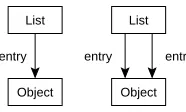
Fig. 1 depicts a possible configuration with two Lists: one containing a single Object and another having two entries referring to the sameObject. In each configuration we assume that allList- andObject-instances have their own identity, although we do not show these identities.
entry entry
Object Object entry
List List
Organisation of the Paper. The remaining of the paper is structured as follows. In Section2
we provide a formal basis for the rest of the paper. In Section3we define our translation of multi-graphs to simple multi-graphs and prove the equivalence ofDPOtransformations on multigraphs on the one hand, and SPO transformations on (special) simple graphs on the other hand. In Section4
we describe how this equivalence can be extended to typed/labelled graphs. Then, in Section5
we describe howDPOtransformations on multigraphs can be handled by tools implementing the SPO transformation approach, such as the GROOVE tool. Finally, in Section6concludes and gives some hints on the way we would like to use the results of this work for improving state space exploration in GROOVE.
2
Background
2.1 Graphs and Graph Morphisms
Graphs are a very powerful means of modelling systems and their behaviour. As will become clear in this paper, in some cases it is very important which notion of graphs is used, since the theory applied may depend on this choice quite heavily.
The graph concept is differently interpreted by people working in different domains or even in the same domain. Graphs can e.g. be deterministic, directed or labelled. In this paper we will explicitly distinguish between what we call multigraphs and simple graphs.
Definition 1 (multigraph, multigraph morphism) A multigraph is a tuple G=hVG,EG,srcG,tgtGi
where:
• VGis a set of nodes (or vertexes);
• EGis a set of edges;
• srcG,tgtG: EG→VGare source and target functions.
A multigraph morphism f : G→H is a pairhfV,fEi, where fV: VG→VH and fE: EG→EH
are functions compatible withsrcandtgtfunctions, i.e.
• fV◦srcG=srcH◦fE;
• fV◦tgtG=tgtH◦fE.
Definition 2 (simple graph, simple graph morphism) LetLabbe a finite set of labels. A simple
graph labelled overLabis a tuple G=hVG,EGiwhere
• VGis a set of nodes (or vertexes);
• EG⊆VG×Lab×VGis a set of edges.
The source and target functionssrcG,tgtG: EG→VGare defined for any edge e= (v,l,v
′)∈E
G bysrcG(e) =v andtgtG(e) =v′.
A simple graph morphism f : G→H is a pairhfV,fEi, where fV: VG→VHand fE: EG→EH
are functions compatible withsrcandtgtfunctions and with labelling, i.e. for any edge(v,l,v
′)∈ EG, fE((v,l,v
′)) = (f
V(v),l,fV(v
In the sequel we will call a graph morphism f : G→H total if its components fV and fE are total functions, and partial if its components are total functions from G′ to H, where G′ is some subgraph of G. An injective morphism is a morphism induced by injective functions. We will denote the set of multigraphs asM G and the set of simple graphs overLabasS G(Lab).
Hereafter, we will use the term graph to designate either a multigraph or a simple graph. In our formal definitions we use unlabelled multigraphs and labelled simple graphs. We start with unlabelled multigraphs in order to keep proofs simple. However, all results of the paper can be extended to labelled graphs, as it will be discussed in Section4. Therefore, our examples will already freely use labels on both nodes and edges.
2.2 Graph Transformations
When modelling system states as graphs, the dynamics of the system can be specified by graph transformations. The changes of states are then described by graph productions, also called
graph transformation rules.
Definition 3 (graph production) A graph production p consists of two graphs L and R, being its left-hand-side and right-hand-side, respectively, together with a partial graph morphism from
L to R, called the rule morphism.
We often denote a graph production p as p : L→R, also using p when referring to the rule
morphism. When combining a graph G with a setP of graph productions, we get a graph pro-duction system GPS=hG,Pi. In a graph production system, G is called the start graph. By
applying graph productions to G we can derive other graphs. The applications of graph
produc-tions are defined on categories in which the objects are multigraphs or simple graphs and the arrows are the corresponding graph morphisms. For an introduction to category theory, see e.g. [BW95]. Whether a rule is applicable and to what resulting graph a derivation leads depends on the particular graph transformation approach being applied. In this paper we distinguish between the Single Pushout (SPO) [EHK+97] and the Double Pushout (DPO) [CMR+97] approach. For applying a production in theSPOapproach, we only need an occurrence of the left-hand-side of the graph production. When the application of a graph production would delete a node but not all of its adjacent edges, those dangling edges will also be removed. Furthermore, if the application prescribes one node (or edge) to be both deleted and preserved, this conflict is solved in favour of deletion. These conflicts are resolved in theDPOapproach by forbidding such applications of productions, i.e. theDPOapproach requires additional conditions on the applications which are called the dangling edge condition and the identification condition (together referred to as the
gluing condition).
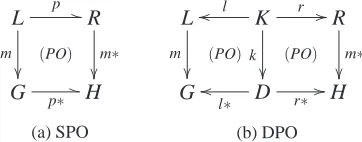
In theDPOapproach, a graph production p : L→R is depicted as a span L←l K→r R of total
graph morphisms, such that K =L∩R, l : dom(p)→L, and r : dom(p)→R. To be
determin-istic, it is necessary that either rule morphisms or matchings are injective. We will now define applications of graph productions and the corresponding derivations for bothSPOandDPO.
Definition 4 (derivation) Given a graph production p : L→R and a graph G, a total graph
the production p via matching m, denoted G=p,m
=⇒H, is constructed:
(SPO) as the pushout of p and m in the category of graphs and partial graph morphisms (see Fig.2(a));
(DPO) by taking, in the category of graphs and total graph morphisms, first the pushout comple-ment D (with k : K→D and l∗: D→G) of l and m, if it exists (ensured by the gluing condition),
and then the pushout of r and k (see Fig.2(b)).
L p /
m
(PO)
R
m∗
G p∗ /H
(a) SPO
L
m
(PO)
K
l
o
o r //
k
(PO)
R m∗ G D l∗ o o
r∗ //H
(b) DPO
Figure 2: Graph H as the result of anSPOand aDPOderivation.
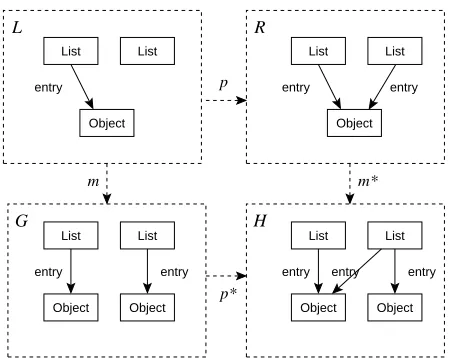
Intuitively, applying a graph production p to a graph G can be seen as a sequence of two actions: find an occurrence (matching) of L in G and then replace that occurrence by R. This then results in the graph H. An example direct derivation is shown in Fig.4.
An important difference between SPOand DPOis the fact thatDPOdoes not work on simple graphs with arbitrary matchings, because in some cases the required pushout construction is not unique or does not exist. In this paper we do applyDPOon simple graphs, but then ensure that we restrict to a special class of matchings and/or morphisms. This issue will be discussed in Section3.
2.3 Back to the Example
Now that we have introduced the notion of graphs and the graph transformation technique, we can recall the example and give a formal description of the actions. In Fig.3we specify some of the actions from the example as graph transformation rules by showing their left-hand-side and right-hand-side graph. The rule morphisms in Fig.3are defined by the placing of the elements.
entry List List R Object p L Object (a)add p L Object List entry List R Object entry List entry List (b)copy
Figure 3: Graph transformation rules for some of the actions in the example.
List
entry List
entry List
entry List
entry List
entry List Object
List
entry entry
m
p*
m* p
G H
R L
entry
Object Object Object Object
Object List
Figure 4: An example direct derivation.
3
From Multigraphs to Simple Graphs and back again
In this section we describe our translation between multigraphs and simple graphs. At a categor-ical level we will show that these translations are functors which are isomorphisms, moreover being each others inverse.
3.1 From Multigraphs to Simple Graphs
Consider the set of labels LMG={s,t}. The function Sim maps multigraphs fromM G into
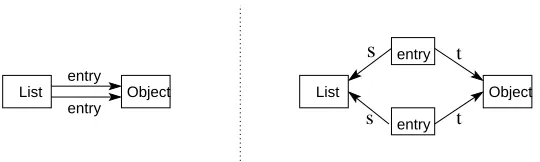
simple graphs in S G(LMG) as follows: every edge e in the multigraph with source node vs
and target node vt becomes a special node (this we call a proxy node) with two outgoing edges
(e,s,vs)and (e,t,vt). Thus, we will use e as a variable ranging over edges of multigraphs and
proxy nodes in simple graphs. Fig.5shows an example applying the Sim function.
Formally, let G =hVG,EG,srcG,tgtGi be a multigraph. Then Sim(G) is the graph H = hVH,EHiwith
• VH=VG∪EG, that is, edges of G are nodes in H;
• EH=Se∈EG{(e,s,srcG(e)),(e,t,tgtG(e))}.
The Sim function can be extended on graph morphisms. That is, if G and H are multigraphs and m : G→H is a morphism, then Sim(m): Sim(G)→Sim(H)is the morphism defined by1:
• for all v in VSim(G)(i.e. v∈VG∪EG),(Sim(m))(v) =m(v);
• for all(e,l,v)in ESim(G),(Sim(m))((e,l,v)) = (m(e),l,m(v)).
Note that the definition of Sim(m)on edges of Sim(G)ensures that Sim(m)is indeed a simple graph morphism.
t
s s
t
Figure 5: Encoding of a multigraph (on the left) into simple graphs with proxy nodes (on the right) by the Sim function.
3.2 From Simple Graphs to Multigraphs
LetS GM G be the set of bipartite simple graphs over LMGsatisfying the following conditions: G= (V,E)∈S GM G if
1. V =Vn∪Vewhere Vnand Ve are two disjoint sets;
2. E=Es∪Etwhere Esand Etare disjoint sets and Es⊆Ve× {s}×Vn, and Et⊆Ve× {t}×Vn;
3. any node e in Vehas exactly two adjacent edges(e,s,v
′
n)∈Esand(e,t,v
′′
n)for some v′n,v
′′
n∈
Vn.
We now define the function Sim−1:S GM G→M G as follows: if G=hVn∪Ve,EGi where Vn and Ve are as in the description of S GM G stated above, then H =Sim−1(G) is the graph
hV,E,src,tgtisuch that V =Vn, E=Ve, and for any e∈E,src(e) =vs andtgt(e) =vt, where
vs,vt∈Vnare the nodes such that(e,s,vs),(e,t,vt)∈EG. We know by condition3of the definition
of the set of graphsS GM G that the nodes vsand vtexist and are unique.
The Sim−1function can also be extended on graph morphisms. If m : G→H is a simple graph
morphism, then Sim−1(m): Sim−1(G)→Sim−1(H)is the multigraph morphism such that for any x in VG,(Sim−1(m))(x) =m(x). We now show that Sim−1(m)defined this way is indeed a multigraph morphism.
Let G′=Sim−1(G), H′=Sim−1(H)and m′=Sim−1(m). Then for any edge e∈EG′,(m′◦
srcG′)(e) =m(vs)where vsis the unique node in G such that(e,s,vs)is an edge of G. As m is
a simple graph morphism,(m(e),s,m(vs))is an edge in H. On the other hand,(srcH′◦m
′)(e) = srcH′(m(e))is the unique node vs′ in H such that(m(e),s,v
′
s)is a edge in H. We deduce then that
both(m(e),s,v
′
s)and(m(e),s,m(vs))are edges in H. By uniqueness of v
′
s, necessarily v′s=m(vs),
so m′◦srcG′ =srcH′◦m′. We can see in a similar way that m′◦tgtG′ =tgtH′◦m′.
It is not very hard to see that S GM G is exactly the set of simple graphs that are images of
multigraphs by the Sim function, and that the function Sim−1is the inverse of the function Sim. This will be formally stated in the following section.
3.3 Categories for Multigraphs and Simple Graphs
SGMG(LMG) to MG respectively. This will guarantee that performingDPO transformations on multigraphs can be simulated byDPOtransformations on simple graphs that belong toS GM G,
as stated in Theorem1. The reader who is not familiar with category theory will probably only be interested in the result of this theorem.
Definition 5 (categories MG, SG(L), and SGMG(LMG)) MG is the category whose objects are
elements ofM G and whose arrows are multigraph morphisms. SG(L) is the category whose
objects are simple graphs over the set of labels L and whose arrows are simple graph morphisms. Finally, SGMG(LMG)is the category whose objects are elements ofS GM G and whose arrows
are simple graph morphisms.
Note that SGMG(LMG) can be equivalently defined as the full subcategory of SG(LMG)
in-duced byS GM G.
Recall that a functor f =hfo,fmifrom a category C to a category D is a function with fo(resp.
fm) associating objects (resp. morphisms) of D with objects (resp. morphisms) of C and such
that f preserves morphisms, identities and composition. The following lemma easily follows from the definitions.
Lemma 1 It holds that
1. Sim is a functor from MG to SGMG(LMG)and
2. Sim−1is a functor from SGMG(LMG)to MG;
3. the functors Sim and Sim−1are isomorphisms:
Sim◦Sim−1=IDSGMG(LMG) and Sim
−1◦Sim=ID MG.
Graph morphisms are called edge reflecting if edges are reflected along their boundary, i.e. whenever there is an edge between two nodes in the image of the morphism, there should be an edge between the pre-images of these nodes in the domain of the morphism (see next lemma).
Lemma 2 All morphisms f : G→H in SGMG(LMG)are edge reflecting, i.e.
if (f(x),l,f(y))∈EH then (x,l,y)∈EG.
Proof. It is enough to show that Sim translates to edge reflecting morphisms, because the
cat-egories are isomorphic. By definition, Sim translates edges to special nodes with two outgoing edges to other nodes. Nodes in MG are connected via structured edges in SGMG(LMG), thus
edges connect an original node with a proxy node. Let f be a graph morphism in MG. If Sim(f) reaches a proxy node, f has to map to the original edge. Therefore, also the adjacent edges are reached by Sim(f)and thus, Sim(f)is edge reflecting.
3.4 Multigraph versus Simple Graph transformations
aim of this paper is to translate MG+DPOinto SG(LMG)+SPO. This is achieved in two steps:
MG+DPO → SGMG(LMG)+DPO → SG(LMG)+SPO
The first step consists in encoding multigraphs and production rules using the Sim function, thus obtaining simple graphs inS GM G and simple graph morphisms. The second step consists in
encoding the DPO rules into SPO rules. In [HHT96] (Proposition 3.5) it has been shown that it is possible to translate the application conditions of a DPO derivation (i.e. dangling edge and identification condition) in MG to equivalent negative application conditions (NACs) for performingSPO derivations in MG. In Theorem1we show that the initialDPOtransformations in MG can be simulated by the translatedSPOtransformation in SG(LMG).
Remark 1 (Uniqueness of derivations) To be deterministic for given graph production and matching,DPOderivations need the uniqueness of pushout complements. In adhesive categories this is the case if the rule morphisms are, or the match is, monomorphic (see Lemma 15 in [LS04]), meaning injective in the category Graph. In our setting, the category MG is adhesive and therefore also SGMG(LMG) is, because it is isomorphic. The monomorphisms in the
lat-ter one are also equalisers by their property of being edge reflecting and thus, they are regular monomorphisms.
Given a DPO rule p=L←l K →r R, we use Sim(p) to denote Sim(L)Sim←(l)Sim(K)Sim→(r)
Sim(R), and we denote by Sim∗(p) the translated rule equipped with additional NACs, as de-scribed in [HHT96]. For the following lemma we interpret graphs of SGMG(LMG)as graphs in MG by forgetting all labels. This allows us to show that pushouts are not only translated to those in a different category, but also remain pushouts in the original category of multigraphs, after applying Sim. An extension of MG with labels is direct and only adds information, which does not interfere with the pushout construction.
Lemma 3
A //
(PO)
B
C //D
in MG implies
Sim(A) //
(PO)
Sim(B)
Sim(C) //Sim(D)
in MG up to label information.
Proof. (sketch) Pushouts in MG are constructed component-wise for the sets of edges and nodes
by building the disjoint union and factorising along the equivalence generated by the span of morphisms. The definition of Sim is compatible with the standard pushout construction, i.e. Sim(D) =Sim(B+AC)∼=Sim(B) +Sim(A)Sim(C).
Theorem 1 (simulation) Given a rule p=L←l K→r R and a match m : L→G in MG, where l is injective, the following three are equivalent:
1. G=p,m
=⇒DPOG′in MG;
2. Sim(G) =========Sim(p),Sim(m⇒) DPOSim(G
3. Sim(G) ==========Sim∗(p),Sim(m⇒) SPOSim(G
′)in SG(L
MG).
Furthermore, if a rule in 2 or 3 is applicable, then the result is always a graph in SG(LMG).
Proof. 1⇔2 Sim and Sim−1are isomorphisms by Lemma1and hence, they preserve all Limits and Colimits. Since l is injective theDPO-derivations are unique up to isomorphism.
2⇒3 The derivation in 2 can be considered as a derivation in MG up to labels, according to Lemma3. Then using [HHT96], it is equivalent to an SPO derivation withNACs in MG with result Sim(G′), that is, Sim(G′)is the pushout of p and m in MG. But, as Sim(G′)is a simple graph, it is also the pushout of p and m in SG(LMG), up to labels. Because of the strict relation between the labels in graphs inS GM G and their structure, it is not difficult
to see that Sim(G′)is also the pushout of p and m in SG(LMG)without ignoring the labels.
3⇒2 Let H′ be the result of the derivation (a) Sim(G) ==========Sim∗(p),Sim(m⇒) SPO H
′ in MG. By
[HHT96] we know that then(b)Sim(G) =========Sim(p),Sim(m⇒) DPOH′is a derivation in MG. Since Sim(p), Sim(m)are morphisms in SGMG(LMG), by Lemma2we know that they are edge
reflecting, and this allows to deduce that the graph H′is a simple graph, that is, an object of SG(LMG). Now, as SG(LMG)is a full subcategory of MG and by(a), we have that H′is the pushout of Sim∗(p)and Sim(m)in SG(LMG). By uniqueness of this pushout and the derivation in point3we deduce that H′=H, thus(b)is a derivation in SG(LMG). Finally, one can see that H′and the context graph in(b)are also objects of SGMG(LMG)because the translated rule will only produce and delete complete structured edges by definition of Sim. Hence, no garbage (i.e. proxy nodes with either an outgoings-edge or at-edge, but not both) will occur. Thus,(b)is also a derivation in SGMG(LMG).
Result H∼=Sim(G′)is a direct consequence of the last part of the proof for the previous item.
4
Extensions
Theorem1immediately extends to rules with negative application conditions, because they con-tain just additional graphs and morphisms of the same kind. Thus, we will not describe this aspect in more detail.
We are also confident that the results from this paper can be extended in a straightforward manner to hypergraphs [K ¨on02], which differ from multigraphs in not having source and target functions, but rather a single function ends: EG→VG∗ that associates with every edge a string of nodes. Hypergraphs can be translated to simple graphs using precisely the same technique of encoding edges as proxy nodes, with in this case as many auxiliary edges (to nodes) as there are elements inends(e).
entry t
s entry t
s
List Object
entry
entry
List Object
Figure 6: Encoding of a labelled multigraph.
A typed graphhG,miis a graph G together with a morphism m : G→TG to some graph TG
called the type graph. A typed graph morphism f :hG,mi → hG
′
,m
′iis a morphism for which m=m′◦f . Transformations of typed graphs should involve only typed graph morphisms. It is
equivalent to consider transformations in a slice category. That is, typed transformations in C w.r.t. the type graph TG are equivalent to transformations in the slice category C↓TG, where C
is either MG or SGMG(LMG)and TG is a multigraph or simple graph, respectively. Now, as MG
and SGMG(LMG) are isomorphic with Sim as isomorphism functor, it is trivial to see that the slice categories are also isomorphic. Thus, there is a pushout in MG↓TG if, and only if, there is
a pushout in SGMG(LMG)↓Sim(TG). Then the simulation result stated in Theorem1also holds for a typed transformation.
However, in this case, an additional translation step is still required to translate to untyped simple graphs. Then we have to extend the labels to encode the typing; hence, the translation is from[SGMG(LMG)↓Sim(TG)]+SPOto[SGMG(LMG×(VT G∪ET G))]+SPO. We are convinced that this translation is straightforward, but we have not given the proof.
5
Simulation in SPO Tools
Tools performing graph transformations often implementSPOsince this requires only one pushout construction whether forDPOan additional pushout complement construction is needed. Prob-lems arise when performing rule applications usingSPOthat do not satisfy the gluing condition. In the running example such a situation would occur when applying thedeleterule on anObject
that is contained in more than oneList.
In order still to be able to performDPOtransformation, there are basically two alternatives:
1. restrict rule applications by checking the gluing condition after searching for matchings;
2. encode the gluing condition using additional negative application conditions in the trans-formation rules.
The second alternative is based on Theorem 1, in which we show that it is possible to sim-ulateDPOon our special simple graphs by adding additional negative application conditions as described in [HHT96].
Let us now briefly describe how one can use the GROOVE tool (or some other tool support-ing simple graph transformations withSPO) for performingDPOtransformations on multigraphs. Given a (multi-) graph production system (GPS) T =hG,Pi, one first has to create the
produc-tion system Sim(T)by encoding the graph G and all graphs and morphisms that are parts of the productions inP in the manner described in Section 3. Note that if some productions include
negative application conditions, these conditions together with the morphisms that relate them to the corresponding production are encoded just as normal graphs and morphisms. Now, if the tool offers the possibility to check for the gluing condition (choice1above), then the GPS Sim(T)can be submitted to the tool, specifying that the check for the gluing condition has to be performed. Otherwise (choice2above), one has to construct the production system Sim∗(T) by augmenting Sim(T)with additional NACs for encoding the gluing condition in Sim(T). The GPS Sim∗(T)is then submitted to the tool as a normal (simple) graph production system. Any derivation results obtained by the tool (e.g. graphs that can be derived from the start graph or the actual rule applications) can be transformed back to multigraphs using the Sim−1mapping. This forth and back translation can be used, for instance, for exchanging results between different graph transformation tools.
6
Conclusion and Future Work
We have proposed a method for performing DPO multigraph transformations using tools han-dlingSPO simple graph transformations. Compared to previous work [HKM06], this method is generic, i.e. has been proved correct on categorical level and does not depend on the tools to be used.
Acknowledgements. The first and third authors are employed in the GROOVE project funded by the Dutch NWO (project number 612.000.314).
Bibliography
[BW95] M. Barr, C. Wells. Category Theory for Computing Science. Prentice Hall, 1995.
[CHS06] A. Corradini, F. Hermann, P. Soboci´nski. Subobject Transformation Systems.
Ap-plied Categorical Structures, 2006. To appear.
[CMR+97] A. Corradini, U. Montanari, F. Rossi, H. Ehrig, R. Heckel, M. L ¨owe. Algebraic Approaches to Graph Transformation, Part I: Basic Concepts and Double Pushout Approach. Pp. 163–246 in [Roz97].
[Cou97] B. Courcelle. The Expression of Graph Properties and Graph Transformations in Monadic Second-Order Logic. Pp. 313–400 in [Roz97].
[DKH97] F. Drewes, H.-J. Kreowski, A. Habel. Hyperedge Replacement Graph Grammars. Pp. 95–162 in [Roz97].
[EEPT06] H. Ehrig, K. Ehrig, U. Prange, G. Taentzer. Fundamentals of Algebraic Graph
Transformation. EATCS Monographs in TCS. Springer Verlag, 2006.
[EHK+97] H. Ehrig, R. Heckel, M. Korff, M. L ¨owe, L. Ribeiro, A. Wagner, A. Corradini. Algebraic Approaches to Graph Transformation, Part II: Single Pushout Approach and Comparison with Double Pushout Approach. Pp. 247–312 in [Roz97].
[Hau06] J. H. Hausmann. Dynamic Meta Modeling: A Semantics Description Technique for
Visual Modeling Techniques. PhD thesis, Universit¨at Paderborn, 2006.
[HHT96] A. Habel, R. Heckel, G. Taentzer. Graph Grammars with Negative Application Con-ditions. Special issue of Fundamenta Informaticae 26(3,4):287–313, 1996.
[HKM06] F. Hermann, H. Kastenberg, T. Modica. Towards Translating Graph Transformation Approaches by Model Transformation. In Proc. of the Int. Workshop on Graph and
Model Transformation (GraMoT’06). 2006.
[KKR06] H. Kastenberg, A. Kleppe, A. Rensink. Defining Object-Oriented Execution Seman-tics Using Graph Transformations. In Gorrieri and Wehrheim (eds.), Proc. of the
8th IFIP Int. Conf. on Formal Methods for Open Object-Based Distributed Systems (FMOODS’06). LNCS 4037, pp. 186–201. Springer Verlag, 2006.
[LS04] S. Lack, P. Soboci´nski. Adhesive Categories. In Walukiewicz (ed.), Proc. of the 7th
Int. Conf. on Foundations of Software Science and Computation Structures (FOS-SACS’04). LNCS 2987, pp. 273–288. Springer Verlag, 2004.
[OMG05] OMG. Unified Modeling Language Specification. 2005.
http://www.omg.org/technology/documents/formal/uml.htm
[Ren04a] A. Rensink. The GROOVE Simulator: A Tool for State Space Generation. In Pfaltz et al. (eds.), Applications of Graph Transformations with Industrial Relevance
(AG-TIVE’03). LNCS 3062, pp. 479–485. Springer Verlag, 2004.
[Ren04b] A. Rensink. Representing First-Order Logic using Graphs. In Ehrig et al. (eds.),
Proc. of the 2nd Int. Conf. on Graph Transformations (ICGT’04). LNCS 3256,
pp. 319–335. Springer Verlag, 2004.
[Roz97] G. Rozenberg (ed.). Handbook of Graph Grammars and Computing by Graph
Transformation. Volume I: Foundations. World Scientific, 1997.
[SSHW] A. Sch¨urr, S. E. Sim, R. Holt, A. Winter. The GXL Graph eXchange Language.
http://www.gupro.de/GXL
[Tae01] G. Taentzer. Towards Common Exchange Formats for Graphs and Graph Transfor-mation Systems. In Padberg (ed.), Proc. of the Workshop on Uniform Approaches to
Graphical Process Specification Techniques (UNIGRA’01). ENTCS 44. 2001.
[TER99] G. Taentzer, C. Ermel, M. Rudolf. The AGG Approach: Language and Tool Envi-ronment. In Ehrig et al. (eds.), Handbook of Graph Grammars and Computing by
Graph Transformations. Volume II: Applications, Languages and Tools, pp. 163–