Formal Modeling of
Adaptive and Mobile Processes
On a General Notion of Transformation for Multiagent Systems and its
Implementation
Jochen Pfalzgraf, Thomas Soboll
21 pages
Guest Editors: Julia Padberg, Kathrin Hoffmann
Managing Editors: Tiziana Margaria, Julia Padberg, Gabriele Taentzer
On a General Notion of Transformation for Multiagent Systems and
its Implementation
Jochen Pfalzgraf, Thomas Soboll
University of Salzburg Department of Computer Sciences
A-5020 Salzburg, Austria {jpfalz, tsoboll}@cosy.sbg.ac.at
Abstract: The focus of this contribution is on the construction of a transformation
system for Multiagent Systems (MAS) based on categorical notions. Based on for-mer work on the categorical modeling of MAS the categoryMASof all Multiagent
Systems is introduced. A transformation system over this category is established using the Double Pushout Approach. For illustration we present a simple example. First steps of implementational work are described.
Keywords: Multiagent Systems (MAS), Graph Transformation, Category Theory
(CAT), Transformation Systems, Double Pushout Approach (DPO), Implementa-tions
1
Introduction
In recent work a generic categorical model for MAS has been introduced leading to the category MAS (cf. [Pfa05] for a first step). In that category the objects are agents of various types and the morphisms represent all kinds of relations between the agents, we call it general communication and cooperation arrows. This general communication and cooperation structure is represented by a corresponding arrow diagram, called Base Diagram of a MAS.
Of basic importance for our work is the observation that every arrow diagram (i.e. directed graph, possibly with labels on the arrows) can be interpreted as a category named PATH - c.f. [Pfa94] - morphisms are sequences (paths) of arrows. This viewpoint leads to a general categor-ical semantics for relational structures. Vice versa, every category is a graphcategor-ical structure (with nodes and arrows). We point out that the identity morphisms can always be assumed to exist, artificially.
The very idea of MAS is to solve problems decentralized by autonomous actors (the agents), this leads to a wide field of applications which resort to MAS techniques. Until now there is no general, unique definition of agent and Multiagent System. We are convinced that there is a strong need for a formalization of MAS. It is our goal to develop a toolbox for MAS modeling using categorical notions. Typical characteristics of Multiagent Systems can be summarized by the following statement: Each agent has only local information and a limited ”sphere of influence”, there is no global system control, information is available only in a decentralized manner and the processes are asynchronous [Woo02].
relations between the agents. To each MAS we associate a Base DiagramDwhich represents the
complete relational structure (i.e. communication in the general sense). The nodes of this arrow diagram represent agents, the arrows (and paths of arrows) are the morphisms of this category.
A MAS is a dynamical system which means that relations between agents can change. This fact gives rise to the definition of the categoryMASof all MAS where the objects are Multiagent
Systems and the morphisms are MAS-Morphisms. Based on this categoryMASa transformation
system for Multiagent Systems is introduced by applying the double pushout approach ([EPS73, EEPT06]) to Multiagent Systems. We introduce it with the aim to develop a generic method for the formal manipulation of a Base Diagram of a MAS. This new activity has links to the extensive work of H. Ehrig and his group.
2
Some Introductory Notions and Notation
Category Theory (CAT) is a general, unifying mathematical modeling language providing many universal construction principles. In the sequel we repeat some basic definitions for the conve-nience of the reader, for more details we refer to the literature, c.f. e.g. [Lan98,Gol84,AHS90].
2.1 Some basic Categorical Notions
Definition 1 A category C consists of a class of objects denoted by A,B,C, ...∈Ob j(C). For each pair of objects A, B there is a set of morphisms, Mor(A,B), also denoted by C(A,B)(the ”arrows” between A and B). C(A1,B1)and C(A2,B2)are disjoint unless A1=A2 and B1=B2.
(Note that Mor(A,B)can be empty). There are two operations assigning to each C -arrow f a
C -object dom(f)and a C -object codom(f). If f∈Mor(A,B)then A=dom(f)and B=codom(f)and we display this as f ∶A→B or A
f
→B. There is a composition operation on
morphisms: if f ∶A→B and g∶B→C are morphisms, then there is a morphism g○f∶A→C, the
composition of f and g. In a category the following axioms have to hold.
• The composition of morphisms is associative, that is for morphisms f ∶A→B,g∶B→C
and h∶C→D it holds: h○ (g○f) = (h○g) ○f .
• For every object A∈Ob j(C)there is the identity morphism idAwith the properties f○idA= f and idB○f= f for all f∶A→B.
“Popular” Examples of categories are: SET the category of sets and set mappings, GROUP the category of groups and group homomorphisms, TOP,etc... “Special ” examples are: Partially ordered set(M,≤), generally an arrow diagram X can be interpreted as a category with the nodes as objects and the sequences (paths) of arrows [Pfa05] as morphisms.
Definition 2 Let X and Y denote two categories. Then a functor F∶X→Y assigns to every
object A∈Ob j(X)an object F(A) ∈Ob j(Y)and to every morphism f ∶A→B in X a morphism
F(f) ∶F(A)→F(B)in Y such that the following holds for morphisms f ∶A→B, g∶B→C and
(1) F(g○f) =F(g) ○F(f)
(2) F(idA) =idF(A)
Definition 3 Such a functor is called covariant. A functor is called contravariant if it reverses arrows.
Remark 1 A category C is said to be small if its class of objects(Ob j(C))is a set. The category of all small categories denoted by Cat , has small categories as objects and for X,Y∈Ob j(Cat) Mor(X,Y)consists of the functors from X to Y .
Definition 4 The diagram (1) is called a pushout (or fibred coproduct) square if it commutes (i.e. g′○f=f′○g) and for any commuting square (i.e. g′′○f=f′′○g ) of the form (2) there exists a unique morphism k∶D→D′such that the diagram (3) commutes (i.e. g′′=k○g′and f′′=k○f′).
A
(1)
f / / g B g′ C
f′ //D
A
(2)
f / / g B g′′ C
f′′ //D
′
A
(3)
f / / g B g′ g′′ C f′ //
f′′ ++ D k @ @ @ @ @ @ @ @ D′
As an example of a pushout situation we consider two morphisms in the category SET f ∶ A→B and g∶A→C, a pushout in SET is obtained by forming the disjoint union B∐C and then
identifying f(x)with g(x)for all x∈A.
2.2 The category PATH(X): Categorical Semantics for Relations
Let R⊂X×X denote a general relation. One can create the corresponding arrow diagram by drawing an arrow from x to y (x,y∈X ) whenever (x,y) ∈R. We associate with it the category
denoted by PATH(X,R), PATH(X) or just PATH. The objects are the elements x∈X and the
morphisms are all sequences (paths) of adjacent arrows. This naturally defines a composition of arrows.
Recall that there is a morphism xÐ→y, iff xRy. In general, for arrows x→y and y→z, we do
not have a “direct arrow” x→z (the relation can be not transitive) - this causes no problem. We
can always form a sequence (path) of consecutive arrows, like x→y→z. This is a morphism of a
more general type between x and z. More generally, we can have (finite) sequences, for example x0→x1→. . .→xn(a path), this is a morphism in Mor(x0,xn) in the new sense of our definition. It can also be interpreted as the composition of other morphisms being represented by adjacent parts of the long sequence.
Thus, PATH becomes a category. The existence of the identity arrow for each object will always be assumed by definition, we interpret the identity arrows as sequences of length zero.
An arbitrary binary relation R on X induces a corresponding arrow diagramD, “visualizing”
the given relations between objects by corresponding arrows. Vice versa, a given arrow diagram
obvious, natural way, i.e. a specific arrow xÐ→y inDdefines xRy. This leads to a categorical
semantics for general relational structures. For more details we refer to PATH(X) in [Pfa94]. Summarizing we point out that every arrow diagram can be interpreted as a category - this aspect is of basic importance.
3
Categorical Modeling of MAS
In [Pfa05] a first formulation of the idea is given. The general communication and cooperation structure of a MAS is represented by a corresponding arrow diagram, called Base Diagram of the MAS. Based on the categorical modeling of relations via PATH(X,R) a natural description of the Base Diagram of a MAS in categorical notions arises. The idea is to define a category with typed objects representing the agents (having individual properties) and to define types of morphisms covering the relational structures between agents - including usual communication. We will speak of ’general communication’ arrows comprising all kinds of relations among agents. This means that in the corresponding arrow diagrams (Base DiagramsD) that visualize the MAS there
can be more than one arrow between agents (directed multigraph).
Remark 2 This is an external (global) modeling of MAS. The modeling approach focuses on general structures not on the internal (technical) modeling or implementation of specific agents.
3.1 The Base Diagram of a MAS
Of basic importance for our subsequent considerations is the observation that every arrow di-agram can be interpreted as a category where the nodes are the objects and every sequence of consecutive arrows, i.e. every path of arrows (not only a single arrow) in the diagram is a morphism. It leads to an associated category PATH, as previously discussed. This categorical interpretation is very useful and has a broad spectrum of concrete applications, in particular for establishing a categorical semantics for general relational structures.
We recall that in our categorical definition of a MAS objects are the agents and morphisms (arrows) are all kinds of relations (of specific types) between agents. This includes “classical agent communication” like KQML (see [FWW+93]) , KIF (see [GFB+92]), etc., and specific comparisons - agent to agent - concerning strength, power, capability, skills, availability, etc., each one represented by a corresponding arrow of specific type (it can be interpreted as a rela-tion). In a very general way, this models the Communication Structure of the MAS - every arrow represents a particular type of general communication - we speak of “communication arrows”.
has a type, i.e. an abstract weight in the sense of a general net. This motivates to consider notions from neural network structure modeling that we have introduced (the category of Geometric Nets, GeoNet). Among others, it deals with the simplicial structure of a geometric net based on the notions of simplex and simplex configurations in topology and noncommutative geometry [Pfa03].
Summarizing, the communication between agents is modeled via typed morphisms between agents, specifying corresponding “communication types”. A subgroup of cooperating agents or a subsystem of a MAS is modeled as a subcategory. A mapping between two MAS is described by the notion of a functor between the two categories.
3.2 Typed Categories
The dependencies in a Multiagent System are only in special cases covered by a single rela-tion. The need for a set of relations arises quickly. Consider as examples logical constraints and specific dependencies concerning agent cooperation and specific order relations as basis for comparisons (e. g. ”winner takes all”, ”dominant agents”, ”power criteria”, ”skills/qualifica-tion”) (compare [Pfa06]). Thus in general we need a method to handle more than one relation.
This leads to typed morphisms and in the sequel to typed categories. With typed morphisms we mean morphisms with additional information attached, holding the type information. Due to the type information in typed categories some differences from the definition of a classical category arise.
Definition 5 A typed category T consists of a collection of objects Ob j(T), a set of ar-row types denoted by ArrTypes(T), a set of object types denoted by Ob jTypes(T), a map τT∶Ob j(T)→P(Ob jTypes(T)) assigning to each object in Ob j(T) a set of object types
where P(Ob jTypes(T)) denotes the power set of the set of object types, and for each triple
(A,B,t)with A,B∈Ob j(T)and t∈ArrTypes(T) a set of T-morphisms Mort(A,B). We call f ∈Mort(A,B) a typed morphism from A to B and write f ∶A→t B, also A
f
→t B. We use the
convention that for t,s∈ArrTypes(T) it holds: Mort(A,B), Mors(A,B)are disjoint sets unless t=s.
The set of all arrows between A and B is given by the coproduct ∐t∈ArrTypes(T)Mort(A,B) in
SET (i.e. the disjoint union of sets). There is a typewise composition operation on morphisms such that for all objects A,B,C∈Ob j(T)and all t∈ArrTypes(T)it holds:
If f ∶A→t B and g∶B→tC then there is a unique morphism g○f ∶A→tC, the composition of f and g. This means in our definition of typed category only arrows of the same type can be composed.
In a typed category the following axioms have to hold:
• The composition of morphisms is associative, i. e. h○ (g○f) = (h○g) ○f .
• For every object A and arrow type t∈ArrTypes(T)there is the corresponding identity morphism denoted by idtAsuch that for every morphism f ∈Mort(A,B)holds f○idtA= f
If ArrTypes(T)is a singleton it follows immediately that T behaves like a classical category. This is the situation if we model a single relation.
Definition 6 For t∈ArrTypes(T) the category St is called a typed subcategory of T if the
following holds:
• Every Stobject is a T-object.
• For A∈Ob j(St)the set of object types in St,τSt(A)equals the set of object typesτT(A) in T .
• For A,B∈Ob j(St)the set of morphisms from A to B in St is a subset of the set of
T-morphisms of type t denoted by Mort(A,B).
Stis called a full typed subcategory of T if for all Stobjects A, B it holds: the set of morphisms
in St from A to B equals the set of T-morphisms of type t, denoted by Mort(A,B).
In a typed category T it holds: T has ∣ArrTypes(T)∣ full typed subcategories, with the set of objects in these subcategories being the set Ob j(T) such that every of these subcategories behaves like a category in the classical sense, and vice versa, each collection of categories having the same collection of objects yields a typed category.
In general a Multiagent System can be modeled as a typed category. The class of objects is the set of agents X , the object types o1,o2, ...,om∈O represent the different properties of the agents, the arrow types t0, ...,tn are the identifiers for the different relations R0, ...,Rn, and the morphisms are the paths that arise for each relation in PATH. We can construct this Multiagent System Category MAS(X) by taking the collection of all PATH(X,Ri) categories which model
the relations and defining the mapτ∶X→P(O)that assigns to each agent its set of properties.
In other words for the relations Ri,i∈ {0,1, ...,n}PATH(X,Ri) together with a suitable mapτ, is a full typed subcategory of the typed category MAS(X).
Remark 3 Such a category is a small category for its class of objects is a set namely the set of agents.
In the following the notion of a typed functor is introduced. Such a typed functor F constitutes the concept of ”map” between typed categories.
Definition 7 Let MASiand MASjbe two typed Categories. A typed functor F∶MASi→MASj
assigns to every object A∈Ob j(MASi) an object F(A) ∈Ob j(MASj), to every arrow type t∈ ArrTypes(MASi)an arrow type F(t) ∈ArrTypes(MASj), to every object type o∈Ob jTypes(MASi)
an object type F(o) ∈Ob jTypes(MASj) and to every typed morphism f ∶A→t B of type t a
morphism F(f) ∶F(A)→F(t)F(B) such that for morphisms f ∶A→t B , g∶B→tC, idA and A∈Ob j(MASi)it holds:
• F(g○f) =F(g) ○F(f)
• F(idA) =idF(A)
Summarizing, we have a tool to interpret the Base Diagram of a MAS as a category and we can establish subcategories and mappings between two such categories. Note that the typewise definition of the composition operation is essential.
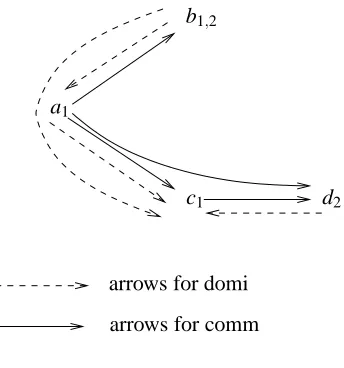
We give a simple example with four agents a,b,c,d two object types 1,2, two arrow types that arise for the binary relations domi∶= {(b,a),(a,c),(d,c)} which models the dominance hier-archy, and comm∶= {(a,b),(a,c),(c,d)} that models the communication structure, the identity morphisms (paths of length zero) are not displayed.
a1
b1,2
c1 d2
arrows for domi arrows for comm
Figure 1: Simple Example
Note that agent b has type 1 and 2, i.e. agent b has both properties. The arrow from a to d is not a ”direct arrow but the path (or sequence) a→c→d. The arrow from b to c of type domi is
also no direct arrow but a path of length 2.
For reasons of readability in the sequel only sequences (paths) of length one are displayed. In particular the identity arrows and the compositions are not visualized in the remainder of this contribution.
4
The Category
MAS
Now we introduce the category of all Multiagent SystemsMAS. The objects ofMASare
Mul-tiagent Systems and the morphisms areMASmorphisms. The previous definition of a MAS is
between the agents and possibly add or delete agents. To be able to model this in categorical no-tions we define the category of all MAS where the objects are typed categories representing the
Multiagent Systems in the above sense and the morphisms areMASmorphisms i.e. covariant
typed functors between the typed categories.
Remark 4 Note that every category can be visualized by a graphΓ(V,E), where V the set of vertices represents the objects and E the set of edges represents the morphisms. We can visualize a general relational structure or a typed category as a labeled graph, having vertices representing the elements of a Universe X , in the case of MAS the agents, and an edge with label Riwhenever
two elements x,y∈X are in relation Ri.
A MASmorphism F is a structure preserving map between two MASobjects, having the
property to respect the type information of the arrows and their direction as well as the object types. This is necessary to preserve the relational information of the Multiagent Systems. We can observe that this is done by covariant typed functors.
Remark 5 MASis a category. Its composition operation is given by the composition of typed
functors, the identity arrows are the identity functors.
4.1 MASMorphisms
In the sequel we will discussMASMorphisms, which are essentially typed functors. The
pur-pose of this section is to introduce MASMorphisms componentwise and thereby motivate the
implementation of the concept that is based on the category SET.
Let MASi be aMASobject, this implies that the class of objects of the typed category MASi
is a set namely the set of agents, as a consequence the class of arrows of MASi is a set too.
In the sequel we will denote the set of all arrows within a Base Diagram MASi as Arr(MASi).
The set of objects, the set of arrows, the set of object types, the set of arrow types, the domain and codomain maps as well as the mapτMASi and a map assigning to each arrow an arrow type πMASi∶Arr(MASi)→ArrTypes(MASi)allow us to analyze the categoryMASby means of sets and maps.
Given two Multiagent Systems MASi and MASj a MASmorphism F ∶MASi→MASj is a
quadruple F= (FO,FA,FOT,FAT)of maps
• FO∶Ob j(MASi)→Ob j(MASj)
• FA∶Arr(MASi)→Arr(MASj)
• FAT∶ArrTypes(MASi)→ArrTypes(MASj)
• FOT∶Ob jTypes(MASi)→Ob jTypes(MASj)
obviously this map induces a map FP∶P(Ob jTypes(MASi))→P(Ob jTypes(MASj))assigning
to each subset of Ob jTypes(MASi)its image via the corresponding image operator.
Remark 6 The introduction of sets of object types for each object (agent) and the corresponding power sets as well as the induced map FP, allows to define agents that have a set of properties,
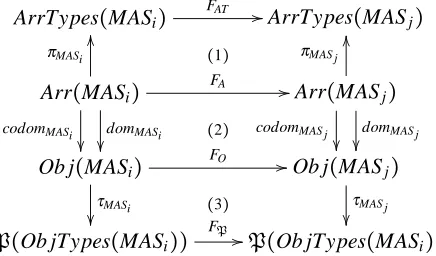
This quadruple is a MASmorphism provided, that for the following diagram it holds that
(1), (2) for domain and (2) for codomain maps are commutative squares and for (3) it holds (because this square is not commutative): ∀A∈Ob j(MASi) ∶ FP○τMASi(A) ⊆τMASj ○FO(A).
ArrTypes(MASi)
(1)
FAT
/
/ArrTypes(MASj)
Arr(MASi)
(2)
domMASi codomMASi FA / /
πMASi OO
Arr(MASj)
domMAS j
codomMAS j
πMAS j OO
Ob j(MASi)
(3)
FO / / τMASi
Ob j(MASj) τMAS j
P(Ob jTypes(MASi)) FP
/
/P(Ob jTypes(MASi))
The diagram above visualizes aMASmorphism in the category SET, the left hand side
repre-sents theMASobject MASi, the right hand side represents theMASobject MASj, and the four
horizontal arrows represent theMASmorphism F= (FO,FA,FOT,FAT).
Remark 7 We take a closer look at the MAS semantic for the maps FAT and FP.
FAT is interpreted as a translation map for arrow types, in addition it allows to merge relations.
Due to the fact that there are in general no constraints to the map, it can be non-monic this leads to the possibility to merge relations by mapping different arrow types in MASito a single arrow
type in MASj.
In a similar way we interpret FPas a translation map. Important is the fact that aMASmorphism
preserves object types, in the sense that after the application of the morphism the translated object types of an agent are at least a subset of the object types of the translated agent. This means we do not ”lose” properties.
Consider as an example Figure2visualizing aMASmorphism F. Note that the MASi arrow
from a to d is mapped to the path a→c→d in MASj.
a1
b1,2
d
a1,2
b1,2
c1 d2
MASi MASj
F
Ð→
arrows for dominance relation arrows for communication relation
4.2 Pushout construction inMAS
Previously we observed that a MASmorphism as well as MASobjects can be described via
sets and maps. In category SET there exist pushouts, this suggests to create pushouts inMAS
componentwise in SET for the objects, the morphisms, the arrow types and the object types. Let I, J and K beMASobjects and F ∶I→J, G∶I→K beMASmorphisms (typed functors),
in this part we show how the pushout PO is constructed. Consider the diagram: I G //
F
K
F′
J
G′ //PO
We construct the pushout componentwise, this leads to the sets
Ob j(PO), Arr(PO), ArrTypes(PO), and a set Ob jTypes(PO)
together with the corresponding maps in the obvious way. Next we need to compute the domain and codomain map domPO, codomPOas well as the mapπPOassigning a morphism type to each
morphism. The last step is to generate the power set over the object typesP(Ob jTypes(PO))
and a mapτPO∶Ob j(PO)→P(Ob jTypes(PO))assigning to each object (agent) its set of types
(properties).
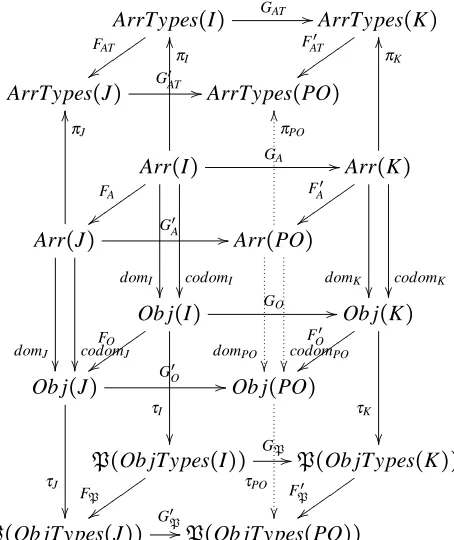
Figure3displays the componentwise pushout construction in SET. The uniqueness of the ar-rows domPO, codomPO, and the map πPO is a consequence of the fact that F and G areMAS
Morphisms i.e. the left and back faces of the two upper cubes are commutative squares and that the horizontal squares are pushouts in SET.
Consider the situation for the map πPO: ArrTypes(PO) is the pushout object for the arrow
types, it holds: FAT′ ○GAT=G′AT○FAT.As a consequence F
′
AT○GAT○πI=G′AT○FAT○πI.Recall that for theMASmorphisms F and G it holds FAT○πI=πJ○FAand GAT○πI=πK○GA. This
im-plies(FAT′ ○πK)○GA= (G′AT○πJ)○FA. Since the square G′A○FA=FA′○GAis a pushout square, due
to the universal property of pushouts it follows that there is exactly one mapπPO∶Arr(PO)→
ArrTypes(PO).
To proof the uniqueness of the maps domPOand codomPOwe argue analogously.
The last step is to compute the mapτPOsuch that F′and G′areMASmorphisms. Recall, for F′ and G′the following property has to hold: ∀Ak ∈Ob j(K) ∶FP′ ○τK(Ak) ⊆τPO○FO′(Ak)and ∀Aj∈Ob j(J) ∶G′P○τJ(Aj) ⊆τPO○G′O(Aj).
We define the map in the following way. To each object Apo in Ob j(PO) we setτPO(Apo)= FP′ ○τK(FO′−1({Apo})) ⋃G′P○τJ(G′−O1({Apo})). ViaτPOwe assign to each object Apothe union
of the ”translated” object type sets of its preimages FO′−1({Apo})and G′−O1({Apo}).
Note that for every object APO∈Ob j(PO)there exits a nonempty preimage set in Ob j(J)or
ArrTypes(I) GAT / / FAT z z vvvv vvv
ArrTypes(K) FAT′
z
z
vvvv
vvv
ArrTypes(J) G
′
AT
/
/ArrTypes(PO)
Arr(I) πI O O domI codomI GA / / FA z z vvvv vvv
Arr(K) πK O O domK codomK
FA′
z
z
vvvv
vvv
Arr(J) πJ O O domJ codomJ
G′A
/
/Arr(PO) πPO O O domPO codomPO
Ob j(I) GO
/ / τI FO z z vvvv vvv
Ob j(K) FO′
z z vvvv vvv τK
Ob j(J) G
′ O / / τJ
Ob j(PO)
τPO
P(Ob jTypes(I)) GP//
FP
z
z
vvvv
vvv
P(Ob jTypes(K))
FP′
z
z
vvvv
vvv
P(Ob jTypes(J)) G
′
P
/
/P(Ob jTypes(PO))
Figure 3: Componentwise Pushout Visualization
4.3 MAS Transformations
In this part we formalize what we mean by a transformation system and derivation steps for Multiagent Systems. A transformation system is defined by a concept introduced by Ehrig, Pfender, and Schneider [EPS73] the so called double pushout (DPO) approach, which is a far developed concept in the field of algebraic graph transformations [EEPT06] and was generalized to adhesive HLR categories which are a suitable categorical framework for graph transformation in a more general sense. Since Category Theory is our common unifying linguistic formal bases there is a natural way to apply these approaches and methods to our MAS modeling problem areas. We give a MAS semantic to the DPO approach. In the sequel we give a brief sketch of the concepts production, derivability, DPO, and pushout complement (c.f. [EEPT06]).
In the sequel we restrict the class ofMASmorphisms in the productions to typed embeddings.
Definition 8 A functor F∶X→Y is called an embedding provided that F is injective on
mor-phisms. Note that F is an embedding if and only if it is injective on objects and injective on the hom-set restrictions F∶MorX(A,B)→MorY(F(A),F(B)). [AHS90]
We define a typed embedding straightforward as a typed functor that acts injectively on mor-phisms, injectively on arrow types and injectively on object types.
Definition 9 InMASaMAS-production p= (pl,p
with common domain. Given aMAS-production p, aMASobject MASjand aMASmorphism m∶codom(pl)→MASj, called match, defines a direct transformation step as follows:
A Object MASr is called direct derivable from an object MASl inMAS, MASl ⇒MASr, iff
there exists aMAS-production p= (pl∶MASI→L,pr∶MASI→R)and a context Object MASC
with corresponding MAS-Morphism g∶MASI→MASC, such that MASl and MASrare pushout
objects in the following diagram. L m MASI g pl o o p r / /R gr
MASl MASC p
−r
/
/
p−l
o
o MASr
Remark 8 This diagram illustrates a Double Pushout, for more details we refer to the book [EEPT06].
MAS′is called derivable from MASl if there exists a sequence MAS0, MAS1, ..., MASn such
that MASl=MAS0∧(∀1≤i≤n) (MASi−1⇒MASi) ∧MASn=MAS′.
Given objects L,MASI,R and a context object MAS
Cand the associated morphisms, the pushout
objects MASl and MASrexist. But the usual situation is the following: We have a production p= (pl,p
r)and a morphism m∶L
→MASl called match. The task is to find a so called pushout
complement PC and two morphisms g,p
−l such that the square
L m MASI g pl o o
MASl p PC
−l
o
o
is a pushout square. Considerations concerning existence and uniqueness of such pushout
complements inMASwill be content of future work. For now we point out that the pushout
complements that arise in the following examples exist.
For MAS the semantic of the match m∶L→MASl is that we search for an occurrence of the
relational structure of L in the system MASl. The match checks if the preconditions required by the left hand side of the production p are fulfilled in MASl, if this is the case the production can be applied, otherwise not.
4.4 Application of MAS Transformations
ECEASST
agent to another.
Next we define the relevant relations that represent the cooperation and communication infor-mation of our example.
4.4.1 Definition of the Relevant Relations
We define:
• A symmetric communication relation C⊆A×A: Two agents a,b are in relation C if a is able to communicate with b i.e. aCb (it follows bCa due to the symmetry of C)
• A relation Dx: two agents a, b are in relation Dx, i.e.(a,b) ∈Dx if a delivers a part of type X to b
• A relation Dy: two agents a, b are in relation Dy, i.e.(a,b) ∈Dy if a delivers a part of type Y to b
• A relation W⊆A×A:(a,a) ∈W if a is assembling the parts.
In the sequel the arrows from Figure4are used to display the relational structure, for the conve-nience of the reader the different arrows indicate the different morphism types (instead of indices at the tip of the arrows).
arrows visualizing paths for W arrows visualizing paths for Dx arrows visualizing paths for Dy arrows visualizing paths for C
Figure 4: Arrow Types
4.4.2 Definition of Productions
Next we define the productions which describe actions together with their application conditions. These productions implement the changes that take place in the MAS. For the convenience of the reader the types of the objects are indicated by indices of the objects.
Remark 9 In the given example the productions are applied from left to right. Obviously a production is symmetric i.e. given a suitable match m defined from the righthand side of the production to aMASobject gives a valid transformation step, too.
In the sequel we give a visualization of the five productions used to describe the systems dynamics.
pcl pcr
production pc= (pcl,pcr) a a
a
b b
b
• pdX (production deliver part of type X ) is applied if two agents having property 2 and 3 can communicate with an agent that has property 1, after the derivation step one of the agents delivers a piece of type X to the assembly agent.
pdX l pdX r
production pdX= (pdX l,pdX r) a1
a1 a1
b2,3 c2,3 b2 c2,3 b2 c2,3
• pdY (production deliver part of type Y ) is applied if two agents having property 2 can communicate with an agent that has property 1 and one of the agents is already delivering a piece of type X and the other agent is able to perform a task(indicated by the property 3), after the derivation step one of the agents delivers a piece of type Y to the assembling agent.
pdY l pdY r
production pdY= (pdY l,pdY r) a1
a1 a1
b2
b2
b2 c2,3 c2 c2
• pba (production begin assembling) is applied if two agents with property 2 can commu-nicate with an agent that has property 1 and parts of type X and Y are delivered to the assembling agent which has the additional property 3, after the derivation step the assem-bly agent received the parts and starts to assemassem-bly them.
pbal pbar
production pba= (pbal,pbar) a1
a1
a1,3
b2
• pea (production end assembling) is applied when an agent stops assembling. This means the task is finished.
peal pear
production pea= (peal,pear) a1
a1 a1,3
b2
b2 c2 c2 b2 c2
4.4.3 Application of Productions
Figure5 shows the application of production pdX to a givenMASobject, the diagram shows
a double pushout situation. We search for three agents that can communicate with each other, one of them (a) can perform the assembly task (1) the others (b), (c) have to be able to perform the delivery task (2), and both of them are free to act, or are not assigned to another task yet (3). Such a situation is given in the downleft object of the diagram, this means we can apply the production. Observe that the communication arrow a↔b in the production is mapped to the
sequence of arrows a↔e↔b. After the transformation step agent b delivers part X to agent a
and is assigned to a task (b lost property 3).
There are in general more possibilities for a production to be applied to a givenMASobject.
In some situations there will exist more than one suitable match whereas in others there might exist no suitable match at all. Future research will try to determine criteria on how to choose the ”best” or most suitable match to address the needs of an efficient transformation system for Multiagent Systems.
a1 a1 a1
b2,3c2,3 b2 c2,3 b2 c2,3
a1,3
a1,3 a1,3
e1 c2,3 e1 c2,3 e1 c2,3
b1,2,3 d2 b1,2 d2 b1,2 d2
4.4.4 System Run
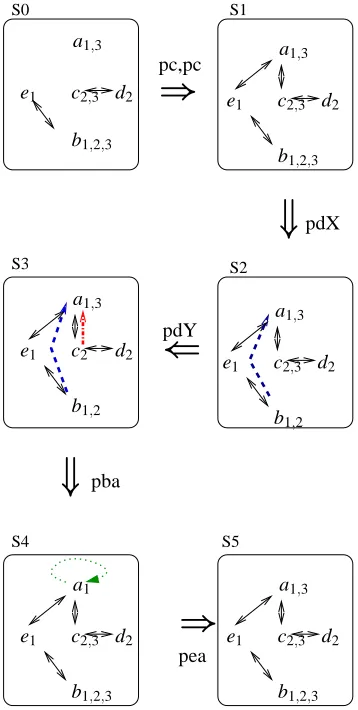
Figure6 shows a sequence ofMAS-transformations, with initial MASobject S0, that fulfills
the assembly task. The productions are applied together with suitable matches.
S5
S0 S1
S4
S3 S2
a1,3
a1,3
a1,3
a1,3
a1,3
a1
b1,2,3 b1,2,3
b1,2,3
b1,2,3
b1,2 b
1,2
e1
e1
e1 e1
e1
e1
c2,3
c2,3 c2,3
c2,3
c2,3
c2 d
2
d2
d2 d2
d2
d2
⇒
pc,pc
⇓
pdX⇐
pdY
⇒
pea
⇓
pbaFigure 6: A sequence of transformation steps
The production pc is applied twice, first with match m0, the object part of the morphism m0is
[m0(a)=a and m0(b)=e], and next with match m1the object part of the morphism is[m1(a)=a
and m1(b)=c].
Now the application condition for pdX is fulfilled and pdX is applied to S1 with a suitable match m2resulting in S2. In the sequel pdY , pba and pea are applied in the obvious way together
5
Implementation
In the working group two new tools concerning MAS Transformations are designed and pro-grammed. The first one ”MASTRANSF” is based on category theory and is implemented as a module that provides support for set like categories and the categoryMAS. It supports
construc-tion of pullbacks, pushouts, equalizers, coequalizers, products, coproducts, among others. As a next step the construction of pushout complements will be implemented.
Due to its fundamental importance the category SET was implemented with the associated set theoretic notions (e.g. equivalence relations, image operator and inverse image operator). Implementation of new results, such as the notion of a quasi coproduct complement [Sob08] as a basis for pushout complement constructions, and modeling with fibered structures for local global modeling, is part of ongoing work, among others. A GUI is under developement that allows the fast input of Base Diagrams, as well as morphisms between them. It will be possible to define a set ofMASproductions and apply them to the Base Diagrams. This results in a rule
based controller for Multiagent Systems.
5.1 Classes
The implementation is organized around 3 abstract classes:
• Category - With objects, morphisms, a composition operation and a name. • Object - Has on the abstract level only a name.
• Morphism - Has a codomain, a domain and a name.
General results can be implemented in abstract classes, that are extended from the above ones. See for example the next section dealing with the canonical construction of pushouts.
Additionally, there are classes for special limit and colimit objects and their associated mor-phisms, e.g. a class Product, that has two Morphisms the projections and one object the product
object. SET andMASimplement the abstract class CategoryWithCoproductsAndCoequalizers.
This is due to the fact that the main focus of the implementation is on Pushouts. Generally, the implementation of limit and colimit constructions inMASfollows the constructive proofs that
category theory provides (see e.g. the proofs in [Sob08]). For an early general treatment using ML implementations we refer to [RB88].
Remark 10 Further work will be necessary to define fitting inheritance schemes. For example abstract classes for finitely cocomplete and complete categories, skeletal categories, etc.. But as mentioned, the focus of this paper is not on a general implementation of category theory, but on the implementation of the categorical notions and results that are applicable within the Category
MAS.
5.2 Implementation of Pushout Construction
The construction of pushouts is implemented within an abstract class (CategoryWithCoproduct-sAndCoEqualizers) which extends the class Category.
See the following Java code:
p u b l i c P u s h o u t c r e a t e P u s h o u t ( Morphism f , Morphism g ) { P u s h o u t p u s h o u t = new P u s h o u t ( ) ;
C o p r o d u c t c o p r o d u c t = new C o p r o d u c t ( ) ;
c o p r o d u c t = c r e a t e C o p r o d u c t ( g . codomain , f . c odom a i n ) ;
C o e q u a l i z e r c o e q u a l i z e r = new C o e q u a l i z e r ( ) ;
c o e q u a l i z e r = c r e a t e C o e q u a l i z e r ( compose ( c o p r o d u c t . i 1 , g ) , compose ( c o p r o d u c t . i 2 , f ) ) ;
p u s h o u t . morA = compose ( c o e q u a l i z e r . mor , c o p r o d u c t . i 1 ) ; p u s h o u t . morB = compose ( c o e q u a l i z e r . mor , c o p r o d u c t . i 2 ) ; p u s h o u t . p u s h o u t O b j e c t = c o e q u a l i z e r . c o e q u a l i z e r O b j e c t ; r e t u r n p u s h o u t ;
}
5.3 Pushout Construction withinMAS
The category MASextends the Class CategoryWithCoproductsAndCoequalizer. The
screen-shots (Figures7and8) show a pushout construction.
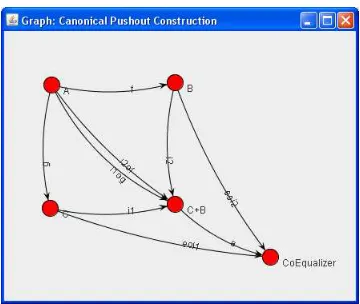
Figure 7: Pushout Construction, Objects and Morphisms
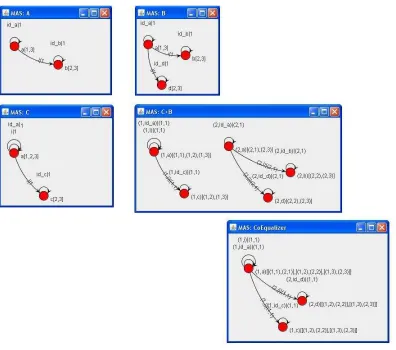
Given 3MAS-objects A, B, C and twoMAS-morphisms f ∶A→B, g∶A→C, we construct
the coproduct of B and C, this results in theMAS-object B+C and two injections i1∶B→B+C
and i2∶C→B+C. The next step is to coequalize along the morphisms i1○f and i2○g. The result
is theMAS-object named ”CoEqualizer” which is the pushout of f and g.
Figure 8: Pushout Contstruction, Base Diagrams
6
Conclusion and Future work
The concept ofMAStransformations, which is an adaption of graph transformations [EEPT06]
to typed categories, is a natural way to describe changes in the Base Diagram of Multiagent Systems. Due to the categorical modeling the proposed approach is independent of the imple-mentation of the agents (agents are analyzed via their external properties). This allows to analyze MAS on the basis of their cooperation and communication structures, which represent signifi-cant information. We can define actions and their corresponding preconditions in a MAS by productions inMAS. Now we can ask the question: Which transformation steps lead to a
de-sired result? For example: Which transformation steps have to take place that the resulting Base Diagram of the MAS has a limit or colimit object for one or more types? This can be interpreted as a universal communicator, mediator, or steering agent [Pfa06].
Another aspect of future work will be the investigation of interdependencies between object types and arrow types. In some cases in aMASthere clearly are interdependencies between the
properties of agents and the relations (arrows) between the agents.
Another part of work in MAS modeling concerns logical modeling aspects. It turned out that logical fiberings [Pfa91] provide a concept to assign a system of distributed logics to a MAS in a natural way. The basic idea is to assign a logical fiber to every agent, this fiber models the local logical state space of an agent, the entire logical fiber bundle forms the global logical state space of the whole MAS. For more details we refer to [Pfa04]. This motivates the introduction of a ’Relational Fibering’ with the aim to model local global interactions in the relational structure of a MAS. We assign a relational fiber to every agent, the fiber models the relational information attached to the agent. A first application of this approach is to compute subcategories of a MAS on demand, by taking the collection of the fibers over a defined set of agents as a starting point.
The notion of Activity Networks, as used in operations research, can be deployed for modeling certain constraints in communication flow in Base Diagrams.
A further aspect of intended future work concerns construction principles from Category The-ory like limit and co-lomit constructions that can be deployed, e.g. to extend a given MAS (using the Base Diagram) by a kind of universal communicator (coordinator) agent. Simple scenarios of cooperating robot agents provided first motivating examples (“experiments”) and first steps. [Pfa06].
We thank the referees for some helpful remarks.
Bibliography
[AHS90] J. Ad´amek, H. Herrlich, G. Strecker. Abstract and Concrete Categories. John Wiley & Sons, 1990.
[EEPT06] H. Ehrig, K. Ehrig, U. Prange, G. Taentzer. Fundamentals of Algebraic Graph
Transformation. Volume 1. Springer, 2006.
[EPS73] H. Ehrig, M. Pfender, H. J. Schneider. Graph Grammars: an Algebraic Approach.
[FWW+93] T. Finin, J. Weber, G. Wiederhold, M. Genesereth, R. Fritzson, D. Mckay, J. McGuire, R. Pelavin, S. Shapiro, C. Beck. DRAFT Specification of the KQML Agent-Communication Language. 1993.
[GFB+92] M. Genesereth, R. E. Fikes, R. Brachman, T. Gruber, P. Hayes, R. Letsinger, V. Lif-schitz, R. Macgregor, J. Mccarthy, P. Norvig, R. Patil. Knowledge Interchange For-mat Version 3.0 Reference Manual. 1992.
[Gol84] R. Goldblatt. TOPOI, The Categorial Analysis of Logic. Studies in Logic and The
Foundations of Mathematics; v. 98. Elsevier Science Publishers B.V., revised edi-tion, 1984.
[Lan98] S. M. Lane. Categories for the Working Mathematician. Springer Verlag, Graduate
Texts in Mathematics 5, 2nd ed., 1998.
[Pfa91] J. Pfalzgraf. Logical Fiberings and Polycontextural Systems. In Fundamentals of
Artificial Intelligence Research, Ph.Jorrand, J.Kelemen (eds.). Lecture Notes in Computer Science 535, Subseries in AI, Springer Verlag. 1991.
[Pfa94] J. Pfalzgraf. On a general notion of a hull. In Automated Practical Reasoning,
J.Pfalzgraf and D.Wang (eds.). Texts and Monographs in Symbolic Computation, Springer-Verlag Wien New York. 1994.
[Pfa03] J. Pfalzgraf. Modeling Connectionist Networks: Categorical, Geometric Aspects
(Towards Homomorphic Learning). In Dubois (ed.), Proceedings Computing An-ticipatroy Systems: CASYS 2003. Volume 718. AIP Conference Proceedings, 2003. Recieved a Best Paper Award.
[Pfa04] J. Pfalzgraf. On logical fiberings and automated deduction in many-valued logics
using Gr¨obner bases. RACSAM, Rev. Real. Acad. Ciencias, Ser. A. Mat., Vol. 98(1), pp. 213–227, 2004.
[Pfa05] J. Pfalzgraf. On Categorical and Logical Modeling in Multiagent Systems. In Lasker and Dubois (eds.), Anticipative and Predictive Models in Systems Science. Vol-ume 1. 2005.
[Pfa06] J. Pfalzgraf. On an Idea for Constructing Multiagent Systems (MAS) Scenarios. In
Lasker and Pfalzgraf (eds.), Advances in Multiagent Systems, Robotics and Cyber-netics: Theory and Practice. Volume 1. International Institute for Advanced Studies in Systems Research and Cybernetics, 2006.
[RB88] D. E. Rydeheard, R. M. Burstall. Computational Category Theory. Prentice Hall,
1988.
[Sob08] T. Soboll. Categorical Modeling of Multiagent Systems. PhD thesis, University of
Salzburg, 2008.
[Woo02] M. J. Wooldrige. An Introduction to Multiagent Systems. John Wiley and Sons LTD,