Address for correspondence Dr. Afsheen Bilal
Department of Dermatology, CMH, Multan
Email: [email protected]
Original Article
Efficacy of 0.1% topical tacrolimus with narrow
band ultraviolet B phototherapy versus narrow
band ultraviolet B phototherapy in vitiligo
Afsheen Bilal*, Zafar Iqbal Shiakh**, Safiullah Khan*, Nadia Iftikhar**, Irfan Anwar**, Sakina Sadiq**
* Department of Dermatology, CMH, Multan
** Department of Dermatology, Military Hospital, Rawalpindi
Abstract
Objective To determine the efficacy of combined treatment with narrowband ultraviolet B phototherapy (NB-UVB) and topical tacrolimus in comparison with NB-UVB alone with placebo control in the treatment of vitiligo affecting face and neck.Methods We included 60 patients with vitiligo affecting face and neck with or without involvement of the rest of body, in this randomized, double-blind, placebo-controlled trial. The patients were randomly allocated in two groups as A and B. Topical 0.1% tacrolimus ointment was given for vitiligo patches twice daily in group A, while placebo ointment was given to be applied in similar way for vitiligo patches in group B. Tri-weekly NB-UVB for depigmented areas with starting dose of 0.1J/cm2 with increment of 10% at every visit was given to the patients in both groups. Percentage of depigmented patches was calculated at the baseline, 1, 2 and 3 months.
ResultsAll patients completed the treatment period of 3 months. The mean response at the end of the 3rd month revealed excellent response (>75% repigmentation) in 16 (53.3%) patients in group A and 9 (30%) patients in group B. Good response (50-75% repigmentation) was seen in 11 (36.7%) in group A and 12 (40%) patients in group B. Moderate response (25-49% repigmentation) was shown by 3 (10%) patients in group A and 5 (16.7%) patients in group B. None of the patient showed poor response (<25% repigmentation) in group A, however 4 (13.3%) patients showed poor response in group B. Comparison of efficacy in both groups show excellent and efficacious response in 16 (53.5%) of patients in group A and in only 9 (30%) of patients in group B (P <0.05).
Conclusion Combined treatment with NB-UVB and topical 0.1% tacrolimus ointment in comparison with NB-UVB with placebo control in the treatment of vitiligo affecting face and neck is more effective.
Key words
Vitiligo, narrowband ultraviolet B, topical tacrolimus
Introduction
Vitiligo is a skin disorder characterized by multiple patches of depigmentation causing significant social and psychological distress,1 Disease can appear at any age but more frequently seen in individuals less than 20 years of age. It affects about 0.1%-2% of
general population and familial incidence is about 30%.2
The exact cause of the disease is yet not known, but several hypothesis suggest that genetic predisposition, autoimmunity and increased vulnerability of melanocyte to destructive effects of toxic metabolites play an important role in disease causation.3
unsatisfactory and is a therapeutic challenge for dermatologists.4 Conventional treatment options are topical steroids, ultraviolet B phototherapy (UVB 280nm-320nm), photochemotherapy (PUVA i.e. psoralen plus UVA 329nm-400nm). Excimer laser and topical calcipotriol are also being used. Studies have shown that narrowband UVB (NB-UVB) is effective alone. In one study, 19.8% patients showed more than 50% repigmentation when treated with NB-UVB alone.4 However, few studies have reported more than 75% repigmentation in patients when treated with NB-UVB in combination with other modalities. Topical immunomodulators (tacrolimus, pimecrolimus) are considered as safe and effective agents for long-term use in vitiligo as they do not cause skin atrophy which is associated with prolonged use of topical corticosteroids.5 Tacrolimus is an effective agent in vitiligo when used alone as in one study 61% patients showed more than 75% repigmentation when treated with tacrolimus alone.4 According to another study 73% patients showed more than 50% repigmentation when tacrolimus given along with NB-UVB.1
The purpose of our study was to present a relatively new mode of treatment which may be beneficial to the patients of vitiligo. It may also cause quick symptomatic improvement, thus decreasing the psychological distress of patients due to cosmetic disfigurement caused by vitiligo, especially on face and neck.
Methods
A total of 60 patients (30 in each group) coming to Department of Dermatology, Military Hospital, Rawalpindi during April 2009 to April 2010 and having vitiligo affecting face and neck with or without involvement of the rest of body between 5-60 years of age were included in the study, while patients with pregnancy and lactation, history
of photosensitivity or photoaggaravated dermatoses, history of any immunosuppressive disorder or use of immunosuppressive medicines, history of using steroids either oral or injectable within the previous one month and history of skin malignancy, were excluded from the study.
After approval from hospital ethical committee, the informed consent of the selected patients was obtained. The record of hospital registration number of the patients was ensured. The sociodemographic profile was entered in the proforma. Each patient was subjected to detailed history and clinical examination including skin examination in which distribution of vitiligo patches was demonstrated and confirmed by Wood’s lamp examination. Vitiligo was classified according to pattern of distribution of patches as segmental and nonsegmental. Patients were randomly allocated to each group based on lottery method. Neither patients nor the doctor knew to which group the patient belonged. Patients in treatment group A was given topical 0.1% tacrolimus ointment and those in group B was given topical placebo ointment twice daily for vitiligo patches over face and neck. Concomitant NB-UVB therapy was performed thrice weekly in both groups, starting with a minimal dose of 0.3J/cm2 which was gradually increased by 10% with each session. The patients were instructed to report any adverse event during the course of treatment e.g. burning, itching, erythema etc. When a previous treatment resulted in intense erythema, no phototherapy was given in next session or the dose was decreased according to symptoms. Light erythema was considered acceptable for treatment with same dose.
quadrants measuring 25% each by using visual analogue scale. Now the percentage of involvement in each quadrant was taken, then by adding all four values percentage of depigmentation was calculated and taken as baseline. On subsequent visits, the percentage of depigmentation was reassessed in the same manner and then percentage repigmentation was calculated by this formula: % repigmentation = Present % depigmentation ÷ Baseline % depigmentation x 100. Two different observers reviewed the patients on each follow-up visit, which was monthly for three months during study period. The results were the mean of two observers findings and response was scored as excellent (>75% repigmentation), good (50-75% repigmentation), moderate (25-49% repigmentation) and poor (< 25% repigmentation). Address and telephone numbers of the patients were taken to ensure follow-up.
The data were analyzed using SPSS version 12.0. Mean and standard deviations were used to describe numeric variables like age and percentage depigmentation at baseline. Frequencies and percentages were used to describe categorical variables like gender, duration of disease, type of vitiligo and response. Independent sample t-test was used to compare the percentage improvement or repigmentation between the two groups. Chi square test was used to compare the efficacy (categorical variables) in two groups. P value of less than 0.05 was considered significant.
Results
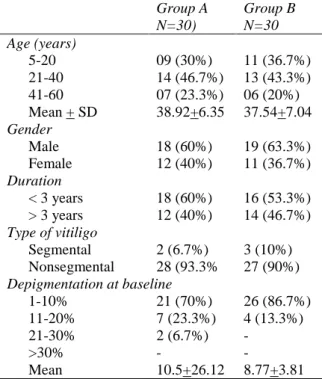
Table 1 compares the baseline clinical
characteristics in two groups. Both groups were comparable in terms of age and se distribution. The mean age in group A was 38.92+6.35 years and that in group B was 37.54+7.04 years. Similarly, both groups had similar male to female ratio.
Table 1 Baseline clinical characteristics of treatment groups.
Group A N=30)
Group B N=30 Age (years)
5-20 09 (30%) 11 (36.7%)
21-40 14 (46.7%) 13 (43.3%)
41-60 07 (23.3%) 06 (20%)
Mean + SD 38.92+6.35 37.54+7.04 Gender
Male 18 (60%) 19 (63.3%)
Female 12 (40%) 11 (36.7%)
Duration
< 3 years 18 (60%) 16 (53.3%) > 3 years 12 (40%) 14 (46.7%) Type of vitiligo
Segmental 2 (6.7%) 3 (10%) Nonsegmental 28 (93.3% 27 (90%) Depigmentation at baseline
1-10% 21 (70%) 26 (86.7%)
11-20% 7 (23.3%) 4 (13.3%)
21-30% 2 (6.7%) -
>30% - -
Mean 10.5+26.12 8.77+3.81
Table 2 Response at 3rd month (n=60).
Response Group A
N=30)
Group B N=30 Excellent 16 (53.3%) 9 (30%)
Good 11 (36.7%) 12 (40%)
Moderate 3 (10%) 5 (16.7%)
Poor 0 4 (13.3%)
Response rated as excellent (>75% repigmentation), good (50-75% repigmentation), moderate (25-49%), and poor (<25% repigmentation)
Table 3 Comparison of efficacy in both groups.
Efficacy Group A
N=30)
Group B N=30
Yes 16 (53.3%) 9 (30%)
No 14 (46.7%) 21 (70%)
P value = 0.026 (<0.05) significant
The segmental type of vitiligo was seen in 2 (6.7%) patients of group A and 3 (10%) patients of group B. However, the remaining 93.3% patients of group A and 90% patients of group B had non-segmental type of vitiligo
(Table 1). The duration of the disease was less
depigmentation was 10.5+26.12% in group A and 8.77+3.81% in group B (Table 1).
The response was recorded at end of the 3rd month, which revealed excellent response in 16 (53.3%) patients group A and 9 (30%) patients group B (P <0.05). Good response was shown by 11 (36.7%) patients group A and 12 (40%) patients of group B. Moderate response was recorded in 3 (10%) patients of group A and 5 (16.7%) patients of group B, while no patient showed poor response in group A but 4 (13.3%) patients group B showed poor response (Table 2).
Comparison of efficacy in both groups showed 16 (53.5%) patients of group A showed effective response which was seen in only 9 (30%) patients of group B (P <0.05), (Table 3).
Discussion
Vitiligo is an acquired pigmentation disorder, characterized by depigmented patches, as a result of the disappearance of functioning melanocytes from the epidermis. This condition, cosmetically disfiguring especially in dark-skinned individuals, makes the lesional skin more sensitive to sunburns and affects 0.1-2% of the world’s population, irrespective of gender and race.6
The current study was conducted to present a new mode of treatment which might be beneficial to the patients of vitiligo. It may also cause quick symptomatic improvement, thus decreasing the psychological distress of patients due to cosmetic disfigurement caused by vitiligo, especially on face and neck.
The result of the study revealed most common age as 38.92+6.35 and 37.54+7.04 years in group A and B, respectively. It was common in both sexes, majority had nonsegmental disease and duration of disease was < 3 years
in 60% and 53.3% in group A and B, respectively. Management response was graded as excellent in 53.3% and 30%, respectively in group A and B at the end of third month and it was statistically significantly higher in group A.
NB-UVB has shown a number of advantages in vitiligo patients in addition to its excellent, efficacy. These advantages include its extremely low side-effect profile particularly on the systemic front, its established use in children and adults and also considered safe in pregnant females.7
Majid8 studied the effect of combining topical tacrolimus and NB-UVB therapy in inducing repigmentation in vitiligo lesions and concluded that addition of topical tacrolimus increases the extent of overall repigmentation achieved with NB-UVB therapy in vitiligo and also reduces the cumulative NB-UVB dose needed to achieve a therapeutic benefit in affected patients of vitiligo. Moreover, the use of tacrolimus may be useful to prevent UVB-induced erythema by inhibiting early-phase events of the inflammatory process.9-11
A recent study by Nordal et al.12 assessed the additive effect of tacrolimus ointment (0.1%) once daily in vitiligo patients treated with NB-UVB and concluded that the combination of NB-UVB and tacrolimus ointment (0.1%) was more effective than UV treatment alone in patients with vitiligo.
The above discussion reveals that topical tacrolimus ointment (0.1%) along with NB-UVB in vitiligo patients is more effective and becomes a new mode of treatment which will be beneficial to the patients of vitiligo. It may also cause quick symptomatic improvement, thus decreasing the psychological distress of patients due to cosmetic disfigurement caused by vitiligo, especially on face and neck.
We concluded that combined treatment with NB-UVB and topical tacrolimus in comparison with NB-UVB with placebo control in the treatment of vitiligo affecting face and neck is more effective.
References
1. Fai D, Cassano N, Vena GA. Narrow-band UVB phototherapy combined with tacrolimus ointment in vitiligo: a review of 110 patients. J Eur Acad Dermatol Venereol. 2007;21:916-20.
2. Nicolaidou E, Antoniou C, Stratigos A, Katsambas AD. Narrowband ultraviolet B phototherapy and 308-nm excimer laser in the treatment vitiligo: A review. J Am Acad Dermatol. 2009;60:470-7.
3. Habib A, Sheikh ZI, Khan Q, Rahman SB. Efficacy and safety of oral dexamethasone pulse treatment for vitiligo. Pak Armed Forces Med J. 2006;56:111-5.
4. Lotti T, Buggiani G, Troiano M et al. Targeted and combination treatment for vitiligo. Comparative evaluation of different current modalities in 458 subjects. Dermatol Ther. 2008;21:S20-6.
5. Berti S, Buggiani G, Lotti T. Use of tacrolimus ointment in vitiligo alone or in combination therapy. Skin Therapy Lett. 2009;14:5-7.
6. Moretti S, Amato L, Bellandi S, Fabbri P. Focus on vitiligo: a generalized skin disorder. Eur J Inflamm.2006;4:21-30.
7. Yones SS, Palmer RA, Garibaldinos TM. Randomized double-blind trial of treatment of vitiligo: efficacy of psoralen-UVA versus narrowband-UVB therapy. Arch Dermatol. 2007;143:578-84.
8. Majid I. Does topical tacrolimus ointment enhance the efficacy of narrowband ultraviolet B therapy in vitiligo? A left-right comparison study. Photodermatol Photoimmunol Photomed. 2010;26:230-4. 9. Ogawa Y, Adachi A, Tomita Y. The
successful use of topical tacrolimus treatment for a chronic actinic dermatitis patient with complications of idiopathic leukopenia. J Dermatol. 2003;30:805-9.
10. Mayuzumi N, Ikeda S, Kawada H, Ogawa H. Effects of drugs and anticytokine antibodies on expression of ATP2A2 and ATP2C1 in cultured normal human keratinocytes. Br J Dermatol. 2005;152:920-4.
11. Lan CC, Yu HS, Wu CS. FK506 inhibits tumour necrosis factor-alpha secretion in human keratinocytes via regulation of nuclear factor-kappa B. Br J Dermatol. 2005;153:725-32.