R E S E A R C H A R T I C L E
Open Access
Applied and implied semantics in
crystallographic publishing
Brian McMahon
Abstract
Background: Crystallography is a data-rich, software-intensive scientific discipline with a community that has undertaken direct responsibility for publishing its own scientific journals. That community has worked actively to develop information exchange standards allowing readers of structure reports to access directly, and interact with, the scientific content of the articles.
Results: Structure reports submitted to some journals of the International Union of Crystallography (IUCr) can be automatically validated and published through an efficient and cost-effective workflow. Readers can view and interact with the structures in three-dimensional visualization applications, and can access the experimental data should they wish to perform their own independent structure solution and refinement. The journals also layer on top of this facility a number of automated annotations and interpretations to add further scientific value.
Conclusions: The benefits of semantically rich information exchange standards have revolutionised the scholarly publishing process for crystallography, and establish a model relevant to many other physical science disciplines.
Keywords: Information exchange standard, Semantics, Ontology, Scholarly publishing, CIF, Crystallography
Background
Crystallography is a discipline with a strong tradition of good data management and cutting-edge software devel-opment, and with a community that actively values free and efficient information exchange. That community’s approach to academic publishing is presented as an exam-ple of good practice of relevance to many other physical science disciplines.
The body that governs the discipline, the International Union of Crystallography (IUCr), has published its own journals for over 60 years. It has tried wherever possible to bring active scientific content into the traditional business of publishing research literature. In the electronic publish-ing age, it shares the growpublish-ing interest in “semantification” of the scientific literature – that is, the application of computing technologies to facilitate linking, annotation, visualization and manipulation of the text of a research publication and its associated supporting data, models and algorithms.
Correspondence: [email protected]
International Union of Crystallography, 5 Abbey Square, Chester CH1 2HU, UK
An early approach within the publishing industry to adding such value (circa1980s) was the manual insertion, during technical editing, of additional “tags”. These were content not originally supplied by the author, but designed to be read, interpreted and executed by software responsi-ble for typesetting the article and converting it to formats that could be displayed and manipulated on computer screens or within computer memory.
The formal system known as Standard Generalized Markup Language (SGML) [1] was developed for this pur-pose during the 1980s. It specified procedures for defining such tags and allowed great flexibility and extensibility of function. It also imposed an orderly structure on the doc-ument (in principle, it allowedanydesired structure to be formally asserted and validated at run time).
SGML was not fully implemented in early electronic publishing technologies, for two reasons as relevant today as they were a generation ago. One is that computa-tional tools to handle general metalanguage systems such as SGML are very complex to design and build. Their efficient implementation can place a heavy burden on hardware resources and on software library design. The
other reason is that the real cost of adding value to pub-lications through manual markup is very high – whether through the skills of trained editorial staff or the volun-tary additional investment of time by a committed author. In particular, relying on an untrained author requires the development of authoring and editing software that is easy to use, but retains the structural integrity of the markup scheme adopted.
The first, technical, challenge has been somewhat ame-liorated by the subsequent evolution of SGML. As is widely known, the ideas behind SGML were incorpo-rated into the HTML language in Tim Berners-Lee’s initial implementation of the World-Wide Web [2,3]. They also strongly influenced the development of XML (Extensible Markup Language), a more restricted metalanguage sys-tem adopted for the development of semantic applications within many evolving Web technologies. It is also widely used in publishing. However, while this has increased the number of parsers and libraries available for soft-ware developers, it remains a challenge to design softsoft-ware that has general applicability across all the areas in which XML is involved. And, of course, if specialised software is written for a specific XML application, it will prob-ably not be interoperable with programs used in other applications.
Likewise, the quest for easy authoring and editing tools continues. While the latest-generation office productivity applications (word processors, spreadsheets etc.) have user-friendly interfaces and internally use an XML model, the resultant XML is often either poorly documented or ill-suited for interoperability with other applications. These tools also suffer from the difficulty that their very ease of use hides the underlying structure of the docu-ment from the author; and in consequence the author often does not appreciate the benefits of structured information markup.
The ecosystem of scholarly publishing is in any case in a state of flux. Economic and some philosophical changes, for example the growth of open-access publication and the general availability to authors of high-quality docu-ment preparation software, are tending to place a heavier burden on authors to prepare and add semantic value to their publications. Given that many authors find this a laborious process – and that many are not expert in the necessary markup formalisms and procedures – there are parallel initiatives by publishers to enhance the seman-tic content of their publications through semi-automated post-processing of the submitted article.
The current article describes some of the experiences of one learned-society publisher in adding value to research publications through semantic markup and processing applied both explicitly, through a structured markup scheme, and implicitly through dynamic post-processing of specialised content in a known context.
A formal semantic markup framework for crystallography
Historical development
Crystallography is characterised in theOnline Dictionary of Crystallography(http://reference.iucr.org/ dictionary/Main_Page) as “the branch of science devoted to the study of molecular and crystalline structure and properties, with far-reaching applications in mineral-ogy, chemistry, physics, mathematics, biology and mate-rials science.” It is thus an interdisciplinary science, with many sub-communities that have their own terminolo-gies, formalisms and philosophies. However, it is fortunate in having many experimental tools and procedures in common across many of these disciplines.
In particular, the accurate determination of the three-dimensional structure of atoms and molecules in a crys-tal lattice, by analysis of the directions and intensities of diffracted rays from a collimated X-ray beam inci-dent on the crystal, is a common technique widely used in fields as diverse as materials characterisation, chem-ical structural analysis, structural biology and structural condensed-matter physics.
The interpretation of such diffraction patterns and the deduction of the three-dimensional structures giving rise to them involve much computation, and crystallographers were early adopters of electronic computers. The rela-tively standard configuration of crystallographic experi-ments, even with different experimental probes such as X-rays, electrons and neutrons, means that it is useful to pass data from one program to another. Various ad hoc standard descriptions and formats of data representation sprang up as the field evolved. In due course, several inte-grated software suites emerged, each with its own internal data representation allowing communication between its different modular routines.
Crystallographic software developers soon became aware of the need to design data formats that could be used by many applications. They also had to address a broad collection of data descriptors (i.e.not solely the few variables involved in, say, an inverse Fourier transform; but also the many different types of measured data that the software could import, manipulate in various ways, and transform into derived model coordinates).
In the early days, this exercise was repeated across each distinct team of software developers. As the number of packages grew, individual crystallographers wanted to use several of them together, and to export data from one package to another.
coordinates, atomic displacement parameters, descrip-tions of molecular geometry etc.) in a format suitable for automated incorporation into published research output.
The SCFS was modelled on the then-traditional style of formatting data in Fortran programs. Its effectiveness was limited because its release coincided with the arrival of minicomputers such as the VAX780 in crystallographic laboratories, and consequent changes in computing, in which new data types and file formats proliferated. Also, new equipment such as automatic diffractometers became standard in laboratories, each with new and different data output types and formats.
By the end of the 1980s, the IUCr considered that it was essential to develop a new standard data exchange mechanism that would break free from the constraints of fixed format, would be easily extensible to cope with new developments, and would attempt to cover all the different experimental data types that occurred across crystallog-raphy. The solution proposed by a Working Party on Crystallographic Information was named the Crystallo-graphic Information File (CIF) [5]; a detailed history of its development can be found in the IUCr’s reference work International Tables for Crystallography[6].
Adding semantics to a standard format
The earliest drafts of the new CIF standard described a simple free-form ASCII-only tag–value structure. Data items with a single value were presented as a tag (always
beginning with an underscore character) separated by white space from the associated value. All “values” appeared in the file as character strings, but there were lexical rules suggesting when a particular string should be interpreted as a numerical value.
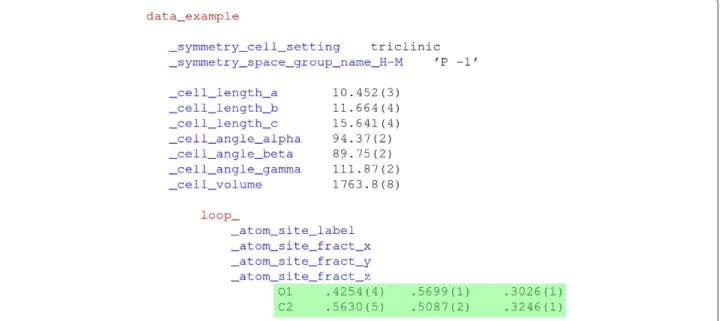
For data items with multiple values (for example vectors or matrix elements), the tag was declared once (preceded by a keyword indicating that succeeding values would be looped), and the repeated elements followed, separated by white space. Several related data items could be declared by a composite loop header, and the respective data val-ues would be listed in interleaved sequences following the ordering of their associated tags. Figure 1 shows a small example.
To encourage rapid adoption of the new format, the ini-tial tag set was designed to be easily human-readable, and to indicate the nature of the associated information by building each tag as an organised concatenation of key-words. Data types were to be inferred solely from lexical cues – “if it looks like a number, treat it as a number”.
However, by the time the standard was published, it was recognised that the approach was extensible to other fields, and that its wider take-up would require explicit rules for data typing, organization and constraints. For any specific application, these could be collected – in machine-readable form – in a “dictionary”. This was itself a file constructed using the same syntax rules, but it contained the information necessary for automated
processing of tag sets developed for specific applications. (The file also contained explicit human-readable defini-tions of the concepts that each data name was associ-ated with – part of the reason the term “dictionary” was adopted.) The particular set of tags used within the dic-tionaries themselves, to identify the names and usage of other tags, was known as a “Dictionary Definition Lan-guage” (DDL) [7].
In principle, one could now begin to construct rather general computer applications that had no inbuilt han-dling mechanism for crystallographic data, say; but which could read a dictionary of CIF tags written in DDL to learn which tags were valid, and how they might be manip-ulated in a crystallographic application. In similar vein, dictionaries of chemistry tags could be created using the same DDL formalism. And, in a neat closure, the DDL tags themselves could be defined in a self-defining dictionary in DDL format.
Such bootstrapping assembly of complex data struc-tures from primitives expressed in the same formalism is not uncommon among computer metalanguages. For instance, document type definitions (DTDs) in XML ap-plications can themselves be written in the XML language. However, the adoption of such a procedure for scientific data exchange was novel at the time CIF was proposed. Interestingly, this development was prompted by the prag-matic need to integrate crystallographic and chemical rep-resentations for organizations and applications that need to manipulate both sorts of data (such as the Cambridge Crystallographic Data Centre, which played a large role in the early development of this standard).
Such machine-readable dictionaries allowed what had beenimplicit semantic information to be replaced by an explicit set of well-defined rules that could be executed by general computer routines. Previously, a programmer had to read and interpret imprecise textual definitions of data types, and try to understand exactly how and when a tag such as chemical formula weightshould be used. Now these details could be recorded unambiguously and in a format that could be used directly by computer programs.
In practice, it transpired that writing software based only on the computer-readable rules was very difficult. This is true of all abstract metalanguage processors, and as suggested in the introduction, was one reason why SGML failed to become widespread. Even today many common crystallographic programs will have been written with significant manual interpretation of the CIF standard.
New dictionaries for new purposes – involving different communities
It also transpired that the relationships between CIF data items described by these DDL terms were not
detailed or rigorous enough to accommodate everyone’s requirements.
Specifically, the data model used in the first CIF dic-tionary provided a good description of X-ray diffrac-tion experiments and derived structural models for small molecules or for inorganic compounds. That was a nat-ural consequence of the route by which they had been developed, building on the structure refinement packages in common use by the small-molecule crystallographic community.
But that data model was not detailed enough to describe the complex relationships between atoms in a large bio-logical macromolecule such as a protein. Protein crys-tallographers are interested in amino-acid sequences and complex folds in the structure, and how specific regions of the molecule might be related to biological activity. This type of information was already stored for structures deposited at the Protein Data Bank, and a new standard format would need at least to retain that type of infor-mation, and, preferably, to improve the efficiency and richness of the information that could be stored.
In consequence, a new, extended dictionary defini-tion language (DDL2) was devised, over the course of a series of workshops, that could encode these data rela-tionships (and the relarela-tionships between structure, form and function that they represented) [8]. This new for-malism was adopted for the crystallography of biological macromolecules.
This has had the effect of creating two “dialects” of CIF. Although DDL2 is a superset of the original DDL (now renamed DDL1), software authors in the small-molecule community did not wish to re-factor their existing code, since the greater complexity of DDL2 brought no addi-tional benefits. However, both dialects of CIF share a com-mon syntax, so that many tools can handle both without any difficulty, and a reasonable degree of interoperability still exists.
At present, the CIF format is well established within the crystallographic community. For small-unit-cell struc-tures, the DDL1-based file format has become the gen-erally accepted standard, helped by its adoption as the sole and mandatory submission format for a number of journals (such asActa Crystallographica Sections C and E). Many other journals (such as those of the American Chemical Society and Royal Society of Chemistry) require authors to deposit crystallographic structural models in CIF format, either with the Cambridge Structural Database or as a supplementary document in the journal archive.
constraints applied during refinement of the crystal structure.
The IUCr journals have played a particularly important role in the process of creating some of these dictionaries. JournalNotes for Authorsformalise the specific informa-tion that is required or recommended for inclusion in var-ious categories of paper, and these are very helpful in col-lecting the concepts that the community requires for shar-ing information within that area of research. For emergshar-ing subject areas, the journals have in turn been guided by recommendations from the relevant IUCr Commission. For example, the Checklist created by the Commission for Aperiodic Crystals [9] was an essential element in the creation of the CIF dictionary for incommensurately mod-ulated crystal structures [10]. More recently, publication guidelines for structural modelling of small-angle scatter-ing data [11] are likely to provide an invaluable startscatter-ing point for formalising a small-angle scattering ontology.
While these new dictionaries spring up within separate communities, the IUCr provides a coordinating com-mittee known as COMCIFS to help to harmonise their approach. COMCIFS also maintains a register of name-space prefixes that can be used by individual developers or groups to create local CIF dictionaries.
The use of such namespaces is very helpful in practice, because the art of writing precise definitions can be very difficult. There have been numerous examples of working groups established to draft CIF dictionaries, who abandon or mothball the project. Often this is because emerging scientific areas are in a state of flux over the precise defi-nitions of still-evolving concepts and new ideas. What can then happen is that new software packages are developed that use these concepts in practical ways, and a renewed effort to draft a dictionary then has a better chance of suc-cess. CIF dictionary definitions can be initially reserved (through a namespace prefix) to a specific software imple-mentation for purposes of test and development, which allows for competing approaches in a developing subject area. However, where interoperability between applica-tions is important, the community will come in time to settle on a common set of terms that can be implemented across all the relevant packages.
Within structural biology, the DDL2-based mmCIF for-mat for biological macromolecules continues to compete with other formats, since many domain applications do not need to make use of all of the information in its rich data model, and so can work with simpler formats. How-ever, mmCIF forms the conceptual basis for the database schemas implemented within the Protein Data Bank, and is a model for ontologies expressed in other formalisms. It has also been enhanced by other structural biology communities, with extensions for structural genomics, nuclear magnetic resonance spectroscopy, cryo-electron microscopy and protein production.
Within crystallography, extensions of the DDL2-based format have also been developed for diffraction images and for a complete description of crystallographic symmetry.
In some application areas, the uptake of CIF is relatively slow. For example, detectors have historically come with their own proprietary image formats and built-in software for handling these, so that, at a purely local level, there is little need for external standards. Yet the use of the image CIF standard (imgCIF) for diffraction images allows for greater interoperability, for example within large facil-ities hosting equipment from different manufacturers. It also makes it feasible to consider a long-term archiv-ing strategy for raw experimental data, and to extend a coherent workflow for data management across the whole data lifecycle, from experiment to publication. As we shall demonstrate later in this article, the greater the poten-tial for interoperability, the more usewillbe made of the information.
Specifying more semantic content: prospects for the future Work is actively under way to develop an extended for-malism that will allow future dictionaries to convey not only, as now, the formal relationships between distinct data items within the hierarchical organization of the data model, but also algorithmic procedures relating their mutual derivation and dependence. This would, in prin-ciple, allow the values of some missing data items to bededucedfrom the values of related data elsewhere in the file.
This formalism will be based on the DDLm (dictio-nary definition language with methods) approach of Spadaccini & Hall [12]. As will readily be appreciated, it provides the potential for remarkable richness in semantic markup. A general-purpose software applica-tion, written with no reference to a specific field such as crystallography, could return the value of a unit-cell volume (cell volume) from a file which does not contain such a value, but which has instead the val-ues of the unit-cell edge lengths (cell length a,
cell length b, cell length c) and internal angles (cell angle alpha, cell angle beta,
cell angle gamma). Such a program will have no inbuilt procedures for calculating solid geometry; all the procedures that it needs to apply in deriving the cell vol-ume will be specified in the dictionary definitions for the cell parameters.
The development of software that can perform extended domain-specific calculations solely from machine-specified semantic relationships is likely to be a long-term project, but implementations such as dREL [13] demon-strate that it is feasible. How well such a project succeeds will probably depend on the perceived need for general semantic querying across several disciplines. Within any individual discipline, much effort will already have gone into writing code that optimizes performance. This may involve mathematical manipulations different from those used in the reference algorithm (i.e. one written in a dictionary specifically to demonstrate the relationships between different quantities).
Nevertheless, the development of such dictionaries could serve a number of useful purposes. They could eliminate ambiguities in calculating values that arise from different implementations (or different understandings) of mathematical and physical formulae in different pro-grams. For example, the multiplicity in a unit cell of atoms that are situated on “special positions” (sites through which a space-group symmetry operation passes) is cal-culated differently by some current crystallographic pro-grams. They could provide benchmarking and perfor-mance functions. And they could provide independent validation of structures modelled by different software implementations. As we describe in the next section, such validation is already an important consequence of the semantic markup in existing CIF-based documents.
Applied semantic markup: visualization and validation
In this section we consider two particular aspects of the improved handling of submitted structure reports arising from the semantically-rich CIF format: the ability to visu-alize the three-dimensional structural model (of particular use to readers of the published article) and the ability to perform independent calculations of derived information and compare with the author’s assertions (permitting in-depth technical peer review, and helping to assure the quality of the published results).
Routine structure visualization
For every published crystal structure in IUCr journals, we provide a three-dimensional visualization, in the form of a Jmol[14] applet that dynamically loads the associated CIF data set and allows the reader to interact with the model (Figure 2). Since we regard this as providing direct access to the supporting data, the “3-D view” is freely accessible from the online contents page, whether or not the actual article is available only to subscribers.
In Figure 2 [15] we illustrate how the semantic markup in the submitted CIF is able to identify several of the atoms as disordered across two distinct locations. These are rep-resented by the translucent ellipsoids on the right. This
representation comes fromJmol, based on the informa-tion that these atoms are disordered – we emphasize that this is not some colouring or rendering scheme chosen by the author. The pop-up menu shown in Figure 2 commu-nicates directly withJmol, and provides options to display only one of the alternative disordered configurations. At the instant this screenshot was captured, the visualiza-tion is still showing the default representavisualiza-tion (i.e.all the disordered sites are shown in a translucent style).
It may be noted that the pop-up menu suggests many of the other things that a reader can do using theJmoltool: show the molecule in ball-and-stick or space-filling rep-resentations, change colouring schemes, show the crystal packing, measure the distances and angles between any atoms in the molecule (or crystal); as well as rotate, trans-late or zoom the view.
In showing the default representation, the application has already used other semantic information in the CIF to display the structure as a connected molecular model. If, instead, the structure were of an inorganic crystal, the default view would be an extended lattice with coordina-tion polyhedra shown. If the molecule were a biological macromolecule,Jmolcould render it as a ribbon or car-toon representation. It should be noted, however, that our journals donot routinely archive structural data for biological macromolecules, because of the long-standing community practice of depositing such coordinates at the Protein Data Bank (where they can also be visualized in the same manner).
Enhanced structure visualization
Since 2008, IUCr journals have also allowed authors to publish such interactive visualizations as an integral part of their research articles, and have provided a toolkit to allow authors unfamiliar with Jmol to use many of its powerful features [16]. Figure 3 [17] is a good example of how authors can use this as a didactic tool. The but-tons and check boxes on the right of this interactive figure have been constructed by the author, using the enhanced-figure toolkit, which constructs the page using HTML and Javascript snippets that the author does not see directly. These “form elements” provide distinct preferred views or representations of the structure selected by the author. In Figure 3, the reader has selected one of the available options (highlighting in maroon a group of molecules lying along a screw axis), but is also able to rotate the figure to understand better how this three-dimensional relationship appears in practice.
Figure 2Three-dimensional visualization of a molecular structure published inActa Crystallographica Section E.The translucent ellipsoids to the left of the pop-upJmolmenu (within the orange ellipse) are alternative locations of disordered atoms. The reader is about to select one of the alternative conformations and suppress display of the other (see text for full details).
the interactive visualization program. Such a figure is a backup device, so that at least some element of the visual information is retained for the longer term.
However, we also retainJmol’s own description of the three-dimensional model it has generated from the input CIF. This is in the form of a state script, a set of com-mands describing the model in terms of solid objects and visual effects. Because the program is designed to describe chemical and crystal structures, the objects are described not as geometric primitives (e.g.“sphere”, “cylinder”), but as objects with an associated semantic function (“atom”, “bond”, “ribbon”). This, at the very least, should make it easier to implement a completely different visualiza-tion tool to render these objects in the same style ifJmol itself becomes defunct. It also provides a good basis for developing a standardised graphics modelling language to describe components of molecular or crystal structures in a program-independent way.
Building such a software-independent visualization lan-guage would not be an easy project, but there have been some prototyping efforts [18]. Such semantification of
graphics languages would in itself be a very useful long-term goal.
Validation of the submitted model
A traditional and laborious task of the reviewer of a crys-tal structure report was the independent validation of the reasonableness of the submitted model. For decades, co-editors of the IUCr journals publishing structural reports undertook such validation by hand; but as the volume of scientific research grew rapidly, this became a heavy, and ultimately unsustainable burden. With the introduc-tion of the CIF standard, automated procedures could be introduced by the journals.
Figure 3Enhanced figure inActa Crystallographica Section E.The author has created a number of preferred views or representations of the molecule, but the reader is free also to interact directly with the three-dimensional visualization.
iucr.org), freely available for checking any crystal structure [20].
Although the analysis of a structure bycheckcif is auto-mated, the interpretation of the analysis still requires human judgement, and socheckcifhas become a tool, and certainly not a replacement, for peer review. It is some-times used by journals from other publishers; and within the IUCr, how it is used varies between journals. Yet, even with the caveat that it cannot be allowed to replace peer review, its routine use does help to make the review process more efficient.
Consider the practice inActa Crystallographica Section E: Structure Reports Online. Submission of an article begins with the upload of a CIF, which is immediately subjected tocheckcif analysis. If the analysis shows that there are “class A” or “class B” alerts (representing, respec-tively, extreme or significant outliers of some calculated value from the range found in most chemical structures of the same type), then the CIFwill not be admitted into the review processunless and until it contains machine-readable comments (added by the author) referring to these outliers. These comments may simply confirm that the reasons for such outliers are discussed in the article itself; or they may provide a justification to the reviewer. In any case, they must be present, and they will be con-sidered by the reviewer as part of the overall assessment of the quality and suitability for publication of the arti-cle.Acta Cryst. Ealso has a policy of publishing the initial validation reportand the authors’ responses to such alerts alongside the published article. This both maximises the
transparency of the review process and provides an eas-ily digestible summary of the technical consistency of the model.
Figure 4Checkcifvalidation report for the structure illustrated in Figure 2.The small pop-up window (towards the bottom right) has been launched as a hyperlink from the notification visible in the lower left corner of the figure.
What may strike the casual observer, however, is the much more pronounced elongation of the red ellipsoids (representing oxygen atoms in the solvent ClO−4 (perchlo-rate) ion at the lower right). Thecheckcif procedure has not considered this ion, since it is common practice for such solvent ions not to be fully refined. This illustrates the extent to which the analysis can take full account of context, given the complete crystallographic information in the submitted CIF.
Implicit semantics in a structure report article As mentioned in theBackground section, it is expensive (in terms of effort and expertise) to add fully semantic markup to documents. For crystal structure reports, there is a great deal of semantic markup in the CIF – happily, most of it “written” by the computer programs used in the reduction and analysis of the data. But in the free-text part of the article, embedded in the CIF as distinct data fields, we do not expect authors to mark up their commentary in any greater detail than in a conventional article. Neverthe-less, from thecontextof this commentary, we are able to make more reliable assumptions and inferences about the subject matter that allow the journals to overlay additional
semantic functionality. In this section we explore a few examples of how this is done.
The virtual hyperglossary
In our simplest example we describe how we annotate the textual content of any of our journal articles, not just structure reports.
It is common for online web pages to highlight terms and phrases and hyperlink them to definitions or expanded explications in online dictionaries. Over-zealous annotation can irritate the reader, if every occur-rence of a common noun is highlighted; but judicious annotation can help non-expert readers better to under-stand the content of technical documents. An early pro-posal to create servers that would annotate documents in this way was put forward by Murray-Rust and West during the 1990s [21] under the name ofvirtual hyperglossary.
one) to compare phrases against a master index. Where a match is found, the phrase is hyperlinked to the tar-get associated with that indexed phrase – usually a definition from the Online Dictionary of Crystallogra-phy(http://reference.iucr.org) or IUPACGold Book (http://goldbook.iupac.org). The index uses “stop words” to exclude common words, or to anno-tate them in certain cases (see the following discussion relating to the word “group”).
The search/match procedure is simple and fast; and it is effective, because we are able to constrain the target ter-minologies to those most appropriate to the material we publish –i.e.to crystallography or chemistry definitions. This is simply because weonlypublish in those domains; and we can construct relevant mappings because we can tune the look-up tables to reflect common patterns of usage.
For example, we do not routinely hyperlink the single word “group”, which can have many meanings. We do identify phrases such as “space group” and “plane group”, which are specific to crystallography, and link them to their definitions in the Online Dictionary of Crystallog-raphy. However, we can also scan for phrases such as “associative group” or “group theory”, or even phrases that do not contain the word “group”, such as “inverse ele-ment”, and link these directly to the entry for “group” in theOnline Dictionary(which is a definition specifically of a mathematical group).
This is, of course, a rather simple example. We select an annotation resource based solely on the general sub-ject matter covered by our journals. Nevertheless, it is a context-specific choice that can add real semantic value and a significant level of extra utility for the reader.
Embedded geometry references
Our second example is a little more interesting, because it mines the active semantic markup in the current docu-ment to provide a context for subsequent inferences.
Figure 5 shows a rendering of a page from one of our journals [22] in a tool used by authors to preview their article before submission. In the top line of the text, some torsion angles are referenced. The reader has placed the mouse over the first of these, and a pop-up window iden-tifies two torsion angles with these atom labels (they occur in the two separate structures discussed in the article). The reader selects the one found in compound II, and a Jmolwindow appears with the selected angle highlighted. Again, within this window the reader is free to modify the view, say by generating the crystal packing to explore exactly where that torsion angle is located in the crystal lattice.
The text in the article hasnotbeen additionally marked up. However, a simple scanner detects regular expressions characteristic of molecular geometry (bond distances, angles, torsions or hydrogen-bond contacts). Using these typographic cues, a lookup can be performed of the actual
geometric values thatarelisted with full semantic tagging elsewhere in the CIF. If a single match is found, the visu-alization will immediately show that; if there are multiple matches, as in this example, the reader is asked to select the feature of particular interest.
This approach is more discriminating than a heuristic basedsolely on typographic cues – candidate geometric properties must not only have the correct typographic form (e.g. C2---C21---C22---C221) but must also correspond to a tabulated angle or bond involving the labelled atoms (C2, C21 etc.). It is an approach that offers significant additional semantic information for a large proportion of the published literature, without additional markup effort from authors or editors.
Chemical structure deduced from crystallography
As our final example, we look at something more chal-lenging – handling the sometimes complex relationship between a crystallographic and a chemical description of a molecule with limited semantic information. Consider again Figure 2. Alongside the three-dimensional represen-tation of the molecule, derived from the crystallographic experiment, there is a two-dimensional chemical diagram that displays molecular connectivity, bond types, assigned charges, and sometimes stereochemistry.
Current practice is to obtain this chemical diagram from the author as a graphic (e.g.TIFF file). While this provides rich visual information, the chemistry cannot reliably be extracted for computational purposes from an image file. A better approach would be to require a machine-readable
description of the chemistry, for example by requiring that the author provide a .mol or .sdf file.
We do not make this a requirement, in part because there may be resistance from the author (this is not a widespread practice throughout chemistry generally); and in part because it would add to the validation require-ments for each submission. Because the available file formats are proprietary, have limitations on the features they can reliably show, and use different atom labelling schemes from crystallographic programs, it is difficult to devise automated validation procedures, such as those in place for the crystallography.
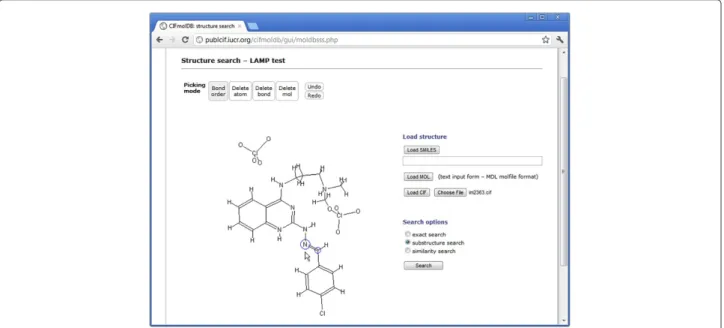
We are therefore investigating the possibility of pro-viding a tool for authors to construct a fully machine-readable description of the molecular chemistry that is derived initially from the crystallographic model (Figure 6). In this example, the same CIF that was used in Figure 2 [15] forms the basis for a chemical description of the molecule. Compare with the chemical diagram in Figure 2. The two-dimensional layout is not as tidy as the author’s supplied diagram, because here it is a projected view of a three-dimensional structure. The bond assign-ments shown are those determined by theJmolloading script (based on standard chemical values), but the author now has the opportunity to correct any mis-assignments.
As the structure is corrected, so the application can generate a connectivity graph that may be used for sub-structure and similarity searching of chemical databases (interfaces for such searches may also be seen in Figure 6). At the same time, the connection table may be written
back into the CIF, using a formalism that has existed from the initial release of the core CIF dictionary.
However, while this procedure works very well for small or simply-connected organic molecules, there are greater challenges in handling large metal–organic complexes, or polymers. This is, of course, not a surprise – stan-dard chemical databases have a variety of approaches to storing descriptions of such types of compound, and the description that is stored in a particular case may depend substantially on the interpretation of the editor loading that structure into the database.
On a number of occasions the CIF community has explored how (indeed, even whether it is possible) to determine a unique and unambiguous chemical descrip-tion of a molecular assembly from its three-dimensional packing in a crystal lattice. It is not an easy project, and so far there has been no success in extending the chemical structural description in the core CIF dictio-nary to accommodate the most complicated cases. It is a particularly difficult problem where there is significant crystallographic disorder.
The conclusion, therefore, is that chemical semantics describing a molecule can be inferred from a crystallo-graphic description in many cases; but that for complex molecules, implied semantics do not suffice – the explicit interpretation of an expert must be added to the otherwise well-defined crystallographic description.
Ontologies and pragmatics
It is not uncommon these days for informatics-driven applications to begin with a formal ontology, frequently specified in a standard representation such as OWL [23]. As mentioned in Section “Background”, CIF pre-dates the development of such ontologies, but its pragmatic adop-tion of dicadop-tionaries and the increasing semantic richness of those machine-readable dictionaries provide an oppor-tunity to compare its ‘bottom-up’ formalism with the ‘top-down’ approach of starting with an ontology.
The early CIF dictionaries supplied elements of tax-onomy and controlled vocabulary for the interchange of specific data between computer packages. Since these packages all shared a common conceptual space (descrip-tion of an X-ray diffrac(descrip-tion experiment and its derived structural model), this was sufficient for interoperability. The new standard also imposed certain constraints on programmers; for example, all physical quantities had to be expressed in the preferred unit stated in the dictionary. Such constraints were accepted, if not always cheerfully, by programmers in the discipline, and so the range of concepts formalised in the CIF dictionaries could be kept within certain limits.
Although these decriptions were optimised for use by crystallographers, their completeness (given an a priori understanding of the context in which they would be used)
made them sufficiently portable that they could be used as the basis for the tags describing structure in Chemical Markup Language (CML) [24].
Where the crystallographic applications overlapped to a greater extent with more general data management, it did become necessary to provide a richer description of the relationships between conceptual classes handled by the dictionary. In structural biology, the macromolecu-lar (mmCIF) dictionary has a strong ontological flavour [25], in which, for example, scale factors and relation-ships between physical units are tabulated. This will allow physical quantities in mmCIF format to be automati-cally scaled or compared with physical quantities in other applications (although the mmCIF standard continues to mandate that only one preferred unit is actually used for each physical quantity).
More substantially, the mmCIF dictionary introduces a classification scheme (‘category groups’) that col-lect together the multiple data names that together comprise the description of a conceptual class. For example, the ‘entity’ group describes the class of dis-crete chemical entities (e.g.separate molecular moieties), while the ‘chem comp’ group describes chemical compo-nents (e.g. amino-acid residues within a polymeric pro-tein molecule). The importance of maintaining separate classes to differentiate such functional and conceptual dis-tinctions has been emphasised in the construction of the ChemAxiom ontologies [26].
is largely compatible with many existing complementary data representations.
The amount of software engineering that is necessary to permit interoperability between systems based on dif-ferent ontological frameworks should not be underesti-mated. Nevertheless, such technical modifications are well within the skill set of competent informatics scientists and software architects. It is in the actual definitions collected in CIF dictionaries, their organisation and classification by domain experts, that the efforts of the crystallographic community have resulted in the most important asset for future semantic mining and applications.
Concluding remarks
We have demonstrated in our section Applied seman-tic markupthat rich tagging of data files provides robust approaches to visualization and validation. As a con-sequence, the quality of structures published in IUCr journals has improved overall; but, more importantly, theactualquality of an individual structure (which can depend on factors outside the experimentalist’s control, such as the susceptibility of a compound to X-ray radia-tion damage) can be objectively assessed. The structure can be easily explored – features of geometry that the author has referenced can be checked, and other geomet-ric details as easily evaluated and explored. Specific data can be extracted from the description and re-analysed or re-purposed in different applications.
In our sectionImplicit semantics in a structure report article, we demonstrated how the publication process can overlay additional semantic information on top of that explicitly provided within an article. At its simplest, we can make certain assumptions concerning words and phrases in the article, based solely on the fact that publi-cation in one of our journals circumscribes the topics that are likely to be discussed.
For the case of structure reports where there is access to semantically tagged data, certain elements of the discus-sion in an article can be keyed to the relevant data values, allowing additional functionality (such as visualization, hyperlinking or structure searches) to be embedded in the article.
In the case of inferring chemical structure, we demon-strated that some semantic enrichment is possible; but, increasingly, the reliability of such inferences will diminish as the complexity of the data increases.
In the short term, the publisher’s ability to add such value through “implied semantification” is of benefit, and does reduce the burden on the author of preparing a manuscript for submission. However, we hope we have indicated some of the shortcomings of such an approach. In spite of the richness of structured information pre-sented in a CIF, there remains scope for ambiguity and error, and we would wish to see progressively more
semantic markup, along with the development of user-friendly tools so that authors come to regard this as a normal part of the publication process.
Key to all these developments has been the develop-ment of CIF as an information interchange standard, and its adoption throughout the crystallographic community. This has made the basic generation of semantic arti-cles straightforward and relatively painless for authors of structure reports. By providing desktop tools such as publcif [30], and web services for authors such as those illustrated in the current article, the IUCr is working to further increase the explicit semantic markup in its article submissions, and consequently the usefulness and reusability of its scholarly publications. But already we have succeeded in changing the research article from an inert record of a scientific experiment to a living publi-cation, delivering straight to the researcher the scientific results, their supporting data, and the ability to interact and critically interrogate those data. We look forward to seeing similar developments in other areas of the physical sciences.
Competing interests
The author is employed as the Research and Development Officer of the International Union of Crystallography.
Acknowledgements
I thank Syd Hall, Nick Spadaccini, David Brown and many colleagues on the IUCr COMCIFS Committee for their contributions to the development of the CIF standard and for many stimulating and challenging discussions; Peter Strickland, Mike Hoyland, Simon Westrip and colleagues in the IUCr editorial offices for helping to develop the IUCr journals as semantic publications; John Helliwell for helpful comments on an early draft; an anonymous referee for requiring a deeper analysis of the relationship between the CIF model and other ontological frameworks; and Peter Murray-Rust and Henry Rzepa for inspiration and vision in the progress towards the most effective and useful means of communicating scientific knowledge in the Information Age.
Received: 25 May 2012 Accepted: 15 August 2012 Published: 30 August 2012
References
1. Goldfarb CF:The SGML Handbook. Oxford University Press; 1990. 2. Berners-Lee T:Information management: a proposal.Internal
document, CERN 1989. [See http://www.w3.org/History/1989/proposal. html]
3. Raggett DS:Raggett on HTML 4. Reading, MA: Addison-Wesley; 1998. 4. Brown ID:Standard crystallographic file structure-87.Acta Cryst1988,
A44:232.
5. Hall SR, Allen FH, Brown ID:The Crystallographic Information File (CIF): a new Standard archive file for crystallography.Acta Cryst1991, A47:655–685.
6. Hall SR, McMahon B (Eds):Definition and exchange of crystallographic data, Volume G of International Tables for Crystallography. Dordrecht: Springer; 2005.
7. Cook APF:Implementing SMD in STAR: dictionary definition language.Report March 8, ORAC Ltd, Leeds, UK 1991. 8. Westbrook JD, Berman HM, Hall SR:Specification of a relational
dictionary definition language (DDL2).InDefinition and exchange of crystallographic data, Volume G of International Tables for Crystallography. Edited by Hall SR, McMahon B. Dordrecht: Springer; 2005:61–70. 9. Chapuis G, Farkas-Jahnke M, P´erez-Mato JM, Senechal M, Steurer W, Janot
international union of crystallography commission on aperiodic crystals.Acta Cryst1997,A53:95–100.
10. Madariaga G:Classification and use of modulated and composite structures data.InDefinition and exchange of crystallographic data, Volume G of International Tables for Crystallography. Edited by Hall SR, McMahon B. Dordrecht: Springer; 2005:131–140.
11. Jacques DA, Guss JM, Svergun DI, Trewhella J:Publication guidelines for structural modelling of small-angle scattering data from biomolecules in solution.Acta Cryst2012,D68:620–626.
12. Spadaccini N, Hall SR:DDLm: a new dictionary definition language. J Chem Inform Model2012,52:1907-1916 doi:10.1021/ci300075z. 13. Spadaccini N, Castleden IR, du Boulay D, Hall SR:dREL: a relational
expression language for dictionary methods.J Chem Inform Model 2012,52:1917-1925 doi:10.1021/ci300076w.
14. Hanson RM:Jmol– a paradigm shift in crystallographic visualization. J Appl Cryst2010,43:1250–1260.
15. Jiang N, Zuo J, Wang H, Han M, Zhai X:
(E)-2-[2-(4-Chlorobenzylidene)hydrazin-1-yl]-4-{ [3-(dimethylazaniumyl)propyl]amino}quinazolin-1-ium bis(perchlorate).Acta Cryst2012,E68:o1557–o1558.
16. McMahon B, Hanson RM:A toolkit for publishing enhanced figures. J Appl Cryst2008,41:811–814.
17. Kocher JL, Edler KL, Bohling BA, Nora GP, Stafford C, Hitchcock SR, Ferrence GM:(5S6R )-5-Methyl-6-phenyl-4-propyl-1,3,4-oxadiazinane-2-thione.Acta Cryst2009,E65:o1421–o1422.
18. Bernstein HJ, Darakev G, Darakev N, Jemilawon J, McQuillan G, Todorov G, Craig PA, Mottarella SE, Wishmeyer C:A simplified unified approach for animations and movies using SBEVSL.Acta Cryst2008,A64:C195. 19. McMahon B:The role of journals in maintaining data integrity:
checking of crystal structure data inActa Crystallographica.J Res Natl Inst Standards Technol1996,101:347–355.
20. Strickland PR, Hoyland MA, McMahon B:Small-molecule crystal structure publication using CIF.InDefinition and exchange of crystallographic data, Volume G of International Tables for Crystallography. Edited by Hall SR, McMahon B. Dordrecht: Springer; 2005:557–569. 21. Murray-Rust P:The globalization of crystallographic knowledge.Acta
Cryst1998,D54:1065–1070.
22. Blanco MC, Palma A, Cobo J, Glidewell C:(2RS,4RS )-7-Fluoro-2-(2-phenylethyl)-2,3,4,5-tetrahydro-1H-1,4-epoxy-1-benzazepine and (2RS, 4RS)-7-chloro-2-(2-phenylethyl)-2,3,4,5-tetrahydro-1H -1,4-epoxy-1-benzazepine are isomorphous but not strictly isostructural. Acta Cryst2012,C68:o195–o198.
23. W3C OWL Working Group:OWL 2 web ontology language document overview.W3C recommendation, W3C 2009. [See http://www.w3.org/ TR/owl2-overview/]
24. Murray-Rust P, Rzepa HS:Chemical Markup, XML, and the Worldwide Web. I. Basic Principles.J Chem Inf Comput Sci1999,39:928–942. 25. Westbrook J, Bourne PE:STAR/mmCIF: an ontology for
macromolecular structure.Bioinformatics2000,16:159–168. 26. Adams N, Cannon EO, Murray-Rust P:ChemAxiom – an ontological
framework for chemistry in science.Nat Precedings2009. doi:10.1038/npre.2009.3714.1.
27. Hall SR, Spadaccini N:The STAR file: detailed specification.J Chem Inf Comput Sci1994,34:505–508.
28. Allen FH, Barnard JM, Cook APF, Hall SR:Specification of the Molecular Information File (MIF).InDefinition and exchange of crystallographic data, Volume G of International Tables for Crystallography. Edited by Hall SR, McMahon B. Dordrecht: Springer; 2005:44–52.
29. Ulrich EL, Markley JL, Kyogoku Y:Creation of a nuclear magnetic resonance data repository and literature database.Protein Seq Data Anal1989,2:23–37.
30. Westrip SP:publCIF: software for editing, validating and formatting crystallographic information files.J Appl Cryst2010,43:920–925.
doi:10.1186/1758-2946-4-19
Cite this article as: McMahon: Applied and implied semantics in crystallographic publishing.Journal of Cheminformatics20124:19.
Open access provides opportunities to our colleagues in other parts of the globe, by allowing
anyone to view the content free of charge.
Publish with
Chemistry
Central and every
scientist can read your work free of charge
W. Jeffery Hurst, The Hershey Company.
available free of charge to the entire scientific community peer reviewed and published immediately upon acceptance cited in PubMed and archived on PubMed Central yours you keep the copyright
Submit your manuscript here:



![Figure 5 shows a rendering of a page from one of our journals [22] in a tool used by authors to preview their article before submission](https://thumb-us.123doks.com/thumbv2/123dok_us/7882670.2100907/10.892.86.808.680.1050/figure-shows-rendering-journals-authors-preview-article-submission.webp)