AUSTRALIAN JOURNAL OF BASIC AND
APPLIED SCIENCES
ISSN:1991-8178 EISSN: 2309-8414 Journal home page: www.ajbasweb.com
Open Access Journal
Published BY AENSI Publication
© 2016 AENSI Publisher All rights reserved
This work is licensed under the Creative Commons Attribution International License (CC BY).
http://creativecommons.org/licenses/by/4.0/
To Cite This Article: T.G. Sakthivel, T.V. Arujunan, R. Vijayakumar and C. Velmurugan., Effect of Internal Reflector on the Performance of a Single Slope Solar Still. Aust. J. Basic & Appl. Sci., 10(1): 375-379, 2016
Effect of Internal Reflector on the Performance of a Single Slope Solar Still
1
T.G.Sakthivel, 2T.V.Arujunan, 3R.Vijayakumar and 4C.Velmurugan
1Department of Mechanical Engineering Panimalar Institute of Technology Chennai, India. 2Department of Mechanical Engineering C.I.E.T. Coimbatore,India
3Department of Mechanical Engineering Panimalar Institute of Technology, Chennai, India. 4Department of Mechanical Engineering Panimalar Institute of Technology, Chennai, India.
Address For Correspondence:
T.G.Sakthivel, Department of Mechanical Engineering Panimalar Institute of Technology Chennai, India.. E-mail: [email protected]
A R T I C L E I N F O A B S T R A C T Article history:
Received 10 December 2015 Accepted 28 January 2016 Available online 10 February 2016
Keywords:
reflector, internal heat transfer, productivity, efficiency, distillation
Two unit of single basin solar stills were fabricated with the inner dimension of 1m x 0.5m (effective area 0.5 m2), the glass cover was tilted at 10° with respect to the horizontal and twelve copper-constantan thermocouples were installed in the still to measure the temperatures of the glass cover, chamber, water and ambient-air in the side wall, back wall etc. An hourly amount of extracted distilled water with various temperatures and the insolation were monitored for a period of three months. The performance of the still was evaluated by implementing the following effective parameters: (a) internal reflector fixed on the inner wall surface of the solar still (b) without reflector and (c) Internal and External heat transfer. It was observed that (i) the productivity of the solar still was increasing 21 % when using reflector on the inner wall surfaces (ii) the still productivity increases with increasing ambient temperature and decreases in wind velocity, and also the still productivity increases with increasing the temperature difference between glass and water. (iii) The maximum amount of heat loss was observed in the solar still by the combination of convection and radiation heat transfer from glass to ambient.
INTRODUCTION
Mostly the availability of impure or mineralized water, which was not used as drinking purpose. This water must be purified by distillation or reverse osmosis. During distillation of water having more energy intensive and the use of solar power for this reason has been pretty well developed and applied in many places. The solar stills are particularly suitable for the developing countries, so for the remote rural areas in such countries, because low cost strategy and not require skilled technical maintenance. Their daily operation and routine maintenance is also quite simple, and the energy available is free of cost on site. A variety of devices and methods have been developed for solar distillation of water (Malik, M.A.S., 1982), which include type of basin, evaporation of water from the wicks or from brine cascade over weirs. The most generally used method is the basin type solar stills with a wide range of variation in their design, configuration, geometry and fabrication materials (Tiwari, G.N., 1985). These stills yield up to 6 liters of distilled water per square meter on a hot day in a place of high solar insolation. In this paper present detailed experimental study of a single basin type solar still.
and evaporation. The evaporated water is condensed on the inner surface of the glass by releasing its latent heat of vaporization. The condensed water trickles down the inner surface of the cover under gravity, until it is collected in internal channel as shown in fig.1. A.Delyannis and E.Delyannis (1983) reviewed about the existing solar distillation plants in the world, as well as the design geometry of various commercial solar stills. Hassan E.S. Fath (1998) gave an overall review and technical assessment of the various and up-to-date developments in single and multi-effect solar stills. His review also includes the development in still configurations, the problems encountered with units during the course of operation as well as the impact on the environment. M.T.Chaibi (2000) has investigated availability of world water resources in the main arid zones in the world; identified different solar energy desalination techniques applicable to remote dry areas especially for agriculture purposes; and economical consideration. He finally concluded that solar energy could make a considerable contribution to remote arid areas fresh water supply for domestic or agriculture use. G.N.Tiwari et al. (2003) reviewed work on solar distillation, its present status in the world today and its future perspective. He also reviewed water sources, water demand, availability of potable water and purification. Eltwail M.A. et al. (2014) conducted experiments by solar still with flat plate solar collector, spraying unit pierced tubes, external condenser and solar air collector are compared with conventional solar still and concluded that the developed solar still gives higher productivity in all aspects. K.KalidasaMurugavel. et al. (2015) experimentally evaluated the single basin solar still with different nanofluids and concluded that aluminum oxide nanofluid gives 29.95% more yield than the still with ordinary water.
Experimental setup:
Fig. 1:
A. Selecting a Template (Heading 2):
Single basin solar stills were fabricated; the basin liner was made of galvanized iron sheet of 0.5 x 1 m2 with back wall height of 288mm, front wall height of 200mm and 1.4 mm thickness. The basin surfaces are painted with black paint to absorb the maximum amount of solar radiation incident on them. The condenser surface of the still is made of glass with 4 mm thickness and angle of inclination is 10° with horizontal. There are certain specifications needed for the used glass cover in the still, and they are (a) Minimum amount of absorbed heat, (b) Minimum amount of reflection for solar radiation energy, (c) Maximum energy transmittance for solar radiation, and (d) high thermal resistance for heat loss from the basin to the ambient. Glass covers have been framed by wood and sealed with silicon rubber which plays an important role to promote efficient operation as it can accommodate the expansion and contraction between dissimilar materials. A collecting trough made by G.I. sheet is used in the still to collect the distillate condensing on the inner surfaces of the glass covers and to pass the condensate to a collecting flask. Steel rule is fixed along with inside wall for measuring water depths. The bottom and sides are insulated with 25 mm thick thermocole and 12.5 mm thick wood with thermal conductivity 0.015 W/mK and 0.055 W/mK respectively. The still technical specifications are shown in Table 1, and Fig. 1 shows the geometrical constructions of the solar still used in the experiments.
RESULTS AND DISCUSSION
25.00 35.00 45.00 55.00 65.00 75.00 85.00 9.00-10.00 10.00-11.00 11.00-12.00 12.00-13.00 13.00-14.00 14.00-15.00 15.00-16.00 16.00-17.00 Time T e m p e ra tu re , °C Water Glass Vapo ur B asin liner Inside backwall
Outside backwall Inside sidewall
Outside sidewall B o tto m side
A mbient
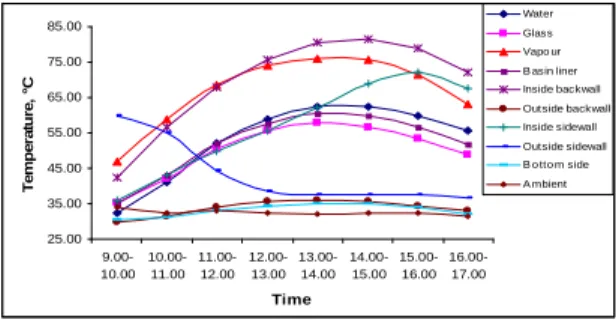
Fig. 2: Hourly variations of temperatures.
Figure 2 shows that the time versus temperature for the conventional still, it can be noted that, the water temperature, glass temperature, basin temperature, glass temperature are increased continuously until reaches the maximum, because the absorbed solar radiation exceed the losses to the environment at afternoon. Then about 14:00 hr, temperatures start to decreases due to the losses of solar still which becomes larger than the absorbed solar radiation. It can be observed that the basin temperature gets closer to the water temperature because of the continuous contact between them which lead to equilibrium. The conventional still obtained largest temperature at the inner wall side, this clearly indicated in fig 2. As the glass temperature is much smaller than the vapour temperature, it causes condensation of vapour on the glass. In the early hours at morning (9:00hrs -10:00hrs), the glass temperature is higher than the water temperature and vapour temperature causing less productivity due to the small energy absorbed by the water at these times. The results are clearly indicates the still has been given more output when Tw – Tg is maximum.
0 100 200 300 400 500 600 700 800
9.00 10.00 11.00 12.00 13.00 14.00 15.00 16.00 17.00
Time S o la r in te n s it y , W /m 2
Fig. 3: Hourly variation of solar intensity.
Fig 3 shows the intensity during the experiment day. It shows the increase in the solar intensity in the early morning until it reaches the maximum at around 12:00 hrs and 13:00hrs, then decreases in the late afternoon. The water temperature can be taken as one of parameters that have a direct effect on the productivity. When the water temperature is high the yield are getting more. Water temperature is depends on the water present inside the basin. 25 30 35 40 45 50 55 60 65 70 75 9.00-10.00 10.00-11.00 11.00-12.00 12.00-13.00 13.00-14.00 14.00-15.00 15.00-16.00 16.00-17.00 Time W a te r te m p e ra tu re , °C
Without ref lector
With ref lector
Fig. 4: Hourly variations of water temperature.
conventional still. The result also indicates the productivity of the solar distillation system in mainly depends on temperature of the basin water.
0 0.05 0.1 0.15 0.2 0.25 0.3 0.35 0.4 0.45 0.5 9.00-10.00 10.00-11.00 11.00-12.00 12.00-13.00 13.00-14.00 14.00-15.00 15.00-16.00 16.00-17.00 17.00-9.00 Time D is ti ll e d o u tp u t, k g With reflector
Without ref lector
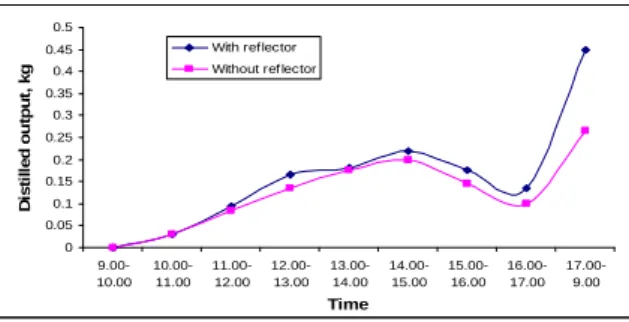
Fig. 5: Hourly variations of distilled output.
The solar still efficiency is considered as the most vital parameter to be estimated as can indicate the best still design. Fig 6 shows that the efficiency increases with time till reaching the extreme value in the afternoon for the both reflector and conventional still. At the maximum, the incident solar radiation is larger than heat losses early in the afternoon. Then the heat losses start overcoming the incident solar radiation, thus the efficiency decrease in the late afternoon. For the whole day the efficiency of the reflector still is higher than the conventional still. The efficiency of the reflector still is much higher in the evening hours; this may due to higher productivity during this period (fig 5).
0.00 10.00 20.00 30.00 40.00 50.00 60.00 70.00 80.00 90.00 100.00 9.00-10.00 10.00-11.00 11.00-12.00 12.00-13.00 13.00-14.00 14.00-15.00 15.00-16.00 16.00-17.00 Time E ff ic ie c n y with reflector without reflector
Fig. 6: Hourly variation of solar still efficiency.
0 50 100 150 200 250 300 350 9.00-10.00 10.00-11.00 11.00-12.00 12.00-13.00 13.00-14.00 14.00-15.00 15.00-16.00 16.00-17.00 Time E x te rn a l h e a t lo s s e s , W /m 2
w ithout ref lector w ith ref lector
Fig. 7: comparison of hourly variation between external heat transfers.
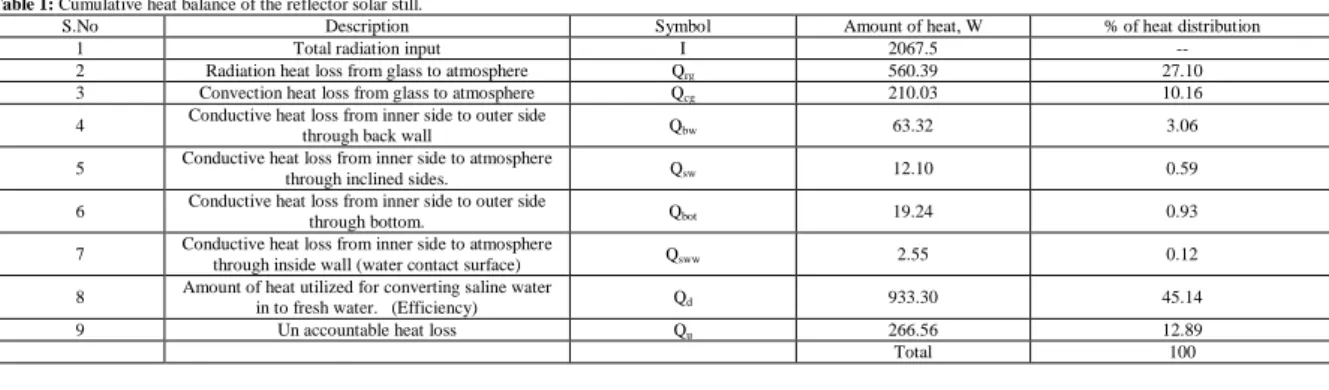
Fig 7 illustrates the external heat transfer for the reflector and conventional still. It shows clearly external heat losses are more in the reflector still when compared with the conventional still. This may due to, in reflector still, the components like water, basin liner, glass etc, are obtaining higher temperature, it will leads the more lose from the still to the atmospheres and also the energy for converting saline water into fresh water is more in the reflector still (high productivity). Table 2 indicates the maximum external loss comes from the still by radiation heat transfer from glass to ambient because of high temperature of glass, and combination of convective and radiation heat loss from glass to ambient is maximum energy transfer in the still is nearly 40%.
Conclusion:
From the result, the conclusions accomplished as follows,
(b) The maximum efficiency occurs in the evening hours and the night time production is more in the reflector solar still.
(c) The higher temperature obtained at inner wall surfaces.
(d) The maximum amount of energy losses occurs from the still at the glass by combined effect of convection and radiation.
Table 1: Cumulative heat balance of the reflector solar still.
S.No Description Symbol Amount of heat, W % of heat distribution
1 Total radiation input I 2067.5 --
2 Radiation heat loss from glass to atmosphere Qrg 560.39 27.10
3 Convection heat loss from glass to atmosphere Qcg 210.03 10.16
4 Conductive heat loss from inner side to outer side
through back wall Qbw 63.32 3.06
5 Conductive heat loss from inner side to atmosphere
through inclined sides. Qsw 12.10 0.59
6 Conductive heat loss from inner side to outer side
through bottom. Qbot 19.24 0.93
7 Conductive heat loss from inner side to atmosphere
through inside wall (water contact surface) Qsww 2.55 0.12
8 Amount of heat utilized for converting saline water
in to fresh water. (Efficiency) Qd 933.30 45.14
9 Un accountable heat loss Qu 266.56 12.89
Total 100
REFERENCES
Malik, M.A.S., G.N. Tiwari, A. Kumar and M.S. Sodha, 1982. “solar Distillation”, Pergamon press, Oxford, UK.
Tiwari, G.N., Madhuri and H.P. Garg, 1985. “Effect of water flow over the glass cover of a single basin solar still with an intermittent flow of waste hot water in the basin”, Energy convers, Mgmt, 25(3): 315-322.
Delyannis and E. Delyannis, 1983. Recent solar distillation developments, Desalination, 45(1-3): 361-369. Hassan, E.S., Fath, 1998. Solar distillation: a promising alternative for water provision with free energy, simple technology and a clean environment , Desalination, 116(1-1): 45-56.
Chaibi, M.T., 2000. An overview of solar for domestic and agriculture water needs in remote arid areas, Desalination, 127(2): 119-133.
Tiwari, G.N., H.N. Singh and Rajesh Tripathi, 2003. Present status of solar distillation, Solar Energy, 75(5): 367-373.
Eltawil, M.A., Z.M. Omara, 2014. Enhancing the solar still performance using solar photovoltaic, flat plate collector and hot air, Desalination. 349: 01-09.