AUSTRALIAN JOURNAL OF BASIC AND
APPLIED SCIENCES
ISSN:1991-8178 EISSN: 2309-8414 Journal home page: www.ajbasweb.com
Open Access Journal
Published BY AENSI Publication
© 2016 AENSI Publisher All rights reserved
This work is licensed under the Creative Commons Attribution International License (CC BY). http://creativecommons.org/licenses/by/4.0/
To Cite This Article: S. Sujatha and V.P. Krishnammal., Performance Analysis of Anurupye Vedic Multiplier in FFT Processor. Aust. J. Basic & Appl. Sci., 10(1): 579-585, 2016
Performance Analysis of Anurupye Vedic Multiplier in FFT Processor
S. Sujatha and V.P. Krishnammal
Department of Electronics and Instrumentation Engineering, Adhiyamaan College of Engineering, India
Address For Correspondence:
S. Sujatha, Department of Electronics and Instrumentation Engineering, Adhiyamaan College of Engineering, India. Tel: +919487819134; E-mail: [email protected]
A R T I C L E I N F O A B S T R A C T Article history:
Received 12 February 2016 Accepted 12 March 2016 Available online 20 March 2016
Keywords:
Anurupye, Ripple Carry (RCA) Adder, Vedic Multiplier (VM), VHDL, Urdhava Tiryakbhyam Sutra.
A high speed processor depends greatly on the multiplier as it is one of the key hardware blocks in most digital signal processing systems as well as in general processors. This paper presents the performance analysis of vedic multiplier such as Urdhva Tiryakbhyam and Anurupye. Since high speed 8-point Vedic multiplier architecture is quite different from the conventional method of multiplication like add and shift. The most significant aspect is that, the developed Anurupye multiplier architecture is based on proportionality, i.e Select a theoretical base which is common to both numbers and then take a proportional base to the theoretical base as acting as the working base. So the design complexity gets reduced for inputs of larger number of bits and modularity gets increased. The proposed Vedic multiplier is coded in VHDL (Very High Speed Integrated Circuits Hardware Description Language), synthesized and simulated using vivado 14.1. Finally the Anurupye results are compared with Urdhava Tiryakbhyam and array multiplier to show the significant improvement in its efficiency in terms of path delay (speed) and power. The high speed processor requires high speed multipliers and the Vedic Multiplication technique is very much suitable for this purpose
INTRODUCTION
The ancient system of Vedic Mathematics was rediscovered from the Indian Sanskrit texts known as the Vedas, between 1911 and 1918 by Sri Bharati Krishna Tirthaji (1884-1960) from the Atharva Vedas. According to his research all of mathematics is based on sixteen Sutras, or word-formulas (Narchi, P., 2011). These formulae describe the way the mind naturally works and are therefore a great help in directing the student to the appropriate method of solution. In the Vedic system difficult problems or huge sums can often be solved immediately by the Vedic method. These striking and beautiful methods are just a part of a complete system of mathematics which is far more systematic than the modern system. Vedic Mathematics manifests the coherent and unified structure of mathematics and the methods are complementary, direct and easy (Vaidya, S., D. Dandekar, 2010; Kumar, A., 2010). An awareness of Vedic mathematics can be effectively increased if it is included in engineering education. In future, all the major universities may setup appropriate research centers to promote research works in Vedic mathematics. The power of Vedic mathematics is not only confined to its simplicity, regularity, but also it is logical. Its high degree of eminence is attributed to the aforementioned facts. ‘Vedic mathematics’ logics and steps can be directly applied to problems involving trigonometric functions, plane and sphere geometry, conics, differential calculus, integral calculus and applied mathematics of various kind. The advantage of Vedic mathematics lies in the fact that it simplifies the complicated looking calculations in conventional mathematics to a simple one in a much faster and efficient manner. This attribute to the fact that, the Vedic formulae are claimed to be based on the “natural principles on which the human mind works”. Hence
FFT processor design using Vedic multiplier with Anurupye sutra which denotes “If one is in ratio, the other is zero operation” is implemented. Conventional mathematics is an integral part of engineering education. Since most engineering system designs are based on various mathematical approaches. All the leading manufacturers of microprocessors have developed their architectures to be suitable for conventional binary arithmetic methods. The need for faster processing speed is continuously driving major improvements in processor technologies, as well as the search for new algorithms. The Vedic mathematics approach is totally different and considered very close to the way a human mind works. A large amount of work has so far been done in understanding various methodologies (sutras) (Kumar, G.G., V. Charishma, 2012; Kerur, S.S., 2014)] . Digital multipliers are the most commonly used components in any digital circuit design. They are fast, reliable and efficient components that are utilized to implement any operation. Depending upon the arrangement of the components, there are different types of multipliers available. Particular multiplier architecture is chosen based on the application (Agarwal, J., 2010). The results are compared in terms of power, delay and area. Fast Fourier Transform (FFT) design methodology using Vedic mathematics algorithms such as Anurupye and Urdhava Tiryakbhyam provides a fast and reliable approach to compute the N-point and the performance is analysed.
II. Vedic Mathematics:
Multiplication is an important function in arithmetic operations. Multiply and Accumulate (MAC) is one of the frequently used Computation- Intensive Arithmetic Functions (CIAF) that are implemented in many Digital Signal Processing (DSP) applications such as convolution operation, filtering, Fast Fourier Transform (FFT) and in microprocessors in its arithmetic and logic unit(ALU). It can be implemented using many algorithms such as array multiplication, booth multiplication, carry save adder, and Wallace tree algorithms used for myriads (Raman, A., 2010). As a processor spends considerable amount of time in performing multiplication operation of numbers, an improvement in multiplication speed can greatly improve by the system performance (Bhongade, R.K., 2014).
2.1. Urdhava Tiryakbhyam:
Urdhava Tiryakbhyam is a Sanskrit word which means vertically crosswise in English. The method is a general multiplication formula applicable to all cases of multiplication. It is based on a novel & rudimentary concept through which all kind of partial products are generated concurrently.
2.2. Anurupye (Shunyamanyat) Sutra:
The upa-Sutra Anurupye means ‘proportionality’. Three-digit multiplication (e.g. 532 x 438) is based on this sutra is explained below.
Step 1 & 2:
Here 100 as the theoretical base and 100*5=500 as the working base.
5 3 2 +32
4 3 8 -62
---
4 7 0 -1984
Step 3:
Since 100 is the theoretical base so RHS has two digits (84). Carry over the (-19) to LHS.
As per sutra says “Proportionality” LHS is multiplied by 5 to get the working base from the theoretical base.
470*5 =2350-19=2331
Step 4:
Since RHS is still a Negative number, to make it positive it is complimented with its theoretical base 100-84=16
Subtract 1 extra from LHS for coming out of compliment 2331-1=2330
Answer is 532*438=233016
III. Implementation of FFT Processor Using Vedic Multiplier:
The 8 bit Vedic multiplier using Urdhava Tiryakbhyam and Anurupye sutra is designed in VHDL Logic
Synthesis and Simulation is done in vivado 14.1. This paper analyze the 8-point multiplications, say A= A7 A6
A5 A4 A3 A2 A1 A0 and B= B7 B6 B5B4 B3 B2 B1B0. The output line for the multiplication result will be of 16 bits
as – S15S14S13 S12 S11 S10 S9 S8 S7 S6 S5 S4 S3 S2 S1 S0. Divide A and B into two parts, the 8 bit multiplicand A
16 bit product can be written as P = A x B = (AH-AL) x (BH-BL) = AH x BH + (AH x BL + AL x BH) + AL x BL Using the fundamental of Vedic multiplication, taking four bits at a time and using 4 bit multiplier block can perform the multiplication. The outputs of 4x4 bit multipliers are added accordingly to obtain the final product.
3.1. 8-point FFT module:
In the DSP Processor, a large amount of work has been devoted to reducing the computation time of a DFT (Baas, B.M., 1999). This has led to efficient algorithms which are known as the Fast Fourier Transform (FFT) algorithms. The N-point discrete Fast Fourier Transform (DFT) is defined in equation (1).
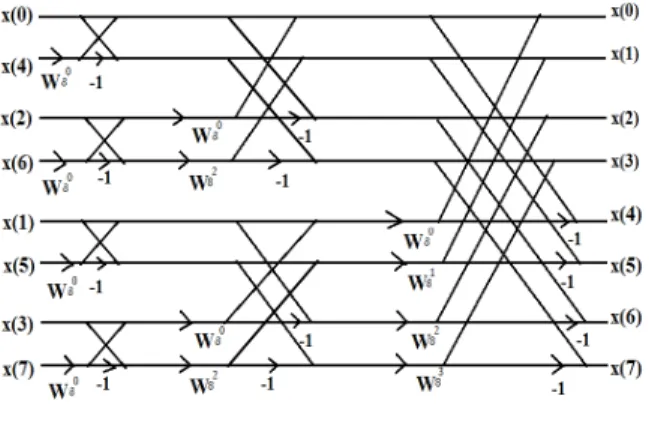
(1) X(k) is the k-th harmonic and x(n) is the n-th input sample. Direct DFT calculation requires a computational complexity of O(N2). The flow graph of complete Decimation in Time (DIT) decomposition of 8-point DFT computation is represented in Fig.1 (Vaithiyanathan, G., 2013).
Fig. 1: 8-Point DIT in FFT Algorithm.
RESULT AND DISCUSSION
In this paper, Vedic Multiplier based design of 8 point FFT using Anurupye sutra has been implemented and its performance is compared with Urdhava Tiryakbhyam. RTL View is a Register Transfer Level graphical representation of the design. It is represented in terms of macro blocks, such as adders, multipliers, and registers. Standard combinatorial logic is mapped onto logic gates, such as AND, NAND, and OR.
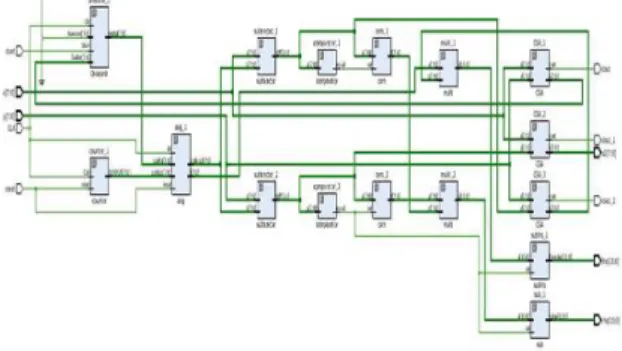
The RTL view of 8×8 bit Vedic multiplier using Urdhava and Anurupye is shown in Fig.2 and 3. The simulated response for 8×8 bit Urdhava and Anurupye is shown in Fig 4 and 5.
Fig. 2: RTL View of 8×8 Vedic multiplier (urdhava).
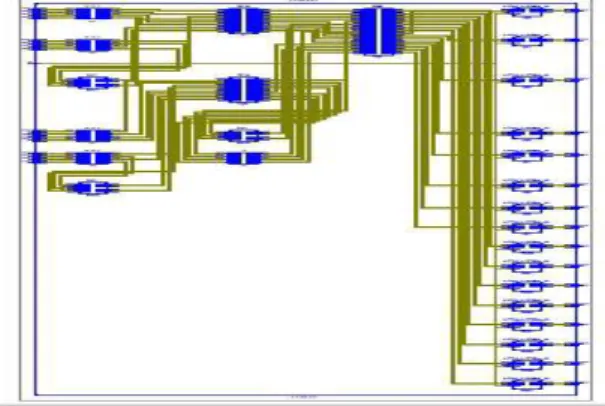
FFT processor is implemented by using both Urdhava and Anurupye algorithm based Vedic Multiplier and compared with Array Multiplier. The simulated response is analysed and the validating parameters such as power, number of gates and delay are compared. The RTL view of 8 point Array FFT and FFT using Urdhava and Anurupye is shown in Fig 6, Fig 7 and Fig 8.
Fig. 3: RTL View of 8×8 Vedic multiplier (Anurupye).
Fig. 4: Simulated Response for 8×8 bit Urdhava.
Fig. 5: Simulated Response for 8×8 bit Anurupye.
Fig. 6: RTL View of Array FFT.
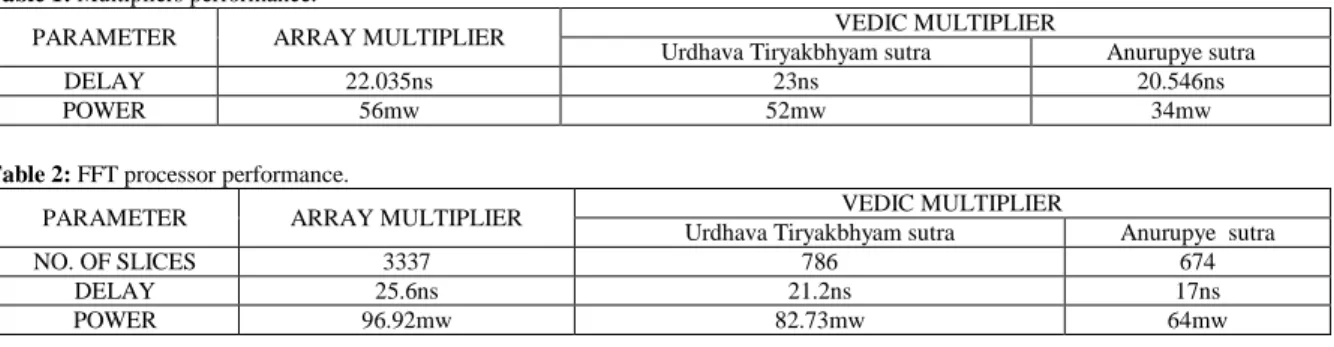
From the Table 1 the performance of array multiplier is compared with the performance of Vedic multipliers implemented in two sutras i.e Urdhava Tiryakbhyam and Anurupye. It shows that the Anurupye sutra based vedic multiplier gives optimum performance than Urdhava by reducing power and delay.
Fig.7: RTL View of FFT(Urdhava).
Fig. 8: RTL View of FFT(Anurupye).
Fig. 9: Simulated Outputs of FFT(Urdhava).
V. Conclusion:
Fig. 10: Simulated response of FFT based Anurupye algorithm.
Table 1: Multipliers performance.
PARAMETER ARRAY MULTIPLIER VEDIC MULTIPLIER
Urdhava Tiryakbhyam sutra Anurupye sutra
DELAY 22.035ns 23ns 20.546ns
POWER 56mw 52mw 34mw
Table 2: FFT processor performance.
PARAMETER ARRAY MULTIPLIER VEDIC MULTIPLIER
Urdhava Tiryakbhyam sutra Anurupye sutra
NO. OF SLICES 3337 786 674
DELAY 25.6ns 21.2ns 17ns
POWER 96.92mw 82.73mw 64mw
ACKNOWLEDGEMENTS
This work was sponsored by UGC.
REFERENCES
Narchi, P., S.S. Kerur, J.C. Nidagundi, H.M. Kittur, 2011. Girish V A. Implementation of Vedic Multiplier for Digital Signal Processing. In IJCA Proceedings on International Conference on VLSI, Communications and Instrumentation (ICVCI)(16), 15.
Vaidya, S., D. Dandekar, 2010. Delay-Power Performance Comparison of multipliers in VLSI circuit design. International Journal of Computer Networks & Communications (IJCNC), 2(4): 47-56.
Kumar, G.G., V. Charishma, 2012. Design of high speed vedic multiplier using vedic mathematics techniques. International Journal of Scientific and Research Publications, 2(3): 1.
Kerur, S.S., J.C. Prakash Narchi, H.M. Kittur, V.A. Girish, 2011. Implementation of Vedic multiplier for digital signal processing. InInternational Conference on VLSI, Communication & Instrumentation (ICVCI), 1-6.
Vaithiyanathan, G., K. Venkatesan, S. Sivaramakrishnan, S. Siva, S. Jayakumar, 2013. Simulation and implementation of Vedic multiplier using VHDL code. International Journal of Scientific & Engineering Research, 4(1).
Kumar, A., A. Raman, R.K. Sarin, A. Khosla, 2010. Small area reconfigurable FFT design by Vedic Mathematics. In Computer and Automation Engineering (ICCAE), The 2nd International Conference on(Vol. 5, pp: 836-838). IEEE.
Chidgupkar, P.D., M.T. Karad, 2004. The implementation of vedic algorithms in digital signal processing. Global J. of Engg. Edu, 8(2).
Kerur, S.S., P. Narchi, H.M. Kittur, V.A. Girish, 2014. Implementation of vedic multiplier in image compression using DCT algorithm. In Devices, Circuits and Systems (ICDCS), 2nd International Conference on (pp: 1-6). IEEE.
Baas, B.M., 1999. A low-power, high-performance, 1024-point FFT processor. Solid-State Circuits, IEEE Journal of, 34(3): 380-387.
Raman, A., A. Kumar, R.K. Sarin, 2010. High speed reconfigurable FFT design by Vedic mathematics. arXiv preprint arXiv:1006.2811.
Bhongade, R.K., S.G. Mungale, K. Bogawar, 2014. Vhdl Implementation and Comparison of Complex Mul-tiplier Using Booth’s and Vedic Algorithm. Compusoft, 3(3): 599.