© The City of Calgary, 2012. ALL RIGHTS RESERVED. No part of this document may be reproduced in any form without permission in writing from the publisher (The City of Calgary).
ROADS CONSTRUCTION
2012 STANDARD SPECIFICATIONS
Transportation Department The City of Calgary, ROADS Construction Division
2012 REVISIONS
ISC: PROTECTED 2012 i
2012 Revisions
Section Page Number or Section Revised Description
303.00.00 Granular Material Section Revised
307.00.00 Asphalt Concrete Section Revised
308.00.00 Pavement Design Section Revised
310.00.00 Portland Cement Concrete Section Revised 311.00.00 Concrete Sidewalk, Curb and Gutter Section Revised 312.00.00 Portland Cement Pavement Section Revised
315.00.00 Architectural Pavements Section Revised
316.00.00 Noise Barriers Section Revised
Drawing Revisions
Sheet Drawing title Description
1 Typical Pavement Structure Revised
2 Typical Pavement Structure Revised
3 Full Depth Asphalt Paving Removed
4 Full Depth Asphalt Paving for DTN > 500 Removed
26 Standard Curb With 250mm Gutter Revised
49 Jointing Details Around Medians and Cul-de-sacs Revised 50 Pavement Joints and Cross Section Details Revised
72 Typical Offset Gates Revised
75 Typical Pathway and WCR Connection Revised
96 Typical Mid Block Crossing Detail Revised
97 Sound Fence Vertical Boards Removed
98 Sound Fence Horizontal Boards Removed
103 Preferred Wood Screen Fence Removed
104 1.80m Screening Fence Removed
105 Wood Screen/Sound Fence New
108 Standard Bus Stop Apron Type ‘C’ Revised
109 Typical Bus Zone Aprons Revised
TABLE OF CONTENTS
ISC: PROTECTED 2012 iii
Table of Contents
Utility and Pipeline Location ... 1
Specification Definitions ... 3
300.00.00 – General ... 5
300.01.00 – Excavation Permits ... 5
300.02.00 – Qualifications of Pre-cast Concrete Manufactures ... 6
300.03.00 – Wood Products... 6
300.04.00 – Coatings ... 6
300.05.00 – Reinforcing Steel ... 7
300.06.00 – Alternate Construction Materials ... 7
300.07.00 – Testing ... 7
301.00.00 – Site Preparation ... 9
301.01.00 – Clearing ... 9
301.02.00 – Grubbing ... 9
301.03.00 – Construction Details ... 10
301.04.00 – Ornamental and Danger Trees ... 10
301.05.00 – Stripping ... 11 302.00.00 – Earthwork ...13 302.01.00 – Definitions ... 13 302.02.00 – Grading General ... 15 302.03.00 – Dust Control ... 16 302.04.00 – Excavation ... 16 302.05.00 – Embankment Construction ... 19 302.06.00 – Sub-grade Preparation ... 22 302.07.00 – Quantity Measurement ... 22 303.00.00 – Granular Material ...25
303.01.00 – Pit Run Fill Gravel ... 25
303.02.00 – Granular Base Course and Sub-Base Course Gravel ... 26
303.03.00 – Drainage Gravel ... 31
303.04.00 – Gravelled Lane Gravel ... 32
TABLE OF CONTENTS iv 2012 ISC: PROTECTED 304.01.00 – General ... 35 304.02.00 – Moisture Requirements ... 36 304.03.00 – Density Requirements ... 36 304.04.00 – Non-Shrink Fill... 37
304.05.00 – Control Density Fill ... 37
304.06.00 – Surface Rehabilitation of Trenches or Cuts ... 39
304.07.00 – Excavation in Newly Resurfaced or Top Lifted Streets ... 40
304.08.00 – Testing ... 41
305.00.00 – Gravel Road and Lane Construction ...43
305.01.00 – Base Gravel Base Course ... 44
305.02.00 – Fine Grading Of Base Course ... 45
305.03.00 – Quantity Measurements ... 45
306.00.00 – Base Stabilization ...47
306.01.00 – Soil Cement Base Course ... 47
306.02.00 – Lime Stabilization ... 53
306.03.00 – Asphalt Stabilization ... 55
306.04.00 – Chemical Stabilization ... 58
307.00.00 – Asphalt Concrete ...59
307.01.00 – Asphalt Binder ... 59
307.02.00 – Asphalt Concrete - Superpave ... 62
307.03.00 – Asphalt Concrete - Marshall ... 94
307.04.00 – Stone Matrix Asphalt ... 126
308.00.00 – Pavement Design ... 157
308.01.00 – General ... 157
308.02.00 – Minimum Pavement Sections ... 158
308.03.00 – Pavement Design – Major and Industrial Roadways ... 158
308.04.00 – Allowable Deflections ... 161
309.00.00 – Special Surface Construction ... 163
309.01.00 – Asphalt Curbs... 163
309.02.00 – Asphalt Walkways and Bicycle Paths ... 164
309.03.00 – Driveway Aprons ... 165
309.04.00 – Roadway Paving Stones ... 169
TABLE OF CONTENTS
ISC: PROTECTED 2012 v
310.00.00 – Portland Cement Concrete ... 171
310.01.00 – General ... 171
310.02.00 – Materials ... 171
310.03.00 – Submittals ... 174
310.04.00 – Concrete Properties ... 175
310.05.00 – Concrete Production and Delivery ... 175
310.06.00 – Quality Assurance ... 176
311.00.00 – Concrete Sidewalk, Curb and Gutter ... 179
311.01.00 – General ... 179 311.02.00 – Site Preparation ... 183 311.03.00 – Base Preparation ... 184 311.04.00 – Forms ... 185 311.05.00 – Reinforcing ... 186 311.06.00 – Concrete Placing ... 187 311.07.00 – Finishing ... 189 311.08.00 – Curing ... 190 311.09.00 – Commercial Sidewalks ... 190
311.10.00 – Crossings, Bus Stop Aprons and Wheel Chair Ramps... 192
311.11.00 – Concrete Walkways and Bicycle Paths ... 196
311.12.00 – Rehabilitation ... 196
311.13.00 – Maintenance Standards ... 198
311.14.00 – Quantity Measurements ... 205
312.00.00 – Portland Cement Pavement ... 207
312.01.00 – General ... 207
312.02.00 – Materials ... 207
312.03.00 – Concrete Mixes: Design and Trial Batch Testing ... 209
312.04.00 – Equipment ... 210
312.05.00 – Paving Operations ... 211
312.06.00 – Strike-Off, Consolidation and Finishing ... 213
312.07.00 – Integral Curbs... 216
312.08.00 – Joints ... 216
312.09.00 – Curing ... 219
312.10.00 – Joint Sealing... 219
312.11.00 – Surface Tolerance ... 219
TABLE OF CONTENTS
vi 2012 ISC: PROTECTED
312.13.00 – Thickness Verification ... 220
312.14.00 – Unit Rate Adjustment ... 221
312.15.00 – Concrete Overlay For Pavement Rehabilitation ... 223
312.17.00 – Bus Lay-Bys ... 227
313.00.00 – Fencing ... 229
313.01.00 – General ... 229
313.02.00 – Barbed Wire Fencing ... 229
313.03.00 – Chain Link Fencing ... 230
313.04.00 – Fence Removal ... 232
313.05.00 – Fence Removal and Relocation ... 232
314.00.00 – Guardrails ... 233
314.01.00 – General ... 233
314.02.00 – Steel W-Beam on Wooden Posts ... 233
314.03.00 – Steel Box Beam on Steel Posts ... 235
314.04.00 – Pre-cast Concrete Guardrail ... 236
314.05.00 – Concrete Guardrail ... 239
315.00.00 – Architectural Pavements ... 241
315.01.00 – Reference Standards ... 241
315.02.00 – Exposed Aggregate Surfaces ... 241
315.03.00 – Concrete Paving Stones ... 243
315.04.00 – Paving Brick ... 248
315.05.00 – Brick Pavement ... 251
315.06.00 – Silane Surface Treatment ... 251
316.00.00 – Noise Barriers ... 253
316.01.00 – General ... 253
316.02.00 – Wood Noise Barrier ... 255
316.03.00 – Pre-cast Concrete Noise Barrier - Zero Slump ... 255
316.04.00 – Pre-cast Concrete Noise Barrier - Wet Cast ... 258
317.00.00 – Railway Crossing Planks ... 261
317.01.00 – General ... 261
318.00.00 – Mudjacking and Soil Stabilization ... 263
318.01.00 – General ... 263
TABLE OF CONTENTS
ISC: PROTECTED 2012 vii
318.03.00 – Grout Material ... 266
318.04.00 – Equipment ... 266
318.05.00 – Construction ... 267
318.06.00 – Inspection and Testing ... 269
318.07.00 – Measurement ... 270
319.00.00 – Geotextiles and Geomembranes ... 271
319.01.00 – Filter Fabrics ... 271 320.00.00 – Agricultural Crossings ... 273 320.01.00 – General ... 273 320.02.00 – Design ... 273 320.03.00 – Construction ... 274 320.04.00 – Inspection ... 275 320.05.00 – Maintenance... 275 321.00.00 – Landscaping ... 277 322.00.00 – Standard Drawings ... 279
322.01.00 – Drawings Changes for 2012 ... 279
LIST OF TABLES
ISC: PROTECTED 2012 ix
List of Tables
Table 1: Rock Excavation Guidelines ... 14
Table 2: Maximum Lift Thickness and Minimum Compaction ... 21
Table 3: Pit Run Fill Gravel ... 25
Table 4: Granular Base Course Gradation Limits ... 28
Table 5: Granular Sub-Base Course Gradation Limits ... 29
Table 6: 40 mm Crushed Gravelled Lane Gravel Gradation Limits ... 32
Table 7: Compaction Requirements for Utility Trench Backfilling Compaction ... 36
Table 8: Aggregate Grading Specifications for Non-Shrink Fill Material ... 37
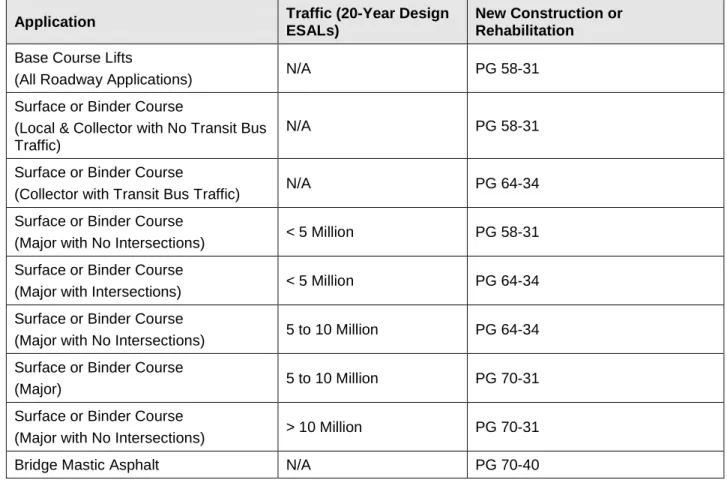
Table 9: Performance Grade Asphalt Binder Requirements for Different Road Classifications ... 61
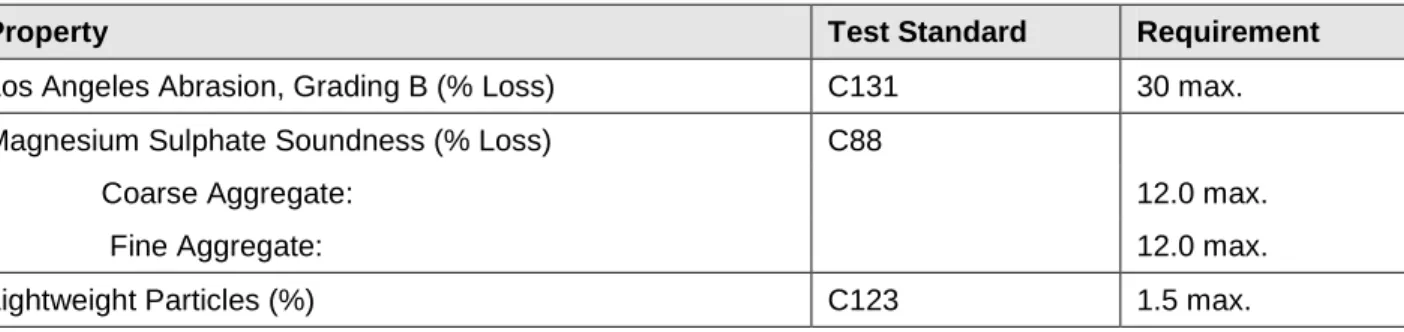
Table 10: Aggregate Physical Property Requirements ... 63
Table 11: Blended Aggregate Gradation Requirements ... 64
Table 12: Minimum Requirements for Coarse Aggregate Fracture Counts ... 64
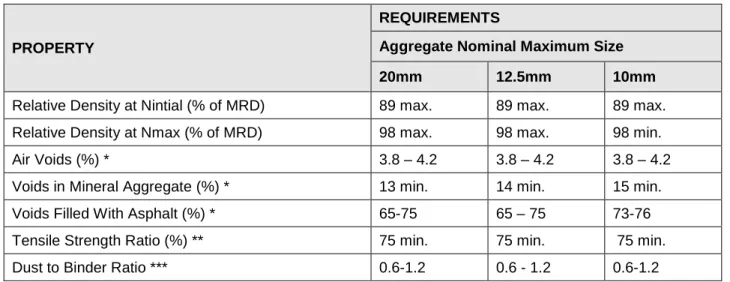
Table 13: Mixture Physical Property Requirements ... 67
Table 14: Aggregate Gradation Tolerance ... 68
Table 15: Pre-Production Quality Control Requirements ... 69
Table 16: Post-Production Quality Control Requirements ... 70
Table 17: Acceptance Testing Requirements - Category A & B Projects ... 72
Table 18: Payment Adjustments for Asphalt Content ... 80
Table 19: Payment Adjustments for Pavement Compaction ... 81
Table 20: Payment Adjustments for Air Void Content ... 81
Table 21: Payment Adjustments for Thickness... 82
Table 22: Payment Adjustments for Major Road Based on Smoothness Specifications ‘A’ ... 86
Table 23: Payment Adjustments for Major Roads Based on Smoothness Specifications ‘B’ ... 88
Table 24: Aggregate Physical Property Requirements ... 96
Table 25: Blended Aggregate Gradation Requirements ... 96
Table 26: Blended Aggregate Gradation Requirements for Polymer Modified Bridge Mastic Mixes ... 97
Table 27: Mixture Physical Property Requirements ... 99
Table 28: Polymer Modified Bridge Mastic Mixes – Property Requirements ... 99
Table 29: Aggregate Gradation - Tolerances... 100
Table 30: Pre-Production Quality Control Requirements ... 102
Table 31: Post-Production Quality Control Requirements ... 103
Table 32: Acceptance Testing Requirements - Category A & B Projects ... 104
Table 33: Payment Adjustment Factors for Asphalt Content ... 112
LIST OF TABLES
x 2012 ISC: PROTECTED
Table 35: Payment Adjustment Factors for Air Void Content ... 113
Table 36: Payment Adjustment Factors for Deficiencies in Thickness ... 114
Table 37: Payment Adjustments for Major Roads Based on Smoothness Specifications ‘A’ ... 118
Table 38: Payment Adjustments for Major Roads Based on Smoothness Specifications ‘B’ ... 120
Table 39: Aggregate Physical Property Requirements ... 127
Table 40: Blended Aggregate Gradation Requirements ... 127
Table 41: Cellulose Fibre Quality Requirements ... 129
Table 42: Mixture Physical Property Requirements ... 130
Table 43: Aggregate Gradation ... 131
Table 44: Pre-Production Quality Control Requirements ... 132
Table 45: Recommended Post-Production Quality Control Requirements ... 133
Table 46: Acceptance Testing Requirements – Category A & B Projects ... 135
Table 47: Payment Adjustments for Asphalt Content ... 143
Table 48: Payment Adjustments for Pavement Compaction ... 143
Table 49: Payment Adjustments for Air Void Content ... 144
Table 50: Payment Adjustments for Thickness... 144
Table 51: Payment Adjustments for Major Roads Based on Smoothness Specifications – ‘A’ ... 148
Table 52: Payment Adjustments for Major Roads Based on Smoothness Specifications ‘B’ ... 150
Table 53: Minimum Pavement Sections ... 158
Table 54: Minimum Pavement Thickness Requirements, Major and Industrial Roadways ... 161
Table 55: Standard Aggregate Requirements ... 172
Table 56: Requirements for Class of Exposure C-2 ... 175
Table 57: Payment Adjustments for Durability and Strength of Concrete ... 178
Table 58: Mix Properties of Concrete Sidewalk, Curb and Gutter ... 179
Table 59: Performance Characteristics of Concrete Sidewalk, Curb and Gutter ... 179
Table 60: Replacement or Liquidated Damages Based on the Percent Affected Area of the Surface Condition ... 199
Table 61: Replacement of Concrete Based on Type ... 199
Table 62: Concrete Pavement Mix Properties ... 209
Table 63: Concrete Overlay Mix Performance ... 210
Table 64: Payment Adjustments Based on Minimum Allowable Strength ... 222
Table 65: Payment Adjustments Based on the Spacing Factor ... 223
Table 66: Concrete Overlay Mix Properties ... 224
Table 67: Concrete Overlay Mix Performance ... 224
Table 68: Minimum Requirements for Rail Elements ... 233
Table 69: Maximum Deflection Limits ... 234
LIST OF TABLES
ISC: PROTECTED 2012 xi
Table 71: Performance Characteristics of Concrete Pavement ... 242
Table 72: Gradation Requirements for Gap Graded Aggregate ... 242
Table 73: Gradation Requirements for Sand Bedding Course ... 246
Table 74: Physical Requirements for Class SX Paving Bricks ... 249
Table 75: Maximum Abrasion Index, Maximum Volume Abrasion Loss and the Tolerance ... 250
Table 76: Maximum Permissible Extend of Chipping from Edges and Corners ... 250
Table 77: Mix Properties of Grout ... 265
Table 78: Separation Membranes ... 271
UTILITY AND PIPELINE LOCATION NUMBERS
ISC: PROTECTED 2012 1
Utility and Pipeline Location
Prior to commencement of any work the Contractor shall contact the appropriate agencies to locate existing underground utilities and pipelines in or adjacent to the construction work site. The utility or pipeline agencies shall be contacted two working days prior to commencement of work.
Excavation Permits
Excavation Permits shall be obtained from The City of Calgary, Transportation, Roads, The Excavation Permit Office located at 2808 Spiller Rd S.E., South Tower, Main Floor , prior to any excavation in public right of ways.
Emergency Services
If you accidentally damage the coating, scrape, sever or rupture any underground line please call the appropriate emergency number immediately.
Watch for above ground structures such as utility pedestals, power lines and hydrants that are located in roadways, lanes and private property. If they are damaged please report the incident immediately.
DEFINITIONS
ISC: PROTECTED 2012 3
Specification Definitions
These definitions appear throughout the document and should be used as a general reference where indicated.
End Product Specification (EPS) – A specification whereby the methods of construction are not defined. Under EPS the Engineer will monitor the Contractor's control of the process that produces the items of construction and will accept or reject the end product according to a specified acceptance plan. The Contractor is responsible for quality control. End product acceptance, including quality assurance is the responsibility of the Engineer.
Engineer – As referred to in this specification, shall be taken to be The City of Calgary Materials and Research Engineer or a designate.
Hot Mix Asphalt (HMA) – Generally refers to the mixture of aggregates and asphalt cement, and other additives where applicable.
Asphalt Concrete – Generally refers to the final HMA product in place.
Pre-Production Quality Control – Materials and process quality control conducted by the Contractor or their Designate, in accordance with this specification prior to plant mixing.
Post-Production Quality Control – Materials and construction quality control conducted by the Contractor or a designate, in accordance with this specification during and after plant mixing.
Quality Assurance – Acceptance testing and the monitoring undertaken on behalf of the Engineer.
Job Mix Formula – The job mix formula (JMF) establishes the proportioning of aggregate, asphalt cement and reclaimed asphalt pavement (RAP) and/or liquid anti-strip agents, where applicable, to be used for the production of hot mix asphalt (HMA).
DEFINITIONS
4 2012 ISC: PROTECTED
Project Category – For the purposes of this specification in section 307.00.00 – Asphalt Concrete, projects are to be identified in the Contract Special Provisions as Category A or Category B. Generally, Category A projects have asphalt concrete quantities greater than 3000 tonne of any one mix type and Category B projects have quantities of any one mix type less than 3000 tonne. Subdivision developments shall be considered Category B projects, with the exception of Major Roads which may be deemed Category A projects at the sole discretion of the Engineer. In all cases the Special Provisions govern with respect to the applicable Project Category.
Lot – A Lot is a portion of the work being considered for acceptance, and is defined as the following:
• Category A Projects – One day of plant production, per mix type, when the day's quantity is greater than 5,000 sq.m. When a day's production is less than 5,000 sq.m., the
material may be added to the previous or subsequent day(s) of production, at the Engineer's discretion. The maximum Category A Lot size shall be 15,000 sq.m.
• Category B Projects – For each mix type, 5000 sq.m., or the entire project quantity when the quantity is less than 5,000 sq.m., or a portion of the entire project less than 5,000 sq.m. as established by the Engineer prior to the project.
300.00.00 GENERAL
ISC: PROTECTED 2012 5
300.00.00 – General
The following section is a list of required specifications and/or qualifications relevant to work carried out under these Specifications.
300.00.01 – Application of Specifications
Notwithstanding any other specification, any deviation from these Specifications shall constitute non-compliance and may result in the rejection of the work.
300.00.02 – Basis for Payments
Payment for work carried out under these Specifications shall be under either: • Lump Sum – no specific unit of payment for work in this category.
• Unit Rate – work paid for by unit, such as tonne, cubic meter (m3), square meter (m2), etc.
Payment made under either mode of payment shall be considered full compensation for all labour, materials and equipment necessary to complete the work.
• Force Account – When directed by the Engineer, additional work not covered by either Lump Sum or Unit Rate shall be paid for under the Schedule of Force Account Rates.
300.01.00 – Excavation Permits
Permits are required for all types of street construction. The Contractor acquires from the Excavation Permit Clerk, Roads, one (1) excavation permit for each job undertaken under this Contract. All three pages of the permit shall be returned to the Roads Excavation Permit Clerk upon completion of work covered by the permit.
This permit shall be taken out at least forty eight (48) hours in advance of construction commencement. In the downtown area, an excavation permit shall be required for each individual block. The downtown area is defined as the area bounded by and including 14 Street S.W. on the West, 17 Avenue S.W. on the South, 6 Street S.E. on the East and the Bow River on the North.
If the work has not commenced within fourteen days after the Permit has been issued, please contact the Excavation Permit Office for an extension, at 403-268 4936.
300.00.00 GENERAL
6 2012 ISC: PROTECTED
300.02.00 – Qualifications of Pre-cast Concrete Manufactures
All pre-cast concrete elements referred to in these specifications shall be fabricated in a manufacturing plant certified by the Canadian Standards Association in the appropriate categories according to CSA Standard A251-M1982. The pre-cast concrete manufacturer shall be certified prior to submitting the tender. Only pre-cast concrete elements fabricated in such certified plants shall be acceptable to The City. Plant certification shall be maintained for the duration of the fabrication of the elements for the project.300.03.00 – Wood Products
Unless otherwise specified, all wood products referred to in these Specifications shall be pressure treated with either Copper Naphthenate or Penta Chlorophenol in accordance with CSA 080.1 and CSA PS-74 and shall be identified using certification marks authorized by the Canadian Wood Preservers Bureau (CWPB) and the National Lumber Grades Authority (NLGA).
Note: Workers should wear personal breathing filters when cutting wood treated with the above mentioned preservatives.
All panels composed of laminated wood boards shall be in accordance with CSA Standard CAN/CSA-0122-M. All glues shall be water resistant in accordance with CSA Standard 0112-M. All nails and other fastening devices used with wood products shall be either hot dip galvanized steel, stainless steel or nonferrous.
300.04.00 – Coatings
All paints, stains and other coatings referred to in these Specifications shall be subject to certification by the supplier that the coating meets or exceeds the accelerated weathering test in accordance with the requirements of CGSB Standard 1-GP-71 Method 122.1 and ASTM Standard G23-81.
When prepared and tested as outlined, the coating shall, at the 2500 hour exposure
evaluation, show no checking, blistering, loss of adhesion or other defects. Chalking shall be seven or higher and the colour difference shall not exceed five units when measured in accordance to CGSB Standard 1-GP-71 Method 12.1. Unless otherwise specified, stains shall be semi-transparent and shall meet or exceed the accelerated weathering
300.00.00 GENERAL
ISC: PROTECTED 2012 7
300.05.00 – Reinforcing Steel
300.05.01 – General
All reinforcing steel, referred to in these Specifications, when placed in the works shall be free from hardened mortar, dirt, rust, scale, paint, oil or other foreign material that may destroy bond.
300.05.02 – Cover
Concrete cover on reinforcing steel shall be a minimum of 50 mm.
300.06.00 – Alternate Construction Materials
Unless otherwise specified, all alternate construction materials including, but not limited to, recycled plastic, recycled concrete, recycled asphalt, etc., proposed as an alternate to materials specified in these specifications, shall be subject to the same or similar specifications as applicable to the already specified material. The use of any alternate material shall be at the sole discretion of the Engineer. The Engineer may request additional tests to ensure that alternate material is suitable for the application intended.
Note: Recycled concrete shall not be used as a surface course or as pipe zone backfill. Recycled asphalt shall not be used as an alternate for gravel under hot mix asphalt.
300.07.00 – Testing
300.07.01 – General
Where reference is made to an ASTM designation or a CSA standard, the current standard applies.
301.00.00 SITE PREPARATION
ISC: PROTECTED 2012 9
301.00.00 – Site Preparation
301.01.00 – Clearing
All work under this item shall be done in accordance with these Specifications and in conformity with the plans.
In developed and semi-developed areas where driveable streets exist and where the project calls for grading and/or paving, the limits of clearing include the area covered by the
improvement including private property if accordingly staked by the Engineer. Buildings, fences, lumber piles, trash and obstructions with the exception of utility poles within the area to be cleared shall be removed and properly disposed of by the Contractor.
Trees, shrubbery and flower beds designated by the Engineer are left in place and care shall be taken by the Contractor not to damage or injure such trees, shrubbery or flower beds by any of his operations. Where required by the Engineer, the Contractor shall construct temporary fencing to keep equipment away from tree roots.
The Contractor shall construct all temporary fences, gates, telephone lines or other structures necessary to provide temporary service during the progress of the work. All buildings, fences, trees, curbs or other properties, which are not to be removed from the right-of-way, shall be protected during the progress of the work. The Contractor shall not cut or remove shrubs or trees without the prior approval of the Engineer. The Contractor shall water and fertilize existing trees and shrubs where these are affected by the Contractor's work.
The Contractor shall be responsible for all damages to existing improvements resulting from the Contractor’s operations.
301.02.00 – Grubbing
301.02.01 – Protection of Existing Improvements
Where it is necessary to remove stumps, and where there are surface or subsurface
improvements, the Contractor shall be responsible for determining which agencies, public or private, have underground or service utilities in the vicinity of the stump to be removed. Further, the Contractor shall notify each agency and request its assistance in locating its services.
301.00.00 SITE PREPARATION
10 2012 ISC: PROTECTED
Where sewer, water, electric, telephone, steam, gas and similar underground services into residences are imperilled by stump removal, the utility agency affected cuts the service and replaces same at no cost to the Contractor. Where telephone cable and/or ducts, water mains, gas mains, steam mains, and sewer trunks exist and are likely to be damaged, special care shall be taken and roots of stump are cut off in such a manner that the existing utility installations are not damaged in any way.
301.02.02 – Contractor’s Responsibility
Regardless of the co-operation of affected agencies and utilities, the Contractor shall be responsible for any damage to service and utilities that are attributable to the Contractor’s operations and shall be responsible for the necessary repairs.
Any damage resulting from the Contractor's operations to existing improvements within the area to be grubbed, but which are not required to be removed by the grubbing shall be repaired by the Contractor at his expense. The Contractor shall not be held responsible for damage to such improvements if the damage occurred previous to beginning of the Contract. If the Contractor removes stumps for private property owners along the project, the
Contractor shall be responsible for all damage resulting there from.
301.03.00 – Construction Details
All stumps, roots, foundations and planking embedded in the ground within the limits
described herein or otherwise described in the special provisions, are removed and disposed of. Piling and butts of utility poles shall be removed to a minimum depth of 600mm below sub-grade or 600 mm below original ground, whichever is lower. Disposal requirements for grubbing are the same as those described in section 301.01.00 – Clearing.
Removal of sod and lawns that are not to be replaced shall be considered as incidental to other work of the project and no payment shall be made. Grubbing shall otherwise meet requirements previously outlined in section 301.01.00 – Clearing.
301.04.00 – Ornamental and Danger Trees
301.04.01 – Ornamental Trees
It shall be the responsibility of the Contractor to preserve any trees in accordance with provisions in G.C.4.35.6 in the Standard General Conditions; and as per the Tree Protection Bylaw.
301.00.00 SITE PREPARATION
ISC: PROTECTED 2012 11
301.04.02 – Danger Trees
(Section Deleted)
301.05.00 – Stripping
The Contractor shall be required to strip, stockpile and re-spread the material as directed by the Engineer.
The Contractor shall ensure that sub-soils do not get mixed in with the topsoil. The Contractor shall notify Parks prior to commencing the stock piling operation.
302.00.00 EARTHWORK
ISC: PROTECTED 2012 13
302.00.00 – Earthwork
302.01.00 – Definitions
All materials excavated in accordance with these Specifications are classified in the following section.
302.01.01 – Common Excavation
This means the excavating, hauling, placing and compacting in embankments of materials which are not classified as “topsoil” and/or "rock excavation" within the limits of the Contract.
302.01.02 – Waste Excavation
This means the excavating, hauling, disposing and levelling, within the limits of the Contract and at designated disposal areas, of materials which are surplus or unsuitable, but not of materials classified as “topsoil” and/or "rock excavation".
302.01.03 – Rock Excavation
1) General
Rock excavation shall be paid for when the material encountered consists of mass or bed rock or a boulder of volume greater than 0.73 cubic meters. Such rock excavation is divided into two categories; (A) and (B), contingent upon its hardness and difficulty experienced in excavation. It shall be the Contractor's responsibility to demonstrate, to the Engineer's satisfaction that the material cannot be removed or that difficulty is being experienced through excavation by conventional means. In doing so, the Contractor may be required by the Engineer to seek and explore planes of weakness or layers that may ease the excavation process.
Type ‘A’ Rock
Type ‘A’ Rock refers to materials, such as fractured sandstone, shale or ledge rock, which can be removed by the minimum size of backhoe specified in the matrix on the following page for the depth of trench excavation and size of pipe being installed. For open excavation, it refers to materials which, in the opinion of the Engineer, result in:
• Substantial delay or decrease in the normal rate of excavation using conventional equipment.
302.00.00 EARTHWORK
14 2012 ISC: PROTECTED
• Significant damage or wear to the excavating equipment.
Type ‘B’ Rock
Type ‘B’ Rock requires drilling, blasting, wedging or jack hammering to remove, as determined by the Engineer.
Table 1: Rock Excavation Guidelines
Pipe Diameter or
Equivalent Duct 0 – 300 mm 301 – 400 mm 401 – 500 mm 501 – 750 mm 750 mm
DEPTH RANGE MINIMUM SIZE BACKHOE (Cu. Yd.)
20mm to 300mm 1½ 1½ 2 2½ 2½ 350mm to 500mm 1½ 1½ 2 2½ 2½ 550mm to 750mm 2 2 2 2½ 2½ 800mm to 1050mm 2½ 2½ 2½ 2½ 4 1050mm to 1400mm 2½ 2½ 2½ 4 4 1450mm to 1700mm 2½ 2½ 4 4 4 1750mm to 2000mm 2½ 2½ 4 4 4 2050mm to 2300mm 2½ 2½ 4 4 4 Over 2300mm 2½ 2½ 4 4 4 302.01.04 – Stripping
Stripping is defined as the excavation, hauling and stockpiling (or immediate re-spreading) within the Contract limits of all organic material considered as topsoil or loam.
302.01.05 – Re-spreading
Re-spreading is defined as the hauling and spreading of topsoil which has previously been stripped and stockpiled.
302.01.06 – Benching
Where embankments are required on hillsides or where a new fill must be applied on an existing embankment, the slopes of the original ground or embankment (except rock embankment) shall be terraced or stepped by approved means before filling shall commence.
302.00.00 EARTHWORK
ISC: PROTECTED 2012 15
302.02.00 – Grading General
The Contractor does all excavation of whatever substance is encountered to the depth and grades established by the Engineer. After excavation has been completed, the sub-grade shall conform to design section and grade.
302.02.01 – Ownership of Material
Under no circumstances shall any excavated material be sold or otherwise disposed of by the Contractor, Sub-Contractor or any of their employees. The excavated materials remain the property of The City.
Suitable excavated material shall be used for the making of all required project
embankments. The suitable portion of the excavated material shall be stored on or off the project, as the Contractor may elect, and used for backfilling of curbs and dressing up the planting areas, the cost of which shall be considered as incidental to the excavation. The Contractor does not dispose of any excavated material until he is certain there is sufficient material to complete all necessary project embankments and plantings. If an undue amount is wasted, the Contractor secures and furnishes the necessary material at his own expense.
302.02.02 – Grading Tolerance
The excavation and fill shall be completed and trimmed to proper lines and grades with tolerance as follows:
• Rock: 100 mm vertically and 300 mm horizontally to line or beyond.
• Other Materials: 30 mm vertically and 150 mm horizontally to line or beyond. Should the Contractor, through negligence or other fault, exceed these tolerances, the Contractor shall bring the grades and lines of all finished surfaces within the specified tolerances at the Contractor’s expense.
When excavation changes from one classification to another, the Contractor shall provide ample opportunity for the Engineer to take necessary cross-sections and measurements before proceeding.
302.00.00 EARTHWORK
16 2012 ISC: PROTECTED
For landscaped areas the maximum allowable slope shall be 3H:1V. The minimum allowable slopes shall be one percent, except for swales where the minimum allowable shall be two percent. Upon completion of rough grading, and prior to the inspection of the rough grading, grade stakes shall be provided on a 15 m grid according to the approved grading plan. These grade stakes shall not be required for tot lots, roadways of a major classification or greater.
302.02.03 – Haul Routes
Common and waste excavation haul routes are within the construction limits unless otherwise authorized by the Engineer.
Haul routes shall be maintained to permit free passage of construction traffic.
On completion of the Contract, haul routes are restored to their original condition, at the Contractor's expense.
302.03.00 – Dust Control
302.03.01 – General
Dust around the work site and along haul routes, shall be controlled by the Contractor at all times. Unless otherwise specified, payment for dust control shall be considered incidental to the contract.
302.03.02 – Lignosulfonate Products
(Clause Deleted)
302.04.00 – Excavation
302.04.01 – General
Approaches to the project shall be excavated to the limits indicated on the plans. This excavation shall be made in conjunction with the street excavation and in such a manner as to provide for easy and safe access for local and emergency traffic at all times. Where existing streets are to be excavated and are presently surfaced with asphalt concrete or bituminous mats on earth or granular base, these surfaces are considered as part of the excavation unless otherwise specified in the special provisions. Where existing street pavements extend behind the new curb line, the Contractor shall also be required to neatly remove the pavement as part of the excavation.
302.00.00 EARTHWORK
ISC: PROTECTED 2012 17
302.04.02 – Excavation Below Grade
Where the Engineer deems sub-grade material unsatisfactory, excavation below grade shall be required to such depths as he may direct. Excavation below grade shall be of the same classification as that above it provided it is removed in the same operation as the normal excavation. The sides of extra depth excavation are sloped at a maximum slope of three units horizontal to one unit vertical.
The Engineer reserves the right to steepen the side-slopes of the sub-excavation in order to conserve material.
Material deposited and compacted in the sub-cut shall be considered as material deposited and compacted in an embankment.
Where the Contractor has completed the roadway excavation and is required to return to remove unsuitable material, or where the additional depth requires special equipment
because of the presence of shallow utilities or other unforeseen conditions, the work shall be performed as directed and a payment for excavation below grade shall be made under the Schedule of Force Account Rates.
If the excavation below grade is required because of negligence on part of the Contractor, the necessary excavation below grade and the backfilling required to restore the surface satisfactorily shall be at the Contractor's expense.
302.04.03 – Explosives and Blasting
When explosives are used the Contractor shall be responsible for their handling, storage and transportation in accordance with City By-laws, and with the provisions of the Explosives Act (Canada) and the regulations made thereunder, and with the provisions of Alberta Regulation 272/76, the Explosives Safety Regulations and any amendments thereto or substitution therefore and with the applicable provisions respecting explosives and the transportation thereof found in the 1968 Calgary Fire Prevention Bylaw and any amendments thereto or substitutions therefore. In the event of any conflict or duplication of the provisions of Alberta Regulation 272/76 and the aforesaid bylaw, the Contractor shall comply with the more stringent provisions.
302.00.00 EARTHWORK
18 2012 ISC: PROTECTED
Notwithstanding the above, no blasting shall be carried out within 150 meters of any water storage reservoir, water storage tank or pumping station without the prior written approval of the Engineer. No blasting shall be carried out within three meters of any underground utility without the prior written approval of the Engineer.
At his sole discretion, the Engineer may require the Contractor to present him with a report by a competent consulting engineer containing sufficient information to show that any proposed blasting can be done judiciously and safely.
302.04.04 – Slides
Side slopes in cuts and on embankments are constructed as staked or established by the Engineer. In the event that a slope that has been finished to the lines as staked or
established by the Engineer slide back of the established slope onto the roadway prism, or out of an embankment, before final acceptance of the work, such slide material shall be removed by the Contractor from the roadway, or replaced in the embankment, at the Unit Rate for the class of excavation involved, and the slopes are to be refinished as directed by the Engineer. Materials to replace embankment slides shall be obtained from sources designated by the Engineer. Slopes undercut at the base or destroyed in any manner by an act of the Contractor are to be re-sloped parallel to the damaged slope, or as established by the Engineer, at the Contractor's expense.
302.04.05 – Ditches
All ditches shall be constructed as shown on the plans and are so graded as to the natural flow of the water to inlets, catch basins, culverts or channels. Ditches from cuts are located in such a manner as to bypass any part of the adjacent fill to prevent damage by running water.
302.04.06 – Borrow
Borrow consists of the excavation and disposal of suitable and satisfactory material obtained from borrow pits designated and measured by the Engineer for the construction of
embankments, sub-grade, parking strips and sidewalk areas, or shoulders and other facilities. The widening of street cuts and ditches shall be considered as street excavation and not as borrow.
302.00.00 EARTHWORK
ISC: PROTECTED 2012 19
302.04.07 – Disposal
All waste materials shall be properly disposed of at approved recycling sites, City of Calgary landfill sites or other approved Waste Management sites. At the direction of the Engineer suitable excess fill material may be stockpiled in designated areas for future use by The City.
302.04.08 – Excavation of Planting Beds
Stake out the locations of all items requiring excavation and obtain the approval of Parks before commencing work. Obtain the approval of Parks for all excavations.
Dispose of excavated material off site unless approved for use as fill material.
Excavate to the elevations and dimensions indicated or required for construction work. Where bearing capacity of the subsoil appears to be insufficient, obtain the written approval of Parks to have soil investigations carried out.
Excavation, exceeding that shown on the drawings, if authorized in writing by the Engineer shall be paid Force Account Rates in accordance with the Standard General Conditions. Do not disturb soil within the branch spread of trees that are to remain. If excavating through roots is required, inform Parks. The cutting of roots shall only be done by Parks or by an approved arborist.
302.04.09 – Excavation of Irrigation System Trenches
Excavate trenches to lines and grades show to a minimum of 75 mm below pipe invert where bedding is required. Provide recesses for bell and spigot pipe to ensure bearing will occur along barrel of pipe.
Cut trenches three times wider than maximum pipe diameter. Trim and shape trench bottoms and leave free of irregularities, lumps or projections.
302.05.00 – Embankment Construction
302.05.01 – General
Embankment construction shall be divided into two classes – rock embankments and earth embankments. Rock embankments are all, or any part of an embankment in which the material consists of 10 percent or more, by volume, of gravel or stone 100 mm or greater in diameter. Embankments of all other material are considered as earth embankments.
302.00.00 EARTHWORK
20 2012 ISC: PROTECTED
The maximum density and optimum moisture content for each soil type shall be determined by ASTM D698.
302.05.02 – Embankments on Soft, Wet or Swampy Ground
When embankments are constructed across wet or swampy ground which does not support the weight of heavy hauling and spreading equipment, the Contractor shall be required to choose such methods of embankment construction and to use such hauling and spreading equipment as will least disturb the soft foundation. When soft foundations are encountered, the lower part of the fill may be constructed by dumping and spreading successive vehicle loads in a uniformly distributed layer of thickness not greater than that necessary to support the vehicle while placing subsequent layers. The remainder of the embankment shall be constructed in layers and compacted as specified.
The Contractor will not be allowed to increase the planned depth of embankment material over soft, wet, or swampy ground for the sole purpose of providing support for heavy hauling and spreading equipment.
302.05.03 – Materials
All materials used in embankments or for any other purpose are subject to the Engineer's approval. The use of frozen materials shall not be permitted for embankment construction. The materials composing the embankments shall be entirely imperishable. Wherever the natural surface upon which the embankment shall be placed is of such nature as, in the judgment of the Engineer, to impair the stability or usefulness of the street, the natural surface shall be stabilized or removed and disposed of as the Engineer may direct.
302.05.04 – Compaction
Embankments are constructed in compacted layers of uniform thickness. The layers are carried up full width from the bottom of the embankment to avoid widening the edges after the centre is brought to grade.
Embankments are compacted with modern, efficient, compacting units capable of
compacting each lift of the material to the specified density. The right shall be reserved for the Engineer to order the use of any particular compacting unit discontinued if it is not capable of compacting the material to the required density in a reasonable time.
Hauling equipment shall not be accepted in lieu of compaction equipment. Water added to the fill material for compaction purposes shall be free from deleterious materials.
302.00.00 EARTHWORK
ISC: PROTECTED 2012 21
302.05.05 – Maximum Lift Thickness and Minimum Compaction
Table 2: Maximum Lift Thickness and Minimum Compaction
For materials classified as:
Maximum Lift Thickness Moisture Content Minimum Density
Soil 200 mm optimum to optimum +3%* 97.0% of maximum Granular 300 mm ±3% of optimum As specified in section
305.00.00 – Gravel Road and Lane Construction.
*Note: Subject to approval by the Engineer, the moisture content may be lowered if warranted by soil conditions to achieve stability requirements for proof rolling.
At all locations that are inaccessible to a roller, the embankment shall be brought up in horizontal layers and compacted thoroughly with mechanical tampers. The horizontal layers shall not exceed 200 mm in loose thickness, except that the layers of the top 600 mm shall not exceed 100 mm in loose thickness.
302.05.06 – Embankment at Structures, Trestles and Bridge Ends
The work of filling around structures and the ends of trestles and bridges and the
constructing of embankments shall be undertaken and completed as soon as possible after each structure is completed, or when ordered by the Engineer
In filling around the structure, trestle and bridge ends, the Contractor shall bring the fill up equally on all sides of the bracing and the columns of the ledge to prevent distortion of the bents and columns. This method shall be used as well in bringing up the fill on both sides of the bulkheads as shown on the plans, or as directed by the Engineer. The embankments are to be constructed under the bridge to the height and dimensions shown on the plans or as directed by the Engineer.
The embankment and backfill at both ends of all rigid frame concrete structures do not have provisions for expansion. They are to be brought up and compacted simultaneously to prevent lateral displacement of the structure due to unbalanced earth loading.
All embankment and backfill within 30 m of an existing or proposed structure, trestle or bridge end shall be compacted to a minimum of 100 percent of the maximum density as determined by ASTM Designation D 698 (Moisture Density Relationships of Soils).
302.00.00 EARTHWORK
22 2012 ISC: PROTECTED
302.06.00 – Sub-grade Preparation
302.06.01 – General
The elevation of any given point shall not vary by more than 15 mm from the design grades. The difference between the actual elevations and the design elevations shall not vary by more than 15 mm in 20 meters.
In any area where fill is required, the fill shall be compacted to a minimum of 97.0 percent of its maximum density as determined by ASTM Designation D 698 (Moisture Density
Relationships of Soils) and then fine graded.
In cut areas, prior to placing any gravel, the sub-grade shall be scarified to the depth of 150 mm and compacted to a minimum of 97.0 percent of its maximum density as determined by ASTM Designation D 698 (Moisture Density Relationships of Soils).
302.06.02 – Proof Rolling
When required by the Engineer, the Contractor shall supply and operate a loaded test vehicle of 8200 kg axle load to test the sub-grade for rutting, weaving and soft spots. Where proof rolling indicates areas that are defective, the Contractor shall remove and replace the material with suitable compacted material. Proof rolling shall be considered incidental to the grading work.
302.07.00 – Quantity Measurement
302.07.01 – Excavation
Quantity of common excavation, waste excavation and rock excavation shall be based on the calculated excavated volume as measured in place in the cut.
Where a disposal area for waste excavation is designated as being outside the common excavation fill area, The City reserves the right to dispose of surplus materials in the common excavation fill area without compaction and to make payment for this work at the Unit Rate for Common or Waste Excavation, whichever is less.
Volume of boulders shall be calculated by multiplying the greatest dimension of the boulder in each of three (3) directions at right angles. Measurement for mass or bedrock excavation shall be taken from the top of the rock strata to the depth below the pipe specified for
"Bedding in Rock Excavation". The maximum width payable for rock excavation shall be the maximum allowable trench width.
302.00.00 EARTHWORK
ISC: PROTECTED 2012 23
302.07.02 – Benching
Benching for embankments shall be measured and included as common excavation.
302.07.03 – Embankments at Structures, Trestles and Bridge Ends
Embankments in connection with this work are considered as incidental to the construction of the improvement and are deemed to be incidental to the Unit Rate of the various units of work involved.
302.07.04 – Overhaul
Where the disposal location is changed by The City, an overhaul adjustment shall be made for additional haul beyond the distance that would have been traveled to the specified disposal location using the overhaul Unit Rate.
302.07.05 – Concrete or Asphalt Breakout
All edges of existing concrete and/or asphalt immediately adjacent to the breakout area shall be saw cut to a minimum depth of one third of the concrete and/or asphalt thickness in order to provide a smooth and even edge. All saw cutting shall be approved by the Engineer prior to proceeding.
303.00.00 GRANULAR MATERIAL
ISC: PROTECTED 2012 25
303.00.00 – Granular Material
303.01.00 – Pit Run Fill Gravel
303.01.01 – Gradation
Table 3: Pit Run Fill Gravel
(Square Openings)
Metric Sieve Sizes Percent Passing by Weight
200 mm 100 150 mm 96 – 100 80 mm 60 – 80 25 mm 70 – 100 5.0 mm 25 – 63 1.25 mm 14 – 41 0.630 mm 7 – 30 0.160 mm 3 – 18 0.080 mm 2 – 9 303.01.02 – Properties
• No oversize material shall be tolerated.
All grading curves submitted shall show the following:
Grading for the total sample.
Grading for material passing the 0.08 mm sieve.
• % Passing 0.08 mm sieve - shall not exceed 2/3 of the material passing the 0.630 mm sieve.
• The material shall be free of harmful coating and any gravel containing loam or other unsuitable materials shall be promptly rejected.
303.00.00 GRANULAR MATERIAL
26 2012 ISC: PROTECTED
303.01.03 – Method of Measurement and Payment
1) Measurements
Pit run gravel fill shall be measured in tonnes of material or square metres at the specified thickness, as identified in the Tender Form.
Materials shall be scaled and recorded by the Contractor on duplicate weigh slips. Weigh slips must be signed by both parties at the time of delivery and a copy supplied to the Engineer.
2) Payment
The granular material shall be paid for at the contract unit prices bid, as listed on the Tender Form. The payment shall be inclusive of the furnishing of all material, production, handling, hauling and placing, spreading, mixing and compacting the materials on the site.
303.02.00 – Granular Base Course and Sub-Base Course Gravel
303.02.01 – General
1) Description
This section specifies requirements for supplying, producing, hauling, placing and compacting processed gravel or quarried stone as a granular base or sub-base to lines, grades and typical cross sections or as otherwise directed.
Granular sub-base is defined as the initial layer of granular material placed upon prepared sub-grade to form an integral part of the total pavement structure.
Granular base is defined as the layer of granular material placed upon the compacted granular sub-base or prepared sub-grade to form an integral part of the total pavement structure.
2) Related Work
Asphalt Concrete – refer to section 307.00.00 – Asphalt Concrete.
3) Samples
At least two (2) weeks prior to commencing work, the Engineer shall be advised of the proposed source of aggregates and access for sampling shall be provided.
303.00.00 GRANULAR MATERIAL
ISC: PROTECTED 2012 27
4) Materials Certification
Aggregates – At least two (2) weeks prior to commencing work provide:
• Test data reports representing granular base and/or granular sub-base processed into stockpile. Submit one complete aggregate gradation analysis report for every 1500 tonnes of each material produced, or one complete analysis for each production day when production rate is less than 1500 tonnes. Include percentage of crushed coarse aggregate particles for each granular base test and for every three granular sub-base tests.
• Certification that the physical properties of the aggregates meet the requirements of this section.
• At least two (2) weeks prior to contemplate change in source of aggregates, provide written notification to the Engineer and provide new materials certification in accordance with the requirements of this section.
5.) Delivery and Storage
• Aggregates shall be delivered and stockpiled in accordance with the requirements of this section.
• Handle and transport products to avoid segregation, contamination and degradation. • Stockpile products in sufficient quantities to meet project schedules. When adding new
products to the stockpile after removal to the project site has commenced, do not deposit material against working face of stockpile.
• Separate product stockpiles by substantial dividers or stockpile far enough apart to prevent intermixing.
• Reject intermixed or contaminated materials. Remove and dispose of rejected materials as directed by the Engineer within 48 hours of rejection.
• Construct stockpiles in uniform lifts using trucks or other equipment approved by the Engineer, being careful to avoid spillage of materials over the ends of previously placed lifts.
• Provide a previously stabilized stockpile base or provide a compacted sand base not less than 300 mm in depth to prevent contamination. Alternatively, stockpile aggregates on the ground but do not incorporate bottom 300 mm of pile into the work.
303.00.00 GRANULAR MATERIAL
28 2012 ISC: PROTECTED
303.02.02 – Products
1) Granular Base
Crushed stone or gravel shall consist of hard, durable, angular particles, and shall be free of clay lumps, cementation, organic material, frozen material and other deleterious materials. Aggregates shall exhibit the following physical properties:
• % Fracture, by weight (2 faces) - 60 min. • Los Angeles Abrasion, loss, % - 45 max. • Liquid Limit, % - 25 max.
• Plasticity Index, % - 6 max.
• California Bearing Ratio, when compacted to 100% of ASTM D698 - 80 min.
Gradation shall be within the following limits when tested to ASTM C-117 with sieve sizes to CAN/CGSBD 8-GP-2M rather than ASTM E11, and to shall have a smooth curve without sharp breaks when plotted on a semi-log grading chart.
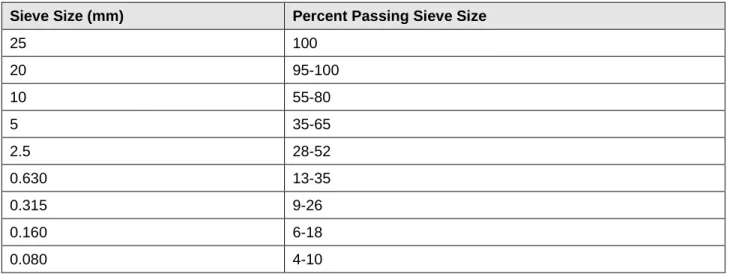
Table 4: Granular Base Course Gradation Limits
Sieve Size (mm) Percent Passing Sieve Size
25 100 20 95-100 10 55-80 5 35-65 2.5 28-52 0.630 13-35 0.315 9-26 0.160 6-18 0.080 4-10 2) Granular Sub-Base
Crushed stone or gravel shall consist of hard, durable, angular particles, and shall be free of clay lumps, cementation, organic material, frozen material, and other deleterious materials. Aggregates shall exhibit the following physical properties:
• % Fracture, by weight (2 faces) - 20 min. • Los Angeles Abrasion, loss, % - 45 max.
303.00.00 GRANULAR MATERIAL
ISC: PROTECTED 2012 29
• Liquid Limit, % - 25 max. • Plasticity Index, % - 6 max.
• California Bearing Ratio, when compacted to 100% of ASTM D698 - 40 min.
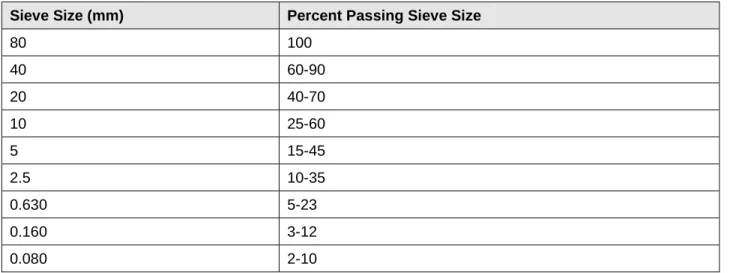
Gradation shall be within the following limits when tested to ASTM C-117 with sieve sizes to CAN/CGSBD 8-GP-2M rather than ASTM E11, and to shall have a smooth curve without sharp breaks when plotted on a semi-log grading chart.
Table 5: Granular Sub-Base Course Gradation Limits
Sieve Size (mm) Percent Passing Sieve Size
80 100 40 60-90 20 40-70 10 25-60 5 15-45 2.5 10-35 0.630 5-23 0.160 3-12 0.080 2-10 303.02.03 – Execution 1) Preparation
The sub-grade shall be prepared according to the requirements of section 302.00.00 – Earthwork, and to the cross-sections shown on drawings. The Contractor shall maintain the sub-grade to the specified section, free from ruts and undulations until granular sub base material is placed. The sub-grade shall be in a dry condition and must be approved by the Engineer before gravel is placed. The depositing of granular base or sub-base on a soft, muddy or rutted sub-grade shall not be permitted.
2) Placement
Material shall only be placed on a clean unfrozen surface, properly shaped and compacted, and free from snow and ice.
Placing methods shall not promote segregation or degradation of the aggregate. Approved methods shall be used to create uniform windrows of material along a crown line or high side of a one-way slope.
303.00.00 GRANULAR MATERIAL
30 2012 ISC: PROTECTED
Materials shall be placed to full width in layers not exceeding 200 mm in compacted thickness.
Each layer shall be placed to a smooth contour and compacted to the specified density before a succeeding layer is placed.
Areas where material becomes segregated shall be removed and replaced.
3) Compacting
Granular sub-base and base coarse materials shall be conditioned to be within -3 and +1 percent of the optimum moisture content of the material.
Compaction shall achieve densities of not less than 98% of maximum dry density in accordance with ASTM D698 (Method C or D).
Granular base and sub-base shall be shaped and compacted alternately to obtain a smooth, even, and uniformly compacted base.
In areas not accessible to rolling equipment, the specified density shall be achieved using approved mechanical tampers.
4) Finish Tolerances
Finished sub-base and base surfaces shall be within plus or minus 10 mm of established grade, but not uniformly high or low.
Surface irregularities shall be corrected by loosening and adding or removing materials until the surface is within the specified tolerances.
5) Maintenance
The finished base shall be maintained in a condition conforming to the requirements of this section until succeeding material is applied or until acceptance.
6) Testing
The Engineer shall perform all tests for acceptance in accordance with the requirements of this section. Test data provided by this testing shall be final and binding on both The City and the Contractor.
303.00.00 GRANULAR MATERIAL
ISC: PROTECTED 2012 31
303.02.04 – Method of Measurement and Payment
1) Measurements
Granular base and granular sub-base shall be measured in tonnes of material or square metres at the specified thickness, as identified in the Tender Form.
Material shall be scaled and recorded by the Contractor on duplicate weigh slips. Weigh slips must be signed by both parties at the time of delivery and a copy supplied to the Engineer.
2) Payment
The granular material shall be paid for at the contract unit prices bid, as listed on the Tender Form. The payment shall be inclusive of the furnishing of all material, production, handling, hauling and placing, spreading, mixing, and compacting the materials on the site.
303.03.00 – Drainage Gravel
303.03.01 – Drainage gravel for roadway applications
Drainage gravel for roadway applications shall be as per the Waterworks specifications.
303.03.02 – Method of Measurement and Payment
1) Measurements
Drainage gravel shall be measured in tonnes of material or square metres at the specified thickness, as identified in the Tender Form.
Material shall be scaled and recorded by the Contractor on duplicate weigh slips. Weigh slips must be signed by both parties at the time of delivery and a copy supplied to the Engineer.
2) Payment
The granular material shall be paid for at the contract unit prices bid, as listed on the Tender Form. The payment shall be inclusive of the furnishing of all material, production, handling, hauling and placing, spreading, mixing and compacting the materials on the site.
303.00.00 GRANULAR MATERIAL
32 2012 ISC: PROTECTED
303.04.00 – Gravelled Lane Gravel
303.04.01 – Constructing Gravelled Lanes
Gravelled lanes shall be constructed using 40 mm crushed gravel as per File Number 454.1011.003 (Sheet 16), and shall have the following gradation limits:
Table 6: 40 mm Crushed Gravelled Lane Gravel Gradation Limits
Aggregates shall exhibit the following physical properties: • % Fracture, by weight (2 faces) - 30 min.
• Los Angeles Abrasion, loss, % - 45 max. • Liquid Limit, % - 25 max.
• Plasticity Index, % - 6 max.
• California Bearing Ratio, when compacted to 100% of ASTM D698 - 40 min.
303.04.02 – Method of Measurement and Payment
1) Measurements
Gravelled lane gravel shall be measured in tonnes of material or square metres at the specified thickness, as identified in the Tender Form.
Material shall be scaled and recorded by the Contractor on duplicate weigh slips. Weigh slips must be signed by both parties at the time of delivery and a copy supplied to the Engineer.
Sieve Size (mm) Percent Passing Sieve Size
50 100 40 95-100 20 50-75 10 25-52 5 15-40 2.5 10-33 0.630 5-23 0.160 2-14 0.080 1-10
303.00.00 GRANULAR MATERIAL
ISC: PROTECTED 2012 33
2) Payment
The granular material shall be paid for at the contract unit prices bid, as listed on the Tender Form. The payment shall be inclusive of the furnishing of all material, production, handling, hauling and placing, spreading, mixing and compacting the materials on the site.
304.00.00 UTILITY TRENCH BACKFILL REGULATIONS
ISC: PROTECTED 2012 35
304.00.00 – Utility Trench Backfill Regulations
304.01.00 – General
The specifications in this section apply to compaction of the following:
• All waterworks and sewer service cuts, repairs, replacements, main breaks, extensions etc.
• All shallow cuts by utility companies.
• All cuts for the installation of streetlight ducts and bases.
• On all existing or proposed streets, lanes or easements for the full width of the right-of-way where the city is responsible for maintenance.
A trench or cut shall be defined as that portion of any excavation extending from within 300mm below the pipe to the finished subgrade surface.
A trench or cut is further divided into the pipe zone and the street zone defined as follows:.
1) Pipe Zone
The pipe zone is defined as that area of a trench or cut from 300 mm below the conduit to 300 mm above the conduit.
The method of bedding, backfill and compaction and type of equipment used in water and sewer installations shall comply with:
• Standard Specifications Waterworks Construction
504.03.00
• Standard Specifications Sewer Construction
403.04.00
403.07.01
403.08.02
2) Street zone
The street zone is defined as that area of a trench or cut from: • The top of the pipe zone to the finished sub-grade surface, and/or
304.00.00 UTILITY TRENCH BACKFILL REGULATIONS
36 2012 ISC: PROTECTED
The street zone shall be backfilled in uniform lifts with native material, and each lift shall be mechanically compacted. Thicknesses of lifts are determined by testing procedures during the construction process.
When soils removed from any trench appear unsuitable for replacement in the trench due to moisture content or for other reasons, and suitable material is not available in the construction area, the street zone shall be backfilled with compacted crushed gravel. At the discretion of the Engineer and if trench width permits, base gravel or bank gravel (pitrun) may be used for backfill. Under no circumstances shall frozen material be used for backfill. Positive drainage to the storm sewer system shall be provided from all granular backfill material.
The use of Granulite, drainage gravel and/or other gap graded material as backfill material in the street zone is prohibited unless the material is enveloped in a drainage membrane and positive drainage to the storm sewer system is provided. Please refer to section 320.00.00 – Agricultural Crossings.
304.02.00 – Moisture Requirements
Soil used for trench backfill shall be within optimum to +2% of its optimum moisture content. Subject to approval by the Engineer, the moisture content for the last metre of backfill may be lowered if warranted by soil conditions.
Granular material shall be within -3 percent to optimum moisture content.
304.03.00 – Density Requirements
304.03.01 – Summer Compaction
Table 7: Compaction Requirements for Utility Trench Backfilling Compaction
Percent of Soils Maximum Density Pipe Zone
(Unless otherwise specified) Minimum 95.0
304.00.00 UTILITY TRENCH BACKFILL REGULATIONS
ISC: PROTECTED 2012 37
Requirements apply to the full width of the right-of-way with the exception of the boundary area from the property line up to one (1) meter from the constructed or designed surface installation. In the boundary area the soil shall be compacted to a minimum of 90 percent of the soil's maximum density.
304.03.02 – Winter Compaction
All settlements related to winter backfill operations shall be reworked and re-compacted by the utility to a minimum standard density of 97% of the maximum obtainable density by no later than the following May 31.
304.04.00 – Non-Shrink Fill
Specifications
• Compressive strength two (2) to five (5) MPa. • Aggregate Grading:
Table 8: Aggregate Grading Specifications for Non-Shrink Fill Material
Sieve Size Percent Passing by Weight
5.0 mm 55 - 100
2.0 mm 37 - 67
0.08 mm 0 - 30
PI 10 maximum
• Binder
Portland cement type 10 or Lime/Fly Ash.
304.04.01 – Placing
Non-shrink Fill (N-S Fill) shall be cast on the compacted backfill from one meter below sub-grade to base of asphalt. N-S Fill shall be rodded or vibrated to eliminate voids, rough areas, honeycombing, and to ensure contact with the sides of the trench.
304.05.00 – Control Density Fill
304.05.01 – General
A flowable fill with self levelling properties for trench backfill consisting of fine aggregate, sand and cementacious content, the control density fill shall be resistant to settlement after hydration.
304.00.00 UTILITY TRENCH BACKFILL REGULATIONS
38 2012 ISC: PROTECTED
304.05.02 – Materials
Portland cement shall conform to the requirements of CSA Standard CAN3-A5-M, Type 10 or Type 30.
Supplementary cementing materials, when permitted, shall conform to the requirements of CSA Standard CAN3-A23.5-M.
Both fine and coarse aggregate shall conform to the requirements of CSA Standard CAN3-A23.1-M. The gradation shall conform to Table 1 of the CSA Standard. Mixing water used shall meet the requirement of CAN3-A23.1-M.
Air-entraining admixtures shall conform to the requirements of CSA Standard CAN 3-A266.1-M.
304.05.03 – Mix Design
The supplier shall immediately after award of Tender and prior to any delivery of control density fill, submit to the Engineer for approval, the proposed mix design including source of proposed aggregates.
• Slump of the control density fill shall be between 150 to 250 mm.
• Minimum performance values at one (1) day shall be a CBR of 15 and compressive strength of 0.10 MPa.
• Maximum performance values at twenty eight days shall be a CBR of 60 and compressive strength of 0.60 MPa.
304.05.04 – Trench Restoration
The utility shall be bedded and protected prior to placing the control density fill. It shall be struck off at a level corresponding to 100 mm below the pavement surface or to the bottom of the existing asphalt whichever is the greater.