Original Research Article
Effects of aloe vera extracted on liver and kidney function changes
induced by hydrogen peroxide in rats
Tarik Abdulqadir Abdal, Aziza Raof Haji*, Melen Mansour Markus
INTRODUCTION
Aloe vera (Aloes) is a member of the Liliaceae family. It is used as a herbal medicine in many cultures for several purposes from thousands of years.1,2 The commonest type of Aloe vera is Aloe barbadensis belongs to a class of plants called Xeropids which can close its stomata completely to avoid water loss.3,4 Aloes barbadensis are mostly succulent with a whorl of elongated, pointed
leaves. The central bulk of the leaf contains colorless mucilaginous pulp, made up of large, thin-walled mesophyll cells containing the A. vera gel.1,3
Aloe vera extract (Aloe Gel) has equally been demonstrated to have antioxidant abilities in both humans and animals. It exhibits the activity of radical scavenging, which is more powerful than capacity than α-tocopherol.2,3,5 The compounds of Aloe vera gel includes ABSTRACT
Background: Aloe vera (Aloes) is a member of theLiliaceaefamily that is used as herbal medicine in many cultures for several purposes. The present study was designed to investigate the role of Aloe vera leaf gel extracts on lipid profiles and liver and kidney functions in rats.
Methods: In this experimental investigation, a total of 20 healthy rats were divided into four following groups. Group I fed with normal diet and water. Group II administrated by 1% hydrogen peroxide with drinking water in a dark bottle prepared daily. Group III administrated with 5 ml of aloe vera oil added to 25 grams of their ratio for each rat (25 ml oil/125 g) also prepared daily with normal drinking water. Group IV also administrated with 5 ml of aloe vera oil added to 25 grams of their ratio with drinking water that contains 1% hydrogen peroxide in a dark bottle. The rats in all four groups fed for 21 days.
Results: The subjects who were included in H2O2 had significantly higher concentrations of TG (146.79 vs. 73.09 mg/dL; p<0.001), cholesterol (123.60 vs. 68.90 mg/dL; p=0.001), and lower concentration of HDL (5.79 vs. 7.53 mg/dL; p<0.001) compared to the control group. While, the subjects in Aloe Vera group had lower concentration of cholesterol (55.90 vs. 68.90 mg/dL; p=0.004), and higher level of HDL (9.22 vs. 7.53 mg/dL; p<0.001). The subjects in the H2O2 had significantly higher concentrations of AST (76.64 vs. 30.04; p<0.001), ALT (64.94 vs. 23.38; p<0.001), urea (59.68 vs. 37.10; p=0.003), uric acid (0.92 vs. 0.59; p<0.001). Whereas, the subjects in Aloe Vera had substantially lower levels of AST (18.76 vs. 30.04; p=0.008).
Conclusions: The present study showed that aloe vera gel extract is effective to improve the lipid profile and liver and kidney function.
Keywords: Aloe vera, Liver and kidney functions, Lipid profiles, Rats
Department of Theriogenology, College of Veterinary Medicine, University of Duhok, Kurdistan, Iraq
Received: 16 November 2019
Revised: 24 November 2019
Accepted: 10 December 2019
*Correspondence:
Dr. Aziza Raof Haji,
E-mail: [email protected]
Copyright: © the author(s), publisher and licensee Medip Academy. This is an open-access article distributed under the terms of the Creative Commons Attribution Non-Commercial License, which permits unrestricted non-commercial use, distribution, and reproduction in any medium, provided the original work is properly cited.
antioxidant, water-soluble and fat-soluble vitamins,
enzymes, minerals, polysaccharides, phenolic compounds, and organic acids.3,5
It has many biological activities such as inflammatory, decrease arthritis, dermatitis, gout, anti-cancer, antioxidant, UV protective, anti-diabetes (hypoglycemic agent), decrease macrophage activation, antiprotozoal, antifungal, gastro-protective (peptic ulcer) and as well as treatment of burns.5-7
It enhances wound healing by the proliferation of epithelial and fibrous tissue.8 The aloes gel also protects the liver (the major detoxification organ) against injury in rats by improving the functions of a liver enzyme that is associated with carcinogen metabolism.3,9
Oxidative stress is defined as an imbalance between pro-oxidant and anti-pro-oxidant species.10 It is considered a fundamental factor that has a role in the pathological changes observed in various liver diseases.11,12 The mitochondria are the main source of Free Radicals (FRs) that lead to the formation of major types of oxidative stress. The types of FRs are Reactive Oxygen Species (ROS) and Reactive Nitrogen Species (RNS). The FRs develop following electron leakages in the respiratory chain, such as superoxide anion O-, Hydrogen Peroxide (H2O2) and the more dangerous hydroxyl radicals (OH).13
The high level of H2O2 causes excessive cellular damage through lipid peroxidation and protein alkylation which leads to the pathogenesis of several disorders such as excessive hepatocytes damage, cancer, diabetes, neurodegenerative disease, arteriosclerosis and also immune disease.9,13,14 Herbal medicines are being extremely used to treat a broad range of diseases.
Herbal remedies with a concomitant antioxidant impact would be more useful in the treatment of liver and kidney dysfunctions and diabetes mellitus. Some of these remedies lower blood glucose and toxic indicators and exhibit anti-oxidative characteristics that may alleviate the oxidative damage in particular patients. Therefore, Aloe vera can be recommended as a plant of considerable interest. It is a cactus-like plant that grows in hot and dry climates. There are some investigations have reported that Aloe Vera has a positive effect on liver and kidney indicators in animals.1,3
The aim of the present study was to examine the effect of Aloe vera gel extract on liver and kidney functions induced by hydrogen peroxide in rats.
METHODS
Extraction of A. vera gel
Aloe barbadensis plant was obtained from the local market in Duhok/Iraqi Kurdistan. The fresh leaves of this cultivated plan were washed thoroughly under tap water
and cut by a sharp knife into small pieces then were weighed and blended by an electrical grinder. The extraction was performed by adding one litter of absolute 70% ethanol to each 1000 g of aloes extraction. It was kept at room temperature for 48 h and then filtered by gauze. The alcoholic Aloe vera gel extract was collected in a flask and concentrated in die rotary flash evaporator. A sufficient amount of extracts (aloes oil) were prepared for feeding the rats.15
Inclusion criteria
• The rates that were considered healthy through clinical and physical examinations weighted 160-230 grams were included in the study.
Exclusion criteria
• The subjects with any recognized comorbidities, including hypertension and inflammatory disease (recognized through lab-based investigations) were excluded from the study.
Experimental animal models
Twenty healthy male Wistar albino rats weighed between 160-230 g were purchased. The rates were bred and housed in the Animal House of the College of Science, University of Duhok. The rats were kept in wire mesh cages under controlled weather conditions with water and food of libitum. The study was conducted at the Department of Physiology, College of the Veterinary Medicine/University of Duhok from the period March 2015 to May 2015.
The scientific committee of the Veterinary Medicine College/University of Duhok approved the present study.
Rats were divided into four groups, each group with five rats in each group, as follows:
Group I (control group) fed with normal diet and water. Group II/ administrated by 1% hydrogen peroxide (H2O2) with drinking water in a dark bottle prepared daily. Group III administrated with 5 ml of aloe vera oil added to 25 grams of their ratio for each rat (25 ml oil/125 g) also prepared daily with normal drinking water. Group IV also administrated with 5 ml of aloe vera oil added to 25 grams of their ratio with drinking water that contains 1% hydrogen peroxide in a dark bottle.
Rats in four groups treated for 21 days. One day after the study was finished, the animals were sacrificed under light anesthesia (diethyl ether).
Blood collection and measurement
by non-heparinized tubes for determination and the serum
isolation was performed by centrifugation of the blood samples at 3500 rpm using cooling centrifuge at 4c° for 10 minutes. The separated sera immediately were taken and stored in deep freezers at -28c° for the estimation of biochemical assays.
The specific enzymatic kits were used to assess the liver, kidney, and lipid profile levels of serum by spectrophotometer according. The following lipid plan markers were measured, including Total Cholesterol (T-CH mg/dL), High-Density Lipoprotein (HDL mg/dL), and Triglyceride (TG mg/dL) and the liver and kidney functions parameters were measured for the levels of AST, ALT, Serum Alkaline Phosphatase (ALP), urea, Uric Acid (UA), and creatinine following 30 seconds and 2 minutes. The blood samples were collected after fasting 8-12 hours.
Analytical methods
The normality of the lipid profiles and kidney parameters among study groups was tested using the Kolmogorov-Smirnov test. The p-value ≥0.05 was considered normally distributed variable. The descriptive purposes of the study were presented in mean and standard deviation.
The comparison of lipid profile, liver and kidney function parameters were performed in ANOVA one-way. The pairwise comparisons were performed in LSD test. The p-value of less than 0.05 was considered a statistically significant difference. The statistical calculations were performed by Statistical Package for Social Sciences version 24:00 (SPSS 24:00; IBM, USA).
RESULTS
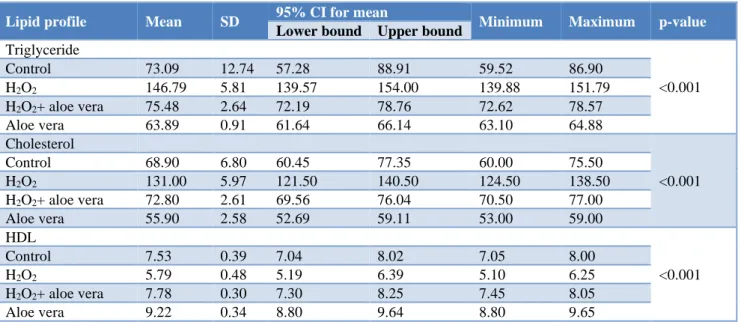
The study showed that there was a significant difference in triglyceride, total cholesterol, and HDL among study groups (p<0.001), as shown in (Table 1).
The study revealed that the subjects who were included in H2O2 had significantly higher concentrations of TG (146.79 vs. 73.09 mg/dL; P<0.001), cholesterol (131.0 vs. 68.90 mg/dL; P<0.001), and lower levels of HDL (5.79 vs. 7.53 mg/dL; P<0.001) compared to the control group.
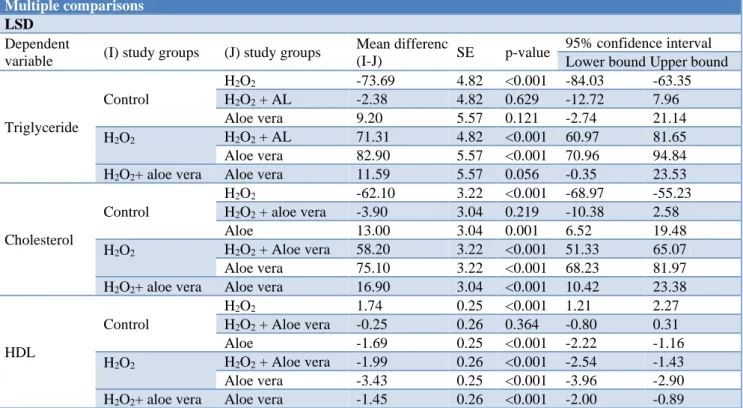
The subjects in Aloe Vera group had not significantly lower level of TG (63.89 vs. 73.09 mg/dL; P=0.121). Whereas, they had lower cholesterol levels (55.90 vs. 68.90 mg/dL; P=0.001), and higher level of HDL (9.22 vs. 7.53 mg/dL; P<0.001), Table 2.
Table 1: Comparison of lipid profile parameters among control and H2O2, H2O2 + aloe vera, and aloe vera groups.
Lipid profile Mean SD 95% CI for mean Minimum Maximum p-value
Lower bound Upper bound
Triglyceride
<0.001
Control 73.09 12.74 57.28 88.91 59.52 86.90
H2O2 146.79 5.81 139.57 154.00 139.88 151.79
H2O2+ aloe vera 75.48 2.64 72.19 78.76 72.62 78.57
Aloe vera 63.89 0.91 61.64 66.14 63.10 64.88
Cholesterol
<0.001
Control 68.90 6.80 60.45 77.35 60.00 75.50
H2O2 131.00 5.97 121.50 140.50 124.50 138.50
H2O2+ aloe vera 72.80 2.61 69.56 76.04 70.50 77.00
Aloe vera 55.90 2.58 52.69 59.11 53.00 59.00
HDL
<0.001
Control 7.53 0.39 7.04 8.02 7.05 8.00
H2O2 5.79 0.48 5.19 6.39 5.10 6.25
H2O2+ aloe vera 7.78 0.30 7.30 8.25 7.45 8.05
Aloe vera 9.22 0.34 8.80 9.64 8.80 9.65
One-way ANOVA was performed for statistical analysis. The bold numbers show the significant difference.
The study found the significant difference in the liver and kidney functions among study groups (Table 3).
The comparison of liver and kidney functions among study showed that the subjects who were included in the H2O2 had significantly higher concentrations of AST (76.64 vs. 30.04; p<0.001), ALT (68.64 vs. 23.38;
Table 2: Comparison of lipid profile parameters between control and H2O2, H2O2 + aloe vera, and aloe vera groups.
Multiple comparisons
LSD
Dependent
variable (I) study groups (J) study groups
Mean difference
(I-J) SE p-value
95% confidence interval Lower bound Upper bound
Triglyceride
Control
H2O2 -73.69 4.82 <0.001 -84.03 -63.35 H2O2 + AL -2.38 4.82 0.629 -12.72 7.96 Aloe vera 9.20 5.57 0.121 -2.74 21.14 H2O2
H2O2 + AL 71.31 4.82 <0.001 60.97 81.65 Aloe vera 82.90 5.57 <0.001 70.96 94.84 H2O2+ aloe vera Aloe vera 11.59 5.57 0.056 -0.35 23.53
Cholesterol
Control
H2O2 -62.10 3.22 <0.001 -68.97 -55.23 H2O2 + aloe vera -3.90 3.04 0.219 -10.38 2.58
Aloe 13.00 3.04 0.001 6.52 19.48
H2O2
H2O2 + Aloe vera 58.20 3.22 <0.001 51.33 65.07 Aloe vera 75.10 3.22 <0.001 68.23 81.97 H2O2+ aloe vera Aloe vera 16.90 3.04 <0.001 10.42 23.38
HDL
Control
H2O2 1.74 0.25 <0.001 1.21 2.27
H2O2 + Aloe vera -0.25 0.26 0.364 -0.80 0.31 Aloe -1.69 0.25 <0.001 -2.22 -1.16 H2O2
H2O2 + Aloe vera -1.99 0.26 <0.001 -2.54 -1.43 Aloe vera -3.43 0.25 <0.001 -3.96 -2.90 H2O2+ aloe vera Aloe vera -1.45 0.26 <0.001 -2.00 -0.89
The bold numbers show the significant difference (the mean difference is significant at the 0.05 level)
Table 3: Comparison of kidney and liver function markers among control, aloe vera, H2O2, and
H2O2 + aloe vera groups.
Kidney and
liver functions Mean SD SE
95% CI for mean
Minimum Maximum p-value
Lower bound Upper bound
AST control 30.04 3.46 1.55 25.74 34.34 27.20 35.60
<0.001
H2O2 76.64 9.19 4.11 65.22 88.06 66.20 84.40
H2O2+ Aloe vera 34.10 3.65 1.82 28.30 39.90 28.80 37.00 Aloe vera 18.27 0.83 0.48 16.20 20.34 17.60 19.20 ALT control 23.38 11.09 4.96 9.60 37.15 8.08 33.36
<0.001
H2O2 68.64 7.53 3.76 56.66 80.62 62.05 79.05
H2O2+ Aloe vera 23.38 11.75 5.25 8.79 37.96 8.50 32.73 Aloe vera 17.06 2.43 1.22 13.18 20.93 14.45 19.13 Urea control 37.10 8.39 3.75 26.68 47.52 29.50 47.80
<0.001
H2O2 59.68 1.30 0.58 58.07 61.29 57.60 60.80
H2O2+ Aloe vera 39.08 9.93 4.44 26.75 51.41 30.10 49.80 Aloe vera 36.76 7.59 3.39 27.33 46.19 25.70 45.50 Uric acid control 0.59 0.05 0.02 0.52 0.66 0.51 0.64
<0.001
H2O2 0.92 0.07 0.03 0.83 1.01 0.82 0.98
H2O2+ Aloe vera 0.61 0.03 0.01 0.58 0.65 0.58 0.65
Aloe vera 0.54 0.03 0.01 0.51 0.58 0.51 0.57
Creatinine control 0.78 0.26 0.11 0.46 1.10 0.38 1.03
0.053
H2O2 1.26 0.49 0.22 0.65 1.87 0.79 1.91
H2O2+ Aloe vera 0.99 0.02 0.01 0.96 1.03 0.98 1.01
Aloe vera 0.60 0.35 0.15 0.17 1.03 0.22 1.08
Table 4: Comparison of kidney and liver function markers between control, aloe vera, H2O2,
and H2O2+ aloe vera groups.
Multiple comparisons
LSD
Dependent variable
(I) study
groups (J) study groups
Mean difference
(I-J) SE p-value
95% confidence interval Lower bound Upper bound
AST
Control
H2O2 -46.60* 3.63 <0.001 -54.43 -38.77 H2O2 + Aloe vera -4.06 3.85 0.310 -12.37 4.25
Aloe vera 11.77* 4.19 0.015 2.73 20.82
H2O2
H2O2 + Aloe vera 42.54* 3.85 <0.001 34.23 50.85 Aloe vera 58.37* 4.19 <0.001 49.33 67.42 H2O2+
Aloe vera Aloe vera 15.83
* 4.38 0.003 6.37 25.29
ALT
Control
H2O2 -45.26* 6.29 <0.001 -58.76 -31.76 H2O2 + Aloe vera 0.00 5.93 1.000 -12.73 12.73
Aloe vera 6.32 6.29 0.332 -7.18 19.82
H2O2
H2O2 + Aloe vera 45.26* 6.29 <0.001 31.76 58.76 Aloe vera 51.58* 6.63 <0.001 37.35 65.81 H2O2+
Aloe vera Aloe vera 6.32 6.29 0.332 -7.18 19.82
Urea
Control
H2O2 -22.58* 4.78 <0.001 -32.71 -12.45 H2O2 + Aloe vera -1.98 4.78 0.684 -12.11 8.15
Aloe vera 0.34 4.78 0.944 -9.79 10.47
H2O2
H2O2 + Aloe vera 20.60* 4.78 0.001 10.47 30.73 Aloe vera 22.92* 4.78 <0.001 12.79 33.05 H2O2+
Aloe vera Aloe vera 2.32 4.78 0.634 -7.81 12.45
Uric acid
Control
H2O2 -0.33* 0.03 <0.001 -0.39 -0.26
H2O2 + Aloe vera -0.02 0.03 0.449 -0.09 0.04
Aloe vera 0.05 0.03 0.140 -0.02 0.11
H2O2
H2O2 + Aloe vera 0.30* 0.03 <0.001 0.24 0.37 Aloe vera 0.38* 0.03 <0.001 0.31 0.44 H2O2+
Aloe vera Aloe vera 0.07
* 0.03 0.033 0.01 0.14
Creatinine
Control
H2O2 -0.48* 0.22 0.046 -0.96 -0.01
H2O2 + Aloe vera -0.22 0.26 0.413 -0.76 0.33
Aloe vera 0.18 0.22 0.440 -0.30 0.65
H2O2
H2O2 + Aloe vera 0.27 0.26 0.311 -0.28 0.82
Aloe vera 0.66* 0.22 0.010 0.19 1.13
H2O2+
Aloe vera Aloe vera 0.39 0.26 0.148 -0.16 0.94 *. The mean difference is significant at the 0.05 level. The bold numbers show the significant difference
DISCUSSION
The authors’ aim in conducting the present investigation was to examine the effectiveness of above vera gel exact on lipid profile, liver and kidney function parameters in rats compared to the control, H2O2 and H2O2+Aloe vera groups. The study found that the subjects who were included in H2O2 had significantly higher concentrations of TG, cholesterol, and a lower concentration of HDL compared to the control group. While, the subjects in the
Aloe Vera group had a lower concentration of TG, cholesterol, and a higher level of HDL.
Some other investigations have examined the role of aloe
vera leaf gel extract on lipid profile status in rats. For instance, Rajasekaran and Ravi et al, administered 300 mg/kg body weight per day to streptozotocin-induced diabetic rats for three weeks.1 The authors found a significant decrease in liver and kidney cholesterol, triglyceride, free fatty acids, and phospholipids, even a substantial improvement in plasma insulin. Importantly, the concentrations of lipid profile parameters in diabetic rats were restored to near-normal levels following the treatment. In the present study, it was found that the Aloe vera group has significant improvement in lipid profile following the treatment compared to the control group. Interestingly, the subjects received aloe vera along with H2O2 did not have a significant difference in lipid profile reflecting the antioxidant role of aloe vera against the H2O2. This role of aloe vera will double its role in diabetic patients due to the rising rate of this disease and to reduce the risk of late complications and negative outcomes of diabetes mellitus, such as renal failure, blindness, and limb amputation.16,17
Another study designed to evaluate the hepatoprotective properties of Aloe vera leaves extract in streptozotocin-induced diabetes in rats. The male Wistar rats were made sick by diabetes with a single injection of streptozotocin. They assigned rats randomly to the following groups; group I: healthy control group; group II were non-diabetic rats who were treated with 50 mg/kg bodyweight injection of Aloe vera exact; group III were diabetic rats, and group IV were diabetic rats who were treated with the Aloe vera extract by 50 mg/kg body weight/day. The subjects were treated for an eight-week period. The investigators measured serum AST, ALT, ALP and albumin levels, MDA in the liver, GSH contents and etc. The study found that MSA content and serum ALT, AST, ALP and bilirubin levels in group III were significantly increased compared to group I. The parameters were significantly decreased in group IV compared to them in group III.5
Iji and Oyagbemi et al, investigated the effects of chronic administration of Aloe vera gel extract on lipid profile, biomarkers of hepatic damage using the Wistar rats. In this regard, they included forty male Wistar rats into four groups.3 The control group received 0.9% physiological saline only. The groups II, III, and IV received Aloe vera gel of 100, 250, and 500 mg/Kg, respectively for one month. There was a significant reduction in plasma ALT (ALT), AST (AST) and ALP (Alkaline phosphatase) in rats who received the gel in comparison with those animals did not receive the aloe vera gel extraction. Similarly, the animals who received the gel had a significant reduction in plasma total cholesterol, TG, LDL-cholesterol ration, and higher levels of HDL-cholesterol compared to the control group.
The lower levels of ALT, AST and ALP in rats who received gel extraction may be linked to the hepato-protective and antioxidant properties of the gel extract.
The hepatic damage induced by carbon tetrachloride in mice has been improved following treating by aqueous extract of dried aerial parts of A. vera.18 The efficacy of water extract of Aloe vera against carbon tetrachloride-induced liver damage has been confirmed in histopathological investigations. The improvement in hepatic damage has been indicated in a reversal of centrilobular necrosis, macro-vascular fatty changes and scattered lymphomononuclear cell infiltrate in hepatic parenchyma. Its hepatoprotective action of the gel has been shown to attribute the liver enzymes by the antioxidant properties of the gel. The following antioxidants materials were isolated from the gel in several studies; superoxide dismutase, catalase, β carotene, α tocopherol, and other antioxidants.19
The antioxidant systems consist of both enzymatic and non-enzymatic antioxidants. The major known enzymatic antioxidants are Superoxide Dismutase (SOD), catalase, and glutathione peroxidase, the vitamins C and E possess the non-enzymatic anti-oxidants), these systems providing the regulation of pro-oxidants in cellular signaling and also balance the level of pro-oxidants during acute oxidative stress.10,11
CONCLUSION
The present study showed that aloe vera gel extract is effective to improve the lipid profile (by lowering LDL, TG, and increasing HDL) and liver and kidney function (by reducing concentrations of ALT and AST).
Funding: No funding sources Conflict of interest: None declared
Ethical approval: The study was approved by the Institutional Ethics Committee
REFERENCES
1. Rajasekaran S, Ravi K, Sivagnanam K, Subramanian S. Beneficial effects of Aloe vera leaf gel extract on lipid profile status in rats with streptozotocin diabetes. Clin Exper Pharmacol Physiol. 2006;33(3):232-7.
2. Anilakumar KR, Sudarshanakrishna KR, Chandramohan G, Ilaiyaraja N, Khanum F, Bawa AS. Effect of Aloe vera gel extract on antioxidant enzymes and azoxymethane-induced oxidative stress in rats. 2010.
3. Iji O, Oyagbemi A, Azeez O. Assessment of chronic administration of Aloe vera gel on haematology, plasma biochemistry, lipid profiles and erythrocyte osmotic resistance in Wistar rats. Nigerian J Physiol Sci. 2010;25(2):107-13.
4. Adesokan A, Oyewole O, Turay B. Kidney and liver function parameters in alloxan-induced diabetic rats treated with aloe barbadensis juice extract. Sierra leone J Biomed Res. 2009;1(1):33-7.
Streptozotocin-induced diabetic rats. Advan Biores.
2012;3(3).
6. Vahedi G, Taghavi M, Maleki AK, Habibian R. The effect of Aloe vera extract on humoral and cellular immune response in rabbit. African J Biotechnol. 2011;10(26):5225-8.
7. Bałan BJ, Niemcewicz M, Kocik J, Jung L, Skopińska-Różewska E, Skopiński P. Oral administration of Aloe vera gel, anti-microbial and anti-inflammatory herbal remedy, stimulates cell-mediated immunity and antibody production in a mouse model. Central-European J Immunol. 2014;39(2):125.
8. Channa AA, Soomro SA, Korejo RA, Qureshi TA, Shah IA, Kalhoro NA, et al. Effect of chronic administration of Aloe vera extract on plasma biochemistry in rabbits. Int J Med Med Sci. 2014;6(8):183-9.
9. Hegazy SK, El-Bedewy M, Yagi A. Antifibrotic effect of aloe vera in viral infection-induced hepatic periportal fibrosis. World J Gastroenterol: WJG. 2012;18(17):2026.
10. Noori S. An overview of oxidative stress and antioxidant defensive system. Open Access Sci Reports. 2012;1(8):1-9.
11. Coyle CH, Martinez LJ, Coleman MC, Spitz DR, Weintraub NL, Kader KN. Mechanisms of H2O2-induced oxidative stress in endothelial cells. Free Radical Biol Med. 2006;40(12):2206-13.
12. Davies KJ. Oxidative stress, antioxidant defenses, and damage removal, repair, and replacement systems. IUBMB Life. 2000;50(4‐5):279-89.
13. Khudiar KK. Effect of 1% hydrogen peroxide (H2O2) in drinking water on some parameters inِ adult male rabbits. Iraqi J Biotech. 2010;9(2):202-10.
14. Lushchak VI. Environmentally induced oxidative stress in aquatic animals. Aquatic Toxicol. 2011;101(1):13-30.
15. Can A, Akev N, Ozsoy N, Bolkent S, Arda BP, Yanardag R, et al. Effect of Aloe vera leaf gel and pulp extracts on the liver in type-II diabetic rat models. Biol Pharmaceu Bulletin. 2004;27(5):694-8. 16. Amos AF, McCarty DJ, Zimmet P. The rising global burden of diabetes and its complications: estimates and projections to the year 2010. Diab Med. 1997;14(S5):S7-S85.
17. Falk E. Pathogenesis of atherosclerosis. J Am Coll Cardiol. 2006;47(8 Supplement):C7-C12.
18. Chandan B, Saxena A, Shukla S, Sharma N, Gupta D, Suri K, et al. Hepatoprotective potential of Aloe barbadensis Mill. against carbon tetrachloride induced hepatotoxicity. J Ethnopharmacol. 2007;111(3):560-6.
19. Hamman J. Composition and applications of Aloe vera leaf gel. Molecules. 2008;13(8):1599-616.