Mathematical and Software Engineering, Vol 6, No 1 (2020), 1–6. Varεpsilon Ltd, http://varepsilon.com/index.php/mse/
An Iterative Method for Solving the Matrix
Equation
X
−
A
∗
XA
−
B
∗
X
−
1
B
=
I
Aynur Ali
1and Vejdi Hasanov
21
[email protected] Preslavsky University of Shumen, Faculty of Mathematics and Informatics, Shumen, Bulgaria
2[email protected] Konstantin Preslavsky University of Shumen, Faculty of Mathematics and
Informatics, Shumen, Bulgaria
Abstract
In this paper we study iterative computing a positive definite solution of the matrix equation X−A∗XA−B∗X−1B = I. We propose an iterative method for finding a positive definite solution of the considered equation. The theoretical results are illustrated by numerical examples.
Subject ClassificationMSC: 15A24, 65F10, 65H10
Keywords: Matrix equation, Positive definite solution, Iterative methods
1
Introduction
We investigate the nonlinear matrix equation
X−A∗XA−B∗X−1B =I , (1) whereA, Baren×ncomplex matrices,I(orIn) is then×nidentity matrix, andA∗denotes
the conjugate transpose of A.
Eq. (1) has been introduced by Ali in [1], where an iterative method for computation a positive definite solution is proposed. A necessary and sufficient condition for the existence of a positive definite solution of Eq. (1) has been derived and a basic fixed point iteration has been proposed in [2]. In [3] by using the fixed point theorem for mixed monotone operator in a normal cone Gao has proved that the equation X −A∗XpA−B∗X−qB = I with
0< p, q <1 always has the unique positive definite solution. In [4] the similar equation X−A∗XA+B∗X−1
B=I (2)
has been investigated. We interpret (1) and (2) as linearly perturbed equations of the well-known and studied equationsX−B∗X−1
B=I[5, 6] andX+B∗X−1
B=I[6, 7, 8, 9, 10], respectively.
In addition, there are some contributions in the literature to the solvability and numerical solutions of the matrix equationX+A∗X−1
A−B∗X−1
Motivated by [1, 2, 3, 4], we study Eq. (1) for finding a positive definite solution as propose an iterative method.
Throughout this paper, we denote byCn×n the set ofn×ncomplex matrices, by Hn
the set of n×n Hermitian matrices, by ρ(A) the spectral radius, by kAk the spectral norm kAk =pρ(A∗A). A > 0 (A ≥ 0) means that A is a Hermitian positive definite
(semidefinite) matrix. If A−B > 0 (or A−B ≥ 0) we write A > B (or A ≥ B). For N ≥M >0 we use [M, N] to denote the set of matrices{X :M ≤X ≤N}.
2
Preliminaries
In this section we give some preliminary results.
In [1], the necessary conditions for existence of a positive definite solution and its lower bound have been obtained.
Theorem 1 [1, Theorem 2.1.] LetX be a positive definite solution of Eq. (1). Then
(a) ρ(A)<1, (b) ρ(X−1B)
<1,
(c) X≥M, whereM is the unique positive definite solution of the equationX−A∗XA=I. In [2], it has been proven that ρ(A)<1 is a necessary and sufficient condition for the existence of a positive definite solution of Eq. (1). Moreover, it has been obtained an upper bound of all the solutions.
Theorem 2 [2, Theorem 2.] Eq. (1) has a positive definite solution X, if and only if ρ(A)<1. Moreover, the all positive definite solutions are in [M, N], where M and N are the unique solutions of the equations X −A∗XA = I and X −A∗XA = I+B∗M−1B, respectively.
Ali in [1] has investigated the iterative method
X0=I, Y0=βI, β >1
Xk+1=I+A∗XkA+B∗Yk−1B, k= 0,1, . . .
Yk+1 =I+A∗YkA+B∗Xk−1B
(3)
for computing a positive definite solution of Eq. (1) based on the mixed monotone operator G(X, Y) = I+A∗XA+B∗Y−1
B. The sequences{Xk} and {Yk} defined by (3) have the following properties
X0≤X1≤ · · · ≤Xk ≤Yk≤ · · · ≤Y1≤Y0. (4) Moreover, it was proven that{Xk}and{Yk}withβ≥ 11+−kkBAkk22 converge to a unique positive
definite solution of Eq. (1) under conditionkAk2+kBk2<1.
In [2], it has been noted that the iterative method (3) can be used with X0 = M and Y0=N, where the matricesM andNare from Theorem 2. Moreover, it has been concluded that, if limk→∞kYk−Xkk= 0, then Eq. (1) has a unique positive definite solution.
Hasanov in [2] has considered the basic fixed point iteration (BFPI):
3
An iterative method
Here, we consider a modification of the iterative method (3), which is a partially inverse free variant.
LetM andN be the unique solutions of the equationsX−A∗XA=IandX−A∗XA= I+B∗M−1B, respectively. We consider
X0=M, Y0=N, (orX0=I, Y0=βI), V0=Y0−1, Vk+1 =Vk(2I−YkVk),
Xk+1=I+A∗XkA+B∗Vk+1B, k= 0,1, . . . Yk+1 =I+A∗YkA+B∗X−
1
k B.
(6)
Lemma 1 [9, Lemma 3.2] Let C and P be Hermitian matrices of the same order and let P >0. Then CP C+P−1≥2C.
Theorem 3 The sequences Vk,Xk andYk generated by iterative method (6) have the
fol-lowing properties
(i) X0≤X1≤. . .≤Xk≤Yk≤. . .≤Y1=Y0, k= 0,1, . . ., (ii) V0≤V1≤. . .≤Vk+1≤Yk−1, k= 0,1, . . .,
(iii) limk→∞Xk = ¯X ≤Y¯ = limk→∞Yk, limk→∞Vk = ¯Y−1.
Proof. We prove the theorem by induction.
We haveX0=M ≤N =Y0 by Theorem 2. We compute V1=N−
1
(2I−N N−1) =N−1=V0,
X1=I+A∗M A+B∗V1B≥I+A∗M A=M =X0, Y1=I+A∗N A+B∗M−1B =N =Y0.
We have by Lemma 1 that
V1= 2V0−V0Y0V0≤Y0−1=N
−1
and
Y1−X1=A∗(N−M)A+B∗(M− 1
−V1)B≥B∗(M− 1
−N−1)B ≥0. Therefore,V0≤V1≤Y−
1
0 ,X0≤X1≤Y1≤Y0.
Assume thatVk−1≤Vk ≤Yk−−11 andXk−1≤Xk ≤Yk ≤Yk−1. Thus, we have Yk+1−Yk =A∗(Yk−Yk−1)A+B∗(Xk−1−Xk−−11)B≤0, Vk+1−Vk =Vk(Vk−1−Yk)Vk ≥Vk(Vk−1−Yk−1)Vk≥0,
and
Xk+1−Xk=A∗(Xk−Xk−1)A+B∗(Vk+1−Vk)B≥0.
By Lemma 1, we have
Vk+1 = 2Vk−VkYkVk ≤Yk−1.
Thus,
Yk+1−Xk+1=A∗(Yk−Xk)A+B∗(Xk−1−Vk+1)B
≥B∗(Y−1
k −Vk+1)B≥0. Hence, Xk ≤ Xk+1 ≤ Yk+1 ≤ Yk and Vk ≤ Vk+1 ≤ Y−
1
k for k = 1,2, . . .. Thus,
the limits limk→∞Xk, limk→∞Yk, and limk→∞Vk exist, and limk→∞Xk ≤ limk→∞Yk,
4
Numerical experiments
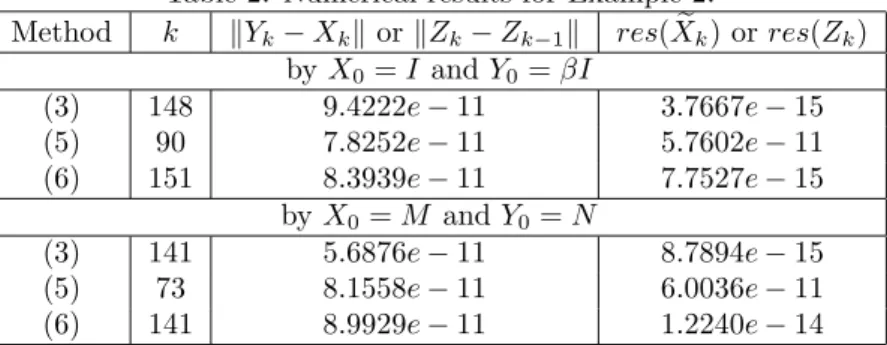
In this section we carry out numerical experiments for computing the positive definite solu-tion of Eq. (1) by iterative methods (3), (5), and (6) withX0=I,Y0=βI, andZ0= X0
+Y0
2 , where β = 1+kBk
2
1−kAk2 (or X0 =M,Y0 =N, where M and N are the unique solutions of the equationsX−A∗XA=IandX−A∗XA=I+B∗M−1B, respectively).
For the stopping criterion we take kYk−Xkk ≤ 10−10 for methods (3) and (6), and kZk −Zk−1k ≤ 10−10 for method (5), where k is the number of iterations. We use the notationres(X) =kX−A∗XA−B∗X−1B−Ik and compute
• res(Xek) for methods (3) and (6), whereXek =Yk+2Xk,
• res(Zk) for method (5).
Example 1 We consider Eq. (1) with
A= 1 56
1 5 3 2
−1 −6 3 4
−4 3 7 5
1 8 2 1
, B=
1 70
7 9 6 8
7 5 8 3
9 8 6 7
11 5 9 3
.
In Table 1 we report the results of experiment for Example 1 by using iterative methods (3), (5) and (6).
Table 1: Numerical results for Example 1.
Method k kYk−Xkk orkZk−Zk−1k res(Xek) orres(Zk)
byX0=IandY0=βI
(3) 11 8.8594e−11 4.5543e−13
(5) 10 4.0638e−12 4.3280e−11
(6) 12 1.4069e−11 3.0624e−14
byX0=M andY0=N
(3) 11 5.8609e−11 3.6315e−13
(5) 10 3.7103e−11 3.4837e−12
(6) 11 6.6076e−11 3.0991e−13
Example 2 We consider Eq. (1) with
A= 1 200
41 15 23 35 66 25 12 27 45 21 23 27 28 16 24 15 45 16 52 65 66 21 24 65 35
, B=
1 30
23 21 23 25 32 21 45 60 42 33 23 24 34 18 17 13 42 18 44 30 32 33 26 30 26
.
In Table 2 we report the results of experiment for Example 2 by using iterative methods (3), (5) and (6).
Acknowledgements
Table 2: Numerical results for Example 2.
Method k kYk−Xkkor kZk−Zk−1k res(Xek) orres(Zk)
byX0=IandY0=βI
(3) 148 9.4222e−11 3.7667e−15
(5) 90 7.8252e−11 5.7602e−11
(6) 151 8.3939e−11 7.7527e−15
byX0=M andY0=N
(3) 141 5.6876e−11 8.7894e−15
(5) 73 8.1558e−11 6.0036e−11
(6) 141 8.9929e−11 1.2240e−14
References
[1] A. Ali, For the matrix equation X −A∗XA−B∗X−1B = I, In: MATTEX 2018, Conference proceeding, Vol. 1, 161-166, (2018). (in Bulgarian)
[2] V. Hasanov, Necessary and sufficient condition for the existence of a positive definite solution of a matrix equation, Annual of Konstantin Preslavsky University of Shumen, vol. XX C, pp. 13-19, (2019).
[3] D. Gao, Iterative methods for solving the nonlinear matrix equation X −A∗XpA−
B∗X−qB =I (0< p, q <1), Advances in Linear Algebra and Matrix Theory, 7, 72-78,
(2017).
[4] V. Hasanov, Positive definite solutions of a linearly perturbed matrix equation, submitted [5] A. Ferrante, B. Levy, Hermitian solutions of the equation X = Q+N X−1
N∗, Linear Algebra Appl., 247, 359-373, (1996).
[6] C.-H. Guo, P. Lancaster, Iterative Solution of Two Matrix Equations, Math. Comput., 68, 1589-1603, (1999).
[7] W. N. Anderson, T. D. Morley, and G. E. Trapp, Positive Solution toX =A−BX−1B∗,
Linear Algebra Appl., 134, 53-62, (1990).
[8] J.C. Engwerda, A.C.M. Ran And A.L.Rijkeboer, Necessary and Sufficient Conditions for the Existence of a Positive Definite Solution of the Matrix EquationX+A∗X−1
A=Q, Linear Algebra Appl., 186, 255-275, (1993).
[9] XZ. Zhan Computing the extreme positive definite solutions of a matrix equation, SIAM J. Sci. Comput., 17, 632-645, (1996).
[10] B. Meini, Efficient computation of the extreme solutions of X+A∗X−1
A = Q and X−A∗X−1
A=Q, Math. Comput., 71, 1189-1204, (2001).
[11] M. Berzig, X. Duan, B. Samet, Positive definite solution of the matrix equationX =Q−
A∗X−1A+B∗X−1B via Bhaskar-Lakshmikantham fixed point theorem, Mathematical Sciences, 6, 27, (2012).
[13] A.A. Ali, V.I. Hasanov, On some sufficient conditions for the existence of a positive definite solution of the matrix equation X+A∗X−1
A−B∗X−1
B =I, In: Pasheva V, Popivanov N, Venkov G, editors, 41st International Conference Applications of Mathe-matics in Engineering and Economics AMEE 2015. AIP Conf. Proc. 1690, 060001 (2015), doi:10.1063/1.4936739.
[14] V. Hasanov, On the matrix equationX+A∗X−1
A−B∗X−1
B=I, Linear Multilinear A., 66, 1783-1798, (2018).
[15] A.C.R. Ran, M.C.B. Reurings, The symmetric linear matrix equation, Electron. J. Linear Al., 9, 93-107, (2002).
[16] P. Lancaster, M. Tismenetsky, The Theory of Matrices, 2nd ed. Academic Press, San Diego (CA), (1985).
[17] K. Deimling, Nonlinear functional analysis, Springer-Verlag, Berlin, (1985).