Long-acting intramuscular cabotegravir and rilpivirine in
adults with HIV-1 infection (LATTE-2): 96-week results of
a randomised, open-label, phase 2b, non-inferiority trial
David A Margolis, Juan Gonzalez-Garcia, Hans-Jürgen Stellbrink, Joseph J Eron, Yazdan Yazdanpanah, Daniel Podzamczer, Thomas Lutz, Jonathan B Angel, Gary J Richmond, Bonaventura Clotet, Felix Gutierrez, Louis Sloan*, Marty St Clair, Miranda Murray, Susan L Ford, Joseph Mrus, Parul Patel, Herta Crauwels, Sandy K Griffith, Kenneth C Sutton, David Dorey, Kimberly Y Smith, Peter E Williams,William R Spreen
Summary
Background Cabotegravir and rilpivirine are antiretroviral drugs in development as long-acting injectable formulations. The LATTE-2 study evaluated long-acting cabotegravir plus rilpivirine for maintenance of HIV-1 viral suppression through 96 weeks.
Methods In this randomised, phase 2b, open-label study, treatment-naive adults infected with HIV-1 initially received oral cabotegravir 30 mg plus abacavir–lamivudine 600–300 mg once daily. The objective of this study was to select an intramuscular dosing regimen based on a comparison of the antiviral activity, tolerability, and safety of the two intramuscular dosing regimens relative to oral cabotegravir plus abacavir–lamivudine. After a 20-week induction period on oral cabotegravir plus abacavir–lamivudine, patients with viral suppression (plasma HIV-1 RNA <50 copies per mL) were randomly assigned (2:2:1) to intramuscular long-acting cabotegravir plus rilpivirine at 4-week intervals (long-acting cabotegravir 400 mg plus rilpivirine 600 mg; two 2 mL injections) or 8-week intervals (long-acting cabotegravir 600 mg plus rilpivirine 900 mg; two 3 mL injections) or continued oral cabotegravir plus abacavir– lamivudine. Randomisation was computer-generated with stratification by HIV-1 RNA (<50 copies per mL, yes or no) during the first 12 weeks of the induction period. The primary endpoints were the proportion of patients with viral suppression at week 32 (as defined by the US Food and Drug Administration snapshot algorithm), protocol-defined virological failures, and safety events through 96 weeks. All randomly assigned patients who received at least one dose of study drug during the maintenance period were included in the primary efficacy and safety analyses. The primary analysis used a Bayesian approach to evaluate the hypothesis that the proportion with viral suppression for each long-acting regimen is not worse than the oral regimen proportion by more than 10% (denoted comparable) according to a prespecified decision rule (ie, posterior probability for comparability >90%). Difference in proportions and associated 95% CIs were supportive to the primary analysis. The trial is registered at ClinicalTrials.gov, number NCT02120352.
Findings Among 309 enrolled patients, 286 were randomly assigned to the maintenance period (115 to each of the 4-week and 8-week groups and 56 to the oral treatment group). This study is currently ongoing. At 32 weeks following randomisation, both long-acting regimens met primary criteria for comparability in viral suppression relative to the oral comparator group. Viral suppression was maintained at 32 weeks in 51 (91%) of 56 patients in the oral treatment group, 108 (94%) of 115 patients in the 4-week group (difference 2·8% [95% CI −5·8 to 11·5] vs oral treatment), and 109 (95%) of 115 patients in the 8-week group (difference 3·7% [−4·8 to 12·2] vs oral treatment). At week 96, viral suppression was maintained in 47 (84%) of 56 patients receiving oral treatment, 100 (87%) of 115 patients in the 4-week group, and 108 (94%) of 115 patients in the 8-week group. Three patients (1%) experienced protocol-defined virological failure (two in the 8-week group; one in the oral treatment group). Injection-site reactions were mild (3648 [84%] of 4360 injections) or moderate (673 [15%] of 4360 injections) in intensity and rarely resulted in discontinuation (two [<1%] of 230 patients); injection-site pain was reported most frequently. Serious adverse events during maintenance were reported in 22 (10%) of 230 patients in the intramuscular groups (4-week and 8-week groups) and seven (13%) of 56 patients in the oral treatment group; none were drug related.
Interpretation The two-drug combination of all-injectable, long-acting cabotegravir plus rilpivirine every 4 weeks or every 8 weeks was as effective as daily three-drug oral therapy at maintaining HIV-1 viral suppression through 96 weeks and was well accepted and tolerated.
Funding ViiV Healthcare and Janssen R&D.
Lancet 2017; 390: 1499–510 Published Online
July 24, 2017 http://dx.doi.org/10.1016/ S0140-6736(17)31917-7 SeeComment page 1468 ViiV Healthcare, Research Triangle Park, NC, USA (D A Margolis MD, M St Clair BS, J Mrus MD, Parul Patel PharmD, S K Griffith Pharm D, K C Sutton MA, K Y Smith MD, W R Spreen Pharm D); Hospital Universitario La Paz/IdiPAZ, Madrid, Spain
(J Gonzalez-Garcia MD); ICH Hamburg, Hamburg, Germany (Prof H-J Stellbrink MD); University of North Carolina, Chapel Hill, NC, USA (Prof J J Eron MD); Hôpital Bichat Claude Bernard, Paris, France (Prof Y Yazdanpanah MD); Hospital Universitari de Bellvitge, L’Hospitalet, Barcelona, Spain (D Podzamczer PhD); Infektiologikum, Frankfurt, Germany (T Lutz MD); The Ottawa Hospital, Ottawa, ON, Canada (J B Angel MD); Broward General Medical Center, Fort Lauderdale, FL, USA (G J Richmond MD); Hospital Germans Trias i Pujol, UAB, UVIC-UCC, Badalona, Catalonia, Spain (B Clotet MD); Hospital General de Elche & Universidad Miguel Hernández, Alicante, Spain (Prof F Gutierrez MD); North Texas Infectious Disease Consultants, Dallas, TX, USA (Prof L Sloan MD); ViiV Healthcare, London, UK (M Murray PhD); GlaxoSmithKline, Research Triangle Park, NC, USA (S L Ford PharmD); Janssen Research and Development, Beerse, Belgium (H Crauwels PhD, P E Williams PhD); and GlaxoSmithKline, Mississauga, ON, Canada (D Dorey MMath) *Prof Louis Sloan died in June, 2017
Introduction
An estimated 36·7 million individuals were living with HIV worldwide at the end of 2015.1 Advances in highly
active antiretroviral therapies (ARTs) have improved
treatment efficacy for patients with HIV, enhancing patient survival and quality of life.2,3 However, adherence
Correspondence to: Dr David A Margolis, ViiV Healthcare, 5 Moore Drive, Research Triangle Park, NC 27709-3398, USA david.a.margolis@ viivhealthcare.com
emergence of drug-resistant mutations.4 Long-acting
injectable ART might provide some patients with a convenient approach to manage HIV infection that avoids daily oral dosing and the need to keep, store, and transport medications as they undertake their activities of daily living.5
Cabotegravir (GSK1265744) is an analogue of the integrase strand transfer inhibitor (INSTI) dolutegravir that exhibits subnanomolar potency and antiviral activity against a broad range of HIV-1 strains.6 Oral administration
of cabotegravir once daily has exhibited acceptable safety and tolerability profiles, a long half-life (40 h), and few drug–drug interactions.7–9 Rilpivirine (TMC278) is a
non-nucleoside reverse transcriptase inhibitor (NNRTI) that is approved as a 25 mg once-daily oral medication for HIV-1 treatment.10–12 In the phase 2b LATTE trial (ClinicalTrials.
gov identifier, NCT01641809), a two-drug regimen of once-daily oral formulations of cabotegravir and rilpivirine demonstrated durable viral suppression in patients whose viral load was previously suppressed to less than 50 HIV-1 RNA copies per mL by treatment with cabotegravir and
two nucleoside reverse transcriptase inhibitors (NRTIs), providing proof of principle for a two-drug maintenance regimen using an INSTI and NNRTI.13
Long-acting injectable nanosuspension formulations of cabotegravir and rilpivirine are in clinical development.12,14
Phase 1 clinical studies investigating long-acting cabotegravir and rilpivirine have shown prolonged exposures at least 30 days following gluteal intramuscular injections, enabling dosing at once-monthly or longer intervals.15,16 Combined administration of long-acting
cabotegravir plus rilpivirine produced no clinically significant pharmacokinetic interactions, supporting investigation of these agents as the first-ever long-acting combination ART regimen.16Here, we report the efficacy
and safety of long-acting cabotegravir plus rilpivirine, given as intramuscular injections every 4 weeks or every 8 weeks, compared with that of oral cabotegravir plus abacavir–lamivudine, as maintenance therapy through 96 weeks for individuals who had achieved successful HIV-1 viral suppression with oral cabotegravir plus abacavir–lamivudine.
Research in context
Evidence before this study
To establish the background for this study, we searched PubMed publications on the topics of antiretroviral therapy and treatment adherence; long-acting injectable therapies; and the safety, efficacy, and pharmacokinetics of cabotegravir (GSK1265744) and rilpivirine using the keywords “antiretroviral therapy”, “treatment adherence”, “long-acting injectable therapies”, “cabotegravir”, “GSK1265744”, “rilpivirine”, and “TMC-2782”. We also located package inserts and government documents using internet search engines. All searches were updated as of March 7, 2017. A review of this literature shows an ongoing challenge in HIV therapy wherein suboptimal adherence to daily oral medication can lead to treatment failure or the emergence of viral resistance. To date, no long-acting injectable regimen is available to patients with HIV. Cabotegravir is an integrase strand transfer inhibitor with clinically demonstrated activity against the HIV-1 virus and a physiochemistry and pharmacokinetic profile amenable to its formulation and use as a long-acting agent. Rilpivirine is a non-nucleoside reverse transcriptase inhibitor approved as an oral agent for the treatment of HIV-1 infection in combination with other antiretrovirals; its physiochemistry is also appropriate for formulation as a long-acting agent. We did a randomised, open-label, parallel group, phase 2b study (LATTE-2) in patients with HIV-1 viral suppression on oral medication to evaluate the efficacy, safety, and tolerability of cabotegravir plus rilpivirine given as long-acting injections every 4 or 8 weeks, compared with daily oral cabotegravir taken with abacavir and lamivudine.
Added value of this study
The LATTE-2 study is the first to investigate the efficacy and safety of a long-acting injectable antiretroviral therapy for the
treatment of HIV-1 infection. An option to treat HIV-1 without the use of daily oral medications represents a paradigm shift in the HIV-1 treatment landscape. The principal finding of the study is that among patients who were suppressed on an oral cabotegravir-based therapy, switching to a long-acting combination of cabotegravir and rilpivirine maintained virological suppression in 90% of patients overall through week 96 following 4-week or 8-week injectable administration at rates comparable to remaining on daily oral cabotegravir-based therapy. The complete week 96 dataset included here provides important evidence for both the durability of virological response and acceptability of intramuscular injections for chronic use with dual antiretroviral therapy in patients infected with HIV-1.
Implications of all the available evidence
To date, the class of integrase strand transfer inhibitors has shown a high level of virological efficacy in clinical studies, which has translated to global widespread successful use. The ability to employ one of these agents, in partnership with one other agent, as an effective long-acting injectable agent has the potential to address the challenges of adherence to daily medication faced by people living with HIV. The daily
Methods
Study design and participants
LATTE-2 is an ongoing phase 2b, randomised, multicentre, open-label, non-inferiority, parallel-group trial, consisting of a 20-week induction period, 96-week maintenance period, extension period, and long-term follow-up period. The study was done at 50 sites in the USA, Canada, Spain, France, and Germany.
Patients who were HIV-1 positive, were aged 18 years or older, and had no more than 10 days of previous ART treatment, with screening HIV-1 RNA of at least 1000 copies per mL and CD4+ T-cell counts of at least 200 cells per mm³, were eligible for inclusion. Key exclusion criteria included the presence of any major antiretroviral resistance-associated mutation, pregnancy, moderate or severe hepatic impairment, clinically relevant hepatitis, hepatitis B infection, laboratory values of clinical concern, creatinine clearance less than 50 mL/min, and a need for chronic anticoagulants.
Eligible patients received the induction period regimen of oral cabotegravir 30 mg plus abacavir–lamivudine 600 mg–300 mg once daily for 20 weeks. Rilpivirine 25 mg once daily was added 4 weeks before randomisation (week −4 [week 16 of the induction period]) and continued until the first injection visit (day 1). Patients who tolerated the induction period regimen and achieved plasma HIV-1 RNA less than 50 copies per mL at week −4 were eligible to enter the maintenance period at day 1 and were randomly assigned to receive intramuscular injections every 4 weeks (long-acting cabotegravir 400 mg plus rilpivirine 600 mg; two 2 mL injections) or every 8 weeks (long-acting cabotegravir 600 mg plus rilpivirine 900 mg; two 3 mL injections), with a provision for a 14-day dosing window, or to continue receiving oral cabotegravir 30 mg plus abacavir–lamivudine once daily for 96 weeks. Long-acting injectable formulations contained 200 mg per mL of cabotegravir and 300 mg per mL of rilpivirine for administration as two separate intramuscular injections into the gluteus medius muscle at each dosing visit. Both 4-week and 8-week dosing regimens had an initial loading dose of cabotegravir 800 mg (two 2 mL injections).
The study was done in accordance with the principles of the Declaration of Helsinki. Written informed consent was obtained from all participants, and the protocol was approved by the institutional review board of each study site. The authors vouch for the accuracy and completeness of the data and the analyses and for the fidelity of the study to the protocol.
Randomisation and masking
A computer-generated allocation sequence created by the validated software, RandALL (version 2.10; GlaxoSmithKline, Research Triangle Park, NC, USA) was used to randomly assign patients at day 1, with stratification by HIV-1 RNA (<50 copies per mL, yes or no) before week −8 (ie, during the first 12 weeks of induction period treatment). Central randomisation,
with blocks shared across sites, was used to conceal the allocation schedule and prevent selection bias.
An open-label design was used because a double-blind, double-dummy design would have resulted in an increased pill burden in all patients, a requirement for sham injections, elevated risk of oral ART non-adherence for oral comparator group patients receiving sham injections, limitations to patient-reported preference data comparing injectable and oral ART, as well as considerable trial design complexities.
Procedures
Planned analyses were done after all patients had completed weeks 32, 48, and 96 of the maintenance period (or discontinued earlier).
Adverse events were graded according to the Division of AIDS Table for Grading the Severity of Adverse and Pediatric Events (2009).17 Serious adverse events were
defined as any untoward medical occurrence that resulted in death, was life-threatening, required hospitalisation, resulted in disability or incapacity, was a congenital anomaly or birth defect, or met predefined liver injury criteria. Liver stopping criteria were met when alanine aminotransferase values met or exceeded the upper limit of normal (ULN) by eight times, five times for 14 days, or three times with bilirubin at least two times the ULN (if >35% direct bilirubin, bilirubin fractionation is required). Pharmacokinetic samples for cabotegravir and rilpivirine were collected at day 1 and at weeks 1, 4, 8, 12, 16, 20, 24, 25, 28, 32, 36, 40, 41, 44, and 48.
Treatment satisfaction was measured using the HIV Treatment Satisfaction Questionnaire (HIVTSQ). The HIVTSQ status version (HIVTSQ[s]) was completed by patients at weeks –16 and –4 of the induction period and at day 1 (long-acting predose) and weeks 8, 32, 48, and 96 of the maintenance period or at withdrawal.
Outcomes
The primary endpoints were the proportion of patients in the maintenance-exposed population (which consisted of randomly assigned patients who received at least one dose of study drug during the maintenance period) with HIV-1 RNA less than 50 copies per mL at maintenance week 32 (using the US Food and Drug Administration [FDA] snapshot algorithm), the proportion of patients with protocol-defined virological failures, and incidence and severity of adverse events and laboratory abnormalities.
through the week 96 analysis; evaluation of plasma pharmacokinetic parameters and steady-state deter-minations for cabotegravir and rilpivirine, as well as pharmacokinetic–pharmacodynamic relationships with safety and antiviral activity; and treatment satisfaction and medication adherence of participants using patient-reported outcome questionnaires.
Protocol-defined virological failure following random-isation was defined as having two consecutive plasma HIV-1 RNA measurements of at least 200 copies per mL. Patients who met the definition of protocol-defined virological failure before receiving any cabotegravir plus rilpivirine injections were
dis continued from the study; those who had received one or more injections entered a 52-week long-term follow-up period.
Statistical analysis
The primary analysis of the maintenance-exposed population used a Bayesian approach to evaluate the hypothesis that the proportion of patients with HIV-1 RNA less than 50 copies per mL (FDA snapshot algorithm) at week 32 (and repeated at week 48) for each intramuscular long-acting regimen is not worse than the oral regimen proportion by more than 10% (denoted comparable). This Bayesian approach provided an
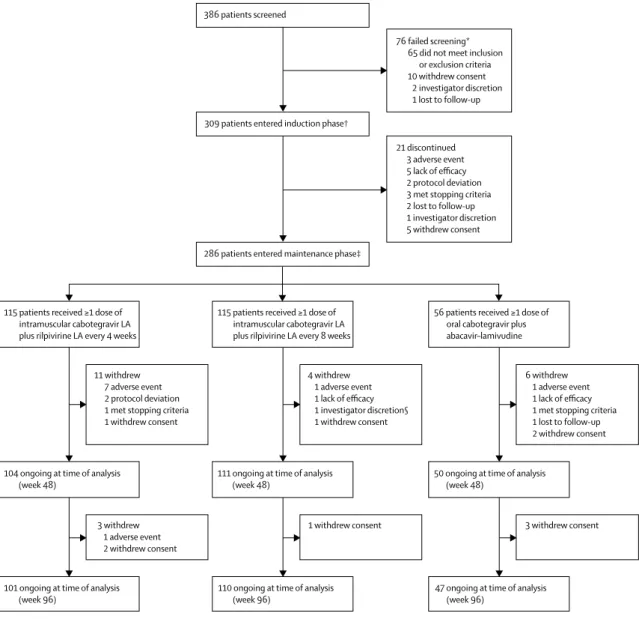
Figure 1: Trial profile
LA=long-acting. *Multiple reasons for screening failure were reported for two patients. †310 patients were enrolled, but one patient withdrew consent after baseline visit procedures were done and before study treatment was initiated. ‡Two patients completed the induction period (and had day 1 assessments) but did not enter the maintenance period and were not randomly assigned (because of investigator discretion and lack of efficacy). §Patient experienced suspected protocol-defined virological failure at the time of withdrawal, which was subsequently confirmed.
115 patients received ≥1 dose of intramuscular cabotegravir LA plus rilpivirine LA every 8 weeks
4 withdrew 1 adverse event 1 lack of efficacy 1 investigator discretion§ 1 withdrew consent
111 ongoing at time of analysis
(week 48) 50 ongoing at time of analysis (week 48) 104 ongoing at time of analysis
(week 48)
1 withdrew consent
110 ongoing at time of analysis
(week 96) 47 ongoing at time of analysis (week 96) 101 ongoing at time of analysis
(week 96)
115 patients received ≥1 dose of intramuscular cabotegravir LA plus rilpivirine LA every 4 weeks
11 withdrew 7 adverse event 2 protocol deviation 1 met stopping criteria 1 withdrew consent
3 withdrew 1 adverse event 2 withdrew consent
56 patients received ≥1 dose of oral cabotegravir plus abacavir–lamivudine
6 withdrew 1 adverse event 1 lack of efficacy 1 met stopping criteria 1 lost to follow-up 2 withdrew consent
3 withdrew consent 386 patients screened
76 failed screening* 65 did not meet inclusion
or exclusion criteria 10 withdrew consent
2 investigator discretion 1 lost to follow-up
309 patients entered induction phase†
21 discontinued 3 adverse event 5 lack of efficacy 2 protocol deviation 3 met stopping criteria 2 lost to follow-up 1 investigator discretion 5 withdrew consent
estimate of the (posterior) probability that the hypothesis is true given the observed data and pre-trial information.18
A Bayesian posterior probability of at least 90% was prespecified as the decision rule for claiming comparability for each comparison. To incorporate previous information for the oral group response rate based on data from the LATTE study,13 a beta (23, 2) prior
distribution was assumed to reflect the belief that the oral group response rate was between 78% and 99% with 95% confidence, and a non-informative prior distribution was assumed for the intramuscular response rate. Sample sizes of 45 patients in the oral cabotegravir plus abacavir–lamivudine group and 90 patients each in the intramuscular groups were chosen to ensure a high probability that a two-drug long-acting regimen with poor response relative to oral cabotegravir plus abacavir– lamivudine once daily would be identified. With the chosen number of patients per treatment group, and assuming true response rates of 82% for long-acting intramuscular cabotegravir plus rilpivirine versus 92% for oral cabotegravir plus abacavir–lamivudine, there was a low probability of falsely concluding that long-acting intramuscular cabotegravir plus rilpivirine was comparable with oral cabotegravir plus abacavir– lamivudine (simulated probability=0·064). Each long-acting intramuscularregimen was evaluated against the oral cabotegravir plus abacavir–lamivudine regimen in the primary analysis; comparability in antiviral response rates between the two intramuscular regimens was assessed as a prespecified key secondary comparison. Normal approximation 95% CIs for the difference in the proportions (each long-acting intramuscularregimen vs oral regimen) are provided as supportive secondary analyses (prespecified b ut without a djustment f or multiple testing). These efficacy analyses used the maintenance-exposed population. Per-protocol sensitivity analyses excluding participants with prespecified protocol deviations were not done as fewer than 5% of participants had such deviations (threshold for conducting analysis specified i n a dvance i n the analysis plan).
In the snapshot analysis, participants with a last HIV-1 RNA result less than 50 copies per mL in the analysis timepoint window were classified a s r esponders. Participants without HIV-1 RNA data at the visit of interest (due to missing data or discontinuation of study drug before analysis visit window) and patients who switched ART after week 4 were classified a s n on-responders. For week 32, if a participant had no data within a window of –2 to +2 weeks, then an expanded window of –6 to +6 weeks was used. For week 48, if a participant had no data within a window of −2 to +6 weeks, then an expanded window of –6 to +6 weeks was used. For week 96, a window of –6 to +6 weeks was used.
Data for the maintenance and induction plus maintenance periods combined, respectively, are summarised by randomised group using the
maintenance-exposed population, whereas data for the induction period and study population characteristics are summarised using the intention-to-treat exposed population (patients who received at least one study dose during the induction period [week −20 to day 1]).
Change from baseline (last value collected up to and including the date of first induction period treatment at week –20) in CD4+ cell count, plasma HIV-1 RNA, and patient-reported outcome endpoints are summarised using observed data with no imputation for missing data. Laboratory abnormalities are presented as maintenance period treatment emergent, which refers to graded toxic effects that developed or increased in intensity while on treatment in the maintenance period relative to the last recorded toxic effect up to and including the date of the first dose of the maintenance period treatment.
Antiretroviral plasma concentrations at the above-mentioned timepoints following long-acting intra-muscular cabotegravir plus rilpivirine administration were analysed using validated LC-MS/MS methods and are summarised over time using evaluable data that met sample collection window criteria, excluding samples affected by dosing errors (wrong dose) or oral bridging. Sampling windows for intramuscular dosing were set relative to the previous injection as follows: 0·5 h for 2 h post-dose samples; 1 day for 1-week post-injection visits; 2 days for predose samples in the 4-week group, weeks 4
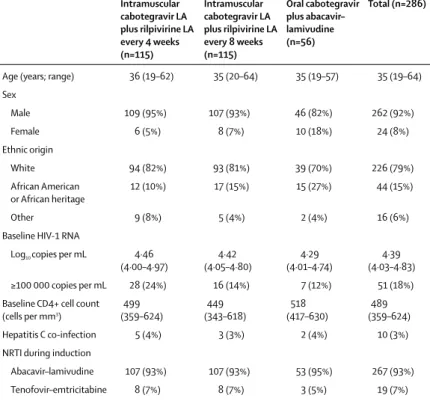
Intramuscular cabotegravir LA plus rilpivirine LA every 4 weeks (n=115)
Intramuscular cabotegravir LA plus rilpivirine LA every 8 weeks (n=115)
Oral cabotegravir plus abacavir– lamivudine (n=56)
Total (n=286)
Age (years; range) 36 (19–62) 35 (20–64) 35 (19–57) 35 (19–64)
Sex
Male 109 (95%) 107 (93%) 46 (82%) 262 (92%)
Female 6 (5%) 8 (7%) 10 (18%) 24 (8%)
Ethnic origin
White 94 (82%) 93 (81%) 39 (70%) 226 (79%)
African American
or African heritage 12 (10%) 17 (15%) 15 (27%) 44 (15%)
Other 9 (8%) 5 (4%) 2 (4%) 16 (6%)
Baseline HIV-1 RNA
Log10 copies per mL 4·46
(4·00–4·97) (4·05–4·80)4·42 (4·01–4·74)4·29 (4·03–4·83)4·39
≥100 000 copies per mL 28 (24%) 16 (14%) 7 (12%) 51 (18%)
Baseline CD4+ cell count (cells per mm3)
499
(359–624) (343–618)449 (417–630)518 (359–624)489
Hepatitis C co-infection 5 (4%) 3 (3%) 2 (4%) 10 (3%)
NRTI during induction
Abacavir–lamivudine 107 (93%) 107 (93%) 53 (95%) 267 (93%)
Tenofovir–emtricitabine 8 (7%) 8 (7%) 3 (5%) 19 (7%)
Data are median (IQR) or n (%) unless stated otherwise. LA=long-acting. NRTI=nucleoside reverse transcriptase inhibitor.
and 8 cabotegravir samples in the 8-week group, and midcycle concentrations 4 weeks post-injection in the 8-week group; and 4 days for predose samples in the 8-week group (except for weeks 4 and 8 cabotegravir samples, as described earlier). Sparse pharmacokinetic sampling obtained after week 48 and through week 96 was not assayed as a matter of routine and therefore is not reported. Plasma concentrations at week 48 are summarised using geometric means and associated 95% CIs, whereas plasma concentration–time profiles are summarised using arithmetic mean (SD). Relationships between cabotegravir and rilpivirine trough concentrations at week 48 (or last available value before week 48 if no week 48 data available) and week 48 virological failure were explored graphically in a post-hoc analysis.
Role of the funding source
This study was funded by ViiV Healthcare and Janssen R&D. The funders participated in the study design, data gathering, analysis, and interpretation. All listed authors meet the criteria for authorship set forth by the International Committee of Medical Journal Editors. All authors had full access to the data and are responsible for the veracity and completeness of the reported data. The corresponding author had final responsibility for the decision to submit the manuscript for publication.
Results
The first patient was screened in April 28, 2014, and the last patient’s week 96 visit occurred in Nov 10, 2016. Of 386 patients screened, 309 were enrolled in the study (figure 1). 282 (91%) patients were male, average age 36·6 years (SD 10·4). 72 (23%) patients had a baseline CD4+ cell count of no more than 350 cells per mm³, and 60 (19%) patients had a baseline HIV-1 RNA of at least 100 000 copies per mL. Baseline characteristics were balanced among the three dosing groups. 288 patients (93%) completed the 20-week induction period (intention-to-treat exposed). 21 patients (7%) discontinued treatment during the induction period (five withdrew consent, five for lack of efficacy, three for adverse events, three met predefined liver chemistry stopping criteria, two for protocol deviation, two were lost to follow-up, and one at investigator discretion). 286 patients qualified for and entered the maintenance period. Patients were randomly assigned (2:2:1) to receive intramuscular injections of long-acting cabotegravir plus rilpivirine every 4 weeks (n=115; 4-week group) or every 8 weeks (n=115; 8-week group) or continue the oral cabotegravir plus abacavir–lamivudine regimen (n=56; oral treatment group; table 1). In the maintenance period, 14 (12%) patients in the 4-week group, five (4%) in the 8-week group, and nine (16%) in the oral treatment group
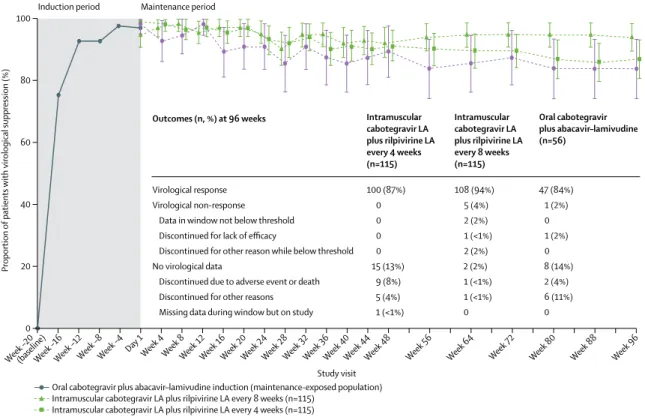
Figure 2: Proportion of patients with HIV-1 RNA concentration less than 50 copies per mL (FDA snapshot algorithm) by visit in the maintenance-exposed population and snapshot outcomes at week 96
Error bars show 95% CIs, derived using the normal approximation. FDA=US Food and Drug Administration. LA=long-acting.
(baseline)
Week –20 Week –16Week –12Week –8Week –4 Day 1
Week 4 Week 8Week 12Week 16Week 20Week 24Week 28Week 32Week 36Week 40Week 44Week 48 Week 56 Week 64 Week 72 Week 80 Week 88 Week 96 0
20 40 60 80 100
Proportion
of patients
with virological suppression (%)
Study visit Virological response
Virological non-response Data in window not below threshold Discontinued for lack of efficacy
Discontinued for other reason while below threshold No virological data
Discontinued due to adverse event or death Discontinued for other reasons Missing data during window but on study
100 (87%) 0 0 0 0 15 (13%)
9 (8%) 5 (4%) 1 (<1%)
Intramuscular cabotegravir LA plus rilpivirine LA every 4 weeks (n=115) Outcomes (n, %) at 96 weeks
108 (94%) 5 (4%) 2 (2%) 1 (<1%) 2 (2%) 2 (2%) 1 (<1%) 1 (<1%) 0
Intramuscular cabotegravir LA plus rilpivirine LA every 8 weeks (n=115)
47 (84%) 1 (2%) 0 1 (2%) 0 8 (14%) 2 (4%) 6 (11%) 0
Oral cabotegravir plus abacavir–lamivudine (n=56)
Induction period Maintenance period
Oral cabotegravir plus abacavir–lamivudine induction (maintenance-exposed population)
Intramuscular cabotegravir LA plus rilpivirine LA every 4 weeks (n=115) Oral cabotegravir plus abacavir–lamivudine (n=56)
withdrew from the study (figure 1). The most common reasons for withdrawal during the maintenance period were adverse events (ten patients [3%]) and withdrawn consent (ten patients [3%]). Eight of the ten patients who withdrew during the maintenance period because of adverse events were in the 4-week group.
During the 20-week induction period, oral treatment induced viral suppression (HIV-1 RNA <50 copies per mL) in 282 (91%) patients by day 1 (week 20 of induction period), with 279 (90%) patients achieving less than 50 copies per mL of HIV-1 RNA within the first 8 weeks of treatment. One patient met the criteria for protocol-defined v irological f ailure ( two c onsecutive plasma HIV-1 RNA measurements ≥200 copies per mL), as a result of poor medication compliance, without experiencing treatment-emergent resistance.
Following randomisation, 108 (94%) of 115 patients achieved the primary efficacy en dpoint (p lasma HI V-1 RNA <50 copies per mL; FDA snapshot algorithm) at week 32 in the 4-week group, 109 (95%) of 115 in the 8-week group, and 51 (91%) of 56 in the oral treatment group (figure 2; appendix p 1). Both long-acting regimens met prespecified e fficacy cri teria for dem onstrating comparability relative to the oral comparator group (posterior probability for comparability >90%; appendix p 2). Treatment differences a t w eek 3 2 f or e ach g roup receiving long-acting injections compared with daily oral treatment were 2·8% (95% CI −5·8 to 11·5) for the 4-week group and 3·7% (−4·8 to 12·2) for the 8-week group. At week 48, comparability between regimens was confirmed (appendix p 2), with virological suppression achieved in 105 (91%) of 115 patients in the 4-week group, 106 (92%) of 115 in the 8-week group, and 50 (89%) of 56 in the oral treatment group (figure 2 ; a ppendix p 1 ). T hrough 96 weeks of maintenance treatment, 100 (87%) of 115 patients in the 4-week group, 108 (94%) of 115 in the 8-week group, and 47 (84%) of 56 in the oral treatment group maintained virological suppression (figure 2 ; appendix p 1). Virological non-response, as defined by the FDA snapshot algorithm, at week 96 occurred in six patients (five i n t he 8 -week g roup, o ne i n t he o ral treatment group; figure 2). Through 96 weeks, no patients in the 4-week group failed for virological reasons. In comparison, at week 48, ten patients met virological non-response criteria (one in the 4-week group, eight in the 8-week group, one in the oral treatment group). For the 8-week group, four patients with virological non-response at week 48 (HIV-1 RNA >50 copies per mL) were resuppressed with HIV-1 RNA less than 50 copies per mL at week 96 without a change in therapy. Of the five patients in the 8-week group with virological non-response at week 96, two had HIV-1 RNA of at least 50 copies per mL at week 96 (one of whom had HIV-1 RNA ≥50 copies per mL at week 48), one discontinued due to protocol-defined v irological f ailure a t w eek 4 , one withdrew consent due to intolerability of injections at week 8, and one withdrew due to investigator discretion
at week 48 while not suppressed (and subsequently confirmed as a protocol-defined virological failure). One
of the two patients with HIV-1 RNA less than 50 copies See Online for appendix
Intramuscular cabotegravir LA plus rilpivirine LA every 4 weeks (n=115)
Intramuscular cabotegravir LA plus rilpivirine LA every 8 weeks (n=115)
Oral cabotegravir plus abacavir– lamivudine (n=56)
Grade
1–4† Grade 3–4‡ Grade 1–4† Grade 3–4‡ Grade 1–4† Grade 3–4‡
Total adverse events*
Any event 115 (100%) 21 (18%) 115 (100%) 24 (21%) 54 (96%) 7 (13%)
Injection-site pain 112 (97%) 6 (5%) 110 (96%) 8 (7%) 0 0
Nasopharyngitis 39 (34%) 0 35 (30%) 0 22 (39%) 0
Injection-site nodule 36 (31%) 1 (<1%) 29 (25%) 1 (<1%) 0 0
Injection-site swelling 34 (30%) 0 29 (25%) 1 (<1%) 0 0
Diarrhoea 32 (28%) 0 27 (23%) 0 11 (20%) 0
Injection-site pruritus 33 (29%) 0 25 (22%) 0 0 0
Headache 27 (23%) 0 29 (25%) 1 (<1%) 14 (25%) 1 (2%)
Injection-site induration 25 (22%) 0 29 (25%) 1 (<1%) 0 0
Injection-site warmth 21 (18%) 0 23 (20%) 1 (<1%) 0 0
Upper respiratory tract
infection 13 (11%) 0 23 (20%) 0 7 (13%) 0
Injection-site bruising 14 (12%) 0 20 (17%) 0 0 0
Nausea 18 (16%) 0 16 (14%) 0 9 (16%) 0
Injection-site erythema 19 (17%) 0 13 (11%) 1 (<1%) 0 0
Pyrexia 16 (14%) 0 16 (14%) 0 3 (5%) 0
Gastroenteritis 15 (13%) 0 14 (12%) 0 6 (11%) 1 (2%)
Fatigue 14 (12%) 0 14 (12%) 0 4 (7%) 0
Syphilis 11 (10%) 0 17 (15%) 0 6 (11%) 0
Back pain 13 (11%) 0 15 (13%) 0 10 (18%) 0
Insomnia 13 (11%) 0 12 (10%) 0 4 (7%) 0
Bronchitis 12 (10%) 1 (<1%) 12 (10%) 0 6 (11%) 0
Cough 13 (11%) 0 11 (10%) 0 7 (13%) 0
Influenza 16 (14%) 0 6 (5%) 0 2 (4%) 0
Arthralgia 10 (9%) 0 12 (10%) 0 4 (7%) 0
Anogenital warts 11 (10%) 0 9 (8%) 0 2 (4%) 0
Pharyngitis 8 (7%) 0 12 (10%) 0 5 (9%) 0
Respiratory tract infection 11 (10%) 0 6 (5%) 0 6 (11%) 0
Asthenia 10 (9%) 0 7 (6%) 0 9 (16%) 0
Treatment-related adverse events*
Any event 113 (98%) 10 (9%) 110 (96%) 10 (9%) 21 (38%) 1 (2%)
Injection-site pain 112 (97%) 6 (5%) 109 (95%) 8 (7%) 0 0
Injection-site nodule 35 (30%) 1 (<1%) 29 (25%) 1 (<1%) 0 0
Injection-site swelling 34 (30%) 0 29 (25%) 1 (<1%) 0 0
Injection-site pruritus 33 (29%) 0 24 (21%) 0 0 0
Injection-site induration 25 (22%) 0 28 (24%) 1 (<1%) 0 0
Injection-site warmth 21 (18%) 0 22 (19%) 1 (<1%) 0 0
Injection-site bruising 14 (12%) 0 19 (17%) 0 0 0
Injection-site erythema 19 (17%) 0 12 (10%) 1 (<1%) 0 0
Nausea 12 (10%) 0 8 (7%) 0 5 (9%) 0
Headache 7 (6%) 0 6 (5%) 0 4 (7%) 0
Pyrexia 7 (6%) 0 5 (4%) 0 0 0
per mL at week 96 remained on the study and had HIV-1 concentrations less than 50 copies per mL at the next scheduled visit. The patient in the 4-week group with virological non-response at week 48 (HIV-1 RNA, 59 copies per mL) remained on the study beyond week 48 and had subsequent viral resuppression with HIV-1 RNA less than 50 copies per mL at week 96. The virological non-responder in the oral treatment group discontinued as a result of protocol-defined virological failure at week 8.
Three patients (two in the 8-week group, [week 4 and week 48], one in the oral treatment group [week 8]) met the criteria for protocol-defined virological failure through week 96. Viral genotyping analysis for the patient in the oral treatment group had no treatment-emergent resistance mutations in the genes encoding viral reverse transcriptase, protease, or integrase. Of the two patients in the 8-week group, a mixture emerged for one at integrase codon 269 (R269R/G), which did not decrease cabotegravir susceptibility. The second patient harboured virus with treatment-emergent reverse transcriptase mutations K103N, E138G, and K238T, with phenotypic resistance to efavirenz, rilpivirine, and nevirapine, and an integrase mutation Q148R, with phenotypic resistance to raltegravir, elvitegravir, and cabotegravir, while remaining sensitive to dolutegravir.
Most patients in all groups maintained HIV-1 RNA less than 200 copies per mL (100 [87%] in the 4-week group, 110 [96%] in the 8-week group, and 47 [84%] in the oral treatment group). The mean change from baseline in plasma HIV-1 RNA concentration was –2·89 log10 copies
per mL (SD 0·713) for patients in the 4-week group, –2·77 log10 copies per mL (0·602) in the 8-week group,
and –2·77 log10 copies per mL (0·582) in the oral treatment
group. At week 96 of the maintenance period, CD4+ cell counts increased from the beginning of the induction
period by a median of 226 cells per mm³ (IQR 145–393) in the 4-week group (n=100), 239 cells per mm³ (111–359) in the 8-week group (n=109), and 317 cells per mm³(214–505) in the oral treatment group (n=47).
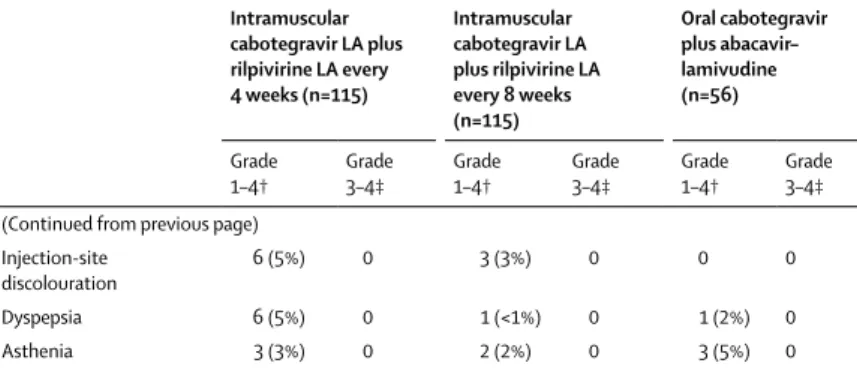
During the induction and maintenance period, in the maintenance-exposed population, total adverse events of any grade and attribution occurred in 115 (100%) patients in the 4-week group, 115 (100%) in the 8-week group, and 54 (96%) in the oral treatment group (table 2). Injection-site pain, the most common injection-Injection-site reaction, was the most frequently reported adverse event in the intramuscular groups (112 [97%] patients in the 4-week group, 110 [96%] patients in the 8-week group). Most injection-site reactions were mild (grade 1; 3648 [84%] of 4360 injections) or moderate (grade 2; 673 [15%] of 4360 injections) in intensity, with median symptom duration of 3 days (appendix p 3). The most commonly reported adverse events other than an injection-site reaction were nasopharyngitis (39 patients [34%] in the 4-week group, 35 [30%] in the 8-week group, and 22 [39%] in the oral treatment group), diarrhoea (32 [28%] in the 4-week group, 27 [23%] in the 8-week group, and 11 [20%] in the oral treatment group), and headache (27 [23%] in the 4-week group, 29 [25%] in the 8-week group, 14 [25%] in the oral treatment group). Serious adverse events occurred in 13 (11%) patients in each of the intramuscular treatment groups and nine (16%) patients in the oral treatment group, only one of which was drug related (migraine, which occurred in the initial oral induction period of the study). During the maintenance period, serious adverse events occurred in 11 (10%) patients in each of the intramuscular groups compared with seven patients (13%) in the oral treatment group. However, none was considered to be related to study treatment. 11 patients (4%) developed an adverse event during the maintenance period, which led to withdrawal: eight patients (7%) in the 4-week group, two (2%) in the 8-week group, and one (2%) in the oral treatment group. Two patients (both in the 8-week group) had injection-site reactions leading to withdrawal within 8 weeks of initiating dosing. Two deaths occurred during the study: one resulted from a motor vehicle accident that occurred in the initial oral induction period of the study, and the second occurred after an epileptic seizure in a patient in the 4-week intramuscular treatment group who had received 48 weeks of cabotegravir and 32 weeks of rilpivirine treatment. The seizure event was not considered likely to be related to cabotegravir or rilpivirine on the basis of the late time to onset of symptoms and both direct and circumstantial evidence of recreational drug use proximal to the event.
Progression of HIV disease was uncommon. One patient in the 4-week group experienced disease progression from Centers for Disease Control and Prevention (CDC) Class A to death (epileptic seizure). Four patients in the 8-week group experienced disease progression from CDC Class A to Class C (one had
Intramuscular cabotegravir LA plus rilpivirine LA every 4 weeks (n=115)
Intramuscular cabotegravir LA plus rilpivirine LA every 8 weeks (n=115)
Oral cabotegravir plus abacavir– lamivudine (n=56)
Grade
1–4† Grade 3–4‡ Grade 1–4† Grade 3–4‡ Grade 1–4† Grade 3–4‡ (Continued from previous page)
Injection-site
discolouration 6 (5%) 0 3 (3%) 0 0 0
Dyspepsia 6 (5%) 0 1 (<1%) 0 1 (2%) 0
Asthenia 3 (3%) 0 2 (2%) 0 3 (5%) 0
Data are n (%). LA=long-acting. *Includes all post-baseline induction period and maintenance period adverse events, as well as long-term follow-up period adverse events for patients withdrawing from intramuscular dosing that occurred within 35 or 63 days (4-week group or 8-week group) of the last maintenance period intramuscular injection until up to and including the start date of the long-term follow-up period on oral highly active antiretroviral treatment. †At least 10% in any treatment group for total adverse events and at least 5% in any treatment group for
treatment-related adverse events. ‡Includes only events listed in the grade 1–4 column; other grade 3–4 events that did not meet the 5% or 10% cutoff for the grade 1–4 column are not shown.
Kaposi’s sarcoma, one had pneumonia, and two had herpes simplex). No patient experienced disease progression to CDC Class C or death in the oral treatment group.
Grade 3 or more severe maintenance period treatment-emergent laboratory abnormalities occurred in 32 patients (28%) in the 4-week group, 21 (18%) in the 8-week group, and 12 (21%) in the oral treatment group. Grade 3 or more severe maintenance period treatment-emergent ALT elevations occurred in four (3%) patients in each of the 4-week and 8-week groups, and in three (5%) patients receiving oral treatment, largely attributable to acute hepatitis C infections. Among patients meeting pre-defined liver stopping criteria, possible drug-induced liver injury occurred in two patients (both treated with oral cabotegravir plus abacavir–lamivudine; one during the induction period [before randomisation], and one during the maintenance period). In both cases, liver chemistry abnormalities resolved following treatment discontinuation, and the patients remained clinically asymptomatic. Mean change from baseline was evaluated across all laboratory parameters, and no clinically significant differences were observed through 96 weeks.
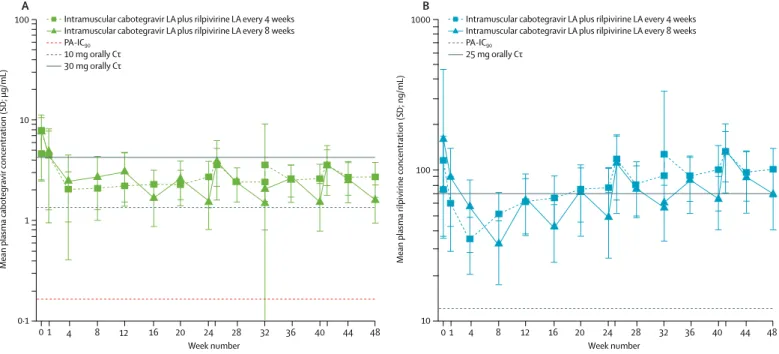
At week 48, cabotegravir geometric mean trough concentrations (C0; 95% CI) were 2·58 μg/mL (2·4–2·8)
for the 4-week group, 1·46 μg/mL (1·3–1·6) for the 8-week group, and 4·47 μg/mL (3·9–5·2) for the oral treatment group, which were 16 times, nine times, and 27 times greater than the in-vitro protein-adjusted 90% inhibitory concentration (PA-IC90) of 0·166 μg/mL
against wild-type HIV-1. For rilpivirine, week 48 geometric mean C0 (95% CI) values were 94·64 ng/mL
(86·6–103·4) for the 4-week group and 64·48 ng/mL (60·0–69·3) for the 8-week group, which were eight times and five times greater than in-vitro PA-IC90 of
12 ng/mL against wild-type HIV-1. Accumulation of rilpivirine was observed through 24–48 weeks of dosing, with the lowest rilpivirine trough concentrations observed after initial intramuscular injections in both groups (figure 3). No relationship was observed between cabotegravir concentrations and virological non-response at week 48. In a post-hoc analysis of seven of the nine patients in the 8-week group with virological non-response at week 48 (FDA snapshot algorithm), rilpivirine trough concentrations at week 48 (or last available trough concentration before week 48) were in the lowest 25th quartile among all rilpivirine samples, whereas cabotegravir trough concentrations were distributed throughout the quartile ranges. Of the two patients in the 8-week group with protocol-defined virological failure during the maintenance period through week 48, one patient had non-quantifiable rilpivirine concentration 4 weeks post injection without treatment-emergent resistance; there was no clear correlation between cabotegravir or rilpivirine concentrations at the time of viral rebound with the other patient.
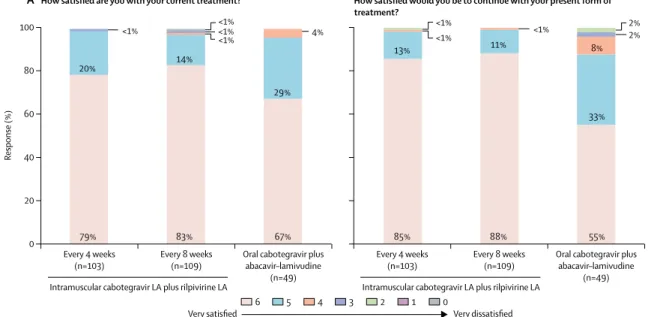
High levels of treatment satisfaction were observed across all treatment groups (figure 4). At week 96, patients reported very high levels of satisfaction across all three groups (4-week, 8-week, and oral treatment, via the HIVTSQ[s]), with 246 (97%) of254 patients selecting a score of 5 or 6 on a 6-point satisfaction scale. A similar percentage of patients in each of the intramuscular groups
1 10 100
0·1
Mean plasma cabotegravir concentration (SD; µg/mL)
1 4 8 12 16 24 28 32 36 40 44 48
0 20
Week number A
100 1000
10
Mean plasma rilpivirine concentration (SD; ng/mL)
1 4 8 12 16 24 28 32 36 40 44 48
0 20
Week number B
Intramuscular cabotegravir LA plus rilpivirine LA every 4 weeks Intramuscular cabotegravir LA plus rilpivirine LA every 8 weeks PA-IC90
10 mg orally Cτ 30 mg orally Cτ
Intramuscular cabotegravir LA plus rilpivirine LA every 4 weeks Intramuscular cabotegravir LA plus rilpivirine LA every 8 weeks PA-IC90
25 mg orally Cτ
Figure 3: Arithmetic mean (SD) plasma concentration–time profiles following every 4 weeks and every 8 weeks administration of (A) cabotegravir LA and (B) rilpivirine LA through week 48
(≥99%; 99 of 100 in the 4-week group and 107 of 108 in the 8-week group) reported they would be highly satisfied to continue their current long-acting regimen, while a lower percentage would elect to continue on oral dosing (78%; 36 of 46 patients in the oral treatment group). Patients who discontinued for any reason before week 96 did not complete the questionnaire at this timepoint, introducing a small degree of selection bias in these results.
Discussion
LATTE-2 is the first study to analyse the efficacy and safety of fully injectable two-drug long-acting ART
regimens in patients with HIV-1 infection and contributes to the growing number of studies evaluating simplification to two-drug therapy. Both the long-acting injectable 4-week and 8-week regimens maintained virological suppression at rates comparable to oral daily three-drug ART, with two protocol-defined virological failures occurring among the 230 patients who received long-acting therapy during the 96-week maintenance period. The long-acting cabotegravir plus rilpivirine regimens were generally well tolerated, with no drug-related serious adverse events and few adverse event-related withdrawals. Although injection-site reactions were common, they
Figure 4: Summary of patient-reported outcomes at (A) week 48 (maintenance treatment) and (B) week 96
The data are based on the observed case dataset of patients who completed questionnaires at week 48 and week 96 (HIV Treatment Satisfaction Questionnaire, status version). LA=long-acting.
88% 11%
<1%
20% 14%
29%
<1% 4%
<1% <1% <1%
55% 33% 8%
85%
83% 67%
79%
13% <1% <1%
2% 2%
89% 10%
<1% 1%
21%
14%
15%
3% <1% 2%
4% 2%
43% 35% 7%
9%
88%
85% 76%
76%
11% 4%
2% Every 4 weeks
(n=103) Every 8 weeks(n=109) Oral cabotegravir plusabacavir–lamivudine (n=49) 0
20 40 60 80 100
Response (%)
A How satisfied are you with your current treatment?
Every 4 weeks
(n=103) Every 8 weeks(n=109) Oral cabotegravir plusabacavir–lamivudine (n=49)
How satisfied would you be to continue with your present form of treatment?
Intramuscular cabotegravir LA plus rilpivirine LA Intramuscular cabotegravir LA plus rilpivirine LA
Every 4 weeks
(n=100) Every 8 weeks(n=108) Oral cabotegravir plusabacavir–lamivudine (n=46) 0
20 40 60 80 100
Response (%)
B How satisfied are you with your current treatment?
Every 4 weeks
(n=100) Every 8 weeks(n=108) Oral cabotegravir plusabacavir–lamivudine (n=46)
How satisfied would you be to continue with your present form of treatment?
Intramuscular cabotegravir LA plus rilpivirine LA Intramuscular cabotegravir LA plus rilpivirine LA
6 5 4 3 2 1 0
Very satisfied Very dissatisfied
6 5 4 3 2 1 0
were transient in nature, mild or moderate in severity, and did not appear to compromise high levels of patient-reported satisfaction. The long-term acceptability of administering chronic intra muscular injections to patients was also shown in LATTE-2, with very few withdrawals resulting from injection-site reactions, two patients (<1%) through 96 weeks.
Treatment with the 4-week and 8-week regimens maintained virological suppression in 87% (n=100) and 94% (n=108) of patients, respectively, compared with 84% (n=47) of patients treated with oral cabotegravir plus abacavir–lamivudine. These proportions are consistent with multiple other studies examining efficacy of switching oral regimens in patients with viral suppression.19–21 The LATTE-2 study was unique compared
with previous switch studies in its evaluation of short-term viral suppression, before dosing simplification. Few virological non-responders, as determined by the stringent FDA snapshot algorithm, were observed with either long-acting regimen in the LATTE-2 study, with a higher rate of non-response observed in the 8-week group (five patients [4%]) than in the 4-week group (none). Only two patients in the 8-week group, and none in the 4-week group, met the criteria for protocol-defined v irological failure. One participant had emergence of well described NNRTI and INSTI mutations that conferred reduced susceptibility. No NNRTI mutations were observed in the second participant, who had undetectable rilpivirine concentrations, and a mixture emerged at an integrase codon not associated with INSTI resistance22 with no
change in cabotegravir susceptibility. The lack of virological non-responders in the 4-week regimen has led to the selection of an optimised 4-week dosing regimen in the ongoing phase 3 clinical programme, while the week 96 data provide supportive evidence for the long-term durable response of both the 4-week and 8-week dosing options, supporting further investigation of both dosing intervals.
One of the challenges of injectable long-acting agents is the potential for serious systemic adverse events without the possibility to curtail exposure to the agent. The LATTE-2 study implemented a period of cabotegravir and rilpivirine oral dosing, before long-acting cabotegravir or rilpivirine dosing, as a strategy to identify any early-onset acute safety issues before giving the long-acting injectable formulations. No drug hypersensitivity reactions were observed in the LATTE-2 study. An oral lead-in strategy has been implemented in phase 3 HIV treatment studies, to determine if there is a need for continued use of the oral lead-in.
The high satisfaction reported by patients in the LATTE-2 study suggests that long-acting regimens might provide a preferred alternative to oral daily therapy for patients infected with HIV.23,24 The acceptability and
tolerability of injectable dosing options will be an important component of long-term treatment success, and a high degree of treatment satisfaction will avail this
option for patients burdened by life-long daily oral medication compliance.
This study has some limitations. Although the LATTE-2 study population included patients from five countries, participants were predominantly male and were restricted at entry to CD4+ cell count of at least 200 cells per mm³, which does not accurately represent the global HIV-infected population.1 Therefore, the efficacy,
safety, and pharmacokinetic outcomes of long-acting cabotegravir plus rilpivirine in different subpopulations infected with HIV-1 needs further evaluation. Additionally, LATTE-2 was an open-label study, and cabotegravir was included in both the intramuscular and oral comparator group, possibly influencing adverse event reporting and limiting adverse event comparisons relative to other, standard-of-care ART. Lastly, treatment satisfaction data from clinical trial participants, who entered the study with an 80% chance of receiving long-acting treatment might not be generalisable to a more diverse population of patients with HIV-1.
Results from the LATTE-2 study show high rates of efficacy and an acceptable safety profile for long-acting cabotegravir plus rilpivirine as injectable two-drug maintenance therapy in virologically suppressed patients with HIV. These results support the further evaluation of monthly long-acting cabotegravir plus rilpivirine as the first all-injectable ART regimen.
Contributors
DAM was the project physician and assisted with study design, medical monitoring of the study, data collection and interpretation, critical review and discussion of the manuscript and final study report, and had final responsibility for the decision to submit for publication. JG-G, H-JS, JJE, YY, DP, TL, JBA, GJR, BC, FG, and LS were study investigators and participated in the conduct of the study, recruitment and follow-up of patients, data collection, interpretation, and drafting and review of the manuscript. DD served as the study statistician; participated in study design, acquisition, analysis, and interpretation of data; and provided critical review of the study report. SLF, PP, and HC served as clinical pharmacologists; participated in study design, acquisition, analysis, and interpretation of data; and reviewed the manuscript. MSC, MM, JM, SKG, KCS, PEW, KYS, and WRS participated in study design, analysis, and interpretation of the data and reviewed the manuscript. All authors provided input to the report and approved the final version.
Declaration of interests
grant funding and consultancy honoraria from Gilead Sciences, Janssen, and Merck; grant funding from ViiV Healthcare; and consultancy honoraria from Abbott. FG has received consultancy honoraria and non-financial support from Bristol-Myers Squibb, Gilead Sciences, and Janssen, and consultancy honoraria from ViiV Healthcare. LS has received grant funding and consultancy honoraria from ViiV Healthcare. MSC has received consultancy honoraria from ViiV Healthcare. SLF is currently a full-time employee of GlaxoSmithKline and is a shareholder in GlaxoSmithKline. HC is a full-time employee of Janssen and stockholder of Johnson & Johnson. DD is employed by and is a shareholder in GlaxoSmithKline. PEW is a full-time employee of Janssen and stockholder of AstraZeneca, GlaxoSmithKline, and Johnson & Johnson. GJR declares no competing interests.
Acknowledgments
We thank everyone who has contributed to the success of this study— including all study participants and their families; the LATTE-2 clinical investigators and their staff in Canada, France, Germany, Spain, and the USA; and the ViiV Healthcare, GlaxoSmithKline, PAREXEL, and Janssen study team members. The study team wishes to express sincere condolences to the family, friends, and patients of Prof Louis Sloan, coauthor and long-term HIV researcher who passed away during the conduct of LATTE-2. Writing and editorial assistance was provided under the direction of the authors by MedThink SciCom with support from Jeffrey Stumpf and Diane Neer and was funded by ViiV Healthcare.
References
1 WHO. Progress report 2016: prevent HIV, test and treat all.
Geneva: World Health Organization, 2016. http://www.who.int/hiv/ pub/progressreports/2016-progress-report/en/ (accessed June 20, 2017).
2 Walensky RP, Paltiel AD, Losina E, et al. The survival benefits of
AIDS treatment in the United States. J Infect Dis 2006; 194: 11–19.
3 Blanc FX, Sok T, Laureillard D, et al, for the CAMELIA (ANRS
1295-CIPRA KH001) Study Team. Earlier versus later start of antiretroviral therapy in HIV-infected adults with tuberculosis.
N Engl J Med 2011; 365: 1471–81.
4 Glass T, Cavassini M. Asking about adherence: from flipping the
coin to strong evidence. Swiss Med Wkly 2014; 144: w14016.
5 Margolis DA, Boffito M. Long-acting antiviral agents for HIV
treatment. Curr Opin HIV AIDS 2015; 10: 246–52.
6 Karmon SL, Mohri H, Spreen W, Markowitz M. GSK1265744
demonstrates robust in vitro activity against various clades of HIV-1.
J Acquir Immune Defic Syndr 2015; 68: e39–e41.
7 Spreen W, Min S, Ford SL, et al. Pharmacokinetics, safety, and
monotherapy antiviral activity of GSK1265744, an HIV integrase
strand transfer inhibitor. HIV Clin Trials 2013; 14: 192–203.
8 Ford SL, Gould E, Chen S, et al. Lack of pharmacokinetic
interaction between rilpivirine and integrase inhibitors dolutegravir
and GSK1265744. Antimicrob Agents Chemother 2013; 57: 5472–77.
9 Spreen WR, Margolis DA, Pottage JCJ. Long-acting injectable
antiretrovirals for HIV treatment and prevention.
Curr Opin HIV AIDS 2013; 8: 565–71.
10 Edurant (package insert). Titusville, NJ: Janssen Therapeutics, 2015. 11 Odefsey (package insert). Foster City, CA: Gilead Sciences, Inc, 2016. 12 Williams PE, Crauwels HM, Basstanie ED. Formulation and
pharmacology of long-acting rilpivirine. Curr Opin HIV AIDS 2015;
10: 233–38.
13 Margolis DA, Brinson CC, Smith GH, et al, for the LAI116482 Study Team. Cabotegravir plus rilpivirine, once a day, after induction with cabotegravir plus nucleoside reverse transcriptase inhibitors in antiretroviral-naive adults with HIV-1 infection (LATTE): a randomised, phase 2b, dose-ranging trial. Lancet Infect Dis 2015;
15: 1145–55.
14 Trezza C, Ford SL, Spreen W, Pan R, Piscitelli S. Formulation and pharmacology of long-acting cabotegravir. Curr Opin HIV AIDS
2015; 10: 239–45.
15 Spreen W, Ford SL, Chen S, et al. GSK1265744 pharmacokinetics in plasma and tissue after single-dose long-acting injectable administration in healthy subjects. J Acquir Immune Defic Syndr
2014; 67: 481–86.
16 Spreen W, Williams P, Margolis D, et al. Pharmacokinetics, safety, and tolerability with repeat doses of GSK1265744 and rilpivirine (TMC278) long-acting nanosuspensions in healthy adults.
J Acquir Immune Defic Syndr 2014; 67: 487–92.
17 DAIDS Regulatory Support Center. Division of AIDS table for grading the severity of adult and pediatric adverse events. https://rsc.tech-res.com/docs/default-source/safety/daids_ae_ grading_table_v2_nov2014.pdf?sfvrsn=8 (accessed June 1, 2017). 18 Bolstad WM, Curran, JM. Introduction to Bayesian statistics,
3rd edn. Hoboken, NJ: John Wiley & Sons, 2017. 19 Palella FJJ, Fisher M, Tebas P, et al. Simplification to
rilpivirine/emtricitabine/tenofovir disoproxil fumarate from ritonavir-boosted protease inhibitor antiretroviral therapy in a randomized trial of HIV-1 RNA-suppressed participants. AIDS 2014;
28: 335–44.
20 Arribas JR, Pialoux G, Gathe J, et al. Simplification to coformulated elvitegravir, cobicistat, emtricitabine, and tenofovir versus continuation of ritonavir-boosted protease inhibitor with emtricitabine and tenofovir in adults with virologically suppressed HIV (STRATEGY-PI): 48 week results of a randomised, open-label,
phase 3b, non-inferiority trial. Lancet Infect Dis 2014; 14: 581–89.
21 Trottier B, Lake JE, Logue K, et al. Dolutegravir/abacavir/ lamivudine versus current ART in virally suppressed patients (STRIIVING): a 48-week, randomized, non-inferiority, open-label, phase IIIb study. Antivir Ther 2017; published online April 12. DOI:10.3851/IMP3166.
22 Wensing AM, Calvez V, Günthard HF, et al. 2015 Update of the drug resistance mutations in HIV-1. Top Antivir Med 2015;
23: 132–41.
23 Mobula L, Barnhart M, Malati C, et al. Long-acting, injectable antiretroviral therapy for the management of HIV infection:
an update on a potential game-changer. J AIDS Clin Res 2015; 6: 1–5.
24 Dolgin E. Long-acting HIV drugs advanced to overcome adherence