154
Mental Processes in Teachers’ Reflection Papers: A Transitivity Analysis in
Systemic Functional Linguistics
LEONARDO O. MUNALIM
School of Arts and Sciences Philippine Women’s University
Metro Manila, Philippines [email protected]
ABSTRACT
The tradition of reflective teaching has been around for thirty-four years since Schӧn (1983) first proposed the notion of reflective practice. Many studies heavily rely on written genres in the investigation of teachers’ reflective practices. Thematic categories were threshed out through content and descriptive analyses. However, these themes were not culled from the clauses of mental processes employed by the teachers to express their inner world of experiences. This exploratory study proposed the transitivity model in Systemic Functional Linguistics (SFL) to generate the mental processes from reflection papers. Initial papers with 17,937 word tokens were produced by 28 teachers of English enrolled in a writing course. All processes were generated by UAM Corpus Tool. The themes generated from the Phenomena felt, thought of, sensed, desired, and perceived by the Senser were culled using content analysis. Results show that teachers are still boxed within the default material and relational processes. Results demonstrate that they employed higher mental types of sensing such as cognitive and desiderative. Based on the Phenomena, the top themes include: (1) commendations for the course professor, (2) writing process, its challenges, nature, and concepts, and (3) actual classroom experiences, learnings, and the subject. Although the results corroborate with the themes identified in previous studies, these present themes may be treated as valid and more realistic views and dimensions of reflective practices. This exploratory study suggests that the Phenomenon in the mental processes may be an ideal situs of looking into teachers’ human internal affairs as reflective practitioners.
Keywords: reflective pedagogy; reflection; transitivity; Systemic Functional Linguistics; teacher education
INTRODUCTION
The rise of reflective teaching may not be considered as a new phenomenon. Historically, this can be traced back to Dewey’s (1933) assertion of the three types of action such as impulsive action, routine action, and reflective action. By reflection, he means any belief or any supposed form of knowledge that is marked with active, persistent and careful consideration. It was Schӧn (1983) who first proposed the notion of reflective practice as a "means of continuous professional development for educators and other professionals" (as cited in Walsh 2011, p. 138). Since then, several books have been published which include some proposed taxonomies and strategies as part of the tradition of reflective practices. For three decades now, the notion of reflective practices has branched out into the landscapes of psychotheraphy (Harper 2009), and most of all into the terrains of language teaching and learning (Astika 2014, Farrell 2013), to mention a few.
155
critical reflection. Results show that a little more than half of the student-teachers moved from a level of non-reflective to a level of understanding.
There appear to have recursive methods of describing and accounting for teachers’ reflective practices. Based on literature, it is found out that reflective practices are under investigation through the use of different, but recursive written tools such as teacher’s log, autobiographies, peer observation, student feedbacks, observation, videotaping and recording, questionnaires and Likert scale, written reports, self-reports, journals, narrative incidents, diary, collaborate diary keeping, papers, online discussions, and student feedback. There are a few cases of spoken reflection such as interview, recorded informal conversation, brainstorming, group discussion, or dialogic approaches (Walsh 2011). However, these studies failed to look into the mental processes of the text-producers through the lens of transitivity approach via Systemic Functional Linguistic (SFL) model.
Although there is a dearth of researches employing transitivity model to understanding reflective practices among teachers, it should be noted that the model is not absent at all. Recently, Chan and Shum (2011) from the medical education used transitivity model in looking at two reflective essays written by first year medical students on their first human dissection experience. Results show that a deeper reflective essay is loaded with more occurrences of mental and relational processes, and low occurrences of material processes. Likewise, de O Malatér (2004) conducted an interview with a Brazilian EFL teacher, and analysed teacher’s discourses with regard to his teaching experiences and professional roles. Results divulge teacher’s concerns with his professional growth and his students’ welfare. However, he failed to share this responsibilities with his colleagues and learners. Likewise, the analysis has shown that teacher’s experiences have been presented mostly by means of relational processes amounting to 36% occurrences. Although de O Malatér also used the transitivity model, much attention has been paid to all processes at the expense of the mental processes. Citing Chan and Shum (2011), a good reflective essay contains more terms indicating mental processes.
What is apparent from these studies is that the themes were not culled from the clauses of the mental processes employed by the teachers to express their inner world of experiences. Through a combined quantitative and qualitative analysis, this exploratory study determined the Phenomena that are being felt, thought of, and perceived by the Sensers, and were integrated with a more detailed qualitative content analysis of Phenomena stretches. Content analysis is an approach that is becoming increasingly popular in the field of linguistics (Eltinge & Roberts 1993) in order to produce meaningful thematic categories. Phenomena were used as basis for the thematic categories.
WHAT REFLECTION AND REFLECTIVE PRACTICE ARE
156
professional worlds as well as make significant and worthwhile change within themselves and in their teaching practices” (p. 194).
Roberts (2016) maintains that reflection has been treated as an indispensable component in the landscape of teacher education programs. For example, Impedovo and Khatoon (2016) explore both reflective practice and research attitudes in relation to teachers’ professional development. They share that senior teachers have critical attitude to reflection, mostly aligned to their desires to improve students’ performance. Reflection among the senior teachers is seen as a tool in teaching that is not a solitary enterprise, but a shared undertaking among the teachers. On the contrary, younger teachers’ reflective practices have been conducted in a “non-systematic way and is not an integral part of everyday practice” (p. 108). Consequently, the differences of reflective practices have been burgeoning which are not only limited to second language acquisition, but also to other disciplines. Cengiz and Karataş (2015) examine the effects of “feedback-supported reflective journal-keeping activities on first-year pre-service science teachers’ achievement” (p. 125). After observing general chemistry laboratory activities for eight weeks, results show a marked improvement on science teachers’ achievement scores. Teachers also aver that journal writing as a form of reflective practice has positively affected their meta-cognition and learning.
It should be noted that reflective teaching is in the nature of every teacher, but it demands and requires knowledge, experience, awareness, and time (Roux, Mora, & Tamez 2012). However, researches on reflective practices are without critics and shortcomings. Theories and models have yet to develop to translate these research insights into practice of reflective pedagogy. Astika (2014) shares his misgivings and apprehensions about whether or not reflective teaching is a realistic enterprise. The case for reflective practice is very strong, but is taking place in a limited way and with minimal impact (Walsh 2011). Lastly, Fatemipour’s (2009) research justifies the reality that there are no established guidelines in the process of reflection, and that the status of reflective practice (RP) remains unsupported as regards detailed, systematic and data-led description of either its nature or value (Mann & Walsh 2013, as cited in Hyacinth & Mann 2014). Hence, this paper is also a proposal that the themes from the Phenomenon from the mental clauses may lead us to a clearer understanding of the reflective practices among the professional teachers; thus, themes from the Phenomena are expected to account for true reflective practices as we continue to learn more about the elusive nature of reflective practices.
BACKGROUND: THE PROPOSED TRANSITIVITY MODEL IN SFL AND CONTENT ANALYSIS
It is important to situate this study in the background of transitivity model in Systemic Functional Linguistics (SFL) propounded by Halliday. SFL plays an indispensable role in attending to how the speakers produce actual utterances and texts in order to convey what they intentionally mean (Halliday 2014). Language here is viewed not as a structure but a resource for meaning-making, whose meanings are realised through the formation of grammatical sequence and word order. SFL has increasingly gained popularity in its useful descriptive and interpretative framework (Eggins 2004) in analysing texts in social contexts.
157
"Transitivity is a system of the clause, affecting not only the verb serving as process but also participants and circumstances" (Halliday 2014, p. 227), which is considered the unit of analysis in Systemic Functional Grammar (SFG). The transitivity structure has at least three aspects of the clause such as the process (realised in the verbal group), participants (realised in the nominal group), and the circumstance (expressed in the adverbial and prepositional phrases). As an ideational dimension of the grammar of the clause, transitivity represents the processes or experiences such as actions, events, consciousness, and relationship, including all the phenomena expressed by a verb. This specifies the different types of processes which are basically characterised into agent + process + goal, including the presence of the object and verb. Halliday divides this system into three major processes, namely: material, mental and relational. Other sub-processes include behavioural, verbal and existential. All processes are realised in the verbal group inherent in clauses. The main purpose of the study is the analysis of the mental processes, thus excluding the discussion of the other major and sub-processes.
Mental processes are always characterised with two obligatory active and non-active participants. The first active participant is the Senser who is the ‘feeler,’ ‘thinker,’ or the ‘perceiver.’ “The Senser must be either a human or an anthropomorphised non-human” (Eggins 2004 p. 227). On the one hand, the non-active second participant in the mental processes clause is called Phenomenon. It is what which is thought of, felt, or perceived by the first active participant. Halliday further categorises the Phenomenon into Acts and Facts. Acts which occur with the mental processes of perception are realised “by an imperfective non-finite clause acting as if it were a simple noun” (Eggins 2004, p. 22), while Facts, the second embedded Phenomenon are usually finite, and are usually introduced by either an explicit or implicit ‘that.’ It should be noted that Fact Phenomenon may undergo reversibility, including the construction of active-passive clauses. A general term Phenomena was employed consistently to dispel confusion.
Because mental processes are those that encode meanings of thinking or feeling, they are not meant to probe the actions or doings in a physical world, but are interested in looking into the human mental affairs and reactions such as thoughts, feelings, perceptions, and desires. Halliday (2014) maintains that experiences of the world of one’s own consciousness are the subject of inquiry of the mental processes. “They are clauses of sensing: a ‘mental’ clause construes a quantum of change in the flow of events taking place in our own consciousness” (p. 245).
It may be logical to claim that the Phenomenon in the mental processes through the transitivity model of SFL is capable of revealing teachers’ clauses of inner world of experiences that encapsulate thematic categories which can be generated through a qualitative content analysis. The hypothesis that a good reflective essay contains more terms indicating mental processes is supported. Lastly, Stedmon and Dallos (2009) explicitly share:
Language essentially provides us with the tools to represent the external world at an internal symbolic level that can be understood and communicated between individuals. Language equips us not only to construct our experiences of the physical world but also to describe the internal states of thoughts and emotions for ourselves and others. (p. 35)
158
These themes can illustrate a wide range of the meanings from the Phenomena which can be practically used for understanding the “what’s on the mind” of the teachers. Presumably, true nature of reflection can be best understood only after examining what is going on teachers’ minds which can eventually affect their strong or weak reflective practices. Therefore, this paper sought answers to the following questions:
1. What is the ranking of mental processes among the three major processes? Are the student-teachers reflective?
2. What higher (cognitive and desiderative) and lower (perceptive and emotive) mental processes do teachers employ when reflecting as student-teachers in a writing class? 3. What thematic categories are achieved based on the Phenomena that are felt, thought
of, desired, and perceived by the Sensers?
METHODOLOGY
The study employed the quantitative-qualitative research approaches. Recently, there have been a number of studies employing mixed-methodological approaches within the linguistic research enterprises (Dörnyei 2007), thus a form of triangulation that verifies reliability of a specific tool (Baker 2006). The initial corpus of reflection papers with 17,937 word tokens were used. Text producers were public and private school teachers, and college instructors who are pursuing Master of Arts in Education- English Language Teaching, and Master of Arts in Literature in a national center for teacher education in Metro Manila, Philippines. The class was composed of 31 students, but only 28 willingly submitted their reflection papers after completing 54 hours of face-to-face and online sessions. The researcher in this present study was also the subject professor of ELT 509 (Advanced Composition), an elective writing course in their master’s degrees. Furthermore, the descriptive quantitative statistics involved the frequency counting and percentages of the hits of the different types of mental processes. They were generated using UAM Corpus Tool (O’Donnell 2015), a corpus-linguistic tool that can analyse extensive data sets in order to discover patterns of use which are consequently used for more interpretative (Baker 2006) or even subjective analyses. The UAM Corpus Tool automatically generates all the Phenomena. To illustrate:
159
On the one hand, the qualitative content analysis was sought in order to arrive at the main purpose of the study, that is, to identify the thematic categories that teachers reflected on. The groupings of four types of sensing under mental processes were re-grouped based on the initial themes that emerged from the sets of Phenomena. The examination of the Phenomena was done inductively until the bigger and related themes were identified. In case of the absent Phenomena, original clauses generated by the corpus tool were manually re-checked line by line. They included, for example, the use of pronouns (for example: I like them [writing tasks]), and other ambiguous clauses that only became salient upon close analysis and careful examinations of the surrounding contexts. Furthermore, Halliday (2014) maintains that there are always two nominal-type participants associated with all mental processes: the Senser and the Phenomenon. Thus, the reversibility of the clauses was also taken into consideration during the identification of the themes. Hence, the context from the clause was identified in order to make sense of the target Phenomena. The process is critical as it necessarily contributes to a more accurate identification of themes in the stage of post-data processing. Consequently, based on the Phenomena that gave birth to the identified bigger thematic concepts, teachers’ inner world of experiences was described and explicated. Meanwhile, three inter-raters who are all professional teachers with more than 20 years of teaching experiences, with master’s degree and doctorate joined in the content analysis. Series of conference was held to discuss the themes. Disagreements were resolved before the final themes were finalised.
RESULTS AND DISCUSSION
This study was aimed at looking into the Phenomena that are thought of, sensed, desired, and perceived by the student-teachers. These Phenomena were analysed using qualitative content analysis in order to identify the thematic categories that they reflected on. This section presents the results and discussion based upon the three specific research questions outlined in this paper.
THE RANKING OF MENTAL PROCESSES IN REFLECTIVE PRACTICES
The first quantitative data generated by the corpus tool shows that these student-teachers present the realities of their world of experiences as students in a writing class mostly by means of material processes. These hits amount to 51.28%, four times higher than the mental world, whose occurrences only amounted to 13.43%. The mental processes even lagged behind the relational processes at 22.46%.
TABLE 1.Ranking of the processes
Processes Hits % Mean S
Material 1340 51.28 47.86 19.86
Relational 587 22.46 20.96 9.31
Mental 351 13.43 12.54 6.44
Verbal 273 10.45 9.75 5.79
Existential 32 1.22 1.14 1.18
Modal 30 1.15 1.07 1.05
Total 2,613 100 15.55 7.27
160
a standard to the depth of teachers’ reflexive practices (Chan & Shum 2011) since reflection is about the mental processes of world experiences. This result may be related to the study of Costantini (2008) where three levels of teachers’ self-reflections such as procedural or literal, theoretical or conceptual, and moral or ethical were examined. Results show that the five grade teachers remained at the procedural level of reflective thinking, which means that the highest level has not been met. Teachers are most reflective only in setting professional learning goals, collaborating with peers, reading professional texts, and taking university classes.
However, the domination of material and relational processes was predictable. In fact, Halliday (2014) maintains that material and relational processes are more frequent than the mental processes. Although the ‘inner’ experience is elusive in nature, Halliday holds that it is “partly a kind of replay of the outer, recording it, reacting to it, reflecting on it, and partly a separate awareness of our states of being” (p. 214). Halliday goes on to say that people’s model of experiences which is continuous in nature goes around the loop of process types as people construe particular experiences. Therefore, material processes may be considered the default processes before the inner world of experiences are made salient. That is, human beings who are reflective in nature begin first with the superficial phenomena before the inner worlds are explored. They cannot go ‘mentally’ without passing ‘materially.’
Meanwhile, the statistical treatment using one-way analysis of variance (ANOVA) shows that the p-value is 0.0000 with least one item different when all generated processes were compared. This inferential statistics shows that these mental processes are significantly different.
HIGHER AND LOWER MENTAL PROCESSES
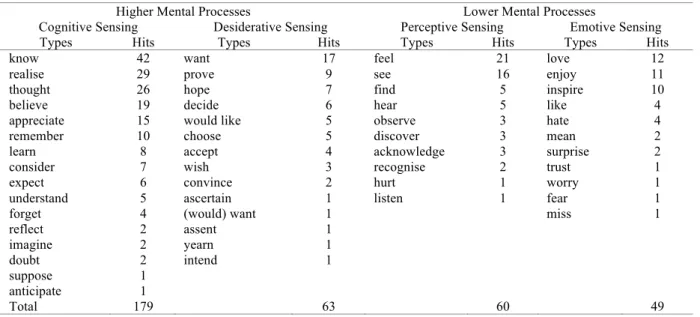
This section presents the different types of sensing from the mental processes. The overall results show the domination of higher forms of sensing such as cognitive and desiderative over lower forms of sensing such as perceptive and emotive processes.
TABLE 2. The mental processes and their sub types of sensing
Table 2 shows that higher mental processes outperform the lower mental processes. The cognitive sensing under the higher domain tops the ranking, with “know” as the highest frequency type, followed by “realise,” and “thought,” respectively. Desiderative sensing contains “want” as the highest frequency sensing. On the one hand, the lower mental
Higher Mental Processes Lower Mental Processes
Cognitive Sensing Desiderative Sensing Perceptive Sensing Emotive Sensing
Types Hits Types Hits Types Hits Types Hits
know 42 want 17 feel 21 love 12
realise 29 prove 9 see 16 enjoy 11
thought 26 hope 7 find 5 inspire 10
believe 19 decide 6 hear 5 like 4
appreciate 15 would like 5 observe 3 hate 4
remember 10 choose 5 discover 3 mean 2
learn 8 accept 4 acknowledge 3 surprise 2
consider 7 wish 3 recognise 2 trust 1
expect 6 convince 2 hurt 1 worry 1
understand 5 ascertain 1 listen 1 fear 1
forget 4 (would) want 1 miss 1
reflect 2 assent 1
imagine 2 yearn 1
doubt 2 intend 1
suppose 1
anticipate 1
161
processes contain more perceptive sensing than emotive sensing. The process “feel” dominates in the perceptive sensing, while “love” dominates the emotive sensing. It should be noted that the hits of “know” correspond to the top recurring theme culled from the Phenomena, that is, “actual classroom experiences, learnings, and the subject/course”. Teachers’ reflection as represented in the Phenomenon participant mostly zeroes in on the learnings they gleaned from the subject, including their challenges in the completion of the writing course. In like manner, the hits of emotive sensing such as “love” correspond to the theme meant to commend the subject/course professor.
TABLE 3. Summary of higher and lower mental sensing, and significance test using t-test
Levels Sensing Types Mean S F % p-value Overall
Cognitive 6.39 3.77 179 51.00
Higher Desiderative 2.25 1.78 63 17.95
0.0000
0.0000
Perceptive 2.15 2.32 60 17.09 0.4189
Lower Emotive 1.75 1.27 49 13.96
Table 3 shows the inferential statistics sought to determine the significant differences of two variables. First, the higher sensing types such as cognitive and desiderative show significant differences. This means that the two types of higher sensing are distinct from each other. They were used differently by the twenty-eight respondents. Secondly, the same table shows that the lower sensing types such as perceptive and emotive do not show any significant difference. The teachers appeared to have employed lower mental processes homogeneously. Lastly, when the two levels of sensing such as higher and lower levels are compared, the results reveal the significant differences of the two. Overall, this statistical treatment confirms that teachers’ reflection papers have been loaded with more number of higher mental sensing than lower mental sensing in the attempt to make sense of their inner world of experiences as students in a writing class. Put simply, they show the propensity to be reflective if we exclude material and relations processes from the context.
RECURRING THEMES BASED ON THE PHENOMENA OF THE SENSERS
The clauses in the mental processes through the Phenomena reveal certain patterns of themes when analysed qualitatively. Looking into a number of Phenomena that are felt, thought of, wanted, and perceived by the Senser, the big themes have been categorised accordingly. It should be worth pointing out, however, that this section does not attempt to discuss all the themes in great detail. A short discussion is offered in lieu of specific discussions.
TABLE 4.The recurring themes from the phenomena
Big thematic categories being reflected on f Mean s
1. Commendations for the course professor 77 2.75 2.49
2. Writing process, its challenges, nature and concepts 74 2.64 2.54
3. Actual classroom experiences, learnings, and the subject/course 65 2.32 1.89
4. Challenges as students 32 1.14 2.03
5. Personal experiences as classroom teachers 31 1.11 3.98
6. Feeling of mediocrity as MA students in this writing class 15 0.54 1.23
7. Choice of subject and university 15 0.54 1.00
8. Drives to improve teaching for students’ welfare 10 0.36 0.78
9. Concepts of good teaching and a good teacher 11 0.39 0.92
10. Experiences as students themselves before 8 0.29 0.90
11. Comparison of the writing subject from other MA subjects 8 0.29 0.85
12. Their classmates 5 0.18 0.39
162
Table 4 shows the domination of commendations for the course professor. Student-teachers had to look back to their professor' professional qualities such as being a master of the subject matter, and being able to vary his teaching styles. Likewise, student-teachers showed the propensity to laud the professor’s personal characteristics and attitudes such as being receptive, open-minded, approachable, and considerate. These teacher qualities have also been a point of emulating the professor’s styles and attitude when they go back to their respective classes. To illustrate:
However, it may be argued that the use of commendations for the professor may illustrate the subjective nature of reflective practices. From the onset, these student-teachers knew that the reflection papers had to be read by their professor. Praises may have been used to crank up solidarity and sustain the rapport with their professor. Presumably, these student-teachers showed an inclination toward building teacher-student relationships as demanded by the culture of gratitude and sense of indebtedness in Filipino culture. They may fall into the umbrella of politeness strategies that consider the reader’s feelings, or even to shield shortcomings of the person in the authority. On an optimistic side, these Phenomenon of commendations may be more than just a thing to flatter the professor; these acts may be an indication that they may have considered themselves as novice teachers who are willing to be mentored by a much more experienced teacher. This idea is made salient in the sixth thematic category about their feelings as mediocre students in this writing class.
The first, the second, and the third big themes such as “writing process, etc.,” “actual classroom experiences, etc.,” and the “challenges as students” appear to be predictable. Needless to say, it would be predictable that their mental worlds revolved around these two related big thematic units given that this was a writing class in their master’s degree program. They had to look back and reflect on how they fared in this class and had to pinpoint their actual experiences as ESL writers. These themes were threshed out from smaller thematic categories such as the importance of learning, the learning processes, their requirements of the subject including the deadline and the quality of their work, and the fulfilment from the expectations of the subject and the professor. All these themes are in consonant with the notion that reflection is a continuous and deliberate examinations of self, beliefs, attitudes, past and future behaviours, in and outside the class. From the backdrop of an international educational system, Kaur Mehar Singh (2016) delves into the challenges of international students in academic writing practices at graduate level. Using an emic perspective analysis, it was found out that students hurdle though methodology and discussion sections. The use of English of a medium of instruction makes the difficulties more salient.
163
these sets of reflection are also related to the fifth thematic category, that is, the reflection on being mediocre teachers in their classrooms. To illustrate: (1) how my students feel when they are asked to write about a given topic; and (2) I was able to understand the troubles of my students in writing.
Equally important, the same table illustrates the other low frequency thematic categories such as their (1) choice of subject and university, (2) concepts of good teaching, a good teacher, and a teaching profession, (3) experiences as students themselves before, (4) comparison of the writing subject from other MA subjects, (5) their classmates. Meanwhile, the one-way analysis of variance (ANOVA) was sought, resulting in the p-value of 0.0000, with at least one item different, that is, the “commendations for the subject professor” which appears to be distinct from the rest of the themes. Generally, the twelve sets of bigger themes identified from the reflection papers, considered to be Phenomena being reflected on are statistically identical. Thus, Figure 1 encapsulates the themes accordingly:
FIGURE 1.The thematic categories culled from the Phenomena of four types of sensing
CONCLUSION
164
Through these mental processes, we are able to infiltrate into the teachers’ rich reservoirs of mental images about their experiences. This is where our roles as mentors set in as we address the issues they think are important. The way they view their lived inner experiences will help us diagnose and pinpoint where we can actually assist them in the teaching-learning process. These themes may be used as a fundamental principle of teacher education development, both for in-service and pre-service teachers. For example, the feeling of mediocrity should be addressed appropriately. In turn, these thematic categories from the Phenomena have the capacity to shape and re-shape and even influence how they view and treat their teaching profession.
Needless to say, a number of limitations are given which engender future research trajectories. For instance, the study failed to include the demographic profiles of the text-producers. Variables such as the number of teaching experience, gender, the levels they are teaching (elementary, secondary, college/university), and whether they are teaching in a public or a private school will also count. Comparison by teachers across career stages from public and private schools can also be a fertile ground for understanding more of their reflective practices. Perhaps, poor reflective practices may be caused by lack of actual teaching experiences.
Given the limited number of corpus, future studies may utilise at least 200,000 words, considered to be enough for a discourse analysis study (Baker 2006). We need to collect reflective practices from multiple sources such as a mix of spoken and written data. These attempts will inform us of more accurate and valid pictures of teachers' continued professional growth. In connection to this, future studies may include a case study into such a design. Typical case studies (Farrell 2013) can provide us with a fuller picture of the reflective practices among our teachers. Thirdly, the content analysis of the Phenomena used to generate the recurring themes, as expected, should be analysed much more carefully. Any coding software package tool that incorporates corpus technology for qualitative studies will be practical for more robust interpretations and explanations in tandem with the manual analysis.
Lastly, teachers’ reflection papers which are not intended to be read by a teacher in authority, but by their fellow teachers should be analysed. Future researchers may require teachers to write reflection papers regularly without any target audience. The intellectualization of reflection may have been detrimental to real reflective practices, perhaps because “reflection is often seen as a solitary, cerebral and introspective affair” (Harper 2009, p. xi), and will remain an elusive issue in teacher education. We need a naturalistic data led-tool in the practice of reflection (Walsh & Mann 2015) after all. However, the challenge in retrieving the texts may be immense. One technique is to request the copies of reflection paper after one year or so.
165
ACKNOWLEDGEMENTS
Merry Ruth M. Gutierrez, PhD for the teaching opportunity at the College of Graduate Studies and Teacher Education Research of the Philippine Normal University-Manila; Gina O. Gonong, PhD, professor in the PhD Applied Linguistics program for introducing a number corpus tools; Philippine Women’s University and its Senior Vice President for Academic Affairs, Felina C. Young, PhD; Dean Olivia Celeste M. Villafuerte for their support; and to the 3L Editor and the three anonymous reviewers for their insightful and enlightening comments on an earlier version of the manuscript.
ENDNOTES
“Student-teachers” here should not be interpreted as student-teachers in the undergraduate level who undergo practice teaching. “Student-teachers” here are the in-service teachers who are pursuing their master’s degrees.
REFERENCES
Astika, G. (2014). Reflective teaching as alternative assessment in teacher education: A case study of pre-service teacher. TEFLIN Journal. Vol. 25(1), 16-32.
Baker, P. (2006). Using Corpora in Discourse Analysis. New York: Continuum.
Cengiz, C. & Karataş, F.Ö. (2015). Examining the effects of reflective journals on pre-service science teachers’ general chemistry laboratory achievement. Australian Journal of Teacher Education. Vol. 40(10), 125-146.
Chan, L.K. & Shum, M.SK. (2011). Analysis of students’ reflective essays on their first human dissection experience. Korean Journal of Medical Education. Vol. 23(3), 209-219.
Costantini, R. (2008). The influence of professional learning communities on teachers' levels of self-reflections. Dissertation from University of Arkansas at Little Rock. Available from ProQuest Education Journals. (230671266).
de O Malatér, L.S. (2004). Looking at the "mental picture of reality" of an EFL teacher: A systemic functional analysis. Ilha Do Desterro: A Journal of English Language, Literature in English and Cultural Studies. Vol. 46, 179-210.
Dewey, J. (1933). How We Think: A Restatement of Reflective Thinking to the Educative Process. Boston: Heath.
Dörnyei, Z. (2007). Research Methods in Applied Linguistics. Oxford: Oxford University Press.
Eltinge, E. M. & Roberts, C. W. (1993). Linguistic content analysis: A method to measure science as inquiry in textbooks. J. Res. Sci. Teach. Vol. 30, 65-83. doi:10.1002/tea.3660300106
Eggins, S. (2004). An introduction to systemic functional linguistics. New York: Continuum.
Farrell, T.S.C. (2013). Critical incident analysis through narrative reflective practice: A case study. Iranian Journal of Language Teaching Research. Vol. 1(1), 79-89.
Fatemipour, H. (2009). The effectiveness of reflective teaching tools in English language teaching. The Journal of Modern Thoughts in Education. Vol. 4(4), 73-90.
Fatemipour, H. & HosseingholiKhani, F. (2014). The impact of reflective teaching on the EFL teachers’ performance. Journal of Educational and Management Studies. Vol. 4(4), 796-799.
Halliday, M.A.K. (2014). In Introduction to Functional Grammar. (3rd ed.). London: Edward Arnold.
Harper, D. (2009). Preface. In Stedmon, J. & R. Dallos (Eds.), Reflective Practice in Psychotherapy and Counselling (pp. 7-13). New York. McGraw Hill, Open University Press.
Hyacinth, T. & Mann, S. (2014). Reflective practice in Nigeria: Teachers' voices and experiences. The Electronic Journal for English as a Second Language. Vol. 3(18).
Impedovo, M.A. & Khatoon, M.S. (2016). Becoming a reflective in-service teacher: Role of research attitude.
Australian Journal of Teacher Education. Vol. 41(1), 100-112.
Jay, J. K. & Johnson, K. L. (2002). Capturing complexity: A typology of reflective practice for teacher education. Teaching and Teacher Education. Vol. 18, 73-85.
Johnson, K.E. (2000). Understanding language teaching: Reasoning in action. Boston, MA: Heinle & Heinle. Kaur Mehar Singh, M. (2016). An emic perspective on academic writing difficulties among international
graduate students in Malaysia. GEMA Online® Journal of Language Studies. Vol. 16(3), 83-97.
Lakshmi, B. S. (2012). Reflective practice through video recording and journal writing-A case study. 3L: The Southeast Asian Journal of English Language Studies. Vol. 18(4), 193-201.
O’Donnell, M. (2015). UAM Corpus Tool (Version 3.2j) [Computer Software]. Available on http://www.wagsoft.com/CorpusTool
166
Roberts, P. (2016). Reflection: A renewed and practical focus for an existing problem in teacher education.
Australian Journal of Teacher Education. Vol. 41(7), 19-35.
Roux, R., Mora, A. & Tamez, A. (2012). Reflective writing of Mexican EFL writers: Levels of reflection, difficulties and perceived usefulness. English Language Teaching. Vol. 5(8), 1-13.
Stedmon, J. & Dallos, R. (2009). Biological and development foundations of reflections. In Stedmon, J. & R. Dallos (Eds.), Reflective Practice in Psychotherapy and Counselling (pp. 23-42). New York. McGrawHill, Open University Press.
Strauss, A. & Corbin, J. (1990). Basics of Qualitative Research: Grounded Theory Procedures and Techniques.
Thousand Oaks, CA: Sage.
Walsh, S. (2011). Exploring Classroom Discourse: Language in Action. New York: Routledge.
Walsh, S. & Mann, S. (2015). Doing reflective practice: A data-led way forward. ELT Journal. Vol. 69(4), 351-362.
Wright, J. (2009.) Reflective practice through a psychodynamic lens. In Stedmon, J., & R. Dallos. (Eds.),