“COOPERATIVE INTEGRATED READING AND
COMPOSITION (CIRC) AND TEAM PAIR SOLO (TPS)
TECHNIQUES FOR HIGH AND LOW STUDENTS’
CREATIVITY IN WRITING NARRATIVE TEXT”
Dian Reftya Wati
E-mail:[email protected]
ABSTRACT
This study was investigated the effectiveness of cooperative learning namely, CIRC and TPS Techniques for High and Low Students’ Creativity in Writing Narrative Text. The objects of this study were conducted at the tenth graders the samples of the research were from two classes, each class consisting of 24 students. Each class was divided into two groups based on their level of creativity (high and low). The data were analyzed by using factorial design 2x2 of ANOVA test. The result of the study showed that: (1) CIRC technique is significance for high students’ creativity in learning teaching writing, (2) TPS is significance for high students’ creativity in teaching writing, (3) CIRC technique is significance for low students’ creativity in teaching writing, (4) TPS is significance for low students’ creativity in teaching writing, (5) there is an interaction among teaching techniques, students’ creativity and writing
INTRODUCTION
Mastering English means acquiring such four basic skills of language, one
of which is writing. Murcia (2000:161) states that writing skill is often perceived
as the most difficult skill since it requires a higher level of productive language
control than other skills. It is no wonder that EFL students think that writing is a
difficult skill to be mastered because it requires many aspects of language in its
production such as organization, content, language use, mechanic and vocabulary.
Moreover, writing is a complex process and commonly difficult for most people.
Cooperative learning technique has been researched and used in a wide
variety of subjects. Writing in the senior high school curriculum had been
conspicuously lacking in this research. This research describes the rational,
development, and evaluation of Cooperative Integrated Reading and Composition
(CIRC), a comprehensive program for teaching reading, writing, and language art.
Although CIRC has clearly supported more than one skill in learning English,
then the writer used this technique in teaching writing skill to know the students’
ability in writing.
Another cooperative technique that can be used to respond students writing
is Team Pair Solo (PTS) technique. This technique is usually use by the teacher in
responding students writing. Kagan (1992:72) stated that this tachnique allows the
students to work on problems first as a team, then a partner, and later they work
easily solve the problems by themselves. Therefore, this technique used the writer
to compare CIRC technique
Another factor that also determines the success of teaching writing is the
students’ creativity. Creativity is the activity to convey something new. In other
words, creativity involves thinking that is aimed at producing ideas or products
that are relatively novel and that are, in some respect, compelling (Kaufman and
Sternberg, 2006:2). Its mean that creativity has a very influential factor to yield a
good writing is verbal creativity. It is an ability to think creatively and to measure
one’s fluency, flexibility, and originality of a verbal form, which deals with words
In line with the background of the study above, this study will attempt to
address the following questions. (1) How significant is the effect of Cooperative
Integrated Reading and Composition (CIRC) for high students’ creativity in
teaching writing? (2) How significant is the effect of Team Pair Solo (TPS) for
high students’ creativity in teaching writing? (3) How significant is the effect of
Cooperative Integrated Reading and Composition (CIRC) for low students’
creativity in teaching writing? (4)How significant is the effect of Team Pair Solo
(TPS) for low students’ creativity in teaching writing? (5) How significant is the
interaction among teaching technique, students’ creativity and writing narrative
text.
REVIEW OF RELATED LITERATURE Nature of Writing
There are several definitions of writing that explained by several experts.
Nunan (1999: 88) defines that writing is the process of thinking to invent ideas,
thinking about how to express into good writing, and arranging the ideas into
statement and paragraph clearly. It indicates that the learners are expected to
explore the ideas and make them into good paragraph According to Brown
(2001:334) Writing is sometimes used as a production mode for learning,
reinforcing, or testing grammatical concepts. Simplify, writing is process of
communication, which uses a conventional graphic system to convey a massage to
a reader that should be learnt.
Components of Writing
To assess and evaluate students writing, there are many scoring rubrics
that proposed by many experts one of the most widely used analytical scales for
ESL writing is the composition profile in Testing ESL Writing (Jacobs in Reid).
According to Smith in Reid (1993: 246) there are some criteria for good writing
namely: (1) content, (2) organization (3) style (4) correctness. In line with Jacobs
scoring rubric, Harris (1995:68-69) said there are five general components in
Narrative Writing
Rachamad (2009: 52) said that narrative is a text which contents about a
story like a story of citizen (folktale), the story of animals (fable), legend (legend),
etc.” It’s mean that a narrative text is a spoken or written text to communicate a
message, which is used to interpret its meaning in the story. Narrative is the most
famous type of any text. Various purposes are communicated in a narrative type.
However the way it is constructed describing certain event, character or
phenomenon in detail. Narrative prefers showing to tell and that the power of
narrative.
Cooperative Learning Technique
According to Wendy (2007:120), there are five key steps to implement
cooperative learning. Step 1 Class cohesion, the activities are include
understanding class friendships, getting to know you activities, class-building
activities, learning how to be a friend, class meetings. The step 2 Team-building
includes, getting to know each other, beginning to work, working together,
reflecting and reviewing. The step 3 being able to resolve conflict, the activities
are, procedures for conflict resolution, understanding body language, peace path.
The next, step 4 teaching the skills, includes: teamwork skills builder exercises,
levels of cooperative learning skills (four-stage rocket), stages in teaching the
skills. And the last, step 5 Incorporating cooperative learning into lessons, the
activities includes: partner work, choosing appropriate lessons, lesson planning,
selecting cooperative learning structures, assessing cooperative group work.
Cooperative Integrated Reading and Composition (CIRC) Technique
Slavin (1995:105) mentions four principles of CIRC Involving effective
use of follow-up activities, oral reading, reading comprehension activities, and
writing processes. In order to achieve the goals of CIRC activities, the teacher
should follow the principal elements of CIRC. Slavin (1995:315) mentions three
principal elements of CIRC: basal-related activities, direct instruction in reading
comprehension, and integrated language arts and writing. In all of these activities,
that involves teacher presentation, team practice, independent practice, peer
assessment, and testing.
Team Pair Solo (TPS) Technique
This technique is organized into three steps: team, pair, and solo. The
procedures of this technique during teaching and learning process are students
from a group with four members, they are simultaneously discuss and learn in
group what they will do about the posted task. In pairs, students discuss the posed
topic in detail. Last, they work the task individually with some prior knowledge
from the previous step (Jacob, Lee, and Ball, 1997:23)
Here is the step-by-step procedure in Team Pair Solo (1)Students work as
a team to solve a problem or accomplish a task, (2) Next, the teams break into
pairs and students work on either the same problem, or a related one, (3) Finally,
the pairs break up and the students work individually to complete the same or a
related task.
Genre Based Approach to Teach Writing
There are some models of teaching writing suggested in GBA with some
stages to be followed by the teacher. In this present study, the teacher used four
stages in GBA as suggested by Derewianka (1990: 6-9), Callaghan and Rothery
(1993: 39) and Hyland (2003: 21) Bellow the four steps which will be applied in
this present study: (1) Building Knowledge of the Field (BKoF) or preparation,
(2) Modeling of Text (MoT), (3) Joint Construction of Text (JCoT), (4)
Independent Construction of Text (ICoT).
Creativity
There are some definitions of creativity. Kaufman and Sternberg (2006:2)
state that creativity involves thinking that is aimed at producing ideas or product
that are relatively novel and that are, in some respect, compelling. Moreover,
creativity is a means by which a person obtains a new perspective and as a result
brings something new to consciousness (Rockler, 1988:6) From the definitions
above, it can be concluded that creativity is the people’s thinking process and
that are useful. Briefly, it can be concluded that creativity has two main
characteristics (new and useful).
Test of Creativity
Based on Munandar (2009:68-69), verbal creativity test are: (1) word
initials, in this test, a subject should think as any words starting with certain
letters.; (2) word creation, when doing this test, a subject is required to arrange as
many words from given word; (3) sentence formulation from three letters, for this
test, a subject has to arrange as many sentence as possible from three given letters;
(4) similar characteristics, this test is to find out as many things from two similar
characteristics given; (5) extraordinary uses of words, this test is to think of as
many devices that have unusual or unique uses, and (6) consequences of effects,
in this test, a subject needs to think as many consequences as possible from a
given condition.
METHOD
In this study, this experimental research is aimed at observing whether
there is an interaction between teaching technique and writing skill viewed from
students’ creativity. The technique used in this experimental research is by
comparing the experimental group I using Cooperative integrated reading and
composition (CIRC) technique to experimental group II using Team pair solo
(TPS) technique as a teaching technique to teach writing. Each group will be
divided in to two different level of creativity (high and low). This research
involves three kinds of variables namely independent variables (teaching
techniques), dependent variable (writing skill), and moderator variable (students’
creativity). The research design used for the research is factorial design 2 x 2 by
technique of multifactor analysis of variance (ANOVA)
Objects of the study
In this research, the target population of this study is all of the tenth
graders of Senior High School Muhammadiyah Tegal in the academic year
2013/2014. The total numbers of the population are 71 students divided into 3
classes. The two classes are X2 and X3 which have 24 students in each class. Two
and X3 as experimental group II. The writer applies cluster random sampling and
does not use random assignment. So, this research is categorized as a
quasi-experimental research.
Procedure of the Study
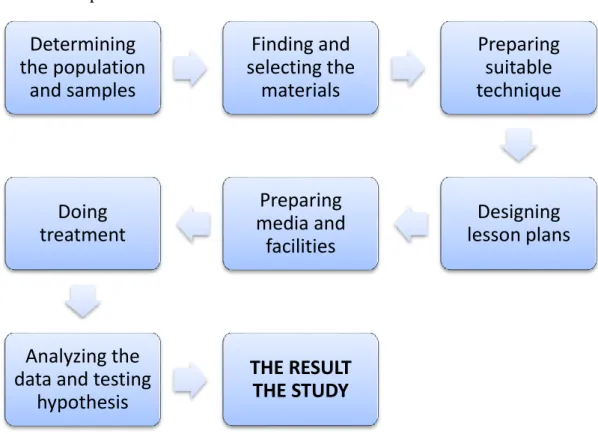
The research procedures are draw below:
Figure 1: Research Procedures Technique of Collecting the Data
The technique of collecting data in this research used test. Test was used to
collect data of students’ writing skill and students’ creativity level. The writer
evaluated the writing test through some aspects, such as: content, organization,
vocabulary, language use (grammar), and mechanics. In order to know the level of
students’ creativity, the students are given creativity test consisting of six kind
including: (1) Word initials, (2) Word creation, (3) Sentence formulation from
three letters, (4) Similar characteristics, (5) Extraordinary uses of words, (6)
Consequences of effects.
Determining
the population
and samples
Finding and
selecting the
materials
Preparing
suitable
technique
Designing
lesson plans
Preparing
media and
facilities
Doing
treatment
Analyzing the
data and testing
hypothesis
One -Sam ple Kolmogorov-Sm irnov Test
8 8 8 8
93.5000 68.8750 93.7500 66.5000 2.56348 4.42194 2.65922 1.51186 .173 .275 .181 .214 .164 .275 .111 .214 -.173 -.190 -.181 -.161 .488 .777 .512 .607 .971 .583 .956 .856 N
Mean Std. Deviation Normal Parametersa,b
Absolute Positive Negative Most Extreme
Differences
Kolmogorov-Smirnov Z Asymp. Sig. (2-tailed)
A1B1 A1B2 A2B1 A2B2
Test distribution is Normal. a.
Calculated from data. b.
FINDINGS AND DISCUSSIONS
The techniques to analyze the data of this study are descriptive (mean,
mode, median, and standard deviation), inferential analysis (Normality and
homogeneity test) and analysis of variance. For the further data description, the
data for each group are described as follows:
Table 1: Descriptive Analysis (Mean, mode, median and standard deviation)
Inferential analysis used in this research related to the design of the
research is multifactor analysis of variance (ANOVA). ANOVA test was used to
find out whether the difference between them is significant or not.
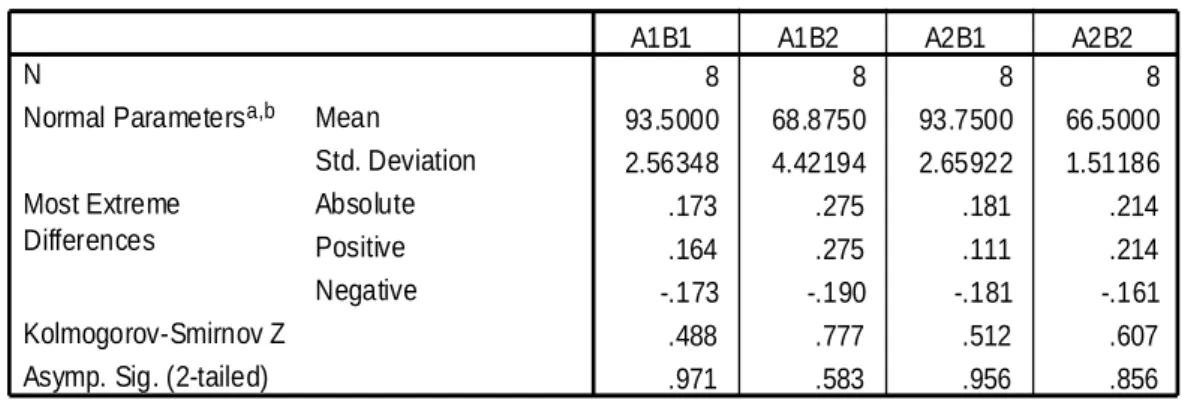
Table 2: the Result of Normality Test
Table 4.2 show the data on SPSS out put, we can see that all Asymp. Sig.
(2-tailed) from all groups are greatter then 0.05 (0.971, 0.53, 0.956, 0.856), so it is
concluded thst all the data was normally distributed or indicate that Ho is
accepted.
Leven e's Test of Equality of Error V ar iancesa
Dependent Variable: Value
.903 3 28 .452
F df1 df2 Sig.
T ests the null hypothesis that the error variance of the dependent variable is equal across groups.
Design: Intercept+SC+T T +SC * T T a.
Statistics
8 8 8 8
0 0 0 0
93.5000 68.8750 93.7500 66.5000 93.5000 68.0000 94.5000 66.5000 90.00a 66.00a 95.00 65.00
2.56348 4.42194 2.65922 1.51186 Valid Missing N Mean Median Mode Std. Deviation
A1B1 A1B2 A2B1 A2B2
Multiple modes exist. T he smallest value is shown a.
Table 3: the Result of Homogeneity Test
From the result of the calculation, it can be seen that F value for levene’s
test is 0.903 with Sig. (p) value of .452. because the Sig. value is greater then our
alpha of 0.05 (p>0.05), the the writer retain the null hypothesis (no diffrntece) for
assumption of homogenity of variance and conclude that there is no significant
diffrence between the two group’s variance. Then, it can be concluded that the
data are homogenous.
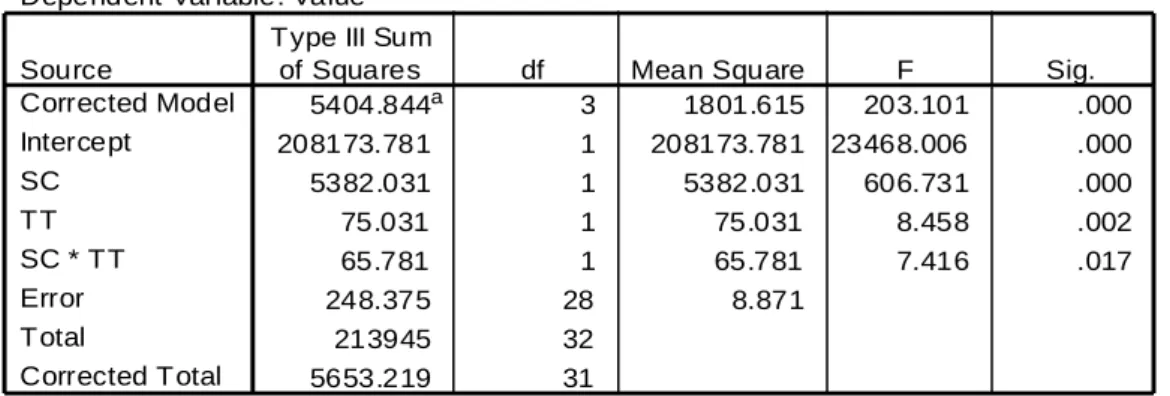
Here is the table for summarizing ANOVA factorial design 2x2 used SPPS
programs as follows:
Table 4: The Summary of ANNOVA
Tests of Between-Subjects Effects
Dependent Variable: Value
5404.844a 3 1801.615 203.101 .000
208173.781 1 208173.781 23468.006 .000
5382.031 1 5382.031 606.731 .000
75.031 1 75.031 8.458 .002
65.781 1 65.781 7.416 .017
248.375 28 8.871
213945 32 5653.219 31 Source Corrected Model Intercept SC TT SC * TT Error Total
Corrected Total
Type III Sum
of Squares df Mean Square F Sig.
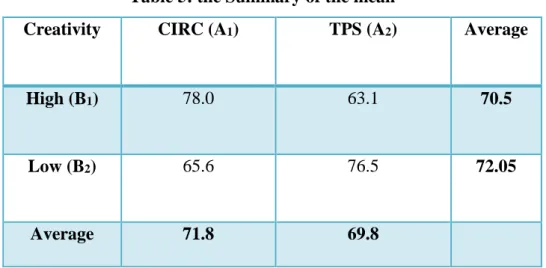
Table 5: the Summary of the mean
Creativity CIRC (A1) TPS (A2) Average
High (B1) 78.0 63.1 70.5
Low (B2) 65.6 76.5 72.05
Average 71.8 69.8
Based on the summary of multifactor analysis of variance, it can be
concluded that:
The result from the independent variables influence simultaneously or
together toward dependent variables. It was significant because the data above
showed that corrected model was 0.000 < 0.05. It means that the null hypothesis
(H0) is rejected. Then, it can be concluded that there is a significant difference
between CIRC and TPS techniques in teaching writing toward students’ writing
ability. Because the mean score of students taught by using CIRC Technique
(71.8) is higher than mean score of students taught by using TPS Technique
(69.8), it can be concluded that CIRC Technique is more effective than TPS
Technique to teach writing for the tenth grade students of Senior High School
Muhammadiyah Tegal in the academic year of 2013/2014.
The result of the table 4.17 showed that Sum of Squares is 5382. 031 4.77
and F value 606.731 at the level of significance α 0.05 is 0.00. It means that the
null hypothesis (H0) is rejected. Then, it can be concluded that there is a
significant difference between the students who having high creativity and those
having low creativity. Because the mean score of students having high creativity
(70.5) is higher than mean score of students having low creativity (72.05), it can
be concluded that the students having high level of creativity have better writing
The result from the data ANOVA explains that Sum of Squares is 65.781
and F value 7.416 at the level of significance α 0.05 is 0.17. It means that the null
hypothesis (H0) is rejected. It can be concluded that there is an interaction
between teaching technique, students’ creativity, and writing narrative text ability.
DISCUSSION AND CONCLUSION
Form the analysis in the previous chapter, the researcher sums up the result of
discussion as follows:
The first result based on the data analysis that Cooperative Integrated
Reading and Composition (CIRC) technique is effective for high students’
creativity in teaching writing. Its show from the result of ANOVA test, Ho
rejected and Ha accepted, it is mean that there is a significant difference between
pre test and post test score or there is positive effect of CIRC for high students’
creativity in teaching writing narrative text. It can be conclude there is a
significance difference for students’ high creativity in writing ability. It means
that the students who have high creativity have better writing ability than students
who have low creativity taught by CIRC technique.
The second conclusion shows that Ho accepted and Ha is rejected, it mean
there is no significant differences between pre test and post test or there is no
effect of TPS technique for high students’ creativity n teaching writing narrative
text. So it is mean there is no significant difference statistically.
The next, Cooperative Integrated Reading and Composition (CIRC)
technique is effective for low students’ creativity in teaching writing. From the
ANOVA test, show that Ho rejected and Ha accepted, it is mean that there is a
significant difference between pre test and post test score or there is positive effect
of CIRC for high students’ creativity in teaching writing narrative text.
The forth conclusion from the data analysis from ANOVA show that Ho
accepted and Ha is rejected, it mean there is no significant differences between
pre test and post test or there is no effect of TPS technique for high students’
creativity n teaching writing narrative text. So it is mean there is no significant
Then the fifth result, there is an interaction between teaching technique,
students’ creativity and writing. The interaction happened because CIRC
Technique is more appropriate technique for students having high creativity, and
TPS Technique is more appropriate for students having low creativity.
Cooperative Integrated Reading and Composition (CIRC) Technique is more
effective than Team Pair Solo (TPS) Technique. Students taught by using CIRC
Technique have better Writing abilities than those taught by using TPS Technique
for the tenth graders of Senior high school Muhammadiyah Tegal in the academic
year of 2013/2014.
Based on the research findings, it can be concluded that CIRC Technique
is effective to teach writing for the tenth graders of senior High School
Muhammadiyah Tegal in the academic year of 2013/2014.
REFERENCES
Alderman, M.K. (2004), Motivation for Achievement Possibilities for Teaching and Learning Second Edition, United States of America: Lawrence Erlbaum
Anderson, Gary with Arsenault Nancy, (2005) Fundamentals of Educational Research, USA, Falmer Press.
Brown, H.D. (2001). Teaching by Principles: An Interactive Approach to
Language Pedagogy. New York: Addison Wesley Longman, Inc.
. (2007). Teaching by Principles, an Interactive Approach to Language
Pedagogy. New York. Longman.
. (1994). Principles of Language Learning and Teaching. New Jersey: Prentice Hall. Johnson, D. (2005). Cooperative learning: increasing college faculty instructional productivity. Online. (www. ntlf.com/html/lib/bib/92-2dig. htm. (2014, January 18).
Byrne, Donn. (1997). Teaching Writing Skills (Longman Handbooks for Language Teachers). Edinburgh Gate. Longman.
Callaghan, M & Rothery, G. (1993). The Power of Literacy. Ersneville, NSW: Metropolitan East Disadvantaged School’s Program.
Durukan, E. (2011). Effects of Cooperative Integrated Reading and Composition (CIRC) Technique on Reading-Writing Skills. Educational Research and Reviews, 6(1)
Derewianka, Beverly. (1990). Exploring How Texts Work. Newtown. Primary English Teaching Association.
Foster, John. (1971). Creativity and the Teacher. London: MacMillan Education Ltd.
Gay, L.R. (1992). Education Research. Competencies for Analysis and
Application. New York: Macmilan Publishing Company.
Gerot, Linda and Peter Weignell, (1994), The Genre- Grammar Connection.
Australia AEE
Harmer, Jeremy. (2004). How to Teach Writing. Edinburgh Gate: Pearson Education Limited.
Harris, T.L., & Hodges, R.E. (Eds.). (1995). The Literacy Dictionary: The Vocabulary of Reading and Writing. Newark, DE: International Reading Association
Heaton. (1988). Writing English Language Test. Lognman Handbooks for Language Teacher. Hongkong: Longman Group Ltd
Henson, Kenneth T. and Bent F. Eller. (1999). Educational Psychology for Effective Teaching. United States of America: Wadsworth Publishing Company.
Hernowo. (2004). Quantum Writing. Bandung: Mizan Learning Center
Hornby, A.S. (2010). Oxford Advance Learner’s Dictionary Eighth Edition,
International Studetns’ Edition. New York: Oxford University Press.
Himawati, Ulya. (2011). The Use of Cooperative Integrated Reading and Composition to improve Students’ Ability in Composing Narrative Writing. Thesis. Semarang: Education Faculty State Institute for Islamic Students Walisongo.
Huda, Choirul, (2009), 'Cooperative Integrated Reading and Composition as a Method to Reduce The Students' Problem in Writing a Recount Text’.
Thesis. Semarang:Education Faculty State Institute for Islamic Students Walisongo.
Jacob, Lee, and Ball: 1997 Implementing cooperative learning. English Teaching Forum.
Johnson, Burke and Christensen, Larry. (2000). Educational Research. Quantitative and Qualitative Approach. New York: A Pearson Education Company.
Johnson, D. W., Johnson, R. T., & Smith, K. A. (1991). Cooperative learning returns to college.
Johson, Roger, and David Johson. (1982). Cooperation in Learning Ignored but Powerful,
Kaegan, S. (1992). Cooperative Learning, Eight Edition. San Clemente, CA: Kaegan.
Kagan, S. (1992) Cooperative Learning. San Juan Capistrano. California: Resources for Teachers.
Kagan, S. (2005). There is no "I" in team - or is there? Online] Available:
Retrieved January 20, 2014 from
http://www.kaganonline.com/free_articles/dr_spencer_kagan/296/There-Is-No-quot-I-quot-In-Team-Or-Is-There
Kaufman, James C. and Robert J. Sternberg. (2006). The International Handbook of Creativity. New York: Cambridge University Press.
Linda, Gerot and Peter Weignell, (1994), The Gewe - Grqnnar Connection,
Australia AEE.
Munandar, Sukarni Catur Utami. (1992). Creativity and Education: Jakarta: Proyek Penggandaan/Penerjemah Buku direktorat Pembinaan Penelitian dan Pengembangan Pada masyarakat Direktorat Jendral Pendidikan Tinggi Departmen Pendidikan dan Kebudayaan.
__________. (2009). Pengembangan Kreativitas Anak Berbakat. Jakarta: PT. Rineka Cipta
Murcia, Celce, Marianne and Elite Olshtein. (2000). Discourse and Context in Language Teaching. New York. Cambridge University Press.
Nina. (2010), entitle The Cooperative Integrated Reading and Composition (CIRC) on Reading Skill. Thesis. Semarang: state university of Semarang
Nunan, David. (1999). Second Language Teaching and Learning. Boston: Heinle&Heinle Publishers. 2003. Practical English Language Teaching.
Singapore: Mc. Graw Hill
Paramita, (2013) Improving Students’ Achievement in Writing News Item Text
Through cooperative Integrated Reading and Composition (CIRC) Technique. Thesis. Medan: State University of Medan
Rachamad Widodo, (2009)“Model Pembelajaran Cooperative Integrated Reading and Composition” Unpublished thesis. Semarang: state university of Semarang.
Rahmatan (2013) entitled, The Development of CIRC Model in Reading Comprehension at Elementary School. Thesis. Surakarta:state university of Surakarta
Rega. Dapartiwi. The Impact of Team Pair Solo Technique and Round Robin Technique on Students’ Ability in Writing Descriptive Text. Journal of English Education Teaching 2 (2), (2013). Department of English, faculty Language, Arts, Semarang State University, Indonesia
Reid, M. Joy. (1993). Teaching ESL Writing. New Jersey. Prentice Hall, Inc.
Richards, J. C., & Rodgers, T. (2001) .Approaches and Methods in Language Teaching: A Description and Analysis. Cambridge: Cambridge University Press.
Robert E. Slavin, (1995). Cooperative Learning: Theory, Research, and Practice, USA.
Rockler, Michael J. (1988). Innovative Teaching Strategies. New York: Gorsuch Scarisbrick Publisher.
Rosita, Amalia (2011). The Use of Team Pair Solo in Reading Comprehension.
Unpublished Thesis. Surakarta: Sebelas Maret University.
Schaedel, B., Hertz-Lazarowitz, R., Walk, A., Learner, M., Juberan, S., &Sarid, M. (1994). The Israeli CIRC (ALASH): First Year Achievements in Reading and Composition. Unpublished paper, Haifa University (Israel).
Sharan, Y. and S.Sharan (1992), Expanding Co-operative Learning through Group Investigation, New York: Teachers College Press.
Classroom Atmosphere of mathayomsuksa five Students. M.A. Dissertation, Chiangmai University
Slavin, E. R. (1995). Cooperative Learning Theory; Research and Practice. New York: The Hopkins University.
Spratt, Mary and Alan. (2005). The Teaching Knowledge Test Course (TKT). New York: Cambridge University Press.
Stenberg, Robert J. (2006). The Nature of Creativity. Creativity Research Journal, Vol. 18, No. 1, 87–98: Lawrence Erlbaum Associates, Inc. Available at
http://people.uncw.edu/caropresoe/GiftedFoundations/SocialEmotional/Cr eativity-articles/Sternberg_Nature-of-creativity.pdf
Stevens, R., Slavin, R., &Farnish, A. (1995). The Effects of Cooperative Learning and Directed Instruction in Reading Comprehension Strategies on Main Idea Identification. Journal of Educational Psychology,Vol 83: 14
Sudarwati, Th. M., (2007), I-ook Ahead An English Course For Senior High School Students 1, Jakarta: Erlangga
Sugiyono. (2012). Statistic Untuk Penelitian, alfabeta
Suharnan. (2012). Kreativitas (Teori dan Pengembangan). Surabaya: Laros
Suharsimi, Arikunto. (2002). Prosedur Penelitian Suatu Pendekatann Praktek. Jakarta: PT. RinekaCipta.
Sullo, Bob. (2009). Motivated Students Unlocking the Enthusiasm for Learning.
Printed in the United States of America.
Ur, P. (1996). A course in Language Teaching Practice Theory. Cambridge Teacher Training and Development. Cambridge: Cambridge University Press.
Wati, Veni Vera. (2012) Improving Students’ Reading Comprehension on Narrative Text trough Team Pair Solo. Thesis. Pontianak: Teacher Training Education Faculty of Tanjungpura University in Pontianak