TECHNICAL UNIVERSITY OF CLUJ-NAPOCA
ACTA TECHNICA NAPOCENSIS
Series: Applied Mathematics, Mechanics, and Engineering Vol. 62, Issue IV, November, 2019
SUSTAINABLE INVESTIGATION ON THERMOFORMING OF
CELLULOSE FIBERS COMPOSITES
Abderraouf GHERISSI, Faris SHUREDYA, Emad ALATAWI, Abdulrahman ALBALAWI, Bareq ALBALAWI
Abstract: In the present paper an experimental investigation on natural palm fibers was carried out. The behavior of the natural fibers was extracted through tensile tests and thermal gravimetric analysis (TGA) test. A thermoplastic matrix of polystyrene (PS) and palm natural fibers was successfully gathering to form a sandwich composite with different fibers ratios. A thermoforming process was conducted to form the composite sheets with controlling production parameters such as speed, time and temperature. Based to the experimental results and measurements, the effects of forming process parameters and the fibers weight fractions for 0/90° fibers orientations have a great impact on the composite behavior and influence the appearance of cracks, delamination and buckling in the final product surface. It was concluded that the composite Palm fibers (PF)/Polystyrene (PS) could be thermoformed and can be taken as replacement of several synthesis preformed composites in several industrial applications to achieve an efficient sustainable and waste management practice.
Key words: cellulose palm fibers; polymer composites; sustainable investigation; thermoforming.
1. INTRODUCTION
The natural fiber strengthened polymer composites became recently highly appreciated materials for sustainable investigations. In this type of materials, several types of natural fibers, such as palm fibers, Alfa fibers, sisal fibers, jute fibers, kenaf fibers, flax fibers, etc. are used as reinforcement for polymer-based matrices [1-7]. In natural fibers reinforced composite NFC the mechanical, physical and recyclability properties of fibers play an important role in the final product quality.
It is principal for any designer to product the natural composite material with minimum cost, through taking into consideration the design constraints, the client need and the minimum environmental impact. To achieve the proper compatibility of the composite material with its performance and recyclability several recent work gives higher priority to engineering product design and material application. In any particular application, numerous factors, constrains, and restrictions influence the usage
of a specific type of composite material [8]. This makes the adjustment of design constrains and fiber-matrix mixture of suitable material type is a very complex matter where accurate decisions have to be taken [9]. Actually the proper material selections as seen in the work of AL-Oqla et al [10] and Jahan et al. [11] become so much important. Then the new environmental rules and sustainability concepts makes the ideal employment of natural composite materials improve. As well the exploiting of natural fibers decrease waste throwing away difficulties, and as well decrease environmental contamination [3] and imported to industrial an alternative materials resources. It was observed that the natural fiber composites has recently operated to replace some glass and carbon reinforced polymer composites [2]. Also natural fibers have major recyclability advantages over traditional glass, carbon and Kevlar fibers in that is make NFC very competitive in the modern industrial policy and applications.
material, the good thermal and acoustic isolation properties, the availability of the fibers in different countries with different forms and strengths, the reduced dermal and respiratory irritation in production process, and the reduced of tool wear in manufacturing operations [2-4]. The mechanical properties and enactment of NFC depend not only on the properties of their individual constituents, fibers and matrix, but also on their compatibility and interfacial (matrix/fiber) characteristics which increase the prospects of manufacturing new NFC with entirely new properties [10]. Several researches focused on mechanical properties, others on chemical modifications to improve fiber/ polymer compatibility, for example, Gherissi et al [1] gives comprehensively studied for polypropylene and PLA composites reinforced with cellulose alfa microfibers through chemical preparation and mechanical production and testing process. Pickering et al. [5] widely investigated Polypropylene hemp fibers through injection molding process. The authors studied also fibers treatments and modifications, to optimize fibers behavior. As examples is was shown in the work of Al-Khanbashi et al. [6] the use of treated the date palm fibers to reinforce polymer matrix and the authors discussed a wide range of physical characteristics of composite. It was also discussed in the study of Alves et al [4] the properties of jute/plastic composites, where several characteristics were examined, such as crystallinity, thermal stability, weathering resistance, and durability. In addition the authors study the suitability of the material to the automotive parts design. Additionally, Nasser et al [7] studied the implementation of date palm in cement composite industry.
The study of the abilities of the bio-based plastics compared with petrochemical plastics potentials on the technical and market was reveled in the work of Shen et al. [12] gives an alternative natural matrix for composite material for many industrial applications .
In this work and based to the previous cited works it was first, conducted an investigation to the physical properties of the most available local cellulose fiber which is the palm natural fiber (PF), evaluated through weight loss degradation and mechanical tensile resistance. Then, the composites sheet fabrication was
carried out and the thermoforming of natural fibers composite materials was conducted under the stamping machine. The present NFC shows some prospective and capabilities of the natural cellulosic fibers reinforcement compared to traditional composites.
2. EXPERIMENTAL STUDY
2.1 Characterization of the palm fibers
The tensile test on palm fibers were conducted in Gant Universal Test Machine WP3, the average curve of the conducted tests is presented in the figure 1.
Fig.1: Tensile test of Palm fibers (PF)
According to the figure 1 the ultimate tensile resistance of the PF is about 27 MPa and maximum strain at break is about 3.44%.This characteristics is so much less than glass or carbon fibers but it could bring a more structure resistance to thermoplastic matrix such as polystyrene plastic (PS).
The Palm fibers in the thermoforming process will be in front of overheating process to permit the forming of the composite PS/PF. In order to evaluate the degradation of the fiber face to the heat process a thermal gravimetric analysis (TGA) test was conducted, the fig. 2 show the weight loss percentage vs the temperature of the PF.
The figure 2 shows clearly that the fiber decreases in weight about 87.5 % after 225 °C, that makes a design constraint for the choice of the appropriate matrix for NFC in order to
0 5 10 15 20 25 30
0 0,01 0,02 0,03 0,04
conduct the thermoforming process in without degrade the natural fibers.
Fig. 2: TGA of the palm fibers
2.2 The composite PS/PF
The plastic was chosen as polystyrene prefabricated from local company ‘styrene Gulf Company’. The general property of the matrix is illustrated in the table 1.
Table 1: General property of the composite matrix PS
Property Value
The Melt Temperature
210-249 °C
The Heat Deflection Temperature
95 °C
The Tensile Strength
53 MPa
The Flexural Strength
83 MPa
According to the table 1 and fig. 2 the combination of the Palm fibers and PS matrix in the process of thermoforming is feasible due to the low weight loss of the fibers under the temperature between 95 °C and 210°C, which represent for the PS matrix the thermoforming operation zone: the heat deflection to melt temperature start zone.
The design of the main sheet was chosen as sandwich composite formed by 0°-90° palm fibers as a core and two sheets upper and down the fibers represent the skin of the composite, see figure 3.
2.3 Design and process
The thermoforming tests of the composite sheets had done in local designed thermoforming machine, see figure 4.
a-The sandwich design of the composite
b-The obtained specimen
Fig. 3: The composite Polystyrene (PS)/Palm fibers (PF)
a-The completed design of the Thermoforming machine
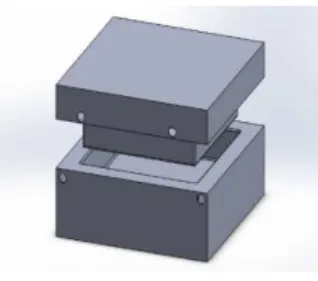
c-The punch and the die
Fig.4: The CAD of the thermoforming machine
a- The machine prototype
b- The heater
c- The stamp forming part
Fig.5: the thermoforming machine prototype
Different tests were conducted to evaluate the thermo-formability of the composite polystyrene - Palm fibers as shown in the figure 6.
The analysis of the process performance had done on several specimen. Quality of finishing product is depending on so many process parameters. Final product is improved by improving process parameters such as the speed of manufacturing, the heating time and temperature control, the punching force and velocity. Types of specimen affect also the efficiency of thermoforming process. Therefore several optimizations was considered to optimize the global thermoforming process. Due to the addition of different percentages of PF, the thermoforming strength of the specimen increased and the presence of cracks and buckling increase as well.
a- Specimen with 10 % weight ratio
b- Specimen with 30 % weight ratio
Fig. 6: Thermoformed specimen obtained at different fiber ratio
of finished product; it was observed in the specimen with 50 % weight ratio of palm fiber more cracks and buckling compared with specimen with 30% weight ratio, and it was no apparent cracks in the specimen with 10% fiber ratio.
3. RESULTS AND DISCUSSION
Thermoforming of the composite PS/PF is an effective way to reduce manufacturing costs and achieve good reproducibility. It was verified that high quality of parts could acquire with the thermoforming machine if the process parameters are optimized.
The defects in the finishing product growth in number and size with the increase of the fiber ratio in the matrix.
Through the present results, it is concluded that the thermoforming process of the PS/PF is feasible and could be implemented to a high-volume manufacturing of the natural fiber-reinforced composite parts.
4. CONCLUSIONS
The core of the present study was to conduct a forming process of the natural fiber composite, Palm fiber/ polystyrene (PF/PS), with different ratio 10, 30 and 50%. To proceed to the forming process, it was necessary to design and construct a thermoforming machine and to prepare the specimen sheets.
The thermoforming of thermoplastic composite in the machine is an effective way to reduce manufacturing costs and achieve good reproducibility. It was observed, first that the palm fibers support the PS matrix structure and prevent breaking during the forming process; second the specimen temperature the punch stroke and the process timing has a strong influence to the finish part quality.
High quality of finish parts could be acquired by the good choice the fiber ratio and the fine control of the process parameters.
5. FUNDING: “This research was funded by [Deanship of scientific Research] grant number [s-0225-1439]”
6. ACKNOWLEDGMENTS: The author
acknowledges the financial support provided by the Deanship of Scientific Research (DSR) at University of Tabuk, Tabuk, Saudi Arabia, under grant No. s-0225-1439.
7. CONFLICTS OF INTEREST: “The author declares no conflict of interest.”
8. REFERENCES
[1] Gherissi, R. Ben Cheikh, E.Dévaux and F. Abbassi. Cellulose whiskers micro-fibers effect in the mechanical proprieties of PP and PLA composites fibers obtained by spinning process. Applied Mechanics and Materials. Vol. 146 pp 12-26, 2012. [2] Faruk, O., Bledzki, A.K., Fink, H.-P., Sain, M.
Biocomposites reinforced with natural fibers. Progr. Polymer Sci. 37, p1552-p1596, 2012.
[3] Kalia, S., Avérous, L., Njuguna, J., Dufresne, A., Cherian, B.M. Natural fibers, bio- and nanocomposites. Int. J. Polymer Sci. 2011. [4] Alves, C., Ferrão, P.M.C., Silva, A.J., Reis,
L.G., Freitas, M., Rodrigues, L.B., Alves. Ecodesign of automotive components making use of natural jute fiber composites. J. Cleaner Prod. 18, p313-p327, 2010.
[5] Pickering, K.L., Beckermann, G.W., Alam, S.N., Foreman, N.J. Optimising industrial hemp fiber for composites. Compos. A Appl. Sci. Manuf. 38, p461-p468, 2007. [6] Al-Khanbashi, A., Al-Kaabi, K., Hammami, A.
Date palm fibers as polymeric matrix reinforcement: fiber characterization. Polymer Compos. 26, p486-p497, 2005. [7] Nasser, R.A., Al-Mefarrej. Midribs of date
palm as a raw material for wood-cement composite industry in Saudi Arabia. World Appl. Sci. J. 15, p1651-p1658, 2011. [8] Ashby, F., Johnson, M. Materials and Design,
Threat and Science of Material Selection in Product Design. Butterworth-Heinemann, Oxford, 2002.
[10] Faris M. AL-Oqla, S.M. Sapuan. Natural fiber reinforced polymer composites in industrial applications: feasibility of date palm fibers for sustainable automotive industry. Journal of Cleaner Production 66, p347-p354, 2014.
[11] Jahan, A., Ismail, M.Y., Sapuan, S.M., Mustapha, F. Material screening and
choosing methods e a review. Mater. Des. 31, 2010.p696-p705, 2010.
[12] Shen, L., Haufe, J., Patel, M.K. Product Overview and Market Projection of Emerging Bio-based Plastics PRO-BIP , Report for European Polysaccharide Network of Excellence (EPNOE) and European Bioplastics, pp 243. 2009.
INVESTIGAREA DURABILĂ A TERMOFORMĂRII FIBRELOR DE CELULOZĂ
COMPOZITE
Rezumat: în lucrarea de față a fost efectuată o investigație experimentală asupra fibrelor naturale de palmier. Comportamentul fibrelor naturale a fost extras prin teste de tracțiune
și testul de analiză termică gravimetrică (TGA). O matrice termoplastică de polistiren
(PS) și fibre naturale de palmier a fost cu succes de colectare pentru a forma un sandwich compozit cu diferite fibre raporturi. Un proces de termoformare a fost efectuat pentru a
forma foile compozite cu parametri de producție de control, ar fi viteza, timp și
temperatură. Pe baza rezultatelor experimentale și măsurători, efectele formării
parametrilor de proces și fracțiunile de greutate fibre pentru 0/90 ° orientări fibre au un impact mare asupra comportamentului compozit și influența apariția de fisuri, exfolierii și flambaj în suprafața produsului final. S-a concluzionat că fibrele compozite de palmier (PF)/polistiren (PS) ar putea fi termoformate, adica pot fi luate ca înlocuire a mai multor compozitii preformate de sinteză în mai multe aplicatii industriale pentru a realiza o practică eficientă durabilă și gestionarea deșeurilor.
Cuvinte cheie: fibre de palmier celuloza; compozite polimerice; investigații sustenabile; termoformare.
Abderraouf GHERISSI, Assistant Professor, University of Tabuk, College of Engineering Mechanical Engineering Department, Email: [email protected], Address: Mechanical Engineering Department, College of Engineering, University of Tabuk, P.O. Box: 741, Tabuk 71491, Saudi Arabia. Tel: +966543440530
Faris SHUREDYA, Mechanical Engineering Student, Mechanical Engineering Department, College of Engineering, University of Tabuk, P.O.Box : 741, Tabuk 71491, Saudi Arabia, Email: [email protected]
Emad ALATAWI, Mechanical Engineering Student, Mechanical Engineering Department, College of Engineering, University of Tabuk, P.O.Box : 741, Tabuk 71491, Saudi Arabia, Email: [email protected]
Abdulrahman ALBALAWI, Mechanical Engineering Student, Mechanical Engineering Department, College of Engineering, University of Tabuk, P.O.Box : 741, Tabuk 71491, Saudi Arabia, Email: [email protected]