Corresponding Author: Syaiful Baharee Jaafar, Commerce Department, Politeknik Tuanku Sultanah Bahiyah Kulim Hi-Tech Park, 09600 Kedah, Malaysia, +6012-5285514
International Journal of Business and Management 2 (5): 09-15, 2018 e-ISSN: 2590-3721
© RMP Publications, 2018 DOI: 10.26666/rmp.ijbm.2018.5.2
Are Soft Skills Required for Accounting Students in Future Career? Syaiful Baharee Jaafar
Commerce Department, Politeknik Tuanku Sultanah Bahiyah Kulim Hi-Tech Park, 09600 Kedah, Malaysia
Abstract: Nowadays, business is very challenging and competitive, so it requires employers to hire multitasking employees. Therefore, students should be learning soft skills linked with industrial requirements. Accounting students should have added value, such as good soft skills, which may lead to higher employability. Higher education institutions need to play a role to provide a curriculum that emphasizes soft skills such as communication skills, time management, and problem solving. This study discusses these skills for accounting graduates during their studies at higher education institutions. Without better soft skills, it is very tough for future accountants to be hired. Higher employability linked with better soft skills may enhance the public’s perception of the accounting field.
Key words: Soft skills, Higher Education Institutions, Curriculum
1. Introduction
Nowadays, an accounting career has become more challenging due to globalization. Even if a student is able to graduate with good results, that is not a guarantee of success in his or her career. Accounting is a technical subject, ensuring that students have the ability to understand the transactions and procedures of accounting matters only. Globalization issues require accounting students to have more soft skills rather than technical knowledge.
Even though company accountants are knowledgeable and experienced regarding accounting matters, the misuse of accounting treatment still happens. This shows that the accountant should be provided with soft skills knowledge along with accounting knowledge. Soft skills need to be taught along with accounting subjects in secondary school, college, or university. Accounting students should be provided with knowledge of leadership, teamwork, communication, and time management. It is not easy for an accountant to deal with people, especially those who have authority and tend to misuse financial reports for personal matters. Through learning the soft skill elements in the curriculum, students have the ability to face those problems. In addition, Mara et al. [1] stated that
accountants are expected to learn both hard and soft skills to
enable them to better multitask when facing challenges in today’s modern business environments.
Lack of communication skills tends to result in misunderstanding of information with clients or employers, which bears costs. Argument and discussion are required in the accounting field because it involves documents. Without good communication skills, companies could have problems with clients. This study further discusses why more soft skills should be required for accounting students for their future careers. Three aspects of soft skills will be further discussed: communication, time management, and problem solving.
2. Literature Review
careers in the future. This shows that an accountant should not only have good technical skills but also good soft skills. According to Weber et al. [3] and Villiers [4], employers prefer to hire employees with a healthy blend of soft and hard skills.
According to the statement above, this study will discuss the importance of soft skills such as communication skills, time management, and
problem solving in an accounting career. Students should be taught soft skills during their studies, along with the technical elements of accounting before becoming accountants. Integration between soft skills and the technical parts of accounting may enhance students’ confidence. The diagram below shows the relationship between soft skills such as communication skills, time management, and problem solving and an accounting career.
Diagram 1: Conceptual Framework
Communication Time
Skills Management
Accounting Firm
Audit Firm
Soft Skills Accounting Career
Taxation Firm
Problem
Solving Private
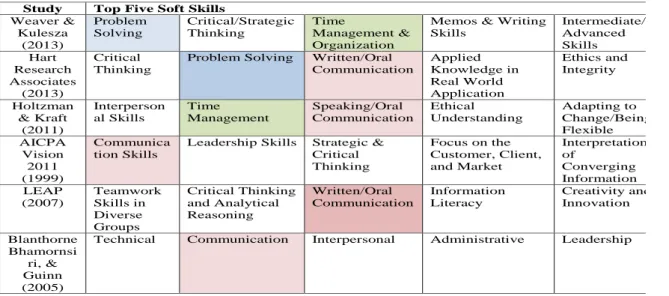
The diagram above shows the elements of soft skills that are considered in this study, basically based on Table 2.1, which shows the top five soft skills from the employer’s perspective. According to Weaver and Kulesza [5] and Hart Research Associates [6], problem solving is one of the top five priorities from the employer’s perspective.
According to Weaver and Kulesza [5] and Holtzman and Kraft [7], time management is a very important soft skill that should be learned by students. Hart Research Associates [6], AICPA Vision 2011 [8], and Blanthorne, Bhamornsiri, and Guinn (2005) show that communication skills should be mastered by students.
Table 2.1 Top Five Soft Skills from the Employer’s Perspective Study Top Five Soft Skills
Weaver & Kulesza
(2013)
Problem Solving
Critical/Strategic Thinking
Time
Management & Organization
Memos & Writing Skills
Intermediate/ Advanced Skills Hart
Research Associates
(2013)
Critical Thinking
Problem Solving Written/Oral
Communication
Applied Knowledge in Real World Application
Ethics and Integrity
Holtzman & Kraft
(2011)
Interperson al Skills
Time Management
Speaking/Oral Communication
Ethical Understanding
Adapting to Change/Being Flexible AICPA
Vision 2011 (1999)
Communica tion Skills
Leadership Skills Strategic & Critical Thinking
Focus on the Customer, Client, and Market
Interpretation of
Converging Information LEAP
(2007)
Teamwork Skills in Diverse Groups
Critical Thinking and Analytical Reasoning
Written/Oral Communication
Information Literacy
Creativity and Innovation
Blanthorne Bhamornsi
ri, & Guinn (2005)
Technical Communication Interpersonal Administrative Leadership
2.1 Soft Skills and Accounting Career
Soft skills are learned during secondary school and continue in tertiary institutions. Research shows that for accounting students, soft skills are associated with an accounting career. Therefore, previous studies emphasized the need for soft skills in accounting [11-12]. For accounting students, learning soft skills is linked with better intelligence and knowledge. Soft skills tend to enhance valued, which is linked with better employability.
There are many questions that need to be addressed regarding soft skills and accounting career issues. For example, how do soft skills enhance the confidence level of students? How serious is it for accountants to have soft skills in their career? How do soft skills increase firm performance? What happens if a student lacks soft skills, and what effect does this have on a company? Without soft skills, are students able to get a job in the accounting field? Who should take responsibility if the employability of students is low? What role should be played by Malaysia Institute Accountant to ensure that future accountants are capable? All of these questions are very important to answer for the practice at the educational level in order to ensure that the employability of accounting students is high. If not, it shows that the curriculum is not relevant to the industrial practice. Hissey [13] stated that it is generally recognized by the industry that the repertoire of skills that successful employees bring to the workplace has two components: technical skills and soft skills. Higher education institutions tend to focus on industrial requirements, especially soft skills. Employers prefer to have employees with more soft skills, along with better technical skills. Without better soft skills, employees possibly face difficulty completing their tasks on time. Understanding the requirement of soft skills in the workplace, higher education institutions emphasize the need for soft skills subjects for students to provide value in their future careers. What is the implication to the employability of the student?When the student can fulfil the requirements of the employee, it increases his or her employability and indicates the curriculum’s relevance. In addition, integration between solid accounting and analytical skills and soft skills enhance employability [4].
One of the key performance indicators of higher education institutions is employability. If students are able to get a job 6 months after completing their study, they are considered to have better employability. Therefore, if students have extra skills, it is possible for them to join the industry earlier. The more soft skills students have, the higher their employability. This shows that students should be provided with soft skills subjects or activities so that they can get a job easily.
Although soft skills are very important, the question is, what types of soft skills are really needed by employers? Should students learn all the soft skills? We know that soft skills involve many elements, so which ones are priorities that need to put into the curriculum? These questions should be taken seriously by those who have the authority to design the curriculum. Students should not be burdened by too many subjects during their studies. Previous studies (e.g., [5-7; 9] show the importance of soft skills needed by employers. The studies show that the elements of soft skills that should be learned by students are problem solving [5-6], communication skills [7,9], time management [5,9], and critical thinking [6].
Accounting is a professional career that requires good technical skills. An excellent accountant can be determined by looking at his or her qualifications, such as good grades in accounting subjects. This is very important for companies to ensure that future accountants have the ability to carry out the necessary tasks. However, accountants need other skills along with their higher technical skills in order to become good accountants. Students, in addition to the technical skills required for an accounting career, also need to develop social or emotional intelligence [14]. According to Rumble [15], an accountant is required to have soft skills and competencies in order to provide high-quality professional services to clients.
Even though technical or hard skills will always be a priority for accounting students, soft skills should be considered important to survive and compete in the dynamic and complex business world [16-18]. This indicates that technical skills should be combined with soft skills to lead to better employability.
posted in the correct column without any errors. Furthermore, the company is very happy with this situation according to the cost reduction and profit increase. Even when an account has been completed, sometimes the clients still have issues to discuss, especially related with tax matters. Therefore, employers are less interested to pay fees in that amount. Thus, the accountant needs to deal with the client and explain the amount without affecting the company profit. This situation requires the graduate to have soft skills such as problem solving in order to satisfy the demands of complex work situations [19]. This shows that the
understanding of clients is very important to create trust and integrity.
The academic content of education leads to the development of skills that are not explicitly listed in the curriculum yet are acquired by students via participation in the various activities making up an academic course [20]. The participation of students is very important to ensure that skills are developed via the curriculum that can be transferred and used in future careers. Therefore, all the activities in the classroom must be designed purposefully to transfer the skills to students, whether they are technical or soft skills.
Diagram 2: Relationship between soft skills and Future Career
Communication Time management
- Clients - Submit documents
- Boss - Complete tasks
- Colleagues - Meetings
- Authority - Punch card
Skills
Problem solving
• Task – Account, Audit, & Tax
• Authority
• Boss
• Colleagues
2.2 Communication skills
Without effective communication skills, can fraud possibly occur? This question is very serious to address because the integrity of accountants can be questioned. Furthermore, what is the relationship between communication skills and fraud? Fraud is a big crime that can possibly to contribute to company bankruptcy. Who tends to commit fraud? It is a person who knows the accounting procedures. Therefore, without effective communication, the clients could possibly think that the company prefers to manipulate the money. This may result in a communication barrier between the accountant and clients due to the fact that the clients do not understand accounting procedures. The implication of this notion is that it contributes toward manipulation by the accountant for personal benefit.
Company survival depends on the number of clients, and their satisfaction is a priority. Therefore, the company has a responsibility to explain and clarify to clients to ensure their understanding regarding the company’s financial status. This shows that communication and technical skills are very important to client satisfaction. If the accountant is unable to communicate effectively and clients have little understanding, it tends to create a bad perception of companies.
order to ensure the employability is higher, students should be taught communication skills, either through co-curriculum activities or during class. How to link communication skills and accounting students? As we know, there are many activities during class, such as excises, tutorials, or case studies. Therefore, sharing answers is required and part of soft skills to gain, such as communication skills, which require presenting answers to others. Presentation is required to provide space for others to address answers if they have less understanding. This shows that a question and answer session is associated with communication skills. Furthermore, students participating in co-curriculum activities such as sports and student body could possibly develop communication skills.
Co-curriculum activities associated with soft skills balance the curriculum and lead to better employability. Most of the sports and uniform body activities involve soft skills such as communication skills. Furthermore, games, exercises, and outdoor activities could increase students’ communication skills. However, effective communication skills depend on participation between the lecturer and students. In addition, students need to know the benefits of better communication linked with their future career. Therefore, the lecturer needs to ensure that students participate in all activities in order to gain better communication skills.
2.3 Time management
Accounting students need to learn how to manage their time during their studies to ensure that they are able to apply time management skills to their future work. For employers, time management is very important because it provides value for money. Without good time management, a company could possibly face financial difficulty because the job is not completed on time and costs may arise. Employers are very happy if their employees come to work on time. No discipline matter among employees regarding time management may cause company performance to decrease.
How can time management skills be applied for accounting students? Are time management and performance related? The lecturer plays a role to ensure that his or her students come early. This is good practice for students to be punctual and learn how to manage their time. Students who come late to class should be punished to create awareness of how important time management is. Without punishment, students may take for granted that they can come early or late.
Accounting students should be taught how time management may affect company performance. For example, a company is required to complete a client account during 2 weeks, which means that the full set of accounting financial statements should be delivered to the client within that time. If the account is not completed during the 2 weeks, it could possibly result in increased costs, such as utilities and wage expenses. The implication of this notion is that clients are not happy with the services provided. This shows that a lack of time management skills could affect company performance.
Time management is associated with cost and profit for a company. Cost tends to increase if the task cannot be completed on time, which affects the profit. The question is, how can time management practices by accounting students be applied toward their future careers? Accounting students are busy with lectures, tutorials, assignments, and presentations for which they are required to submit materials according to the timeline. The classroom activities tend to lead to better time management and are beneficial for future careers. In addition, other skills such as problem solving can be transferred through the activities.
2.4 Problem solving
Problem solving skills are very important in terms of customer satisfaction and accounting regulation. Customers usually prefer lower tax payments, which are very costly for them. At the same time, they want the profitability to be higher, which is important to link with new investments. This situation may attract potential investors to invest in companies. If the accountant prefers to follow the customer’s desire, he or she may break the accounting regulations, which would impact his or her reputation. This requires accountants to have good problem solving skills in order to satisfy each party.
Furthermore, accountants should know how to properly handle the client’s account, which is important. If documents cannot be provided during preparation of the account, the accountant should know how to solve the problem. The documents are very important in accounting as evidence. Even if the client’s documents are not well prepared, the accountant should complete the financial statement. Therefore, without activities in the classroom, students may not learn problem solving skills. The implication of this notion it that the interview stage could possibly be difficult for the students.
For exercise activities, the lecturer may set a time limit for completing the questions and require students to solve the problems within a certain time frame. Thus, students would need to think and write down the answers quickly. Each student should have equal chance to be involved in the activities. Answers should be discussed during the class to ensure that students can see their mistakes and try to improve on them.
The more activities are provided in the classroom, the more problem solving skills will increase. It is very important for all students to participate in activities to ensure equal change among the students. Benefits from the activities can be applied to their work. Creativity by lecturers and serious participation by students during problem solving activities is linked with better employability. 3. Conclusion
The previous discussion shows that soft skills are necessary in the accounting field, where without good soft skills, it is harder for students to penetrate the market. According to this situation, soft skills should be taught in higher education institutions, which is beneficial to reduce costs and leads better firm performance. Furthermore, technical skills such as accounting knowledge are also important and should be a priority to be hired as an accountant.
Accounting is a professional career that requires good technical skills in order to carry out the tasks easily. However, good technical skills do not guarantee that a task can be completed because the accounting field requires good soft skills such as time management, communication skills, and problem solving. A combination of technical and soft skills is an advantage for an accounting firm to survive in very competitive business nowadays.
Employers are interested in hiring multitasking employees because it may save costs. Good communication skills enable employees to satisfy client requirements. Task can be completed on time when the employee has good time management and problem solving skills. All of these things may be applicable to reducing costs without further delay, ensuring that the client is happy to continue using the firm’s services and leading to better firm performance.
This study suggests that higher education institutions have a responsibility to provide a curriculum that emphasizes soft skills linked with the accounting field. Furthermore, top management at higher education institutions, especially in Politeknik Malaysia, should seriously look into this matter because it is related to employability. Better
employability will result in a better perception of the public, resulting in Politeknik Malaysia being a first choice of higher education for their children. Furthermore, creativity of the lecturer during class tends to enhance students’ soft skill development. Lecturers need to ensure that all students participate in all activities because it is associated with gaining soft skills. Better policies developed by management and applied by lecturers lead to better soft skills among the students and possibly to better employability.
References
[1] Mara Ridhuan Che Abdul Rahman, Tengku Akbar Tengku Abdullah, Arawati Agus & Mohd Mohid Rahmat. (2007). Universities - Workplace Competency Gaps: A Feedback from Malaysian Practising Accountants.
Journal of Financial Reporting and Accounting,
Vol. 5, No.1, 119 – 137
[2] Bancino, R. & Zevalkink, C. (2007). Soft skills: The new curriculum for hard core technical
professionals. Retrieved May 28, 2011.
http://www.acteonline. org
[3] MR. Weber, DA Finley, A Crawford, D Rivera Jr (2009). An exploratory soft skill competencies in entry-level managers. Tourism and hospitality Research, vol 9, issue 4, 353-361
[4] De. Villiers (2010). The incorporation of soft skills into accounting curricula: Preparing accounting graduates for their unpredictable futures. Meditari Accountancy Research, Vol. 18 Issue: 2, pp 1- 22.
[5] Weaver, P. Q., & Kulesza, M. G. (2013). Are new accounting hires equipped to meet employers' expectations? Connecticut CPA(November/December), 12-14.
[6] Hart Research Associates (2013). It takes more than a major: Employer priorities for college learning and student success. Retrieved Sept 15,
2017, from
http://www.aacu.org/leap/presidentstrust/co mpact/2013SurveySummary
[7] Diane M Holtzman Richard and Ellen M, Kraft Richard (2011). Skills needed in the21st century workplace: A comparison of feedback from undergraduate business alumni and employers with a national study. Business Education &
Accrediation, Vol 3, No1
[8] American Institute of Certified Public Accountants (AICPA). (1999). The CPA vision project 2011 and beyond. Retrieved Sept 15,
2017 from
025/cpavisionproject/downloadabledocumets/cp avisionproject_finalreport.pdf
[9] Blanthorne, C., Bhamornsiri and R.E. Guinn. (2005). “Are technical skills still important?”
The CPA Journal, March, 2005
[10] Weaver, P., & Kulesza, M. (2014). Critical skills for new accounting hires: What’smissing from traditional college education? Academy of
Business Research Journal, 4, 34-49.
[11] Hassall, T., Joyce, J., Montano, J.L.A. & Gonzalez, J.M.G. (2010). The vocational skill priorities of Malaysian and UK students. Asian
Review of Accounting, Vol. 18, No. 1, 20-29.
[12] Johnston and McGregor ( 2005). Recognizing and supporting a scholarship of practice: Soft skills are hard. Asia Pacific Journal of
Cooperative Education, Vol.6 No.1, 1-6.
[13] Hissey TW. Enhanced Skills for Engineers (Part. 3): Setting Yourself Apart With Soft Skills. 2002; Accessed 13 November, 2017. Available:
http://www.todaysengineer.org/2002/Sep/skills 3.asp.
[14] Golemon, D., Boyatzis, R. & McKee, A. (2004). Primal Leadership: Learning to Lead
with Emotional Intelligence. New York:
Perseus Publishers.
[15] Rumble, R.W. (1998). Accounting skills and programs needed for the next century as viewed by colleges and universities. Dissertation
Abstracts. (University Microfilm No. 9914572,
152).
[16] French, G.R. & Coppage, R.E. (2000). Educational issues challenging the future of the accounting profession. Ohio CPA Journal, Vol. 59, No. 3, 69-73.
[17] Kermis, G. & Kermis, M. (2008). Professional presence and soft skills: a role for accounting
education. Retrieved September 18, 2011.
http://www.aabri. com/manuscripts/09246.pdf [18] Ng, A.Y. (2000). Perceptions of first-line
managers in the manufacturing sector on tertiary accounting education: A Hong Kong study. Education Journal, Vol. 28, No. 1, 139-150.
[19] Quek, A.H. (2005). Learning for theworkplace: a case study in graduate employees’ generic competencies. Journal of
Workplace Learning, Vol. 17, No. 4, 231-242.
[20] Caruana S. Accreditation of Soft Skills in Higher Education using ICT. Soft Skill Accreditation. 2011; Accessed Dis 07, 2017. Available: