Logistics Interoperability Model
Version 1
Document Summary
Document Item Current Value
Document Title Logistics Interoperability Model , Version 1 Date Last Modified August 2007
Current Document Issue Issue 1.0
Status Approved
Log of Changes
Issue No. Date of Change Summary of Change
1.0 draft June 2007 Final draft version of full report.
Disclaimer
“Whilst every effort has been made to ensure that the guidelines to use the GS1 standards contained in the document are correct, GS1 and any other party involved in the creation of the document HEREBY STATE that the document is provided without warranty, either expressed or implied, of accuracy or fitness for purpose, AND HEREBY DISCLAIM any liability, direct or indirect, for damages or loss relating to the use of the document. The document may be modified, subject to developments in technology, changes to the standards, or new legal requirements.“
TABLE OF CONTENTS
Introduction & Acknowledgements ... 7
About this document ... 7
Contributors... 7
Executive Summary ... 8
SECTION I – THE PROJECT ... 9
1.
Mission ... 10
2.
Rationale ... 10
3.
Objective ... 10
4.
Approach... 11
4.1. EDI Message development ... 11
4.2. LIM Version 2 ... 12
SECTION II – THE MODEL ... 13
1.
Scope... 14
1.1. Parties and Roles ... 15
1.2. LIM Overview ... 17
2.
Interoperation Agreement ... 18
2.1. Scope ... 18
2.2. Transactions... 18
2.2.1. Interoperation Settings ... 18
3.
Master Data Alignment ... 19
3.1. Scope ... 19
3.2. Transactions... 19
3.2.1. Location Master Data ... 19
3.2.2. Item Master Data ... 20
3.2.3. Transport Routing Data ... 20
4.
Logistic Services Conditions ... 21
4.1. Scope ... 21
4.2. Transactions... 21
5.
Planning ... 22
5.1. Scope ... 22
5.2. Transactions... 22
5.2.1. Warehousing Requirements... 22
5.2.2. Transport Requirements... 23
5.2.3. Transport Requirements Response ... 23
6.
Warehousing... 24
6.1. Scope ... 24
6.2. Modules... 24
6.3. Transactions for Inbound Management ... 25
6.3.1. Instruction to Receive... 25
6.3.2. Inbound Delivery Status ... 25
6.4. Transactions for Inbound Operations... 25
6.4.1. Despatch Notification Inbound ... 25
6.4.2. GS1 Logistics Label (Inbound) ... 25
6.4.3. Receipt Notification Inbound ... 25
6.5. Transactions for Outbound Management ... 26
6.5.1. Instruction to Despatch... 26
6.5.2. Outbound Delivery Status ... 26
6.6. Transactions for Outbound Operations... 26
6.6.1. Despatch Notification Outbound... 26
6.6.2. GS1 Logistics Label (Outbound) ... 27
6.6.3. Receipt Notification Outbound ... 27
6.7. Other Transactions... 27
6.7.1. Warehouse Service Order... 27
6.7.2. Inventory Status Instruction... 27
6.7.3. Inventory Report ... 28
7.
Transport... 29
7.1. Scope ... 29
7.2. Modules... 29
7.3. Transactions for Transport Management... 30
7.3.1. Transport Instruction ... 30
7.3.2. Transport Instruction Response ... 30
7.3.3. Accompanying Transport Documents ... 30
7.3.4. Transport Status Request ... 30
7.3.5. Transport Status Notification ... 30
7.3.6. Final Transport Status Notification ... 31
7.4. Transactions for Transport Pick-up Operations ... 31
7.4.1. Pick-up Request ... 31
7.4.2. Pick-up Response ... 31
7.5.2. Drop-off Response ... 32
7.5.3. Signed Transport Documents... 32
7.6. GS1 Logistics Label (Transport) ... 32
8.
Financial Settlement ... 33
8.1. Scope ... 33
8.2. Transactions... 33
8.2.1. LSC Freight/Service Statement of Charges ... 33
8.2.2. LSP Freight/Service Statement of Charges ... 34
8.2.3. Freight/Service Invoice... 34
8.2.4. Self-Billed Freight/Service Invoice ... 35
8.2.5. Remittance Notification ... 35
SECTION III – THE SCENARIOS... 36
1.
Scope... 37
2.
Scenarios between Material Supplier and Manufacturer ... 38
2.1. Transport managed by Material Supplier... 38
2.2. Transport managed by Manufacturer... 40
2.3. Consolidated transport managed by Material Supplier ... 42
2.4. Consolidated transport managed by Manufacturer... 44
2.5. Returns (transport managed by Material Supplier) ... 45
3.
Manufacturer Intra-company Scenarios... 47
3.1. Transport from Manufacturer Plant to Manufacturer DC ... 47
4.
Scenarios between Manufacturer and Retailer ... 49
4.1. Transport to Retailer DC driven by Manufacturer ... 49
4.2. Transport to Retailer DC driven by Retailer ... 51
4.3. Direct delivery to Retailer Store ... 53
4.4. Cross-docking to Retailer Store ... 55
4.4.1. Transport from Manufacturer DC into the Cross-docking Point ... 56
4.4.2. Transport from the Cross-docking Point into the Retailer Store ... 58
4.5. Returns of RTI from Retailer to Manufacturer or Pallet-Pool ... 60
4.6. Returns of goods from Retailer DC to Manufacturer DC ... 61
5.
Transport managed by freight forwarders... 64
5.1. Forwarder is responsible for Planning and Monitoring only (4PL) ... 66
5.2. Consolidation and Break-Bulk operations... 67
5.3. Merge-In-Transit operations... 70
6.
Warehousing scenarios... 73
6.1. Inventory Management ... 73
6.1.1. Inventory Status Management ... 73
6.1.3. Inventory Activity Reporting... 73
6.2. Services... 75
6.2.1. Re-palletization... 75
6.2.2. Quality Inspection ... 75
6.2.3. Product Recall ... 75
SECTION IV – APPENDICES... 77
Appendix A: Glossary of terms... 78
Appendix B: Sources and references ... 87
Appendix C: The GS1 Standards ... 88
C.1 GS1 System ... 88
C.1.1 GS1 BarCodes ... 88
C.1.2 GS1 eCom... 88
C.1.3 Global Data Synchronisation Network ... 88
C.1.4 GS1 EPCglobal ... 88
C.2 GS1 Identification Keys... 89
C.2.1 GTIN (Global Trade Item Number)... 89
C.2.2 GLN (Global Location Number)... 89
C.2.3 SSCC (Serial Shipping Container Code) ... 89
C.2.4 GRAI (Global Returnable Asset Identifier) ... 89
Introduction & Acknowledgements
About this document
The purpose of this report is to describe the Logistics Interoperability Model (LIM) Version 1. This report has been created by the GS1 Logistics Forum where Retailers, Manufacturers, Material Suppliers and Logistic Service Providers are represented.
The mission of the GS1 Logistics Forum (LF) is to lead the development and drive the implementation of the GS1 Logistics Solutions to gain business benefits for global supply chains by fostering interoperability between the partners to overcome barriers of scalability and achieve visibility.
Contributors
Logistic Services Providers:
DHL Exel Supply Chain
FM Logistics
Frigoscandia
GEFCO
GEODIS
Linjegods
Schenker Material Suppliers:
Firmenich Manufacturers:
Henkel
Nestlé
Procter & Gamble
Unilever
Organizations:
GS1 Czech Republic
GS1 France
GS1 Germany
GS1 Italy
GS1 Netherlands
GS1 Norway
GS1 Poland
GS1 US
GS1 Global Office
VICS
UN/CEFACT
Solution Providers:
Executive Summary
Logistic Services Providers play a significant role in today’s Consumer Packaged Goods (CPG) supply chain in managing the internal and external goods flows for Retailers, Manufacturers and Material Suppliers. In many of these relationships, trading partners are faced with different business scenarios and data interchanges, especially when they move into more advanced interactions with Logistic Service Providers.
Therefore these partners need solutions based on common business processes, common communication and identification solutions to be able to overcome barriers of interoperability and scalability. These solutions will lead to more transparency of operations and visibility of the flow of goods and ultimately take out unnecessary cost of the supply chain.
The foundation for the solution is the development of a framework of common business processes and related data communications interchanges and driving alignment on all levels of these interoperations from master data alignment to financial settlement. This framework is the LIM, the Logistics Interoperability Model. This is the first deliverable of the GS1 Logistics Forum and the basis for further work.
The GS1 Logistics Forum (LF) has the mission to lead the development and drive the implementation of the GS1 Logistics Solutions to achieve business benefits for global supply chains by fostering interoperability between the participants and overcoming barriers of scalability because of different business processes and different formats of data interchanges.
The aim of the Logistics Interoperability Model (LIM) is to establish business interoperability in the Transport and Warehousing business processes. Business interoperability is the capability to run business processes seamlessly across organisational boundaries.
The LIM describes the high level business processes and a comprehensive set of transactions that occur in these processes. The LIM has been developed by the GS1 Logistics Forum, which includes representatives of different parties of the supply chain.
The LIM covers the following business functions;
Procurement
Planning
Warehousing
Transport
Financial settlement
Several existing warehouse and transport scenarios and the way the LIM can cope with these practices have been outlined in this report. On top of that the LIM includes some future directions like transactions and messages for Master Data Alignment, Purchase Conditions and planning which is not common business today in interaction with Logistic Service Providers.
In the next stage, a dedicated LIM Work Group will be created in the GS1 Global Standards Management Process (GSMP) to work on the gap-analysis with current GS1 eCOM message standards and the development of necessary enhancements to these standards. Besides that the work will start to enhance the LIM (LIM version 2) with cross continental logistics focusing on transport and customs handling for the relevant transport modes especial air and sea.
1.
Mission
The GS1 Logistics Forum (LF) has the mission to lead the development and drive the implementation of the GS1 Logistics Solutions to achieve business benefits for global supply chains by fostering interoperability between the participants and overcoming barriers of scalability because of different business processes and different formats of data interchanges.
The scope covers Transport and Warehousing for large enterprises as well as small and medium enterprises (SME’s). The aim is to deliver common sets of solutions and to drive GS1 standards implementation cross industry and cross regions.
In the GS1 Logistics Forum retailers, manufacturers, material suppliers and logistic service providers are represented.
2.
Rationale
The current reality in the CPG supply chain is that many trading partners, i.e. Retailers, Manufacturers and Material Suppliers are faced with different business processes and data interchanges with their Logistic Service Providers. This becomes even more apparent when they move into more advanced interactions whereas the role of the Logistic Service Providers becomes more and more significant. Different business processes and approaches create a barrier to the scalability and visibility whilst also imposing many extra costs and efforts on the daily operation.
Parties will obtain benefits from more interoperable systems and better scalable solutions leading to more efficiency and transparency of operations and visibility of the flow of goods. This is achieved through enhanced business interoperability.
Business interoperability is the capability to run business processes seamlessly across organisational boundaries. Interoperability is achieved by understanding how business processes of different organisations can interconnect, developing the standards to support these business processes efficiently and by specifying the semantics of messages exchanged between the organizations to support these business processes in a scalable way.
3.
Objective
The logistic partners in the supply chain need global solutions to be able to overcome barriers of scalability and improve visibility.
The foundation for these solutions is the development of a framework of common business processes and related data communications interchanges and driving alignment on all levels of these interoperations from master data alignment to financial settlement. This framework is the LIM, the Logistics Interoperability Model. This is the first deliverable of the GS1 Logistics Forum and the basis for further work.
The LIM describes the high level business processes and a comprehensive set of transactions that occur in these processes. The LIM has been developed by the GS1 Logistics Forum where Retailers, Manufacturers, Material Suppliers and Logistic Service Providers are represented.
The LIM covers the following business functions;
Procurement
Transport
Financial settlement
4.
Approach
4.1.
EDI Message development
This LIM Version 1 report will be submitted as a Change Request (CR) on the current GS1 eCOM (EDI) standards to the GSMP on behalf of the GS1 Logistics Forum. As this CR will be a Complex CR, a specifically dedicated LIM Work Group will be created in the GSMP through a call-to-action.
The Global Standards Management Process, or GSMP, is the pre-eminent worldwide collaborative forum where GS1 standards are built and maintained.
The Logistics Forum will recommend a prioritisation of the work related to existing eCOM standards (addressing both EANCOM® and GS1 XML). It will also investigate inclusion for solutions for the SME’s like eDocs, XML-forms, which are not yet part of the standard
The prioritisation of the work is as follows:
1. Gap-analysis of the proposed LIM transactions to EANCOM® and GS1 XML messages
2. Development of eCOM messages for the parts of the LIM with the highest priority, eg. business need, being first of all Transport and secondly Warehousing .
3. Compilation of an LIM Implementation Guide for Transport and Warehousing.
4. Subsequent gap-analysis and development of messages and enhancement of the LIM-guide with the other blocks; Financial settlement, Master Data Alignment, Logistic Service Conditions and Planning.
The GS1 standards provide an integrated solution for identification of the logistics units, automated data capture and electronic data interchange. Using a standard common approach to the numbering and bar-coding of trade items and logistics units delivers benefits of speed, accuracy and cost savings in the processes of handling and distribution of goods throughout the entire supply chain. These benefits are increased when applying the GS1 identification standards in electronic data interchange. The benefits include the following:
Facilitate international supply chain management
Provide more accurate information on the logistics units, trade items, services and locations
Reduce manual entry efforts
Facilitate improved traceability of goods and shipments
Reduce compliance costs of trading partners
The GS1 standards enable improvements in operations efficiency and internal supply chain management, and offer compliance with the demands of the trading partners and requirements of legal regulations.
GS1 creates international and multi sectorial standards and helps to overcome barriers of international commerce created by national and industry specific standards. In defining the business processes, transactions and standards GS1 aligns with UN/CEFACT standards that already exist or are under development. This ensures further interoperability with trading partners active in other industries
4.2.
LIM Version 2
The scope of the LIM Version 1 is basically continental transport. In Version 2 the model will be extended to include cross continental logistics. To enhance the scope cross continents implies more focus on sea and air and also what is called 'single window', the one approach for customs handling. Another enhancement is the incorporation of Retailers. Not only as active participants in the LIM but also for more detailed requirements also cross continents. Retailer requirements have been taken already in account for LIM Version 1 through the LSP’s that work for them.
1.
Scope
The scope of the LIM covers Transport and Warehouse management and includes activities associated with the movement of goods from the material supplier to the manufacturer to the retailer using logistic service providers, incorporating the return of goods (reverse logistics). The focus is on the Consumer Packaged Goods (CPG) supply chain.
The LIM describes common business processes and data interchanges to support interoperability with Logistic Service Providers.
The following statements will further clarify the scope of the LIM:
Focus is on continental transport modes (road, rail, inland water, short sea). For road transport this includes Full Truck Load (FTL) transport, Less Than Truck Load (LTL) transport and Parcel distribution.
Value added services like dry filling, repacking for promotions, re-stacking or re-labelling are also included. As long as the GTIN of serviced item stays the same it is considered to be a value added logistic service (in scope), if the GTIN changes it is considered to be contract manufacturing (out of scope).
Load tendering within the frame of a contract is also included. Strategic tendering (to negotiate new contracts) and load tendering on spot market are out of scope.
The LIM covers the following business functions:
Procurement
Planning
Warehousing
Transport
Financial settlement
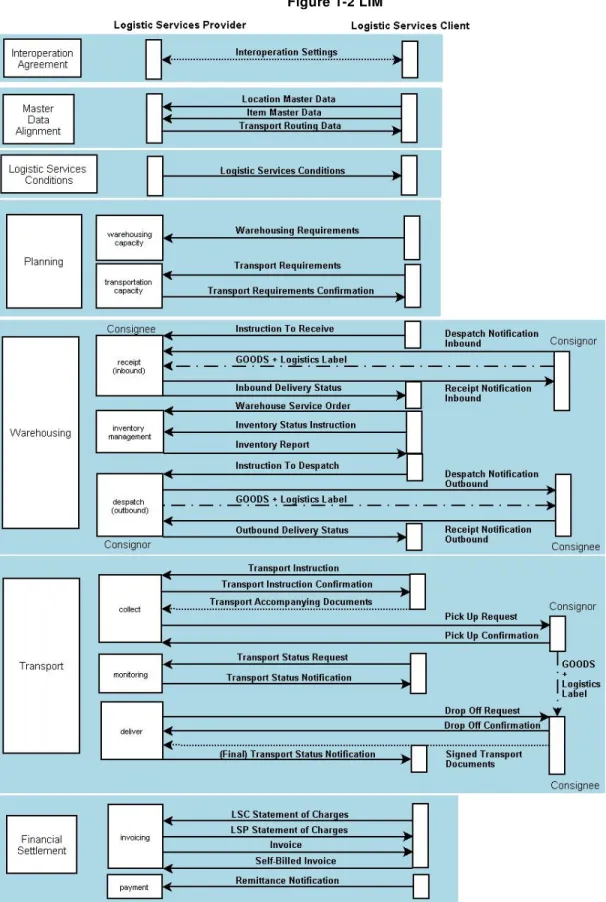
The actual model is composed of business processes or business process blocks, divided into business transactions, These business transactions will be mapped to electronic messages (GS1 eCOM). Relationship between transactions and messages is not by default 1 to 1. Several transactions can be mapped to 1 message. All transactions however will have a specific message implementation guide explaining the use of the message in the context of the business transaction.
The model consists of 7 distinct business processes:
Interoperation Agreement
Master Data Alignment
Logistic Services Conditions
Planning Warehousing Transport Financial Settlement
1.1.
Parties and Roles
Throughout the model specific terms are used to depict the types of trading partners and the roles they play.
The following generic terms are used to refer to parties:
Retailer
Manufacturer
Material Supplier
Logistic Services Provider (Warehousing and/or Transport)
These parties can play one or more of the following roles in the business processes:
1. Logistic Services Provider (LSP)
2. Logistic Services Client (LSC)
These two roles represent the primary parties involved in the commercial transaction of buying logistic services.
3. Consignor
4. Consignee
These two roles represent the primary parties in the commercial transaction of trading goods.
A party will have multiple physical locations, such as warehouses, distribution centres and stores. Generic location names are used to further detail the physical locations of the parties in relation to the relevant business process:
Inventory Location
Ship From Location
Ship to Location.
Pick-up Location
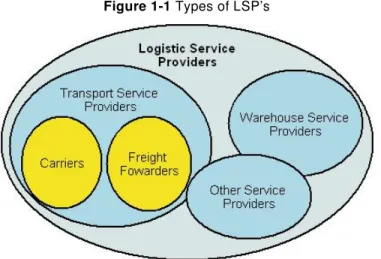
There are various terms to refer to types of Logistic Services Providers (LSP):
Transport Service Providers
Carriers
Freight Forwarders
Warehouse Service Providers
Other Service Providers such as Customs Brokers.
The diagram below illustrates how these terms relate to each other.
1.2.
LIM Overview
2.
Interoperation Agreement
2.1.
Scope
Interoperation Agreement
Master Data Alignment
Logistic Services Conditions
Planning Warehousing Transport Financial Settlement
The "Interoperation Agreement" represents the first of the LIM building blocks. Its scope is agreement on the operational and tactical elements between Logistic Services Provider and Client. It contains the following components for which the roles and responsibilities as well as parameters and targets have to be defined: master data management, warehouse and transport capacity management, service delivery, frequency of rate review, payment, claims, systems security, confidentiality/non-disclosure agreement, traceability requirements, service levels (and other performance measures), quality management and requirements and escalation procedures. It also defines the technical, administrative and computing methods by which integration between Logistic Services Provider and Client will occur, including standards used, performance expectations, back-up procedures and data privacy.
2.2.
Transactions
Figure 2-1 LIM Interoperation Agreement
2.2.1. Interoperation Settings
Purpose: This transaction enables the exchange of the interoperation agreement, containing information on scenarios to be implemented and parameter settings (e.g. response times) to be applied between the trading partners.
Trigger: Logistic Services Provider and Logistic Services Client jointly carry out this transaction during initial implementation of the interoperation agreement, as well as when a change needs to be made to the existing interoperation agreement.
3.
Master Data Alignment
3.1.
Scope
Interoperation Agreement
Master Data Alignment
Logistic Services Conditions
Planning Warehousing Transport Financial Settlement
Master Data Alignment includes definition of the items, locations and routing codes used in the logistics execution to ensure that both parties have the same and unambiguous understanding of this basic supply chain information. One challenge facing all trading relationships is maintaining accuracy and distribution of base item, location and routing data given the rapid changes to specifications and logistics information that can arise. Therefore, on-going alignment and synchronisation of the item, location and routing data is an essential element in ensuring interoperability.
In the future it is envisaged that this will also be applied to service items.
3.2.
Transactions
Figure 3-1 LIM Master Data Alignment
3.2.1. Location Master Data
Purpose: The Location Master Data transaction enables the alignment and synchronisation of location information between trading partners.
Location Master Data consists of generic data, such as names and addresses of parties and locations, and information specifically required for logistics, such as:
time-windows allowed for Pick-up and Drop-off (these may be different on a single site),
constraints regarding vehicles allowed for pick-up/delivery (inner city => vans/small trucks only), equipment requirements (e.g. tail-lift trucks or “kooiaap”),
indicator for need to book slot for drop-off/pick-up,
etc.
Each set of data can be uniquely identified by a Global Location Number (GLN). In this way data covered in the Location Master Data does not need to be filled in other transactions.
Trigger: The Logistic Services Client will be responsible to maintain and communicate the party and location data of its trading partners to the Logistics Service Provider. The Location Master Data will be aligned each time information changes or new information is added.
3.2.2. Item Master Data
Purpose: The Item Master Data transaction enables the alignment and synchronisation of item information between trading partners. Item Master Data is a set of data which describes the specifications and structures of each item involved in supply chain processes. Each set of data can be uniquely identified by a Global Trade Item Number (GTIN). In this way data covered in the item master data does not need to be filled in other transactions.
Responsible party: In logistic services scenarios the Item Master Data will be supplied by the Logistic Services Client. The Item Master Data will be aligned each time information changes or new information is added.
Response: Not foreseen
3.2.3. Transport Routing Data
Purpose: The Transport Routing Information enables the alignment and synchronisation of routing information between trading partners. The data contained in the message allow a shipper to produce shipping unit labels displaying correct routing and transit information and, if required, to load pre-positioned delivery vehicles in accordance with the carrier's or freight forwarder's routing plan.
Trigger: The Logistic Service Provider –freight forwarder or carrier – will send the transport routing information to the Logistic Services Client. Transport Routing Data will be aligned each time information changes or new information is added.
4.
Logistic Services Conditions
4.1.
Scope
Interoperation Agreement
Master Data Alignment
Logistic Services Conditions
Planning Warehousing Transport Financial Settlement
The Logistic Services Conditions describes the commitment between the logistic service client and the logistic service provider on execution of the agreed service around warehousing, transport or both, for a given period and at the stated rate / price.
The Logistic Services Conditions define the relevant contractual data to be able to invoice the logistic services rendered. It does not intend to cover the totality of the contractual data.
4.2.
Transactions
Figure 4-1 LIM Logistic Services Conditions
4.2.1. Logistic Services Conditions
Purpose: The Logistic Services Conditions transaction is typically used in the case where a general contract has been established between parties against which services will be ordered over a period of time on an order by order basis. The contract will have been previously negotiated and accepted. The aim of the transaction is to provide the contractual conditions of a previously negotiated contract in order to enable the automatic validation of orders and in the verification of invoices prior to payment. The Logistics Services Conditions include various factors that will determine the service tariffs. These may include:
Postal-Code Area (PC-area from and PC-Area to); PC-area may cross country borders (transport from Venlo-NL to German destinations may be handled with German domestic tariffs)
Load Unit type and/or Loading Metres
Type of goods, e.g. Hazardous, Frozen/Chilled/Ambient
Service Level, e.g. Expedited, Standard, Deferred
Trigger: Triggered by Logistic Services Provider on establishment of the contract
5.
Planning
5.1.
Scope
Interoperation Agreement
Master Data Alignment
Logistic Services Conditions
Planning Warehousing Transport Financial Settlement
Planning focuses on future activities in relation to warehousing or transport and aims to ensure capacity for the fulfilment of requested services. For warehousing capacity this applies to the storage volume and resource capacity. For transportation capacity this applies to transport volumes and timings.
The capacity planning is driven by the monthly and / or weekly forecasted shipments / pallets / picking until the actual demand (shipment) is released to the Warehouse and or Transport Provider via a delivery instruction (for transport booking, order picking, packing and loading). In some cases, actual planned shipments are available to increase forecast accuracy.
5.2.
Transactions
Figure 5-1 LIM Planning
5.2.1. Warehousing Requirements
Purpose: The purpose of this transaction is to define and share warehouse planning information based on historical and forecasted demand data (by category and customer), event data and, in some business cases, actual planned shipments before they are released to the DC for processing. This and any other relevant data can be shared between the two parties in order to jointly plan warehousing capacity demand for the future.
Warehousing Requirements may include information that will enable the Logistic Services Provider to plan:
No. of picking / pallet spots (warehouse capacity)
No. of order pickers / fork lift drivers (people capacity)
No. of in and outbound trucks (dock door capacity) Anticipated Dates / Period
Trigger: The Logistic Services Client will monthly and / or weekly communicate the planning information, until the actual demand (shipment) is released to the DC for order picking, packing and loading.
Response: Not foreseen
5.2.2. Transport Requirements
Purpose: The purpose of this transaction is to define and share transportation planning information based on historical and forecasted demand data (by category and customer), event data and, in some business cases, actual planned shipments before they are released to the DC for processing. This and any other relevant data can be sent by the Logistic Services Client in order to plan transportation capacity demand for the future
Transportation Requirements may include information that will enable the Logistic Services Provider to plan::
Type and No. of Transport
Trade-lane (from / to location indicators)
Available transport Logistic Service Providers
Anticipated Dates / Period
Trigger: The Logistic Services Client will monthly and / or weekly communicate the planning information, until the actual demand (shipment) is released to the DC for transport booking.
Response: The Logistic Services Provider should confirm if the planned transportation data can or cannot be used for the actual firm transport booking.
5.2.3. Transport Requirements Response
Purpose: To confirm whether the Logistic Services Provider has capacity to deliver all or part of the required transport services.
Trigger: After receipt of the Transport Requirements the Logistic Services Provider will calculate whether he can fulfil the requirements and will send a response.
6.
Warehousing
6.1.
Scope
Interoperation Agreement
Master Data Alignment
Logistic Services Conditions
Planning Warehousing Transport Financial Settlement
Warehousing is the receipt, storage, and preparation of products for customer delivery on the basis of orders. It also includes all involved administrative activities. Within storage this also covers the control of stocks including traceability in the warehouse.
The return flow of products and materials in the supply chain is also included, like product recalls and reverse logistics for empty pallets or crates.
On top of these warehousing activities, additional services may be rendered like, dry filling, repacking for promotions, re-stacking or re-labelling are also included. This is often defined as value added services. As long as the GTIN of serviced item stays the same this is considered to be a value added logistic service (in scope), if the GTIN changes this is considered to be contract manufacturing (out of scope).
6.2.
Modules
The Warehousing business transactions have been clustered in a number of coherent modules. Each module represents an interaction between two trading partners.
The transactions in the next paragraph have been clustered by module: Inbound Management (6.3), Inbound Operations (6.4), Outbound Management (6.5), Outbound Operations (6.6) and Other Transactions (6.7).
6.3.
Transactions for Inbound Management
6.3.1. Instruction to Receive
Purpose: Communicate anticipated receipts to the Logistic Services Provider. This will help the LSP to plan required capacity, especially in case the Despatch Notification (provided by the consignor) is absent or received late in the process.
Trigger: Triggered by the Logistic Services Client after he has ordered the goods.
Response: Inbound Delivery Status
6.3.2. Inbound Delivery Status
Purpose: The purpose is for the Logistic Services Provider to inform the logistic services client regarding the status of the inbound delivery. The transaction can be used to communicate discrepancies of the actual receipt versus the information in the Instruction to Receive.
Trigger: Triggered by the Logistic Services Provider after he has received the goods.
Response: Not foreseen
6.4.
Transactions for Inbound Operations
6.4.1. Despatch Notification Inbound
Purpose: Generally, the Despatch Notification enables one Shipper (Consignor) to provide information about the content of a shipment to one Receiver (Consignee). Specifically the Inbound Despatch Notification serves to inform the Logistic Services Provider (Consignee) on shipments (including returns) despatched to him.
Trigger: Triggered by the Consignor at shipment creation.
Response: Receipt Notification
6.4.2. GS1 Logistics Label (Inbound)
Purpose:
Logistic units are items made up for transport and distribution purposes, and pallets are one particular example. Using the GS1 Logistics Label containing the Serial Shipping Container Code (SSCC) allows users to identify logistic units uniquely so that they can be tracked and traced throughout the supply chain.
Trigger:
The consignee is responsible at the time of receiving the goods to register information from the logistic label, and to use it in the further communication, such as the Receipt Notification.
6.4.3. Receipt Notification Inbound
Purpose: The purpose of the Inbound Receipt Notification is for the Logistic Services Provider to inform the shipper (Consignor) of actual goods received, compared to what was notified as being sent.
Typical business uses of the receipt information can include – updating of inventory, identifying shipping discrepancies, and adjusting orders and related invoicing.
Trigger: Triggered by the Logistic Services Provider (= Consignee) at receipt of the shipment.
Response: No response is foreseen, only a general notification message that the business application has received the request.
6.5.
Transactions for Outbound Management
6.5.1. Instruction to Despatch
Purpose: The purpose of the Instruction to Despatch is to order the picking and loading / load preparation of a specific shipment, and can include customer related value added services on products (e.g. unpack from various different packages and re-pack and label in another package). It does not cover the ordering of transport services.
The information may include:
Carrier / destination (market, country, postal code area)
Type of transport means to be used
Type of packaging to be used
Information to be printed on the shipping documents
Trigger: Triggered by the Logistic Services Client at the point of order release to the warehouse.
Response: No response is foreseen, only a general notification message that the business application has received the request.
6.5.2. Outbound Delivery Status
Purpose: The purpose is for the logistic services provider to inform the logistic services client regarding the status of the outbound delivery. Can be used to communicate discrepancies of the actual delivery versus the information in the Instruction to Despatch, based on information from the Despatch Notification and /or Receipt Notification.
Trigger: Triggered by the Logistics Services Provider after despatch of the goods (definitely after sending the Despatch Notification to the consignee, possibly after processing the Receipt Notification
from the consignee).
Response: No response is foreseen, only a general notification message that the business application has received the request.
6.6.
Transactions for Outbound Operations
6.6.1. Despatch Notification Outbound
Purpose: Generally, the Despatch Notification enables one Shipper (Consignor) to provide information about the content of a shipment to one Receiver (Consignee). Specifically the Outbound Despatch Notification serves to inform the Consignee on shipments despatched to them.
Trigger: Triggered by the Logistic Services Provider (Consignor) at shipment creation.
6.6.2. GS1 Logistics Label (Outbound)
Purpose:
Logistic units are items made up for transport and distribution purposes, and pallets are one particular example. Using the GS1 Logistics Label containing the Serial Shipping Container Code (SSCC) allows users to identify logistic units uniquely so that they can be tracked and traced throughout the supply chain.
Trigger:
The consignor is responsible at the time of despatching the goods to create and register information from the logistic label, and to use it in the further communication, such as the Despatch Notification. The layout of the GS1 Logistics Label groups information into three logical sections for the supplier, customer and carrier.
Each label section may be applied at a different point in time as relevant information becomes known:
1. The supplier section of the label contains information that is generally known at the time of packaging by the supplier.
2. The customer section of the label contains information that is generally known at the time of order and order processing by the supplier or logistic service provider.
3. The carrier section of the label contains information that is generally known at the time of shipment and is typically related to transport, see paragraph 3.6.2.5 GS1 Logistics Label (Transport).
6.6.3. Receipt Notification Outbound
Purpose: The purpose of the Outbound Receipt Notification is for the Consignee to inform the Logistic Services Provider (Consignor) of actual goods received, compared to what was notified as being sent. Typical business uses of the receipt information can include – updating of inventory, identifying shipping discrepancies, and adjusting orders and related invoicing.
Trigger: Triggered by the Consignee at receipt of the shipment.
Response: No response is foreseen, only a general notification message that the business application has received the request.
6.7.
Other Transactions
6.7.1. Warehouse Service Order
Purpose: A client canuse an LSP to carry out non customer related value added services on products (e.g. internal movements, re-packing for quality reasons, etc.). The Warehouse Service Order may be used to order these services.
Trigger: Triggered by Logistic Service Client at order creation.
Response: Not foreseen
6.7.2. Inventory Status Instruction
Purpose: To carry out a status change of the goods (e.g. from quarantine to free for sale).
Trigger: Triggered by the Logistic Service Client on inventory status change
6.7.3. Inventory Report
The inventory report consists of two parts: Inventory Movement and Inventory Status.
Inventory Movement
Purpose: Inventory movements are identified as adjustments of the inventory over a certain period of time (e.g. hour, week, day, month). For each item and location the reported movements over a certain period should match with the reported begin and end status over that same period.
Inventory data can be exchanged based on the location (and then item) or on the item (and then location in case of the same item stored at more than one location).
Trigger: The transaction will be triggered by the Logistic Service Provider at the agreed upon date(s) and time(s) for sending.
Response: No response is foreseen, only a general notification message that the business application has received the request.
Inventory Status
Purpose: Inventory status is used to report on the actual inventory at a certain point in time (e.g. hour, week, day, month). All of the reported movements over a certain period should match the changes in the inventory status over that same period. For each item and location the reported begin and end status over a certain period should match with the reported movements over that same period.
Inventory data can be exchanged based on the location (and then item) or on the item (and then location in case of the same item stored at more than one location).
Trigger: The transaction will be triggered by the Logistic Service Provider at the agreed upon date(s) and time(s) for sending.
Response: No response is foreseen, only a general notification message that the business application has received the request.
7.
Transport
7.1.
Scope
Interoperation Agreement
Master Data Alignment
Logistic Services Conditions
Planning Warehousing Transport Financial Settlement
Transport is the movement of goods from factories to warehouses or depots (collection), the movement of goods from warehouses to the customer delivery locations (delivery) and the monitoring of these movements.
With respect to transport modes the LIM model aims to be mode independent so it can be applied to road, rail, ocean and air. Focus is on continental transport modes. For road transport this includes Full Truck Load (FTL) transport, Less Than Truck Load (LTL) transport and Parcel distribution.
7.2.
Modules
The business transactions have been clustered in a number of coherent modules. Each module represents an interaction between two trading partners.
Figure 7-1 LIM Transport Modules
The transactions in the next paragraph have been clustered by module: Transport Management (7.3), Transport Pick-up Operations (7.4) and Transport Drop-off Operations (7.5).
7.3.
Transactions for Transport Management
7.3.1. Transport Instruction
Purpose: The main objectives are to communicate/ share the arrangement of the transport of goods between all parties involved in the movement of the consignment (s) as well as providing the information necessary to perform that transport and delivery of the goods. The transaction can cater for one consignment or multiple consignments.
Trigger: The Transport Instruction will be sent by the Logistic Services Client (supplier, retailer, 3rd party warehouse or freight forwarder) to a Logistic Services Provider (freight forwarder or carrier) upon order creation.
Response: Transport Instruction Response
7.3.2. Transport Instruction Response
Purpose: The main objectives are to give the confirmation or modification of the arrangement of the transport of goods between all parties.
Trigger: The Response will be sent by the Logistic Services Provider (freight forwarder or carrier) to the Logistic Service Client. The transaction will be triggered within the agreed time interval from receipt of the Transport instruction.
Response: Not foreseen
7.3.3. Accompanying Transport Documents
Purpose: Communicate information for paper documents that have to be transported together with the goods, such as hazard information. This information can be communicated electronically, but still needs to be available as physical document during transport.
Trigger: These documents are sent by the Logistic Services Client to the Logistic Services Provider (freight forwarder or carrier) at the agreed upon date and time for sending. Logistic Services Client and Logistic Services Provider need to decide and agree who will be responsible for printing the documents.
Response: Not foreseen.
7.3.4. Transport Status Request
Purpose: To request information regarding the status of the consignment.
Trigger: The Transport Status Request will be sent by the Logistic Services Client (who can be the supplier, retailer, 3rd party warehouse or freight forwarder) to the Logistic Services Provider (the carrier). The transaction can be used at any time.
The Logistic Services Client may authorize other parties to have access to the transport status information, such as the consignor or the consignee.
Response: The Transport Status Notification is the response to this transaction.
7.3.5. Transport Status Notification
Purpose: This transaction enables the transmission of status information by a freight forwarder or carrier, to a party requesting information concerning a consignment of goods for which a Transport Instruction was previously sent. Status information at a consignment level, either coded or free text, is
provided in conjunction with any other information relevant to the status reported (e.g. the identification number of the truck transporting the goods item).
Responsible party: The Transport Status Notification will be sent by the Logistic Services Provider to the Logistic Services Client. The transaction may be sent on a scheduled basis at predetermined times, as a result of a direct enquiry (Transport Status Request), or following a specified event or milestone. The Logistic Services Client may authorize other parties to have access to the transport status information, such as the consignor or the consignee.
Response: Not available
7.3.6. Final Transport Status Notification
Purpose: This transaction allows to send the final status of the delivery (also known as IOD, Information on Delivery) to the Logistic Services Client.
Information may include actual date and time of delivery, exceptions such as damages & shortages, name of the person who signed for receipt.
Trigger: The Final Transport Status Notification will be sent by the Logistic Services Provider after the delivery.
Response: Not foreseen
7.4.
Transactions for Transport Pick-up Operations
7.4.1. Pick-up Request
Purpose: Request information for the pick-up of the goods, such as the time window and loading dock.
Trigger: The Pick-up Request will be sent by the Logistics Services Provider (carrier) to the Consignor before the pick-up is to take place, exact timing depends on the agreements.
Response: Pick-up Response
7.4.2. Pick-up Response
Purpose: To communicate the pick-up information to the Logistic Services Provider.
Trigger: After receipt of the Pick-up Request the Consignor will send the Pick-up Response to the Logistics Services Provider (carrier).
Response: Not foreseen
7.5.
Transactions for Transport Drop-off Operations
7.5.1. Drop-off Request
Purpose: Request information for the drop-off of the goods, such as the time window and unloading dock. The transaction can also serve as pre arrival notification to the Consignee.
The Drop-off Request should only contain very basic info such as approximate total weight, total volume, shipper, type of materials that would allow the Drop-off point to plan when this shipment (goods) should be delivered .
Trigger: The Drop-off Request will be sent by the Logistics Services Provider (carrier) to the Consignee before the drop-off is to take place, exact timing depends on the agreements.
Response: Drop-off Response.
7.5.2. Drop-off Response
Purpose: A transaction to communicate the drop-off information to the Logistic Services Provider. The Drop-off Response should only contain very basic information such as date and time-window, booking-reference to quote when delivering and delivery-instructions
Trigger: After receipt of the Drop-off Request the Consignee will send the Drop-off Response to the Logistics Services Provider (carrier).
Response: Not foreseen
7.5.3. Signed Transport Documents
Purpose: The signed transport documents (also known as POD, Proof of Delivery) serve as proof for the Logistic Services Provider that he collected the goods at the Consignor and delivered them to the Consignee. After the transport has been carried out the Logistic Services Provider (carrier) archives the signed transport documents.
The Logistic Services Provider may allow the Logistic Services Client to access the archived transport documents, for example by providing a web link
Trigger: The transport documents are signed upon collection (by the Consignor) and upon delivery (by the Consignee), and after that archived by the Logistic Services Provider (carrier).
Response: Not foreseen.
7.6.
GS1 Logistics Label (Transport)
Purpose:
Logistic units are items made up for transport and distribution purposes, and pallets are one particular example. Using the GS1 Logistics Label containing the Serial Shipping Container Code (SSCC) allows users to identify logistic units uniquely so that they can be tracked and traced throughout the supply chain.
Trigger:
The Consignor is responsible at the time of transport preparation to create and apply the
carrier section of the logistic label. The carrier section of the label contains information that is generally known at the time of shipment and is typically related to transport.
The Carrier is responsible at the time of transport to register information from the Logistics Label, and to use it in the further communication, such as the Transport Status Notification.
8.
Financial Settlement
8.1.
Scope
Interoperation Agreement
Master Data Alignment
Logistic Services Conditions
Planning Warehousing Transport Financial Settlement
Financial Settlement covers the process from where the services are delivered to the Logistic Services Client to the confirmation of payment by the Logistic Services Provider. Financial settlement takes place based on the actual volumes / weight of the goods serviced, according to the Logistic Service Conditions. Financial settlement mainly differs depending on whether the invoicing process is triggered by the Logistic Services Provider (traditional invoicing) or by the Logistic Services Client (self-billing).
8.2.
Transactions
Figure 8-1 LIM Financial Settlement
8.2.1. LSC Freight/Service Statement of Charges
Purpose: The purpose is to instruct the Logistics Service Provider on the detailed charges as calculated by the Logistic Services Client. In both invoicing options, i.e. normal invoicing or self-billing, this information may be used for reconciliation and/or alignment between Logistic Services Client and Logistic Services Provider before the final (self-billing) invoice is produced.
Examples of Warehousing Charges:
Rent/Storage
Handling (restacking, (re)labelling, quality control, order picking, receiving, shipping, weekend work, etc.)
Service Orders (customization, manipulations, etc.) Examples of Transport Charges:
Cost per Trade Lane
Special Truck Drivers (ADR/Dangerous Goods)
Drop Lot
Multiple Stops/drop-offs
Additional Equipment
Additional Manpower for Pick-up or Drop-off
Trigger: The Logistic Services Client generates the Statement Of Charges monthly and/or weekly depending on the contractual agreement/Interoperation Settings.
Response: Not foreseen
8.2.2. LSP Freight/Service Statement of Charges
Purpose: The purpose is to instruct the Logistics Service Client on the detailed charges as calculated by the Logistic Services Provider. In both invoicing options, i.e. normal invoicing or self-billing, this information may be used for reconciliation and/or alignment between Logistic Services Client and Logistic Services Provider before the final (self-billing) invoice is produced.
Examples of Warehousing Charges:
Rent/Storage
Handling (restacking, (re)labelling, quality control, order picking, receiving, shipping, weekend work, etc.)
Service Orders (customization, manipulations, etc.) Examples of Transport Charges:
Cost per Trade Lane
Special Truck Drivers (ADR/Dangerous Goods)
Drop Lot
Multiple Stops/drop-offs
Demurrage
Additional Equipment
Additional Manpower for Pick-up or Drop-off
Trigger: The Logistic Services Provider generates the Statement Of Charges monthly and/or weekly depending on the contractual agreement/Interoperation Settings.
Response: Not foreseen
8.2.3. Freight/Service Invoice
Purpose: The purpose is for the Logistic Services Provider to generate and send an overview of charges to the Logistic Services Client for payment. The Invoice can be based on the charges that were detailed and agreed in the Statement of Charges.
Trigger: Generated by the Logistic Services Provider monthly and/or weekly depending on the contractual agreement.
8.2.4. Self-Billed Freight/Service Invoice
Purpose: The purpose is for the Logistic Services Client to generate and send an overview of charges to the Logistic Services Provider for payment by the Logistic Services Client. The Self-Billed Invoice
can be based on the charges that were detailed and agreed in the Statement of Charges.
Trigger: Generated by the Logistic Services Client monthly and/or weekly depending on the contractual agreement.
Response: Not foreseen
8.2.5. Remittance Notification
Purpose: The purpose is for the Logistic Services Client to inform the Logistic Services Provider on the invoices that have been paid.
Trigger: Generated by the Logistic Services Client after the payment has been made.
1.
Scope
In this section the transport and warehousing processes are analyzed in more detail. The diagrams have been grouped as follows:
Intercompany scenarios between Material Supplier and Manufacturer.
Intracompany scenarios of Manufacturer
Intercompany scenarios between Manufacturer and Retailer
Freight forwarding scenarios
Inventory management scenarios.
Figure 1-1 Overview of scenarios
Note: To help define the scenarios in a structured way in the diagrams instead of the individual business transactions the modules are depicted. The sequence of events is captured in the textual description and not in the diagrams. The modular diagrams cannot capture the detailed sequence of the transactions.
2.
Scenarios between Material Supplier and
Manufacturer
2.1.
Transport managed by Material Supplier
The business process of shipping the goods from a Material Supplier to a Manufacturer executed by a Transport Service Provider. The Supplier will provide shipping instructions to the Transport Service Provider. In this scenario the Transport Service Provider will pick up the goods directly from the Material Supplier Warehouse at a scheduled and agreed time. The Transport Service Provider is responsible for pick-up and drop-off appointments.
Figure 2-1 Transport managed by Material Supplier
The sequence of events is as follows:
The Manufacturer will request the Material Supplier to replenish the inventory in his warehouse. Can be done either with purchase order or SMI/SMOI process.
The Material Supplier will instruct the Warehouse to prepare a despatch (outbound management). This is an internal process.
The Material Supplier will instruct the Transport Service Provider to carry out the transport. Optionally the Transport Service Provider sends a Response to the Material Supplier. The Transport Service Provider will prepare the transport documentation such as the CMR or waybill.
(transport management)
The Material Supplier may ask for intermediate transport status notifications. (transport management).
The Transport Service Provider may need to book a pick-up slot at the Material Supplier Warehouse based on transport instruction previously confirmed. Material Supplier Warehouse confirms the pick-up slot request. (pick-up operations).
The Material Supplier prepares the shipment, and prints and applies the GS1 Logistics Label. Transport Service Provider arrives at the Supplier Warehouse to collect the goods. The goods are
loaded. The Material Supplier will provide the delivery note to the Transport Service Provider. The Transport Service Provider will complete the transport documentation. (transport pick-up operations)
Transport Service Provider may need to book a drop-off slot at the Manufacturer Warehouse based on the transport instruction previously confirmed. Manufacturer Warehouse confirms the drop-off slot request. (transport drop-off operations)
The Material Supplier will notify the Manufacturer of the despatch (outbound operations)
Transport Service Provider arrives at the Manufacturer Warehouse. Transport Service Provider is directed to the unloading dock. The goods are unloaded. The Manufacturer signs off the waybill or delivery note. Transport Service Provider leaves the site. (transport drop-off operations)
The Transport Service Provider may inform the supplier that the transport has been carried out. The Manufacturer will receive the goods and notify the Material Supplier of the receipt (inbound
operations).
Most common variations
Variation 1: The Material Supplier organizes the appointments for pick-up and drop-off. In that case the pick-up and drop-off times will be communicated directly to the Transport Service Provider via the Transport Instruction.
Variation 2: A Warehouse Service Provider can manage the transport on behalf of the Material Supplier. In that case he will act as the LSC in the Transport Management process.
2.2.
Transport managed by Manufacturer
The business process of shipping the goods from a Material Supplier to a Manufacturer executed by a Transport Service Provider. The Manufacturer will provide shipping instructions to the Transport Service Provider. In this scenario the Transport Service Provider will pick up the goods directly from the Material Supplier Warehouse at a scheduled and agreed time.
The main difference from the previous scenario is that now the Manufacturer is involved in the transport of the goods.
Figure 2-2 Transport managed by Manufacturer
The sequence of events is as follows:
The Manufacturer will request the Material Supplier to replenish the inventory in his Warehouse. Can be done either with purchase order or SMI/SMOI process.
The Material Supplier will instruct the Warehouse to prepare a despatch (outbound management) and inform that the Manufacturer will manage the transport through his LSP. This is an internal process.
The Manufacturer will instruct the Transport Provider to carry out the transport. Optionally the Transport Service Provider sends a Response to the Manufacturer. The Transport Service Provider will prepare the transport documentation such as the CMR or waybill. (transport management).
The Manufacturer may ask for intermediate transport status notifications. (transport management).
The Transport Service Provider may need to book a pick-up slot at Supplier Warehouse based on transport instruction previously confirmed. Material Supplier Warehouse confirms the pick-up slot request. (pick-up operations).
Transport Service Provider arrives at the Supplier Warehouse to collect the goods. The goods are loaded. The Material Supplier will provide the delivery note to the Transport Service Provider. The Transport Service Provider will complete the transport documentation. (transport pick-up operations)
Transport Service Provider may need to book a drop-off slot at Manufacturer Warehouse based on the transport instruction previously confirmed. Manufacturer Warehouse confirms the drop-off slot request. (transport drop-off operations)
The Material Supplier will notify the Manufacturer of the despatch (outbound operations)
Transport Service Provider arrives at the Manufacturer Warehouse. Transport Service Provider is directed to the unloading dock. The goods are unloaded. The Manufacturer signs off the waybill or delivery note. Transport Service Provider leaves the site. (transport drop-off operations)
Optionally the Transport Service Provider may inform the Manufacturer that the transport has been carried out.
The Manufacturer will receive the goods and notify the supplier of the receipt (inbound operations).
Most common variations
Variation 1: The Manufacturer organizes the appointments for pick-up and drop-off. In that case the pick-up and drop-off times will be communicated directly to the Transport Service Provider via the Transport Instruction.
Variation 2: Warehouse Service Provider can manage the transport on behalf of the Manufacturer. In that case he will act as the LSC in the Transport Management process.
2.3.
Consolidated transport managed by Material Supplier
The business process of shipping the goods consolidated from a Material Supplier to a Manufacturer supported and executed by a Consolidation Centre. The Material Supplier will provide instructions on the goods to pick-up from different Material Supplier Warehouses. For the Material Supplier the Freight Forwarder acts as the principal LSP. The Freight Forwarder may involve other LSPs such as Consolidation Centres and Transport Service Providers.
Note: This scenario is very similar to the Merge-In-Transit scenario described in paragraph 5.3.
Figure 2-3 Consolidated transport managed by Supplier
The sequence of events is as follows:
The Manufacturer will request the Material Supplier to replenish the inventory in his warehouse. Can be done either with purchase order or SMI/SMOI process.
The Material Supplier will instruct his warehouses to prepare despatch (outbound management). This is an internal process.
The Material Supplier will instruct the Freight Forwarder to carry out the transport. Optionally the Freight Forwarder will send a Response to the Material Supplier. (transport management)