The Vindhyan example
Chandan Chakraborty
Geological Studies Unit, Indian Statistical Institute, 203 B.T. Road, Kolkata 700 108, India. e-mail: [email protected]
The Vindhyan basin is a classic example of Proterozoic intracontinental basin that developed in the central part of the Indian shield along with several other basins such as Cuddapah, Chattis-garh, etc. The strata are exposed in three major sectors: Son valley, Bundelkhand and Rajasthan. Substantially thick Vindhyan rocks have also been recognized under the Gangetic alluvium. The constituent stratigraphic units of the Vindhyan Supergroup are laterally correlatable and verti-cally stacked in similar fashion in individual sectors, but their stratigraphic and sedimentologic attributes vary from one sector to the other. The basin fill in the Son valley (around 3 km thick) exhibits an asymmetric cross-sectional geometry normal to the regional strike (ENE–WSW), with the thickest part occurring to the south, and is divisible into four groups: Semri, Kaimur, Rewa and Bhander, from bottom to top. The boundary between the Semri and Kaimur Groups is marked by a pronounced unconformity. The dominant lithologies include conglomerate, sandstone, shale, limestone as well as volcaniclastics. The Vindhyan strata define a broad, regional syncline trending ENE–WSW. The axis of the syncline is slightly curved (convex towards north) and plunges gen-tly towards west. The average dip of the southern limb is greater than that of the northern limb rendering the axial plane to dip southerly.
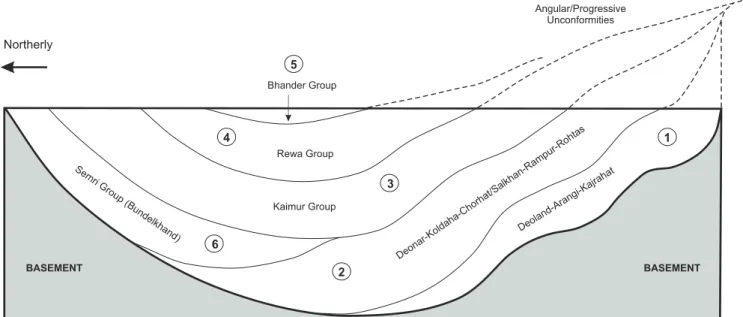
The Vindhyan succession can be divided into five major sequences separated by unconformities. The unconformities are manifested in the field by angular discordances and/or long-term subaer-ial exposure features. Unconformity surfaces are disposed in the succession defining what is known as progressive unconformity, indicating contemporaneous tectonic activity during sedimentation. Individual sequences comprise of a spectrum of depositional systems that include alluvial fan, fan delta, braidplain, braidplain delta, eolian sandsheet, siliciclastic/carbonate tidal flat, siliciclas-tic/carbonate shoreface, siliciclassiliciclas-tic/carbonate shelf. The paleocurrents revealed by the Vindhyan strata are typically northerly suggesting that the evolving Satpura orogen served as the source for the Vindhyan sediments. However, the source for the clastics occurring within the Semri and the lower parts of the Kaimur and Rewa Groups in the Bundelkhand sector was perhaps the Bun-delkhand Granite Gneiss, Bijawar and Gwalior Group of rocks as manifested by the southerly paleocurrent.
The sequences of the Vindhyan succession are composed of several systems tracts. The differ-ent paleogeographic settings characterizing the systems tracts within individual sequences are as follows:
Sequence 1:
• TST – alluvial fan–fan delta–shelf (Deoland and Arangi Formations)
• HST – carbonate ramp (Kajrahat Formation)
Keywords.Intracratonic basin; Proterozoic; depositional environments; sedimentation; sequence stratigraphy. J. Earth Syst. Sci.115, No. 1, February 2006, pp. 3–22
Sequence 2:
• TST – shelf (Deonar Formation)
• FSST to TST – braid/fan delta–shelf (Koldaha Formation)
• HST – tidal flat–shoreface–shelf (Chorhat and Koldaha Formations)
• TST – shelf (Rampur Formation)
• TST – carbonate ramp (Rohtas Formation) Sequence 3:
• TST – shoreface–shelf (Sasaram Formation)
• FSST – shoreface (Ghaghar Formation)
• TST – shelf (Bijaygarh Formation)
• HST – braidplain–braid delta–shelf (Mageswar and Dhandraul Formations) Sequence 4:
• TST – shelf (Panna Formation)
• FSST to TST – shoreface (Assan and Jhri Formations)
• HST – braidplain–braid delta–shelf (Jhiri, Drammondgunj and Govindgarh Formations) Sequence 5:
• TST – tidal flat (Ganurgarh Formation)
• HST – carbonate platform (Bhander Formartion)
• TST – tidal flat to coastal lagoon (Bundihill and Sirbu Formations)
• FSST – tidal flat–braidplain–eolian (Shikhaoda Formation)
1. Intracratonic basin: An overview
The middle to late Proterozoic was the period of development of intracratonic basins on the conti-nental shields all over the world (Windley 1977; Condie 1989). The basin fills, often several kilo-meters thick, are typically unmetamorphosed, varyingly deformed sedimentary strata that got deposited in an unvegetated landscape. The strata lie unconformably on the Archean–early Protero-zoic gneisses, high-grade rocks, granite-greenstones or metasedimentaries of Proterozoic mobile belts.
There are significant differences between Pre-cambrian sedimentary deposits of intracratonic basin and their Phanerozoic-modern equivalents. For example, epeiric seas constitute an impor-tant depositional setting characterizing most of the Proterozoic intracratonic basins, but do not have any exact modern analogue (Friedman et al
1992; Erikssonet al 1998). Precambrian and some younger deposits sharing the features of mod-ern tide-wave affected shoreface and shelf sedi-ments have been ascribed as products of epeiric seas. These epeiric seas were much wider (hun-dreds of kilometers), and had a very low gradient with a maximum paleobathymetry around 100 m (Friedman et al 1992; Eriksson et al 1998). The basins, however, virtually lacked a discernible shelf-slope break that characterizes present day conti-nental margin shelf seas (Shaw 1964; Irwin 1965;
Schopf 1980; Friedman et al 1992; Aspler et al
1994; Runkel et al 1998).
Accumulation of a huge thickness of shallow water sediments in intracratonic basins clearly indicates synsedimentary subsidence. The driving forces of subsidence have remained unclear for many cratonic basins. Cratons are stable continental interiors or continental intraplate regions relatively free from tectonic effects, which are preferentially localized along their boundaries. However, intracontinental regions do experience intraplate stresses inducing subsidence and uplift though at much slower rates than that at plate boundaries (Park and Jaroszewski 1994). Tradi-tionally cratonic basins have been thought to have suffered subsidence and uplift independently of the activities at the craton margin or plate boundary. Sediment loading, subcrustal loading and thermal subsidence have been considered to be the dominant mechanisms of subsidence in such basins. However, Sloss (1988a, b) pointed out that exclusion of cratons from the dynamics of plate tectonics is not a valid proposition and intraplate tectonic activities in many cases can be related to compressional or extensional events at the mar-gin of the craton. In many basins, the subsidence is related to thermal contraction or subcrustal loading; these basins are typically oval in shape, and show symmetric isopach distribution (e.g., Illi-nois and Michigan basins, Angevine et al 1990). Subsidence induced by extensional tectonism has
Figure 1. Outcrop of the Vindhyan basin as revealed by SRTM data. Note: (i) confinement of the basin between the Great Boundary Fault and the Son–Narmada lineament; (ii) occurrence of the Bundelkhand Gneiss at the middle of the basin; (iii) the Gangetic plain covering the northern part of the basin; (iv) occurrences of the Vindhyan strata in three different sectors – Rajasthan, Bundelkhand and Son valley. Locations of illustrative outcrops and sections are also shown.
been invoked for basins that are conspicuously narrow and linear (e.g., Pranhita–Godavari valley basin, Naqvi and Rogers 1987). The subsidence in basins located in front of Proterozoic mobile belts, on the other hand, has been thought to be due to supracrustal, thrust loading in the hinterland (Allen and Homewood 1986); the thickness of the basin fill in these basins systematically increases towards the orogenic front resulting in strongly asymmetric isopach distribution.
The Vindhyan basin of central India offers unique scope to resolve all these issues concern-ing the development and evolution of intracratonic basins during the Proterozoic. In the Indian shield, there are four large intracratonic basins of Protero-zoic age:
1. Vindhyan basin, 2. Cuddapah basin,
3. Pranhita–Godavari basin, and
4. Chattisgarh basin barring the smaller Indra-vati, Kaladgi, Bhima and Badami basins. Despite many differences in details, the sedi-mentaries developed in these widely separated basins display marked similarities in their lithology, depositional setting and stratigraphic architecture (Naqvi and Rogers 1987). This note sum-marises the stratigraphy, stratal architecture, sed-imentology and geochronology of the Vindhyan
Supergroup occurring in the Son valley region (figure 1).
2. The Vindhyan basin
The Vindhyan strata are exposed in three sectors: 1. Rajasthan sector
2. Bundelkhand sector and 3. Son valley sector (figure 1).
In the west and south of the Vindhyan outcrop occur the fold-belts of Aravalli–Delhi and Satpura. At the central part of the basin occurs an isolated inlier of basement gneiss designated as the Bun-delkhand massif. Along the southern edge of the Vindhyan outcrop and the eastern flank of the Bun-delkhand massif are exposed a low-grade metamor-phic group of volcano-sedimentary rocks, termed as the Mahakoshal Group and the Bijawar Group respectively. The northern part of the basin is hid-den under the Gangetic alluvium (figure 1).
The southern margin of the Vindhyan basin is marked by a major ENE–WSW trending lineament termed Narmada–Son lineament south of which occurs the Satpura orogen (figure 1). The western margin of the Vindhyan basin in the Rajasthan sec-tor is also marked by a NE–SW trending major lin-eament known as Great Boundary Fault separating
Figure 2. Strike-wise stratigraphic column of the Vindhyan Supergroup in the Son valley prepared by combining several discrete logs constructed at different locations along the structural strike. The upper boundary of the column represents the present-day topography. Maihar town has been shown as a reference location on the topographic profile.
the Aravalli–Delhi orogen from the Vindhyan (figure 1).
2.1 Lithostratigraphy
The entire Vindhyan succession, maximum thick-ness estimated to be around 3 km, and comprising mainly sandstone, shale and limestone is assigned
as the Vindhyan Supergroup (Bhattacharyya 1996). The Supergroup is divisible into four groups:
1. Semri Group, 2. Kaimur Group, 3. Rewa Group and 4. Bhander Group,
from bottom to top (figure 2). Each group is again subdivided into several formations. An outline of the lithostratigraphy of the Vindhyan Supergroup of the Son valley is presented in table 1 (see also figure 2).
The Semri Group in the Son valley rests uncon-formably on a variety of pre-Vindhyan rocks such as granites and metamorphics. In the Bundelkhand area, the group overlies the Bundelkand Gran-ite Gneisses and Bijawar Group of metamorphics, whereas in the southern Son valley, Mahakoshal is the basement in most places (figure 3A); however, in some localities (e.g., Deoland, M.P.) the base-ment is granite.
The Semri succession of the Bundelkhand area has two detached outcrops around Chitrakut and Bijawar respectively, and is only a few tens of meters thick (figure 1). The successions in these two outcrops are dissimilar. Moreover, these two successions have several dissimilarities with that of the southern Son valley:
• The succession in the Bundelkhand area is much thinner and dominated by carbonates, whereas in the southern Son valley both carbonates and siliciclastics are prevalent,
• The lithological attributes of the carbonates of the Bundelkhand area are quite different from that of the carbonates occurring in the southern Son valley,
• In the southern Son valley, volcaniclastic deposits form a major lithostratigraphic unit of the succession but are absent in the Bundelk-hand area (Singh and Kumar 1978; Sastry and Moitra 1984).
The basal part of the Kaimur Group in the Bun-delkhand area is represented by arkosic, pebbly sandstones and has no analogue in the Son valley. However, the overlying rocks are similar in the two regions.
The basal part of the Rewa Group occurring in the northern part of the Son valley is represented by conglomerates and arkosic sandstones, which have no equivalent in the southern part (Boseet al
1997). However, the overlying units are correlat-able across the entire outcrop of the Vindhyans in the Son valley.
The field appearances of different formations are presented through a series of photographs (fig-ures 3–6).
3. Structural style of the Vindhyan strata
The outcrop of the Vindhyan lithounits in the Son valley shows a parabolic pattern with easterly clo-sure (figure 1). The northern arm has southerly dip,
whereas the southern arm dips northerly with the basal units showing steep dips (figure 3A, B, C). This indicates a regional scale syncline with west-erly plunge (figure 7). The trace of the axial plane is mildly curved with an overall ENE–WSW trend. In the Rajasthan sector near the Great Bound-ary Fault, the Vindhyan strata show tight and locally overturned folds trending parallel to the fault (Banerjee and Sinha 1981; Prasad 1984).
The geological profiles across the regional strike (ENE–WSW) in the Son valley (figure 8) revealed the presence of several sub-regional folds on the southern limb of the regional syncline (Chakraborty and Karmakar 1998). The differ-ent folds are recognizable in differdiffer-ent stratigraphic units. However, integration of all the profiles leads to reconstruction of the overall structural pattern of the Vindhyan strata (figure 9). The salient fea-tures are:
• The cross-sectional geometry of the Vindhyan basin fill, normal to the regional strike, is asym-metric with the thickest part occurring towards south.
• The Vindhyan strata define a broad, regional syncline trending ENE–WSW. The axis of the syncline is slightly curved and plunges gently towards west. The average dip of the southern limb is greater than that of the northern limb rendering the axial plane to dip southerly.
• The preserved southern limb of the regional syncline shows two smaller, local anticlines inter-vened by two synclines. In contrast, the low-dipping northern limb is homoclinal (<5◦).
• The smaller folds are asymmetric in nature with one limb longer and steeper (northern limb in case of anticlines and southern limb in case of synclines) than the other. Their axial planes dip southerly. In other words, the fold geometry is that of successive monoclines defining a terrace like or ramp-and-flat pattern.
4. Stratal discontinuities in the Vindhyan succession
The profiles constructed have also revealed the presence of angular discordances between different lithostratigraphic units of the Vindhyan succession at various levels (figure 9) as mentioned below.
• Between Kajrahat and Deonar Formations of the Semri Group.
• Between Rohtas Formation of the Semri Group and Sasaram Formation of the Kaimur Group. This is the most conspicuous unconformity sur-face within the Vindhayn succession.
• Between Dhandraul Formation of the Kaimur Group and Rewa Group.
Ta b le 1 . Li thostr ati g raphy and dep osi ti onal e nvi ronm e nts of the Vi ndhyan Sup e rg roup (Son val ley) . Bhande r G roup Shi kha o da F o rma ti o n (Sha rda F o rma ti o n ? ? ) T h e lo w e r pa rt o f the fo rma ti o n is o f mi xe d li tho lo g y c o n ta ini ng sa nds to ne b e ds e n c a se d w it hi n sha le . T he upp e r pa rt is do mi na te d b y m e d iu m-g ra ine d sa nds to ne s. T h e lo w e r pa rt re pre se n ts de p o si ts o f st o rm-i nflue nc e d ti da l fl a t sy st e m , w he re a s the upp e r sa nds to ne -do m in a te d pa rt c o n ta ins bra idpl a in a nd e o li a n st rat a (S in gh 1980; Ch ak rab o rt y 2001; Bose et al 1999; Ch ak rab o rt y a n d Ch ak rab o rt y 2001) . Si rbu Sha le Th is format ion b egin s w it h o olit ic an d st romat olit ic limest o n e s follo w e d b y sh a les w it h st rin gers of san d st o n e an d silt st on e. A lago on al en v iron m e n t h a s b een in ferred (S in gh 1980; Ch ak rab o rt y 2001; S a rk ar et al 2002) . B undi hi ll F o rma ti o n (M a ih a r F o rma ti o n? ? ) T h e fo rma ti o n c o ns is ts o f sa nds to ne s w it h in te rl a y e rs o f re ddi sh m uds to ne . T he de p o si ti o n a l sy st e m is c o ns id e re d a s a ti d e -s to rm influe nc e d c o a sta l fla t (B o se a nd Ch au d h u ri 1990; Ch ak rab o rt y 2001) . L a k h eri F orm a ti on (D oln i L im e st on e??) Th is format ion is ch a ract erized b y limest o n e s, at p laces st romat o lit ic , w it h a n in terv e n in g u n it o f siliciclast ics (san d st o n e -sh a le h e te rolit h ic uni t). T h e d e p o si ti o na l e n vi ro nme n t h a s b e e n in fe rre d a s a st o rm-i nflue nc e d , h o m o c li n a l c a rb o n a te ra m p (Sa rk a r et al 1996; Ch ak rab o rt y 2004) . Gan u rgarh F orm a ti on T h e fo rma ti o n is re pre se n te d b y sha le s w it h in te rv e ni ng la y e rs o f si lt st o n e a nd sa nds to ne . A ti de -a ffe c te d , c o a sta l fl a t sy st e m ha s b e e n in fe rre d fo r its dep o si ti o n (C h a k rab ort y et al 1998) . Re w a Group G o vi ndg a rh Sa nds to ne P e b b ly to c oarse-g rain ed san d st o n e rep resen tin g d e p o sit s of a b raid p lain w it h p at ch es of eolian it e s (Ch ak rab o rt y a n d Ch au d h u ri 1990; Bose an d C h a k rab o rt y 1994) . Dra mmo ndg unj Sa nds to ne Med iu m -g rain ed san d st o n e d e p o sit e d in sh o reface en v iron m en t (Ch ak rab o rt y a n d Ch au d h u ri 1990; Bose an d C h a k rab ort y 1994) . Re w a Sha le (P a nna Sha le , A sa n S a nds to ne , J hi ri Sha le ) Pu rp le to green sh ale w it h san d st o n e in te rb ed s u p to sev eral m e te rs th ic k a n d m e te r th ic k an d v olcan iclast ic b ed s (Ch ak rab o rt y P et al 1996) . T h e in ferred d ep osit ion a l en v iron m en t is in n e r sh e lf wit h th e san d in terb e d s em p laced b y st orm fl o w s (Ch ak rab o rt y a n d Ch au d h u ri 1990) . Kai m ur Group Dha ndra u l S a nds to ne T h is fo rma ti o n is re p re se n te d b y me di um to c o a rs e -g ra in e d sa nds to ne s. T h e d e p o si ti o na l e n v ir o n me n ts inc lude bra idpl a in, e o li a n sa nds he e t (upp e r pa rt), bra idpl a in d e lta (lo w er p a rt ) (Bh at ta ch ary y a a n d Morad 1993; Ch ak rab o rt y 1993, 1996) . Man g esw a r F orm a tion T h is fo rma ti o n is re p re se n te d b y fine to me di um-g ra in e d , d e c im e te r to me te r-thi ck, ta bul a r sa nds to ne b o di e s w ith sh a le p a rti ng s. T h e inf e rre d d e p o sit ion a l e n v iron men t is storm-influenc ed inner shelf (C hak rab ort y and B ose 1992). Bija y gart h S h a le T h e lo w e r pa rt o f thi s fo rma ti o n is cha ra c te ri z e d b y a sa nds to ne -s ha le in te rc a la te d uni t w it h the sa nds to ne / sha le ra ti o d e c re a si n g u p w a rds ; w he re a s, the upp e r pa rt is rep resen te d b y c la y st o n e s w it h sign ifi c an t p y rit e c on cen trat ion at A m jh ore, R o h tas D ist rict , B ih ar. T h e su ccession record s g rad u a l tran sit ion fro m inne r she lf to o u te r sh elf (Ch ak rab o rt y 1995) . A t th e to p v olcan iclast ics o ccu r lo c ally (C h a k rab ort y et al 1996) .
G h a g h a r Sa nds to ne T h is is a m edium-grained sandsto ne unit d ep osited in shoref ace e n v ironmen t under the influence o f w a v e a nd tide (C hak rab ort y 1999). S a saram F orm a ti on T h is fo rma ti o n b e g in s w it h m e d iu m-g ra ine d sa nds to ne a n d is fo ll o w e d b y a sa nds to ne -s ha le in te rc a la te d uni t. T h e lo w e r pa rt re pre se n ts de p o si ts o f tid e-aff ect e d sh o reface en v ironmen t a nd the upp er part a storm influenced inner shelf setting (C hak rab ort y and B ose 1990). Se m ri G roup R o h tas F o rm at ion Th is format ion b egin s w it h m assiv e , p lan e -lamin at ed an d /or st romat o lit ic limest o n e s follo w e d b y a n in tercalat e d u n it o f limest o n e an d sh a le. In th e w estern part at Ju k e h i, S at n a D ist rict , M .P ., th e limest o n e s o f th e format ion a re o v erlain b y th ic k (30 m) v o lcan iclast ic d e p o sit s. T h is v olcan iclast ic h orizon th ins to w a rds e a st. T h e o v e ra ll d e p o sit ion al en v iron m en t is in ferred to b e a carb on at e p lat form w it h a d ist ally st eep en ed ram p (C h a k rab ort y , T et al 1996) . Ra mpur F o rma ti o n T h is fo rma ti o n c o n si st s o f g re e n is h sha le s w it h in te rb e ds o f sa nds to ne re pre se n ti ng de p o si ts o f st o rm-i nflue nc e d inne r a nd o u te r she lf (Sa rk a r et al 2002) . Sa lk ha n F o rma ti o n Th is form at ion is w ell d ev elop ed in th e e ast e rn p a rt of th e S on v a lley in M irzap u r d ist rict an d is rep resen ted b y st rom a to lit ic a s w ell a s n on -st rom at o lit ic limest on es. T h is form at ion is a lat e ral e q u iv alen t o f C h o rh at F o rm at ion . A p erit id al en v o rn m e n t is in ferred for it s d ep osit ion (Ban e rjee an d J eev a n k u m ar 2003) . Ch orh a t F orm a tion T h is fo rma ti o n is re p re se n te d b y sa nds to ne s w it h a nd w itho u t m ud pa rti n g s a n d la y ers. Th e format ion is w e ll d e v e lop e d in th e w e st ern p art of S on v a lley in th e C h o rh at a re a o f Si dhi Di st ri c t, M .P . T he in fe rre d d e p o si ti o na l e n v ir o n me n t v a ri e s fr o m sh o re fa c e to ti d e -s to rm influe nc e d c o a sta l fl a t. T he fo rma ti o n y ie ld e d som e m ark in g s c laim ed to b e of tr ails of tr ip lob last ic m et azoan s (S a rk ar et al 1998; S e ilac h er et al 1998) . K o ld ah a F orm a tion T h e K o lda ha F o rma ti o n b e g in s w it h a sa nds to ne -s ha le in te rc a la te d uni t a nd g ra dua ll y b e c o me s c la y e y . T h e re a re thre e d is ti nc t c o a rs e r uni ts w ithi n the fo rma ti o n, the b o tto m-mo st o f w h ic h is c o n g lo m e ra ti c c o n ta ini ng c la sts o f the unde rl yi ng ho ri z o ns ; the o the r tw o uni ts a re c o a rs e to me di um-g ra in e d sa nds to ne s. T h ere is a lso a th in li m e sto ne ba nd o c c u rri ng b e lo w the to p-mo st sa nds to ne uni t. T h e sha le s o f thi s fo rma ti o n yi e lde d so m e m a rki ng s c la im e d to b e o f tra il s o f me ta z o a n s (S ark a r et al 1998; S e ilac h er et al 1998) . T h e sh aly p art s are p ro d u c ts in n e r a n d ou te r sh e lf, w h e reas th e e n c ased coarser c last ics h a v e b een in te rp ret e d a s d ep osit s o f fan d e lt as (B an er jee 2000; Pa ik a ray et al 2005; Ban e rjee an d J eev an k u m a r 2005) . D e on ar F o rm at ion Th e D eon a r F orm a ti on is en ti rely rep resen te d b y v olcan iclast ic d ep osit s. Th ere a re fi n e -g rain ed tu ff s alon g w it h in freq u en t th ic k er an d c oarser v olc an iclast ics d ep osit ed in ou te r sh e lf en v iron m en t (R o y a n d Ban e rjee 2002) . K a jrah at F o rm at ion Th is format ion is o v e rwh e lmin gly rep resen ted b y limest o n e s, wh ic h a re at p laces st romat o lit ic. H o w ev er, a few in terb e d s of v o lcan iclast ics a n d sil iciclast ics h a v e a lso b een recogn ized . T h e form at ion is b est d ev elop ed in th e e ast e rn p a rt at D a la, M irzap u r D ist rict , U .P . In th e w e st ern p art , it again c rop s ou t a t K u tesw a r, S a tna D is tri c t, M .P . Th ey d o m in a n tly rep resen t p erit id al to su b tid al carb on at e d ep osit s o f a carb on at e p lat form (Bose et al 2001) . A ran gi F o rm at ion Th is format ion is ch a ract erized b y san d st o n e -sh a le in te rcalat ion follo w e d b y p u re c la y st o n e s. Th e format ion also con tain s a few in te rcalat ed h o ri z o ns o f fine -g ra in e d v o lcan iclast ics (t u ff s) . Th e o v e rall en v iron m en t o f d ep osit ion is in n e r to o u ter sh elf (Ch ak rab o rt y a n d Bh at ta ch ary y a 1996; Bose et al 2001) . D e olan d F orm a tion T h is is the b o tto m-mo st fo rma ti o n o f the Vi ndh y a n Sup e rg ro up. It st a rts w ith c o ng lo me ra te s fo ll o w e d b y p e bbl y sa nds to ne a n d sa nds to ne re pre se n ti ng d e p o sit s of allu v ial fan s an d fan d e lt as (C h a k rab ort y an d Bh a tt a ch ary y a 1996; Bose et al 2001) .
Figure 3. Field appearances and vertical disposition of different stratigraphic units of the Semri Group in Son valley. Note: (i) steep dips of the Deoland Formation in A and B; (ii) tight, upright folds in the Kajrahat Limestone in C; (iii) dipping beds of Deonar Formation in D; (iv) vertical section through the Koldaha Formation in E; (v) vertical lithological variation within the Koldaha Formation in F.
Figure 4. Field appearances and vertical disposition of different strati-graphic units of the Kaimur Group in the Son valley. Note: (i) Vertical succession of the Kaimur Group occurring between Rohtas Lime-stone of the Semri Group and Panna Shale of the Rewa Group in A. (ii) Continuous section of the whole Kaimur Group occurring above Semri Group in B and below Rewa Group in C.
Figure 5. (A) Field appearance of the vertical transition from Dhandraul Sandstone (Kaimur Group) to the Rewa Group. (B) Vertical lithological variation within the Rewa Shale overlying the Kaimur Group.
• Between Govindgarh Formation of the Rewa Group and Ganurgarh Formation of the Bhan-der Group.
These angular discordances are recognizable in the south and they gradually grade into conformi-ties, paraconformities or disconformities towards north.
Besides the angular unconformities, the stratal architecture is also suggestive of ‘cumulative wedge systems’ or ‘progressive unconformities’ indicating “a depositional surface which is tilted by uplift of one side and the subsidence of the other, with no interruption of sedimentation. Such features would be generated over an anticlinal flank and would especially well develop on the flanks of overfolds, overthrusts. . . ” (Riba 1976).
It is, therefore, logical to infer that synsedimen-tary tectonism played an important role in the development of the Vindhyan succession and the deformation pattern shown by the Vindhyan strata was not a result of the post-Vindhyan tectonic event.
5. Depositional systems
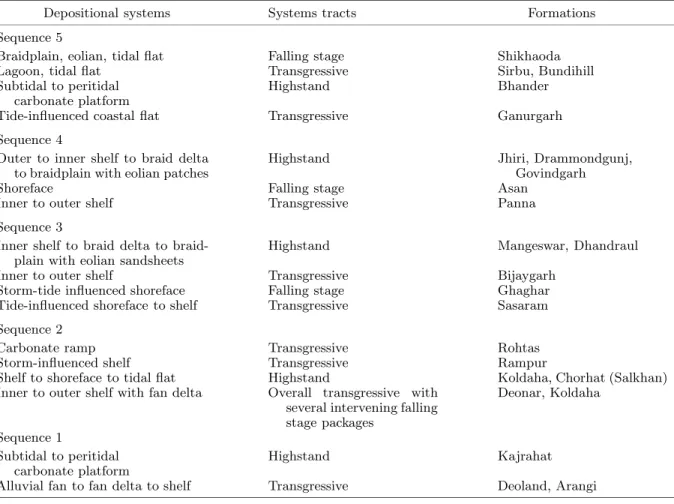
In the Vindhyan succession many depositional sys-tems have been recognized, the products of which occur at different stratigraphic levels, within dif-ferent lithostratigraphic units (table 2).
5.1 Description of depositional systems
5.1a Alluvial fan
Lithosomes of gravity-flow dominated alluvial fan depositional system are characterized by disor-ganized, poorly-sorted breccias and conglomer-ates comprising angular to subangular fragments (1–20 cm long) of igneous and metamorphic rocks, vein quartz and jasper set in a matrix of coarse sand and granules. The content of matrix varies resulting in both clast-supported and matrix-supported texture. The sediment bodies are usually massive; however, at places crude layering defined by weakly oriented clasts may be observed. The grains of breccias at places show matching bound-aries. Lithosomes are laterally impersistent and apparently appear to be lenticular in shape.
Lithosomes of stream-flow dominated alluvial fan depositional system are characterized by sedi-ment bodies of conglomerates and pebbly to coarse grained sandstones. The conglomerates are mod-erately sorted, dominantly clast supported. Clasts are of metamorphic rocks, vein quartz, jasper, etc. and range in length from 10–15 cm. The bodies may be massive, horizontally stratified or cross
Figure 6. Field appearances of different stratigraphic units of the Bhander Group.
stratified. Channel cuts with stratified or mas-sive fills are common. At places laterally extenmas-sive, graded (normal as well and reverse) beds have been observed.
5.1b Fan delta
Lithosomes of the fan delta plain depositional sys-tem are characterized by sheet-like, laterally exten-sive conglomerate beds with or without interbeds of granular sandstones. The clasts are poorly sorted, and mostly of vein quartz and jasper with a few fragments of basic and schistose rocks. The length of the clasts ranges from 1 to 15 cm. They are dominantly subangular, supported by variable amounts of coarse sandy to granular matrix and are mostly unoriented; however, where the pro-portion of matrix is less they may be oriented with their long axis parallel to the bedding. The
conglomerates are usually normally graded. The interbedded sandstones may be horizontally strat-ified, cross stratified or massive. At places, the sys-tem is represented by multistoreyed sandstones. The sandstones are cross stratified and often show preserved dunes of transitional flow regime.
Lithosomes of the delta front depositional sys-tem are characterized by parallel-sided beds of pebbly sandstones that become gradually pebble-free towards the top of the beds. The beds often show Tabc type succession. The pebbles are subangular and dominantly of vein quartz and jasper and range in size from 0.5 to 5 cm. There are also sandstone lithosomes with inter-nal low-angle cross-stratification and with segre-gated pebble layers; on bedding planes wave ripples are common suggesting wave reworking of the delta front deposit. Pebble segregation can also be inter-preted to be the result of wave reworking processes.
Figure 7. Sectional view of the Vindhyan Supergroup along the line A–B constructed from the DEM provided by SRTM and field observations. Note plateaus formed by the Semri, Kaimur, Rewa and Bhander Groups of rocks.
5.1c Prodelta/shelf
Lithosomes of the prodelta/shelf depositional sys-tem are represented by regular alternation between fine-to-medium grained sandstones and claystone. The sandstone beds are sharp based, parallel sided and show parting lineated parallel laminae.
5.1d Braidplain and braid delta
Lithosomes of braidplain depositional system are typically represented by vertically superimposed sheet-like, several meters thick sandstone bodies with little mudstones. The sandstone bodies have erosional lower contacts, at places replete with flutes, mud clasts and showing broad concave-upward geometry. Sandstones are dominantly medium grained; however, pebbly and gritty vari-eties are also common in some lithostratigraphic units. The sandstones are thoroughly cross strati-fied with trough, tabular and lenticular set geome-try. The shape of cross-strata within a set may vary laterally from planar to concave-up to sigmoidal. The sigmoidal cross-sets often grades vertically into parallel-laminated units with parting lin-eation and current crescent. The cross-set thickness ranges between 30 cm and 70 cm and they show different types of reactivation surfaces. There are also solitary sets of planar cross-strata with a set
thickness of more than a meter. Down current dip-ping cross-sets pertaining to ‘foreset macroform’ and small-scale channel fill sandstones have also been observed. Patches of eolianites characterized by adhesion ripples, translatent strata, along with rain prints are common.
The sandstone bodies show a systematic ver-tical distribution of sedimentary structures from cross-stratification to parallel-lamination suggest-ing deposition from flood events.
Lithosomes of braid delta depositional system share the features of braidplain depositional sys-tem. However, they are comparatively finer-grained and often show effects of reworking by wave and tide and altogether lack subaerial exposure features.
5.1e Aeolian sandsheet
Aeolian sandsheets have been recognized in the Dhandraul, Govindgarh and Shikhaoda Forma-tions wherein they occur sandwiched between lithosomes of braidplain and coastal plain deposi-tional system. The deposits include:
• sheet-like sandstones with internal translatent strata, capped by aeolian and adhesion ripples,
• sandstones internally showing adhesion ripple cross-lamination,
Figure 9. Inferred depositional sequences of the Vindhyan succession. Not to scale.
• lenticular sandstones showing cross-stratification characteristic of meter-scale longitudinal (seif) dunes, and
• lenticular sandstones with transverse aeolian dune cross-strata. The proportions of the last two types of lithosomes are much lower than the other types in the aeolian deposit.
5.1f Siliciclastic tidal flat
Upper tidal flat deposits include interlayered rippled-sandstones and mudstones with the sand:mud ratio varying widely resulting in lentic-ular bedding, wavy bedding, flaser bedding, etc. The lower tidal flat deposits are cross-stratified sandstones with little mud and the cross-strata are arranged in herring-bone pattern. The deposits are characterized by interference ripples, ladder-back ripples, flat-topped ripples, abundant rain prints, adhesion structures, desiccation cracks, mud clasts. Within the tidal deposits, there are also thicker sandstone beds (parallel and/or cross-laminated) showing sole marks, gutters, mud pebbles, etc. rep-resenting deposition from storm induced shooting flows on the tidal flat setting.
5.1g Shoreface
Shoreface deposits are represented by decimeter to meter thick sandstone beds with minor silt-stones and claystones. Two types can be recognized: wave/storm dominated shoreface and tide-dominated shoreface.
Wave/storm dominated shoreface deposits show sharp based (often with sole marks), parallel-sided, cross-stratified sandstone beds grading upward into
ripple bedded muddy sandstones. Cross-strata are dominantly low angle, planar to concave-up, uni-directional and anisotropic, hummocky. Ripples may be symmetric and asymmetric in profile with internal wave-diagnostic lamination. The features suggest deposition from sediment-laden combined flows induced by storms. The vertical variation in sedimentary structure and texture indicate domi-nance of unidirectional current component in the combined flow during the initial stage of deposition while oscillatory flow dominated the later phase of sedimentation. Amalgamation of beds is also common.
Tide-dominated shoreface deposits include sand-stone beds showing compound cross-stratification characterized by horizontal and dipping cross-sets with the internal cross-strata arranged in herring-bone pattern along with reactivation surfaces, mud drapes, mud clasts. The features suggest a shoreface surfaced by asymmetric dunes of tidal origin with superimposed smaller dunes.
5.1h Inner shelf
The indigenous deposits of inner shelf setting are muds. However, sands may be introduced by storm flows resulting in interbedded sandstone and mudstone. Storm deposited sandstone beds are sharp based with sole marks such as grooves, prods, flutes, gutters, etc. The beds deposited under the dominance of oscillatory component show hummocky cross-stratification and/or wave-ripple bedding grading vertically into the mud-stone. Beds deposited under the dominance of unidirectional current are typically parallel sided with sole marks and internally show Bouma
Table 1. Systems tracts of the Vindhyan Supergroup (Son valley).
Depositional systems Systems tracts Formations
Sequence 5
Braidplain, eolian, tidal flat Falling stage Shikhaoda
Lagoon, tidal flat Transgressive Sirbu, Bundihill
Subtidal to peritidal carbonate platform
Highstand Bhander
Tide-influenced coastal flat Transgressive Ganurgarh
Sequence 4
Outer to inner shelf to braid delta to braidplain with eolian patches
Highstand Jhiri, Drammondgunj,
Govindgarh
Shoreface Falling stage Asan
Inner to outer shelf Transgressive Panna
Sequence 3
Inner shelf to braid delta to braid-plain with eolian sandsheets
Highstand Mangeswar, Dhandraul
Inner to outer shelf Transgressive Bijaygarh
Storm-tide influenced shoreface Falling stage Ghaghar
Tide-influenced shoreface to shelf Transgressive Sasaram
Sequence 2
Carbonate ramp Transgressive Rohtas
Storm-influenced shelf Transgressive Rampur
Shelf to shoreface to tidal flat Highstand Koldaha, Chorhat (Salkhan)
Inner to outer shelf with fan delta Overall transgressive with
several intervening falling stage packages
Deonar, Koldaha
Sequence 1
Subtidal to peritidal carbonate platform
Highstand Kajrahat
Alluvial fan to fan delta to shelf Transgressive Deoland, Arangi
type sequences. Amalgamation of beds is also common.
5.1i Outer shelf
The deposits of outer shelf depositional system are typically mudstones with or without thin, parallel-sided layers of parallel laminated and/or micro cross-laminated fine sandstones deposited from storm suspensions with or without the influ-ence of unidirectional current.
5.1j Peritidal carbonates
Peritidal carbonate deposits are characterized by intraclastic, flat pebble conglomerates, tepee struc-tures, desiccation cracks, molar tooth strucstruc-tures, wavy or lenticular bedded limestones, micro-bial laminites, microdigitate or mini stromato-lites (tufa), domal stromatostromato-lites, chert nodules and birds-eye structures.
5.1k Shallow subtidal carbonates
Carbonates of shallow subtidal regime can be divided into two types:
1. Biohermal and 2. Clastic.
Biohermal carbonates show columnar stromato-lites. Clastic carbonates show unidirectional (both high angle and low angle) as well as hummocky cross-stratification and horizontal stratification.
5.1 Deep water carbonates
Biohermal deep water carbonates are character-ized by conical stromatolites. The other types of deposits include carbonate mud-encased suspen-sion flow deposits characterized by massive carbon-ate conglomercarbon-ates and calcareous sandstone beds showing vertical variation in structure from paral-lel lamination to ripple drift cross-lamination. The distal deposits are typically represented centimeter thick interlayers of limestone-shale rhythmites.
6. Sequence stratigraphy
The whole Vindhyan succession in the southern Son valley can be divided into five sequences sep-arated by unconformities with one sequence in the
Bundelkhand region (figure 9). The unconformities are manifested in the field by angular discordances and/or long-term subaerial exposure features. Each individual sequence again can be subdivided into several systems tracts represented in the succession as a sediment package defining a particular pale-ogeographic setting (table 2). The systems tracts are bounded by chronstratigraphically significant surfaces across which a change in paleogeographic setting can be inferred.
6.1 Sequences of Vindhyan succession
6.1a Sequence 1
Sequence 1 is represented by Deoland, Arangi and Kajrahat Formations (figures 2, 3A, B). It consists of two systems tracts (table 2). The lower tract reflects a paleogeography characterized by alluvial fan, fan delta and prodeltaic shelf and the systems are arranged in the succession retrogradationally defining what is known as transgressive systems tract (TST). The TST is followed by a sediment package representing the paleogeography of a car-bonate platform – a homoclinal carcar-bonate ramp. In this package, the deep-water carbonates are over-lain by shallow subtidal carbonates with the peri-tidal carbonates occurring at the top. The stacking pattern indicates a highstand systems tract (HST). The boundary between the two systems tracts is, therefore, a maximum flooding surface.
The strata of the alluvial fan system mostly have high (>50◦) dips. As a result, true paleocurrent directions could not be determined; however, the data suggest northerly transport of sediments with a source towards the south. The mean paleocurrent of the fan delta plain system is towards north, but the cross-strata azimuths show wide scatter (Bose
et al 1997).
6.1b Sequence 2
Sequence 2 is represented by Deonar, Koldaha, Chorhat, Salkhan, Rampur and Rohtas Forma-tions (figure 2). It consists of four major systems tracts (table 2). The first (from the bottom) systems tract is represented by the volcaniclastics of the Deonar Formation and claystones of the Koldaha Formation. The volcaniclastics and the claystones were deposited in shelfal water depths and the package shows a deepening-upwards trend defining a transgressive systems tract. However, this tract is often intervened by packages of coarser clastics (conglomerate, medium to coarse sandstone) deposited in shoreface region in the form of fan delta and braidplain delta represent-ing fallrepresent-ing stage systems tracts within the over-all transgressive tract (figure 3F). The second
systems tract represents a paleogeography char-acterized by tidal flat, shoreface and shelf depo-sitional systems. Several parasequences could be recognized in this tract represented by prograda-tional packages of shoreface to tidal flat strata and bounded by flooding surfaces. The parase-quences show an aggradational to progradational stacking pattern. The systems tract is, therefore, a highstand systems tract consisting of upper parts of Koldaha Formation and Chorhat Formation (figure 3F).
The tidal flat deposits of the highstand systems tract are sharply overlain by shelf strata belonging to the Rampur Formation (figure 2). The upper bounding surface of the highstand systems tract may thus be interpreted as a transgressive surface representing a submarine discontinuity. The sys-tems tract overlying the transgressive surface is represented by inner and outer shelf strata defin-ing a deependefin-ing upwards trend and thus a trans-gressive systems tract. The top-most or the fourth systems tract of sequence 2 represents a paleogeog-raphy as a distally steepened carbonate ramp in which deposits of deeper systems occur upwards in the package. The tract is, therefore, a transgres-sive systems tract comprising the Rohtas Forma-tion (figure 2).
Sequence 2 ends with a transgressive systems tract instead of a highstand systems tract. The upper bounding surface of the top-most TST of sequence 2 is a major unconformity surface of the Vindhyan succession delineating the Lower Vin-dhyan (Semri) from the Upper VinVin-dhyan (fig-ure 4A). In addition to angular discordances, this surface is also marked by long term subaerial exposure features, e.g., karstic dissolution, baux-itization, etc. Therefore, the absence of the HST could be due to erosional removal of the highstand strata.
The mean crestal trend of the wave ripples occur-ring in the shelf deposits of the second systems tract is along NW–SE. The cross-strata azimuths of the sandy braid delta systems of the same tract of the sequence indicates a mean paleocurrent towards NNW, whereas the mean paleocurrent indicated by the conglomerating fan delta systems is towards NE.
6.1c Sequence 3
Sequence 3 is represented by Sasaram, Ghaghar, Bijaygarh, Mangeswar and Dhandraul Forma-tions of the Kaimur Group and consists of two systems tracts (figures 2 and 4). The lower sys-tems tract reflects a paleogeography character-ized by shoreface and shelf depositional systems (table 2). This tract contains several parase-quences represented by progradational successions
of tide-dominated shoreface to inner shelf strata, and each parasequence is bounded at the top by flooding surfaces. The parasequences are stacked retrogradationally. This set of retrogradational parasequences is topped by a regressive surface on which sharply occurs a parasequence defined by a progradational succession of storm-dominated shoreface strata which is bounded at the top by a flooding surface representing a falling stage deposit within the lower systems tract. The rest of the suc-cession of the lower systems tract is represented by shelfal strata showing a deepening upwards trend. The lower systems tract, therefore, repre-sents an overall transgressive tract with an inter-vening falling stage (regressive) wedge.
The upper systems tract represents a paleogeog-raphy characterized by braidplain, braid delta and shelf depositional systems arranged in prograda-tional pattern defining a highstand systems tract. The boundary between the two systems tracts is, therefore, a maximum flooding surface.
In the TST, the azimuths of the cross-strata associated with tidal dunes reveal a bipolar, tri-modal distribution and indicate an average tidal flow along NE (ebb)–SW (flood) direction. The storm-generated cross-strata in the regres-sive wedge of the TST show wide divergence of azimuths, but a mean orientation towards north is indicated suggesting offshore transport of sed-iments. The wave ripples of the TST show wide scatter with a mean orientation along NNW–SSE. The sole marks occurring in the inner shelf deposits of the TST are typically oriented along NW–SE suggesting that the storm flow had along-shore components.
In the HST, the cross-strata/lamina of the inner shelf deposits shows a mean orientation towards NNW. The associated sole marks are dominantly oriented towards NW, although bipolar distri-bution is also common. The paleocurrent pat-tern of the braidplain and braid delta systems shows a mean sediment transport direction towards NNW.
6.1d Sequence 4
Sequence 4 is represented by Panna, Assan, Jhiri, Drammondgunj and Govindgarh Formations of the Rewa Group (figures 2 and 5). It consists of three systems tracts (table 2). The lower tract repre-sents a paleogeography characterized by inner to outer shelf depositional systems. The tract is dom-inantly represented by shelfal strata with deep-ening upwards trend, i.e., a transgressive systems tract. This tract is sharply overlain by a package of shoreface strata bounded below by a regressive surface and above by a flooding surface (falling stage deposits). The uppermost systems tract is
represented by braidplain, braid delta and shelf depositional systems arranged in progradational pattern defining a highstand systems tract. The boundary between the two systems tracts is evi-dently a maximum flooding surface.
In the braid delta system of the HST, the cross-strata azimuths show a wide scatter with a mean trend towards WNW, whereas the cross-strata of the braid-plain systems are more consistently ori-ented with a mean direction towards NNW.
6.1e Sequence 5
Sequence 5 is represented by Ganurgarh, Bhander, Bundihill, Sirbu and Shikhaoda Formations of the Bhander Group (figures 2 and 6). There are four systems tracts in the succession (table 2). The first tract is represented by siliciclastic tidal flat, pre-sumably with a carbonate domain in the subtidal part. The systems are arranged in retrogradational pattern and thus define a transgressive systems tract. The second tract is represented by a homo-clinal carbonate ramp with a progradational array of the depositional systems defining a highstand systems tract. The third tract reflects a paleogeog-raphy characteristic of siliciclastic, coastal lagoon-tidal flat depositional system overlain by marine strata representing a transgressive systems tract. The third tract is sharply overlain by coarser, proximal peritidal deposits and thus its top may be interpreted as a regressive surface. The fourth tract overlying the regressive surface is represented by strata reflecting progradation of a braidplain over the peritidal domain, i.e., a falling stage tract.
The cross-strata of the carbonate platform show a bipolar distribution along NE–SW with the stronger mode towards NE. The associated asym-metric ripples also reveal a mean migration direc-tion towards NE, whereas the symmetric ripples have a mean crestal trend along NS.
The wave ripple trends in all the peritidal systems, although boxing the compass, reveal a mean trend along 140◦–320◦. The asymmetric rip-ples in the Bundihill Formation show a mean ori-entation towards 35◦, whereas the sole marks in the Sirbu Formation are grossly oriented along 71◦–249◦. Only three flute cast orientations could be measured from the lower unit of the Shikhaoda Formation which indicate flows towards 215◦, 10◦ and 357◦. In Bundihill Formation sole mark ori-entations could not be measured due to exposure limitations. It is thus inferred that the gross orien-tation of the shoreline was NNW–SSW. The WNW directed paleocurrent of the fluvial deposit in the upper Shikhaoda Formation suggests that the land was located south of the inferred shoreline. The wind-induced currents operating in the peritidal
flat thus appear to have had strong cross-shore components.
6.2 Systems tracts at the Bundelkhand sector
It has already been mentioned that there are sed-iment packages in the Vindhyan succession at the Bundelkhand region that, lithologically as well as in respect of paleocurrent, stand out from the depositional systems represented in the southern part of the Son valley. These packages should thus be considered as representing separate systems tracts and sequences from those of the southern Son valley.
The entire Semri Group of the northern part perhaps represents a sequence. Absence of vol-caniclastics (represented by the widespread Deonar Formation in southern Son valley and Rajasthan) in this sequence suggests that the sequence post-dates TST-1 of sequence 2 in the southern part. Interestingly, the paleocurrent data of this sequence demonstrate southerly transport of sedi-ments from a northerly occurring source land.
There are two other sediment packages, at the base of the Kaimur and Rewa Groups, in the north-ern part standing apart from the depositional sys-tems of the southern Son valley. These packages represent fan delta depositional systems prograd-ing southerly from a northerly occurrprograd-ing scarp (Boseet al 1997).
7. Summary
• The features of the Vindhyan succession clearly indicate a vast intracratonic basin that remained within tens of meters of sea level throughout its lifetime. Apparently, shallow water condition was maintained over a large area for a long period of time suggesting that the sub-Vindhyan lithosphere suffered subsidence over a larger area producing a wide shallow ramp type basin. Hun-dreds of meters thick accumulation of peritidal strata in sequence 5 of the Vindhyan succession indicates that the subsidence rate was in perfect concert with the rate of sediment supply for a considerably long period of time during the end phase of Vindhyan basin evolution – the hall-mark of cratonic basins Sloss (1988a, b). It is inferred that during the terminal period of the Vindhyan sedimentation a self-regulating system of uplift, erosion, sedimentation and subsidence controlled the accumulation of strata.
• The Vindhyan basin-fill in the Son valley exhibits an asymmetric cross-sectional geometry normal to the regional strike (ENE–WSW) with the thickest part occurring to the south.
• The Vindhyan strata define a broad, regional syncline trending ENE–WNW. The northern limb of the syncline is homoclinal and has low dip. In contrast, the southern limb is steeper and shows several sub-regional anticlines inter-vened by synclines arranged in a terrace-like (ramp and flat) fashion.
• In the southern part of the Son valley, the Vindhyan basin fill shows several angular uncon-formities that grade into conuncon-formities, para-conformities and/or disconformities towards north.
• The different depositional systems recognized in the Vindhyan succession are: alluvial fan, fan delta, braid delta, braidplain, eolian sand sheet, tidal flat (carbonate as well as siliciclastic), shoreface (tide and storm dominated), storm dominated shelf, homoclinal carbonate ramp, distally steepened carbonate ramp and epeiric peritidal flat (siliciclastic).
• The overall paleocurrent directions of the depo-sitional systems in the Son valley are northerly suggesting a source towards south.
• The unconformities divide the Vindhyan suc-cession of Son valley into five sequences. Each sequence consists of several systems tracts rep-resenting different paleogeographic settings and marking paleogeographic shifts.
• The different strata of the Vindhyan succes-sion show evidences of soft-sediment deformation suggesting synsedimentary tectonic activity.
• The progressive and successive angular uncon-formities suggest that the deformation pattern shown by the Vindhyan strata is a reflection of synsedimentary tectonic activity.
• It is postulated that the individual sequences of the Vindhyan succession are related to discrete episodes of tectonism that induced the subsi-dence necessary for accumulation of sediments and resulted into deformation of the older strata. Angular unconformities resulted due to erosion of the uplifted crest of the anticlines on which the next sequence of strata was deposited with an angular discordance.
• There are sediment packages at the northern part of the Vindhyan basin developed from a northerly source and thus representing differ-ent tracts and sequences from those of the southern part. These packages are represented intermittently in the succession and have been interpreted as representing periods of uplift of the Bundelkhand Granite and subsequent ero-sion in the north.
References
Allen P A and Homewood P 1986 Foreland basins; Spec.
Angevine C L, Heller P L and Paola C 1990 Quantitative
sedimentary basin modelling;AAPG Continuing
Educa-tion Course Note Series 32p. 133.
Aspler L B, Chiarenzelli J R and Bursey T L 1994 Ripple marks in quartz arenites of the Hurwitz Group, northwest territories, Canada: evidence for sedimentation in a vast,
early Proterozoic, shallow, fresh-water lake;J. Sed. Res.
A64282–298.
Banerjee A K and Sinha P N 1981 Structure and tectonics of
Vindhyan in eastern Rajasthan;Misc. Publ. Geol. Surv.
India5041–47.
Banerjee S and Jeevankumar S 2003 Facies motif and paleo-geography of Kheinjua Formation, Vindhyan Supergroup,
eastern Son valley;Gondwana Geological Magazine,
Spe-cial Volume7363–370.
Banerjee S and Jeevankumar S 2005 Microbially originated wrinkle structures on sandstone and their stratigraphic context: Paleoproterozoic Koldaha Shale, central India; Sedim. Geol.176211–224.
Banerjee S 2000 Climatic versus tectonic control on storm cyclicity in Mesoproterozoic Koldaha Shale, central India; Gond. Res.3521–528.
Bhattacharyya A (ed.) 1996 Recent advances in Vindhyan
geology;Geol. Soc. India Memoir 36p. 331.
Bhattacharyya A and Morad S 1993 Proterozoic braided ephemeral fluvial deposits: an example from the Dhan-draul Sandstone Formation of the Kaimur Group, Son
valley, India;Sedim. Geol.84101–114.
Bose P K and Chaudhuri A K 1990 Tide versus storm in epeiric coastal deposition: two Proterozoic sequences,
India;Geological Journal 2581–100.
Bose P K and Chakroborty P P 1994 Marine to Fluvial transition: Proterozoic Upper Rewa sandstone, Maihar,
India;Sedim. Geol.89285–302.
Bose P K, Banerjee S and Sarkar S 1997 Slope-controlled seismic deformation and tectonic framework of
depo-sition of Koldaha Shale, India; Tectonophysics 269
151–169.
Bose P K, Chakraborty S and Sarkar S 1999 Recognition of ancient aeolian longitudinal dunes: a case study from the
Upper Bhander sandstone, Son valley, India; J. Sedim.
Res.6986–95.
Bose P K, Sarkar S, Chakraborty S and Banerjee S 2001 Overview of the Meso- to Neoproterozoic evolution of the
Vindhyan basin, central India (1.4–0.55 Ga);Sedim. Geol.
141395–419.
Chakraborty C 1993 Morphology, internal structure and mechanics of small longitudinal (seif) dunes in an aeolian
horizon of Proterozoic Dhandraul Quartzite, India;
Sedi-mentology 4079–85.
Chakraborty C 1995 Gutter casts from the Proterozoic Bijaygarh Shale Formation, India: their implication for
storm-induced circulation in shelf settings; Geological
Journal 3069–78.
Chakraborty C 1996 Sedimentary records of erg develop-ment over a braidplain: Proterozoic Dhandraul
Sand-stone;Mem. Geol. Soc. India 3677–99.
Chakraborty C 1999 Forced regressive shoreface deposits: Proterozoic Ghaghar Formation, Vindhyan Supergroup,
Son valley;Indian Journal of Geology 71265–275.
Chakraborty C 2001 Lagoon-tidal flat sedimentation in an epeiric sea: Proterozoic Bhander Group, Son valley, India; Geological Journal 36125–141.
Chakraborty C and Bose P K 1990 Internal structures of sandwave in a tide-storm interactive system:
Protero-zoic Lower Quartzite Formation, India;Sedim. Geol.67
133–142.
Chakraborty C and Bose P K 1992 Rhythmic shelf storm
beds: Proterozoic Kaimur Formtion, India;Sedim. Geol.
77259–268.
Chakraborty C and Bhattacharyya A 1996 Fan delta
sedi-mentation in a foreland moat: Deoloand Formation;Geol.
Soc. India Memoir 3627–48.
Chakraborty C and Karmakar S 1998 Structural archi-tecture of Vindhyan strata in Son valley:
implica-tions for basin tectonics; J. Geol. Soc. India 51
377–382.
Chakraborty P P 2004 Facies architecture and sequence
development in a Neoproterozoic carbonate ramp:
Lakheri Limestone, Member, Vindhyan Supergroup,
Cen-tral India;Precam. Res.13229–53.
Chakraborty P P, Sarkar S and Bose P K 1998 A viewpoint on intracratonic chenier evolution: clue from a reappraisal of the Proterozoic Ganurgarh Shale, central India; In: The Indian Precambrians (ed.) Palliwal B S (Jodhpur: Scien-tific Publishers, India) pp. 61–72.
Chakraborty P P, Sarkar S, Banerjee S, Das N G and Bose P K 1996 Volcaniclastics and their sedimentological
bearing in Proterozoic Kaimur and Rewa Groups; Geol.
Soc. India Memoir 3659–75.
Chakraborty T and Chaudhuri A K 1990 Stratigraphy of the late Proterozoic Rewa Group and palaeogeography of the Vindhyan basin in central India during Rewa
sed-imentation;J. Geol. Soc. India36383–402.
Chakraborty T and Chakraborty C 2001 Eolian and aque-ous interactions in the development of a Proterozoic sand
sheet: Shikhaoda Formation, Bhopal, India; J. Sedim.
Res.71106–115.
Chakraborty T, Sarkar S, Chaudhuri A and
Das-gupta S 1996 Depositional environments of Vind-hyan and other Purana basins: a reappraisal in the
light of recent findings; Geol. Soc. India Memoir 36
101–126.
Condie K C 1989 Plate tectonics and crustal evolution (New York: Pergamon) p. 476.
Eriksson P G, Condie K C, Tirsgaard H, Mueller W U, Altermann W, Miall A D, Aspler L B, Catuneanu O and Chiarenzelli J R 1998 Precambrian clastic sedimentation
systems;Sedim. Geol.1205–53.
Friedman G M, Sanders J E and Kopaska-Merkel D C 1992 Principles of sedimentary deposits (New York: Macmillan) p. 717.
Irwin M L 1965 General theory of epeiric clear water
sedi-mentation;AAPG Bull 49445–459.
Naqvi S M and Rogers J J W 1987 Precambrian geology of India (Oxford: Clarendon Press) p. 223.
Paikaray S, Banerjee S and Mukherji S 2005 Facies analy-sis of the Koldaha Shale, Vindhyan Supergroup and its
paleogeographic implications;Ind. J. Petrol. Geol.13(2)
1–11.
Park R G and Jaroszewski W 1994 Craton, tectonics, seis-micity; In: Continental deformation (ed.) P L Hancock (Oxford: Pergamon) p. 222.
Prasad B 1984 Geology, sedimentation and paleogeography
of the Vindhyan Supergroup, SE Rajasthan;Geol. Surv.
India Memoir 116(1)1–102.
Riba O 1976 Sytectonic unconformties of the Alto Cardener,
Spanish Pyrenees, a genetic interpretation;Sedim. Geol.
15213–233.
Roy S and Banerjee S 2002 Facies and petrography of the Porcellanite Formation around Chopan, Uttar Pradesh; J. Ind. Assoc. Sedim.20195–205.
Runkel A C, McKay R M and Palmer A R 1998 Origin of a classic cratonic sheet sandstone: stratigraphy across the Sauk II-Sauk III boundary in the Upper Mississippi
valley;GSA Bull.110188–210.
Sarkar S, Banerjee S and Bose P K 1998 Trace fossils in the Mesoproterozoic Koldaha Shale, Central India, and their
Sarkar S, Chakraborty P P and Bose P K 1996 Proterozoic Lakheri Limestone, central India: facies, paleogeography,
and paleophysiography; Geol. Soc. India Memoir 36
5–26.
Sarkar S, Chakraborty S, Banerjee S and Bose P K 2002 Facies sequence and occult imprint of sag
tec-tonics in Sirbu Shale; Spec. Publ. Int. Assoc. Sed. 33
369–381.
Sarkar S, Banerjee S, Chakraborty S and Bose P K 2002 Shelf storm flow dynamics: insight from the
Mesopro-terozoic Rampur Shale, central India;Sedim. Geol.147
89–104.
Sastry M V A and Moitra A K 1984 Vindhyan stratigraphy –
a review;Geol. Surv. India Memoir 116109–148.
Schopf T J M 1980 Oaleoceanography (Cambridge, MA: Harvard University Press).
Shaw A B 1964 Time in stratigraphy (New York:
McGraw-Hill).
Seilacher A, Bose P K and Pflueger F 1998 Triploblastic ani-mals more than 1 billion years ago: trace fossil evidence
from India;Science 28280–83.
Singh I B and Kumar S 1978 On the stratigraphy and sed-imentation of the Vindhyan sediments in the Chitrakut area, Banda District (U.P.)–Satana District (M.P.); J. Geol. Soc. India 8359–367.
Singh I B 1980 Precambrian sedimentary sequences of India: their peculiarities and comparison with modern
sedi-ments;Precamb. Res.12411–436.
Sloss L L 1988a Introduction; In:Sedimentary cover – North
American craton. The Geology of North America (ed.) Sloss L L, p. D-2, 1–3.
Sloss L L 1988b Conclusions; In:Sedimentary cover – North
American craton. The Geology of North America (ed.) Sloss L L, p. D-2, 493–496.
Windley B F 1977 Evolving cotinents (London: John Wiley & Sons) p. 385.