E/M LEVEL WORKSHEET
STEP 1 : IDENTIFY THE CATEGORY AND SUBCATEGORY OF SERVICE
Carefully read the documentation. Using the Table of Contents, identify the appropriate category/subcategory. Category ________________
Subcategory (if applicable) ______________ (new/established, etc.)
STEP 2: REVIEW THE REPORTING INSTRUCTIONS FOR THE SELECTED CATEGORY OR SUBCATEGORY Read the section-specific instructions for the selected category/subcategory.
STEP 3: REVIEW THE LEVEL OF E/M SERVICE DESCRIPTORS (HISTORY, EXAM, MEDICAL DECISION MAKING, COUNSELING, COORDINATION OF CARE, NATURE OF PRESENTING PROBLEM AND TIME) Read the E/M service descriptors (history, exam, medical decision making, counseling, coordination of care, nature of presenting problem and time)
STEP 4: DETERMINE THE EXTENT OF HISTORY OBTAINED
a. Identify the Chief Complaint: _____________ b. Evaluate the HPI for the following elements:
location (anatomical place, position or site of the chief complaint) severity (a degree or measurement of the severity)
timing (when or at what frequency the problem is noticed)
modifying factors (anything that makes the problem better or worse) quality (a problem’s characteristics, such as how it looks or feels) duration (description of approx. duration of symptoms)
context (description of how symptoms began)
associated signs and symptoms (significant signs or symptoms patient feels are related to injury/illness or a lack thereof)
HPI contains three or more chronic problems Total elements _____
In addition to using the above elements, the level of the HPI can be based on the physician’s documentation of the status of 3 or more of chronic
problems. If the physician documents the status of 3 of more chronic problems the HPI would be counted as extended.
Number of chronic problems referenced _____ brief
extended
c. Analyze Review of Systems
Constitutional (weight loss, fever, chills, malaise)
Ear, nose, throat, and mouth (hearing loss, sinusitis, sore throat, oral cavities, ulcers) Gastrointestinal (nausea, vomiting, diarrhea, constipation, ulcer)
Integumentary (skin rashes, moles, dryness, lumps, pigmentation) Endocrine (polyuria, polydypsia, cold-heat intolerance, diabetes) Genitourinary (hematuria, nocturia, menopause, hernia)
Hematologic/lymphatic (anemia, bruising, bleeding, lymph node enlargement) Eyes (diplopia, blurred vision)
Cardiovascular (chest pain or pressure, palpitations, murmur, hypertension) Musculoskeletal (arthritis, joint stiffness, swelling, myalgias, gout)
Neurologic (dizziness, syncope, vertigo, weakness, tremor)
Allergic/immunologic (allergies to medicine, food, dye; hepatitis; HIV) Respiratory (cough, hemoptysis, pleuritic chest pain, wheezing, asthma) Psychiatric (depression, agitation, panic-anxiety, memory disturbance) Total body systems covered ________
Determine extent of ROS:
None (no problem pertinent ROS/no ROS)
Problem pertinent (problem pertinent ROS, one system)
Extended (problem pertinent ROS w/limited additional systems (problem pertinent + at least one additional body system, up to nine)
Complete (problem pertinent + all additional (minimum of 10) body systems) Analyze PFSH:
Past medical history: Adult and childhood illnesses or trauma, vaccinations and screenings, past surgical history, and past and present medications
Family history: Describes parents, siblings, children, genetic diseases of family or other family history
Social history: Information about the patient’s habits and circumstances (smoking, alcohol consumption, drug use, sexual orientation, marital status, place of birth, residence, occupation, education level, religion, recent travel destinations)
Determine extent of PFSH
None = No documented past, family, and/or social history
Pertinent = Documentation of at least one item from any of the three history areas.
Complete = Documentation of at least one item from two of three history areas or three of three history areas depending on E/M code type.
KEY COMPONENT: Extent of History Obtained:
Problem focused (CC, brief HPI)
Expanded problem focused (CC, brief HPI w/problem pertinent ROS)
Detailed (CC, extended HPI w/extended ROS (1-9 add’l body systems), pertinent PFSH) Comprehensive (CC, extended HPI w/extended ROS (10+ body systems), complete PFSH
STEP 5: DETERMINE THE EXTENT OF EXAMINATION PERFORMED USING THE ELEMENTS OF EXAMINA-TION REFERENCE SHEET
Identify body areas covered (check) and count elements: Chest, including breasts and axillae
Elements: _____
Neck trachea-larynx, thyroid Elements: _____
Identify organ systems covered (check) and count elements: Constitutional
Elements _____ Eyes
Elements _____ Ears, nose, throat Elements _____ Cardiovascular Elements _____ Respiratory Elements _____ Gastrointestinal Elements _____ Genitourinary Elements _____ Musculoskeletal Elements _____ Skin
Elements _____ Neurological Elements _____ Psychiatric Elements _____ Lymphatic Elements _____
KEY COMPONENT: Extent of Examination Obtained:
None
Problem focused (one to five elements identified by a bullet)
Expanded problem focused (at least six elements identified by a bullet)
Detailed (at least two elements identified by a bullet from each of six areas/systems or at least twelve ele-ments identified by a bullet in two or more areas/systems)
Comprehensive (all elements in nine body areas/organ systems. For each area/system, documentation of at least two elements identified by a bullet is expected)
STEP 6: DETERMINE THE COMPLEXITY OF MEDICAL DECISION MAKING
Identify and classify problem as self-limited, minor, established stable or improved, or established worsening. If problem is new, determine if additional workup is planned.
Use the DMO Table to determine points.
DIAGNOSIS/MGMT OPTIONS TABLE (NUMBER X POINTS = TOTAL
NUMBER POINTS TOTAL
Self-limited or minor problem 1
Established problem (to provider) stable or improved 1 Extablished problem (to provider) worsening 2 New problem (to provider) no additional work up planned 3 New problem (to provider) additional work up planned 4
Total Points
Max number of self-limited or minor problems = 2
Max number of new problem no additional work planned = 1 Assign Diagnosis/Mgmt Options Level:
1 point = Straightforward 2 points = Low
3 points = Moderate 4+ points = High
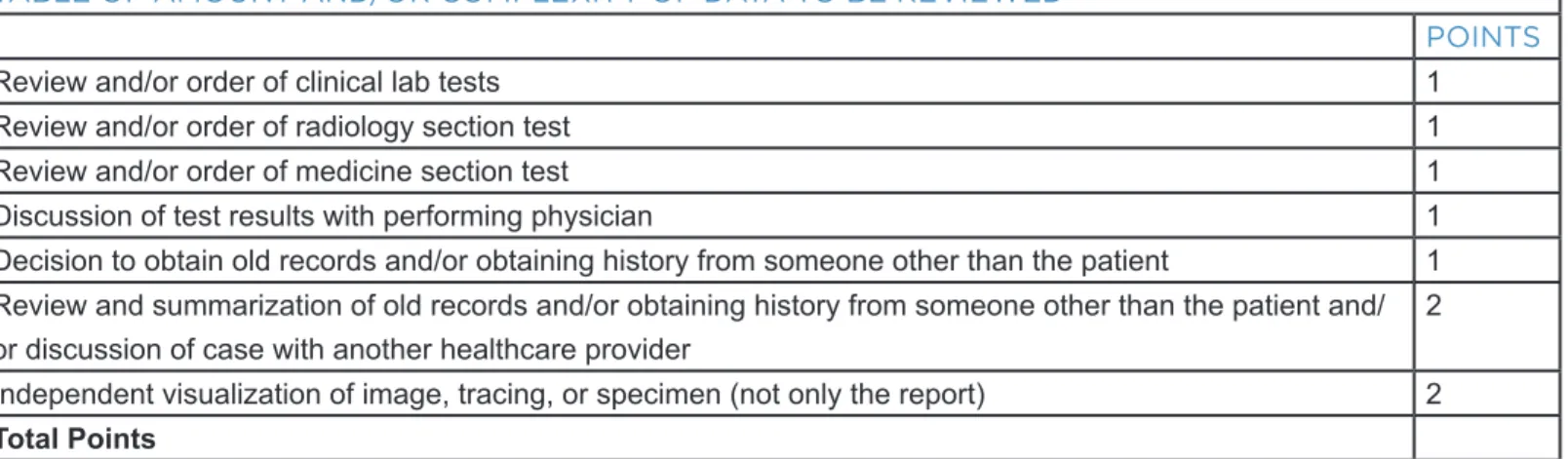
TABLE OF AMOUNT AND/OR COMPLEXITY OF DATA TO BE REVIEWED
POINTS
Review and/or order of clinical lab tests 1
Review and/or order of radiology section test 1
Review and/or order of medicine section test 1
Discussion of test results with performing physician 1
Decision to obtain old records and/or obtaining history from someone other than the patient 1 Review and summarization of old records and/or obtaining history from someone other than the patient and/ or discussion of case with another healthcare provider
2 Independent visualization of image, tracing, or specimen (not only the report) 2
Total Points
Assign Amount and/or Complexity of Data Level: 0-1 point = Straightforward
2 points = Low 3 points = Moderate 4+ points = High
Table of Risk
Presenting Problem Straightforward Low
Moderate High
Diagnostic Procedures Ordered Straightforward
Low Moderate High
Management Options Selected Straightforward
Low Moderate High
Assign the Level of Risk (highest of presenting problem, diagnostic procedures ordered, and management options selected):
Straightforward Low
Moderate High
Diagnosis/Mgmt Options, Amount and/or Complexity of Data to be Reviewed, and Level of Risk are analyzed to determine extent of MDM obtained (2 out of 3 must be met or exceeded).
KEY COMPONENT: Extent of MDM Obtained:
Straightforward medical decision making Medical decision making of low complexity Medical decision making of moderate complexity Medical decision making of high complexity
STEP 7: SELECT THE APPROPRIATE LEVEL OF E/M SERVICES
Career Step, LLC www.careerstep.com