Technology (Mandatory)
Years 7–8
Syllabus
This document contains Material prepared by the Board of Studies NSW for and on behalf of the State of New South Wales. The Material is protected by Crown copyright.
All rights reserved. No part of the Material may be reproduced in Australia or in any other country by any process, electronic or otherwise, in any material form or transmitted to any other person or stored electronically in any form without the prior written permission of the Board of Studies NSW, except as permitted by the Copyright Act 1968. School students in NSW and teachers in schools in NSW may copy reasonable portions of the Material for the purposes of bona fide research or study. Teachers in schools in NSW may make multiple copies, where appropriate, of sections of the HSC papers for classroom use under the provisions of the school’s Copyright Agency Limited (CAL) licence.
When you access the Material you agree:
• to use the Material for information purposes only
• to reproduce a single copy for personal bona fide study use only and not to reproduce any major extract or the entire Material without the prior permission of the Board of Studies NSW
• to acknowledge that the Material is provided by the Board of Studies NSW
• not to make any charge for providing the Material or any part of the Material to another person or in any way make commercial use of the Material without the prior written consent of the Board of Studies NSW and payment of the appropriate copyright fee
• to include this copyright notice in any copy made
• not to modify the Material or any part of the Material without the express prior written permission of the Board of Studies NSW.
The Material may contain third party copyright materials such as photos, diagrams, quotations, cartoons and artworks. These materials are protected by Australian and international copyright laws and may not be reproduced or transmitted in any format without the copyright owner’s specific permission. Unauthorised reproduction, transmission or commercial use of such copyright materials may result in prosecution.
The Board of Studies has made all reasonable attempts to locate owners of third party copyright material and invites anyone from whom permission has not been sought to contact the Copyright Officer, ph (02) 9367 8289, fax (02) 9279 1482.
Published by
Board of Studies NSW GPO Box 5300 Sydney NSW 2001 Australia
Tel: (02) 9367 8111 Fax: (02) 9367 8484
Internet: www.boardofstudies.nsw.edu.au June 2003
ISBN 1 7409 9277 6
2003196 20120482 20121658
1 Introduction ... 5
1.1 The K–10 Curriculum ... 5
1.2 Students with Special Education Needs ... 6
2 Rationale ... 8
3 The Place of the Technology (Mandatory) Years 7–8 Syllabus in the Technology K–12 Curriculum ... 10
4 Aim ... 11
5 Objectives ... 12
6 Outcomes ... 13
7 Content ... 14
7.1 Organisation of Content ... 14
7.2 Content for Stage 4 ... 20
8 Life Skills Outcomes and Content ... 41
8.1 Outcomes ... 41
8.2 Content ... 42
9 Continuum of Learning in Technology (Mandatory) K–10 ... 51
9.1 Stage Outcomes ... 51
9.2 Stage Statements ... 55
10 Assessment ... 60
10.1 Standards ... 60
10.2 Assessment for Learning ... 60
10.3 Reporting ... 62
1
Introduction
1.1 The K–10 Curriculum
This syllabus has been developed within the parameters set by the Board of Studies NSW in its K–10 Curriculum Framework. This framework ensures that K–10 syllabuses and
curriculum requirements are designed to provide educational opportunities that:
engage and challenge all students to maximise their individual talents and capabilities for
lifelong learning
enable all students to develop positive self-concepts and their capacity to establish and
maintain safe, healthy and rewarding lives
prepare all students for effective and responsible participation in their society, taking
account of moral, ethical and spiritual considerations
encourage and enable all students to enjoy learning, and to be self-motivated, reflective,
competent learners who will be able to take part in further study, work or training
promote a fair and just society that values diversity
promote continuity and coherence of learning, and facilitate the transition between
primary and secondary schooling.
The framework also provides a set of broad learning outcomes that summarise the
knowledge, understanding, skills, values and attitudes essential for all students to succeed in and beyond their schooling. These broad learning outcomes indicate that students will:
understand, develop and communicate ideas and information
access, analyse, evaluate and use information from a variety of sources work collaboratively with others to achieve individual and collective goals
possess the knowledge and skills necessary to maintain a safe and healthy lifestyle understand and appreciate the physical, biological and technological world and make
responsible and informed decisions in relation to their world
understand and appreciate social, cultural, geographical and historical contexts, and
participate as active and informed citizens
express themselves through creative activity and engage with the artistic, cultural and
intellectual work of others
understand and apply a variety of analytical and creative techniques to solve problems understand, interpret and apply concepts related to numerical and spatial patterns,
structures and relationships
be productive, creative and confident in the use of technology and understand the impact
of technology on society
understand the work environment and be equipped with the knowledge, understanding
and skills to evaluate potential career options and pathways
develop a system of personal values based on their understanding of moral, ethical and
spiritual matters.
The ways in which learning in the Technology (Mandatory) Years 7–8 Syllabus contributes to the curriculum and to the student’s achievement of the broad learning outcomes are outlined in the syllabus rationale.
In accordance with the K–10 Curriculum Framework, the Technology (Mandatory)Years 7–8 Syllabus takes into account the diverse needs of all students. It identifies essential knowledge, understanding, skills, values and attitudes. It enunciates clear standards of what students are
expected to know and be able to do in Years 7–8. It provides structures and processes by which teachers can provide continuity of study for all students, particularly to ensure successful transition through Years 5 to 8 and from Year 10 to Year 11.
The syllabus also assists students to maximise their achievement in Technology (Mandatory) through the acquisition of additional knowledge, understanding, skills, values and attitudes. It contains advice to assist teachers to program learning for those students who have gone beyond achieving the outcomes through their study of the essential content.
1.2 Students with Special Education Needs
In the K–6 curriculum, students with special education needs are provided for in the following ways:
through the inclusion of outcomes and content in syllabuses which provide for the full
range of students
through the development of additional advice and programming support for teachers to
assist students to access the outcomes of the syllabus
through the development of specific support documents for students with special
education needs
through teachers and parents planning together to ensure that syllabus outcomes and
content reflect the learning needs and priorities of students.
Students with special education needs build on their achievements in K–6 as they progress through their secondary study and undertake courses to meet the requirements for the Record of School Achievement.
It is necessary to continue focusing on the needs, interests and abilities of each student when planning a program for secondary schooling. The program will comprise the most appropriate combination of courses, outcomes and content available.
Life Skills
For most students with special education needs, the outcomes and content in sections 6 and 7 of this syllabus will be appropriate but for a small percentage of these students, particularly those with an intellectual disability, it may be determined that these outcomes and content are not appropriate. For these students the Life Skills outcomes and content in section 8 and the Life Skills assessment advice below can provide the basis for developing a relevant and meaningful program.
Access to Life Skills outcomes and content in Years 7–10
A decision to allow a student to access the Technology (Mandatory) Years 7–8 Life Skills outcomes and content should include parents/carers and be based on careful consideration of the student’s competencies and learning needs.
The decision should establish that the outcomes and content in sections 6 and 7 of the Technology (Mandatory) Years 7–8 Syllabus are not appropriate to meet the needs of the student. Consideration should be given to whether modifications to programs and to teaching, including adjustments to learning activities and assessment, would enable the student to access the syllabus outcomes and content.
As part of the decision to allow a student to access the Technology (Mandatory) Years 7–8 Life Skills outcomes and content, it is important to identify directions and goals for the student’s program of study, relevant settings, strategies and resource requirements that will assist the student in the learning process. Clear time frames and strategies for monitoring progress, relevant to the age of the student, need to be identified and collaborative plans should be made for future needs.
It is not necessary to seek permission of the Office of the Board of Studies for students to undertake the Technology (Mandatory) Years 7–8 Life Skills outcomes and content,nor is it necessary to submit planning documentation.
Life Skills assessment
Each student undertaking a Technology (Mandatory) Years 7–8 Life Skills will have specified outcomes and content to be studied. The syllabus content listed for each outcome forms the basis of learning opportunities for students.
Assessment should provide opportunities for students to demonstrate achievement in relation to the outcomes and to generalise their knowledge, understanding and skills across a range of situations or environments including the school and the wider community.
Students may demonstrate achievement in relation to Technology (Mandatory) Years 7–8 Life Skills outcomes independently or with support. The type of support will vary according to the particular needs of the student and the requirements of the activity. Examples of support may include:
the provision of extra time
physical and/or verbal assistance from others the provision of technological aids.
2
Rationale
Technology and an understanding of design processes enable people to manage, interpret, shape and alter their environment to improve their quality of life at home, school, in work places and in the broader community. The rapid rate of technological change in an
increasingly knowledge-based society highlights the need for flexible technological capability, innovative thinking and effective communication skills.
Technology education integrates both procedural and conceptual knowledge based on a holistic view of design. Students identify needs that have personal relevance, apply design theory and use design processes that encourage flexibility, resourcefulness and imagination in the development, communication and production of quality solutions.
Students learn about technologies and use a range of materials, tools and techniques relevant to the personal, commercial and global areas of human activity. Technologies assume increased importance when they are applied to solve real problems and to create ideas and solutions in response to needs and opportunities for customers, clients or themselves. They can be used to add functional, aesthetic and environmental value to products.
Students can further develop a fascination with, and enjoyment of, innovating and creating through making decisions and in their production of working solutions. They will experience a core of design processes and technological experiences. In the broader community, the application of this process can involve the consideration of factors relating to organisations, people, environments, sustainability, appropriateness, materials, machines and equipment, systems, communication infrastructures, social and ethical solutions.
Thinking skills are developed experientially through the Technology (Mandatory) course as students design and make. The use of reflective, flexible and creative thinking skills are encouraged to build understanding of underlying principles that can be transferred to different project settings and applications. Study in technology develops skills in enterprise and
initiative. Through practical experience it leads students to develop, select and apply technological skills involved in designing and producing. This includes processes of analysing, planning, producing, evaluating and maintaining the material and information needs of our society. Technology (Mandatory) builds on Science and Technology K–6 and is the foundation course in Secondary education that provides broad experience in a range of contexts that can be further explored in Technology elective courses 7–10 and Stage 6. The development of knowledge, skills and understanding gained through study of
Technology (Mandatory) will enable students to contribute positively to Australia’s future. They will be given opportunities to learn how to function safely in a working environment and in a society driven by rapid technological change, communication and in a global society with increasingly competitive knowledge-driven economies.
The capacity to solve problems and generate ideas through the use of new conceptual approaches, models, drawings and information and communication technologies, and the ability to develop, produce and implement quality solutions are keys to technological competence. These know-why and know-how capabilities often distinguish leading companies, innovators and regions from their competitors.
Students will be prepared for lifelong learning and career opportunities in the study of design and related fields. They will be given further opportunity to develop an inspired interest in developing innovative solutions, an appreciation of, and satisfaction in producing products and projects of enduring functional quality. Students will learn to meet the requirements of an identified need through a design brief.
3
The Place of the Technology (Mandatory) Years 7–8 Syllabus
in the Technology K–12 Curriculum
4
Aim
The aim of the Technology (Mandatory) Years 7–8 Syllabus is to develop students’ ability to design, produce and evaluate quality solutions that respond to identified opportunities and needs. It enables students to justify solutions and to responsibly, safely and creatively use and select materials, tools and techniques.
5
Objectives
Knowledge, understanding and skills
Students will develop:
1 knowledge, understanding and appreciation of and skills in design processes, design theory and the work of designers
2 knowledge of and skills in researching, experimenting, generating and communicating creative design ideas and solutions
3 knowledge and understanding of and skills in the responsible selection and safe use of materials, tools and techniques
4 knowledge, understanding and appreciation of the impact of innovation and emerging technologies on the individual, society and the environment
5 knowledge of and skills in managing quality solutions to successful completion
6 understanding and appreciation of and skills in evaluating and reflecting on the success of their own and others’ design activities.
6
Outcomes
Objectives
Students will develop:
Stage 4 Outcomes A student:
1 knowledge, understanding and appreciation of and skills in design processes, design theory and the work of designers
4.1.1 applies design processes that respond to needs and opportunities in each design project
4.1.2 describes factors influencing design in the areas of study of Built Environments, Products, and Information and Communications
4.1.3 identifies the roles of designers and their contribution to the improvement of the quality of life
2 knowledge of and skills in researching, experimenting, generating and communicating creative design ideas and solutions
4.2.1 generates and communicates creative design ideas and solutions
4.2.2 selects, analyses, presents and applies research and experimentation from a variety of sources
3 knowledge and understanding of and skills in the responsible selection and safe use of materials, tools and techniques
4.3.1 applies a broad range of contemporary and appropriate tools, materials and techniques with competence in the development of design projects
4.3.2 demonstrates responsible and safe use of a range of tools, materials and techniques in each design project
4 knowledge, understanding and appreciation of the impact of innovation and emerging technologies on the individual, society and the environment
4.4.1 explains the impact of innovation and emerging technologies on society and the environment
5 knowledge of and skills in managing quality solutions to successful completion
4.5.1 applies management processes to successfully complete design projects 4.5.2 produces quality solutions that respond to
identified needs and opportunities in each design project
6 understanding and appreciation of and skills in evaluating and reflecting on the success of their own and others’ design activities
4.6.1 applies appropriate evaluation techniques throughout each design project
4.6.2 identifies and explains ethical, social, environmental and sustainability considerations related to design projects Life Skills
For some students with special education needs, particularly those students with an
intellectual disability, it may be determined that the above outcomes are not appropriate. For these students, Life Skills outcomes and content can provide the basis for the development of a relevant and meaningful program – see section 8.
7
Content
7.1 Organisation of Content
Technology (Mandatory) involves designing, producing and evaluating quality design solutions. When developing design projects teachers are required to integrate essential content through the focus area of study. The needs and interests of students should be addressed when developing design projects.
Design Projectsinvolve the design, production and evaluation of quality solutions that are
functional and meet identified needs or opportunities. Students must undertake a minimum of four and a maximum of eight design projects.
For each design project students will develop a design folio as a document that provides ongoing evidence of the application of a design process and the specific technologies used in this process.
Areas of Study
The areas of study are the Built Environments, Products and Information and Communications. These provide the situation or context for the design project.
At least one design project must be based on each of the three areas. Each area of study includes a number of design specialisations. To provide a breadth of study for students, no more than three design specialisations can be selected from any one area of study. A specialisation can be studied only once during the course.
Built Environments
The focus of this area is on space, place and use. People create, construct and modify their surroundings for a wide range of purposes. The environments people build are an important part of our communities and culture. When designing environments, it is important to consider the functional, physical and material properties, aesthetic, ethical, environmental, socio-cultural, human form and scale and safety aspects of the development.
This area may include the following design specialisations:
ArchitecturalDesign – design projects may result in plans, drawings, models and
construction for buildings, set designs, facility design, exhibit design
Environmental Design – design projects may result in plans, drawings, models and
construction that enhance or support natural environments such as public access routes, habitats, aquariums, land management systems, water management strategies, responses to environmental issues, plant production systems
Interior Design – design projects may result in plans, drawings, models and construction
for layout and styling of spaces, finishes and furnishings
Landscape Design – design projects may result in plans, drawings, models and
construction of residential, commercial and recreational spaces both internal and external
Structural Design – design projects may result in plans, drawings, models and structures
such as bridges, shelters, enclosures for animals, play equipment.
Products
The focus of this area is on objects, systems and artifacts. People produce, distribute, use and consume both an enormous quantity and variety of goods and commodities. A considerable proportion of human activity is aimed at providing these products. These range from items that are individually crafted through to those mass produced. When designing products, it is important to consider aesthetics, material properties, ergonomics, human form,
environmental, socio-cultural, safety and functional impacts of the development. This area may include the following design specialisations:
Accessories Design – design projects may result in bags, hats, masks, belts
Agricultural Product Design – design projects may result in animal produce, plant
produce, systems for producing animal or plant produce
Fashion Design – design projects may result in clothing, presentations to display fashion
design
Food Design – design projects may result in food products, menus, food preparation
systems, diets for special purposes, food presentation
Industrial Design – design projects may result in toys, mechanisms, furniture, leisure
products, production systems
Jewellery Design – design projects may result in products for body adornment and
personal expression.
Information and Communications
The focus of this area is on various types of data and information – text, images, audio, video and numbers for the purposes of conveying a message. Information and communications systems are fundamental to human activity. Communication involves the accessing, processing and transferring of information and ideas through a range of media including written, oral, graphical and electronic. The principles of audio and visual communications design are important in the study of this strand. When designing Information and
Communications solutions it is important to consider the aesthetic, socio-cultural, ethical, and functional aspects of the development.
This area may include the following design specialisations:
Communication Systems Design – design projects may result in radio broadcasting,
signage, video production, event design, multi-media design
Information Systems Design – design projects may result in design of databases,
information management systems, information kiosks
Promotional Design – design projects may result in videos, websites, packaging,
presentations, brochures, advertisements, branding
Software Design – design projects may result in simple games programs, data
management and analysis systems
Digital Media Design – design projects may result in websites, on-screen presentations
When developing a design project within a design specialisation, essential design-related content must be integrated with essential technologies-specific content. Content from a minimum of 6 technologies must be addressed by the end of the course. The specific content of each technology can be addressed in a single project or across a number of projects. Design-related content is provided for:
design processes
factors influencing design roles of designers
generating and communicating design ideas and solutions research and experimentation
responsible and safe use of tools, materials and techniques
innovation and emerging technologies and their impact on society and the environment managing quality design projects
producing quality design projects evaluation techniques
ethical, social, environmental sustainability considerations.
Details of essential design-related content are provided on pages 20–25. Technologies-specific content includes:
materials tools techniques
associated with:
animal production technologies control technologies
electronics technologies food technologies graphics technologies information technologies media technologies metals technologies
mixed material technologies model-making technologies plant production technologies polymer technologies
textile technologies timber technologies
school-developed technologies (see page 40).
Details of essential technologies-specific content are provided on pages 26–40.
Life Skills
Cross-curriculum content
Cross-curriculum content assists students to achieve the broad learning outcomes defined in the Board of Studies K–10 Curriculum Framework. It is incorporated in the content of the Technology (Mandatory) Years 7–8 Syllabus in the following ways:
Information and Communication Technologies (ICT)
ICT will assist students to achieve educational outcomes more efficiently and with greater quality through the development of analytical, organisational and problem-solving skills to cope with expanding access to computerised/digital information. This is consistent with advances in ICT in all aspects of workplaces and the community.
Students are required to engage with ICT throughout the Technology (Mandatory) course and this is specifically embedded in the content. Students will utilise ICT within each design project and have the opportunity to study ICT in depth in the Information and
Communications area of study. Projects will integrate a variety of ICT applications including:
word processing to assist planning, data collection and recording, and specifically the
presentation of design folios
graphics in the form of existing and created images in design development and
presentation
electronic communication in the researching of information
software management in the efficient storage of electronic information. Work, Employment and Enterprise
The use of processes to design, produce and evaluate give students the opportunity to develop skills highly sought after in the workplace. In Technology (Mandatory) students develop initiative, an ability to work in groups, an appreciation of quality and the ability to manage with flexibility. They develop technological literacy and are encouraged to become
independent thinkers and confident communicators. Students study careers in a range of fields of technology and design. They study the cooperation, gender and leisure issues related to work and employment.
Aboriginal and Indigenous
Through designing, producing and evaluating Technology (Mandatory) students consider the appropriateness of design for different groups, including Aboriginal and Torres Strait
Islanders and other Indigenous peoples. This provides students with the opportunity to develop awareness of issues relevant to these groups.
Civics and Citizenship
In studying the role and responsibility of designers, Technology (Mandatory) students learn their individual roles as responsible citizens. They are better prepared to become active members of a society driven by change, emerging technology and increasingly sophisticated communication and information systems.
Difference and Diversity
Through designing, producing and evaluating Technology (Mandatory) students become aware of diversity and differences in society as they respond to the needs of a particular market through design projects. When working collaboratively, students develop an appreciation of the opinions and ideas of all group members.
Environment
Technology (Mandatory) students develop an appreciation of technologies through a study of design. They consider environmental impacts of technologies, encouraging them to become globally aware of sustainability issues.
Gender
Technology (Mandatory) students consider issues such as access to and interest in design and technological activities for all. Technological activities will be gender-inclusive and
accessible to all students and will provide the opportunity to consider the impact of different gender perspectives in the development of projects. Students will discuss gender stereotypes in paid/unpaid work and leisure time applications. The roles and contributions of successful designers and technologists, both men and women, will be studied.
Key Competencies
Technology (Mandatory) Years 7–8 provides a defined context within which to develop general competencies considered essential for the acquisition of effective, high-order thinking skills necessary for further education, work and everyday life. Technology (Mandatory) students will:
source, select and sequence information with regard to design research and idea
generation, developing competence in collecting, analysing and organising information
debate, describe, discuss and explain design-related issues in written, graphic and oral
form, developing competence in communicating ideas and information
work as individuals and as members of groups to conduct investigations and analysis,
developing competence in planning and organising activities
cooperate with individuals and groups, developing competence in working with others and in teams
design, implement and evaluate solutions to materials-based problems, developing
competence in solving problems
plan, develop and modify projects including costing, quantities, measurement and time,
developing competence in using mathematical ideas and techniques
experiment with a range of tools, materials and techniques, developing competence in
using technology.
Literacy
Technology (Mandatory) students are provided with opportunities to develop literacy skills, particularly technological literacy, in recording their project work as they complete a
minimum of four design projects.
Students learn to include subject-specific vocabulary, to describe, classify, and interpret meaning in order to develop and present design solutions using a range of media, including word processing. They evaluate information and construct text for specific audiences at various stages of design development.
Multicultural
Technology (Mandatory) students engage in activities that often involve them in analysing the appropriateness of design for different cultural groups, enhancing their appreciation of contributions made from people of all backgrounds.
Numeracy
In the development of solutions to design problems, students use numeracy concepts such as size, proportion and measurement as tools to assist in the communication of design ideas.
7.2 Content for Stage 4
A note to teachers about practical experiences
To satisfy the requirements of the syllabus students must undertake a range of practical experiences that occupy the majority of course time. Practical experiences will be used to develop knowledge and understanding of, and skills, in designing, producing and evaluating. Student capability, confidence and expertise at their current stage of development is an important consideration in determining the teaching and learning sequences in the course. In developing and delivering teaching programs teachers should be aware of and adopt relevant guidelines and directives of their education authorities and/or schools. Teaching programs should recognise and reflect relevant State and Commonwealth legislation, regulations and standards including Occupational Health and Safety, Chemical Safety in Schools and Animal Welfare guidelines. Teachers need to be aware of activities that may require notification, certification, permission, permits and licences.
Teachers should be aware that students may have food allergies that can result in anaphylaxis, a severe and sometimes sudden allergic reaction which is potentially
life-threatening and always requires an emergency response. This is an important consideration in selecting the foods to be handled and consumed.
Essential design-related content
The essential design-related content assists students to understand the application of design processes in the completion of design projects. Structured design processes assist people to apply technological know-how in the creative development and production of quality solutions to identified needs and opportunities.
Outcomes
A student: Students learn about: Students learn to:
4.1.1 applies design processes that respond to needs and opportunities in each design project
design processes including
analysing needs,
problems and opportunities
establishing criteria for
success
researching
generating creative
ideas
communicating ideas
experimenting and
testing ideas
risk management
managing resources
producing design
solutions
evaluating ideas and
solutions
needs and opportunities in
the areas of study
establish a design process
that responds to an identified need and opportunity
apply a design process when
developing quality solutions for each design project
establish criteria for
successful achievement of needs and opportunities
record design processes and
decision making in a design folio for each design project.
consider short-term and
long-term consequences of design in the design process
evaluate design processes
identify needs and
opportunities that require solutions in the areas of study
Outcomes
A student: Students learn about: Students learn to:
Built Environments
Products
Information and
Communications
design processes used by
designers identify a design process used by a designer
4.1.2 describes factors
influencing design in the areas of study of Built Environments, Products, and Information and Communications
definitions of design
factors affecting design
function
aesthetics
human form
scale
ergonomics
ethical
environmental
legislation including
OHS
cost
socio-cultural
resource availability
physical and material
properties
safety
recall a definition of design
examine factors affecting
design in the areas of study of Built Environments, Products, and Information and Communications
describe the factors affecting
design in the development of each design project
evaluate the appropriateness
of specific design solutions for different cultural groups including Aboriginal and Torres Strait Islanders and other Indigenous peoples 4.1.3 identifies the roles of
designers and their contribution to the improvement of the quality of life
relationship of design to the
areas of study of Built Environments, Products, and Information and Communications
identify relationships of
design to each area of study
different design
specialisations
describe the nature of each of
the areas of study of Built Environments, Products, and Information and
Communications
identify a range of design
specialisations relevant to each area of study
the nature of the work of
designers as individuals and as collaborators
apply group work and
collaborative strategies to project development
the contributions of females
and males who engage in design and technology
identify the contribution the
designer makes to the
improvement of everyday life
work and training
opportunities for people who engage in design and technology in each area of study
explore work and training
opportunities for people who engage in design and
technology relevant to each area of study
Outcomes
A student: Students learn about: Students learn to:
4.2.1 generates and
communicates creative design ideas and solutions
methods used to generate
creative design ideas including
mind mapping
brain storming
sketching and drawing
modelling
experimenting and
testing
use a variety of methods to
generate creative design ideas for each design project
use of design folio to
record and reflect on design ideas and decisions
use a design folio to record
and reflect on design ideas and decisions
communication methods
including
drawings, sketches and
models
written reports
oral presentations
digital presentations
sketch, draw and model to
aid design development
manipulate images with tools
such as editing, resizing, grouping, aligning and positioning
communication methods
suitable for specific audiences including
users and clients
technical experts
peers
communicate information
appropriate to specified audiences
using ICTs to plan, develop
and document design projects
compose a design folio for a
specific audience in electronic format including features such as tabs, indents, headers and footers, margins and line and paragraph spacing and using appropriate layout and graphic design
use ICTs to communicate
information including saving a document in various file types and storage locations from within the application
use word processing features
including page numbering and page breaks, find and replace, word count, spell check and thesaurus, columns and sections, inserting text/objects/images
Outcomes
A student: Students learn about: Students learn to:
4.2.2 selects, analyses, presents and applies research and
experimentation from a variety of sources
experimentation and testing
of design ideas apply the results of experimentation to designing
and making when developing each design project
relationship of
experimentation to success criteria
identify, interpret and
evaluate data from a variety of sources
research methods
needs analysis
surveys and interviews
searching techniques
including use of the Internet
use effective research
methods to identify needs and opportunities and locate information relevant to the development of each design project
identify solutions to other
similar needs and opportunities
use the internet when
researching 4.3.1 applies a broad range of
contemporary and appropriate tools, materials and techniques with competence in the development of design projects
For outcome 4.3.1 refer to
pp 26–40 (Essential technologies-specific content)
4.3.2 demonstrates
responsible and safe use of a range of tools, materials and techniques in each design project
risk management strategies
responsible behaviour in
working environments
Occupational Health and
Safety practices
manage risk when
developing design projects
the safe and responsible use
of materials, tools and techniques in each design project
use tools, materials and
techniques in a responsible and safe manner in each design project.
maintenance of tools and
equipment maintain tools and equipment including
Outcomes
A student: Students learn about: Students learn to:
4.4.1 explains the impact of innovation and
emerging technologies on society and the environment
innovation and emerging
technologies relating to tools, materials, techniques or products in each area of study
identify and describe a
selected innovation or emerging technology in each area of study of Built Environments, Products, and Information and
Communications
the impact of innovation
and emerging technology on society and the environment
explain the impact of
innovations and emerging technologies on society and the environment including new ICTs
4.5.1 applies management processes to
successfully complete design projects
resource availability
including
time
money
materials, tools and
techniques
human resources
including skills and expertise
other resources
management techniques
including action, time and budget planning
identify resource availability
and apply realistic limitations to each design project
develop and apply action,
time and budget plans in design projects
4.5.2 produces quality
solutions that respond to identified needs and opportunities in each design project
suitable materials, tools and
techniques for design projects
skill development and
refinement
identify suitable materials,
tools and techniques for each design project
practice and refine skills
needed for design projects
construction steps that
contribute to a quality solution
apply a design process that
responds to needs and opportunities for each design project
relationship of quality
solutions to needs and opportunities and the criteria for success for each design project
produce solutions reflecting
quality standards appropriate to each design project
Outcomes
A student: Students learn about: Students learn to:
4.6.1 applies appropriate evaluation techniques throughout each design project
developing criteria for
success as a tool for assessing design development and production
apply criteria for success in
decision making during the development of each design project
ongoing evaluation of
design ideas and decisions
final evaluation considering
design process used
design solutions
reflection on learning
use criteria for success to
reflect on the design process used and the solutions
evaluate prior to, during and
at completion of each design solution
self-assess and peer-assess
design solutions 4.6.2 identifies and explains
ethical, social, environmental and sustainability
considerations related to design projects
ethical and responsible
design
environmental and
sustainability considerations
identify ethical, social, and
environmental and
sustainability considerations relevant to each design project
be responsible and ethical in
the decisions made in the development and production of each design project
explain the responsibilities of
designers
demonstrate appropriate
ethics and etiquette in relation to computer use such as general computer care, passwords, file security, network use, printing and shared resources
7.3 Content for Stage 4
Essential technologies-specific content
Technological know-how in the context of the Technology (Mandatory) syllabus assists students to use materials, tools and techniques in the development of quality projects. Animal Production Technologies
Outcome
A student: Students learn about: Students learn to:
4.3.1 applies a broad range of contemporary and appropriate tools, materials and techniques with competence in the development of design projects
Materials/Inputs
characteristics of different
breeds of animals the selection of animals for a research, select and justify
specific purpose
nutritional requirements of
animals
the ideal environment
suitable for the type of animal/s studied to satisfy both physical and
behavioural needs
select, justify and provide the
appropriate feed and environment for a design project
Tools/equipment
specific tools relating to
animal production technologies
the function, selection and
correct use of a range of contemporary tools and equipment
select and correctly use
appropriate tools and equipment for a design project
Techniques
handling and feeding of
animals and other tasks appropriate for the purposes select and use techniques
of a design project
animal welfare codes of
practice accordance with identified apply techniques in
codes of practice
keeping records of animals maintain animal records
handling and packaging of
animal products animal products if it is correctly handle and package
appropriate to the design project
Control Technologies
Outcome
A student: Students learn about: Students learn to:
4.3.1 applies a broad range of contemporary and appropriate tools, materials and techniques with competence in the development of design projects
Materials/Inputs
data types, formats and
information as inputs of design and production
component categories for
hardware, including input devices, processors and output devices
identify and select appropriate
data for use in a design project
recognise, connect and use
input and output devices to construct systems including sensors, switches, wiring, lights and motors for a design project
robots and other mechatronic
devices, sensors, actuators such as motors, switches, lights
programmable logic
controllers (PLCs) and associated hardware Tools
specific tools relating to
control technologies
the function, selection and
correct use of a range of contemporary tools including
simple programming
languages
simple programs that
meet identified needs
construction tools
simple testing tools
including multimeter
select and correctly use tools
appropriate for the
construction, maintenance and management of systems for a design project
Techniques
program design
compiling programs
select and use appropriate
program development techniques and structures for an identified need
connecting interdependent
devices connect interdependent devices for the purposes of a
design solution
modelling and prototyping
systems troubleshoot problems with systems
testing systems in the
working environment test function of solutions for a design project
industrial production
Electronics Technologies
Outcome
A student: Students learn about: Students learn to:
4.3.1 applies a broad range of contemporary and appropriate tools, materials and techniques with competence in the development of design projects
Materials/components
types and functions of
common electronic
components such as diodes, resistors, capacitors, switches and batteries
identify and categorise
common electronic components
select and use electronic
components for a design project
Tools
specific tools relating to
electronics technologies
the function, selection and
correct use of a range of contemporary tools used for
cutting
marking out and
measuring
construction including
soldering irons
machine tools including
drill press
select and correctly use tools
of electronics technology for a design project
Techniques
techniques such as
soldering
drilling
cutting
methods of production of
circuits and circuit boards
solder efficiently
set out and construct simple
Food Technologies
Outcome
A student: Students learn about: Students learn to:
4.3.1 applies a broad range of contemporary and appropriate tools, materials and techniques with competence in the development of design projects
Materials
characteristics and
properties of foods appropriate to a design project
identify common properties
of food within each of the food groups
select and prepare food for a
design project Tools
specific tools related to
food technologies
the functions and correct
and safe use of a variety of contemporary food utensils and appliances used for
cutting
measuring
preparation, processing
and cooking
select and correctly use a
variety of appropriate food utensils and appliances to prepare quality food items for a design project
recipes including the
format and abbreviations commonly used
select, interpret and/or
modify/develop recipes for a design project
Techniques
specific techniques used in
food preparation
food processing
cooking food
select and use techniques
appropriate for the purposes of a design project
presenting food for visual
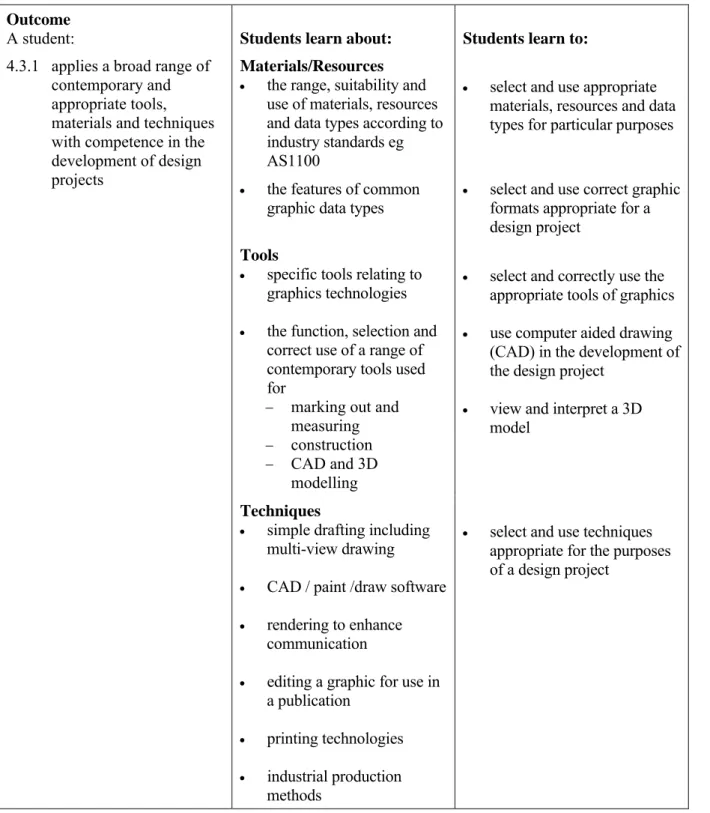
Graphics Technologies
Outcome
A student: Students learn about: Students learn to:
4.3.1 applies a broad range of contemporary and appropriate tools, materials and techniques with competence in the development of design projects
Materials/Resources
the range, suitability and
use of materials, resources and data types according to industry standards eg AS1100
select and use appropriate
materials, resources and data types for particular purposes
the features of common
graphic data types formats appropriate for a select and use correct graphic
design project Tools
specific tools relating to
graphics technologies
the function, selection and
correct use of a range of contemporary tools used for
marking out and
measuring
construction
CAD and 3D
modelling
select and correctly use the
appropriate tools of graphics
use computer aided drawing
(CAD) in the development of the design project
view and interpret a 3D
model
Techniques
simple drafting including
multi-view drawing
CAD / paint /draw software
rendering to enhance
communication
editing a graphic for use in
a publication
printing technologies
industrial production
methods
select and use techniques
appropriate for the purposes of a design project
Information Technologies
Outcome
A student: Students learn about: Students learn to:
4.3.1 applies a broad range of contemporary and appropriate tools, materials and techniques with competence in the development of design projects
Materials
range, suitability and use of
data types including hypertext
the internet as a source of
information
select and use appropriate
data types for particular purposes
select and justify the use of
correct file formats in a design project
Tools
software including
presentation, draw and paint, word processing, databases and spreadsheets
the function, selection and
correct use of a range input and output tools including
printer
scanner
storage devices
select and use software for
specific purposes in a design project
select and correctly use the
appropriate tools of
information technology for a design project
Techniques
information processes
collecting
organising
analysing
storage and retrieval
processing
displaying
select and use techniques
appropriate for the purposes of a design project
Media Technologies
Outcome
A student: Students learn about: Students learn to:
4.3.1 applies a broad range of contemporary and appropriate tools, materials and techniques with competence in the development of design projects
Materials
range, suitability and use of
data types
a range of media such as
video, animation, audio
the internet as a source of
information
select and use appropriate
data types for particular purposes
Tools
software including desktop
publishing, presentation, video editing, draw and paint, word processing, web design
the function and correct use
of a range of input and output tools used for
capturing images such
as digital cameras, videos, scanners
storing
printing
select and use appropriate
computer hardware and software in the development of a design project
Techniques
uses of media technologies
collecting information from
primary and secondary sources including digitising sound, text, graphics
organising information for
an appropriate audience
planning including
storyboards, scripts
storing and retrieving
processing techniques for
combining and manipulating such as special effects, cropping, tweening, morphing
displaying the final product
select and use techniques
appropriate for the purposes of a design project
Metals Technologies
Outcome
A student: Students learn about: Students learn to:
4.3.1 applies a broad range of contemporary and appropriate tools, materials and techniques with competence in the development of design projects
Materials
characteristics and
properties of metals including alloys and sheet metals
a range of appropriate
fittings and hardware
select and use metals in the
development of a design project
investigate and use
accessories where appropriate for a design project
Tools
specific tools relating to
metals technologies
the function, selection and
correct use of a range of contemporary tools used for
cutting
measuring and marking
out
bending and joining
machine tools for finishing,
drilling and folding
select and correctly use
appropriate hand and machine tools for a design project
Techniques
construction techniques
including cutting, shaping, joining and finishing metals
cut, shape and finish metals
select and use appropriate
techniques for the purpose of a design project
Mixed Material Technologies
Outcome
A student: Students learn about: Students learn to:
4.3.1 applies a broad range of contemporary and appropriate tools, materials and techniques with competence in the development of design projects
Materials
characteristics and
properties of a wide range of materials such as
metals
polymers
textiles
timber
the use of materials in
traditional and non-traditional ways
experiment with
combinations of a wide range of materials considering their
characteristics and properties
identify how materials have
been used in innovative and non-traditional ways
select and use a wide range
of materials for the identified needs and opportunities of a design project
Tools
specific tools related to
materials appropriate to a design project
the function and safe use of
a range of contemporary tools used for
measuring
marking out
cutting
construction
explore ways that tools can
be safely used to achieve new results
select and safely use tools
and equipment for a design project
Techniques
traditional and
non-traditional techniques used for
cutting
shaping a variety of
materials
joining different
materials
finishing
experiment with traditional
and non-traditional techniques
select and use traditional and
non-traditional techniques for the identified needs and opportunities of a design project
Model-Making Technologies
Outcome
A student: Students learn about: Students learn to:
4.3.1 applies a broad range of contemporary and appropriate tools, materials and techniques with competence in the development of design projects
Materials
characteristics and
properties of model-making materials such as
adhesives and joining
materials
balsa
card
figures and other
incorporated objects
foamboard
modelling clay
paper
polymers
textiles
timber
experiment with
combinations and types of materials
select and use appropriate
materials for the purposes of a design project
Tools
specific tools related to
model-making technologies
the function and correct use
of a range of contemporary tools used for
measuring
marking out
cutting
construction
finishing
select and correctly use tools
and equipment to produce a design project
Techniques
techniques such as
systematic planning for
model development
working to
pre-established scale
cutting accurately
shaping and sanding
joining a range of
different materials
clamping and pinning
finishing including
painting, lacquering, polishing
experiment with a variety of
techniques for cutting, shaping, joining, clamping and finishing
select and use a variety of
techniques appropriate for the purposes of a design project
Plant Production Technologies
Outcome
A student: Students learn about: Students learn to:
4.3.1 applies a broad range of contemporary and appropriate tools, materials and techniques with competence in the development of design projects
Materials
characteristics of different
plant types and varieties
plant requirements which
may include the use of nutrients, chemical, fertilisers and growing medium
identify a variety of plants
appropriate to the design project
research and evaluate plant
requirements in the development of a design project
Tools
specific tools relating to
plant production technologies
the function, selection and
correct use of a range of contemporary tools used for
planting
managing
harvesting
select, maintain and correctly
use tools and equipment for specific purposes in design project development
Techniques
techniques used for
planting
managing
harvesting
select and use techniques
appropriate for the purposes of a design project
Polymer Technologies
Outcome
A student: Students learn about: Students learn to:
4.3.1 applies a broad range of contemporary and appropriate tools, materials and techniques with competence in the development of design projects
Materials
characteristics and
properties of common thermosetting and thermoplastics materials
common uses of polymers
identify and select materials
appropriate to a design project
Tools
specific tools relating to
polymer technologies
the function, selection and
correct use of a range of contemporary tools used for
measuring and marking
out
construction
finishing
machine tools including
scroll saw and local bender (strip heater)
select and correctly use
polymer technology tools for a design project
Techniques
construction techniques
including
scoring and snapping
sawing
filing
abrading, polishing
moulding
select and use techniques
appropriate for the purposes of a design project
Textile Technologies
Outcome
A student: Students learn about: Students learn to:
4.3.1 applies a broad range of contemporary and appropriate tools, materials and techniques with competence in the development of design projects
Materials
characteristics and
properties of different fabric types including
wovens
knits
non-wovens
properties of fibres
including
naturals
synthetics
fibre blends
investigate fibre properties
and fabric characteristics appropriate to the design project
select and use appropriate
textile materials for a design project
Tools
specific tools related to
textiles technologies
the function and correct use
of a range of contemporary tools used for
measuring and cutting
patterns and pattern
marking
joining, constructing,
and assembling
surface decoration of
textiles
select and correctly use
appropriate tools and equipment for a design project
Techniques
specific techniques used to
construct and embellish textile items including
joining textiles
finishing
colouring and
decorating
care and maintenance of
textile products
select and use techniques
appropriate for the purposes of a design project
Timber Technologies
Outcome
A student: Students learn about: Students learn to:
4.3.1 applies a broad range of contemporary and appropriate tools, materials and techniques with competence in the development of design projects
Materials
characteristics and
properties of timber and timber products
a range of appropriate
fittings and hardware such as hinges, handles, catches, locks
identify, select and use
appropriate materials for a design project
Tools
specific tools related to
timber technologies
the function, selection and
correct use of a range of contemporary tools used for
marking out and
measuring
cutting
joining
finishing including
abrasives
machine tools including
scroll saw, drill press and disc sanding machines
select and correctly use tools
of timber technology for a design project
Techniques
construction techniques
including
cutting
shaping
finishing
industrial production
methods
cut, shape and finish timber
or timber products
select and use appropriate
techniques for the purposes of a design project
use appropriate surface
preparations and finishes for a design project
School-developed Technologies
The school-developed technologies allows for local relevance and the use of available expertise and resources (eg glass, automotive, ceramics). The following is a guide to be used when developing the essential technologies-specific content for the school-developed
technologies.
Outcome
A student: Students learn about: Students learn to:
4.3.1 applies a broad range of contemporary and appropriate tools, materials and techniques with competence in the development of design projects
Materials
characteristics and
properties of materials relating to school-developed technologies
select and use appropriate
materials for the purposes of a design project
Tools
specific tools related to
school-developed technologies
the function and correct use
of a range of contemporary tools used for the school-developed technologies
select and correctly use the
appropriate tools and equipment for a design project
Techniques
specific techniques used for
the school-developed technologies
select and use techniques
appropriate for the purposes of a design project
Life Skills
For some students with special education needs, particularly those students with an intellectual disability, it may be determined that the above content is not appropriate. For these students, Life Skills outcomes and content can provide the basis for the development of a relevant and meaningful program – see section 8.