Improved Ant Colony Optimization
Algorithm for Reservoir Operation
M.R. Jalali1, A. Afshar
and M.A. Mari~no2
In this paper, an improved Ant Colony Optimization (ACO) algorithm is proposed for reservoir operation. Through a collection of cooperative agents called ants, the near-optimum solution to the reservoir operation can be eectively achieved. To apply the proposed ACO algorithm, the problem is approached by considering a nite horizon with a time series of inow, classifying the reservoir volume to several intervals and deciding for releases at each period, with respect to a predened optimality criterion. Pheromone promotion, explorer ants and a local search are included in the standard ACO algorithm for a single reservoir, deterministic, nite-horizon problem and applied to the Dez reservoir in Iran. The results demonstrate that the proposed ACO algorithm provides improved estimates of the optimal releases of the Dez reservoir, as compared to traditional state-of-the-art Genetic Algorithms. It is anticipated that further tuning of the algorithmic parameters will further improve the computational eciency and robustness of the proposed method.
INTRODUCTION
Ant Colony Optimization (ACO), called ant sys-tem [1,2], was inspired by studies of the behavior of ants [3]. Ant algorithms were rst proposed by Dorigo [3] and Dorigo et al. [4] as a multi-agent approach to dierent combinatorial optimization prob-lems, like the traveling salesman problem and the quadratic assignment problem. The ant-colony meta-heuristic framework was introduced by Dorigo and Di Caro [5], which enabled ACO to be applied to a range of combinatorial optimization problems. Dorigo et al. [6] also reported the successful application of ACO algorithms to a number of bench-mark combinatorial optimization problems. Montgomery and Randall [7,8] introduced several alternative pheromone applications. So far, very few applications of ACO algorithms to water resources problems have been reported [9,10]. Abbaspour et al. [9] employed ACO algorithms to estimate the hydraulic parameters of unsaturated soil.
1. Mahab Ghods Consulting Engineers, Tehran, I.R. Iran.
*. Corresponding Author, Department of Civil Engineering, Iran University of Science and Technology, Tehran, I.R. Iran.
2. Department of Civil and Environmental Engineering, University of California, Davis, CA, USA.
Maier et al. [10] used ACO algorithms to nd a near global optimal solution to a water distribution system, indicating that ACO algorithms may form an attractive alternative to genetic algorithms for the optimum design of water distribution systems. In this paper, a novel way of addressing the optimum reservoir operation problem is proposed, making use of an improved ACO algorithm. To do so, the reservoir operation will be structured to t an ACO model and the features related to ACO algorithms will be introduced. Performance of the proposed algorithm in the operation of the Dez reservoir in Iran, as well as the inuence of the values of the algorithmic parameters on the performance of the ACO algorithm, will be described.
ANT COLONY BEHAVIOR
Ant colony algorithms have been founded on an ob-servation of real ant colonies. By living in colonies, ants' social behavior is directed more to the survival of the colony as an entity rather than to that of an individual member of the colony. An interesting and signicantly important behavior of ant colonies is their foraging behavior and, in particular, their ability to nd the shortest route between their nest and a food source, realizing that they are almost blind. The path
taken by individual ants from the nest in search for a food source, is essentially random [4]. However, when they are traveling, ants deposit on the ground a substance called pheromone, forming a pheromone trail as an indirect means of communication. By smelling the pheromone, there is a higher probability that the trail with a higher pheromone concentration will be chosen. The pheromone trail allows ants to nd their way back to the food source and vice versa. The trail is used by other ants to nd the location of the food source located by their nest mates. It follows that when a number of paths are available from the nest to a food source, a colony of ants may be able to exploit the pheromone trail left by the individual members of the colony to discover the shortest path from the nest to the food source and back [5]. As more ants choose a path to follow, the pheromone on the path builds up, making it more attractive to other ants seeking food and, hence, more likely to be followed.
Generally speaking, metaheuristic population-based algorithms [11] search for a global optimum by generating a population of trial solutions. Ant colony optimization, as a metaheuristic population-based algorithm, has many features which are similar to Genetic Algorithms (GAs). Table 1 compares some common and/or similar features of ACO algorithms with those of GAs, as described in detail by Maier et al. [10]. The most important dierence between GAs and ACO algorithms is the way the trial solutions are generated. In ACO algorithms, trial solutions are constructed incrementally, based on the information contained in the environment and the solutions are improved by modifying the environment via a form of indirect communication called stigmergy [6]. On the other hand, in GAs, the trial solutions are in the form of strings of genetic material and new solutions are obtained through the modication of previous solutions [10]. Thus, in GAs, the memory of the system is embedded in the trial solutions, whereas, in ACO algorithms, the system memory is contained in the environment itself.
ANT COLONY OPTIMIZATION (ACO)
ALGORITHMS: GENERALASPECTS
An interesting and very important behavior of ant colonies is their foraging behavior and, in particular, their ability to nd the shortest route between their nest and a food source, realizing that they are almost blind. The path taken by individual ants from the nest to the food source is essentially random [4]. However, when they are traveling, ants deposit a substance called pheromone, forming a pheromone trail as an indirect means of communication. As more ants choose a path to follow, the pheromone on the path builds up, making it more attractive for other ants to follow.
In the ACO algorithm, articial ants are permit-ted to release pheromone while developing a solution or after a solution has been fully developed, or both. As stated, the amount of pheromone deposited is made proportional to the goodness of the solution an articial ant develops. A rapid drift of all ants toward the same part of the search space is avoided by employing the stochastic component of the choice decision policy and numerous mechanisms, such as pheromone evaporation, explorer ants and local search.
Let ij(
t) be the total pheromone deposited on
path ij at time t, and ij(
t) be the heuristic value of
path ij at time t, according to the measure of the
objective function. Heuristic value is a measure of objective function, which along with the pheromone (
ij), will determine the transition probability from
optionito j, at time periodt, as follows:
P ij(
k;t) = 8 < :
[ij(t)] [
ij(t)] P
NC j=1[
ij(t)] [
ij(t)] if
j2N k(
t)
0 otherwise ; (1)
whereP ij(
k;t) is the probability that antkselects path ij at time periodt;N
k(
t) is the feasible neighborhood
of antkwhen located at time periodtandand are
two parameters that control the relative importance of the pheromone trail and heuristic value.
Letqbe a random variable uniformly distributed
over [0,1] andq0 2[0;1] be a tunable parameter. The
Table 1.
Similarities of ACO and genetic algorithmsGenetic Algorithm
ACO Algorithm
Population size Number of ants One generation One iteration
Trial solutions utilize the principle It is based on foraging behavior of of survival of the ttest ant colonies
Probabilistic process is governed by Probabilistic process is dened by pheromone crossover and mutation intensities and local heuristic information Encouraging wider search space is Wider search space is guaranteed by achieved by mutation operator pheromone evaporation
next option,j, that antkchooses is [12]:
j= 8 < :
arg max
l2N k(
t) n
[ il(
t)]
[ il(
t)]
o
ifqq0
J otherwise
; (2)
where J is a value of a random variable selected
according to the probability distribution of P ij(
k;t)
(Equation 1). Equations 1 and 2 provide a probabilistic decision policy to be used by the ants to direct their search towards the optimal regions of the search space. The level of stochasticity in the policy and the strength of the updates in the pheromone trail determine the balance between the exploration of new points in the state-space and the exploitation of accumulated knowledge [12]. To simulate pheromone evaporation, the pheromone evaporation coecient, (), is dened,
which enables greater exploration of the search space and minimizes the chance of premature convergence to sub-optimal solutions upon completion of a tour by all ants in the colony. The global trail updating is done as follows:
ij(
t)
iteration(1
): ij(
t) +: ij
; (3)
where 0 1; (1 ) is evaporation (i.e., loss)
rate; and the symboliterationis used to show the next iteration.
There are several denitions for pheromone depo-sition on path ij during time period t,
ij(
t) [4,12].
From three well known algorithms, namely; Ant Sys-tem (AS), Ant Colony SysSys-tem iteration-best (ACSib)
and Ant Colony System global-best (ACSgb), the latter
was chosen in this study [13], in which:
ij( t)=
(
1=G k
g b if (
i;j)2tour done by antk gb
0 otherwise ;
(4) whereG
k
g b is the value of the objective function for ant k
gb, which is the ant with the best performance within
the past total iterations.
ACO ALGORITHMS FOR OPTIMUM
RESERVOIR OPERATION
To apply ACO algorithms to a specic problem, the following steps have to be taken:
1. Problem representation as a graph or a similar structure easily covered by ants;
2. Assigning a heuristic preference to generated solu-tions at each time step (i.e., selected path by the ants);
3. Dening a tness function to be optimized; 4. Selection of an ACO algorithm to be applied to the
problem.
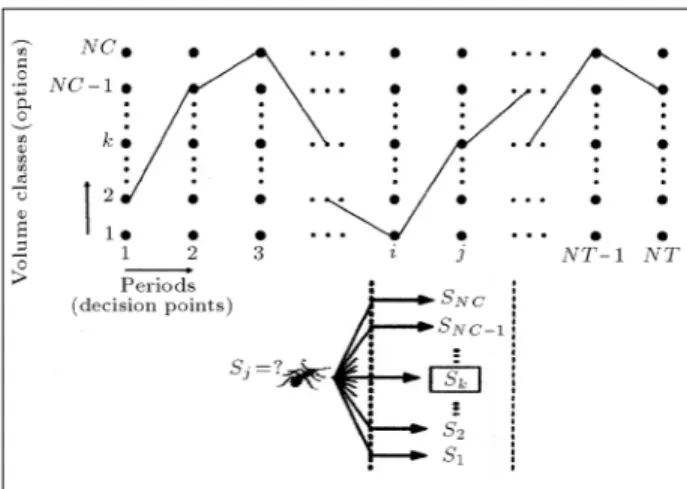
In order to apply ACO algorithms to the optimum reservoir operation problem, it is convenient to see it as a combinatorial optimization problem with the capability of being represented as a graph. The problem may be approached considering a time series of inow, classifying the reservoir volume to several intervals and deciding for releases at each period, with respect to an optimality criterion. As depicted in Figure 1, links between initial and nal storage volumes at entire periods form a graph which represents a feasible solution.
The heuristic value of this problem is dened as minimum square deviation from target demand, which is an indicator of the objective value as employed in the transition rule (Equations 1 and 2):
ij(
t) = 1=([R ij(
t) D(t)]
2+
c); (5)
where R ij(
t) is release at period t (provided that the
initial and nal storage volume are at classes i and j, respectively); D(t) is demand of period t and c
is a constant to avoid irregularity (dividing by zero in Equation 5). To determine R
ij(
t), the continuity
equation, along with the following constraints, may be employed as:
R ij(
t) =S i
S j+
I(t) LOSS ij(
t); (6a)
SminS i
Smax; (6b)
SminS j
Smax; (6c)
S1=S NT+1
; (6d)
where S i and
S
j are the initial and nal storage
volumes (class iandj), respectively;I(t) is the inow
to the reservoir at time periodt; LOSS ij(
t) is the loss
(e.g., evaporation) at periodt, provided that initial and
nal storage are at classes i and j, respectively; Smin
Figure 1.
Decision graph of ACO algorithm for optimum reservoir operation problem.andSmax are the minimum and maximum storage
al-lowed, respectively, andNT is total number of periods.
The proposed model takes \end-of-period storage" as decision variables. Therefore, the release associated with S
i and S
j may easily be determined using the
continuity equation, as dened by Equation 6a. Using the transition rule (Equations 1 and 2), each ant is free to choose the class of nal storage (end-of-period storage), if it is feasible through the continuity equation and storage constraints (Equations 6). In another words, selection of pathij at time periodt will result
in releaseR ij(
t), according to the continuity equation,
as dened by Equation 6a. Selection of path ij is
permitted, if, and only if, end-of-period storage (i.e.,
S
j) satises Constraints 6a and 6b and the resulted
release,R ij(
t), is positive. Otherwise, option j is not
feasible and may not be taken at periodt by antk.
The tness function is a measure of the goodness of the generated solutions, according to the dened objective function. For this study, tness function is dened as the Total Square Deviation (TSD) from the target demand:
TSDk =
NT
X t=1
R k(
t) D(t) 2
; (7)
where R k(
t) is release at period t recommended by
antk.
Jalali et al. [13] showed that from three dierent ACO algorithms, namely: the Ant System (AS), the Ant Colony System-Iteration Best (ACSib) and the
Ant Colony System-Global Best (ACSgb), the ACSgb
provides better solutions compared to two others, as applied to a reservoir management problem. In this research, 3 improved versions of ACSgb are introduced
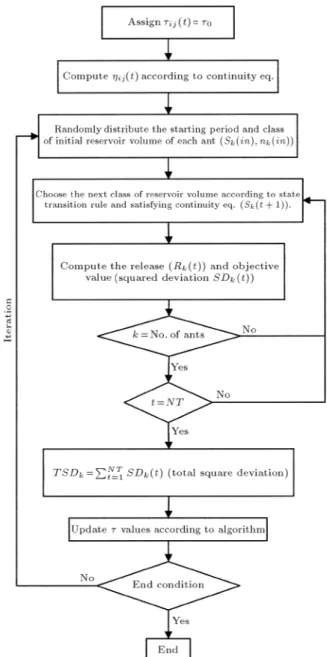
and tested. A simple ow diagram of the proposed ACO algorithm for the optimum reservoir operation is depicted in Figure 2.
IMPROVED ACO ALGORITHM IN
RESERVOIR OPERATION
As mentioned in Equation 1, a three-dimensional (3D) pheromone,
ij(
t), being dened as the total
pheromone deposited on pathij at time periodt, may
cause a dimensionality problem in large scale and/or multi-reservoir problems. In order to reduce the extent of the dimensionality problem, one may assign the pheromone to options, rather than paths. In this case, a two-dimensional (2D) pheromone,
i( t), may
be dened as the pheromone deposited at optioniand
time periodt. Now, Equations 1 and 2 may be modied
for the new scheme, as follows:
P ij(
t) = (
[ j(
t+1)] [
ij(
t)] PNC
l=1[
l( t+1)]
[
il( t)]
if j2N
k( t)
0 otherwise ; (8)
Figure 2.
ACO algorithm for optimum reservoir operation.j= 8 < :
arg max
l2Nk(t) n
[ l(
t+1)]
[ il(
t)]
o
ifqq0
J otherwise
:
(9) To improve the convergence of the results, Pheromone Promotion (PP) is introduced as a new approach. Due to pheromone deposition and evaporation (Equation 3), a rapid convergence syndrome or stagnation problem may prevail, if no improvement is gained after a few iterations. Now, if a new solution with an improved objective value is identied, its pheromone must be promoted to the maximum existing pheromone con-centration (i.e., available global best solution). If the existing pheromone concentration is very low, such an improved solution may not be desirable for the agents to follow. Therefore, to reduce the possibility of facing
a stagnation problem, pheromone concentration,, for
all new paths with better objective value, must be promoted.
Under some circumstances, pheromone evapora-tion may eventually eliminate a soluevapora-tion with some locally positive decision elements. To minimize this possibility, an anti-pheromone approach was proposed by Montgomery and Randall [7]. In one of the anti-pheromone approaches, Explorer Ants (EA) are assigned to explore inferior paths randomly, to nd out paths with insignicant pheromone and reasonable performance. With this approach, one may regenerate solutions that have locally lost their pheromone, due to evaporation during the last iterations. Assigning some explorer ants at each iteration, they may take their paths, as follows:
P ij(
t) = 8 > < > :
[max j( t+1)] [ ij( t)] NCP l=1
[max l( t+1)] [ il( t)]
ifj 2N k( t) 0 otherwise ; (10) j= 8 > > < > > : arg max l2N k( t) n
[max l(
t+ 1)] [ il( t)] o
ifqq0 J otherwise
;
(11) wheremax is maximum value of, realized during the
last iterations.
In some circumstances, A Local Search (LS) approach may cause a signicant improvement in the nal results, if employed after each iteration. In this approach, which is, more or less, similar to crossover in genetic algorithms, one, or a few, sections of the generated solutions after each iteration are exchanged. As an example, in a 3-opt local search algorithm [12], two elements from two dierent solutions are exchanged randomly, which result in two new solutions. In the present work, one of the solutions for a local search application is the present best solution and the other one selected randomly.
Finally, integration of the local search, explorer ants and pheromone promotion may facilitate the convergence of the scheme, as well as improve the nal results. In fact, explorer ants may generate a string of solutions with relatively low total pheromone concentration, which is an indication of a solution with low desirability. However, within such an undesirable string, some local sections may exist that reveal low pheromone concentration, which might make some other solutions more desirable, if they were substi-tuted in those solutions. Combinations of a local search with explorer ants provide such a possibility and minimize the chance of losing good pieces of information.
MODEL APPLICATION
To illustrate the performance of the proposed model, the Dez reservoir in southern Iran, with an eective storage volume of 2,510 MCM and average annual demand of 5,900 MCM, is selected. For illustration purposes, a period of 60 months, with an average annual inow of 5,303 MCM, is employed. The reservoir volume is divided into 14 classes, with 200 MCM intervals. To limit the range of values of the tness function, a normalized form of Equation 7 has been used as follows:
TSDk =
NT X t=1 (R k(
t) D(t))=Dmax 2
; (12)
where Dmax is maximum monthly demand. To make
the results at dierent runs comparable, initial and ending storages were xed at 1430 MCM for all runs. Therefore, the starting point for all ants was xed at the rst period with an initial storage volume of 1430 MCM. Feasible paths for the ants to follow are constrained by the continuity equation and the minimum and maximum permitted storage volume (Equations 6).
Due to the limited number of iterations (i.e., end condition criteria) and presence of the random parameter, q, in the transition rule (Equation 2), the
nal results for the dierent runs may not be the same. Therefore, the model so developed was tested with 10 dierent runs. In order for results to be comparable, the total number of ants (M) assigned to
the problem was 100, with = 0:1,= 1, = 4 and q0= 0:9, as proposed by Jalali et al. [13]. To start with,
the pheromone was uniformly distributed all over the dened paths (i.e., 0 = 1). To normalize the value of
the heuristic function, parameter c was chosen to be
unity (Equation 5). The total number of iterations at each run was limited to 500.
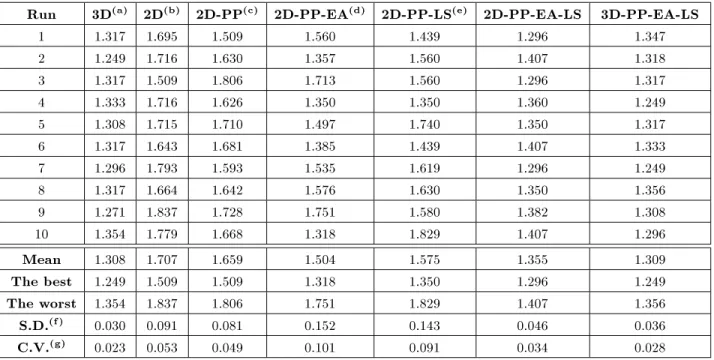
Results of the model for dierent improved algo-rithms are presented in Table 2. Mean values of the objective function at each iteration for 10 dierent runs are illustrated in Figure 3. As is clear, by reducing the dimension of the pheromone from
ij to
i, inferior
results are obtained. In this case, the TSD for the best result and its mean value for 10 runs exceeds those of
ij by 20% and 30%, respectively.
To improve model performance, Pheromone Pro-motion (PP), Explorer Ants (EA) and Local Search (LS) operators were included in the proposed algo-rithm. The mean value of TSD for 10 runs at each it-eration for dierent versions of the improved algorithm is depicted in Figure 3 and Table 2. One may note that the pheromone promotion is a great contribution to model convergence. Individual inclusion of explorer ants and local search have improved the best result and
Table 2.
Total Square Deviation (TSD) from target demand of 10 runs of several improved ACO algorithms in reservoir operation problem.Run
3D
(a)2D
(b)2D-PP
(c)2D-PP-EA
(d)2D-PP-LS
(e)2D-PP-EA-LS 3D-PP-EA-LS
1 1.317 1.695 1.509 1.560 1.439 1.296 1.347
2 1.249 1.716 1.630 1.357 1.560 1.407 1.318
3 1.317 1.509 1.806 1.713 1.560 1.296 1.317
4 1.333 1.716 1.626 1.350 1.350 1.360 1.249
5 1.308 1.715 1.710 1.497 1.740 1.350 1.317
6 1.317 1.643 1.681 1.385 1.439 1.407 1.333
7 1.296 1.793 1.593 1.535 1.619 1.296 1.249
8 1.317 1.664 1.642 1.576 1.630 1.350 1.356
9 1.271 1.837 1.728 1.751 1.580 1.382 1.308
10 1.354 1.779 1.668 1.318 1.829 1.407 1.296
Mean
1.308 1.707 1.659 1.504 1.575 1.355 1.309The best
1.249 1.509 1.509 1.318 1.350 1.296 1.249The worst
1.354 1.837 1.806 1.751 1.829 1.407 1.356S.D.
(f) 0.030 0.091 0.081 0.152 0.143 0.046 0.036C.V.
(g) 0.023 0.053 0.049 0.101 0.091 0.034 0.028(a) 3D: Three Dimensional Pheromone; (b) 2D: Two Dimensional Pheromone; (c) PP: Pheromone Promotion; (d) EA: Explorer Ants;(e) LS: Local Search; (f) S.D.: Standard Deviation; (g) C.V.: Coecient of Variation.
Figure 3.
Convergence of several improved ACO algorithms in reservoir operation problem (averaged over 10 runs).their mean values for 10 runs by (13%, 11%) and (10%, 5%), respectively. It is also important to note that the initial rate of convergence improved signicantly, when LS and EA were employed.
Integrating LS and EA in the algorithm has signicantly increased the initial and nal rate of convergence, as well as resulting in highly improved results. In this case, the best result and mean value for 10 runs show 14% and 19% improvement, respectively, over only pheromone.
To compare the performance of the proposed improved ACO algorithm with that of the Genetic
Figure 4.
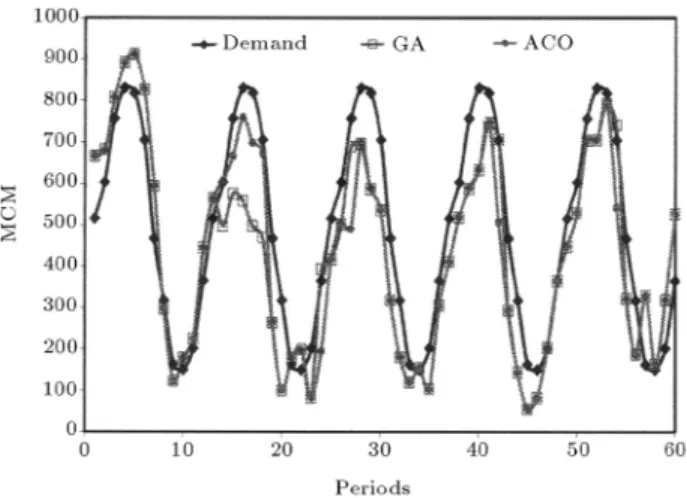
Evolution of the total square deviation from target demand resulted from genetic algorithm.Algorithm (GA), the same model was solved using the Fast Messy genetic algorithm of Boulos et al. [14]. For a population size of 100 and a 2000 generation, using the best combinations of crossover and mutation probability and by employing a real value coding, a TSD of 1.38 was achieved. Results of the GA model at each generation for the problem under consideration are depicted in Figure 4. As is clear, the results of the proposed ACO algorithm, integrated with PP, EA and LS for 500 iterations and an agent size of 100, show, approximately, a 6 percent improvement over that of GA, with 2000 generations and 100 populations. Periodic reservoir release values resulted from ACO
Figure 5.
Reservoir release values resulted from GA and ACO models compared to demand series.and GA compared to demand series are depicted in Figure 5.
In order to examine the eect of three-dimensional pheromone (i.e., assigning pheromone to path ij), the
same problem was solved integrating PP, EA and LS operators in a 3D pheromone. Comparing the results with those of 2D-PP-EA-LS, an improvement of 3.5 percent in the best result and mean value for 10 runs was achieved, which may not be justied on a large scale or in multi-reservoir problems. Even though the best result and average value for 10 runs in simple 3D and 3D-PP-EA-LS are the same, integration of PP, EA and LS has signicantly improved the initial convergence. As an example, in the rst 40 iterations, the rate of convergence has increased by more than 12 percent.
CONCLUDING REMARKS
While walking from one point to another, ants deposit a substance called pheromone, forming a pheromone trail. It has been shown, experimentally [4], that this pheromone trail, once employed by a colony of ants, can give rise to the emergence of a shortest path. In general, the amount of pheromone deposited by an articial ant is made proportional to the goodness of the solution an ant may build. To apply ACO algorithms to the reservoir operation problem, one may view it as a combinatorial optimization problem. The problem may be approached by considering a time series of inow, classifying the reservoir volume to several intervals and deciding on the release at each period, with respect to an optimality criterion. Feasible paths for ants to follow may be constrained by the continuity equation, as well as constraints on the storage volume. Upon each tour completion, a nite number of feasible solutions will form, leaving a new value for the pheromone.
Realizing the values of the tness function, the
pheromones will be updated by a global update rule. The inclusion of Explorer Ants (EA) and a Local Search (LS), along with a new operator called Pheromone Promotion (PP), improves the performance of the classic ACO signicantly. The improvement includes the nal result, as well as the initial and nal rate of convergence. Application of the proposed model to the Dez reservoir in Iran provided promising results. From three dierent pheromone updating algorithms (i.e., Ant System, Ant Colony System-iteration best and Ant Colony System-global best), the ACSgb was
employed in this research, which includes explorer ants, pheromone promotion and local search operators. Results of the model compare well with those of the GA and global optimum. As for any search method, the performance of the proposed model is quite sensitive to setup parameters, hence, ne tuning of the parameters is recommended.
NOMENCLATURE
pheromone persistence coecient P
ij(
t) transition probability from optionito
optionj at time periodt
ij(
t) total pheromone deposited on pathij
at timet
ij(
t) the heuristic value of pathij at timet ; parameters that control the relative
importance of the pheromone trail versus a heuristic value
q a random variable uniformly
distributed over [0,1]
q0 a tunable parameter2[0;1] 0 initial value of pheromone k
gb the ant with the best performance
within the past total iterations
G k
g b value of the objective function for the
ant with the best performance within the past total iterations
R ij(
t) release at periodt D(t) demand of periodt c a constant
S storage
I(t) inow to the reservoir at time periodt
LOSSij(
t) loss (e.g., evaporation) at period t
provided that initial and nal storage are at classesi andj, respectively Smin minimum storage allowed
Smax maximum storage allowed NT total number of periods
R k(
t) release at period t recommended by
antk
Dmax maximum monthly demand
max maximum value of realized during
the last iterations
REFERENCES
1. Colorni, A., Dorigo, M. and Maniezzo, V. \Distributed optimization by ant-colonies", Proc., 1st European Conf. on Articial Life (ECAL'91), Cambridge, MIT Press, Mass, USA, pp 134-142 (1991).
2. Dorigo, M. \Optimization, learning and natural al-gorithms", Ph.D. Thesis, Politecnico di Milano, Italy (1992).
3. Deneubourg, J.L., Pasteels, J.M. and Verhaeghe, J.C. \Probabilistic behavior in ants: A strategy of errors?",
J. Theoretical Biology,
105
, pp 259-271 (1983). 4. Dorigo, M., Maniezzo, V. and Colorni, A. \The antsystem: optimization by a colony of cooperating ants",
IEEE Trans. Syst. Man. Cybern.,
26
, pp 29-42 (1996). 5. Dorigo, M. and Di Caro, G., The Ant Colony Opti-mization Metaheuristic, InNew Ideas in Optimization, D. Corne, M. Dorigo, and F. Glover, Eds., McGraw-Hill, London, UK, pp 11-32 (1999).6. Dorigo, M., Bonabeau, E. and Theraulaz, G. \Ant al-gorithms and stigmergy",Future Generation Comput. Systems,
16
, pp 851-871 (2000).7. Montgomery, J. and Randall, M. \Anti-pheromone as a tool for better exploration of search space", Pro-ceedings of the Third International Workshop on Ant Algorithms, ANTS 2002, Brussels, Belgium (2002).
8. Montgomery, J. and Randall, M. \Alternative pheromone applications for ant colony optimization",
Technical Report TR02-07, Faculty of Information Technology, Bond University, Australia (2002). 9. Abbaspour, K.C., Schulin, R. and van Genuchten,
M.T. \Estimating unsaturated soil hydraulic param-eters using ant colony optimization", Adv. Water Resour.,
24
(8), pp 827-933 (2001).10. Maier, H.R., Simpson, A.R., Zecchin, A.C., Foong, W.K., Phang, K.Y., Seah, H.Y. and Tan, C.L. \Ant colony optimization for design of water distribution systems",J. Water Resour. Plng. and Mgmt.,
129
(3), pp 200-209 (2003).11. Blum, C. and Roli, A. \Metaheuristics in combinato-rial optimization: Overview and conceptual compar-ison", ACM Computing Surveys,
35
(3), pp 268-308 (2003).12. Dorigo, M. and Gambardella, L.M. \Ant colony sys-tem: A cooperative learning approach to the traveling salesman problem",IEEE Transactions on Evolution-ary Computation,
1
(1), pp 53-66 (1997).13. Jalali, M.R., Afshar, A. and Marino, M.A. \Optimum reservoir operation by ant colony optimization algo-rithms", Iranian Journal of Science and Technology,
30
(B1), pp 107-117 (2006).14. Boulos, P.F., Wu, Z.Y., Orr, C.H. and Ro, J.J. \Least-cost design and rehabilitation of water distribution systems using genetic algorithms."Proceedings of the AWWA IMTech Conference, Seattle, WA, USA (Apr. 16-19, 2000).