An Adaptive Secure Channel Coding Scheme for
Data Transmission over LEO Satellite Channels
A. Payandeh
, M. Ahmadian
1and M.R. Aref
2Both secure and error control coding are very extensive subjects, each with a variety of sub-disciplines. A secure channel coding (joint encryption-channel coding) scheme provides both data secrecy and data reliability in one process to combat problems in an insecure and unreliable channel. In this paper, a joint encryption-channel coding scheme is developed, based on concatenated turbo codes for more ecient and secure transmission of LEO satellite data. Reliability and security are achieved by adapting the pseudo-random puncturing strategy with a change of distance between satellites and ground stations in the communication seance, an issue further burdened by reducing energy consumption or increasing bit rate of data transmission. Simulation results show the relevance and superior performance of the proposed scheme compared with the traditional data transmission system.
INTRODUCTION
Error control and security are both important aspects of modern digital communications and are often used together in one application. The demand for a reliable, secure and ecient digital data transmission system has been accelerated by the emergence of large-scale and high speed communication networks. In recent years, the use of small satellites in Low Earth Orbit (LEO) for remote sensing imagery has been extensive. Remote sensing imagery produces large amounts of data that often need to be secretly and reliably trans-mitted over a band-limited channel.
In 1948, Shannon [1] demonstrated that errors induced by a noisy channel can be reduced to a desired level by proper encoding of the information. Since Shannon's work, a great deal of developments have contributed toward achieving data transmission reliability, so that the use of error control coding has become an integral part in the design of modern communication systems and digital computers. For-ney [2] studied concatenated coding schemes as a class
*. Corresponding Author, Department of Electrical En-gineering, K.N. Toosi University of Technology and Applied Science Research Association (ASRA), Tehran, I.R. Iran.
1. Department of Electrical Engineering, K.N. Toosi Uni-versity of Technology, Tehran, I.R. Iran.
2. Department of Electrical Engineering, Sharif University of Technology, Tehran, I.R. Iran.
of codes whose probability of error decreased expo-nentially at rates less than the capacity, while decod-ing complexity increased only algebraically. Parallel-concatenated convolutional codes (turbo codes) intro-duced in [3] obtained remarkable coding gains close to theoretical limits, yet admitting a relatively simple iterative decoding technique. The recently proposed serial concatenation of interleaved codes may oer a superior performance to that of parallel concatenated codes [4]. In both schemes, the core of the iterative decoding structure is a Soft-Input Soft-Output (SISO) A Posteriori Probability (APP) module [5].
Adding security to channel coding is an attractive topic, as it could reduce the overall processing cost of providing secure encoded data. A secret channel coding scheme is one that provides both data secrecy and data reliability in one process, to deal with problems in an insecure and unreliable channel. Using error-correcting codes as cryptosystems was introduced by McEliece [6]. The McEliece proposal was to use a Goppa code as the underlying basis of an ingenious public-key scheme. The security of this scheme is based on the well known NP-completeness of the decoding problem for general linear codes [7] and the fact that there are a huge number of equivalent Goppa codes with a given set of parameters. Some other public-key cryptosystems, based on algebraic linear codes, are proposed in [8-11]. It is well-known that public-key cryptosystems can be used as private-key cryptosystems. There-fore, Rao and Nam [12] proposed a modication of the McEliece scheme and, subsequently, introduced
a new approach to the private-key algebraic coded cryptosystems requiring simple error-correcting codes. Hwang and Rao [13] then devised a class of private-key cryptosystems, called secret error-correcting codes. However, the problems of requiring large keys for security and existing doubts about the strength of security, in current schemes of combining security and error-correcting codes, have not yet been solved.
During data transmission between the LEO satel-lite and ground station, the distance may change. The LEO satellite data transmitting systems are normally designed for a pre-specied bit error probability, which leads to the worst case of a communications channel (maximum distance and worst environmental condi-tions). This pre-specied bit error probability is a requirement to achieve a desired image quality. The consequence of such design is a wasteful use of system resources. To overcome this problem, one can either save power by reducing the transmission level during favorable channel conditions or increasing the infor-mation throughput by transmitting at a higher rate. While adaptive power control is, at least conceptually, straightforward, adaptive rate control can be achieved by varying the bit rate, the coding rate, the modulation level, or any combination thereof. More advanced schemes were subsequently proposed, based on adap-tation of the data transmission system, in accordance to environmental condition variations [14-17]. In [18], one method was presented, based on an adaptation of channel coding, with the distance between satellite and ground station in the communication zone.
In this paper, an adaptive secure channel coding (adaptive joint encryption-channel coding) scheme is proposed, based on secret puncturing of a (parallel or serial) concatenated code and adaptation with change of distance, to keep the bit error rate at a pre-specied level in the communication zone. The advantages of this scheme are: Achieving good security without requiring a large key and improving the eciency of the data transmission system by adaptation of the coding rate with a change of distance.
The paper is organized as follows. In the following section, after a description of the problem statement, an adaptive joint encryption-channel coding algorithm for secure and ecient data transmission over LEO satellite channels, is proposed and its security level is discussed. Then, computer simulation results of the proposed scheme are given and nally, conclusions are drawn.
PROPOSEDSCHEMESTRUCTURE
Any communication link design between a satellite and a ground station must account for all power losses between transmitting and receiving nodes. Signal-to-Noise Ratio (SNR) in a ground receiver's input is
calculated by [18]: SNR=
P ST
dB+
A+20log(sin) B
sin
10log(BR);
(1) whereP
ST is the satellite transmitter power, BR is the
transmission bit rate,is the elevation angle andAand B are constants, which depend on the environmental
conditions and receiver specications. Therefore, the received SNR for a specied communications system depends on the bit rate, transmission power, environ-mental conditions and distance (elevation angle). LetA
andB be determined for the worst environmental
con-ditions and assume that transmission rate and power are constants in the whole communication seance.
One can see from Equation 1, the distance be-tween the satellite and ground station has a consider-able eect on the performance (bit error rate) of the communication systems. In other words, the distance in LEO satellite conguration changes continuously. To access a desired image quality, a pre-specied bit error probability is enough. If bit error rate is less than a pre-specied value, the quality of the received image will improve, but this quality improvement, in practice, is not used. Therefore, designing the on-board data transmission system for the worst case of a channel, leads to a wasteful use of communication system resources. On the other hand, data con-dentiality in satellite systems is usually an important issue. To overcome these problems, it is useful to use a combination of adaptive channel coding and encryption. Combining these two steps into one may result in faster and more ecient implementation. A secure channel coding scheme is one that provides both data secrecy and data reliability in one process.
As a powerful coding technique, (parallel or serial) concatenated codes have been proposed for any com-munication system where a signicant power saving is required or the operating signal to noise ratio is very low, such as in deep space and satellite communication systems. Performance of turbo codes depends on the selection of component codes, as well as the interleaver structure. The criteria for selection of component codes have been discussed in [4,19] and several interleaver structures have been presented in [3,20,21]. A union bound of bit error probability for turbo codes was obtained in [22]. Since the \error-oor" portion of the Bit Error Rate (BER) curves is very time consuming to simulate, an estimated error-oor bound (free-distance asymptote) for the BER, over Additive White Gaussian Noise (AWGN) channels, is given by:
P b(
e)
= N free
W free K
Q r
2d free
R E
b N
0 !
; (2)
whered
freeis the free distance of the code, N
freeis the
number of code words with output weight d free,
W free
represents the weight of input sequence associated with output weightd
free,
K is the input block length andR
is the code rate.
From Equation 2, it is observed that the BER for a specic concatenated code depends on code rate, transmission power and channel conditions. By substituting Equation 1 into Equation 2, one obtains the following:
P b(
e)
= N free
W free K
Q r
2d free
P ST
BW
BR2 10 A 10 h
R()sin 2(
)10 B 10sin()
i !
;
(3) where BW is the transmission bandwidth. For access to a given bit error probability in the whole com-munication seance with constant transmission power, the code rate must be varied, in accordance with the elevation angle (distance). The distance between the satellite and the ground station varies continuously. Therefore, one will need an error-correcting code with a continuous code rate variation. One method can be realized by using a lookup table of many nearly optimal codes with various code rates, and selecting a suitable code, according to the distance. The implementation cost of this method is very high. Hence, an adaptive secure punctured turbo coding scheme is proposed, whose puncturing rate can be changed with distance, so that the bit error probability is kept at a pre-determined value.
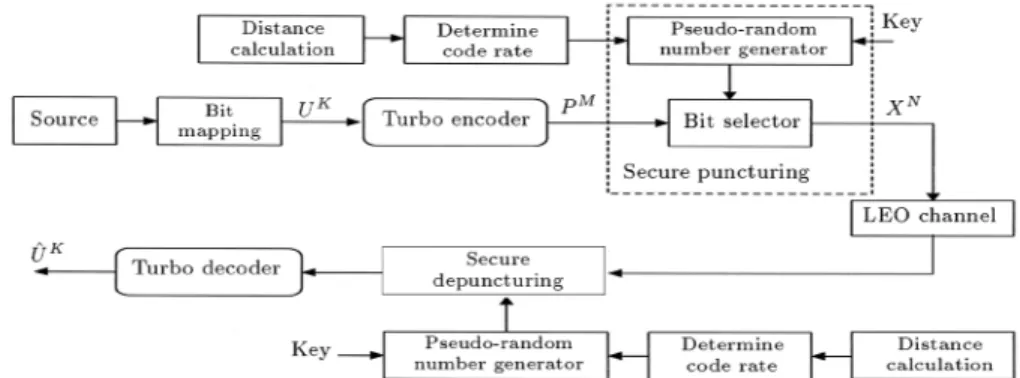
Figure 1 displays the adaptive secure channel coding scheme. Each symbol of the source is rst mapped to a binary sequence. A turbo encoder then takes a block, U
K, of information bits and delivers a
block,P
M, of code bits, which is punctured to achieve
the transmitted code word,X
N. The distance between
the LEO satellite and the ground station is measured at the receiver and the transmitter instantaneously. The transmitter uses this information to adjust its appropriate puncturing rate block-by-block. When the distance is longer, the transmitter picks more
redundant bits for protection. Therefore, the overall throughput is low. As the distance gets shorter, less redundancy is needed for protection. Hence, a higher throughput is achieved. The error rate of the channel will depend on the SNR at the receiver, the code rate and the complexity of the channel code.
The puncturing device selects N bits from M
turbo-encoded bits, using N independent
pseudo-random numbers over [1;M]. Therefore, it punctures
each encoded bit independently, with probability =
1 N
M. If a codeword of weight
denters the puncturing
device, the codeword at the output will have a weight,
h, with probability
c d
(1 ) h
d h. The expected
number of punctured codewords of weight,h, is given
by:
A C
P h =
X dh
A C d
d h
(1 ) h
d h
; (4)
where A C
d is the average number of unpunctured code
words of weight d. For an (N;K) binary linear code, C, with the weight enumerator,A
C
h, one has the well
known union-Bhattacharyya bound on the Maximum Likelihood (ML) decoder word error probability [23]:
P w(
e) N X h=1
A C h
h
; (5)
whereis the Bhattacharyya noise parameter. By
ap-plying Equation 4 in the above bound in Expression 5, one has:
P w(
e) N X h=1
A C d
d h
(1 ) h
d h
h
: (6)
It was shown in [23] that for a turbo code, A 0 =
limsupN!1max d
free <hN
logA C h
h is a nite positive
number. Therefore, it can be seen that on a mem-oryless channel with Bhattacharyya parameter <
exp A 0+ log
1
, P w(
e) goes to zero as N
in-creases.
In order to study the security of the system, one needs to determine, essentially, how dicult it is for an eavesdropper who doesn't know the key of the pseudo-random number generator and intercepts
X
N to determine U
K. The security of this system is
based on two computationally hard problems, which are an exhaustive search on the key space and the turbo decoding of a random punctured sequence. It appears that an eavesdropper uses two basic attacks: Decoding attacks and trapdoor attacks.
In decoding attacks, the attacker may try to recover the plaintext, U
K, directly from intercepted
ciphertext X
N. In the case of a successful decoding
attack, the plaintext is recovered but the cryptosystem remains intact. The basic problem to be solved is turbo decoding a punctured sequence without know-ing the puncturknow-ing pattern. For each turbo-encoded sequence, one has a set of (M)
N = M!
(M N)!
punc-tured sequences. If the length of the turbo-encoded block, (M), is suciently large, then, this attack will
also be infeasible. Suppose M = 1000 and N =
400 are chosen, then, there will be about
M N
=
p 2MM
M 2
p
N(M N)N N
(M N) M N
= 10292possible puncturing
patterns. For longer block lengths, the complexity of decoding without knowing the puncturing pattern is much greater.
In trapdoor attacks, the cryptanalyst may try to nd the key of the pseudo-random number generator from an intercepted ciphertext (cipher text-only at-tack) or U
K and X
N pairs (known/chosen-plaintext
attack). In a ciphertext-only attack, the attacker is assumed to have several ciphertexts and tries to guess the key by a brute-force search. In known/chosen-plaintext attacks, the attacker is assumed to have obtained several plaintext and ciphertext pairs (all of these pairs share a common key) and tries to analyze these pairs to obtain the common key. There are sev-eral types of cryptanalytic known/chosen-plaintext at-tacks against algebraic-code cryptosystems, discussed in [24,25]. These attacks are performed, based on the linearity of the system. They will not be applicable for nonlinear coding scheme. Therefore, the trapdoor attacks seem to be hopeless if the structure of the pseudo-random number generator is nonlinear and its period is suciently large, because there are so many possibilities for the key. In particular, suppose a nonlinear feedback shift register of length n = 100 is
chosen, then, there will be about 22 n
= 22 100
possible keys.
These attacks are performed under the assump-tion that there is no occurrence of error in the channel. The presence of channel errors introduces an additional level of data security to this system.
Compared with the conventional methods, such
as a combination of turbo coding and an Advanced Encryption Standard (AES) cryptosystem, this scheme has the advantages of: High-speed encryption and decryption with high security, smaller encoder and decoder size and greater eciency. In a conventional method, if there is even a single error in the received ciphertext (after channel decoding), there will be a huge number of errors in the decrypted plaintext, whereas, in the proposed scheme, it is not so. Also, for an adaptation code rate, according to the distance in conventional methods, the appropriate puncturing patterns have to be saved. Therefore, a very high memory is needed.
SIMULATION RESULTS
To underline the eectiveness of the proposed secure channel coding scheme for a LEO satellite channel, an onboard data transmission system is designed for a practical example. The main parameters of the system are: f = 1:7 GHz,G
SA = 2 dB (satellite transmitter
antenna gain),G
EA= 29 dB (ground station antenna
gain), T = 600 sec (duration time), H = 850 km
(orbital height), BPSK Modulation, 10
170
(elevation angle),V 0= 3
:1810
9bit (total transmitted
data in one communication seance),P b(
e)10 6 and
SNR= P
STdB+71
:2+20log(sin)+ 0:74
sin 10log(BR).
The calculated values of the transmission rate and power for the basic data transmission system are:
BR0= 5
:3 Mbps P
b( e)10
6
!SNR
= 10dB!P ST0
= 49 w:
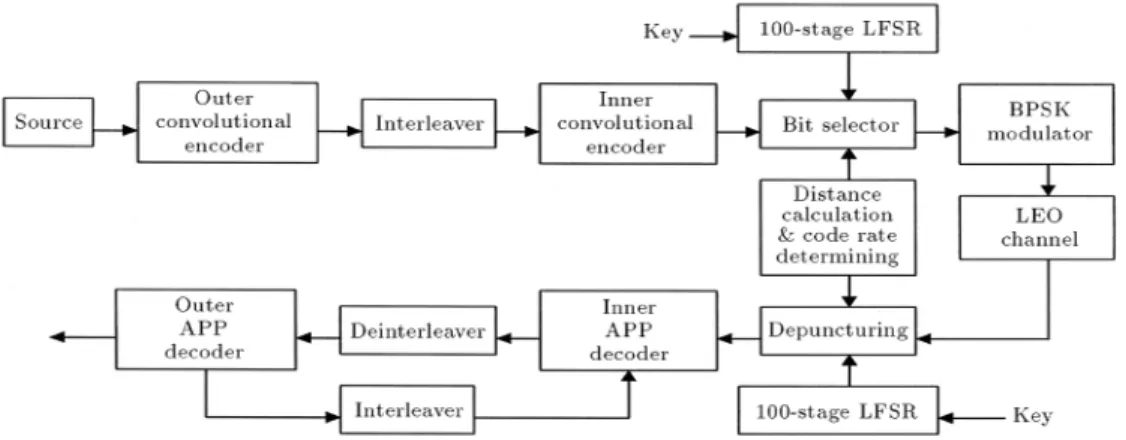
Figure 2 displays a proposed coding scheme for the improved data transmission system. Each block of satellite data is encoded, using a serially concatenated turbo code, formed by an outer 4-state recursive systematic conventional code with:
G outer(
D) = h
1 1+D 2 1+D+D
2 i
;
and an inner 4-state recursive systematic conventional code with:
G inner(
D) = "
1 0 1+D 2 1+D+D
2
0 1 1+D 1+D+D
2 #
:
The size of the source block for turbo coding is K =
1024. For simplicity, a 100-stage Linear Feedback Shift Register (LFSR) is used for a pseudo-random number generator. The BPSK-modulated punctured signals are transmitted through a LEO satellite channel. At the receiver, the depuncturing process is done with permuting symbols in the received block, based on a secure key and substituting zero values for punctured
Figure 2. A simulated secure serially concatenated coding scheme for LEO satellite data transmission system.
bits. Details of serially concatenated turbo decoding are explained in [4,26,27]. The performance (punctur-ing rate allocation versus dierent SNRs) of this secure serially concatenated turbo code forP
b( e)
= 10 5 and P
b( e)
= 10 6 is given in Figure 3. It can be observed
that the maximum code rate is about 0.84. The values of the transmission rate and power for the improved data transmission system can be calculated by knowing the total transmitted data,V =V
0: V =
Z T 0
BRR()dt: (7)
Therefore, forV = 3:1810
9 bits and P
b( e)
= 10 6,
the calculated values for an improved data transmis-sion system (Figure 2), based on this secure serially concatenated code, are:
BR= 8
:93 Mbps; P
ST
= 11:9 w:
Figure 4 shows the bit error rates versus the eleva-tion angle for basic and improved data transmission
Figure3. Code rate versus SNR for simulated secure
serially concatenated code.
Figure 4. Bit error rates versus elevation angle for the
basic and improved data transmission systems.
Table 1. Performance comparison of the basic and
improved data transmission system.
Type PST (w) BR(Mbps) V (bits)
Basic System 49 5.3 3:1810 9
Improved System 11.9 8.93 3:1910 9
systems. As one can see from Figure 4, the BER is approximately constant at dierent distances. A comparison of basic and improved systems is given in Table 1. For V
= V
0, the improved system provides
about 75.7% enhancement in onboard consumption energy, compared to the basic system. The BER value can be changed by changing the puncturing rate value.
CONCLUSION
A secure channel coding scheme combines data en-coding and data encryption into one process. In this paper, an adaptive secure channel coding scheme for more ecient transmission data over the LEO satellite channels is presented. This scheme is based on adaptive and pseudo-random puncturing of the turbo-encoded
block. The puncturing rate in this scheme is selected in proportion to the distance between the LEO satellite and ground station.
Two cryptoanalytical attacks against this scheme are investigated. It would be a challenge, indeed, to nd cryptoanalytic attacks that can break this system. Simulation results show that one can obtain an ecient data transmission system, with good reliability and security, by using this scheme.
REFERENCES
1. Shannon, C.E. \A mathematical theory of communi-cation",Bell Systems Technical Journal,7, pp 379-423
(Part I) and 623-656 (Part II) (1948).
2. Forney Jr., G.D., Concatenated Codes, MIT Press, Cambridge, MA, USA (1966).
3. Berrou, C., Glavieux, A. and Thitimajshima, P. \Near Shannon limit error-correcting coding and decoding: Turbo-codes", inProc. ICC'93, Geneva, Switzerland, pp 1064-1070 (May 1993).
4. Bennedetto, S., Divsalar, D., Montorsi, G. and Pollara, F. \Serial concatenated of interleaved codes: Perfor-mance analysis, design, and iterative decoding",IEEE Trans. on Information Theory,44(3), pp 909-926 (May
1998).
5. Bahl, L.R., Cocke, J., Jelinek, F. and Raviv, J. \Op-timal decoding of linear codes for minimizing symbol error rate",IEEE Trans. Information Theory,IT-20,
pp 284-287 (1974).
6. McEliece, R.J. \A public-key cryptosystem based on algebraic coding theory",JPL DSN Progress Rep. 42-44, pp 114-116 (Jan.-Feb. 1978).
7. Berlekamp, E.R., McEliece, R.J. and Van Tilborg, H.C.A. \On inherent intractability of certain coding problems", IEEE Trans. Information Theory, IT-24,
pp 384-386 (1978).
8. Niederreiter, H. \Knapsack-type cryptosystems and algebraic coding theory", Problems of Control and Information Theory,15(2) (1986).
9. Gabidulin, E.M. \Ideals over a non-commutative ring and their applications in cryptography",Lecture Notes in Computer Science,547, Proc. Eurocrypt 91,
Springer Verlag (1991).
10. Gabidulin, E.M. \On public-key cryptosystems based on linear codes: Eciency and weakness",Codes and Ciphers, Proc. 4th IMA Conference on Cryptography and Coding(1993).
11. Sidelnikov, V.M. \A public-key cryptosystem based on binary Reed-Muller codes",Discrete Mathematics and Applications,4(3) (1994).
12. Rao, T.R.N. and Nam, K.H. \A private-key algebraic-coded cryptosystem", Proc. Crypto'86, pp 35-48 (1986).
13. Hwang, T. and Rao, T.R.N. \Secret error-correcting codes (SECC)",Proc. Crypto'88, pp 540-563 (1988). 14. Ue, T., Sampei, S., Morinaga, N. and Hamaguchi, K.
\Symbol rate and modulation level-controlled adap-tive modulation/TDMA/TDD system for high bit rate wireless data transmission",IEEE Trans. Vehicel Technology,47, pp 1134-1147 (Nov. 1998).
15. Lim, C.H. and Cio, J. \Performance of the adaptive rate MQAM with on/o power control", IEEE Com-munication Letters,5, pp 16-18 (Jan. 2001).
16. Stojanovic, M. and Chan, V. \Adaptive power and rate control for satellite communications in Ka band",
IEEE International Conference on Communications (ICC'02), New York, USA (May 2002).
17. Mehta, M., Nunn, D. and Braithwaite, S. \Predictive action power control scheme for a land mobile satellite system", Research Journal, University of Southamp-ton, pp 33-36 (1995/6).
18. Payandeh, A., Ahmadian, M. and Aref, M.R. \A novel joint source-channel coding scheme for image transmission over the LEO satellite channel", 2nd Asian Space Conference (ASC), Hanoi, Vietnam (8-11 Nov. 2005).
19. Divsalar, D. and Pollara, F. \On the design of turbo codes",The Telecommunication and Data Acquisition Progress Report, Jet Propulsion Laboratory, pp 99-121 (Nov. 1995).
20. Berrou, C. and Glavieux, A. \Near optimum error correcting coding and decoding: Turbo codes", IEEE Trans. on Communications, 44(10), pp 1261-1271
(Oct. 1996).
21. Divsalar, D. and Pollara, F. \Multiple turbo codes for deep-space communication", The Telecommunication and Data Acquisition Progress Report, Jet Propulsion Laboratory, pp 66-77 (May 1995).
22. Divsalar, D., Dorlinar, S. and McEliece, R.J. \Trans-fer function bounds on the performance of turbo codes",The Telecommunications and Data Acquisition Progress Report, TDA PR 42-122, pp 44-55 (1995). 23. Jin, H. and McHliece, R.J. \Coding theorems for turbo
code ensembles",IEEE Trans. on Information Theory,
48, pp 1451-1461 (June 2002).
24. Nam, K.N. \Complexity analysis of algebraic-coded cryptosystems", PhD Dissertation, Tech Report NSA-1-85, The Center for Advanced Computer Studies, University of Southwestern (June 2006).
25. Chabaud, F. \On the security of some cryptosystems based on error-correcting codes", inAdvances in Cryp-tology (EUROCRYPT'94), 0950 of Lecture Notes in Computer Science, Springer-Verlag, USA (1994). 26. Benedetto, S. and Montorsi, G. \Iterative decoding of
serially concatenated convolutional codes",Electronic Letters,32(13), pp 1186-1187 (June 1996).
27. Payandeh, H. \An improved secure and ecient coding system for remote sensing satellite", PhD Thesis, K.N. Toosi University of Technology, to be published.