Identifying culturally significant areas for marine spatial planning
Kira Geea*, Andreas Kannena, Robert Adlamb, Cecilia Brooksc, Mollie Chapmand, Roland Cormiera, Christian Fischera, Steve Fletchere, Matt Gubbinsf, Rachel Shucksmithg, Rebecca Shellockh *
corresponding author a
Helmholtz Zentrum Geesthacht, Max-Planck-Str. 1, 21502 Geesthacht, Germany, [email protected], [email protected], [email protected], [email protected]
b
Mount Allison University, 144 Main Street, Sackville, NB, E4L 1A7, Canada, [email protected] c
Fredericton, New Brunswick E3A 5R7, Canada d
Institute for Resources Environment and Sustainability, Institute for Resources Environment and Sustainability, Aquatic Ecosystem Research Laboratory, 429-2202 Main Mall, University of British Columbia, Vancouver, B.C., Canada, V6T 1Z4, [email protected]
e
United Nations Environment Programme - World Conservation Monitoring Centre (UNEP-WCMC), Cambridge, CB3 0DL, UK, and Centre for Marine and Coastal Policy Research, School of Marine Science and Engineering, Plymouth University, Plymouth, PL4 8AA, UK, [email protected]
f
Marine Scotland Science, Marine Scotland Science, Marine Laboratory, PO Box 101, 375 Victoria Road, Aberdeen, AB11 9DB, UK, [email protected]
g
NAFC Marine Centre, University of the Highlands and Islands, Port Arthur, Scalloway, Shetland Shetland, ZE1 0UN, UK, [email protected]
h
Plymouth Marine Laboratory, Plymouth, PL1 3DH, UK, [email protected] *2 Title Page with all author info
Highlights
Cultural values are often neglected in marine spatial planning.
A key challenge is to identify cultural values and to link them to specific places. Five criteria are proposed for defining “culturally significant areas” for MSP.
A community-based approach is needed when working with cultural values in MSP. Highlight (for review)
1
Identifying culturally significant areas for marine spatial planning
Abstract
Despite the growing recognition of their importance, immaterial cultural values associated with the sea still tend to be neglected in marine spatial planning (MSP). This socio-cultural evidence gap is due to inherent difficulties in defining and eliciting cultural values, but also to difficulties in linking cultural values to specific places, thus enabling an area-based approach to management. This paper addresses three aspects that are important for including marine cultural values in MSP: Defining cultural values, identifying places of cultural importance, and establishing the relative significance of places of cultural importance. We argue that common classification schemes such as cultural ecosystem services can be a helpful starting point for identifying cultural values, but only go so far in capturing communities’ cultural connections with the sea. A method is proposed for structuring a community-based narrative on cultural values and “spatialising” them for MSP purposes, using five criteria that can lead to the definition of “culturally significant areas”. A baseline of culturally significant areas is suggested as an aid to planners to pinpoint places where cultural connections to the sea are particularly strong. Throughout, we emphasise the need for participative processes.
Keywords
Marine spatial planning, socio-cultural values, culturally significant areas, participatory approach
1. Introduction
Supported by the introduction of the EU MSP Directive in 2014, maritime/marine spatial planning1 (MSP) is gaining increasing prominence in Europe as an integrated approach to marine management (Douvere & Ehler, 2007; Ehler & Douvere, 2009; Jay, 2010; Kannen, 2012). As a “process by which the relevant (…) authorities analyse and organise human activities in marine areas to achieve ecological, economic and social objectives" (EPC, 2014), the overall aim of MSP is to contribute to a more balanced and sustainable use of ocean resources, making use of spatial designations such as priority areas or restricted areas to decide which outputs are to be produced from a marine area over time (UNESCO-IOC, online). The development of a marine plan, and with this the development of spatial priorities, is thus a normative process which must carefully negotiate potentially competing interests. In doing so, MSP crucially relies on evidence and the ability to express such evidence – and the decisions that result - in a spatially explicit way.
While the ecological and economic evidence base for MSP tends to be relatively well developed, this cannot be said for socio-cultural values associated with the sea, understood here as mainly
1 We use the terms marine and maritime spatial planning interchangeably in this paper, although we are aware of the subtle differences in meaning. The term “marine” is arguably more strongly associated with the marine environment and “maritime” with marine activities and uses, although in planning practice, “marine spatial planning”, “maritime spatial planning” and “marine planning” are all used to describe similar processes. The EU uses “maritime spatial planning” to describe a holistic approach to managing when and where human activities take place at sea to ensure these are as efficient and sustainable as possible; this common practice is what we are referring to here. (http://ec.europa.eu/maritimeaffairs/policy/maritime_spatial_planning/index_en.htm, accessed 27 September 2016)
*3 Manuscript (without Title Page) Click here to view linked References
2
immaterial values placed on the environment by people2. Their neglect in MSP runs counter to the growing recognition of their importance. Immaterial cultural values have been shown to generate sense of place and identity (MacKinnon & Brennan, 2012; Ratter & Gee, 2012; Gee, 2010), and there is strong evidence that they contribute to delivering high level objectives for the sea, in particular social objectives related to perceived quality of life and human well-being (Busch et al., 2011; Summers et al., 2012; Jobstvogt et al, 2014; Church et al., 2014). At the same time, cultural values and their associated benefits can be threatened by changing marine activities. Disregarding them in MSP therefore restricts the choices available to communities and wider communities of interest and may lead to the irrevocable loss of key marine benefits.
There are several reasons why cultural values have not been more widely included in MSP. The most obvious is that contrary to the land (Van Berkel & Verburg, 2012) many resist spatial delineation in the sea (Guerry et al., 2012), rendering them difficult to link to spatial concepts such as zoning. Some marine plans3 attempt to resolve this by referring to archaeological sites, historic assets, seascape character areas or other designated sites as expressions of cultural values. This approach, however, does not account for the fact that non-designated assets may be of equal importance to communities, that designated sites may insufficiently reflect the full range of cultural values; and that merely recognising sites as such gives insufficient consideration to the benefits obtained from them and the spatial implications of these.
But the reasons for the cultural evidence gap in MSP go deeper. There is also an awareness gap with respect to the cultural benefits the sea offers to communities (Fletcher et al., 2011; Jefferson et al., 2015). Marine areas do not commonly "engender the deep cultural, historical and emotional attachment and sense of place that are highly developed in landward environments (...)" (Kidd & Ellis, 2012 p.51); nevertheless, user groups such as fishermen do have a highly intimate relationship and profound knowledge of the sea (MacKinnon & Brennan, 2012). The sea plays a key role in shaping national and regional cultures, and there is a wealth of information indicating the strong cultural role of the sea as a place of heritage, imagination and projection (Gee, 2010; Hooley, 2011). Problems also present themselves at the conceptual level, in that cultural values cover a broad range of elements from very specific areas to broader sustainability needs and cultural practices. Ambiguity persists with respect to what should be understood as a cultural value, how these values then relate to geographical scale and management, and how trade-offs among different types of value can be evaluated to inform MSP (e.g. Lester et al., 2013). Problems in working with socio-cultural values in environmental management are well-known, stemming, for example, from different conceptions of culture, the immateriality of many cultural practices and attributes, or the fact that cultural values such as worldviews may well resist articulation and classification (Satterfield et al., 2013).
Lastly, there has been significant focus on cultural ecosystem services (CES) as a way of expressing, classifying and measuring socio-cultural values (MEA, 2005). The CES concept is not the only way of measuring such values, and various criticisms can be levied at this approach (see section 3); here we
2 We understand cultural values as a type of assigned value, in other words the “relative importance or worth of an object to an individual or group in a given context” (Brown 1984 p. 233). The ‘object’ that is valued in this context can be a place, a cultural practice, a benefit, an experience, or an ecosystem service; these values are often non-monetary. We use the term ‘cultural value’ synonymous with ‘socio-cultural value’, based on the understanding that cultural values tend to be socially conditioned and are finding expression in particular cultural contexts or through specific cultural practices both at the individual and community level.
3 e.g. the English East Inshore and East Offshore Marine Plan (HM Government, 2014), Scotland’s sectoral plans for offshore renewable energy (e.g. Davies et al., 2012) or the Shetland Island’s Marine Spatial Plan (Shucksmith et al., 2014).
3
simply point out that CES are not synonymous with cultural values although the two are often conflated (Zoderer et al., 2016).
Specifically in a marine setting, some studies have elicited the non-material benefits people obtain from ecosystems (e.g. Liquete et al., 2013; Jobstvogt et al., 2014; Ruiz-Frau et al., 2013), partly with a view towards making these benefits more tangible to planning processes. The debate surrounding marine CES, however, has rarely been led from a practical MSP perspective (Böhnke-Henrichs et al., 2013; Rees et al., 2010). Consequently, many practical challenges that arise when working with cultural values in an MSP context have not yet been addressed.
2. Aims and structure of the paper
For planners and managers, the key question is how MSP can take account of cultural values in MSP in a way that is commensurate with the recognition already awarded to ecological or economic values. This requires a two-step approach. The first requirement is an ability to define what is meant by cultural values in each specific planning context and why such values are important to communities. A community-based approach is essential here as cultural values are created and assigned by groups and/or communities acting in specific cultural and temporal contexts. This is all the more important as cultural values not only comprise commodities (such as cultural artefacts), but also actions, processes and systems of understanding through which social life is transacted (Winthrop 2014 p.209) – including the MSP process itself. Rather than pre-conceived criteria, planners and managers – and importantly also the communities affected – therefore require a method that allows them to identify and describe relevant cultural values in a structured and participative way.
Once identified, the second question is how to link these values to specific places and then rate the relative significance of these places so they can become included in spatial management considerations. Spatialisation followed by priorisation is a common approach in spatial management; a similar rationale is applied when establishing areas of ecological significance, for example. Again, this requires a participative approach. Rather than a set way to calculate significance, a structure is needed that enables managers and communities to think through different options. These options, and their potential conflicts with other values, can then be further addressed as part of the MSP process.
The paper addresses the following three aspects:
1. Definition of cultural values. The first part of the paper discusses conceptual issues surrounding cultural values, focusing on the concept of cultural ecosystem services as an example. Recent work establishing links between cultural values and specific places is also discussed.
2. Identifying places of cultural importance. We puts forward the concept of ‘culturally significant areas’ as a way of translating cultural values into the spatially explicit language required by MSP. Five criteria of cultural significance are proposed to help establish culturally significant areas.
3. Determining their relative significance. The third part of the paper argues that transparent criteria and processes are needed so that an understanding can be reached on what areas should be considered most ‘culturally significant’. Added understanding of the constituency associated with particular values is important for understanding the repercussions that might arise from (not) taking these values into account.
We then present conclusions on the implications of this approach for MSP.
The intention of our approach is not to be prescriptive, nor does it offer a means for quantitatively rating different areas. Rather, it seeks to provide guidelines so that managers can better understand
4
and protect aspects of the biophysical world that are culturally important to different groups. Our approach offers a way of structuring a community-based narrative of why specific places are culturally important. This deeper understanding of the values at stake allows planners and managers to better account for culturally important areas in the MSP process and defend their importance.
3. Method
The paper is based on the joint HZG/LOICZ/ICES workshop “Mapping cultural dimensions of marine ecosystem services” that took place in June 2013 at the Helmholtz Zentrum Geesthacht, Germany. The aim of the workshop was to discuss ways of increasing the visibility of cultural values in the planning process. During the workshop, 13 scientists and MSP experts from five countries shared experiences of CES assessment methods, formulated criteria for identifying culturally significant areas, and informally tested these criteria against practical case study examples. Further field testing has since been carried out in the south of England (Shellock et al., forthcoming).
Throughout the paper, we use the term "cultural value" in the sense of shared and immaterial values, but also in the sense of assigned or contextual values which may have a material dimension (Kenter et al., 2014). Our focus is on those cultural values that arise from human interaction with nature in the marine environment and/or marine space, and which yield both tangible and intangible cultural benefits to individuals and communities.
4. Defining cultural values for inclusion in MSP
a. Definition of cultural values
Defining what culture is and for whom has been termed a “nontrivial problem for any environmental management regime” (Satterfield et al., 2013 p.105). Culture is a very broad concept; nevertheless, it can be characterised along several dimensions including cultural world views, cultural symbols (e.g. language, ritual, stories), cultural assets (e.g. sites, place names), and cultural institutions and practices (Satterfield et al., 2013). It has also been suggested that culture is less an entity of its own but an adjective and process, best understood as a qualifier and modifier of dimensions such as belief systems or institutions (Appadurai, 1996 p. 12-15, Satterfield et al., 2013 p. 105). This corresponds to anthropology’s usage of ‘culture’ which views culture as the collective understandings that enable social life (Winthrop 2014).
Correspondingly, it is difficult to come to a comprehensive definition of cultural values. Indeed, MSP itself could be considered a cultural value, or a means of generating or expressing cultural values. This is compounded by the fact that a clear distinction is rarely made between different conceptions of value. For example, it has been shown that cultural values comprise both held or transcendental values and assigned, or contextual values, i.e. those that refer to objects or places (Rokeach, 1973; Brown, 1984; Gee, 2013; Kenter et al., 2014). This distinction is important as it points to the essential difference between the object of value, the act of valuing as a process, and the reasons why an object is valued. Essentially thus, cultural values are complex, non-static and social constructs that comprise material and immaterial dimensions and arise from the specific cultural context of time and place (Stephenson 2008 p. 129). They are also a type of shared value, defined as “…those values that are shared by a group or community, or are given legitimacy through a socially accepted way of assigning value” (Stephenson, 2008 p. 129).
The problem of defining cultural values is only beginning to be reflected upon in marine planning. Cultural values are mostly discussed from the perspective of cultural goods and commodities, or objects of value or substances (Appadurai 1996). Given spatial entities where certain values manifest themselves are often understood as equivalents to those values (e.g. landscapes understood as
5
aesthetic values). In some cases, the links between places and cultural values may indeed be obvious, e.g. where cultural practices depend on specific sites (such as a ritual site or fishing grounds) or where particular settings come into play in the context of particular practices (such as a challenging marine environment for recreational activities and experiences). There is a wider aspect in that meaningful sites and areas (such as seascapes) are keepers or enablers of a range of cultural values; as such, they can be read as material expressions of world views and practices generally4 (e.g. Bieling & Plieninger 2013, Church et al., 2014). In other cases, however, such links may be much less obvious or even inappropriate. Hardly any debate has yet been had on the production of new cultural values and practices in the sea and the process of “becoming”, as well as the importance of culture as an enabler of social processes.
b. Cultural values and classification systems
In order to operationalise cultural values for marine planning, value classification systems seem to offer a ready-made solution. The concept of cultural ecosystem services (CES), defined as the “non-material benefits people obtain from ecosystems” (MEA 2005) is widely used as a proxy for identifying cultural values, increasingly also in a marine context (see e.g. Klain & Chan, 2012; Milcu et al., 2013; Laband, 2013; Leyshon, 2014; Fletcher et al., 2014). Standardised classifications have been proposed by the Common International Classification of Ecosystem Services (CICES, http://cices.eu) and The Economics of Ecosystems and Biodiversity (TEEB, www.teebweb.org) which include categories such as aesthetic, recreational, spiritual and inspirational values, but as CES have individual meaning to different people (Barrena et al., 2014), these categories are increasingly understood as a broad framework which can and should be adapted to local contexts.
Several fundamental criticisms have been levelled at the CES concept which apply to classification systems generally. An important criticism is the inability of CES to account for culture as a processual activity of meaning-making (Pröpper & Haupts, 2014). Further challenges relate to how value information is gathered, as well as the value information itself. For example, human experience is not of discrete elements in a classification system, but of ‘tangled whole capabilities and experiences’ (Klain, 2012). Moreover, the application of classification systems may “…fail to reflect the nature and range of values expressed by those who feel they ‘belong’ to the landscape” (Stephenson, 2008 p.128). In addition, many values are not static and dynamic data may be needed to adequately capture values over time (Stephenson, 2008). Last not least, classification systems such as CES are unable to account for cultural values that are not preference-based, e.g. held values or existence and bequest values. Determining the people who value a place for existence or bequest value may also prove challenging as many may live far away, belong to different communities and have no contact with the actual place.
Most importantly perhaps for marine planning, concepts such as CES offer insufficient differentiation between values, services and benefits. As a result, they may offer a ready classification of cultural values but only yield insufficient understanding of why and how much these cultural values matter. In order to differentiate more clearly between spaces of value, CES and benefits, an approach has been developed that understands spatial entities (such as a seascape) as ‘providing units’ for cultural services and benefits (Church et al., 2014). This contends that people value spaces and places on account of the cultural practices they enable and the benefits these practices yield. Benefits might include the contribution of maritime traditions to social continuity and collective memory or the identification with specific marine values, traditions and practices (Kenter et al., 2014). They may also be aesthetic, recreational or spiritual experiences, or the generation of capabilities such as knowledge or particular skills (Church et al., 2014; Chan et al., 2012). Ongoing cultural practices and associated benefits may lead to strong place attachment – the assigning of value to places - (e.g.
4 In the UK, this is gradually being recognised in requiring marine plans to ‘take into account existing character and quality of the seascape, how highly it is valued and its capacity to accommodate change specific to any development’ (HM Government, 2011).
6
Walker & Ryan, 2008; Brown & Raymond, 2007); consequently, the loss of marine and coastal settings as enablers of practices and experiences can lead to the loss of a wide range of cultural benefits.
In the light of the above, MSP is tasked with giving due consideration to the physical spaces and marine/coastal settings on which important cultural practices and experiences depend (Satterfield, 2013 p.104, Peterson et al., 2008). This not only means accounting for physical space as such, but also for the particular qualities that are needed for spaces to maintain its cultural significance. This could be a wider environmental setting for built heritage, visual amenity qualities, or a link between a cultural practice and a particular habitat (e.g. a culturally important fish species). Awareness is also required of the spatial requirements that enable important cultural practices to continue, such as accounting for traditional activity patterns that are not limited to a single location.
c. Implications for working with cultural values in MSP
The above has made clear that classification-based concepts such as CES are only partly able to reflect the interrelationships humans have with the natural world and the meanings and values associated with places in the marine environment. It is difficult, therefore, to be prescriptive in terms of codifications of cultural values and meanings. Whilst the CES concept may resonate with some communities or cultures, other conceptualisations of culture, cultural values and non-material benefits may need to be found in other cases. Definitions will need to be established for each social and geographical context (Gee & Burkhard, 2010), enabling planners and communities to construct case-specific narratives on why places or features are culturally important.
To begin the construction of such narratives, we put forward the notion of “connection” as an inclusive descriptor of the many ways that people relate to and value marine ecosystems or spaces. It is a word considered meaningful and understandable to a wide variety of marine users, and one which encompasses many different concepts of cultural value. Without offering a specific definition, we therefore suggest that cultural values for MSP are about the connections that people have with marine, ocean, or coastal areas.
Existing classification systems such as CES may be a useful starting point in helping to draw out the many ways in which people connect to marine areas. However, they need to be tailored to the local context, allowing for locally specific definitions and potentially very different categories or views to emerge. Rather than a specific ecosystem, as implied by the term “cultural ecosystem service”, the frame of reference in MSP may be a wider marine area or particular coastal place.
Participation is essential as a way to allow stakeholders or communities of interest to define what cultural values are important to them and how they wish to express them. Participatory processes can also help to identify ways that allow for respectful participation and for locally-held knowledge to emerge. Such information may include, but is not limited to:
• Descriptions of activities (fishing, hunting, gathering)
• Accounts about specific events linked to place recounted in stories or myths • Ritual observances
• Belief practices
5. The concept of Culturally Significant Areas
Following on from the identification of cultural values, this section sets out a framework for “spatialising” these values to facilitate their inclusion in a marine spatial plan. Although this may not be possible for all the cultural values in question, spatialisation is still useful for MSP as otherwise, these values are difficult to offset against other spatially explicit values. Furthermore, MSP requires priorisation, in other words the ability to differentiate between areas that are highly significant for cultural reasons and others that are less so. Such differentiation enables targeted risk assessment
7
and spatial management measures to be put into place, for example restrictions on certain developments in the vicinity of culturally important areas.
a) Definition of Culturally Significant Areas and associated concepts
The concept of “culturally significant areas” is proposed out of a desire to spatially prioritise areas in a way that is sensitive to the local context and appropriate to the values in question. We propose flexible criteria that structure a narrative but are not prescriptive. Focusing on the places rather than disaggregated values allows cultural values to remain bundled and for discussions to emerge based on community priorities. To identify an area as culturally significant is thus to conclude that the area provides cultural benefits that are significant to the wellbeing and identity of a given community. A high level of cultural significance implies high priority to the community concerned.
The concept of culturally significant areas is different, but in some ways parallel to designations of societal significance, such as World Heritage Sites or nature conservation areas. A major difference is that the importance of an area to a community may not always overlap with societal significance. A national park in a remote rural location, for example, may be very important to society at large but unimportant to the local residents in the area. Naturally, different cultural values held by different groups and communities may also conflict with each other, with each group considering “their” key value highly important. Identifying the cultural significance of places, therefore, does not exempt marine planners from weighing different values, nor is there a ready-made quantification of relative importance. Identifying culturally significant areas is simply a way of making cultural values more visible.
In the following, we consider culturally significant areas to be places containing one or several culturally significant features, where one or more communities have a significant connection to that feature. The term features is used here as shorthand for elements or objects in the landscape (such as a monument, heritage site, a beach or rock), places or areas (e.g. sacred places or historical sites), or the activities associated with either of these. Features may also be an ecosystem property (e.g. the migration of a species), or species themselves.
The term “connection” is used in this particular context to characterise a broad spectrum of immaterial values that people hold related to ecosystems, seascapes and places. These values may be physical, intellectual, spiritual, emblematic or symbolic (Maes et al., 2013 p.57). Connectedness can be described as convergence of place, practices and social factors, including transcendental and contextual values, leading to the experience of cultural ecosystem benefits.
Significance is linked to connectedness, and is determined based on the priority of the cultural feature to the community concerned. It can generally be thought of as an area where there is connectedness based on cultural values and traditions related to the identity of the community, and where these values and traditions are critical to the wellbeing and identity of that community.
Community in the present context can mean a local residential community or a wider community of interest such as tourists, seasonal residents, or recreational groups. A community of interest is a gathering of people assembled around a topic of common interest (Henri & Pudelko, 2003). In contrast to a spatial community, a ‘community of interest’ is thus defined not by space, but by some common bond (e.g. feeling of attachment) or entity (e.g. farming, church group) (Ramsey & Beesley, 2007). Rightholders are groups with special legal rights, e.g. First Nations in Canada5.
5 Section 35 of the Canadian Constitution Act, 1982 gives constitutional protection to existing Aboriginal and treaty rights as well as to rights that are acquired through treaty and land claim negotiations. https://www.cba.org/BC/public_media/rights/237.aspx,
8
We also emphasise the importance of local context. Cultural, ecological, economic and social values are intertwined and priorities may vary greatly between geographical regions and socio-economic settings. There may also be variation between different groups in a region. MSP will need to strike a balance between different definitions of cultural significance, defining societal significance through methods appropriate for each case.
b) Criteria for establishing cultural significance
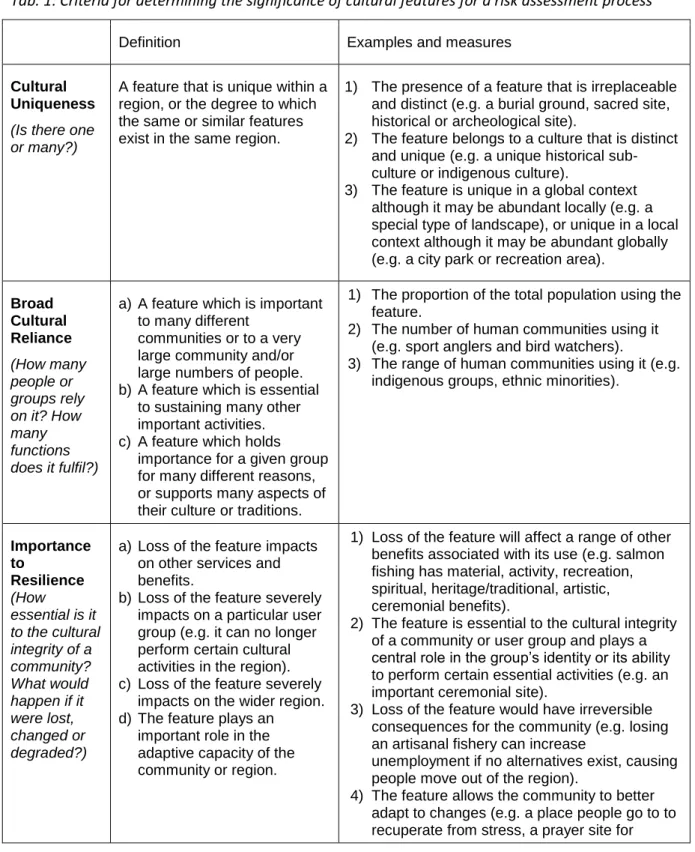
Five criteria of cultural significance are proposed to help establish culturally significant areas. They are purposely high level to allow for different expressions of values and ‘translation’ between different cultural contexts, and are designed to help planners and communities structure their discussion. Although modelled on criteria of ecological significance (DFO, 2004; 2006; UN, 1992; Dunn et al., 2014), they have been adapted to the cultural sphere. Tab. 1 provides additional detail and examples of how the criteria can be applied.
Cultural Uniqueness: Areas may be classed as culturally significant because they themselves are unique, rare or otherwise distinct, to the degree that no alternatives or replacements exist. They may also be classed as culturally significant because they contain unique features or enable unique cultural activities. Uniqueness may be considered in a local, regional, national or global cultural context, and may apply differently at different levels. For example, a feature may be unique in a local context (and therefore of high significance to a local community) but not when viewed at the national level. Uniqueness in itself does not convey importance; that importance needs to be assigned by a community (which may be a global community in the case of a heritage site).
Broad Cultural/Community Reliance: This describes an area, activity or feature that is important to many different communities, or important to a very large community. Another definition of broad cultural or community reliance is that the area, activity or feature is essential to sustaining many other important activities, holds importance for a given group for many different reasons, or supports many aspects of a culture or traditions.
Importance of the feature to the resilience of the social-ecological system: This describes situations where the loss of an area, feature or activity with cultural characteristics leads to the loss of services that are important for the stability of a community or wider socio-economic system. For example, the loss of a service (e.g. fish) may have knock-on effects on other services (e.g. loss of recreational fishing and tourism), leading to a cascade of socio-economic effects. The loss of the service may also impact on particular user groups within a local community, meaning they can no longer perform certain activities in the region (e.g. fishing). Knock-on effects may be severe if these activities are a central pillar in the socio-economic system: Losing a fishery, for example, might have significant effects on unemployment, forcing people to move out of the area if no alternative jobs exist and leading to the decline or even loss of the community.
Degree of tradition: This describes features, areas or activities that are linked to long-standing traditions. Practices – which may also be rituals or cultural meanings – may have existed for generations and be crucial to the identity of a community, often representing a particular type of connectedness to a place. Degree of tradition may also be expressed as breadth of tradition, meaning that a large proportion of the community is connected to it. In the case of the latter, the tradition does not need to be particularly old; what matters in both cases is the collective importance assigned to it.
Dramatic cultural change: The last criterion describes the role and importance of the feature, place or activity against a background of extreme cultural change. Sudden and dramatic cultural change may be caused by war or conquest (as in the case of
9
indigenous communities, for example), but it can also result from ecological disaster (natural hazards) or sudden economic change. Dramatic cultural change may lead to a severe disruption of cultural practices and suddenly elevate places, features or activities that would normally have been considered ordinary. Communities that have experienced dramatic cultural change are therefore in specific situations, warranting particular care and consideration when identifying culturally significant areas.
None of these criteria are associated with absolute thresholds of significance. The threshold of significance will always need to be set by the relevant community itself.
Tab. 1: Criteria for determining the significance of cultural features for a risk assessment process
Definition Examples and measures Cultural
Uniqueness (Is there one or many?)
A feature that is unique within a region, or the degree to which the same or similar features exist in the same region.
1) The presence of a feature that is irreplaceable and distinct (e.g. a burial ground, sacred site, historical or archeological site).
2) The feature belongs to a culture that is distinct and unique (e.g. a unique historical sub-culture or indigenous sub-culture).
3) The feature is unique in a global context although it may be abundant locally (e.g. a special type of landscape), or unique in a local context although it may be abundant globally (e.g. a city park or recreation area).
Broad Cultural Reliance (How many people or groups rely on it? How many functions does it fulfil?)
a) A feature which is important to many different
communities or to a very large community and/or large numbers of people. b) A feature which is essential
to sustaining many other important activities. c) A feature which holds
importance for a given group for many different reasons, or supports many aspects of their culture or traditions.
1) The proportion of the total population using the feature.
2) The number of human communities using it (e.g. sport anglers and bird watchers).
3) The range of human communities using it (e.g. indigenous groups, ethnic minorities).
Importance to
Resilience (How
essential is it to the cultural integrity of a community? What would happen if it were lost, changed or degraded?)
a) Loss of the feature impacts on other services and benefits.
b) Loss of the feature severely impacts on a particular user group (e.g. it can no longer perform certain cultural activities in the region). c) Loss of the feature severely
impacts on the wider region. d) The feature plays an
important role in the adaptive capacity of the community or region.
1) Loss of the feature will affect a range of other benefits associated with its use (e.g. salmon fishing has material, activity, recreation, spiritual, heritage/traditional, artistic, ceremonial benefits).
2) The feature is essential to the cultural integrity of a community or user group and plays a central role in the group’s identity or its ability to perform certain essential activities (e.g. an important ceremonial site).
3) Loss of the feature would have irreversible consequences for the community (e.g. losing an artisanal fishery can increase
unemployment if no alternatives exist, causing people move out of the region).
4) The feature allows the community to better adapt to changes (e.g. a place people go to to recuperate from stress, a prayer site for
10
difficult times, an alternative species that has similar cultural functions as an endangered species).
Degree of Tradition (How long and to what degree has the culture valued the feature?)
The feature is associated with a long-standing (referring to historical depth) or broadly anchored traditions; the tradition is important to the community or to wider society.
1) The feature has a long history of importance in the region or within society. This may mean it has been valued by many generations, or been carried out for many generations, or contributed to shaping the identity of the region/community – e.g. a fishing community). 2) The feature draws strong commitment from
the user group or is associated with high participation rates (e.g. ceremonies involving the entire community, recreational activities involving a large proportion of the total users). Dramatic
Cultural Change (Does the unique context of the culture that values the feature give the feature special importance?)
The feature has importance in the context of sudden dramatic change or the historical context of change. Dramatic change may be caused by the loss of essential ecosystem functions, invasion, war or conquest, or any other severe changes in a culture outside the normal parameters of change.
Many indigenous groups around the world have been subjected to attempts at cultural
extermination, not only through colonialism, but also the policies and actions that followed (such as forced removal of children and their “education” in Western norms, language and religion). This situation may justify special consideration of features associated with these cultures.
Other unique cultures and communities also face extreme pressures from internal and external forces (e.g. the collapse of a fishery).
c) Significant Attribute Considerations
The successful management of Culturally Significant Areas requires added consideration of the following attributes:
Location/spatial extent to determineappropriate boundaries of culturally significant areas. This is best determined by considering the spatial relationships of the community to the feature in question (e.g. traditional routes to reach a place of significance). If the exact extent of a culturally significant area remains unclear, or where the community does not wish to release detailed information for reasons of sensitivity, precautionary buffers could be applied.
Temporal scale to take account of the fact that cultural activities and functions do not necessarily take place at a location all the time. However, the area still needs to be considered as culturally significant throughout the year to ensure it is not altered in such a way that the seasonal activity can no longer take place.
Some definitions of cultural significance depend on the environmental quality of a feature or location. Environmental change outside the culturally significant area may still influence its connectedness, access to it or its intrinsic value, for example by affecting viewsheds, water quality or essential habitats for a culturally significant species. This aspect highlights the notion of interconnectedness and wholeness in ecosystems, aspects that may not be well expressed spatially.
It should be pointed out that the criteria presented here are not amenable to quantitative comparative rating. As stated before, they serve as a starting point for describing the context of cultural features of importance and why they hold importance. Narratives of importance would
11
ideally also include the socio-cultural and historical context of the planning area and any processes of cultural change that may have been experienced.
d) Dealing with conflicting cultural values
In line with criteria for ecological significance, we suggest that an area should be considered as culturally significant as soon as one of the five criteria applies. We also note that different criteria could apply to different communities, and new cultural values may arise that conflict with older values. For example, fishers may relate more to degree of tradition and social-ecological resilience, whilst tourism operators or those engaged in recreational activities may more readily relate to broad cultural reliance or uniqueness. Conflicts may arise between these different communities and the cultural values they hold; these will need to be resolved just like other value conflicts as part of the MSP process.
6. Translating the criteria into practice: Creating a baseline of culturally significant areas Evidence on culturally significant areas needs to be structured and organised to allow it to be presented alongside other types of evidence. Working with the communities concerned, a baseline of culturally significant areas could be created, using acknowledged techniques to allow cultural concerns to be heard in decision-making (Satterfield et al., 2013; Poe et al., 2013; Klain et al., 2014). Such a baseline has a number of practical advantages.
Firstly, collecting cultural data can be a lengthy process and may not be completed in time in the context of rapid new developments. Collecting baseline information would enable planners to assess the relative importance of cultural features ahead of new projects, establishing a sense of which culturally significant areas might be valued for what reasons and which areas are particularly important to the communities concerned.
Secondly, a baseline could also contribute to identifying particularly vulnerable cultural features and values in the planning area. Similar to an ecological assessment, a socio-cultural assessment could then be carried out to identify, predict and evaluate the potential cultural impacts of a development. This would constitute a step towards a full-scale socio-cultural risk assessment of marine developments (Cormier et al. 2015).
Thirdly, a baseline of cultural data would allow planners and communities to work with developers early in the process to identify areas of least conflict, ensuring culturally significant areas are considered early in the planning process.
Another advantage of a baseline is that it could provide a more balanced picture of the socio-cultural values and ecosystem benefits provided by an area. Presently, traditional and cultural values are often identified as part of stakeholder consultation processes in the light of a development proposal. This may provide a partial and biased picture of the cultural values in an area, potentially leading to an over-rating of cultural significance or an emotional response as a result of a felt threat. Few comprehensive studies are undertaken to identify these services without the threat of a development proposal. Without a baseline of cultural values, there is also the danger that the community ends up expressing their concerns solely in terms of ecosystem risks.
The representativeness and significance of a baseline of culturally significant areas and features of importance will be greatly enhanced if it can be established along criteria and guidelines that are underpinned by social science methodologies. Set criteria and metrics would underpin and formalise cultural risk assessments, providing a level playing field when introducing them to marine planning initiatives.
The key baseline questions are:
12
Where is it located in space, and can it be delineated?
Is the cultural feature/activity linked to a particular date or season?
To whom is it important? This relates to the constituency of the cultural feature, which could be a local community or a wider community of interest.
What qualities are needed to sustain it? These could be ecological, visual, acoustic, economic, related to access etc.
7. Practicing community involvement
The collection and use of baseline data, including risk assessment, must be embedded in a culturally sensitive process, recognising the importance of communities setting their own rules for engaging in collecting baseline data (Plieninger et al., 2013). This also recognises the importance of specific value sets which may differ from those of other communities or the values held by planners.
An important part of the process is to be clear on who could and should be included. Who is the community in each instance – is it local residents, recreational groups, or the general public? The process may include representatives of the community of interest (those who have something to lose), stakeholders (those who must manage the risk) and (especially in the case of indigenous groups) rightholders. In order to fully understand the value sets of the community, practitioners engaging in the collection and use of baseline data should seek to understand the cultural context of the community, the role and relevance of change and the history of the community.
Connections to features and places are ideally identified together with or by those with the connection. Community workers and organisations that are deeply involved in the community can offer initial insight on the importance of cultural values (including for example artists, landscape architects, or faith-based groups) (Fish, 2011). Where time and resources allow, communities may wish to develop their own criteria and definitions around areas and features of cultural significance, although their validity and adequate representation would need to be ensured. Difficulties of articulation may also need to be overcome. Once the baseline data has been collected, the community should receive feedback on how these data are being used and interpreted. It could be called upon to verify and amend this if necessary, for example the spatial representation of baseline data on maps. It is also important determine how to handle sensitive data and the level of detail that is made publically available.
Good preparation is essential and may involve special training for those engaging in data collection. For example, translating the importance of something from one culture to another can be very difficult. This needs people of the right skills who are able to interpret between the two cultures. Special consideration is necessary when working with indigenous groups and when collecting indigenous knowledge. Trust must be built over time and will require investment in building relationships.
8. Conclusions
The importance of cultural values to MSP cannot be overstated. Understanding what people value about their environment, and why they care about a particular place or region, can lead to a deeper understanding of potential conflicts that might arise in the context of proposed developments, and may enable these conflicts to be lessened if addressed at an early stage of a development proposal. This particularly applies to the immaterial benefits derived from marine spaces and ecosystems, which may be related to cultural identity, aesthetic appreciation, or personal and community competences, learning and empowerment.
Identification and codification of cultural values associated with sea areas or marine ecosystems is an important first step for incorporating them in MSP processes, especially for any subsequent risk
13
assessment carried out as part of MSP. Despite the widespread use of CES as a proxy for cultural values, this and other general classification systems can only incompletely represent the full range of cultural values associated with the sea. This is due to the inherent complexity of cultural values and their multiple constitutive layers, including non-preference based held values. Cultural values are fluid constructs which arise from a specific context of space and time, which makes participative processes key to identifying and describing the many connections people have to the sea. An open and respectful process may reveal diverse elements such as beliefs, cultural practices, rituals, emotions, or reference to past histories, which may be different from pre-conceived categories or Western cultural references. Understanding the reasons why particular places or ecosystems are considered culturally valuable is important for spatially managing these places as part of a multi-use environment: Risks and impacts of developments on places of cultural importance can only be estimated if the reasons for that importance and the factors that contribute to the essential qualities of a culturally important area or feature are known. There is also a wider argument that arises from Appadurai’s (1996) view of culture as a process: If cultural values are less about being, but more about becoming, then cultural values may best be encapsulated in a participative MSP process that is open to results in the sense of allowing different and changing mixes of place characteristics and practices to emerge.
Nevertheless, MSP is an area-based approach; hence it is important to identify the spatial dimension of the connections people have with the sea. Some cultural values will have a stronger spatial link than others; in some cases, links may be indirect or seasonal. A baseline of culturally significant areas can help to pinpoint places where cultural connections to the sea are particularly strong. Like the identification of cultural values and meanings associated with marine areas, identification of culturally significant areas should be carried out in a participative process involving relevant communities.
MSP often involves the spatial delineation of areas, for purposes such as restricting activities in particular areas or giving precedence to a particular activity. The ability to spatially delineate culturally significant areas may facilitate their inclusion in a marine spatial plan. However, some cultural meanings may be difficult to confine, or there may be resistance to defining hard and fast boundaries between areas considered significant and others that are not. Many of the difficulties recognised in the context of mapping CES (e.g. Shucksmith et al., 2014) are therefore likely to persist in the case of culturally significant areas. Although a wider debate is currently springing up on boundaries in MSP and alternative concepts such as fuzzy or soft boundaries (Knieling et al., 2015), practical alternatives in the short term may be to specify core areas denoting culturally important features, surrounded by a buffer zone designed to maintain the essential qualities of place or enabling the continuation of a cultural practice or experience. It should be noted, however, that the concept of culturally significant areas, and determining the relative importance of such areas, is primarily designed to feed into risk assessment and does not aim to resolve difficulties of mapping. Cultural values are about meanings and relationships between people and the environment, and so the participative element in dealing with connections to the coast and sea and identifying culturally significant areas is crucial. Initially, this may make MSP processes more time-consuming and expensive, requiring social science skills and cultural sensitivity. On the other hand, drawing up a baseline of culturally significant areas could serve to dissociate the discussion of cultural values from specific development projects and the potential emotionality this may involve. MSP processes can become more efficient as a baseline will have identified particularly valuable areas and the risks they will be susceptible to already, facilitating decisions on what might constitute appropriate development and what should be avoided. England’s marine plans already include elements of this, requiring planners to consider the impact of an activity or development on the seascape and heritage assets, taking into account existing seascape character and quality, how highly it is valued and its capacity to accommodate change specific to any development (HM Government, 2011). A caveat is that participative processes require the building of trust and the ability of MSP to deliver on
14
community expectations. Risk assessment in particular must lead to tangible results for the community involved, for example minimising the impacts of proposed developments on culturally important areas. This suggests that risk assessment must go hand in hand with a solid understanding of the compatibility of marine developments and activities with the cultural values identified as significant.
Rather than ready-made solutions, the approach set out in this paper provides a framework for thinking about cultural values and considering options, allowing them to be included in MSP in a way which is commensurate with ecological and economic values. Ultimately, what should be given priority where in a marine planning area is a matter of deliberation, negotiation and trade-offs, which applies to conflicting cultural values just as much as to cultural values conflicting with ecological and economic values. Just like ecological values which may be given priority in certain areas, however, it should be possible to give priority to cultural values which are widely considered to be of particular significance. The concept of sustainable development suggests that socio-cultural values are neither negligible nor frivolous; the concept set out above suggests they are by no means too intangible to count.
References
Appadurai, A. 1996 Modernity at Large: Cultural Dimensions of Globalization. University of Minnesota Press.
Barrena, J., Nahuelhual, L., Báez, A., Schiappacasse, I., Cerda, C. 2014. Valuing cultural ecosystem services: Agricultural heritage in Chiloé island, southern Chile. Ecosystem Services 7, 66-75. Bieling, C. & Plieninger, T. 2013. Recording Manifestations of Cultural Ecosystem Services in the
Landscape. Landscape Research 38 (5), 649-667.
Böhnke-Henrichs, A., Baulcomb, C., Koss, R., Hussain, S., de Groot, R.S. 2013. Typology and indicators of ecosystem services for marine spatial planning and management. Journal of Environmental
Management 130, 135-145.
Brown, T. C. 1984. The concept of value in resource allocation. Land Economics, 60(3), 231–246. Brown, G., & Raymond, C. 2007. The relationship between place attachment and landscape values:
Toward mapping place attachment. Applied Geography 27(2), 89-111.
Busch, M., Gee, K., Burkhard, B., Lange, M., Stelljes, N. 2011. Conceptualizing the link between marine ecosystem services and human well-being: the case of offshore wind farming.
International Journal of Biodiversity Science, Ecosystem Services & Management 7(3), 190-203. Chan, K.M., Satterfield, T. & Goldstein, J., 2012. Rethinking ecosystem services to better address and
navigate cultural values. Ecological Economics 74(0), 8–18.
Church, A., Fish, R., Haines-Young, R., Mourato, S., Tratalos, J., Stapleton, L., Willis, C., Coates, P., Gibbons, S., Leyshon, C., Potschin, M., Ravenscroft, N., Sanchis-Guarner, R., Winter, M., & Kenter, J. 2014. UK National Ecosystem Assessment Follow-on. Work Package Report 5: Cultural ecosystem services and indicators. UNEP-WCMC, LWEC, UK.
Cormier, R., Kannen, A., Elliott, M. and, Hall, P. 2015. Marine Spatial Planning Quality Management System. ICES Cooperative Research Report 327, 106 pp.
Davies, I.M., Gubbins, M.J., Watret, R. 2012. Scoping study for tidal stream energy development in Scottish waters. Scottish Marine and Freshwater Science Vol 3 No 1. Edinburgh: Scottish Government, 38pp. DOI:
10.7489/1522-DFO, 2004. Identification of Ecologically and Biologically Significant Areas. DFO Can. Sci. Advis. Sec. Ecosystem Status Report 2004/006.
15
DFO, 2006. Identification of Ecologically Significant Species and Community Properties. DFO Can. Sci. Advis. Sec. Sci. Advis. Rep. 2006/041.
Douvere, F. & Ehler, C. 2007. International Workshop on Marine Spatial Planning, UNESCO, Paris, 8–10 November 2006. Marine Policy 31(4), 582–583.
Dunn, D. C., Ardron, J., Bax, N. J., Bernal, P., Cleary, J., Cresswell, I., Donnelly, B., et al. 2014. The Convention on Biological Diversity’s Ecologically or Biologically Significant Areas: Origins, development, and current status. Marine Policy 49: 137–145.
Ehler, C. & Douvere, F. 2009. Marine Spatial Planning: a step-by-step approach toward ecosystem-based management. Intergovernmental Oceanographic Commission and Man and the Biosphere Programme. IOC Manual and Guides no. 53, ICaM Dossier no. 6. Paris: UNESCO.
European Parliament & Council (EPC), 2014. Directive 2014/89/EU of the European Parliament and of the Council of 23 July 2014 Establishing a Framework for Maritime Spatial Planning, Official
Journal of the European Union, L 257, 135-145.
Fish, R. D. 2011. Environmental decision making and an ecosystems approach: Some challenges from the perspective of social science. Progress in Physical Geography, 35(5), 671–680.
Fletcher, S., Saunders, J., Herbert, R. 2011. Description of the ecosystem services provided by broad-scale habitats and features of conservation importance that are likely to be protected by Marine Protected Areas in the Marine Conservation Zone Project area. Natural England Research Report RP0334.
Fletcher, R., Baulcomb, C., Hall, C., Hussain, S. 2014. Revealing marine cultural ecosystem services in the Black Sea. Marine Policy 50A, 151–161.
Gee, K., Burkhard, B. 2010. Cultural ecosystem services in the context of offshore wind farming: a case study from the west coast of Schleswig-Holstein. Ecological Complexity 7(3), 349-358. Gee, K. 2013. Trade-offs between seascape and offshore wind farming values: An analysis of local
opinions based on a cognitive belief framework. PhD Dissertation, Geographisches Institut, Universität Göttingen.
Gee, K. 2010. Offshore wind power development as affected by seascape values on the German North Sea coast. Land Use Policy 27, 185-194.
Guerry, A.D. et al., 2012. Modeling benefits from nature: using ecosystem services to inform coastal and marine spatial planning. International Journal of Biodiversity Science, Ecosystem Services & Management, 8(1-2), 107–121.
Henri, F. and Pudelko, P. 2003. Understanding and analysing activity and learning in virtual communities. Journal of Computer Assisted Learning 19, 474-487.
HM Government 2011. UK Marine Policy Statement. London, March 2011.
HM Government. 2014. East Inshore and East Offshore Marine Plans. Published by the Department for Environment, Food and Rural Affairs, April 2014.
Hooley D. 2011. What have we done? Mapping the historic cultural processes that shape our coastal and marine environment. Wadden Sea Ecosystem 26, 133-138.
Jay, S. 2010. ‘Built at Sea: marine management and the construction of marine spatial planning’,
Town Planning Review 81 (2), 173-191.
Jefferson, R., McKinley, E., Capstickc, S., Fletcher, S., Griffin, H., Milanese, M. 2015. Understanding audiences: Making public perceptions research matter to marine conservation. Ocean & Coastal
16
Jobstvogt, N., Watson, V., Kenter, J.O. 2014. Looking below the surface: The cultural ecosystem service values of UK marine protected areas (MPAs). Ecosystem Services 10, 97-110.
Kannen, A. 2012. Challenges for marine spatial planning in the context of multiple sea uses, policy arenas and actors based on experiences from the German North Sea. Regional Environmental Change 14 (6), pp 2139-2150.
Kenter, J.O., Reed, M. S., Irvine, K.N., O'Brien, E., Brady, E., Bryce, R., Christie, M., Church, A., Cooper, N., Davies, A., Hockley, N., Fazey, I., Jobstvogt, N., Molloy, C., Orchard-Webb, J., Ravenscroft, N., Ryan, M., & Watson, V. 2014. UK National Ecosystem Assessment Follow-on. Work Package Report 6: Shared, Plural and Cultural Values of Ecosystems. UNEP-WCMC, LWEC, UK.
Kidd, S. & Ellis, G. 2012. From the Land to Sea and Back Again? UsingTerrestrial Planning to Understand the Process of Marine Spatial Planning. Journal of Environmental Policy & Planning 14 (1), 49-66.
Klain, S. C., Chan, K. M. A., & Satterfield, T. 2014. What matters and why? A participatory methodology for identifying and characterizing cultural and other ecosystem services. Global Environmental Change 107, 310–320.
Klain, S.C. & Chan, K.M., 2012. Navigating coastal values: Participatory mapping of ecosystem services for spatial planning. Ecological Economics, 82(0), 104–113.
Klain, S. C. 2012. Participatory mapping of ecosystem services for marine spatial planning in Vancouver Island, Canada. Presentation at the 97th Annual Meeting, Ecological Society of America, Oregon, USA.
Knieling, J., Othengrafen, F., Allmendinger, P., Haughton, G. 2015. Soft Spaces in Europe: Re-negotiating Governance, Boundaries and Borders. In: Regions and Cities. Abingdon, Oxon: Routledge.
Laband, D. 2013. The neglected stepchildren of forest-based ecosystem services: Cultural, spiritual, and aesthetic values. New Frontiers of Forest Economics, Forest Policy and Economics 35, 39-44 Lester, S., Costello, C., Halpern, B.S., Gaines, S.D., White, C., Barth, J.A. 2013. Evaluating trade-offs
among ecosystem services to inform marine spatial planning. Marine Policy 38, 80-89.
Leyshon, C. 2014. Cultural Ecosystem Services and the Challenge for Cultural Geography. Geography Compass 8/10, 710–725.
Liquete, C; Zulian, G; Delgado, I; Stips, A; Maes, J. 2013. Assessment of coastal protection as an ecosystem service in Europe. Ecological Indicators 30, 205-217.
MacKinnon, & Brennan, R. 2012. Belonging to the sea. Exploring the cultural roots of maritime conflict on Gaelic speaking islands in Scotland and Ireland.
Maes J, Teller A, Erhard M, Liquete C, Braat L, Berry P, Egoh B, Puydarrieux P, Fiorina C, Santos F, Paracchini ML, Keune H, Wittmer H, Hauck J, Fiala I, Verburg PH, Condé S, Schägner JP, San Miguel J, Estreguil C, Ostermann O, Barredo JI, Pereira HM, Stott A, Laporte V, Meiner A, Olah B, Royo Gelabert E, Spyropoulou R, Petersen JE, Maguire C, Zal N, Achilleos E, Rubin A, Ledoux L, Brown C, Raes C, Jacobs S, Vandewalle M, Connor D, Bidoglio G. 2013. Mapping and Assessment of Ecosystems and their Services. An analytical framework for ecosystem assessments under action 5 of the EU biodiversity strategy to 2020. Publications office of the European Union, Luxembourg.
Milcu, A. Ioana, J. Hanspach, D. Abson, and J. Fischer 2013. Cultural ecosystem services: a literature review and prospects for future research. Ecology and Society 18(3), 44
17
Millennium Ecosystem Assessment (MEA) 2005. Ecosystems and human well-being: A synthesis report based on the findings of the Millennium Ecosystem Assessment. Washington, DC, Island Press.
Peterson, R.B., Russell, D., West, P., Brosius, J.P., 2008. Seeing (and doing) conservation through cultural lenses. Environmental Management 45 (1), 5-18.
Plieninger, T., Dijks, S., Oteros-Rozas, E., Bieling, C. 2013. Assessing, mapping, and quantifying cultural ecosystem services at community level. Land Use Policy 33, 118–129.
Poe, M., Norman, K. C., & Levin, P. S. 2013. Cultural dimensions of socioecological systems: key connections and guiding principles for conservation in coastal environments. Conservation Letters, 1–10.
Pröpper, M., & Haupts, F. 2014. The culturality of ecosystem services. Emphasizing processand transformation. Ecological Economics 108, 28-35.
Ramsey, D. and Beesley K.B., 2007. ‘Perimeteritis’ and rural health in Manitoba, Canada: perspectives from rural healthcare managers. Rural and Remote Health 7, 850. (Online). Available: http://www.rrh.org.au
Ratter, B.M.W & Gee, K. 2012. Heimat - A German concept of regional perception and identity as a basis for coastal management in the Wadden Sea. Ocean and Coastal Management 68, 127-137. Redford, K.H., Brosius, J.P., 2006. Diversity and homogenization in the endgame. Global
Environmental Change 16 (4), 317-319.
Rees, S., Rodwell, L.D., Attrill, M.J., Austen, M.C., Mangi, S.C. 2010. The value of marine biodiversity to the leisure and recreation industry and its application to marine spatial planning. Marine Policy
34, 868–875.
Rokeach, M. 1973. The nature of human values. The Free Press, Macmillan Publishing.
Ruiz-Frau, A.; Hinz, H., Edwards-Jones, G., Kaiser, M.J. 2013. Spatially explicit economic assessment of cultural ecosystem services: Non-extractive recreational uses of the coastal environment related to marine biodiversity. Marine Policy 38, 90-98.
Satterfield, T., Gregory, R., Klain, S., Roberts, M., Chan, K.M. 2013. Culture, intangibles and metrics in environmental management. Journal of Environmental Management 117, 103-114.
Shucksmith, R., Gray, L., Kelly, C. & Tweddle, J.F. 2014. Regional marine spatial planning: The data collection and mapping process, Marine Policy 50, 1–9.
Stephenson, J. 2008. The cultural values model: An integrated approach to values in landscapes.
Landscape and Urban Planning 84(2), 127-139.
Summers, J.K., Smith, L. M., Case, J.L., Linthurst, R.A. 2012. A Review of the Elements of Human Well-Being with an Emphasis on the Contribution of Ecosystem Services. AMBIO 41, 327–340.
UNESCO-IOC, online. http://www.unesco-ioc-marinesp.be/marine_spatial_planning_msp. United Nations, 1992: Convention on Biological Diversity.
Van Berkel, D.B., Verburg, P.H. 2014. Spatial quantification and valuation of cultural ecosystem services in an agricultural landscape. Ecological Indicators 37 Part A, 163-174.
Walker, A. J., & Ryan, R. L. 2008. Place attachment and landscape preservation in rural New England: A Maine case study. Landscape and Urban Planning 86(2), 141-152.
Winthrop, R.H. 2014. The strange case of cultural services: Limits of the ecosystem services paradigm. Ecological Economics 108, 208-214.
18
Zoderer, B.M., Stanghellini, P.S.L., Tasser, E., Walde, J., Wieser, H., Tappeiner, U. 2016. Exploring cultural values of ecosystem service categories in the Central Alps: the influence of socio-demograhpic factors and landscape type. Regional Environmental Change 16, 2033-2044.