Received: 09 January 2019 • Accepted: 17 April 2019
doi: 10.22034/jcema.2019.92090
Journal of Civil Engineering and Materials Application
Journal home page:
http://jcema.comEffect of Using Different Fibers on Slab on Grades
2
*, Milad Orak
1
Abdolkarim Abbasi Dezfouli
. Department of Civil Engineering, Islamic Azad University, Ahvaz Branch, Khouzestan, Iran 1
2 Department of Civil Engineering, Islamic Azad University, Masjed-Soleyman Branch, Khouzestan, Iran.
*Correspondence should be addressed to Abdolkarim Abbasi Dezfouli, Department of Civil Engineering, Islamic Azad University, Ahvaz Branch, Khouzestan, Iran; Tel: +9161147209 ; Fax:+984533628475 ; Email: [email protected].
Copyright © 2019 Abdolkarim Abbasi Dezfouli. This is an open access paper distributed under the Creative Commons Attribution License.Journal of Civil Engineering and Materials Applicationis published by Pendar pub; Journal p-ISSN 2676-232X; Journal e-ISSN 2588-2880.
1. INTRODUCTION
esistance to crack propagation is achieved by fiber-reinforced concrete (FRC) that contain coarse aggregate, and the existence of coarse aggregate in the matrix, brings some difficulties for fiber distribution or dispersion. Thus the volume fraction is highly limited. For fiber reinforced concrete used in practice, the applicable fiber volume fraction range from 0.4 to 2% for steel fiber and 0.06 to 0.5% for polypropylene. Slab on grades are the most important element in industrial projects. Considering to the use of floors are subjected to the damages and with repair and retrofitting need expenditure. The design and construction of a durable concrete floor in the storage, saloon and platforms are important [1]. The industrial floors have two functions; one bearing operational loadings, storages of material, the dynamic load from lift truck wheels and transferring them to the subgrades, secondly, providing a smooth surface for ease of use and safety [2]. It is necessary to enhance the quality of the concrete. Normal concrete is weak in tension about 1/10 of the compressive strength.
It is brittle against the impact loadings. Reinforcement with steel rebar cannot prevent their resistance against cracking, therefore the fibers is introduced. These fibers are separated and are distributed in concrete randomly. The precedence of the use of fibers is backed to the old Egyptians that they used fibers in mud walls. Also, rock wools fibers for reinforcement of clay is used about 5000 years ago [3]. From different kinds of fibers used in concrete the steel and polypropylene are mostly used. This research tried to evaluate two kinds of fibers. The flexural and impact resistance are the most important parameters. Base on this, six prisms specimens were prepared for testing flexural strength, six concrete disks for impact testing and nine cubes for compressive strength tests. In general, slab on grade problems can be categorized as cracking, surface deterioration, curling, settlement or heave, failure of joints, delamination of finishes, water penetration, chemical attack and wearing out [4].
Most structural failure in slabs on grade are caused by point loading, wheel loading of cranes and other
construction equipment, and heavy stacks of material. Quite often, structural cracking can be traced to loading
R
ABSTRACT
Slab on grade, also called floors on ground, are different from other structural members. First, they are supported directly by soil, and their success or failure may depend more on the soil qualities than on the slab construction. Second, they carry equipment and floor finishes, and any defect in the slab's integrity or moisture resistance affects those elements. A floor slab undergoing drying shrinkage may not only crack, but also break the brittle ceramic tile it carries. Failure may also occur due to overloading. For reducing cracks propagation, control or contraction joints are used. In this research, 225 specimens by fifteen-mix design with different dosage of polypropylene and steel fibers were prepared for evaluating compressive, impact and flexural testing at the ages of 7 and 28 days. As a result, the optimum dosage of polypropylene fibers was 1.6 kg/m3 and at this dosage, impact resistance enhanced about 460% and flexural strength enhanced about 70% in comparison with control specimens. Steel fibers improved impact resistance and flexural strength about 312% and 58% respectively, at the dosage of 30 kg/m3. Results also showed that the compressive strengths of specimens are not significantly increased by using fibers.
that was applied too early, before concrete could gain its full strength [5,6]. The industrial floors are kind of slabs on grade and are very important elements. The slabs on grade are supported by ground and their performance is more depend on soil qualities and they are noticeable by employers [7]. Mirmiran, A et al. (2014) [8] saying that FRC is known to provide good resistance to plastic shrinkage and has a proven record in the building industry, particularly with slab-on-grade application. However, the current specification does not address the use of FRC in civil infrastructure. Results indicated that both polyethylene and nylon fibers provided the best resistance to early-age shrinkage. However, balling was a problem for nylon fiber reinforced concrete. Short fibers (< 1-in.) also had the best performance in resisting early-age shrinkearly-age, while long fibers (> 1-in.) provided additional post-cracking capacity. For replacement slab, it is recommended that a short polyethylene fiber be used to eliminate uncontrolled cracking. In conclusion, adding a fiber to concrete can increase the early age compressive strength by up to 48%. Furthermore, the age at cracking can be more than doubled by just adding 0.3% volume of polypropylene fibers and the crack width is reduced to a fourth. Other fiber can also be used for intermediary effects. Steel fibers are found to provide residual strength. However, they are also prone to deterioration due to corrosion. The steel fibers used were found to be rusted even under laboratory conditions. Gharehbaghil et al. (2017) [9] were mentioned that FRC can also significantly improve flexural strength when compared to traditional Concrete. This improvement in flexural strength can be varied depending on the actual fibers used. Although not new, FRC is gradually gaining popularity in the construction industry, in particular for high rise structures. This included the involvement of additional structural reinforcement, particularly for demanding areas such as seismic areas. Moreover, FRC was thus utilized for non-load bearing structural component, predominantly for seismic areas.Grija et al. (2016) [10], work on the martial called Hypo sludge. This sludge was added at a dosage of 25%, 50% and recon 3s fibers has to be added at a dosage of 0.5%, 1% by weight of cement. In this paper, studies shall be conducted on a mix and tests like compression test, split tensile test, flexural test, capillary and porosity shall be conducted. Finally, the results of fiber reinforced
concrete shall be compared with the conventional concrete. Industrial waste materials were found to be performing better than normal concrete, in properties such as workability, durability, permeability and compressive strength. Utilization of these wastes in concrete will not only provide economy but also help in reducing disposal problems. Silawat and Kumar (2016) [11], were investigated the properties of steel fiber reinforced concrete like flexure and compressive strength. Tests were conducted to study the flexural and compressive strength of steel fiber reinforced concrete with varying aspects and varying percentages of fiber. In the experiments conducted four aspect ratio were selected i.e. 40,50,60,70 and percentage of steel in each case varied from 0.5% to 2.5% at interval of 0.5%. The various strength parameters studied are compressive strength and flexural strength as per the relevant IS standards. From load deflection curve, it is observed that as the percentage of fiber increases with constant aspect ratio, the deflection of the beam is also increased before failure. The maximum deflection is observed with 2.5% fibers and aspect ratio of 70 and it was 3.2mm. Abbas Zaidi et al. (2016) [12] presented a paper that reviews the literature related to the utilization of waste material and its various effects on compressive strength, split tensile strength, flexural strength and workability of concrete. The steel powder, empty tins, soft drink bottle caps were deformed into the rectangular strips of 3mm width and 10mm length. This included that fiber addition improves ductility of concrete and its post-cracking load-carrying capacity. Ragavendra et al. (2017) [13]Fiber Reinforced Concrete (FRC) is gaining attention as an effective way to improve the performance of concrete. Fibers are currently being specified in tunneling, bridge decks, pavements, loading docks, thin unbounded overlays, concrete pads, and concretes slabs. These applications of fiber reinforced concrete are becoming increasingly popular and are exhibiting excellent performance. Fiber-reinforced concrete pavements prove to be more efficient than conventional RC pavements. In several aspects, compressive strength for fiber-reinforced concrete is seen to be improved. It can be clearly seen that strength at 28 days for CSFRC 1% is better than other cases hence recommended.
2. MATERIALS AND METHODS
The main materials used in this research work is polypropylene fibers (PP) their specification is given in
Table 1 and steel fibers (SF) specification is given in
Table 2, these are described more as follows; the PP fibers made in different shapes and sizes. The integrity of PP fibers to concrete is weak chemically, but the mechanical adhesion is suitable; these fibers are possible to have tensile failure. Polypropylene material is obtained from a raw hydrocarbon C3H6. Their production process is similar to Nylon and Rayon fibers. PP fibers in alkali environment of concrete have a high resistivity. PP fibers with ratio is used for pedestrian overlays, slab on grades, floors system and tunnel linings, canals, reservoirs for preventing crack the range of use is between 0.05-0.3 percent [14]. The PP fibers have elastic modulus of 3-5GPa. Also, these fibers prevent initial shrinkage in plastic state of concrete. After casting, at the time cracks
occurred, the PP fibers are exerted a low displacement load for preventing crack propagation. Also, due to strip shapes of PP fibers, better bonding is occurred at interface with concrete. As concrete is hardened, the effect of PP fibers is reduced [15]. Other properties of PP fibers are their effect on the fire. Due to fire, PP fibers are disappeared (the fibers are melted) and exerted from concrete porosity. The steam of water is come out from the ducts that produced by burning PP fibers. Therefore, not only PP fibers have not negative effect but for a certain time preventing concrete failures. The characteristics of the PP fibers used in this research, is given in Table 1. And Figure 1 shows the Polypropylene fibers used in this research and Figure 2 shows stress-strain curves of Polypropylene fiber reinforced concrete with different percentage of used.
Table 1. Details of polypropylene fibers in use
Polypropylene Material
8 mm Length
20 Diameter
400 Aspect ratio (l/d)
0/9 gr/cm3 Density
350 MPa Tensile strength
Figure 1. Polypropylene fibers used in this research
Figure 2. Stress-Strain curves of Polypropylene fiber reinforced concrete [19]
2.1. STEEL FIBERS
The industrial floors and overlaying are used mostly steel fibers [16]. The E value is about 200GPa with a high tensile strength of 800-2500MPa. At the early age of concrete, it is possible that very fine cracks due to shrinkage have appeared. Also, in this duration, the fibers are not adhered to concrete. Based on this, steel fibers are not effective in early age, but at hardened state, their effects are increased and crack propagation is reduced. Due to using steel fibers, corrosion may occur mostly near to surface and causes discoloration of concrete but not effected on load-bearing capacity. Corrosion potential in steel fibers is reduced by two methods:
- Optimization of the fiber concrete ingredient - Use of galvanize or stainless fibers
- Another reason for the importance of using steel fibers is their strength against fire. Steel fibers have not specific character against fire but have the worse behavior against fire in comparison with normal concrete [15]. In Table 2, the characteristic of steel fibers, used in this research, is given. Figure 3shows the steel fiber used in this research. - Steel Fibers do little to enhance the static compressive strength of concrete, with increases in strength ranging from essential nil to perhaps 25%. Even in members that contain conventional reinforcement in addition to the steel fibers, the fibers have little effect on compressive strength. However, the fibers do substantially increase the post-cracking ductility, or energy absorption of the material. This is shown graphically in the compressive
stress-strain curves of steel fiber reinforced concrete in Figure 4.
Table 2. Details of steel fibers in use
Steel Material
25 mm Length
1 mm Diameter
25 aspect ratio (l/d)
100 MPa Tensile strength
-Figure 3. Steel fibers used in this research
Figure 4. Stress-Strain curves in compression for steel fiber reinforced concrete [20]
The normal amount of the use of steel fibers is 20-40 kg/m3 of concrete. As the amount is increased, the flexural strength increases. Those mixes that used conveyor belts for transporting concrete usually the fibers
are mixed with aggregates and are entered into the mixer. If l/d is less than 50 the gathering fibers are not causes of concern. However, if l/d is more than 50 care should be taken to prevent fibers gathering.
2.2. EXPERIMENTAL PROGRAM
In this research, 225 specimens in fifteen different mix designs were provided to evaluate the properties of concrete. 90 specimens were tested at the age of 7 days and 135 specimens were tested at the age of 28 days. Two types of specimens with different dosage of steel and polypropylene fibers and one type as control were prepared. Compressive strength, impact loading and flexural strength tests were undertaken. For compressive test, 150 mm concrete cubes based on ASTM C39 [17],
for impact loading test, disks with dimension of 6" diameter and 1.5" thickness based on ACI 544-2R[18] and for flexural strength, beams with dimension of 600*125*75 mm based on ASTM C293-02 [16] were provided. Figure 5 shows the method to exert flexural load to beams that used in this research. Figure 6 shows constructed beam under one-point flexural loading.
According to ACI 544-2 [18], good impact resistance (dynamic energy absorption as well as strength) is one of the important attributes of FRC. One type of tests that have been used to measure the impact resistance of FRC is drop-weight test. In this method, the number of blows in a “repeated impact” test to achieve a prescribed level of distress shows impact resistance of concrete. This number serves as a qualitative estimate of the energy absorbed by
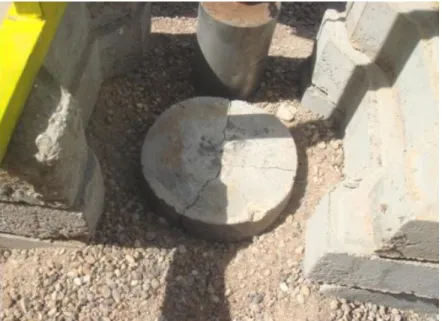
the specimen at the levels of distress specified. The test can be used to compare the relative merits of different fiber-concrete mixtures and to demonstrate the improved performance of FRC compared to conventional concrete. In this research, a standard manually operated 4.54 kg (10 lb.) compaction hammer with a 457 mm (18 in.) used to apply 20 Joules energy by impact loading (Figure 7).
E = mgh = 4.54*0.457*9.81 = 20 J Apparatus for impact loading test is made by a steel frame in
dimension of 350*650 mm.
Figure 6. Impact loading test
Type 2 cement, crashed coarse aggregate with maximum size of 19 mm and washed sand with drinkable water were used. Superplasticizers based on poly-carboxylate ether with dosage of 0.8% cement content were used and
the water-cement ratio was constant for all the mixes.
Table 3 gives the amount of materials per m3.
Table 3. Materials used in concrete (Kg/m3)
Material Mass (kg)
Cement 400
Coarse Aggregate 985
Fine Aggregate 816
Water 132
Super Plasticizer 3.2
Water-Cement Ratio 0.33
The amount of use of PP fibers per m3 were 0.8, 1, 1.2, 1.4, 1.6, 1.8 and 2 kg and steel fibers were 20, 22.5, 25, 27.5, 30, 32.5 and 35kg. Air temperature was 28°C and relative humidity 36%. The specimens were moistening for 24 hours in mold, then de-molded and submerged in water for curing. The tests were undertaken at the ages of 7 days and 28 days and before testing, specimens were
maintained in the oven for 24 hours in 105°C temperature. For each mix design, 3 specimens made for test at each age and average amount of each test intended as a result of the test. The fibers were added to the mix by careful observation. To prevent balling phenomena, fibers added to mixture slowly and especially, for PP fibers, first fibers added to water, then added to mixture in gradual stages.
3. RESULTS AND DISCUSSION
All of the tests were carried in laboratory of Technical and Mechanical Soil in Khuzestan under standard with temperature of 36°C and relative humidity 36%. For
Compressive test hydraulic jack by 300 ton capacity at loading rate 0.3 Sec
mm N
2
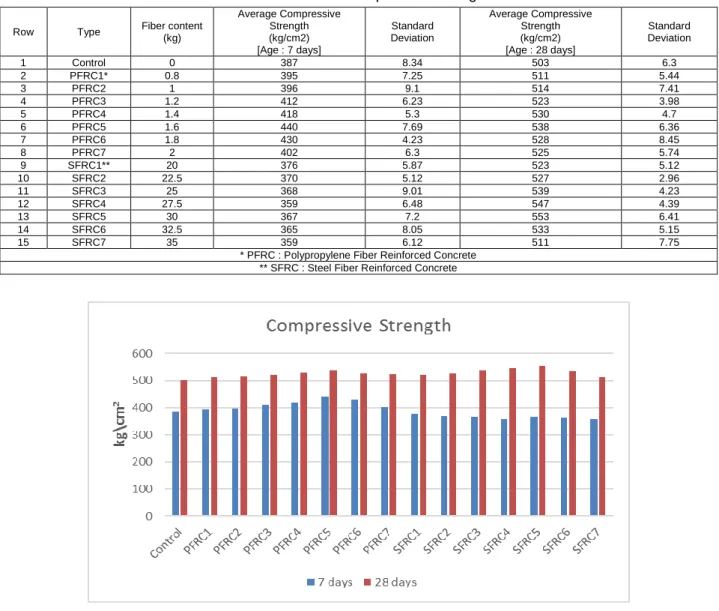
was used. Results are given in Table 4.
96
Table 4. Results of the compressive strength tests
Row Type Fiber content
(kg)
Average Compressive Strength (kg/cm2) [Age : 7 days]
Standard Deviation
Average Compressive Strength (kg/cm2) [Age : 28 days]
Standard Deviation
1 Control 0 387 8.34 503 6.3
2 PFRC1* 0.8 395 7.25 511 5.44
3 PFRC2 1 396 9.1 514 7.41
4 PFRC3 1.2 412 6.23 523 3.98
5 PFRC4 1.4 418 5.3 530 4.7
6 PFRC5 1.6 440 7.69 538 6.36
7 PFRC6 1.8 430 4.23 528 8.45
8 PFRC7 2 402 6.3 525 5.74
9 SFRC1** 20 376 5.87 523 5.12
10 SFRC2 22.5 370 5.12 527 2.96
11 SFRC3 25 368 9.01 539 4.23
12 SFRC4 27.5 359 6.48 547 4.39
13 SFRC5 30 367 7.2 553 6.41
14 SFRC6 32.5 365 8.05 533 5.15
15 SFRC7 35 359 6.12 511 7.75
* PFRC : Polypropylene Fiber Reinforced Concrete ** SFRC : Steel Fiber Reinforced Concrete
Figure 7. Compressive strength of specimens
As a result, the fibers are not so effective on compressive tests. However, results showed that in the use of steel fibers, 30kg/m3 is optimum dosage and compressive strength increased about 10%. Also, using of
polypropylene fibers cause increasing about 7% at the optimum dosage of 1.6%. The results are given in Table 5.
Table 5. Results of the impact strength tests
Row Type Fiber
content (kg)
Average No. of impacts till first crack [Age : 7 days]
Standard Deviation
Average No. of impacts till first crack [Age : 28 days]
Standard Deviation
1 Control 0 3 1.26 8 1.18
2 PFRC1* 0.8 9 2.2 31 1.98
3 PFRC2 1 10 1.8 31 1.82
4 PFRC3 1.2 12 1.68 33 2.1
5 PFRC4 1.4 18 2.01 34 1.62
6 PFRC5 1.6 23 2.22 41 2.65
7 PFRC6 1.8 20 1.98 37 2.14
8 PFRC7 2 17 1.76 34 1.98
9 SFRC1** 20 6 2 17 1.07
10 SFRC2 22.5 8 0.89 20 1.25
11 SFRC3 25 9 1.73 22 1.78
12 SFRC4 27.5 12 1.95 23 1.65
13 SFRC5 30 15 2.3 25 1.23
14 SFRC6 32.5 13 0.78 24 2.01
15 SFRC7 35 12 1.12 24 1.8
* PFRC : Polypropylene Fiber Reinforced Concrete ** SFRC : Steel Fiber Reinforced Concrete
Figure 8. Impact resistance of specimens
Table 5 shows that the impact resistance of specimens with steel fibers can enhance up to 3 times bigger than control specimens. While polypropylene fibers can enhance the impact resistance up to more than 5 times
bigger than control specimens. Results also showed that polypropylene fibers are more effective than steel fibers to improve impacts resistance.
Table 6. Results of the flexural strength tests
Row Type Fiber
content (kg)
Maximum load (KN) [Age : 28 days]
Maximum flexural strength (KN.m) [Age : 28 days]
1 Control 0 24 3
2 PFRC1* 0.8 32 4
3 PFRC2 1 34 4.025
4 PFRC3 1.2 33 4.125
5 PFRC4 1.4 38 4.75
6 PFRC5 1.6 41 5.125
7 PFRC6 1.8 40 5
8 PFRC7 2 36 4.5
9 SFRC1** 20 30 3.75
10 SFRC2 22.5 32 4
11 SFRC3 25 35 4.375
12 SFRC4 27.5 36 4.5
13 SFRC5 30 38 4.75
14 SFRC6 32.5 37 4.625
15 SFRC7 35 32 4
* PFRC : Polypropylene Fiber Reinforced Concrete ** SFRC : Steel Fiber Reinforced Concrete
Table 6 shows that the flexural strength of specimens made by PP fibers enhanced about 70% and this amount is 58% for steel fibers in comparison with control. The maximum amount of flexural strength in corporation with
PP and steel fibers earned at the dosage of 1.6 kg and 30 kg respectively. Figure 10 shows the effect of different dosages of fibers on flexural strength of concrete.
4. CONCLUSION
The effect of steel and PP. fibers on industrial floors was evaluated in this paper. Summary of the results are given as follow:
- In construction of fiber concretes l/d ratio and optimize dosage of fiber should be controlled to prevent gathering and segregation.
- Concrete without fibers is brittle, but with fiber propagation of cracks is prevented.
- If fiber used, the control or contraction joints can be eliminated on the slab on grade.
- No significant effect was observed in compressive strength using fiber in concrete.
- Polypropylene fibers significantly increase flexural strength.
- Absorbing energy due to dropping load can be enhanced in early age while in steel fibers, effectiveness is seen at hardened concrete.
- The increase in the various mechanical properties of the concrete mixes with polypropylene fibers is not in the same league as that of the steel fibers.
FUNDING/SUPPORT
Not mentioned any Funding/Support by authors
.
ACKNOWLEDGMENT
Thanks to Mechanical and Technical Laboratory of Khuzestan Province and Mr. Bahrami and Beton Sang Mehr Ahwaz Company for providing samples for testing.
AUTHORS CONTRIBUTION
This work was carried out in collaboration
among all authors
.CONFLICT OF INTEREST
The author (s) declared no potential conflicts of
interests with respect to the authorship and/or
publication of this paper
.5. REFERENCES
[1] CANFIELD S, CN NO. Tag Archives: concrete slab construction. 2010 February 01. [View at Google Scholar] ; [View at Publisher].
[2] Neal F, Ice Design and Practice Guide Concrete Industrial Ground Floors. 2nd ed. London: Thomas Telford Publishing; 2002. [View at Google Scholar] ; [View at Publisher].
[3] Asdrubali F. Survey on the acoustical properties of new sustainable materials for noise control. InProceedings of Euronoise 2006 May 30;30:1-10. Tampere: European Acoustics Association. [View at Google Scholar] ; [View at Publisher]. [4] Li Z, Leung C, Xi Y. Structural renovation in concrete. 1st ed. New York: CRC Press; 2009. [View at Google Scholar] ; [View at Publisher].
[5] Johnson RP. Composite Structures of Steel and Concrete: beams, slabs, columns and frames for buildings. 3ed ed. United States: John Wiley & Sons; 2018. [View at Google Scholar] ; [View at Publisher].
[6] Lee YL, Lim JH, Lim SK, Tan CS. Flexural behaviour of reinforced lightweight foamed mortar beams and slabs. KSCE Journal of Civil Engineering. 2018 Aug 1;22(8):2880-2889. [View at Google Scholar] ; [View at Publisher].
[7] Naseri F, Jafari F, Mohseni E, Tang W, Feizbakhsh A, Khatibinia M. Experimental observations and SVM-based prediction of properties of polypropylene fibres reinforced self-compacting composites incorporating nano-CuO. Construction and Building Materials. 2017 Jul 15;143:589-598. [View at Google Scholar] ; [View at Publisher].
[8] Suksawang N, Mirmiran A, Yohannes D. Use of fiber reinforced concrete for concrete pavement slab replacement. Florida. Dept. of Transportation. Research Center. 2014 Mar 1; BDK80 TWO 977-2712. [View at Google Scholar] ; [View at Publisher].
[9] Gharehbaghi K, Chenery R. Fiber reinforced concrete (FRC) for high rise construction: Case studies. InIOP Conference Series: Materials Science and Engineering. 2017 Dec 01; 272(1): p.012034. [View at Google Scholar] ; [View at Publisher].
[10] Shanthini D. Fibre Reinforced Geopolymer Concrete–A Review. 2016 September; 7(5):435-438. [View at Google Scholar] ; [View at Publisher].
[11] Arunakanthi E, Kumar JC. Experimental studies on fiber reinforced concrete (FRC). International Journal of Civil Engineering and Technology. 2016 October 01;7(5):329-336. [View at Google Scholar] ; [View at Publisher].
[12] Foti D. Preliminary analysis of concrete reinforced with waste bottles PET fibers. Construction and building materials. 2011 Apr 1;25(4):1906-1915. [View at Google Scholar] ; [View at Publisher].
[13] Guglielmetti V, Grasso P, Mahtab A, Xu S. Mechanized tunnelling in urban areas: design methodology and construction control. 1st ed. London: CRC Press; 2008. [View at Google Scholar] ; [View at Publisher].
[14] De Belie N, Soutsos M, Gruyaert E. Properties of Fresh and Hardened Concrete Containing Supplementary Cementitious Materials. Springer; 2018.Volume 25. ISBN : 978-3-319-70605-4. [View at Google Scholar] ; [View at Publisher].
[15] Vats G, Kuhar P, Kumar S. Mechanical Behaviour of Cement Concrete using Fibres. Int. J. of Multidisciplinary and Current research. 2018 Jul;6(4): 825-830. [View at Google Scholar] ; [View at Publisher].
[16] Nanda RP, Behera B, Majumder S, Khan HA. RC Beam Strengthening by Glass Fibre Reinforced Polymer. International Journal of Engineering Technology Science and Research. 2018 March; 5(3): 21-26 [View at Google Scholar] ; [View at Publisher].
[17] Santana M, De Albuquerque MD, Isique WD, Pereira TP, Gonçalves AC, Junior EF, Costa CN. Behavior of Concrete and Mortar in Response to the Inclusion of Toxic Jatropha Seed Cake. BioResources. 2018 Jan 30;13(1):1993-2004. [View at Google Scholar] ; [View at Publisher].
[18] Al Rikabi FT, Sargand SM, Khoury I, Hussein HH. Material properties of synthetic fiber–reinforced concrete under freeze-thaw conditions. Journal of Materials in Civil Engineering. 2018
Mar 28;30(6):04018090. [View at Google Scholar] ; [View at Publisher].
[19] Ma Q, Yang Y, Xiao H, Xing W. Studying Shear Performance of Flax Fiber-Reinforced Clay by Triaxial Test. Advances in Civil Engineering. 2018 Oct 15; 2018(1); Article ID 1290572. [View at Google Scholar] ; [View at Publisher].
[20] Banthia N, inventor; Banthia Consulting Services Ltd, assignee. Polymer Fibers For Reinforcement Of Cement-Based Composites. United States patent application US 16/069,879. 2019 Apr 25. [View at Google Scholar] .

![Figure 4. Stress-Strain curves in compression for steel fiber reinforced concrete [20]](https://thumb-us.123doks.com/thumbv2/123dok_us/8378881.2225829/4.894.187.724.1009.1167/figure-stress-strain-curves-compression-steel-reinforced-concrete.webp)