HOW TO MANAGE JOINT STUDY PROGRAMMES?
___________________________________________
Guidelines and Good Practices from the JOIMAN Network
Document developed within the framework of the JOIMAN Network by the joint effort of the following partners:
University of Bologna (coordinator), University of Padova, University of Science and Technology Lille 1, University of Strasbourg, University of Bordeaux 1, University of Deusto, University of Graz, University of Antwerp, University of Vilnius, University of Iasi, Masaryk University of Brno, University of Lund, University of Bergen, University of Bochum, University of Leipzig
JOIMAN Network has been financed by the EC within the framework of the LLP – Erasmus Structural Network Programme
2
Table of contents
• Foreword 4
• List of abbreviations 5
• Introduction 6
• How to read this report 8
BOOK 1: GOOD PRACTICE REPORT FOR THE MANAGEMENT AND
ADMINISTRATION OF JOINT PROGRAMMES
PART I
• Methodology and tools 29
• Presentation of the sample 33
PART II
• The role of the institution 39
• Management and organisation of the Joint Programmes 45
• Students’ administration timeline 53
• Financial management of Joint Programmes 70
• Quality assurance related issues 85
PART III
• Recommendations and good practices 95
BOOK 2: DEVELOPMENT AND MANAGEMENT OF JOINT
PROGRAMMES WITH NON EUROPEAN PARTNERS
PART I – METHODOLOGY
• Definition of the geographical scope 118
• Definition of the scope of the research 118
• Methodology approach 118
PART II – ANALYSIS AND RESULTS OF THE SURVEY
• Strategy 123
• Development 134
• Management 149
PART III – CONCLUSIONS AND RECOMMENDATIONS
• Conclusions 153
BOOK 3: DEVELOPING AND MANAGING JOINT DOCTORAL
PROGRAMMES: CHALLENGES AND OPPORTUNITIES
• Study methods 164
• Different types of Joint Doctoral Programmes 167
• Issues to be considered when developing and managing Joint Doctoral
Programmes 171
• Why joint doctorates? The added value of collaborative programmes 197
4
Foreword
This book is addressed to all Higher Education Institutions which intend to implement joint programme initiatives and which would like to know which practices and solutions have been adopted for the administration and management of existing joint programmes. The report therefore addresses academics wishing to start new collaborative programmes, but also academics and administrators in charge of defining and implementing the internationalisation policies and strategies at their institution.
The report is the result of the work carried out by 15 European Universities involved in the JOIMAN project, a Network financed by the European Commission in the framework of the Lifelong Learning Erasmus Programme. Out of the 15 universities, 12 are members of the Utrecht Network, 6 of which are involved in the “Joint Programmes” task force, and all 15 universities have a long experience in the field of development and management of joint programmes.
The 15 universities have been working on these reports during the 2 years of the JOIMAN project, supported by 3 Erasmus Mundus National Structures.
While important papers, reports and surveys have been developed in the issue of Joint Programme development (cf. Bibliography), these Reports are the first
attempt to investigate the administration and management of joint programmes, at Master and Doctoral level.
It presents and comments the data collected on the following topics:
BOOK 1: The administration and management of Joint Programmes at Master level 1. Institutional strategies and policies adopted for the development and
management of joint programmes
2. The management structures of joint programmes 3. Administration of students in joint programmes 4. The financial management of joint programmes 5. Quality assurance in joint programmes
BOOK 2: The development and management of Joint Programmes among EU and non EU institutions, at Master level.
6. Strategies behind the development of Joint Programmes with non EU partners 7. The development and management of Joint Programmes within different
educational settings
BOOK 3: The Development and management of joint programmes at Doctoral level 8. Different models of joint doctorates
9. The joint doctorate structure
List of abbreviations
JP: Joint Programme
HEI: Higher Education Institution IRO: International Relations Office DD: Double Degree
JD: Joint Degree
DS: Diploma supplement QA : Quality Assurance
ENQA: European Association for Quality Assurance in Higher Education EM : Erasmus Mundus
EMMC: Erasmus Mundus Master Courses
ENIC: European Network of Information Centres
NARIC: National Academic Recognition Information Centres EHEA: European Higher Education Area
EACEA: Education, Audiovisual and Culture Executive Agency EU : European Union
EFTA : European Free Trade Association EC: European Commission
6
Introduction
Since the late eighties, European Universities have been involved in the development of joint programmes leading to the award of double or joint degrees.
The Bologna Process, which started in 1999 with the Bologna Declaration, has increased the interest in JPs among European and non-European Higher Education Institutions, and in many cases European countries have adapted their legislation to allow the development of JPs.
The first phase of the Erasmus Mundus Programme, launched in 2003 and implemented in the years 2004 – 2008, triggered an essential change in the philosophy of JP creation and administration. The Erasmus Mundus Programme focuses predominantly on the concept of “consortia” as well as on the concept of
“integration” to be applied to the curricular aspects as well as to the administration
and management issues of a JP.
The Erasmus Mundus Programme has also set an explanation of the most commonly used terminology, with particular reference to the final delivery of the diploma, providing a definition for the terms “double degree”, “multiple degree” and “joint degree”. However, following the Erasmus Mundus philosophy, whatever the final diploma delivered, the consortia should implement a jointly planned and developed
programme, including a strong integration of both curricula and organisation.
Concerning the curriculum, this has to be jointly developed, taking care of the professional profile to be created, the competences required for that particular professional profile, the definition of learning outcomes of the whole programme, the workload to be attributed to the single teaching units and modules for the achievement of the identified learning outcomes.
Concerning the integration of the organisation and management of JPs, Erasmus Mundus focuses on the integration of student administration procedures (application, admission, selection and enrolment procedures), as well as in the definition of a common tuition policy among the consortium participants and in the assurance of providing each student the same level of services. The basic assumption behind this requirement is that students enrolled in a JP will acquire the same learning outcomes regardless of the institution where they start the programme, and they should therefore benefit from the same level of services and should pay the same tuition fee. The Erasmus Mundus Programme has achieved incredible success among European institutions in the five years of implementation, and its philosophy has been considered both a challenge and an opportunity to implement attractive master programmes within the European Higher Education Area.
The Erasmus Mundus Programme has pushed European universities to find solutions to administrative and management problems connected to JPs and have, either directly or indirectly, fostered European institutions to advocate changes at institutional and national level to permit the implementation of JPs.
Problematic issues such as the accreditation of joint degrees at national level (some European Countries seem not to have adapted the national legislation on this issue yet) or the administrative consequences of joint selection, enrolment and
administrative units in all the partner universities, have been faced and overcome by European institutions.
Another challenging issue is the sustainability of joint programmes, which requires a special effort since it juxtaposes different national university funding systems, challenges the social cohesion dimension, and demands common procedures and tools for consortium co-operation.
Furthermore, the second phase of Erasmus Mundus has broadened the spectrum of possibilities, allowing Third Country Institutions to become full partners within an Erasmus Mundus Master Course and opening to the third cycle, thus allowing Joint Doctorates to compete for Erasmus Mundus grants. This “ouverture” is a great opportunity for Higher Education Institutions, but it also constitutes a further challenge when it comes to a common definition of “doctorate” and more precisely “joint doctorate” and when it comes to the development of collaborative programmes between institutions belonging to different geographical, cultural and, more technically, educational settings.
In 2008, a group of 15 European Universities and 3 Erasmus Mundus National Structures coordinated by the University of Bologna, created the JOIMAN Network, which has been funded under the umbrella of the Lifelong Learning Erasmus Programme.
The JOIMAN Network intends to intervene in the above mentioned issues, trying to identify models of JP management and solutions adopted, either by Erasmus Mundus Consortia or by institutions involved in other kinds of collaborative programmes, in order to provide information and tools to overcome administrative problems in the management of JPs. For additional information on the aims and objectives of the JOIMAN project, and on the future activities and research fields, please refer to the JOIMAN web site: www.JOIMAN.eu.
8
How to read this report
This publication, presented in 3 separate books, contains the results of the 2 years of the JOIMAN project and addresses academics in charge of JPs or involved in the international relations strategies of their institutions, as well as administrators at different levels involved in the management or implementation of the procedures connected to JPs (International relations officers, registrar officers, quality assurance officers etc).
BOOK 1 “Management and administration of joint programmes”
This book presents the results of the survey launched in 2009 by the JOIMAN Network, addressed to Joint Programme coordinators and academics and administrators covering political and decision making roles within institutions. This book describes the methodology applied by the project and the quantitative data provided (Part I), and contains presentations of the collected data organised under the following chapters (Part II):
1. The role of the institutions (Part II chapter 3), i.e. the policies and the strategies adopted for the development and management of joint programmes at institutional level;
2. The management structures of joint programmes and the organisation of services (Part II chapter 4);
3. Students’ administration timeline (Part II chapter 5), including the application and selection procedures, admission and enrolment practices and certification and award of diploma issues;
4. The financial management of JPs (Part II chapter 6), including tuition policies and the issue of the sustainability;
5. Quality assurance for JPs (Part II chapter 7).
Each one of the above mentioned headings is presented through the interpretation of the data facilitated by graphs and the comments and reflections deducted from the analysed data, presented in “boxes”.
Part III summarises the main findings in the form of a list of recommendations of actions to be implemented or issues to be taken into consideration when developing a new Joint Programme.
BOOK 2 “Development & management of joint programmes with non-European partners
This book presents the results of the study visits carried out to European institutions which coordinate or participate in joint programmes with non European partners. It contains a description of the methodology applied (Part I) and the analysis of the results of the interviews carried out during the project life. These results are presented in PART II and are divided in the following chapters:
1. Strategy: motives for the development of JP with non EU partners, type of partnership and target group
2. Development: design of the joint study programmes and impact of the educational structures
3. Management: Administration of the joint programmes, mobility – related issues and financial matters
Finally, Part III presents conclusions and a list of recommendations for the development and management of joint programmes with non European partners.
BOOK 3 “Developing and managing joint doctoral programmes: challenges and opportunities
This book presents the results of the self-evaluation exercise and the study visits carried out to European institutions which coordinate or participate in joint programmes at doctoral level. It contains a description of the methodology applied (Chapter 3) and the presentation of the different models of joint doctorates (chapter 4). The second part of the book (Chapter 5) is dedicated to the issues to be considered when developing and managing a joint doctoral programme; each session (partnership, research and training, student supervision and monitoring, organisational structure, recruiting and selection of students, legal framework, employability and funding) is accompanied by a conclusive paragraph on challenges and opportunities.
The third part (chapter 6) is an analysis of the added value of the joint doctorates and is followed by a conclusive chapter.
The last section of this publication presents all relevant annexes which can be used not only for a better reading of the report, but also as complementary tools for the development and management of joint programmes. The first annex contains the two questionnaires which were sent out for the JOIMAN Surveys. The questionnaires will help to follow the presentation of the data, but they can also be considered a tool in their own right, as they describe in detail the whole administrative process applied to the management of a joint programme.
The Glossary (annex 3), which is not meant to give a definitive answer on the terminology connected to joint programmes, is useful for the reading and comprehension of the report but it is also a useful additional tool for understanding the debate on joint programmes.
An additional tool developed by the JOIMAN project is the cooperation agreement template (annex 4). This could serve as a reference for the institutions wishing to start a new joint programme and in particular could be used as a tool for mapping the issues which need to be addressed and negotiated before the implementation of the programme.
Annex 5 is an example of institutional guidelines for the development of joint programmes developed by the University of Lund and by the University of Bergen, and it is an example of good practice developed at institutional level.
Annex 6 are the papers collected on the theme “Joint Programmes with non EU partners”, which we decided to include for a better understanding on Book 2.
10
BOOK 1
Good Practice Report for the Management and
Administration of Joint Programmes
Authors: Adeline Barre, Violaine Boye, Béatrice Delpouve, Boas Erez, Francesco
12
SUMMARY
Executive Summary
14
PART I
1. Methodology and tools
29
1.1 Joiman survey on institutional policies 30
1.2 Joiman survey on the organisation of JPs 30
1.3 Study visits 31
1.4 National regulations on tuition fees 31
1.5 Cooperation agreement template 31
2. Presentation of the sample
33
2.1 Survey on institutional policies 34
2.2 Joiman survey on the organisation of joint programmes 37
PART II
3. The role of the institution
39
3.1 Legal rights related to JPs 39
3.2 Strategic policy for JPs 40
3.3 Guidelines for the development and management of JPs 42
3.4 Framework to sustain JPs 44
4. Management and organisation of the Joint Programmes
45
4.1 Governance Processes 45
4.2 Organisation and management of the JP 47
4.3 The cooperation agreement 51
5. Students’ administration timeline
53
5.1 Target students 53
5.2 General issues related to students’ administration timeline 54
5.3 Application process 57
5.4 Selection process 58
5.5 Enrolment and registration 60
5.6 Welcoming and mobility 61
5.7 Monitoring 65
5.8 Grading system 66
5.9 Awarding the diploma and the diploma supplement 67
6. Financial management of joint programmes
70
6.1 National legislation 70
6.2 Tuition fees 71
6.3 Scholarships 77
6.4 Sustainability 80
7.Quality assurance related issues
85
7.1 ENQA Standards 85
7.3 Quality, transparency and clarity of information 88
7.3.1 Information on mobility scheme 88
7.3.2 Quality of admission procedures 89
7.4 Assessment and evaluation measures 90
7.4.1 Evaluation of teaching 90
7.4.2 Evaluation of services 91
7.4.3 Overall evaluation of the programme 92
PART III
8. Recommendations and good practices
95
8.1 The implementation phase 95
8.2 Main challenges during the implementation phase 97 8.3 Recommendations and good practices for the development phase 99 8.4 Recommendations and good practices for the “role of the institution”106
14
Executive Summary
METHODOLOGYThe people involved in the elaboration of Good Practice Report are the administrators of the 15 Universities involved in the JOIMAN project, which have been divided in three thematic task forces working separately and coordinated by the Steering Committee of the JOIMAN project. The three groups have been working on the following topics:
• Institutional strategies and policies adopted for the development and management of JPs, the management structures and the organisation of services and Quality Assurance (QA) for JPs;
• Educational administrative issues in JPs, including application and selection procedures, admission and enrolment practices and the certification and award of diplomas.
• Financial issues related to JPs, including the additional costs of the programmes, tuition policies and the issue of the sustainability of joint programmes.
The first step of the working groups was the discussion on the terminology to be adopted; for this purpose a specific “JOIMAN Glossary” was developed, including the most relevant terms related to JPs. The second step consisted in the collection of
data to be analysed and processed. Data have been collected through the following
means:
• Survey on institutional policies of HEIs involved in the development and management of JPs;
• Survey on the organisation of JPs;
• Study visits and interviews addressed to respondents to the survey
• The collection of cooperation agreement samples from the JOIMAN partners. The following step consisted in the organisation and first analysis of the collected
data with the aim of identifying trends and tendencies as well as the major
challenges encountered by JP coordinators and institutions, and to identify some institutions to be visited in order to deepen the analysis.
After the analysis, study visits to the selected institutions were carried out and research work on the national legislations on tuition fees for higher education programmes was undertaken in parallel.
A separate working group has been working on the analysis of the cooperation agreement samples collected from the partners and has drawn up the cooperation
agreement template, which is meant as a transferable tool which could be adopted
by the HE community.
The last step was the consolidation of the data and the presentation of the main findings on the Good Practice Report.
THE ROLE OF THE INSTITUTION
This chapter synthesises the results of the survey on institutional policies submitted to HEIs involved in the development and management of joint programmes.
Strategic Policy
The results extracted from the survey on institutional policies, show that a strategic policy on JPs adopted at the highest level of an institution seems to contribute to a systematic development of JPs. Thus a JP policy enhances internationalisation and gives the institution an international profile. Moreover, a strategic policy gives the institution credibility when cooperating with other institutions.
A strategic policy anchors the development and running of JPs within the institution and at the highest level. It may also enhance the quality of the programme. Furthermore, a strategy can also motivate academic and administrative staff to work towards the development and running of a JP.
Two basic approaches to set up a strategic policy can be distinguished:
Top-down approach: developed from the highest level of the institution and then spread inside the institution. So for instance one HEI has developed a JP policy, has then integrated it in its general policy documents, and finally has disseminated a “JP culture” to faculties and departments.
Bottom- up approach: a strategic policy is developed after the institution becomes involved in JPs in order to streamline and frame the development of new JPs. Such a policy might also be defined in order to help the existing JPs to run more smoothly.
The strategic policies can have different emphasis:
- They might stress the administrative side and hence limit themselves to defining a framework
- They might add an incentive to work inside a framework
- Or else they might aim at rationalising the development of JPs, by creating an appropriate professional culture.
Guidelines to develop JPs and other institutional support
The majority of universities do not have a support framework or guidelines to develop JPs or to manage them (75% of the respondents do not have guidelines for the development of JPs and 70% of the respondents do not have any guidelines for the management of JPs).
However, based on the analysis of the good examples of guidelines presented by some of the respondents, and on the effects that those guidelines had within the universities concerned, we can state that Internal guidelines guarantee that the institution functions or operates in a homogeneous way concerning all its JPs.
Such guidelines also enhance the transparency of procedures and make the institution more accountable, as a partner. If guidelines are available, academic staff and administrators work in a more systematic way within JPs.
From the point of view of the institutional leadership, guidelines are a good tool for monitoring the implementation and running of JPs. If the institution has a quality
16 assurance system, these guidelines must be in alignment with this system. The purpose of the guidelines should help to support the staff in developing and running JPs.
At the same time guidelines should be flexible at the point to allow negotiations with partners.
Apart from the guidelines, a framework to support JPs can consist of i.e. financial support, staff support, strategic policy, guidelines, and support from the leadership (such as a quality label or inclusion in the general promotion of the institution).
Most of the respondents (70%) have not developed a framework to support JPs. Those who have developed such a framework did it either by:
• Providing (direct/indirect) funding;
• Ensuring staff support (with some dedicated staff from the students affairs and International Relations Offices or dedicated unit to JPs). This seems to be the new trend.
A framework to support JPs (especially funding) motivates the participation in these programmes and contributes to the internationalisation of the institution. A framework is also of great importance in securing (long term) sustainability of JPs.
There is a trend to create units dedicated to the development and management of JPs (within/attached to IROs or QA units) . Their goal is to support and frame initiatives in a professional way. It is also interesting to note that very few HEIs have mentioned direct support to students as an issue. The study visits have shown that some HEIs provide (special) scholarships to students enrolled in a selected group of JPs (determined at the institutional level).
Another kind of institutional support shown by the survey is a financial support transferred to the Faculties running Joint Programmes matching the quality requirements defined (teaching units taught in a foreign language, a minimum percentage of international students enrolled, the presence of international visiting professors, a dedicated tutor etc.).
In two cases, shown by a study visit and by the survey, a less direct financial support is provided to international programmes in the form of a “special agreed distribution of the tuition fees” among the central administration and the study programme. In these cases the study programmes are conceived as “autonomous” and they can count on a percentage of the fees (80 – 85%) for running the programmes. These funds are additional funds to be added to the costs incurred by the institution for the provision of the regular services (teaching rooms, academic personnel, student’s services) and are generally used for additional services for international students or for scholarships.
THE GOVERNANCE MODELS OF JOINT PROGRAMMES
The JOIMAN Survey on JP organisation aimed to investigate, among the other issues, the management and governance structures of the targeted JPs in order to identify which bodies and administrative units, either external or internal to the Institutions, are involved in the different processes and phases. Here below we resume the main data collected on the governance strcture of JPs.
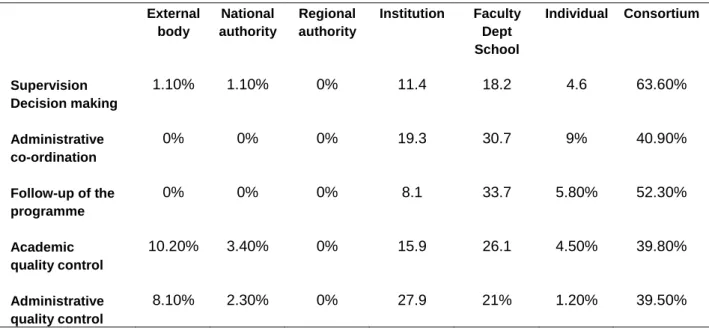
Supervision/decision making-process are mostly performed at consortium level (63.6%), while the administrative coordination is either performed at consortium level (40.9%), for instance through a technical secretariat, or also at the level of the departments/faculties of the partner institutions (30.7%).
The responsibility for the follow up of the programme is shared, again, between the consortium and the faculties or departments, while the selection of students is mostly performed at consortium level.
Academic quality control is mostly performed at consortium level (39.8% each), but often at faculty/department level (26.1%), and also at institution level (15.9%) or external body level (10.2%), while the administrative quality control is mostly done at consortium level (39.5% each) and at institution level (27.9%).
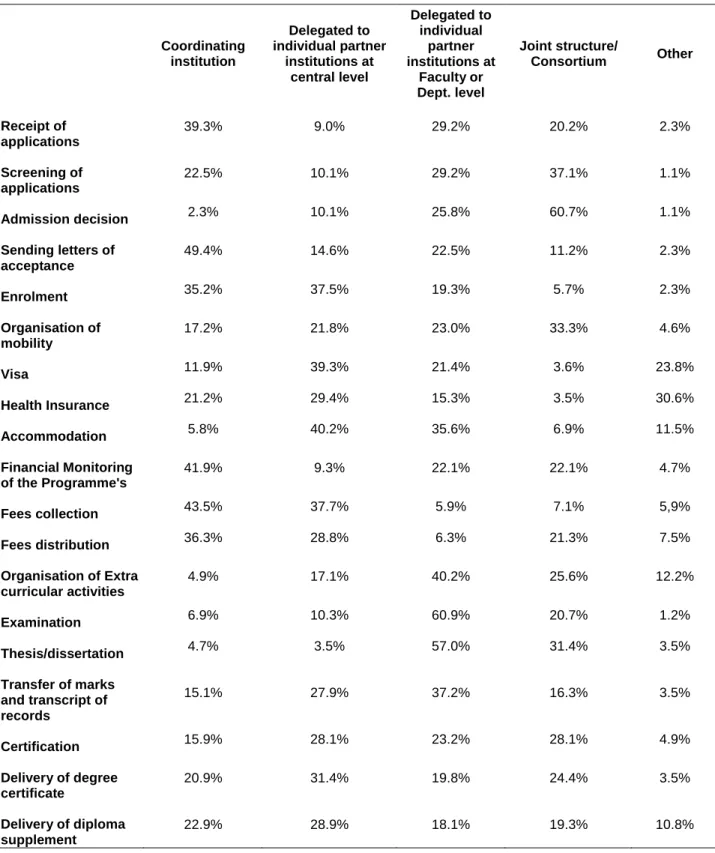
The coordinating institution is usually in charge of receiving the applications, sending letters of acceptance, financially monitoring the programme, collecting and
distributing fees.
The consortium is then in charge of the following tasks: screening of applications, deciding on admission, organising the mobility and issuing the certificate.
The partner institutions are usually in charge of the following tasks: at central level: enrolment, visas, accommodation, certification, delivery of degree certificate and delivery of diploma supplement; at faculty/departmental level: organisation of extra curricular activities; examination, thesis/dissertation and transfer of marks and transcript of records.
Visa and Health Insurance are usually delegated to other instances (mostly the students/individuals concerned).
Based on the above reading, one could identify different models for the organisation of JPs. A centralised organisation, in which the coordinating institution as such is in charge of most of the procedures; an integrated organisation, in which partners delegate most of the procedures to a well identified entity, such as a consortium/technical secretariat; a decentralised organisation, in which partners share the burden and responsibility of performing the various tasks. In most cases, the technical secretariat will be located at the coordinating institution, but it will function as a relay between the partners and the other branches of the institution’s administration.
Depending on the tasks to be achieved, different patterns have been identified:
• Academic tasks, which are under the responsibility of teachers are usually more distributed over the consortium;
• Administrative tasks can be decentralised/delegated to other bodies like IROs or student affairs offices or at the Faculty administrative offices;
18
STUDENTS’ ADMINISTRATION
A specific section of the survey was dedicated to the administrative processes connected to students, from the application phase to the final awarding of the diploma and diploma supplement and a specific chapter of the report is dedicated to the students’ administration timeline” presenting the current procedures and main problems faced in the whole process including the following phases: application, selection, admission, enrolment, registration, monitoring, academic calendar, grading systems and final certification.
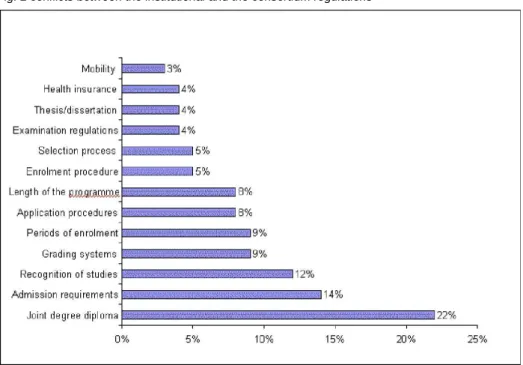
First of all, it can be seen from Fig.1 that the majority of the respondents don’t have conflicts regarding all the above listed points, as the highest rate reported is 36%. The main challenge faced by respondents is the delivery of a joint degree diploma (36%) followed very closely by the grading system issues (33%). The former includes the difficulties with the format, the legality of the joint diploma and its accreditation. Concerning the grading systems, they are mostly different between the partners, thus the transfer of marks among partners institutions may engender problems.
Other challenges include: the admission requirement (25%) in terms of institutional regulations; the examinations regulations (22%); the period of enrolment (22%) as the academic calendar may not be the same at all partner institutions; the application procedures (19%); the recognition of the studies (18%); the enrolment process (17%); the length of the programme (15%) and the thesis dissertation (15%). Selection process (9%), health insurance (8%) and mobility (8%) are considered less problematic. The majority of the problems encountered for the awarding of the joint degree diploma seem to be related to national legislation conflicts, as shown by graph 13. The admission requirements may also lead to conflicts with the national legislation (14%).
Nearly all respondents solved this issue (83%). Recognition of studies may be an issue related to national authorities or legislation, 12% of respondents had or still have conflicts regarding that matter. Half of them found a solution to clear up the problem.
As it is shown by Fig. 2, the main issue between institutional regulation and the consortium, is the grading system (23%). 80% of the institutions have solved the problems related to this issue. The examination regulations may lead to conflicts as well (19%), but most of the institutions have cleared up the problem (87%). In addition, for the period of enrolment, the enrolment procedures, the thesis dissertation and the application procedures, challenges often come from institutional regulation conflicts; most of the respondents have managed to solve these issues. As shown in the 2 graphs above, difficulties regarding the delivery of the joint diploma may come from institutional conflicts, however as we said above, this issue is more often linked to national legislation. As confirmed by a specific question asked on the “academic calendar”, partially confirmed by some study visits, although 72% of the sample was able to adapt the academic calendar to consortium needs, flexibility in calendars is not easy to obtain.
Most of the respondents have experienced conflicts either with national legislation or institutional regulations and have more easily overcome the institutional barriers. Solutions could be either the flexibility of the JPs with regards to general regulation of the institution or a dedicated institutional strategy on JPs. In the first case,
exceptions to ordinary regulations may be awarded to single JPs (“ex – post
passive approach”), while in the second case it is the institution which creates
special regulations valid for all JPs (“ex – ante active approach”). This has also
been applied to solve the problem of harmonisation of academic calendars where flexible solutions have been adopted for JP by their institutions derogating from the general institutional regulations.
20
FINANCIAL MANAGEMENT OF JOINT PROGRAMMES
Joint Programmes require to institutions supplementary investments to cover the additional costs for the organisation and implementation of the programmes. These investments can be either in the form of additional human resources, additional services or scholarships or direct money support. The Erasmus Mundus Programme has introduced the requirement of the common policy on tuition fees, which was almost unexplored by JP in Europe before the EM era, but which requires the harmonisation of an issue – tuition fees – which is linked to the social systems of the Countries concerned, which are, up to now, not harmonised in Europe. Erasmus Mundus, in this sense, has revealed the many national and institutional differences in EU and demanded that measures be taken to synchronise or even harmonise the various national approaches. This is why these issues have raised the interest of the JOIMAN project which has dedicated a specific part of its research to this field.
Tuition fees
Traditionally in Europe, there is a great diversity in national legislations concerning tuition fees. In some countries, such as the United Kingdom, the Netherlands, Portugal etc. all students pay tuition fees, whereas in others, as some Nordic Countries, tuition charged have not (yet) been introduced. This variation is also reflected in the fees being charged in Joint Programmes (JP). The main explanation for not charging tuition fees seems to consist in legal constraints. This goes along with the fact that programmes not charging tuition fees are located in countries where these fees are either not legally possible or holding up a long tradition of “free” university education. Some examples include Norway, Germany (some Federal States), Austria, Czech Republic, and Sweden. Presumably, EMMC can afford to charge students the full costs of their tuition because the EM label renders the programmes more attractive on the educational market. Another explanation might be that their students are often provided with very generous scholarships from the European Commission.
Not all partners in the consortia charge the same tuition fees. In some cases differences are explained by the legal restrictions in some countries. One existing model to overcome that obstacle consists in one member (co-ordinator) of the consortia collecting fees and distributing the money to all the partners. However, this policy is forbidden by some national legislation, e.g. Norwegian. Generally, EMMC seem to be better organised as consortia and share unified policies; non EMMC consortia are more open to meet the needs and consider legal obstacles of every partner. Some of the consortia charge very low fees or none at all. This means that institutions have to invest their own resources or rely on government grants. From the programme’s perspective this leads to a growing dependence on the institutions. Yet the investment out of non-financial motives might increase the quality of the programme as well as the support of JP when facing difficulties with external funding.
Scholarships
Although the sample might be too small for general conclusions, it is obvious that EMMC are better off in terms of their ability to award scholarships. Public sources (EU, state, university) prevail over non-public sources significantly. The
programmes should be encouraged to consider the contact with business sponsors as well. This could have positive side effects on the employability of their
graduates and the curriculum design. Moreover, the amount of EMMC scholarships could attract students of (non EU origin) for economic rather than academic reasons. Additionally, some EMMC JPs are in a kind of dilemma: either they recruit sufficiently from the region they are supposed to regardless of the applicant’s performance, or they miss the EMMC benchmarks in recruiting from a particular region and only enrol the best students regardless of their passport. Student’s merit should always be the dominant criterion to register a student and award a scholarship.
Sustainability
Nearly half of the JP respondents do not have any reserves to ensure sustainability. Apparently, the institution’s motivation for continuing the programmes is high even though serious issues arise in practical terms. The high percentage of non-existing answers and the use of the “do not know” options when questioned about continuity of the JP in the event of external funds ceasing imply a lack of awareness of the matter of sustainability or insecurity when faced with unclear conditions. Yet the findings imply that EMMCs are better informed about financial matters and are more structured in thinking ahead when it comes to sustainability. Many of the experts interviewed during the study visits could not present a strategy to support their programmes. The potential suspension of funding from public sources is not on the agenda until it is about to happen. It was also said that the consortium was built on the personal friendship of the academics involved; when the co-ordinator retires the network is endangered. In addition, administrative personnel in JPs are usually paid out of the JP income; when the income dries up there could be no continuity.
Generally, sustainability is a priority item in JPs which is obviously disastrously underestimated or even ignored. Programmes heavily rely on the
already established funding sources and on public funding in general. In particular EMMC get used to a rather comfortable situation of public funding which has a tranquillising effect. While the JP is running successfully and all the staff are rather busy there is almost no room for the effort to look out for new partners in business or elsewhere away from the well trodden path. Another conclusion would be that many JPs have not been institutionalised yet, i.e. they are regarded as a temporary positive addition to the “regular” study programmes offered, or as a private matter of a professor extraordinarily committed to international exchange. That is why it is often so hard to install a long-term plan to sustain a programme not only academically, but financially as well. A solution could be to install a unit within the administration
of a university which co-ordinates all JPs which is at least partially independent from the funding of the JPs. This unit should accompany and support
22 the programmes administratively from the starting line and ensure their sustainability by developing and monitoring their financial planning, in particular by putting aside reserves and establishing contacts with business or different sources of funding. Institutions could even charge JPs for the service of that unit and, thus, force them to make provisions for sustainability. It might help JP co-ordinators to have a universal terminology at their disposal (e.g. “full costs”, “revenue reserve”, “ad hoc-funding” and “sustainability”) to encourage communication and sharing information which even co-ordinators of the same nation up to the same university do not seem to do yet. In line with this, seminars and get-togethers should be arranged to profit
from mutual experience and to raise awareness about the various matters including the best ignored question of sustainability .
The JPs are not islands, and their inhabitants (academic and administrative co-ordinators) should not operate in splendid isolation, they need professional
development and mutual exchange. The EMMC are a privileged group in this
regard, as they can benefit from EC and National Agencies’ seminars and meetings and from the networking opportunities put in place for them by the stakeholders. However, as the survey clearly shows, the EM model is not the only one and not all the JPs could aim to be part of the EM club. Therefore, information and specialised
training initiatives could be organised by National agencies or institutional units
involving potential coordinators of JP, regardless of the willingness to participate in the EM Programme.
QUALITY ASSURANCE
A specific section of the Survey has been dedicated to QA measures, investigating the QA systems and understandings in the development of the curriculum, for the mobility of students and for the evaluation of the teaching and services of the programmes.
Quality Assurance for the curriculum
With reference to QA for the curriculum, three questions were asked in the Survey. The first question asked the target how they ensure that their programme is a coherent, holistic programme of study and not just a curriculum consisting of separate, loosely compounded modules; the second question aimed to investigate how learning outcomes at programme, module and teaching units level have been defined among the consortium and the third one aimed to know whether guidelines for the workload of students are implemented within the consortium.
A fourth question referred to the quality of the final certification, which we include in this paragraph as we think the quality in the awarding of certification may vary – positively – considerably if it is part of the development and planning phase. Not all respondents demonstrated their understanding of the first question, therefore some of the answers are not usable for this report. However, two main approaches have arisen from the open answers which can summarised by these two main quoted answers:
• The initial design of the JP, which has been jointly developed, is sufficient for the programme to be coherent and holistic;
• Having a periodic evaluation and follow-up system (like a QA committee, a joint board, students evaluation and assessment).
To ensure quality in the awarding of certifications (including the issuing of the diploma), two main answers were identified
• It is regulated in the consortium agreement (52.4%)
• During the planning of the joint programme the awarding of degrees will be agreed within the Consortium (35.3%)
Quality Assurance for the Mobility
Mobility is an intrinsic aspect of JPs and has to be treated with great care, as it is intimately linked with the success of the programme. The answers show that indeed great attention is given to the mobility scheme by the consortia, since precise guidelines and individual counselling are the two main sources of information for students on this delicate matter. Study visits show that counselling of students can be done as follows:
At central level: by offering general guidance and counselling from a specified unit in charge of JPs. At faculty level: by providing more specific guidelines
24
Evaluation
An important part of quality assurance processes are the evaluation and assessment procedures implemented by the programme.
From the study visits it appeared that the JP have put their own evaluation systems in place which in some cases have been added to the regular evaluation activities put in place by each institution or faculty, or in other cases have substituted those activities. Quality assurance offices in the visited institutions have in some cases developed guidelines to be applied before the development of the programmes; those guidelines, however, do not impose any evaluation system which can be defined and agreed among the consortium.
An effective, updated and comprehensive evaluation system is a crucial tool for the success of a joint programme. The system should include regular evaluation of the academic activities (which is mostly the case of our sample) as well as of services (in this case there is a clear need for improvement).
Evaluation should be made by different stakeholders, including the students and the academic staff, as well as the feedback from the labour market which is essential for the adjustment of the curricula. Evaluation procedures allow programmes to be up to date and respondent to students needs and expectations and permit to avoid high drop–out rates.
MAPPING OF THE PROCESSES
The “joint programme life cycle” can be divided in two main macro phases which are the
“development phase” and the “implementation phase”. A third phase, which is
the “marketing of the programme”, can be placed in between, where not considered under the implementation phase. These macro–phases refer to each JP singularly, while the “role of the institution”, in the sense of how each institution is capable and prepared to invest in the internationalisation of education and in particular in JPs, is an important factor which is not necessarily directly related to each singular joint programme but which may considerably influence the macro-phases indicated.
Based on the data presented and commented in the previous chapters, we can assert that the majority of the actions which could prevent the challenges and
problems arising during the implementation phase, need to be addressed in the planning of the programme or can be prevented thanks to the “role of the institution ” in terms of the policy defined and strategy implemented to support joint
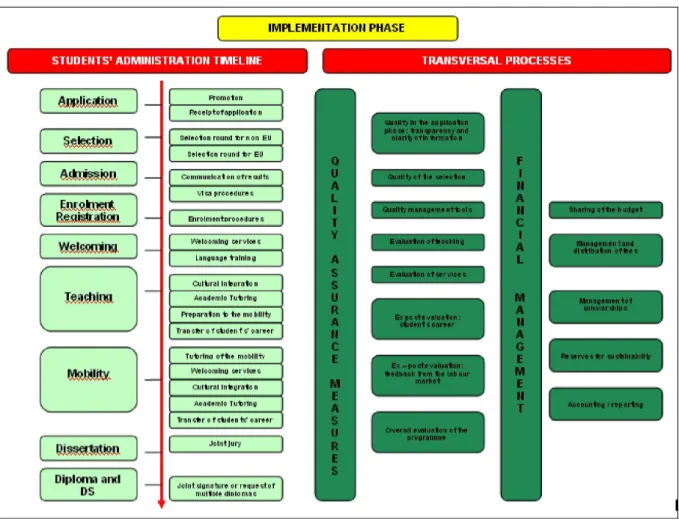
programmes. The graph represented in Figure 3 has been conceived to represent the whole process and to describe the tools which can be adopted in the various phases, while Fig 4 represents in details the implementation phase, with the aim to give a picture of the main activities and processes of the JP implementation.
26
CONCLUSIONS
Based on the sample analysis, we can identify 3 main causes which originated the main obstacles to JPs, 2 of which are exogenous and one is endogenous. The exogenous causes are the national legislation on joint degrees and the national legislation on tuition fees for higher education , the latter more specifically when it is put in relation with the rules of the main European Programmes in support to joint programmes. Among the “endogenous causes” we mention the lack of institutional support or commitment in the joint programmes’ initiatives and the difficulties faced by the actors involved in the processes with regards to the challenges of the international environment.
Starting from the legislative constraints, the main obstacle pointed out is connected with the accreditation of joint degrees. Indeed, in some European countries the accreditation of joint degrees it is still not regulated and consequently the awarding of joint diploma is not possible. However, national legislations on this issue are in a continuing evolution and the governments involved in the Bologna Process are working to harmonise the laws on this theme. However, it seems that the numerous actors involved in the development of joint programmes are not always fully aware of this legislative evolution. On this point the GPR provides recommendations and suggestions in order to overcome the gap of information, proposing a list of specialised organisations to be involved during the development phase. In addition, it has been detected, even from the academic side, a suspicious approach in relationship to joint diplomas since part of the academic world considers joint diploma a certificate which may mislead the labour market and therefore prefers to award double of multiple diplomas which are more “readable” and more easily understood and assessed. In order to remove this obstacle, with a cultural rather than normative nature, information and raise awareness campaigns addressed to the main stakeholders (students first) are necessary.
Concerning the legal constraints generated by the main European Programmes sustaining joint programmes, the main obstacle seems to be the requirement of a common tuition policy among the institutions involved in a funded joint programme. This issue, which need to be addressed by those institutions wishing to apply for the European support, is usually the cause of conflicts among the consortia since the institutions involved belong to higher education systems, and more widely to socio-economic systems, with different approaches and traditions with regards to higher education funding. Therefore, it is often hard and sometimes impossible to harmonise the tuition policies among the institutions involved in a joint programme. On this particular issue, some good practice examples or recommendations can be extracted by the report in order to find, if not a solution, a support for the development of new joint programmes. An additional tool which has been developed by the JOIMAN Network is the table with the description of the national rules (in the 27 EU Countries) on tuition fees at master level.
In addition to the legal constraints above described, for the resolution of which it is necessary a process of raise awareness and change which may need long time and which requires the involvement of all the national and international decision makers, the majority of the obstacles detected by the research appears during the implementation phase of the joint programme and it is linked to the students’ administration in all phases, from the joint application phase to the final certification. Those obstacles can
28 international or national decision makers. It is not possible to find a universal solution for those obstacles, however, in order to avoid being surprised and overwhelmed by them, it is necessary to be fully aware of all the processes in place. At this regard, the Report can be a valid support, mapping all the management processes, identifying the barriers which may arise during all the life cycle of the project and proposing a number of good practices examples and recommendations which may serve to anticipate, avoid or overcome them.
PART I
1.
Methodology and tools
The people involved in the elaboration of this Report are the administrators of the 15 Universities involved in the JOIMAN project, which have been divided in three thematic task forces working separately and coordinated by the Steering Committee of the JOIMAN project. The three groups have been working on the following topics:
1.
Institutional strategies and policies adopted for the development and management of joint programmes, the management structures of joint programmes and the organisation of services and Quality assurance for joint programmes;2.
Educational administrative issues in joint programmes, including application and selection procedures, admission and enrolment practices and the certification and award of diplomas.3.
Financial issues related to joint programmes, including the additional costs of the programmes, tuition policies and the issue of the sustainability of joint programmes.The first step of the working groups was the discussion on the terminology to be adopted; for this purpose a specific “JOIMAN Glossary” was developed, including the most relevant terms related to joint programmes (see annex 5).
The second step consisted in the collection of data to be analysed and processed to be presented and commented in this report. Most of the data have been collected online, thanks to online surveys.
The means for the collection of the data adopted by the project were:
1. A survey on institutional policies of HEIs involved in the development and management of joint programmes;
2. A survey on the organisation of JPs;
3. Study visits and interviews addressed to respondents to the survey or to institutions from Countries not covered by the survey;
4. The collection of cooperation agreement samples from the JOIMAN partners. The following step consisted in the organisation and first analysis of the collected
data with the aim of identifying trends and tendencies as well as the major challenges
encountered by JP coordinators and institutions, and to identify some institutions to be visited in order to deepen the analysis.
After the analysis, study visits to the selected institutions were carried out and research work on the national legislations on tuition fees for higher education programmes was undertaken in parallel.
A separate working group has been working on the analysis of the cooperation agreement samples collected from the partners and has drawn up the cooperation
30
agreement template, which is meant as a transferable tool which could be adopted by
the HE community.
The last step was the consolidation of the data acquired and the presentation of the main findings in this report.
1.1 JOIMAN survey on institutional policies
The Survey on institutional policies (Annex 2) has been designed to gather relevant information on the institutional strategies adopted at central level for the development, management and support for joint programmes. In addition, the survey contains questions on the governance structure of the respondent institutions in order to compare the governance structure, size and typology of the institution with the above mentioned policies adopted for the JPs. The ideal respondent defined by the project is either an academic with administration functions involved in the definition of the policies for JPs (i.e.: Rector’s delegate for international relations or Rector’s delegate for teaching) or administrators involved in the development and management of JPs (i.e.: International relations officers, quality assurance officers etc).
The survey was promoted within the 15 universities involved in the JOIMAN project and beyond the project using the institutional networks of the people involved.
1.2 JOIMAN survey on the organisation of JPs
This survey was designed to collect relevant information on the administration and management phases of the joint programmes. While the survey addressed to administrators referred to institutional policies adopted for all JPs, this survey asked specific questions to academic coordinators on the specific joint programme which they coordinate.
The survey was divided into 4 sections: A. Organisation and Management
B. Educational administrative issues (timeline of students’ administration including application, selection, enrolment and certification and final award of the diploma)
C. Financial issues (including costs calculation, tuition and fees and sustainability issues)
D. Quality assurance
The survey was promoted within the JOIMAN institutions and beyond, using the institutional networks of the JP coordinators and thanks to the information campaign realised by the three Erasmus Mundus National Structures participating in the project. The survey contains 82 questions, including matrix questions, open questions and requests for comments. On one hand this generated a long and detailed questionnaire which may have jeopardised the respondency rate; on the other hand, it allowed the collection of a large amount of data from the respondents and, above all, was an important process for mapping the management procedures of a JP, which can be considered an important tool itself (see annex 3).
1.3 Study Visits
After the closure of the survey, in order to extend the analysis, five study visits and 2 institutional interviews were carried out by the JOIMAN group. Out of the 5 institutions visited, 3 are JOIMAN partners and 2 are external to the network. All 5 institutions were selected on the basis of the answers they provided in the 2 surveys. During the visits, the JOIMAN partners interviewed the administrators in charge of policy implementation and the academic coordinator of JPs. Two additional interviews were carried out to administrators of UK institutions, because the data collected did not represent any UK university.
Institutions visited:
• University of Padova (IT)
• University of Trento (IT)
• University of Antwerp (BE)
• University of Bergen (NO)
• University of Ghent (BE)
Interviews to administrators of UK institutions
• University of Sheffield
• University of Reading
1.4 National regulations on tuition fees
Using the existing networks, the JOIMAN group requested data on the national legislation on tuition fees to one representative of each EU Country with the aim of creating an overview of the ongoing tuition fees policies adopted by each EU Country. The questions asked were:
1. What are the legal regulations in your state system for tuition fees of master programmes?
2. Do they make a distinction on the citizenship of the student? 3. Are there special regulations for joint degrees?
4. Do they distinguish EMMC from others?
The findings of this survey will be added as an annex of this report at the end of the project.
1.5 Cooperation agreement template
The Survey addressed to JP coordinators showed that 95% of the coordinators are currently using a cooperation agreement which can be considered a good practice for the development and management of a new JP if addressed at the very beginning of the development phase. The Survey contained two additional questions on the cooperation agreement:
32 1. Which issues are regulated by the cooperation agreement?
2. Why a cooperation agreement?
The answers to the first question helped the JOIMAN Network to identify what are the most frequently included issues in the cooperation agreement. Furthermore, the second question reinforced the idea that the cooperation agreement is an indispensable tool for the development and running of a JP. Indeed, the vast majority of users replied that the main reason for having a cooperation agreement is because it is a good practice, which may avoid troubles and misunderstandings during the running of the programme
The cooperation agreement template, including administrative and educational issues as well as financial issues related to JP management, is one of the transferable outputs of the JOIMAN project. This output, which is included in the annexes to this report, is meant as a tool which could be adopted by HEIs interested in the development of new JPs, or interested in adapting existing ones to a different quality model.
2.
Presentation of the sample
This chapter intends to introduce the general results of the JOIMAN surveys and to present the sample analysed in terms of quantitative results, geographical coverage, kind of institutions involved and number of JPs covered. A first graphical representation of the sample is provided by the map below, showing the institutions involved either in the survey on institutional policies, the survey on JP organisation and with study visits.
Institutions visited
Answers to survey on JP organisation
34
2.1 Survey on institutional policies
The survey on institutional policies contained questions on the governance structure and on the policies and strategies implemented at institutional level for the development and management of JPs. A specific question aimed to identify the size of the institution in terms of number of students enrolled and number of programmes implemented at bachelor and master level, while the last question of the survey asked respondents the total number of joint programmes activated by their institution.
The questionnaire ran from the 1st May to 22nd June. The total number of questionnaires received was 36 from 36 different institutions.
The total number of countries covered is 19; the graph below shows the distribution of respondents per Country.
Graph 1
The above graph shows that the 30% of the respondents come from France and the rest of the sample is distributed quite homogenously. Out of the 19 Countries represented, 15 are Members of the EU (France, Germany, Belgium, Italy, Austria, Hungary, Finland, Nederland, Czech Republic, Sweden, Portugal, Romania, Slovenia and Lithuania) 1 is member of EFTA (Norway) and 3 are not members of the EU (Republic of Serbia, Albania and Armenia).
Concerning the Governance structure, as shown in graph 2, the vast majority of institutions are public institutions (31 out of 36 respondents i.e. 86% of the sample). Although 5 institutions are private, only 3 respondents stated that they receive their main financial resources from sources other than the State or Regional Government. More than half of the sample defined themselves as centralised and autonomous, while 7 institutions are based in more than one city.
Distribution of respondents per Country
11
2 1
5
3
1 1 1 1 1 1 1 1 1 1 1 1 1 1 0
2 4 6 8 10 12
Graph 2
Concerning the size of the institutions represented by the sample, Graph 3 represents the distribution of respondents grouped per number of students enrolled.
Graph 3
It can be noted that essentially the same percentage of respondents represent respectively very small institutions (less than 1000 students enrolled), small institutions (from 1000 to 10000 students enrolled), medium sized institutions (10000 to 30000 students enrolled) and big institutions (from 30000 to 50000 students enrolled). Two additional institutions are to be considered “very big” (more than 50000 students enrolled).
The above described data on the size of institutions is confirmed by the distribution of respondents per number of bachelor and master programmes offered (Graphs 4 and 5).
Governance Structure
86%
56% 58%
19%
0% 10% 20% 30% 40% 50% 60% 70% 80% 90% 100%
Public Centralised Autonomous Multi city
Respondents grouped per number of students enrolled
0 1 2 3 4 5 6 7 8 9 10
X < 1000 1000 < X < 10000 10000 < X < 30000 30000 < X < 50000 X > 50000
36 Graph 4
Graph 5
It is also relevant to note that all respondents but 1 are both teaching and research institutions, regardless of their size.
The last question of the survey asked the respondents to indicate the total number of JPs developed at bachelor, master and doctoral level.
The total number of JPs represented by the sample at the first two cycles is 184 (28 at bachelor and 156 at master level). At doctoral level, the sample represents 59 implemented JPs, but this data may not be relevant as the survey did not give the respondent a proper definition of joint programmes at doctoral level. However, it is interesting to note that two thirds of the respondents have implemented JP at master level, while only one third of the sample have implemented JP at bachelor and doctoral level.
Respondents grouped per number of bachelor programmes 0 1 2 3 4 5 6 7 8 9
X < 10 10 < X < 30 30< X < 50 50 < X < 70 70 < X < 100 X > 100 number of bachelor programmes
r e s p o n d e n t s
Respondents grouped per number of master programmes 0 1 2 3 4 5 6 7 8 9
X < 10 10 < X < 30 30< X < 50 50 < X < 70 70 < X < 100 X > 100 number of master programmes
r e s p o n d e n t s
2.2 JOIMAN survey on the organisation of joint programmes
The survey on the organisation of JPs, addressed mainly to JP academic coordinators, aimed to gather relevant information on specific joint programmes managed or coordinated by the respondent.
The total number of valid questionnaires received is 89, covering 45 different institutions in 15 European Countries. The total number of JPs represented by the sample is 75 as some questionnaires have been filled in by more than one partner of the same JP. Graph 6 presents the distribution of the sample by Country:
Graph 6
As can be seen in Graph 7, 34 respondents represent an EMMC while 55 are “non Erasmus Mundus” programmes.
Graph 7
EMMCs vs non EMMCs
34; 38%
55; 62%
EMMC non EMMC
Questionnaires received per Country and number of Institutions per Country
8
2 1 3
17
3 16
1 24
2 1 3 2 2 4
3 2
1 1
14
1 7
1 7
2 1 1 1 2 1
0 5 10 15 20 25 30
AT BE CY CZ DE ES FR IE IT LT LV NO PT RO SE Number of questionnaires received Number of Institutions