COMMON EUROPEAN FRAMEWORK
OF REFERENCE FOR LANGUAGES:
LEARNING, TEACHING, ASSESSMENT
Language Policy Unit, Strasbourg
CONTENTS
Prefatory Note
Notes for the user
Synopsis
Chapter 1:
The Common European Framework in its political and educational context
Chapter 2:
Approach adopted
Chapter 3:
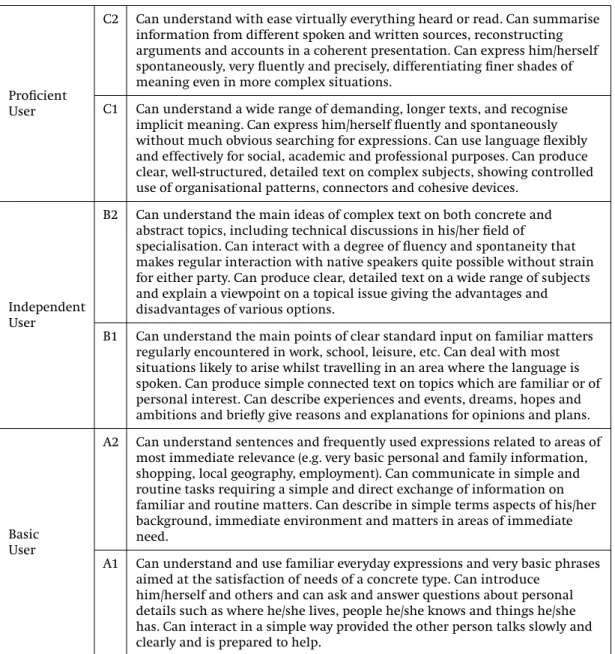
Common Reference Levels
Chapter 4:
Language use and the language user/learner
Chapter 5:
The user/learner’s competences
Chapter 6:
Language learning and teaching
Chapter 7:
Tasks and their role in language teaching
Chapter 8:
Linguistic diversification and the curriculum
Chapter 9:
Assessment
General Bibliography
Appendix A:
developing proficiency descriptors
Appendix B:
The illustrative scales of descriptors
Appendix C:
The DIALANG scales
Appendix D:
The ALTE ‘Can Do’ statements
This restructured version of the Common European Framework of reference for language
learning, teaching and assessment represents the latest stage in a process which has been actively
pursued since 1971 and owes much to the collaboration of many members of the teaching
profession across Europe and beyond.
The Council of Europe therefore acknowledges with gratitude the contribution made by:
•
The Project Group
Language Learning for European Citizenship
, representing all member
countries of the Council for Cultural Co-operation with Canada as a participating observer,
for their general oversight of its development.
•
The Working Party set up by the Project Group, with twenty representatives from member
countries representing the different professional interests concerned, as well as
representatives of the European Commission and its LINGUA programme, for their
invaluable advice and supervision of the project;
•
The Authoring Group set up by the Working Party, consisting of Dr. J.L.M. Trim (Project
Director), Professor D. Coste (Ecole Normale Supérieure de Fontenay/Saint Cloud, CREDIF,
France), Dr. B. North (Eurocentres Foundation, Switzerland) together with Mr. J. Sheils
(Secretariat). The Council of Europe expresses its thanks to the institutions mentioned for
making it possible for the experts concerned to contribute to this important work.
•
The Swiss National Science Foundation for their support of the work by Dr B. North and
Professor G. Schneider (University of Fribourg) to develop and scale descriptors of language
proficiency for the Common Reference Levels.
•
The Eurocentres Foundation for making available their experience in defining and scaling
levels of language proficiency.
•
The U. S. National Foreign Languages Center for providing Mellon Fellowships to Dr Trim
and Dr North which facilitated their contribution.
•
The many colleagues and institutions across Europe, who responded, often with great care
and in concrete detail, to the request for feedback on earlier drafts.
The feedback received has been taken into account in revising the Framework and User Guides prior
to their adoption on a Europe-wide basis. This revision was carried out by Dr J.L.M. Trim and Dr B.
North.
NOTES FOR THE USER
The aim of these notes is to help you to use the Common European Framework for language
learning, teaching and assessment more effectively, either as a language learner or as a member of
one of the professions concerned with language teaching and assessment. They will not be
concerned with specific ways in which teachers, examiners, textbook writers, teacher trainers,
educational administrators, etc. may use the Framework. These are the subject of special guidance
addressed to the particular category of user concerned, contained in a fuller User Guide available
from the Council of Europe, which can also be consulted on its website. These notes are meant as a
first introduction to the Framework for all its users.
You may, of course, use the Framework document in any way you wish, as with any other
publication. Indeed, we hope that some readers may be stimulated to use it in ways we have not
foreseen. However, it has been written with two main aims in mind:
1. To encourage practitioners of all kinds in the language field, including language learners
themselves, to reflect on such questions as:
•
what do we actually do when we speak (or write) to each other?
•
what enables us to act in this way?
•
how much of this do we need to learn when we try to use a new language?
•
how do we set our objectives and mark our progress along the path from total ignorance
to effective mastery?
•
how does language learning take place?
•
what can we do to help ourselves and other people to learn a language better?
2. To make it easier for practitioners to tell each other and their clientèle what they wish to help
learners to achieve, and how they attempt to do so.
One thing should be made clear right away. We have NOT set out to tell practitioners what to do, or
how to do it. We are raising questions, not answering them. It is not the function of the Common
European Framework to lay down the objectives that users should pursue or the methods they
should employ.
This does not mean that the Council of Europe is indifferent to these issues. Indeed, a great deal of
thought and work has been put into the principles and practice of language learning, teaching and
assessment over the years by colleagues in our member countries working together in the Council of
Europe's Modern Languages Projects. You will find the basic principles and their practical
consequences set out in Chapter 1. You will see that the Council is concerned to improve the quality
of communication among Europeans of different language and cultural backgrounds. This is because
better communication leads to freer mobility and more direct contact, which in turn leads to better
understanding and closer co-operation. The Council also supports methods of learning and teaching
they need to become more independent in thought and action, and also more responsible and
co-operative in relation to other people. In this way the work contributes to the promotion of
democratic citizenship.
Given these fundamental aims, the Council encourages all those concerned with the organisation of
language learning to base their work on the needs, motivations, characteristics and resources of
learners. This means answering questions such as:
•
What will l earners need to do with the language?
•
What do they need to learn in order to be able to use the language to achieve those ends?
•
What makes them want to learn?
•
What sort of people are they (age, sex, social and educational background, etc.)
•
What knowledge, skills and experiences do their teachers possess?
•
What access do they have to course books, works of reference (dictionaries, grammars, etc.),
audio-visual aids, computer hard - and software, etc.?
•
How much time can they afford (or are willing, or able) to spend?
On the basis of this analysis of the learning/teaching situation, it is seen as fundamentally important
to define, clearly and explicitly, objectives which are at once worthwhile in terms of learner needs
and realistic in terms of their characteristics and resources. Many parties are concerned with
organised language learning, not only the teachers and learners in the classroom, but also
educational authorities, examiners, textbook writers and publishers, etc. If they agree on objectives,
they can work coherently, even if quite separately, to help learners achieve them. They are also in a
position to make their own objectives and methods clear and explicit for the benefit of those who use
the products of their work.
As explained in Chapter 1, it is for this purpose that the Common European Framework of reference
has been developed. To perform its function it must satisfy certain criteria. It must be
comprehensive, transparent and coherent.
These criteria are also set out and explained in Chapter 1. A further word may be useful in respect of
'comprehensive'. This means simply that you should find in it all you need to describe your
objectives, methods and products. The scheme of parameters, categories and examples explained in
Chapter 2 (most compactly in the boxed text at the beginning) and presented in some detail in
Chapters 4 and 5 is intended to give a clear picture of the competences (knowledge, skills, attitudes)
which language users build up in the course of their experience of language use and which enable
them to meet the challenges of communication across language and cultural boundaries (i.e. to carry
out communicative tasks and activities in the various contexts of social life with their conditions and
constraints). The common reference levels introduced in Chapter 3 offer a means to map progress as
learners build up their proficiency across the parameters of the descriptive scheme.
On the assumption that the aim of language teaching is to make learners competent and proficient in
the language concerned, the scheme should enable you to define and describe your objectives clearly
and comprehensively. You may well find that this scheme contains more than you yourself need.
From Chapter 4 onwards you will find sets of questions at the end of each section, which invite you
to consider whether the section is relevant to your objectives and concerns, and if so how. You may
decide that it is not relevant, perhaps because it is not appropriate to the learners you have in mind,
or that, while it would be useful to them, it is not a priority given limited time and other resources. In
that case you can ignore the section. If however it is relevant (and perhaps seeing it in context may
draw it to your attention), Chapters 4 and 5 of the Framework will supply names for major
parameters and categories for your use, with some examples.
Neither the categories nor the examples claim to be exhaustive. If you want to describe a specialised
area, you may well need to sub-categorise further than the present classification goes. The examples
are suggestive only. You may well wish to keep some, reject others and add some of your own. You
should feel quite free to do so, since it must be for you to decide on your objectives and your
product. Remember that what you find unnecessary has its place in the Framework because someone
else, with a different background, working in a different situation and responsible for a different set
of learners, may find it essential. In the case of ‘conditions and constraints’ for instance, a school
teacher may find it quite unnecessary to take noise levels into account, but a teacher of airline pilots
who fails to train them to recognise digits 100 % in appallingly noisy ground-to-air communication
may condemn them and their passengers to death! On the other hand, the additional categories and
exponents you find it necessary to add may well be found useful by other users. For this reason, the
taxonomic scheme presented in Chapters 4 and 5 of the Framework is not seen as a closed system,
but one which is open to further development in the light of experience.
This principle also applies to the description of levels of proficiency. Chapter 3 explains clearly that
the number of levels which a particular user wishes to distinguish is determined by the reason for
making the distinction, the use to be made of the resulting information. Levels, like entities, should
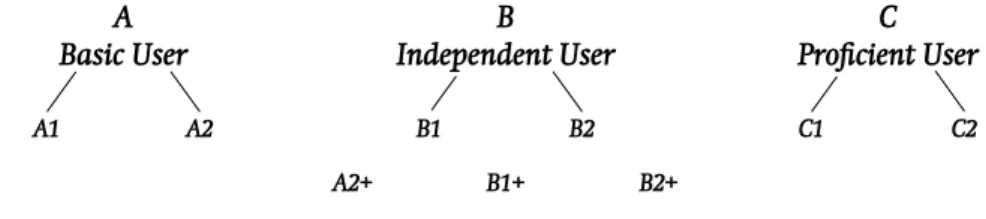
not be multiplied beyond necessity! The 'hypertext' branching principle, set out in section 3.4,
enables practitioners to establish broad- or narrow-band levels in accordance with their need to make
finer or coarser distinctions among a population of learners. It is also, of course, possible (even
usual) to distinguish between objectives in terms of levels, and the achievement of those objectives
in terms of grades.
The six-level frame used throughout is based on the normal practice of a number of public
examining bodies. The descriptors proposed are based on those which "have been found transparent,
useful and relevant by groups of non-native and native-speaker teachers from a variety of
educational sectors with very different profiles in terms of linguistic training and teaching
experience" (p. 30). They are nevertheless presented as recommendations and are not in any way
mandatory, “as a basis for reflection, discussion and further action... The aim of the examples is to
common reference levels as a calibrating instrument is particularly welcomed by practitioners of all
kinds who, as in many other fields, find it advantageous to work with stable, accepted standards of
measurement and format.
As a user, you are invited to use the scaling system and associated descriptors critically. The Modern
Languages Section of the Council of Europe will be glad to receive a report of your experience in
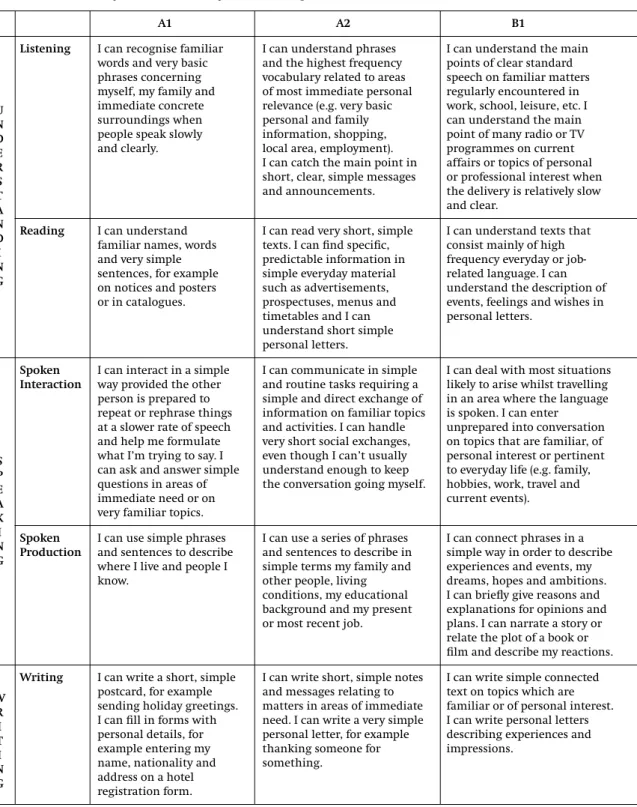
putting them into use. Please note also that scales are provided not only for a global proficiency, but
for many of the parameters of language proficiency detailed in Chapters 4 and 5. This makes it
possible to specify differentiated profiles for particular learners or groups of learners.
In Chapter 6, attention turns to questions of method. How is a new language acquired or learnt?
What can we do to facilitate that learning or acquisition process? Here again, the aim of the
Framework is not to prescribe or even recommend a particular method, but to present options,
inviting you to reflect on your current practice, to take decisions accordingly and to describe what
you actually do. Of course, when considering your aims and objectives we would encourage you to
take into consideration the Recommendations of the Committee of Ministers, but the aim of the
Framework is to assist you in your own decision-taking. Chapter 7 is devoted to a closer
examination of the role of tasks in language learning and teaching, as one of the main areas of
advance in recent years.
Chapter 8 discusses the principles of curriculum design involving the differentiation of language
learning objectives, especially in the context of building an individual's plurilingual and pluricultural
competence in order to deal with the communicative challenges posed by living in a multilingual
and multicultural Europe. The chapter deserves close study by those who are devising curricula
covering a number of languages and considering the options open to them in seeking the best way to
distribute resources for various categories of learners.
Chapter 9 passes finally to questions of assessment, explaining the relevance of the Framework to
the assessment of language proficiency and achievement, and then with assessment criteria and
different approaches to the assessment process.
The appendices deal with some further aspects of scaling which interested users may find useful.
Appendix A deals with some general and theoretical concerns for the benefit of users who wish to
develop scales specifically geared to a particular population of learners. Appendix B gives
information concerning the Swiss project which developed the scaling descriptors used in this
Framework. Appendices C and D present scales developed by other agencies, namely the
DIALANG Language Assessment System and the ‘Can-do’ scales of the Association of Language
Testers in Europe (ALTE).
SYNOPSIS
Chapter 1 defines the aims, objectives and functions of the proposed Framework in the light of
the overall language policy of the Council of Europe and in particular the promotion of
plurilingualism in response to European linguistic and cultural diversity. It then sets out the
criteria which the Framework should satisfy
Chapter 2 explains the approach adopted. The descriptive scheme is based on an analysis of
language use in terms of the strategies used by learners to activate general and communicative
competences in order to carry out the activities and processes involved in the production and
reception of texts and the construction of discourse dealing with particular themes, which enable
them to fulfil the tasks facing them under the given conditions and constraints in the situations
which arise in the various domains of social existence. The words underlined designate the
parameters for the description of language use and the user/learner's ability to use language.
Chapter 3 introduces the common reference levels. Progress in language learning with regard to
the parameters of the descriptive scheme can be calibrated in terms of a flexible series of levels of
attainment defined by appropriate descriptors. This apparatus should be rich enough to
accommodate the full range of learner needs and thus the objectives pursued by different
providers, or required of candidates for language qualifications.
Chapter 4 establishes in some (but not exhaustive or definitive) detail the categories (scaled
where possible) needed for the description of language use and the language user/learner
according to the parameters identified, covering in turn: the domains and situations providing the
context for language use; the themes, tasks and purposes of communication; communicative
activities, strategies and processes; and text; especially in relation to activities and media.
Chapter 5 categorises in detail the user/learner's general and communicative competences, scaled
where possible.
Chapter 6 considers the processes of language learning and teaching, dealing with the relation
between acquisition and learning and with the nature and development of plurilingual
competence, as well as with methodological options of a general or more specific kind, in relation
to the categories set out in Chapters 3 & 4.
Chapter 7 examines in greater detail the role of tasks in language learning and teaching
Chapter 8 is concerned with the implications of linguistic diversification for curriculum design
and considers such issues as: plurilingualism and pluriculturalism; differentiated learning
objectives; principles of curriculum design; curricular scenarios; life-long language learning;
modularity and partial competences.
Chapter 9 discusses the various purposes of assessment and corresponding assessment types, in
the light of the need to reconcile the competing criteria of comprehensiveness, precision and
operational feasibility. The General Bibliography contains a selection of books and articles which
users of the Framework may wish to consult in order to go into greater depth with regard to the
published elsewhere.
Appendix A discusses development of descriptors of language proficiency. Methods of and
criteria for, scaling and the requirements for formulating descriptors for the parameters and
categories presented elsewhere. are explained.
Appendix B gives an overview of the project in Switzerland which developed and scaled the
illustrative descriptors. The illustrative scales in the text are listed with page references.
Appendix C contains the descriptors for self-assessment at series of levels adopted by the
DIALANG Project of the European Commission for use on the Internet.
Appendix D contains the "Can Do" descriptors at the series of levels developed by the
Association of Language Testers in Europe (ALTE)
1
The Common European Framework in its political
and educational context
1.1 What is the Common European Framework?
The Common European Framework provides a common basis for the elaboration of lan-guage syllabuses, curriculum guidelines, examinations, textbooks, etc. across Europe. It describes in a comprehensive way what language learners have to learn to do in order to use a language for communication and what knowledge and skills they have to develop so as to be able to act effectively. The description also covers the cultural context in which language is set. The Framework also defines levels of proficiency which allow learners’ progress to be measured at each stage of learning and on a life-long basis.
The Common European Framework is intended to overcome the barriers to communi-cation among professionals working in the field of modern languages arising from the different educational systems in Europe. It provides the means for educational adminis-trators, course designers, teachers, teacher trainers, examining bodies, etc., to reflect on their current practice, with a view to situating and co-ordinating their efforts and to ensuring that they meet the real needs of the learners for whom they are responsible.
By providing a common basis for the explicit description of objectives, content and methods, the Framework will enhance the transparency of courses, syllabuses and qual-ifications, thus promoting international co-operation in the field of modern languages. The provision of objective criteria for describing language proficiency will facilitate the mutual recognition of qualifications gained in different learning contexts, and accord-ingly will aid European mobility.
The taxonomic nature of the Framework inevitably means trying to handle the great complexity of human language by breaking language competence down into separate components. This confronts us with psychological and pedagogical problems of some depth. Communication calls upon the whole human being. The competences separated and classified below interact in complex ways in the development of each unique human personality. As a social agent, each individual forms relationships with a widening cluster of overlapping social groups, which together define identity. In an intercultural approach, it is a central objective of language education to promote the favourable devel-opment of the learner’s whole personality and sense of identity in response to the enrich-ing experience of otherness in language and culture. It must be left to teachers and the learners themselves to reintegrate the many parts into a healthily developing whole.
The Framework includes the description of ‘partial’ qualifications, appropriate when only a more restricted knowledge of a language is required (e.g. for understanding rather than speaking), or when a limited amount of time is available for the learning of a third or fourth language and more useful results can perhaps be attained by aiming
at, say, recognition rather than recall skills. Giving formal recognition to such abilities will help to promote plurilingualism through the learning of a wider variety of European languages.
1.2 The aims and objectives of Council of Europe language policy
CEF serves the overall aim of the Council of Europe as defined in Recommendations R (82) 18 and R (98) 6 of the Committee of Ministers: ‘to achieve greater unity among its members’ and to pursue this aim ‘by the adoption of common action in the cultural field’. The work of the Council for Cultural Co-operation of the Council of Europe with regard to modern languages, organised since its foundation in a series of medium-term projects, has derived its coherence and continuity from adherence to three basic principles set down in the preamble to Recommendation R (82) 18 of the Committee of Ministers of the Council of Europe:
• that the rich heritage of diverse languages and cultures in Europe is a valu-able common resource to be protected and developed, and that a major edu-cational effort is needed to convert that diversity from a barrier to communication into a source of mutual enrichment and understanding; • that it is only through a better knowledge of European modern languages
that it will be possible to facilitate communication and interaction among Europeans of different mother tongues in order to promote European mobil-ity, mutual understanding and co-operation, and overcome prejudice and dis-crimination;
• that member states, when adopting or developing national policies in the field of modern language learning and teaching, may achieve greater conver-gence at the European level by means of appropriate arrangements for ongoing co-operation and co-ordination of policies.
In the pursuit of these principles, the Committee of Ministers called upon member governments
(F14) To promote the national and international collaboration of governmental and non-governmental institutions engaged in the development of methods of teaching and evaluation in the field of modern language learning and in the pro-duction and use of materials, including institutions engaged in the propro-duction and use of multi-media materials.
(F17) To take such steps as are necessary to complete the establishment of an effec-tive European system of information exchange covering all aspects of language learning, teaching and research, and making full use of information technology. Consequently, the activities of the CDCC (Council for Cultural Co-operation), its Committee for Education and its Modern Languages Section, have been concerned to encourage, support and co-ordinate the efforts of member governments and non-governmental institutions to improve language learning in accordance with these
funda-mental principles and in particular the steps which they take to implement the general measures set out in the Appendix to R(82)18:
A. General measures
1. To ensure, as far as possible, that all sections of their populations have access to effective means of acquiring a knowledge of the languages of other member states (or of other communities within their own country) as well as the skills in the use of those languages that will enable them to satisfy their communicative needs and in particular:
. 1.1 to deal with the business of everyday life in another country, and to help foreigners staying in their own country to do so;
. 1.2 to exchange information and ideas with young people and adults who speak a different language and to communicate their thoughts and feel-ings to them;
. 1.3 to achieve a wider and deeper understanding of the way of life and forms of thought of other peoples and of their cultural heritage. 2. To promote, encourage and support the efforts of teachers and learners at all
levels to apply in their own situation the principles of the construction of language-learning systems (as these are progressively developed within the Council of Europe ‘Modern languages’ programme):
. 2.1 by basing language teaching and learning on the needs, motivations, characteristics and resources of learners;
. 2.2 by defining worthwhile and realistic objectives as explicitly as possible; . 2.3 by developing appropriate methods and materials;
. 2.4 by developing suitable forms and instruments for the evaluating of learning programmes.
3. To promote research and development programmes leading to the introduc-tion, at all educational levels, of methods and materials best suited to ena-bling different classes and types of student to acquire a communicative proficiency appropriate to their specific needs.
The preamble to R(98)6 reaffirms the political objectives of its actions in the field of modern languages:
• To equip all Europeans for the challenges of intensified international mobil-ity and closer co-operation not only in education, culture and science but also in trade and industry.
• To promote mutual understanding and tolerance, respect for identities and cultural diversity through more effective international communication. • To maintain and further develop the richness and diversity of European
cul-tural life through greater mutual knowledge of national and regional lan-guages, including those less widely taught.
• To meet the needs of a multilingual and multicultural Europe by appreciably developing the ability of Europeans to communicate with each other across linguistic and cultural boundaries, which requires a sustained, lifelong effort to be encouraged, put on an organised footing and financed at all levels of education by the competent bodies.
• To avert the dangers that might result from the marginalisation of those lacking the skills necessary to communicate in an interactive Europe. Particular urgency was attached to these objectives by the First Summit of Heads of State, which identified xenophobia and ultra-nationalist backlashes as a primary obstacle to European mobility and integration, and as a major threat to European stability and to the healthy functioning of democracy. The second summit made preparation for demo-cratic citizenship a priority educational objective, thus giving added importance to a further objective pursued in recent projects, namely:
To promote methods of modern language teaching which will strengthen inde-pendence of thought, judgement and action, combined with social skills and responsibility.
In the light of these objectives, the Committee of Ministers stressed ‘the political impor-tance at the present time and in the future of developing specific fields of action, such as strategies for diversifying and intensifying language learning in order to promote plu-rilingualism in a pan-European context’ and drew attention to the value of further devel-oping educational links and exchanges and of exploiting the full potential of new communication and information technologies.
1.3 What is ‘plurilingualism’?
In recent years, the concept of plurilingualism has grown in importance in the Council of Europe’s approach to language learning. Plurilingualism differs from multilingual-ism, which is the knowledge of a number of languages, or the co-existence of different languages in a given society. Multilingualism may be attained by simply diversifying the languages on offer in a particular school or educational system, or by encouraging pupils to learn more than one foreign language, or reducing the dominant position of English in international communication. Beyond this, the plurilingual approach emphasises the fact that as an individual person’s experience of language in its cultural contexts expands, from the language of the home to that of society at large and then to the lan-guages of other peoples (whether learnt at school or college, or by direct experience), he or she does not keep these languages and cultures in strictly separated mental compart-ments, but rather builds up a communicative competence to which all knowledge and experience of language contributes and in which languages interrelate and interact. In different situations, a person can call flexibly upon different parts of this competence to achieve effective communication with a particular interlocutor. For instance, partners may switch from one language or dialect to another, exploiting the ability of each to express themselves in one language and to understand the other; or a person may call upon the knowledge of a number of languages to make sense of a text, written or even spoken, in a previously ‘unknown’ language, recognising words from a common interna-tional store in a new guise. Those with some knowledge, even slight, may use it to help those with none to communicate by mediating between individuals with no common language. In the absence of a mediator, such individuals may nevertheless achieve some degree of communication by bringing the whole of their linguistic equipment into play,
experimenting with alternative forms of expression in different languages or dialects, exploiting paralinguistics (mime, gesture, facial expression, etc.) and radically simplify-ing their use of language.
From this perspective, the aim of language education is profoundly modified. It is no longer seen as simply to achieve ‘mastery’ of one or two, or even three languages, each taken in isolation, with the ‘ideal native speaker’ as the ultimate model. Instead, the aim is to develop a linguistic repertory, in which all linguistic abilities have a place. This implies, of course, that the languages offered in educational institutions should be diver-sified and students given the opportunity to develop a plurilingual competence. Furthermore, once it is recognised that language learning is a lifelong task, the develop-ment of a young person’s motivation, skill and confidence in facing new language expe-rience out of school comes to be of central importance. The responsibilities of educational authorities, qualifying examining bodies and teachers cannot simply be confined to the attainment of a given level of proficiency in a particular language at a particular moment in time, important though that undoubtedly is.
The full implications of such a paradigm shift have yet to be worked out and translated into action. The recent developments in the Council of Europe’s language programme have been designed to produce tools for use by all members of the language teaching pro-fession in the promotion of plurilingualism. In particular, The European Language Portfolio (ELP) provides a format in which language learning and intercultural experi-ences of the most diverse kinds can be recorded and formally recognised. For this purpose, CEF not only provides a scaling of overall language proficiency in a given language, but also a breakdown of language use and language competences which will make it easier for practitioners to specify objectives and describe achievements of the most diverse kinds in accordance with the varying needs, characteristics and resources of learners.
1.4 Why is CEF needed?
In the words of the Intergovernmental Symposium held in Rüschlikon, Switzerland November 1991, on the initiative of the Swiss Federal Government, on: ‘Transparency and Coherence in Language Learning in Europe: Objectives, Evaluation, Certification’:
1. A further intensification of language learning and teaching in member coun-tries is necessary in the interests of greater mobility, more effective interna-tional communication combined with respect for identity and cultural diversity, better access to information, more intensive personal interaction, improved working relations and a deeper mutual understanding.
2. To achieve these aims language learning is necessarily a life-long task to be promoted and facilitated throughout educational systems, from pre-school through to adult education.
3. It is desirable to develop a Common European Framework of reference for language learning at all levels, in order to:
. • promote and facilitate co-operation among educational institutions in different countries;
. • provide a sound basis for the mutual recognition of language qualifica-tions;
. • assist learners, teachers, course designers, examining bodies and educa-tional administrators to situate and co-ordinate their efforts.
Plurilingualism has itself to be seen in the context of pluriculturalism. Language is not only a major aspect of culture, but also a means of access to cultural manifestations. Much of what is said above applies equally in the more general field: in a person’s cultu-ral competence, the various cultures (national, regional, social) to which that person has gained access do not simply co-exist side by side; they are compared, contrasted and actively interact to produce an enriched, integrated pluricultural competence, of which plurilingual competence is one component, again interacting with other components.
1.5 For what uses is CEF intended?
The uses of the Framework include:
The planning of language learning programmes in terms of:
• their assumptions regarding prior knowledge, and their articulation with earlier learning, particularly at interfaces between primary, lower secondary, upper secon-dary and higher/further education;
• their objectives; • their content.
The planning of language certification in terms of: • the content syllabus of examinations;
• assessment criteria, in terms of positive achievement rather than negative deficien-cies.
The planning of self-directed learning, including:
• raising the learner’s awareness of his or her present state of knowledge; • self-setting of feasible and worthwhile objectives;
• selection of materials; • self-assessment.
Learning programmes and certification can be:
• global, bringing a learner forward in all dimensions of language proficiency and com-municative competence;
• modular, improving the learner’s proficiency in a restricted area for a particular purpose;
• weighted, emphasising learning in certain directions and producing a ‘profile’ in which a higher level is attained in some areas of knowledge and skill than others; • partial, taking responsibility only for certain activities and skills (e.g. reception) and
The Common European Framework is constructed so as to accommodate these various forms.
In considering the role of a common framework at more advanced stages of language learning it is necessary to take into account changes in the nature of needs of learners and the context in which they live, study and work. There is a need for general qualifica-tions at a level beyond threshold, which may be situated with reference to the CEF. They have, of course, to be well defined, properly adapted to national situations and embrace new areas, particularly in the cultural field and more specialised domains. In addition, a considerable role may be played by modules or clusters of modules geared to the specific needs, characteristics and resources of learners.
1.6 What criteria must CEF meet?
In order to fulfil its functions, such a Common European Framework must be compre-hensive, transparent and coherent.
By ‘comprehensive’ is meant that the Common European Framework should attempt to specify as full a range of language knowledge, skills and use as possible (without of course attempting to forecast a prioriall possible uses of language in all situations – an impossible task), and that all users should be able to describe their objectives, etc., by reference to it. CEF should differentiate the various dimensions in which language proficiency is described, and provide a series of reference points (levels or steps) by which progress in learning can be calibrated. It should be borne in mind that the development of communi-cative proficiency involves other dimensions than the strictly linguistic (e.g. sociocultural awareness, imaginative experience, affective relations, learning to learn, etc.).
By ‘transparent’ is meant that information must be clearly formulated and explicit, available and readily comprehensible to users.
By ‘coherent’ is meant that the description is free from internal contradictions. With regard to educational systems, coherence requires that there is a harmonious relation among their components:
• the identification of needs; • the determination of objectives; • the definition of content;
• the selection or creation of material;
• the establishment of teaching/learning programmes; • the teaching and learning methods employed; • evaluation, testing and assessment.
The construction of a comprehensive, transparent and coherent framework for language learning and teaching does not imply the imposition of one single uniform system. On the contrary, the framework should be open and flexible, so that it can be applied, with such adaptations as prove necessary, to particular situations. CEF should be:
• multi-purpose: usable for the full variety of purposes involved in the planning and pro-vision of facilities for language learning
• flexible: adaptable for use in different circumstances
• open: capable of further extension and refinement
• dynamic: in continuous evolution in response to experience in its use
• user-friendly: presented in a form readily understandable and usable by those to whom it is addressed
• non-dogmatic: not irrevocably and exclusively attached to any one of a number of com-peting linguistic or educational theories or practices.
2
Approach adopted
2.1 An action-oriented approach
A comprehensive, transparent and coherent frame of reference for language learning, teaching and assessment must relate to a very general view of language use and learn-ing. The approach adopted here, generally speaking, is an action-oriented one in so far as it views users and learners of a language primarily as ‘social agents’, i.e. members of society who have tasks (not exclusively language-related) to accomplish in a given set of circumstances, in a specific environment and within a particular field of action. While acts of speech occur within language activities, these activities form part of a wider social context, which alone is able to give them their full meaning. We speak of ‘tasks’ in so far as the actions are performed by one or more individuals strategically using their own specific competences to achieve a given result. The action-based approach therefore also takes into account the cognitive, emotional and volitional resources and the full range of abilities specific to and applied by the individual as a social agent.
Accordingly, any form of language use and learning could be described as follows:
• Competencesare the sum of knowledge, skills and characteristics that allow a person to perform actions.
• General competences are those not specific to language, but which are called upon for actions of all kinds, including language activities.
• Communicative language competencesare those which empower a person to act using specifically linguistic means.
• Context refers to the constellation of events and situational factors (physical and others), both internal and external to a person, in which acts of communication are embedded.
Language use, embracing language learning, comprises the actions performed by persons who as individuals and as social agents develop a range of competences, both generaland in particular communicative language competences. They draw on the competences at their disposal in various contexts under various conditions
and under various constraintsto engage in language activitiesinvolving language processesto produce and/or receive textsin relation to themesin specific domains, activating those strategieswhich seem most appropriate for carrying out the tasks
to be accomplished. The monitoring of these actions by the participants leads to the reinforcement or modification of their competences.
• Language activities involve the exercise of one’s communicative language competence in a specific domain in processing (receptively and/or productively) one or more texts in order to carry out a task.
• Language processes refer to the chain of events, neurological and physiological, involved in the production and reception of speech and writing.
• Text is any sequence or discourse (spoken and/or written) related to a specific domain and which in the course of carrying out a task becomes the occasion of a language activity, whether as a support or as a goal, as product or process.
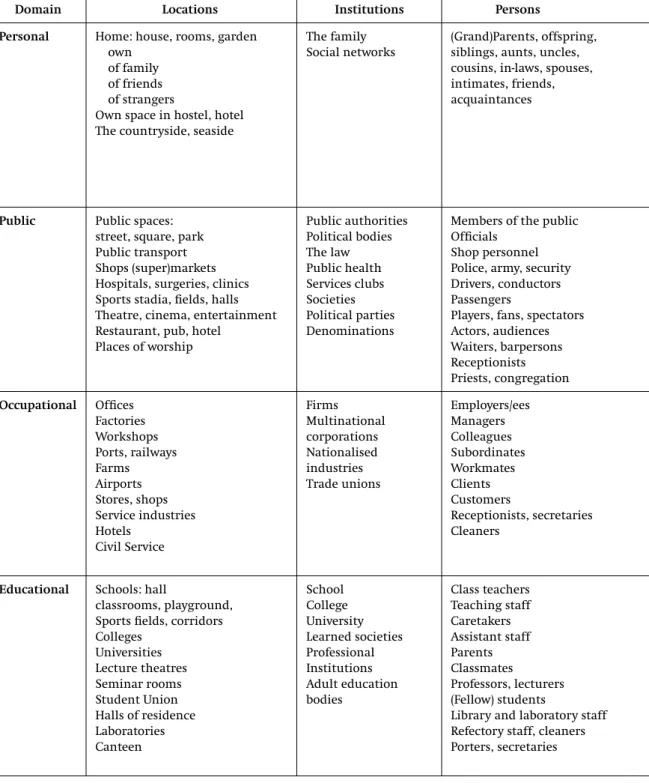
• Domain refers to the broad sectors of social life in which social agents operate. A higher order categorisation has been adopted here limiting these to major categories relevant to language learning/teaching and use: the educational, occupational, public and personal domains.
• A strategyis any organised, purposeful and regulated line of action chosen by an indi-vidual to carry out a task which he or she sets for himself or herself or with which he or she is confronted.
• A taskis defined as any purposeful action considered by an individual as necessary in order to achieve a given result in the context of a problem to be solved, an obligation to fulfil or an objective to be achieved. This definition would cover a wide range of actions such as moving a wardrobe, writing a book, obtaining certain conditions in the negotiation of a contract, playing a game of cards, ordering a meal in a restau-rant, translating a foreign language text or preparing a class newspaper through group work.
If it is accepted that the different dimensions highlighted above are interrelated in all forms of language use and learning, then any act of language learning or teaching is in some way concerned with each of these dimensions: strategies, tasks, texts, an individ-ual’s general competences, communicative language competence, language activities, language processes, contexts and domains.
At the same time, it is also possible in learning and teaching that the objective, and therefore assessment, may be focused on a particular component or sub-component (the other components then being considered as means to an end, or as aspects to be given more emphasis at other times, or as not being relevant to the circumstances). Learners, teachers, course designers, authors of teaching material and test designers are inevita-bly involved in this process of focusing on a particular dimension and deciding on the extent to which other dimensions should be considered and ways of taking account of these: this is illustrated with examples below. It is immediately clear, however, that although the often stated aim of a teaching/learning programme is to develop commu-nication skills (possibly because this is most representative of a methodological approach?), certain programmes in reality strive to achieve a qualitative or quantitative development of language activities in a foreign language, others stress performance in a particular domain, yet others the development of certain general competences, while others are primarily concerned with refining strategies. The claim that ‘everything is connected’ does not mean that the objectives cannot be differentiated.
Each of the main categories outlined above can be divided into sub-categories, still very generic, which will be looked at in the following chapters. Here, we are looking only at the various components of general competences, communicative competence, language activities and domains.
2.1.1 The general competences of an individual
The general competencesof language learners or users (see section 5.1.) consist in particu-lar of their knowledge, skills and existential competence and also their ability to learn:
Knowledge,i.e. declarative knowledge (savoir, see 5.1.1.), is understood as knowledge result-ing from experience (empirical knowledge) and from more formal learnresult-ing (academic knowledge). All human communication depends on a shared knowledge of the world. As far as language use and learning are concerned, the knowledge which comes into play is not directly related exclusively to language and culture. Academic knowledge in a scien-tific or technical educational field, and academic or empirical knowledge in a profes-sional field clearly have an important part to play in the reception and understanding of texts in a foreign language relating to those fields. Empirical knowledge relating to day-to-day living (organisation of the day, mealtimes, means of transport, communication and information), in the public or private domains is, however, just as essential for the management of language activities in a foreign language. Knowledge of the shared values and beliefs held by social groups in other countries and regions, such as religious beliefs, taboos, assumed common history, etc., are essential to intercultural communica-tion. These multiple areas of knowledge vary from individual to individual. They may be culture-specific, but nevertheless also relate to more universal parameters and constants. Any new knowledge is not simply added onto the knowledge one had before but is con-ditioned by the nature, richness and structure of one’s previous knowledge and, further-more, serves to modify and restructure the latter, however partially. Clearly, the knowledge which an individual has already acquired is directly relevant to language learning. In many cases, methods of teaching and learning pre-suppose this awareness of the world. However, in certain contexts (e.g. immersion, attending school or univer-sity where the language of tuition is not one’s mother tongue), there is simultaneous and correlated enrichment of linguistic and other knowledge. Careful consideration must then be given to the relationship between knowledge and communicative competence.
Skillsand know-how (savoir-faire, see section 5.1.2.), whether it be a matter of driving a car, playing the violin or chairing a meeting, depend more on the ability to carry out pro-cedures than on declarative knowledge, but this skill may be facilitated by the acquisi-tion of ‘forgettable’ knowledge and be accompanied by forms of existential competence (for example relaxed attitude or tension in carrying out a task). Thus, in the example quoted above, driving a car, which through repetition and experience becomes a series of almost automatic processes (declutching, changing gear, etc.), initially requires an explicit break-down of conscious and verbalisable operations (‘Slowly release the clutch pedal, slip into third gear, etc.’) and the acquisition of certain facts (there are three pedals in a manual car set out as follows, etc.) which one does not have to consciously think about once one ‘knows how to drive’. When one is learning to drive, one generally needs a high level of concentration and heightened self-awareness since one’s own self-image is particularly vulnerable (risk of failure, of appearing incompetent). Once the skills have been mastered, the driver can be expected to be much more at ease and self-confident; otherwise this would be disconcerting for passengers and other motorists. Clearly, it would not be difficult to draw parallels with certain aspects of language learning (e.g. pronunciation and some parts of grammar, such as inflexional morphology).
Existential competence(savoir-être, see 5.1.3.) may be considered as the sum of the individ-ual characteristics, personality traits and attitudes which concern, for example, self-image
and one’s view of others and willingness to engage with other people in social interaction. This type of competence is not seen simply as resulting from immutable personality char-acteristics. It includes factors which are the product of various kinds of acculturation and may be modified.
These personality traits, attitudes and temperaments are parameters which have to be taken into account in language learning and teaching. Accordingly, even though they may be difficult to define, they should be included in a framework of reference. They are considered to be part of an individual’s general competences and therefore an aspect of his or her abilities. In so far as they are capable of being acquired or modified in use and through learning (for example, of one or more languages), attitude formation may be an objective. As has frequently been noted, existential competences are culture-related and therefore sensitive areas for inter-cultural perceptions and relations: the way one member of a specific culture expresses friendliness and interest may be perceived by someone from another culture as aggressive or offensive.
Ability to learn(savoir apprendre, see 5.1.4.) mobilises existential competence, declarative knowledge and skills, and draws on various types of competence. Ability to learn may also be conceived as ‘knowing how, or being disposed, to discover “otherness”’ – whether the other is another language, another culture, other people or new areas of knowledge. Whilst the notion of ability to learn is of general application, it is particularly relevant to language learning. Depending on the learners in question, the ability to learn may involve varying degrees and combinations of such aspects of existential competence, declarative knowledge and skills and know-how as:
• Existential competence: e.g. a willingness to take initiatives or even risks in face-to-face communication, so as to afford oneself the opportunity to speak, to prompt assis-tance from the people with whom one is speaking, such as asking them to rephrase what they have said in simpler terms, etc; also listening skills, attention to what is said, heightened awareness of the risks of cultural misunderstanding in relations with others.
• Declarative knowledge: e.g. knowledge of what morpho-syntactical relations corre-spond to given declension patterns for a particular language; or, awareness that there may be a taboo or particular rituals associated with dietary or sexual practices in certain cultures or that they may have religious connotations.
• Skills and know-how: e.g. facility in using a dictionary or being able to find one’s way easily around a documentation centre; knowing how to manipulate audiovisual or computer media (e.g. the Internet) as learning resources.
For the same individual there can be many variations in the use of skills and know-how and the ability to deal with the unknown:
• Variations according to the event, depending on whether the individual is dealing with new people, a totally unknown area of knowledge, an unfamiliar culture, a foreign language.
• Variations according to context: faced with the same event (e.g. parent/child relation-ships in a given community), the processes of discovery and seeking meaning will doubtless be different for an ethnologist, tourist, missionary, journalist, educator or doctor, each acting according to his or her own discipline or outlook.
• Variations according to the prevailing circumstances and past experience: it is quite probable that the skills applied in learning a fifth foreign language will be different from those applied in learning the first.
Such variations should be considered alongside concepts such as ‘learning styles’ or ‘learner profiles’ as long as the latter are not regarded as being immutably fixed once and for all.
For learning purposes, the strategies selected by the individual in order to accomplish a given task will depend on the diversity of the various abilities to learn at his/her dispo-sal. But it is also through the diversity of learning experiences, provided they are not compartmentalised nor strictly repetitive, that the individual extends his/her ability to learn.
2.1.2 Communicative language competence
Communicative language competence can be considered as comprising several compo-nents: linguistic, sociolinguisticand pragmatic.Each of these components is postulated as comprising, in particular, knowledge and skills and know-how. Linguistic competences include lexical, phonological, syntactical knowledge and skills and other dimensions of language as system, independently of the sociolinguistic value of its variations and the pragmatic functions of its realisations. This component, considered here from the point of view of a given individual’s communicative language competence, relates not only to the range and quality of knowledge (e.g. in terms of phonetic distinctions made or the extent and precision of vocabulary) but also to cognitive organisation and the way this knowledge is stored (e.g. the various associative networks in which the speaker places a lexical item) and to its accessibility (activation, recall and availability). Knowledge may be conscious and readily expressible or may not (e.g. once again in relation to mastery of a phonetic system). Its organisation and accessibility will vary from one individual to another and vary also within the same individual (e.g. for a plurilingual person depend-ing on the varieties inherent in his or her plurildepend-ingual competence). It can also be held that the cognitive organisation of vocabulary and the storing of expressions, etc. depend, amongst other things, on the cultural features of the community or commu-nities in which the individual has been socialised and where his or her learning has occurred.
Sociolinguistic competences refer to the sociocultural conditions of language use. Through its sensitivity to social conventions (rules of politeness, norms governing rela-tions between generarela-tions, sexes, classes and social groups, linguistic codification of certain fundamental rituals in the functioning of a community), the sociolinguistic com-ponent strictly affects all language communication between representatives of different cultures, even though participants may often be unaware of its influence.
Pragmatic competences are concerned with the functional use of linguistic resources (production of language functions, speech acts), drawing on scenarios or scripts of inter-actional exchanges. It also concerns the mastery of discourse, cohesion and coherence, the identification of text types and forms, irony, and parody. For this component even more than the linguistic component, it is hardly necessary to stress the major impact of interactions and cultural environments in which such abilities are constructed.
All the categories used here are intended to characterise areas and types of compe-tences internalised by a social agent, i.e. internal representations, mechanisms and capacities, the cognitive existence of which can be considered to account for observable behaviour and performance. At the same time, any learning process will help to develop or transform these same internal representations, mechanisms and capacities.
Each of these components will be examined in more detail in Chapter 5.
2.1.3 Language activities
The language learner/user’s communicative language competence is activated in the per-formance of the various language activities, involving reception, production, interaction
or mediation(in particular interpreting or translating). Each of these types of activity is
possible in relation to texts in oral or written form, or both.
As processes, reception and production (oral and/or written) are obviously primary, since both are required for interaction. In this Framework, however, the use of these terms for language activities is confined to the role they play in isolation. Receptive activities include silent reading and following the media. They are also of impor-tance in many forms of learning (understanding course content, consulting text-books, works of reference and documents). Productive activities have an important function in many academic and professional fields (oral presentations, written studies and reports) and particular social value is attached to them (judgements made of what has been submitted in writing or of fluency in speaking and deliver-ing oral presentations).
In interactionat least two individuals participate in an oral and/or written exchange in which production and reception alternate and may in fact overlap in oral communica-tion. Not only may two interlocutors be speaking and yet listening to each other simul-taneously. Even where turn-taking is strictly respected, the listener is generally already forecasting the remainder of the speaker’s message and preparing a response. Learning to interact thus involves more than learning to receive and to produce utterances. High importance is generally attributed to interaction in language use and learning in view of its central role in communication.
In both the receptive and productive modes, the written and/or oral activities of medi-ation make communication possible between persons who are unable, for whatever reason, to communicate with each other directly. Translation or interpretation, a para-phrase, summary or record, provides for a third party a (re)formulation of a source text to which this third party does not have direct access. Mediating language activities – (re)processing an existing text – occupy an important place in the normal linguistic func-tioning of our societies.
2.1.4 Domains
Language activities are contextualised within domains.These may themselves be very diverse, but for most practical purposes in relation to language learning they may be broadly classified as fourfold: the public domain, the personal domain, the educational domainand the occupational domain.
The publicdomainrefers to everything connected with ordinary social interaction (busi-ness and administrative bodies, public services, cultural and leisure activities of a public nature, relations with the media, etc.). Complementarily, the personaldomaincomprises family relations and individual social practices.
The occupationaldomainembraces everything concerned with a person’s activities and relations in the exercise of his or her occupation. The educationaldomain is concerned with the learning/training context (generally of an institutional nature) where the aim is to acquire specific knowledge or skills.
2.1.5 Tasks, strategies and texts
Communication and learning involve the performance of taskswhich are not solely lan-guage tasks even though they involve lanlan-guage activities and make demands upon the individual’s communicative competence. To the extent that these tasks are neither routine nor automatic, they require the use of strategiesin communicating and learning. In so far as carrying out these tasks involves language activities, they necessitate the pro-cessing (through reception, production, interaction or mediation) of oral or written texts. The overall approach outlined above is distinctly action-oriented. It is centred on the relationship between, on the one hand, the agents’ use of strategies linked to their com-petences and how they perceive or imagine the situation to be and on the other, the task or tasks to be accomplished in a specific context under particular conditions.
Thus someone who has to move a wardrobe (task) may try to push it, take it to pieces so as to carry it more easily and then reassemble it, call on outside labour or give up and convince himself or herself that it can wait until tomorrow, etc. (all strategies). Depending on the strategy adopted, the performance (or avoidance, postponement or redefinition) of the task may or may not involve a language activity and text processing (reading instructions for dismantling, making a telephone call, etc.). Similarly, a learner at school who has to translate a text from a foreign language (task) may look to see if a translation already exists, ask another learner to show what he or she has done, use a dic-tionary, try to work out some kind of meaning on the basis of the few words or structures he or she knows, think of a good excuse for not handing in this exercise, etc. (all possible strategies). For all the cases envisaged here there will necessarily be language activity and text processing (translation/mediation, verbal negotiation with a classmate, letter or verbal excuses to the teacher, etc.).
The relationship between strategies, task and text depends on the nature of the task. This may be primarily language-related, i.e. it may require largely language activities and the strategies applied relate primarily to these language activities (e.g. reading and com-menting on a text, completing a ‘fill in the gaps’-type exercise, giving a lecture, taking notes during a presentation). It may include a language component, i.e. where language activities form only part of what is required and where the strategies applied relate also or primarily to other activities (e.g. cooking by following a recipe). It is possible to carry out many tasks without recourse to a language activity. In these cases, the activities involved are not necessarily language-related at all and the strategies applied relate to other types of activity. For instance, erecting a tent can be carried out in silence by several people who know what they are doing. They may perhaps engage in a few oral exchanges relating to technique, or they may at the same time hold a conversation having nothing Approach adopted
at all to do with the task, or they may carry out the task while one of them is humming a tune. The use of language becomes necessary when one of the group does not know what to do next, or when for some reason the established routine does not work.
In this type of analysis communication strategies and learning strategies are but strat-egies among others, just as communicative tasks and learning tasks are but tasks among others. Similarly, ‘authentic’ texts or texts specially designed for teaching purposes, texts in textbooks or texts produced by learners are but texts among others.
In the following chapters a detailed account is offered for each dimension and subcat-egory in turn, with examples and scaling where appropriate. Chapter 4 deals with the dimension of language use – what a language user or learner is required to do, whilst Chapter 5 deals with the competences that enable a language user to act.
2.2 Common reference levels of language proficiency
In addition to the descriptive scheme glossed above, Chapter 3 provides a ‘vertical dimen-sion’ and outlines an ascending series of common reference levels for describing learner proficiency. The set of descriptive categories introduced in Chapters 4 and 5 map out a ‘horizontal dimension’ made up of parameters of communicative activity and commu-nicative language competence. It is quite common to present a series of levels in a series of parameters as a profiling grid with a horizontal and a vertical dimension. This is, of course, a considerable simplification since just the addition of domain, for example, would give a third dimension turning such a grid into a notional cube. A full diagram-matic representation of the degree of multidimensionality involved would in fact be very challenging, if not impossible.
The addition of a vertical dimension to the Framework nevertheless enables learning space to be mapped or profiled, even if simply, and this is useful for a number of reasons: • The development of definitions of learner proficiency related to categories used in the Framework may assist in making more concrete what it may be appropriate to expect at different levels of achievement in terms of those categories. This in turn may aid the development of transparent and realistic statements of overall learning objectives.
• Learning which takes place over a period of time needs to be organised into units which take account of progression and can provide continuity. Syllabuses and mate-rials need to be situated in relation to one another. A framework of levels may help in this process.
• Learning efforts in relation to those objectives and those units need also to be situ-ated on this vertical dimension of progress, i.e. assessed in relation to gains in profi-ciency. The provision of proficiency statements may help in this process.
• Such assessment should take account of incidental learning, of out-of-school experi-ence, of the kind of lateral enrichment outlined above. The provision of a set of pro-ficiency statements going beyond the scope of a particular syllabus may be helpful in this respect.
• The provision of a common set of proficiency statements will facilitate comparisons of objectives, levels, materials, tests and achievement in different systems and situa-tions.
• A framework including both horizontal and vertical dimensions facilitates the defi-nition of partial objectives and the recogdefi-nition of uneven profiles, partial competen-cies.
• A framework of levels and categories facilitating profiling of objectives for particular purposes may aid inspectors. Such a framework may help to assess whether learners are working at an appropriate level in different areas. It may inform decisions on whether performance in those areas represents a standard appropriate to the stage of learning, immediate future goals and wider longer-term goals of effective lan-guage proficiency and personal development.
• Finally, in their learning career students of the language will pass through a number of educational sectors and institutions offering language services, and the provision of a common set of levels may facilitate collaboration between those sectors. With increased personal mobility, it is more and more common for learners to switch between educational systems at the end of or even in the middle of their period in a particular educational sector, making the provision of a common scale on which to describe their achievement an issue of ever wider concern.
In considering the vertical dimension of the Framework, one should not forget that the process of language learning is continuous and individual. No two users of a language, whether native speakers or foreign learners, have exactly the same competences or develop them in the same way. Any attempt to establish ‘levels’ of proficiency is to some extent arbitrary, as it is in any area of knowledge or skill. However, for practical purposes it is useful to set up a scale of defined levels to segment the learning process for the pur-poses of curriculum design, qualifying examinations, etc. Their number and height will depend largely on how a particular educational system is organised and for which pur-poses scales are established. It is possible to set down procedures and criteria for scaling and for the formulation of the descriptors used to characterise successive levels of profi-ciency. The issues and options concerned are discussed in depth in Appendix A. Users of this framework are strongly advised to consult that section and the supporting biblio-graphy before taking independent policy decisions on scaling.
One also needs to remember that levels only reflect a vertical dimension. They can take only limited account of the fact that learning a language is a matter of horizontal as well as vertical progress as learners acquire the proficiency to perform in a wider range of communicative activities. Progress is not merely a question of moving up a vertical scale. There is no particular logical requirement for a learner to pass through all the lower levels on a sub-scale. They may make lateral progress (from a neighbouring category) by broadening their performance capabilities rather than increasing their proficiency in terms of the same category. Conversely, the expression ‘deepening one’s knowledge’ rec-ognises that one may well feel the need at some point to underpin such pragmatic gains by having a look at ‘the basics’ (that is: lower level skills) in an area into which one has moved laterally.
Finally, one should be careful about interpreting sets of levels and scales of language proficiency as if they were a linear measurement scale like a ruler. No existing scale or set of levels can claim to be linear in this way. Talking in terms of the series of Council of Europe content specifications, even if Waystageis situated halfway to Threshold Level on a scale of levels, and Threshold half way to Vantage Level, experience with existing scales suggests that many learners will take more than twice as long to reach Threshold Level Approach adopted