National curriculum assessments
Key stage 1
English reading test
framework (draft)
National curriculum tests from 2016
KEY STAGE
1
YEARS
1–2
20
16
Electronic version product code: STA/14/7100/e ISBN: 978-1-78315-342-8
You may re-use this document / publication (not including logos) free of charge in any format or medium, under the terms of the Open Government Licence v2.0.
To view this licence, visit www.nationalarchives.gov.uk/doc/open-government-licence/
version/2 or email: [email protected].
Where we have identified any third party copyright information you will need to obtain permission from the copyright holders concerned.
Contents
1. Overview 4
1.1 Purposes of statutory assessment 4
2. What is a test framework? 5 3. Nature of the test 6
3.1 Population to be assessed 6
3.2 Test format 6
4. Content domain 8
4.1 Content domain relating to texts 9
4.2 Content domain relating to questions 10
4.3 Elements of the curriculum that cannot be assessed in this format 11
5. Cognitive domain 12
5.1 Descriptions of each strand of the cognitive domain 12
6. Test specification 15
6.1 Summary of test 15
6.2 Breadth and emphasis 16
6.3 Format of questions and responses 17
6.4 Marking and mark schemes 18
6.5 Reporting 19
6.6 Desired psychometric properties 19
6.7 Performance descriptor 19
7. Diversity and inclusion 22
7.1 Access arrangements 23
7.2 Children with English as an additional language (EAL) 23
1. Overview
This test framework is based on the national curriculum programme of study (2014) for English, introduced for teaching in schools from September 2014 and first assessed in the summer term 2016. The framework specifies the purpose, format, content and cognitive demand of the key stage 1 English reading tests; it is not designed to be used to guide teaching and learning or to inform statutory teacher assessment.
This document has been produced to aid the test development process and is therefore draft at this stage. Although any changes are expected to be minor, the document will be updated as required following evidence from trialling the tests. The document will be finalised and published on the Department for Education’s (DfE’s) website in advance of full sample test materials being released for schools in summer 2015.
1.1 Purposes of statutory assessment
The main purpose of statutory assessment is to:•
ascertain what children have achieved in relation to the attainment targetsoutlined in the national curriculum (2014) in English reading.
The main intended uses of the outcomes as set out in the Bew Report1 and the
Government’s consultation document on primary assessment and accountability are to:
•
hold schools accountable for the attainment and progress made by their children•
inform parents and secondary schools about the performance of individualchildren
•
enable benchmarking between schools, as well as monitor performance locallyand nationally.
1 Independent review of key stage 2 testing, assessment and accountability (2011), Lord Bew.
2. What is a test framework?
The purpose of the test framework is to provide the documentation to guide the development of the tests. The framework is written primarily for those who write test materials and to guide subsequent development and test construction. It is being made available to a wider audience for reasons of openness and transparency; it is not designed to be used to guide teaching and learning or to inform statutory teacher assessment. Some elements of the statutory national curriculum are not possible to assess using the current form of testing; they will need to be assessed by teachers as part of their statutory assessment of the complete national curriculum.
The framework includes those parts of the programme of study as outlined in the national curriculum (2014) that will be covered in the test (the ‘content domain’). The cognitive processes considered central to the English reading tests are also detailed in the cognitive domain.
Also included in the test framework is a test specification from which valid, reliable and comparable tests can be constructed each year. This includes specifics about test format, question types, response types and marking as well as a clear test-level reporting strategy. By providing all of this information in a single document, the test framework answers questions about what the test will cover, and how, in a clear and concise manner. The framework does not provide information on how teachers should teach the national curriculum.
The test development process used by the Standards and Testing Agency (STA) embeds within it the generation of validity and reliability evidence through expert review and trialling. Given that the tests will be internally marked by teachers, an additional study to consider the reliability of marking will be undertaken as part of the ‘technical pre-test’ trial. The test framework does not provide detail of the validity and reliability of individual tests; this will be provided in the test handbook which will be published on the DfE’s website following the administration of the test.
The test framework should be used in conjunction with the national curriculum (2014) and the annual ‘Assessment and reporting arrangements’ (ARA) document.
3. Nature of the test
The key stage 1 English reading test forms part of the statutory assessment arrangements for children at the end of key stage 1.
The test is based on the relevant sections of the national curriculum (2014) statutory programme of study for English reading at key stage 1.
The reading test will cover the aspects of comprehension that lend themselves to testing. The key stage 1 English reading test will be internally marked by teachers.
3.1 Population to be assessed
All eligible children who are registered at maintained schools, special schools or academies (including free schools) in England and are at the end of key stage 1 will be required to take the key stage 1 English reading test, unless they have taken it in the past. Independent schools may choose to participate in the statutory assessment arrangements on a year by year basis.
Some children are exempt from the tests. Further details are in the ARA which can be
downloaded from the Department’s website at www.education.gov.uk/ks1.
3.2 Test format
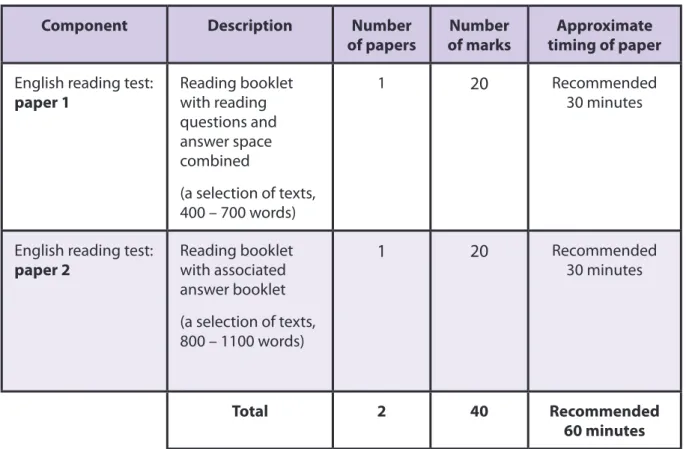
The key stage 1 English reading test is comprised of two components; one integrated reading and answer booklet and one separate reading booklet with an associated reading answer booklet.
Children will have access to all components but teachers can stop the child at any stage of the test that they feel is appropriate for that particular child.
The test is administered on paper. The tests are designed to enable children to
demonstrate their attainment and as a result are not strictly timed since the ability to work at pace is not part of the assessment. Guidance will be provided to schools to ensure that children are given sufficient time to demonstrate what they understand, know and can do without prolonging the test inappropriately. The table below provides an indication of suggested timings for each component. The total testing time is approximately
60 minutes.
One reading booklet comprises a selection of text(s) with questions interspersed. The word count will be approximately 400 – 700 words. This component contains 20 marks.
The second reading booklet comprises a selection of texts, totalling approximately 800 - 1100 words. The associated reading answer booklet contains 20 marks.
Table 1: Format of the test
Component Description Number
of papers of marksNumber timing of paperApproximate
English reading test:
paper 1 Reading booklet with reading questions and answer space combined
(a selection of texts, 400 – 700 words)
1 20 Recommended
30 minutes
English reading test:
paper 2 Reading booklet with associated answer booklet (a selection of texts, 800 – 1100 words)
1 20 Recommended
30 minutes
Total 2 40 Recommended 60 minutes
4. Content domain
The content domain draws out the relevant elements from the national curriculum (2014) programme of study for English at key stage 1 that are assessed in the English reading test. The tests will, over time, sample from each area of the content domain.
The content domain also identifies elements of the programme of study that cannot be assessed in the key stage tests (see Table 4). Attainment in these elements will be monitored through teacher assessment.
The following tables detail content from the national curriculum (2014). Elements from the curriculum are ordered to show progression across the years. The curriculum has been grouped into subdomains and these are detailed in the strand column. A referencing system is used in the content domain to enable classification of questions during test development.
Table 2 shows the content domain for texts and table 3 shows the content domain for questions.
4.1 C
ontent domain r
ela
ting to texts
Table 2: C
on
ten
t domain r
ela ting t o t ex ts Str and Na
tional curriculum r
ef er enc e Year 1 Na
tional curriculum r
ef er enc e Year 2 A ssessable elemen ts
Range of t
ex
ts
1a
[list
ening t
o and] discussing a
wide r
ange of poems
, st
or
ies and
non-fic
tion [a
t a lev
el bey
ond
tha
t a
t which they can r
ead independen tly] 1a [list ening t
o,] discussing and
expr
essing view
s about a wide
range of poetr
y (including
con
tempor
ar
y and classic),
st
or
ies and non-fic
tion [a
t a lev
el
bey
ond tha
t a
t which they can
read independen
tly]
1RT1
Tests t
o include age
-appr
opr
ia
te
fic
tion and non-fic
tion, fr
om a
var
iet
y of or
ig
ins and tr
aditions , co ver ing o ver -time
, a wide
range of t
ex t t ypes , f or ms and pur poses . 1c bec oming v er
y familiar with
key st or ies , fair y st or ies and tr aditional tales , [r et elling them and] c onsider
ing their par
ticular char ac ter istics 1c bec oming incr easingly familiar
with [and r
et
elling] a wider
range of st
or ies , fair y st or ies and tr aditional tales 1d being in tr oduc ed t o non-fic tion books tha t ar e struc tur ed in diff er en t w ay s
4.2 C
ontent domain r
ela
ting to ques
tions
Table 3: C
on
ten
t domain r
ela ting t o questions Str and Na
tional curriculum r
ef er enc e Year 1 Na
tional curriculum r
ef er enc e Year 2 A ssessable elemen ts M ak ing inf er enc es 2d mak ing inf er enc
es on the basis
of wha
t is being said and done
2c
mak
ing inf
er
enc
es on the basis
of wha
t is being said and done
1MI1 M ake inf er enc es fr
om the t
ex t 2e pr edic ting wha t migh t happen
on the basis of wha
t has been
read so far
2e pr edic ting wha t migh t happen
on the basis of wha
t has been
read so far
1MI2
Pr
edic
t wha
t migh
t happen on
the basis of wha
t has been r
ead so far Compr ehension 2a dr
awing on wha
t they alr
eady
kno
w or on backg
round
inf
or
ma
tion and v
ocabular
y
[pr
ovided b
y the t
eacher]
2a
dr
awing on wha
t they alr
eady
kno
w or on backg
round
inf
or
ma
tion and v
ocabular
y
[pr
ovided b
y the t
eacher]
1CI
Dr
aw on k
no
wledge of
vocabular
y t
o understand t
ex
ts
1b
discussing the sequenc
e of
ev
en
ts in books and ho
w it ems of inf or ma tion ar e r ela ted 1C2 Iden
tify and e
xplain the
sequenc
e of ev
en
ts in t
ex ts 1C3 Iden tify ho w it
ems of inf
or ma tion ar e r ela
ted and or
ganised in t
ex
ts
4
explain clear
ly their
understanding of wha
t is r
ead
[t
o them]
4
explain and discuss their understanding of books
, poems
and other ma
ter
ial
, [both those
tha
t they list
en t
o and] those
they r ead f or themselv es 1C4 Iden
tify key aspec
ts of fic
tion and non-fic tion t ex ts , such as char ac ters , ev en ts and inf or ma tion 2c
discussing the sig
nificanc
e of
the title and ev
en
ts
1C5
Explain key aspec
ts of fic
tion
and non-fic
tion t
ex
ts
, such as
titles , char ac ters , ev en ts and inf or ma tion Language f or eff ec t 1e rec og
nising simple [r
ecur
ring]
lit
er
ar
y language in st
or ies and poetr y 1L fE1 Iden
tify simple lit
er
ar
y language
in st
or
ies and poetr
4.3
Elements of the cur
ricu
lum tha
t cannot be assessed in this f
or
ma
t
The table belo
w iden
tifies ar
eas tha
t ar
e difficult t
o fully assess in a paper
-based f
or
ma
t. S
ome of the poin
ts belo
w ma
y be par
tially assessed
.
Table 4: E
lemen
ts of the curriculum tha
t c
annot b
e assessed in this f
orma
t
Na
tional curriculum r
ef er enc e Year 1 Na
tional curriculum r
ef er enc e Year 2 Explana tion 1b being enc our aged t
o link wha
t they r
ead
or hear r
ead t
o their o
wn e
xper
ienc
es
1f
discussing their fa
vour ite w or ds and phr ases O wn e xper ienc
es and pr
ef er enc es ar e t oo unk no
wn and t
oo br
oad t
o be pr
ac tically assessable . 1d rec og
nising and joining in with
pr edic table phr ases A spec
ts of the cur
riculum r equir ing or al sk ills ar
e not possible t
o include in a paper
assessmen t. 1e lear ning t o appr ecia te r hymes and poems
, and t
o r
ecit
e some b
y hear
t
1g
con
tinuing t
o build up a r
eper toir e of poems lear nt b y hear t, appr ecia ting
these and r
eciting some , with appr opr ia te in tona tion t
o make the
meaning clear
It is not possible t
o include aspec
ts of the
cur
riculum r
equir
ing or
al sk
ills in a paper
-based assessmen t. 2b check ing tha
t the t
ex
t makes sense
to them as they r
ead and c
or rec ting inac cur at e r eading 2b
discussing the sequenc
e of ev
en
ts in
books and ho
w it
ems of inf
or ma tion ar e rela ted
This is an in
ter
ac
tiv
e pr
oc
ess not assessable in
a wr itt en assessmen t. 3 par ticipa
te in discussion about wha
t is
read t
o them, tak
ing tur
ns and list
ening
to wha
t others sa
y
3
par
ticipa
te in discussion about books
,
poems and other w
or ks tha t ar e r ead t o
them and those tha
t they can r
ead f or themselv es , tak ing tur
ns and list
ening t
o
wha
t others sa
y
It is not possible t
o include aspec
ts of the
cur
riculum r
equir
ing or
al sk
ills in a paper
-based assessmen t. 2d answ er
ing and ask
ing questions
This is a t
eacher
-led or
al task tha
t takes plac
e in
the c
on
te
xt of classr
oom discussion of t
ex
ts and
is not assessable in a paper
-based assessmen
5. Cognitive domain
The cognitive domain seeks to make the thinking skills and intellectual processes required for the key stage 1 English reading test explicit. Each question will be rated against the five strands of the cognitive domain listed in the tables below. Information on how the questions are rated is shown in section 5.1.
The cognitive domain will be used during test development to ensure comparability of demand as well as difficulty for tests of successive years.
The cognitive domain for the English reading test was based on ‘The Revised PISA reading
item difficulty scheme’ 2, as the research we undertook indicated that the range of
question types used in the PISA assessments are similar to the requirements of the national curriculum tests. The PISA model also considers the text and the added dimension this brings to a cognitive scale, which STA felt was an essential feature of measuring test and question demand.
5.1 Descriptions of each strand of the cognitive
domain
In the following tables, descriptors are provided for the top and bottom of the rating scale. Judgement is then used to categorise questions appropriately on the rest of the scale. The cognitive scale presented in this framework assumes age-appropriate texts and is a stand-alone scale for national curriculum assessments at the end of key stage 1.
5.1.1 Accessibility of the target information
This strand relates to the accessibility of the target information that is needed to answer the question. This means the:
•
number and proximity of features that need to be located in the text•
extent to which the location of the information within the text is identified in thequestion
•
extent to which competing information in the text and/or distractors maymistakenly be selected.
It can be thought of as ‘Where can the information be found?’
2 Lumley, Tom; Routitsky, Alla; Mendelovits, Juliette; and Ramalingam, Dara, ‘The Revised PISA reading item difficulty scheme’ (2012). http://research.acer.edu.au/pisa/5
Table 5: Strand A - Accessibility of the target information
A1 (Low) A2 A3 A4 (High)
The information that needs to be located is basic, is highly prominent and limited to one or two pieces. It is clearly located by question wording and limited to a short section of the text. Competing information is limited.
The target information is not strongly located by the question. It is not prominent within the text, and not limited to one or two pieces. There is significant competing information, either within the text or in the form of functional distractors.
5.1.2 Complexity of the target information
This strand relates to the complexity of the target information that is needed to answer the question. This means the:
•
lexico-grammatical density of the stimulus•
level of concreteness / abstractness of the target information•
level of familiarity of the information needed to answer the question.It can be thought of as ‘What is the language of the text like?’
Table 6: Stand B - Complexity of the target information
B1 (Low) B2 B3 B4 (High)
Target information has a low level of abstractness and lexico-grammatical density, is largely familiar to pupils and is easily cued by the wording of the task.
Target information has a high level of abstractness and lexico-grammatical density and a low level of familiarity. There is a low level of semantic match between task wording and relevant information in the text.
5.1.3 Task-specific complexity
This strand relates to task-specific complexity. This means the:
•
degree of cognitive complexity involved in answering the question, from retrievalthrough to inference and higher level skills.
It can be thought of as ‘How much work is needed to answer the question?’
Table 7: Stand C - Task specific complexity
C1 (Low) C2 C3 C4 (High)
Requires only simple retrieval, with little/no inference and has concrete task requirements.
There are complex inference and abstract task requirements.
5.1.4 Response strategy
This strand relates to response strategy. This means the:
•
the complexity of the written response required•
the extent to which children need to organise / structure their response.It can be thought of as ‘How easy is it to organise and present the answer?’
Table 8: Stand D - Response strategy
D1 (Low) D2 D3 D4 (High)
Answers will be limited to multiple choice or a few words and will require little organisation; the structure of response required will be clearly indicated in the question or answer booklet.
Answers are extended, and require children to fully structure and organise their own responses.
5.1.5 Technical knowledge required
This strand relates to the technical knowledge required. This means the:
•
extent of knowledge of vocabulary required by the question•
subject-specific technical language and knowledge required that is not given intext.
It can be thought of as ‘How complex is the language of the question and / or the knowledge needed to answer it?’
Table 9: Strand E - Technical knowledge required
E1 (Low) E2 E3 E4 (High)
No complex word meanings or subject
specific technical language is required. Knowledge of complex word meanings and subject specific technical language required.
6. Test specification
This section provides details of the test.
6.1 Summary of test
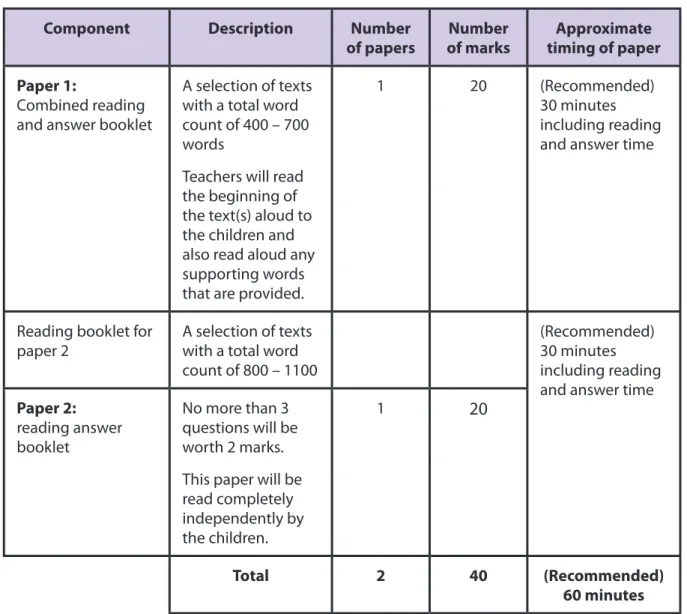
There are two components: one integrated reading and answer booklet and one separate reading booklet with associated reading answer booklet.
1. Combined reading and answer booklet: Lower demand - integrated reading and answer booklet
2. Reading booklet and reading answer booklet: Higher demand - separate reading booklet with associated reading answer booklet.
All children will have access to all test components, with teachers using their judgement as to when to withdraw the child from the test.
Table 10: Format of the test
Component Description Number
of papers of marksNumber timing of paperApproximate Paper 1:
Combined reading and answer booklet
A selection of texts with a total word count of 400 – 700 words
Teachers will read the beginning of the text(s) aloud to the children and also read aloud any supporting words that are provided.
1 20 (Recommended)
30 minutes including reading and answer time
Reading booklet for
paper 2 A selection of texts with a total word count of 800 – 1100
(Recommended) 30 minutes including reading and answer time
Paper 2:
reading answer booklet
No more than 3 questions will be worth 2 marks. This paper will be read completely independently by the children.
1 20
Total 2 40 (Recommended) 60 minutes
6.2 Breadth and emphasis
The content and cognitive domains for the English reading tests are specified in sections 4 and 5. The test will sample from the content domain in any given year. Although each element may not be included within each test, the full range of content detailed in this document will be assessed over time. The questions in each test are placed in order of difficulty, where possible, whilst maintaining chronology with the text.
The following sections show the proportion of marks attributed to each of the areas of the content and cognitive domains in a test.
6.2.1 Range of texts
A range of texts will be included in the tests – with a balance of text type including fiction, non-fiction and poetry.
Texts will be appropriate in terms of content and difficulty for children aged 7. This will include texts that are age-appropriate (themes in narratives will be familiar and non-fiction texts will be suitable for 6–7 year olds) and that require inference and comprehension skills. The demand of the text will increase throughout the reading booklet.
6.2.2 Profile of content domain
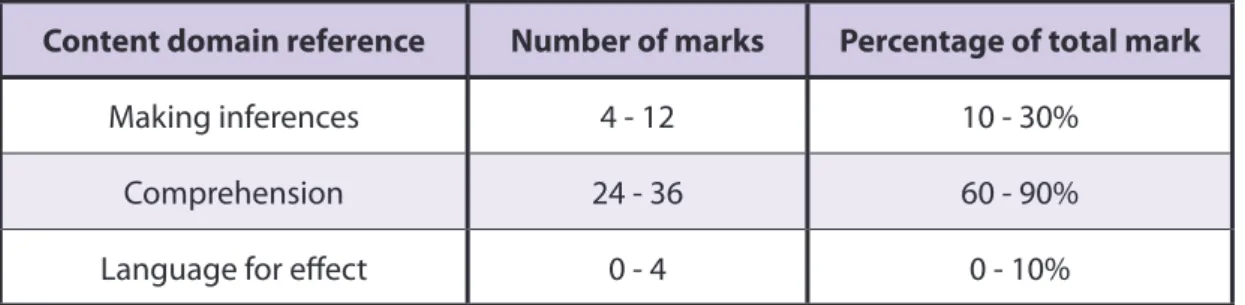
The national curriculum coverage within the test is specified in the content domain in section 4. Content is broken down into three areas – which will be present in the tests in the following proportions:
Table 11: Profile of marks by content area
Content domain reference Number of marks Percentage of total mark
Making inferences 4 - 12 10 - 30%
Comprehension 24 - 36 60 - 90%
Language for effect 0 - 4 0 - 10%
The content domain references are further broken down into assessable elements within the content domain given in section 4.
6.2.3 Profile of cognitive domain
The cognitive domain is specified in section 5. Taking into account the target information and the task itself, each question will be rated in terms of demand against each of the five strands of the cognitive domain.
For congnitive strands A, B and C, there will be questions across the range of demand 1– 4, predominantly at 2 to 4.
For strand D, the range of questions across the cognitive domain will be in the following approximate proportions.
Table 12: Profile of ratios for strand D
Strand Percentage of total marks
D1 35 – 55%
D2 and D3 35 – 55%
D4 5 – 15%
For strand E, the majority of questions will be at E1 and E2.
6.3 Format of questions and responses
The table below shows how marks will be distributed across different mark tariffs.
Table 13: Profile of mark tariffs
Mark tariffs Range of marks at mark tariff
1 mark questions 34 –36 marks
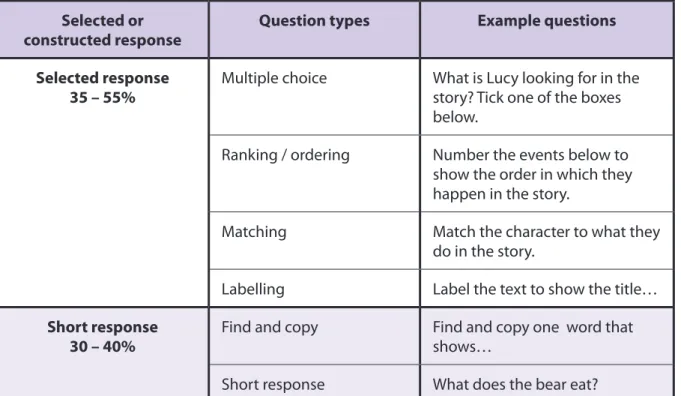
2 mark questions 4 – 6 marks (2-3 questions) The question types in the test will be distributed across the selected and constructed response questions in the proportions shown in the table. The range of question types are exemplified by, but not limited to, those listed in the table below.
Table 14: Profile of marks by question type Selected or
constructed response Question types Example questions Selected response
35 – 55% Multiple choice What is Lucy looking for in the story? Tick one of the boxes below.
Ranking / ordering Number the events below to show the order in which they happen in the story.
Matching Match the character to what they do in the story.
Labelling Label the text to show the title…
Short response
30 – 40% Find and copy Find and copy one word that shows… Short response What does the bear eat?
Selected or
constructed response Question types Example questions Extended response
10 – 20% Open ended response Why did Lucy write the letter to her grandmother? Give two reasons.
6.4 Marking and mark schemes
The key stage 1 tests will be internally marked by teachers.The mark scheme will give the general principles for marking the test to ensure consistency of marking, together with specific guidance for the marking of each question.
The mark scheme will provide the total number of marks available for each question and the criteria by which markers should award the marks to children’s responses. Where multiple correct answers are possible, examples of different types of correct answer will be given in the mark schemes. Additional guidance will indicate minimally acceptable responses and unacceptable responses, where applicable.
For all questions, the mark schemes will be developed during the test development process and will combine the expectations of experts with examples of children’s responses that have been obtained during trialling.
For multi-mark questions, if the correct answer is not reached and, therefore, full marks cannot be awarded, the mark scheme will provide details of how partial credit can be awarded.
The mark schemes will contain the following information:
•
the question•
a content domain reference•
the mark allocation•
square bullets indicating the required responses / acceptable points•
round bullets exemplifying children’s responses from the trials•
on 2 mark questions, the examples awarded higher marks should be placed beforethe examples awarded lower marks
•
open 2 mark questions should also consider the child’s ability to express theirreasoning through developed answers.
There will be a system of sampling and moderation of marking organised by the STA to ensure consistency between schools. Full details will be available in the ARA.
6.5 Reporting
The raw score on the test (the total achieved marks out of the total 40 marks) will be converted into a scaled score using a conversion table. The purpose of translating raw scores onto scaled scores is that performance can be reported on a consistent scale for all children, which retains the same meaning from one year to the next so a particular scaled score reflects the same level of attainment in one year as in the previous year, having adjusted for any differences in difficulty of the test.
Additionally, each child will receive an overall result indicating whether or not he or she has achieved the required standard on the test. A standard setting exercise will be conducted on the first live test in 2016 in order to determine the scaled score needed for a child to be considered to have met the standard. This process will be facilitated by the performance descriptor in section 6.7 which defines the performance level required to meet the
standard. In subsequent years the standard will be maintained using appropriate statistical methods to translate raw scores on a new test into scaled scores with an additional
judgemental exercise at the expected standard. The scaled score required to achieve the expected level on the test will always remain the same.
The exact scale for the scaled scores will be determined following further analysis of trialling data. This will include a full review of the reporting of confidence intervals for scaled scores.
6.6 Desired psychometric properties
While the focus of the outcome of the test will be whether a child has achieved the expected standard, the test must measure children’s ability across the spectrum of
attainment. As a result, the test must aim to minimise the standard error of measurement at every point on the reporting scale, particularly around the expected standard threshold. The provision of a scaled score will aid in the interpretation of children’s performance over time as the scaled score which represents the expected standard will be the same year on year. However, at the extremes of the scaled score distribution, as is standard practice, the scores will be truncated such that above or below a certain point all children will be awarded the same scaled score in order to minimise the effect for children at the ends of the distribution where the test is not measuring optimally.
6.7 Performance descriptor
This performance descriptor describes the typical characteristics of children whose
performance in the key stage 1 tests is at the threshold of the expected standard. Children who achieve the expected standard in the tests have demonstrated sufficient knowledge to be well placed to succeed in the next phase of their education having studied the full key stage 1 programme of study in English. This performance descriptor will be used by panels of teachers to set the standards on the new tests following their first administration in summer 2016. It is not intended to be used to support teacher assessment since it only reflects the elements of the programme of study that can be assessed in a written test (see content domain in section 4).
6.7.1 Overview
Children working at the expected standard will be able to engage with all questions within the test. However, they will not always achieve full marks on each question, particularly if working at the threshold of the expected standard.
Questions will range from those requiring only simple retrieval in concrete tasks with little or no inference to those requiring some inference in more abstract tasks. There will be a variety of question formats including selected response, short answer and extended answer, which require fully structured, organised and accurately communicated responses. Question difficulty will be affected by the strands of the cognitive domain such as the accessibility and complexity of the target information within the reading text and the complexity of the technical language or other vocabulary in the question. This should be borne in mind when considering the remainder of this performance descriptor, since children working at the threshold of the expected standard may not give correct responses to questions where target information is not strongly located in the question or has a high level of abstractness and lexico-grammatical density, or where there is significant competing information in the text that functions as a distractor. This will be true even when the performance descriptor determines that a skill should be within the child’s capacity if working at the expected standard.
The following sections describe the typical characteristics of children in Year 2 working at the threshold of the expected standard. It is recognised that different children will exhibit different strengths, so this is intended as a general guide rather than a prescriptive list.
6.7.2 Range of texts
Children working at the threshold of the expected standard will be able to read the full range of text types and forms specified in the key stage 1 programme of study. This will include texts that are age-appropriate and that require inferential and comprehension skills as well as an emerging understanding of how language is used for effect.
6.7.3 Making inferences
Children working at the expected standard are able to:
•
make simple and general inferences based on the text [1MI1]6.7.4 Comprehension
Children working at the expected standard are able to:
•
identify the meaning of vocabulary in context [1C1]•
identify sequences of events in a range of straightforward texts [1C2]•
identify how information is related and/or organised within texts [1C3].provide simple explanations for:
•
the significance of titles in fiction and non-fiction texts [1C5]•
events and characters’ actions [1C5]•
key information [1C5]•
retrieve relevant details from fiction and non-fiction to demonstrate understandingof character, events and information [1C4].
6.7.5 Language for effect
Children working at the expected standard are able to:
7. Diversity and inclusion
The Equality Act 2010 sets out the principles by which the national curriculum assessment and associated development activities are conducted. During the development of the tests, the test development division will make provision to overcome barriers to fair assessment for individuals and groups wherever possible.
National curriculum assessments will also meet Ofqual’s core regulatory criteria. One of the criteria refers to the need for assessment procedures to minimise bias: “The assessment should minimise bias, differentiating only on the basis of each learner’s ability to meet national curriculum requirements” (Ofqual,
www.ofqual.gov.uk/files/2011-regulatory-framework-for-national-assessments.pdf). The end of key stage 1 English reading assessment should:
•
use appropriate means to allow all children to demonstrate their reading ability•
provide a suitable challenge for all children and give every child the opportunity toachieve as high a standard as possible
•
provide opportunities for all children to achieve, irrespective of gender, includingchildren with special educational needs, children with disabilities, children from all social and cultural backgrounds
•
use materials that are familiar to children and for which they are adequatelyprepared
•
not be detrimental to children’s self-esteem or confidence•
be free from stereotyping and discrimination in any form.The test development process uses the principles of universal design, as described in the Guidance on the Principles of Language Accessibility in National Curriculum Assessments
(Ofqual, 2012; www.ofqual.gov.uk/news/new-language-accessibility-guidance-published/).
In order to improve general accessibility for all children, where possible, questions will be placed in order of difficulty. Accordingly, to be consistent with all national curriculum tests, attempts have been made to make the question rubric as accessible as possible for all children, including those who experience reading and processing difficulties, and those for whom English is an additional language, whilst maintaining an appropriate level of demand to adequately assess the content. This includes applying the principles of plain English and universal design wherever possible, conducting interviews with children, and taking into account feedback from expert reviewers.
For each test in development, expert opinions on specific questions are gathered, for example, at inclusion panel meetings, which are attended by experts and practitioners from across the fields of disabilities and special educational needs. This provides an
opportunity for some questions to be amended or removed in response to concerns raised. Issues likely to be encountered by children with specific learning difficulties have been considered in detail. Where possible, features of questions that lead to construct irrelevant variance (for example, question formats and presentational features) have been considered and questions have been presented in line with best practice for dyslexia and other specific learning difficulties.
7.1 Access arrangements
The full range of access arrangements applicable to key stage 1 assessments as set out in the relevant ARA will be available to eligible children as required.
7.2 Children with English as an additional
language (EAL)
Children with English as an additional language should be registered for the national curriculum tests. If a child’s limited ability to communicate in English means that he or she is unable to access the test, then they will be working below the standard of the English tests and should not take them, as set out in the relevant ARA.
Appendix: Glossary of terminology used in
the test framework
cognitive domain Cognitive processes refer to the thinking skills and intellectual processes that occur in response to a stimulus. The cognitive domain makes explicit the thinking skills associated with an assessment. The cognitive domain, as shown in this framework, also identifies other factors that may influence the difficulty of the questions.
component A section of a test, presented to children as a test paper or test booklet. Some tests may have two or more components which each child needs to sit in order to complete the test. The key stage 1 English reading test has two test components.
content domain The body of subject knowledge to be assessed by the test.
construct irrelevant
variance Construct irrelevant variance is the variation in children’s test scores that does not come from their knowledge of the ideas being tested. It can result in children gaining fewer marks than their knowledge would suggest or lead to the award of more marks then their knowledge alone would deserve.
The former can occur, for example, when questions in a mathematics test also unintentionally measure reading ability. The latter often occurs when unintended clues within questions allow children to answer correctly without having the required subject knowledge.
distribution The range of possible scaled scores.
domain The codified definition of a body of skills and knowledge.
mark scheme The document explaining the creditworthy responses or the criteria that must be applied to award the mark for a question in the test.
national curriculum For each subject and key stage, the national curriculum outlines the content and skills that should be taught in schools.
performance
descriptor Description of the typical characteristics of children working at a particular standard. For these tests, the performance descriptor will characterise the minimum performance required to be working at the appropriate standard for the end of the key stage.
programme of study The statutory curriculum of subject knowledge, skills and
understanding for a key stage. The key stage 1 and 2 programmes of study are published online at at:
raw score The unmodified score achieved on a test, following marking. In the case of these tests it is the total marks achieved.
For example, if a child scores 27 out of 60 possible marks, the raw score is 27. Raw scores are often then converted to other measures such as percentile ranks, standardised scores or grades.
scaled score A score which has been translated from a raw score onto a score on a fixed, defined scale. This allows performance to be reported on a consistent scale for all children, which retains the same meaning from one year to the next. Therefore, a particular scaled score reflects the same level of attainment in one year as in the previous year, having adjusted for any differences in difficulty of the specific tests.
standard The required level of attainment in order to be classified into a particular performance category.
standard error of
measurement A reliability estimate that allows the user to determine a confidence interval around a test score. It is a measure of the distribution of scores that would be attained by a child had that child taken the test repeatedly under the same conditions.
standard setting The process of applying the standard onto a particular test in order to determine the score required for a child to be classified within a particular performance category.
test framework A document to set out the principles, rationale and key information about the test, and containing a test specification.
test specification A detailed specification of what is to be included in a test in any single cycle of development.
Who is it for?
This document is primarily aimed at those responsible for developing the key stage 1 national curriculum test in English reading. It may also be of interest to schools with children in key stage 1 and other education professionals.
What does it cover?
Detailed information to ensure an appropriate test is developed, including the:
•
content domain•
cognitive domain•
test specification.Related information
Visit the Department for Education’s website at www.education.gov.uk/ks1 and
www.gov.uk/government/collections/national-curriculum for all related information.
For more copies
Printed copies of this document are not available. It can be downloaded from the