Overview
Cisco
1700 Series
Modular Access Routers
Figure 1 Cisco 1700 Series
Cisco 1700 Series Modular Access Router Solutions The Cisco 1700 Series of modular access routers are designed to provide a
cost-effective integrated platform for small and medium-sized businesses and enterprise small branch offices. They provide flexibility and manageability to meet the most demanding and evolving business requirements such as multiservice data/ voice/video/fax integration, business-class digital subscriber line (DSL), and comprehensive network security. See Figure 1.
The Competitive Advantage Today’s businesses are recognizing that business success relies on more than simply using e-mail or putting up a Web site. Companies that want to streamline operations and reduce costs while gaining the competitive advantages of the Internet need to integrate business processes
into their everyday business practices by adopting applications such as Web-based transaction processing, telecommuting, and e-learning. These kinds of business tools improve communications between employees, customers, and suppliers; increase productivity and efficiency; and enhance customer satisfaction to make businesses more competitive. The
effectiveness of business solutions depends on the performance and capabilities of the access solution.
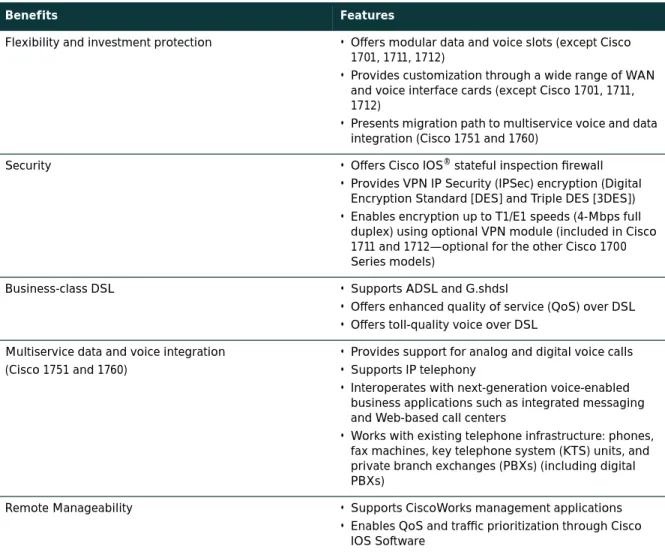
To fully realize all the competitive advantages companies need a flexible and affordable access solution that supports a full range of technologies and applications. The Cisco 1700 Series of modular access routers are optimized to provide comprehensive features such as virtual private networks (VPNs), security firewalls, business-class DSL, and multiservice integration of data, voice, video, and fax. The routers deliver high-speed WAN connectivity for communications over the Internet and between remote office sites. For an overview of Cisco 1700 Series features, refer to Table 1.
The Cisco 1760 Modular Access Router provides multiservice voice/video/data solutions in a 19-inch rackmount chassis. Four modular slots are available to support a variety of WICs and VICs. The Cisco 1751 Modular Access Router designed in a desktop form factor also provides multiservice voice/video/data integration.
The Cisco 1721 Modular Access Router is optimized for flexible data-access solutions supporting dual WAN applications for high availability.
The Cisco 1711 and 1712 Security Access Router provides a cost-effective integrated security and routing solution in a single device for secure broadband access.
The Cisco 1701 ADSL Security Access Router provides secure and reliable Internet and corporate network connectivity and business-class ADSL over basic telephone service (POTS) with a redundant ISDN WAN link. Table 1 Overview of Cisco 1700 Series Features
Benefits Features
Flexibility and investment protection • Offers modular data and voice slots (except Cisco 1701, 1711, 1712)
• Provides customization through a wide range of WAN and voice interface cards (except Cisco 1701, 1711, 1712)
• Presents migration path to multiservice voice and data integration (Cisco 1751 and 1760)
Security • Offers Cisco IOS® stateful inspection firewall
• Provides VPN IP Security (IPSec) encryption (Digital Encryption Standard [DES] and Triple DES [3DES]) • Enables encryption up to T1/E1 speeds (4-Mbps full
duplex) using optional VPN module (included in Cisco 1711 and 1712—optional for the other Cisco 1700 Series models)
Business-class DSL • Supports ADSL and G.shdsl
• Offers enhanced quality of service (QoS) over DSL • Offers toll-quality voice over DSL
Multiservice data and voice integration (Cisco 1751 and 1760)
• Provides support for analog and digital voice calls • Supports IP telephony
• Interoperates with next-generation voice-enabled business applications such as integrated messaging and Web-based call centers
• Works with existing telephone infrastructure: phones, fax machines, key telephone system (KTS) units, and private branch exchanges (PBXs) (including digital PBXs)
Remote Manageability • Supports CiscoWorks management applications
• Enables QoS and traffic prioritization through Cisco IOS Software
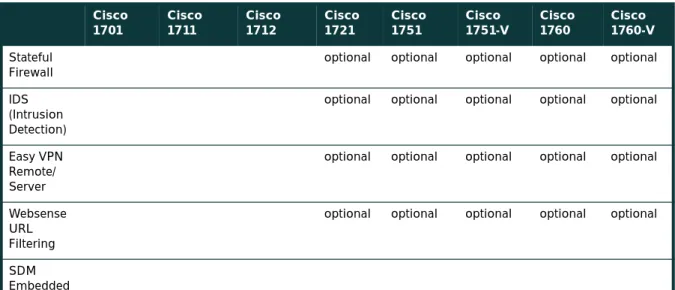
Table 2 Cisco 1700 Series Comparison Cisco 1701 Cisco 1711 Cisco 1712 Cisco 1721 Cisco 1751 Cisco 1751-V Cisco 1760 Cisco 1760-V Application ADSL Security Broadband Security Broadband Security Data Access Data and Voice Data and Voice Data and Voice Data and Voice Form Factor Desktop Desktop Desktop Desktop Desktop Desktop 19"
Rack-mount
19" Rack-mount Fixed/
Modular
Fixed Fixed Fixed Modular Modular Modular Modular Modular
Default Memory (Flash/ DRAM MB) 32/64 32/64 32/64 32/96 32/64 32/96 32/64 32/96 Maximum Memory (Flash/ DRAM MB) 32/128 32/128 32/128 32/128 32/128 32/128 64/128 64/128 WAN Access Modular Slots 2 3 3 4 4 Integrated WAN Port ADSL 10/100 10/100 Backup WAN ISDN Analog Modem
ISDN optional optional optional optional optional
LAN LAN Ports 1–10/100 4–10/100 4–10/100 1–10/100 1–10/100 1–10/100 1–10/100 1–10/100 802.1Q VLAN Multiservice Voice Voice over IP Analog/ Digital Voice QoS Integrated Security Hardware Accelerated VPN
optional optional optional optional optional optional
VPN Tunnels
The Cisco 1700 Series Key Benefits
The Cisco 1700 Series routers are designed to enable small/medium-sized businesses and small enterprise branch offices to successfully deploy networked applications by providing:
• Flexibility and investment protection • Comprehensive security
• Business-class DSL
• Multiservice data/voice/video/fax integration • Enhanced manageability
Flexibility and Investment Protection
The modularity of the Cisco 1700 Series allows it to easily fit the needs of growing companies. Interchangeable WICs and voice interface cards (VICs) enable easy additions or changes in WAN technologies without requiring a forklift upgrade of an entire platform. The wide range of available WIC and VIC solutions gives customers a choice when implementing WAN and voice technologies. It allows customers to start out with a solution that meets current needs and easily expand as business demands grow. WAN technologies supported include broadband DSL, ISDN, leased lines, and Frame Relay. Voice technologies supported are VoIP and VoFR. These WICs and VICs are also shared with the Cisco 2600, 3600, and 3700 Series routers.
Comprehensive Security
To succeed, companies must deploy robust network security measures. Business applications often involve storing and transmitting sensitive data, such as customer credit information, and this data can be an attractive target for hackers and other malicious agents. To keep networks secure and protect sensitive information, businesses deploy a range of security technologies, including firewalls, VPNs, and intrusion detection systems.
Stateful Firewall
optional optional optional optional optional
IDS (Intrusion Detection)
optional optional optional optional optional
Easy VPN Remote/ Server
optional optional optional optional optional
Websense URL Filtering
optional optional optional optional optional
SDM Embedded Web Tool
Table 2 Cisco 1700 Series Comparison Cisco 1701 Cisco 1711 Cisco 1712 Cisco 1721 Cisco 1751 Cisco 1751-V Cisco 1760 Cisco 1760-V
Cisco IOS Software is the industry’s widely accepted standard for the Internet and private network operations. Based on Cisco IOS security technology, the Cisco 1700 Series routers provide powerful, integrated firewall, VPN, and IDS capabilities. As new security technologies are developed, they often can be simply uploaded to a Cisco 1700 Series Router—there is no need for costly hardware replacements.
Firewall
Just as physical businesses require security measures for protection against theft of physical assets, businesses also require tools to maintain the security and confidentiality of its intellectual property. Firewalls provide this protection by preventing unauthorized users from accessing confidential corporate data.
The Cisco 1700 Series routers offer integrated security features, including stateful inspection firewall functionality as an optional Cisco IOS Software feature. By deploying Cisco IOS Software firewall functionality, customers do not need to purchase or manage multiple devices, simplifying network management and reducing capital costs. Cisco IOS Software firewall security features include access control lists (ACLs), user authentication, authorization, and accounting (such as Password Authentication Protocol/Challenge Handshake Authentication Protocol [PAP/ CHAP], TACACS+, and Remote Access Dial-In User Service [RADIUS]). These security features provide the optimal level of firewall protection to customers.
Virtual Private Networks
The Cisco 1700 Series is part of the end-to-end Cisco VPN solution. VPNs create secure tunnel connections via the Internet to connect geographically dispersed offices, business partners, and remote users while providing security, traffic prioritization, management, and reliability equal to that of private networks. VPNs significantly reduce WAN costs, and they can be set up and torn down rapidly to provide secure extranet links to customers, business partners, and remote employees on demand.
By supporting industry standards such as IPSec, Layer 2 Tunneling Protocol (L2TP), and DES, 3DES, and AES Cisco 1700 Series routers deliver robust VPN solutions to ensure data privacy, integrity, and authenticity.
The optional* VPN Hardware Encryption Module for Cisco 1700 Series routers further optimizes VPN encryption performance. Through offloading encryption tasks to the VPN module, the router processor is freed to handle other operations. The VPN module accelerates the rate at which encryption occurs, speeding the process of transmitting secure data, and this factor is critical when using 3DES encryption.
*The VPN hardware encryption module is included on Cisco 1711 and 1712 Security Access Routers and optional on all other Cisco 1700 Series routers.
Intrusion Detection
Preventing unauthorized users from entering the corporate network is an essential role of any security system. A network-based IDS provides around-the-clock network surveillance, analyzing packets and data streams and searching for signs of unauthorized activity. When it identifies unauthorized activity, the IDS can generate alarms to alert network managers for immediate response and corrective action.
Through Cisco IOS Software, Cisco 1700 Series routers can provide customers with an integrated IDS solution. With this feature deployed, businesses can benefit from continuous security monitoring to detect unauthorized activity that may occur over the Internet or other unsecured networks.
Security Device Manager (SDM)
Cisco SDM is an intuitive, Web-based device management tool embedded within the Cisco 1700 access routers. Cisco SDM simplifies router and security configuration through smart wizards enabling customers to quickly and easily deploy, configure and monitor a Cisco 1700 access router without requiring knowledge of Cisco IOS Software Command Line Interface (CLI).
Business-Class DSL
The Cisco 1700 Series supports business-class DSL through the optional ADSL or symmetrical high-bit-rate DSL (G.shdsl) WICs, or with the 1701 which has a built in ADSL port. The Cisco 1700 Series business-class DSL solution combines the cost benefits of DSL service with the advanced routing capability required for business use of the Internet. Cisco business-class DSL delivers advanced QoS and industry-proven reliability. Through enhanced DSL QoS features, performance levels for mission-critical applications and toll-quality voice/data integration are maintained. (Refer to Figure 2.)
Figure 2
The Cisco 1700 Series Deployed with an ADSL WIC
Cisco 1711 and 1712 routers, and Cisco 1721, 1751, 1760 routers with optional Ethernet WIC, support dual Ethernet configuration, enabling deployment with an external broadband modem (such as DSL, cable modem, or wireless modem)—often supplied by a service provider (Figure 3).
Figure 3
The Cisco 1700 Series Deployed with an Ethernet WIC and an External DSL or Cable Modem
Small Enterprise Branch Office
Cisco 1700 Series Router with ADSL
Cisco 6000 (DSLAM) Headquarters Cisco 7000 WAN ADSL Internet DSL/Cable Modem
Cisco 1700 Series Router with Cisco IOS Firewall and Dual Ethernet
Multiservice Data/Voice/Video/Fax Integration
In addition to supporting the same security and business-class DSL features as the entire Cisco 1700 Series, the Cisco 1751 and 1760 provide a cost-effective way to extend multiservice (data and voice) networks to branch offices. Using the sophisticated QoS features of Cisco IOS Software, the Cisco 1751 and 1760 allow voice traffic to be digitized, encapsulated in data packets, and prioritized over other data traffic. Data/voice/video/fax integration using IP protocols over the Internet enables administrators to reduce long-distance toll charges between offices and support voice-enabled desktop applications such as integrated messaging and packet video.
The Cisco 1751 and 1760 support analog and digital voice communications while working with the existing telephone infrastructure—such as phones, fax machines, KTSs, and PBXs—thus minimizing capital costs by reducing the need for additional equipment expenditure. In addition, these routers provide for easy deployment of IP telephony. (Refer to Figure 4.)
Figure 4
Multiservice Data/Voice/Fax Integration
Enhancements to Cisco IOS Software allow the Cisco 1751 and 1760 to support survivable remote site telephony (SRST). This feature allows branch offices to utilize key telephony features such as hold and call forwarding if the main call server fails. Recently introduced VIC cards support direct inward dial (DID), allowing customers to directly reach key employees and caller ID (CLID) ensures that employees can identify and respond to important customer calls. Phone Fax Fax IP Phone 1-8* Analog Calls or 1-16 Digital Calls
* 1 WIC slot is left for WAN access. The maximum number of analog calls for the Cisco 1760 is 8. KTS/PBX
PSTN Small Enterprise Branch Office
Cisco 1760 Cisco 2600 Headquarters Branch Office Up to 288 Digital Calls Up to 60 Digital Calls Intranet Leased Line Frame Relay MCM Gatekeeper IP
V
V
PBX PBX Cisco Voice Manager Fax Cisco 3600V
Manageability
Cisco 1700 Series routers support a wide range of network installation and management tools:
• SDM—Cisco SDM is a Web-based device management tool embedded within the Cisco IOS access routers. Using smart wizards, SDM simplifies router and security configuration enabling customers to quickly and easily deploy, configure and monitor a Cisco access router without requiring knowledge of Cisco IOS Software Command Line Interface (CLI).
• CiscoView—This GUI-based device management software application for UNIX and Windows platforms provides dynamic status, statistics, and comprehensive configuration information.
• CiscoWorks—This industry-leading, Web-based network management suite simplifies tasks such as network inventory management and device change, rapid software image deployment, and troubleshooting from a central location.
• Cisco Secure Policy Manager—This Windows NT-based application allows users to define, configure, distribute, enforce, and audit network-wide security policies, simplifying Cisco IOS firewalls, VPNs, and IDS deployments. • Cisco QoS Policy Manager—This tool offers the ability to define QoS policies across multiple devices, easing the
task of creating and configuring QoS policies for users and applications.
• Cisco Voice Manager—This application enables configuration and provisioning of voice ports, and creation and modification of dial plans on voice-enabled Cisco routers for VoIP and VoFR.
Cisco 1700 Series Business Features
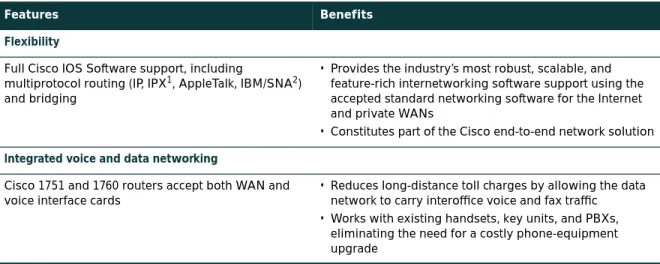
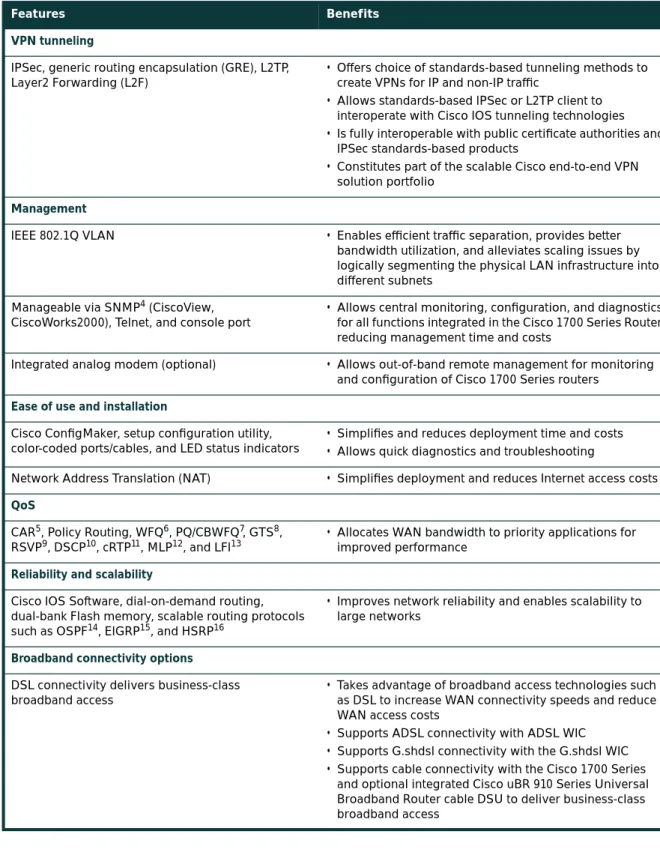
The Cisco 1700 Series offers a comprehensive feature set designed to enable small to medium-sized businesses and small enterprise branch offices to connect to the Internet and to the corporate intranet. For a complete description of platform features and benefits, refer to Table 3.
Table 3 Benefits and Features of the Cisco 1700 Series
Features Benefits
Flexibility
Full Cisco IOS Software support, including
multiprotocol routing (IP, IPX1, AppleTalk, IBM/SNA2) and bridging
• Provides the industry’s most robust, scalable, and feature-rich internetworking software support using the accepted standard networking software for the Internet and private WANs
• Constitutes part of the Cisco end-to-end network solution Integrated voice and data networking
Cisco 1751 and 1760 routers accept both WAN and voice interface cards
• Reduces long-distance toll charges by allowing the data network to carry interoffice voice and fax traffic • Works with existing handsets, key units, and PBXs,
eliminating the need for a costly phone-equipment upgrade
Modular architecture
Accepts an array of WICs and VICs • Adds flexibility and investment protection WICs are shared with Cisco 1700, 2600, and
3600 routers
• Reduces cost of maintaining inventory • Lowers training costs for support personnel
• Protects investments through reuse on various platforms Autosensing 10/100 Fast Ethernet • Simplifies migration to Fast Ethernet performance in the
office
Expansion slot on motherboard • Allows expandability to support hardware-assisted encryption at T1/E1 speeds
• Allows support for future technologies
Dual DSP slots (Cisco 1751 and 1760) • Allows expandability to support additional voice channels Security
SDM • Simplifies router and security configuration through
smart wizards to enable customers to quickly and easily deploy, configure and monitor a Cisco access router without requiring knowledge of Cisco IOS Command Line Interface (CLI).
Cisco IOS Firewall feature set includes context-based access control for dynamic firewall filtering, denial-of-service detection and prevention, Java blocking, real-time alerts, IDS, and encryption
• Allows internal users to access the Internet with secure, per-application-based dynamic access control, while preventing unauthorized Internet users from accessing the internal LAN
IPSec DES and 3DES • Enables creation of VPNs by providing industry-standard data privacy, integrity, and authenticity as data traverses the Internet or a shared public network
• Supports up to 168-bit encryption
Hardware-based encryption module • Supports wire-speed encryption up to T1/E1 speeds Easy VPN server/remote • Allows router to act as VPN server to terminate VPN client
sessions initiated by Cisco VPN clients
• Easy VPN Remote provides ease of deployment by allowing centralized VPN policy pushed from a VPN concentrator to Cisco 1700 router
Device authentication and key management IKE3, X.509v3 digital certification, and support for Certificate Enrollment Protocol (CEP) with
certification authorities such as Verisign and Entrust
• Ensures proper identity and authenticity of devices and data
• Enables scalability to very large IPSec networks through automated key management
User authentication
PAP/CHAP, RADIUS, TACACS+ • Supports all leading user identity-verification schemes Table 3 Benefits and Features of the Cisco 1700 Series
VPN tunneling
IPSec, generic routing encapsulation (GRE), L2TP, Layer2 Forwarding (L2F)
• Offers choice of standards-based tunneling methods to create VPNs for IP and non-IP traffic
• Allows standards-based IPSec or L2TP client to interoperate with Cisco IOS tunneling technologies • Is fully interoperable with public certificate authorities and
IPSec standards-based products
• Constitutes part of the scalable Cisco end-to-end VPN solution portfolio
Management
IEEE 802.1Q VLAN • Enables efficient traffic separation, provides better bandwidth utilization, and alleviates scaling issues by logically segmenting the physical LAN infrastructure into different subnets
Manageable via SNMP4 (CiscoView, CiscoWorks2000), Telnet, and console port
• Allows central monitoring, configuration, and diagnostics for all functions integrated in the Cisco 1700 Series Router, reducing management time and costs
Integrated analog modem (optional) • Allows out-of-band remote management for monitoring and configuration of Cisco 1700 Series routers
Ease of use and installation
Cisco ConfigMaker, setup configuration utility, color-coded ports/cables, and LED status indicators
• Simplifies and reduces deployment time and costs • Allows quick diagnostics and troubleshooting
Network Address Translation (NAT) • Simplifies deployment and reduces Internet access costs QoS
CAR5, Policy Routing, WFQ6, PQ/CBWFQ7, GTS8, RSVP9, DSCP10, cRTP11, MLP12, and LFI13
• Allocates WAN bandwidth to priority applications for improved performance
Reliability and scalability
Cisco IOS Software, dial-on-demand routing, dual-bank Flash memory, scalable routing protocols such as OSPF14, EIGRP15, and HSRP16
• Improves network reliability and enables scalability to large networks
Broadband connectivity options DSL connectivity delivers business-class broadband access
• Takes advantage of broadband access technologies such as DSL to increase WAN connectivity speeds and reduce WAN access costs
• Supports ADSL connectivity with ADSL WIC • Supports G.shdsl connectivity with the G.shdsl WIC • Supports cable connectivity with the Cisco 1700 Series
and optional integrated Cisco uBR 910 Series Universal Broadband Router cable DSU to deliver business-class broadband access
Table 3 Benefits and Features of the Cisco 1700 Series
Cisco IOS Technology
Cisco IOS Software is an innovative and feature-rich network system software that offers networks intelligence and agility. It allows the effective deployment of new applications and services quickly and without
disruption—applications and services that enable your customer’s business to generate revenue, reduce costs, and improve customer service.
Service and Support
Technical Support Services
Technical Support Services for the Cisco 1700 Series are available through Cisco SMARTnet™ and SMARTnet Onsite service programs. Cisco SMARTnet support augments the resources of business operations staff; it provides access to a wealth of expertise, both online and via telephone; it provides the ability to refresh system software at will; and it offers a range of hardware Advance Replacement options. Table 4 details the features and benefits of Cisco SMARTnet offerings.
Device integration
Integrated router, voice gateway, firewall, encryption, VPN tunnel server, DSU/CSU17, and NT1 in a single device
• Reduces costs and simplifies management
• Offers voice gateway functionality (Cisco 1751/1760)
1. Internetwork Packet Exchange 2. Systems Network Architecture 3. Internet Key Exchange
4. Simple Network Management Protocol 5. Committed Access Rate
6. Weighted Fair Queuing 7. Priority Queuing/Class-Based WFQ 8. Generic traffic shaping 9. Resource Reservation Protocol 10. Differentiated services code point 11. Real-Time Transport Protocol 12. Multilink PPP
13. Link Fragmentation and Interleaving 14. Open Shortest Path First
15. Enhanced Interior Gateway Routing Protocol 16. Hot Standby Router Protocol
17. Data service unit/Channel service unit
Table 4 Cisco SMARTnet Features and Benefits
Technical
Support Services Features Benefits
Cisco SMARTnet Support Cisco SMARTnet Onsite Support
Access 24 x 7 to software updates Web access to technical repositories Telephone support through the Technical Assistance Center (TAC)
Advance Replacement of hardware parts
Enables proactive or expedited issue resolution
Lowers cost of ownership by utilizing Cisco expertise and knowledge
Table 3 Benefits and Features of the Cisco 1700 Series
Corporate Headquarters
Cisco Systems, Inc. 170 West Tasman Drive San Jose, CA 95134-1706 USA www.cisco.com Tel: 408 526-4000 800 553-NETS (6387) Fax: 408 526-4100 European Headquarters
Cisco Systems International BV Haarlerbergpark Haarlerbergweg 13-19 1101 CH Amsterdam The Netherlands www-europe.cisco.com Tel: 31 0 20 357 1000 Fax: 31 0 20 357 1100 Americas Headquarters
Cisco Systems, Inc. 170 West Tasman Drive San Jose, CA 95134-1706 USA
www.cisco.com Tel: 408 526-7660 Fax: 408 527-0883
Asia Pacific Headquarters
Cisco Systems, Inc. Capital Tower 168 Robinson Road #22-01 to #29-01 Singapore 068912 www.cisco.com Tel: +65 6317 7777 Fax: +65 6317 7799
Cisco Systems has more than 200 offices in the following countries and regions. Addresses, phone numbers, and fax numbers are listed on the
C i s c o W e b s i t e a t w w w . c i s c o . c o m / g o / o f f i c e s
Argentina • Australia • Austria • Belgium • Brazil • Bulgaria • Canada • Chile • China PRC • Colombia • Costa Rica • Croatia Czech Republic • Denmark • Dubai, UAE • Finland • France • Germany • Greece • Hong Kong SAR • Hungary • India • Indonesia • Ireland Israel • Italy • Japan • Korea • Luxembourg • Malaysia • Mexico • The Netherlands • New Zealand • Norway • Peru • Philippines • Poland Portugal • Puerto Rico • Romania • Russia • Saudi Arabia • Scotland • Singapore • Slovakia • Slovenia • South Africa • Spain • Sweden S w i t z e r l a n d • Ta i w a n • T h a i l a n d • Tu r k e y • U k r a i n e • U n i t e d K i n g d o m • U n i t e d S t a t e s • Ve n e z u e l a • Vi e t n a m • Z i m b a b w e Cisco SMARTnet Onsite provides all Cisco SMARTnet services and complements the hardware Advance Replacement feature by adding the services of a field engineer, offering support that can be critical for those locations where staffing is insufficient or unavailable to perform parts replacement activities.
Technical Support Services Delivery
Cisco SMARTnet support is available to customers from both Cisco directly and through Cisco’s channel partners. How to Order
To order a Cisco 1700 Series Modular Access Router contact your local Cisco reseller. To find the one nearest you, visit the Cisco Reseller Locator at: