FEATURES
●
LOW NOISE: 4.5nV/
√
Hz max at 1kHz
●
LOW OFFSET: 100
µ
V max
●
LOW DRIFT: 0.4
µ
V/
°
C
●
HIGH OPEN-LOOP GAIN: 117dB min
●
HIGH COMMON-MODE REJECTION: 100dB min
●
HIGH POWER-SUPPLY REJECTION: 94dB min
●
FITS OP-07, OP-05, AD510, AND AD517
SOCKETS
Ultra-Low Noise, Precision
OPERATIONAL AMPLIFIERS
APPLICATIONS
●
PRECISION INSTRUMENTATION
●
DATA ACQUISITION
●
TEST EQUIPMENT
●
PROFESSIONAL AUDIO EQUIPMENT
●
TRANSDUCER AMPLIFIERS
●
RADIATION HARD EQUIPMENT
OPA27
OPA37
OPA27OPA27
SBOS135B – JANUARY 1984 – REVISED FEBRUARY 2005
DESCRIPTION
The OPA27 and OPA37 are ultra-low noise, high-precision
monolithic operational amplifiers.
Laser-trimmed thin-film resistors provide excellent long-term
voltage offset stability and allow superior voltage offset
compared to common zener-zap techniques.
A unique bias current cancellation circuit allows bias and
offset current specifications to be met over the full –55
°
C to
+125
°
C temperature range.
The OPA27 is internally compensated for unity-gain stability.
The decompensated OPA37 requires a closed-loop gain
≥
5.
The Texas Instrument OPA27 and OPA37 are improved
replacements for the industry-standard OP-27 and OP-37.
PRODUCTION DATA information is current as of publication date. Copyright © 1984-2005, Texas Instruments Incorporated
Please be aware that an important notice concerning availability, standard warranty, and use in critical applications of
Texas Instruments semiconductor products and disclaimers thereto appears at the end of this data sheet.
All trademarks are the property of their respective owners.
Output +VCC –VCC +In –In Trim Trim 8 7 6 4 1 2 3
Top View
PIN CONFIGURATION
ABSOLUTE MAXIMUM RATINGS
(1)Supply Voltage ...±22V Internal Power Dissipation (2) ... 500mW
Input Voltage ...±VCC
Output Short-Circuit Duration (3)... Indefinite
Differential Input Voltage (4) ...±0.7V
Differential Input Current (4) ...±25mA
Storage Temperature Range ... –55°C to +125°C Operating Temperature Range ... –40°C to +85°C Lead Temperature:
P (soldering, 10s) ... +300°C U (soldering, 3s) ... +260°C NOTES: (1) Stresses above these ratings may cause permanent damage. Exposure to absolute maximum conditions for extended periods may degrade device reliability. (2) Maximum package power dissipation versus ambient temperature. (2) To common with ±VCC = 15V. (4) The inputs are protected by
back-to-back diodes. Current limiting resistors are not used in order to achieve low noise. If differential input voltage exceeds ±0.7V, the input current should be limited to 25mA.
PACKAGE PACKAGE PRODUCT PACKAGE-LEAD θJA DRAWING MARKING
OPA27 DIP-8 100°C/W P OPA27GP OPA27 SO-8 160°C/W D OPA27U OPA37 DIP-8 100°C/W P OPA37GP OPA37 SO-8 160°C/W D OPA37U NOTE: (1) For the most current package and ordering information, see the Package Option Addendum located at the end of this document, or see the TI website at www.ti.com.
PACKAGE/ORDERING INFORMATION
(1)ELECTROSTATIC
DISCHARGE SENSITIVITY
This integrated circuit can be damaged by ESD. Texas
Instru-ments recommends that all integrated circuits be handled with
appropriate precautions. Failure to observe proper handling
and installation procedures can cause damage.
ESD damage can range from subtle performance degradation
to complete device failure. Precision integrated circuits may be
more susceptible to damage because very small parametric
changes could cause the device not to meet its published
specifications.
1 2 3 4 5 6 7 8 Offset Trim +VCC –In +In –VCC Output NC NC = No Connection Offset TrimELECTRICAL CHARACTERISTICS
At VCC = ±15V and TA = +25°C, unless otherwise noted.
OPA27 OPA37
PARAMETER CONDITIONS MIN TYP MAX UNITS
INPUT NOISE(6) Voltage, fO = 10Hz 3.8 8.0 nV/√Hz fO = 30Hz 3.3 5.6 nV/√Hz fO = 1kHz 3.2 4.5 nV/√Hz fB = 0.1Hz to 10Hz 0.09 0.25 µVPP Current,(1) f O = 10Hz 1.7 pA/√Hz fO = 30Hz 1.0 pA/√Hz fO = 1kHz 0.4 0.6 pA/√Hz OFFSET VOLTAGE(2)
Input Offset Voltage ±25 ±100 µV
Average Drift(3) T
A MIN to TA MAX ±0.4 ±1.8 (6) µV/°C
Long Term Stability(4) 0.4 2.0 µV/mo
Supply Rejection ±VCC = 4 to 18V 94 120 dB
±VCC = 4 to 18V ±1 ±20 µV/V
BIAS CURRENT
Input Bias Current ±15 ±80 nA
OFFSET CURRENT
Input Offset Current 10 75 nA
IMPEDANCE
Common-Mode 2 || 2.5 GΩ || pF
VOLTAGE RANGE
Common-Mode Input Range ±11 ±12.3 V
Common-Mode Rejection VIN = ±11VDC 100 122 dB
OPEN-LOOP VOLTAGE GAIN, DC RL≥ 2kΩ 117 124 dB
RL≥ 1kΩ 124 dB
FREQUENCY RESPONSE
Gain-Bandwidth Product(5) OPA27 5(6) 8 MHz
OPA37 45(6) 63 MHz Slew Rate(5) V O = ±10V, RL = 2kΩ OPA27, G = +1 1.7(6) 1.9 V/µs OPA37, G = +5 11(6) 11.9 V/µs
Settling Time, 0.01% OPA27, G = +1 25 µs
OPA37, G = +5 25 µs
RATED OUTPUT
Voltage Output RL≥ 2kΩ ±12 ±13.8 V
RL≥ 600Ω ±10 ±12.8 V
Output Resistance DC, Open Loop 70 Ω
Short Circuit Current RL = 0Ω 25 60(6) mA
POWER SUPPLY
Rated Voltage ±15 VDC
Voltage Range,
Derated Performance ±4 ±22 VDC
Current, Quiescent IO = 0mADC 3.3 5.7 mA
TEMPERATURE RANGE
Specification –40 +85 °C
Operating –40 +85 °C
NOTES: (1) Measured with industry-standard noise test circuit (Figures 1 and 2). Due to errors introduced by this method, these current noise specifications should be used for comparison purposes only. (2) Offset voltage specification are measured with automatic test equipment after approximately 0.5 seconds from power turn-on. (3) Unnulled or nulled with 8kΩ to 20kΩ potentiometer. (4) Long-term voltage offset vs time trend line does not include warm-up drift. (5) Typical specification only on plastic package units. Slew rate varies on all units due to differing test methods. Minimum specification applies to open-loop test. (6) This parameter specified by design.
OPA27 OPA37
PARAMETER CONDITIONS MIN TYP MAX UNITS
INPUT VOLTAGE(1)
Input Offset Voltage ±48 ±220(3) µV
Average Drift(2) T
A MIN to TA MAX ±0.4 ±1.8(3) µV/°C
Supply Rejection ±VCC = 4.5 to 18V
±VCC = 4.5 to 18V 90 (3) 122 dB
BIAS CURRENT
Input Bias Current ±21 ±150(3) nA
OFFSET CURRENT
Input Offset Current 20 135(3) nA
VOLTAGE RANGE
Common-Mode Input Range ±10.5(3) ±11.8 V
Common-Mode Rejection VIN = ±11VDC 96(3) 122 dB
OPEN-LOOP GAIN, DC
Open-Loop Voltage Gain RL≥ 2kΩ 113(3) 120 dB
RATED OUTPUT
Voltage Output RL = 2kΩ ±11.0(3) ±13.4 V
Short Circuit Current VO = 0VDC 25 mA
TEMPERATURE RANGE
Specification –40 +85 °C
NOTES: (1) Offset voltage specification are measured with automatic test equipment after approximately 0.5s from power turn-on. (2) Unnulled or nulled with 8kΩ to 20kΩ potentiometer. (3) This parameter specified by design.
ELECTRICAL CHARACTERISTICS
TYPICAL PERFORMANCE CURVES
At TA = +25°C, ±VCC = ±15VDC, unless otherwise noted.
INPUT OFFSET VOLTAGE WARM-UP DRIFT
Time From Power Turn-On (min) 0 +10 +5 0 –5 –10
Offset Voltage Change (
µ
V)
1 2 3 4 5 6
INPUT VOLTAGE NOISE vs NOISE BANDWIDTH (0.1Hz to Indicated Frequency) Noise Bandwidth (Hz) 100 1k 10k 100k 10 1 0.1 0.01 Voltage Noise ( µ Vrms) R = 0S Ω
TOTAL INPUT VOLTAGE NOISE SPECTRAL DENSITY vs SOURCE RESISTANCE Source Resistance ( )Ω 100 1k 10k 100 80 60 10 8 6 40 20 4 2 1 Voltage Noise (nV/ √ Hz) -+ R1 R1 R = 2 RSOURCE x 1
Resistor Noise Only 1kHz
10Hz
VOLTAGE NOISE SPECTRAL DENSITY vs SUPPLY VOLTAGE 5 4 3 2 1 0 Supply Voltage (V )CC ±5 ±10 ±15 ±20 Voltage Noise (nV/ √ Hz) 1kHz 10Hz Voltage Noise (nV/ √ Hz)
VOLTAGE NOISE SPECTRAL DENSITY vs TEMPERATURE 5 4 3 2 1 –75 –50 –25 0 +25 +50 +75 +100 +125 Ambient Temperature (°C) 10Hz 1kHz
INPUT CURRENT NOISE SPECTRAL DENSITY
Current Noise (pA/
√ Hz) 10 8 6 4 2 1 0.8 0.6 0.4 0.2 0.1 10 100 1k 10k
This industry-standard equation is inaccurate and these figures should be used for comparison purposes only!
Current Noise Test Circuit
In =√(eno)2 – (130nV)2 1M 100Ωx DUT 100kΩ 500kΩ 500kΩ 10kΩ eno Frequency (Hz) Warning:
TYPICAL PERFORMANCE CURVES
(Cont.)
At TA = +25°C, ±VCC = ±15VDC, unless otherwise noted.
INPUT VOLTAGE NOISE SPECTRAL DENSITY
1 10 100 1k Frequency (Hz) Voltage Noise (nV/ √ Hz) 10 8 6 4 2 0
OPEN-LOOP FREQUENCY RESPONSE
Frequency (Hz) 10 100 1k 10k 100k 1M 10M 100M 140 120 100 80 60 40 20 0 Voltage Gain (dB) OPA27 OPA37
BIAS AND OFFSET CURRENT vs TEMPERATURE
Ambient Temperature (°C) –75 –50 –25 0 +25 +50
Bias
Offset
+75 +100 +125
Absolute Bias Current (nA)
20
15
10
5
0
Absolute Offset Current (nA)
20
15
10
5
0
OPA27 CLOSED-LOOP VOLTAGE GAIN AND PHASE SHIFT vs FREQUENCY (G = 100)
Frequency (Hz)
10 100 1k 10k 100k 1M 10M 100M
Voltage Gain (dB)
Phase Shift (degrees)
50 40 30 20 10 0 –10 –20 0 –45 –90 –135 –180 –225 ∅ Gain
OPA37 CLOSED-LOOP VOLTAGE GAIN AND PHASE SHIFT vs FREQUENCY (G = 100)
Frequency (Hz)
10 100 1k 10k 100k 1M 10M 100M
Voltage Gain (dB)
Phase Shift (degrees)
50 40 30 20 10 0 –10 –20 0 –45 –90 –135 –180 –225 Ø Gain G = 5
COMMON-MODE REJECTION vs FREQUENCY 140 120 100 80 60 40 20 0 Common-Mode Rejection (dB) Frequency (Hz) 1 10 100 1k 10k 100k 1M 10M OPA37 OPA27
TYPICAL PERFORMANCE CURVES
(Cont.)
At TA = +25°C, ±VCC = ±15VDC, unless otherwise noted.
POWER SUPPLY REJECTION vs FREQUENCY 140 120 100 80 60 40 20 0
Power Supply Rejection (dB)
Frequency (Hz)
1 10 100 1k 10k 100k 1M 10M OPA27
–VCC
+VCC
OPEN-LOOP VOLTAGE GAIN vs SUPPLY VOLTAGE 130 125 120 115 Voltage Gain (dB) ±5 Supply Voltage (V )CC ±10 ±15 ±20 ±25 R = 2kL Ω R = 600L Ω
OPEN-LOOP VOLTAGE GAIN vs TEMPERATURE
Voltage Gain (dB) 135 130 125 120 115 Ambient Temperature (°C) –75 –50 –25 0 +25 +50 +75 +100 +125 RL = 2kΩ
SUPPLY CURRENT vs SUPPLY VOLTAGE 6 5 4 3 2 1 0
Supply Current (mA)
0 Supply Voltage (V )CC ±5 ±10 ±15 ±20 +25°C +125°C –55°C
COMMON-MODE INPUT VOLTAGE RANGE vs SUPPLY VOLTAGE +15 +10 +5 0 –5 –10 –15 Common-Mode Range (V) 0 Supply Voltage (V )CC ±5 ±10 ±15 ±20 T = +25A °C T = +125A °C T = –55A °C T = +25A °C T = +125A °C T = –55A °C
OPA27 SMALL SIGNAL TRANSIENT RESPONSE
Time (µs) +60 +40 +20 0 –20 –40 –60 Output Voltage (mV) 0 1 2 A = +1 C = 15pF VCL L 0.5 1.5 2.5
TYPICAL PERFORMANCE CURVES
(Cont.)
At TA = +25°C, ±VCC = ±15VDC, unless otherwise noted.
OPA37 SMALL SIGNAL TRANSIENT RESPONSE
Time (µs) +60 +40 +20 0 –20 –40 –60 Output Voltage (mV) 0.2 0.4 0.6 A = +5 C = 25pF V L 0 0.8 1.0 1.2
OPA27 LARGE SIGNAL TRANSIENT RESPONSE
Time (µs) +6 +4 +2 0 –2 –4 –6 Output Voltage (V) 2 4 6 0 8 10 12 A = +1VCL
OPA37 LARGE SIGNAL TRANSIENT RESPONSE
Time (µs) +15 +10 +5 0 –5 –10 –15 Output Voltage (V) 1 2 3 0 4 5 6 A = +5V
APPLICATIONS INFORMATION
OFFSET VOLTAGE ADJUSTMENT
The OPA27 and OPA37 offset voltages are laser-trimmed
and require no further trim for most applications. Offset
voltage drift will not be degraded when the input offset is
nulled with a 10k
Ω
trim potentiometer. Other potentiometer
values from 1k
Ω
to 1M
Ω
can be used, but V
OSdrift will be
degraded by an additional 0.1
µ
V/
°
C to 0.2
µ
V/
°
C. Nulling
large system offsets by use of the offset trim adjust will
degrade drift performance by approximately 3.3
µ
V/
°
C per
millivolt of offset. Large system offsets can be nulled without
drift degradation by input summing.
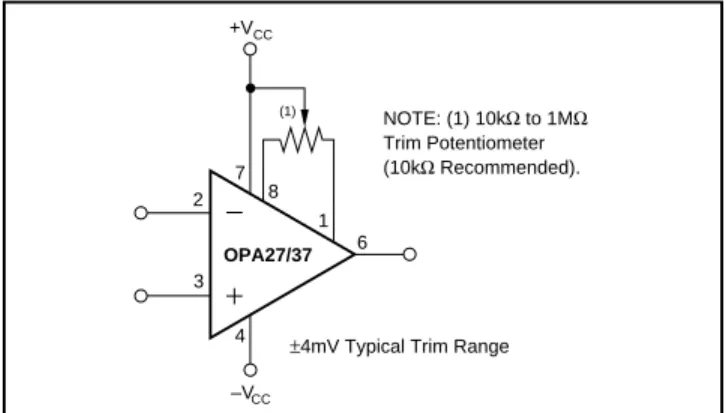
The conventional offset voltage trim circuit is shown in Figure
3. For trimming very small offsets, the higher resolution
circuit shown in Figure 4 is recommended.
The OPA27 and OPA37 can replace 741-type operational
amplifiers by removing or modifying the trim circuit.
THERMOELECTRIC POTENTIALS
The OPA27 and OPA37 are laser-trimmed to microvolt-level
input offset voltages, and for very-low input offset voltage
drift.
Careful layout and circuit design techniques are necessary to
prevent offset and drift errors from external thermoelectric
potentials. Dissimilar metal junctions can generate small
EMFs if care is not taken to eliminate either their sources
(lead-to-PC, wiring, etc.) or their temperature difference (see
Figure 11).
Short, direct mounting of the OPA27 and OPA37 with close
spacing of the input pins is highly recommended. Poor layout
can result in circuit drifts and offsets which are an order of
magnitude greater than the operational amplifier alone.
FIGURE 1. 0.1Hz to 10Hz Noise Test Circuit.
FIGURE 2. Low Frequency Noise.
DUT OPA111 100kΩ 2kΩ 4.7µF Voltage Gain Total = 50,000 10Ω
NOTE: All capacitor values are for nonpolarized capacitors only. 0.1µF Scope x1 RIN = 1MΩ 100kΩ 24.3kΩ 4.3kΩ 110kΩ 0.1µF 22µF 2.2µF 0.1Hz TO 10Hz NOISE 1s/div 40nv/div
COMPENSATION
Although internally compensated for unity-gain stability, the
OPA27 may require a small capacitor in parallel with a
feedback resistor (R
F) which is greater than 2k
Ω
. This
ca-pacitor will compensate the pole generated by R
Fand C
INand eliminate peaking or oscillation.
INPUT PROTECTION
Back-to-back diodes are used for input protection on the
OPA27 and OPA37. Exceeding a few hundred millivolts
differ-ential input signal will cause current to flow, and without
external current limiting resistors, the input will be destroyed.
Accidental static discharge, as well as high current, can
dam-age the amplifier’s input circuit. Although the unit may still be
functional, important parameters such as input offset voltage,
drift, and noise may be permanently damaged, as will any
precision operational amplifier subjected to this abuse.
Transient conditions can cause feedthrough due to the amplifier’s
finite slew rate. When using the OPA27 as a unity-gain buffer
(follower) a feedback resistor of 1k
Ω
is recommended, as
shown in Figure 6.
NOISE: BIPOLAR VERSUS FET
Low-noise circuit design requires careful analysis of all noise
sources. External noise sources can dominate in many
cases, so consider the effect of source resistance on overall
operational amplifier noise performance. At low source
im-pedances, the lower voltage noise of a bipolar operational
amplifier is superior, but at higher impedances the high
current noise of a bipolar amplifier becomes a serious
liabil-ity. Above about 15k
Ω
, the OPA111 low-noise FET
opera-tional amplifier is recommended for lower total noise than the
OPA27, as shown in Figure 5.
FIGURE 3. Offset Voltage Trim.
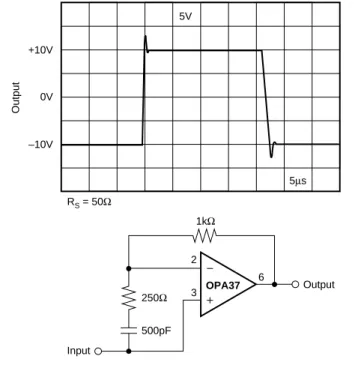
FIGURE 6. Pulsed Operation.
FIGURE 7. Low-Noise RIAA Preamplifier.
FIGURE 4. High Resolution Offset Voltage Trim.
1 2
3 4
6
±4mV Typical Trim Range NOTE: (1) 10kΩ to 1MΩ Trim Potentiometer (10kΩ Recommended). +VCC –VCC OPA27/37 7 8 (1) 1 2 3 4 6
±280µV Typical Trim Range
NOTE: (1) 1kΩ Trim Potentiometer. +VCC –VCC OPA27/37 7 8 4.7kΩ 4.7kΩ (1) 100 1k 10k 100k 1M 10M 1k 100 10 1
Voltage Noise Spectral Density, E
O Typical at 1kHz (nV/ √ Hz) OPA111 + Resistor OPA27 + Resistor Source Resistance, RS (Ω) EO RS EO = √en2 + (inRS)2 + 4kTRS FO = 1kHz Resistor Noise Only
OPA27 + Resistor
OPA111 + Resistor
Resistor Noise Only
OPA27 Output 1.9V/µs RF ≈ 1kΩ Input – + OPA37 Output 97.6kΩ G ≈ 40dB at 1kHz. Metal film resistors. Film capacitors. RL and CL per cartridge
manufacturer’s recommendations. 100Ω 2 3 6 0.03µF 0.01µF 7.87kΩ 1µF 20kΩ RL Moving Magnet Cartridge CL OPA27 Output Input 1kΩ 1kΩ 2 3 6
FIGURE 11. Low Frequency Noise Comparison.
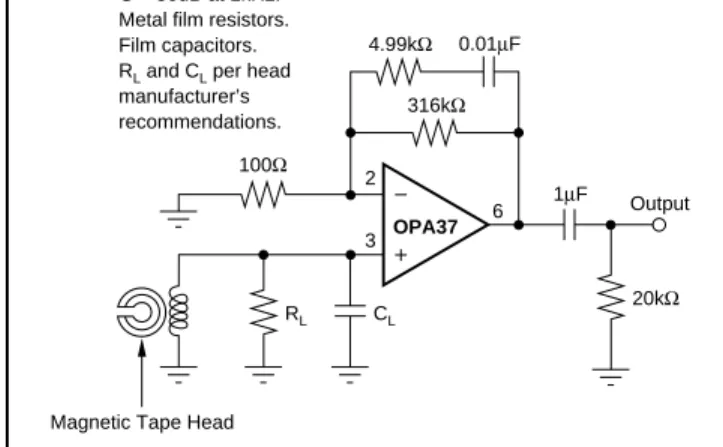
FIGURE 10. NAB Tape Head Preamplifier.
FIGURE 9. High Slew Rate Unity-Gain Inverting Amplifier.
OPA37 Output Input 1kΩ 1kΩ 2 3 6 500pF 250Ω OPA37 Output 316kΩ 4.99kΩ G ≈ 50dB at 1kHz.
Metal film resistors. Film capacitors. RL and CL per head
manufacturer’s recommendations. 100Ω 2 3 6 0.01µF 1µF 20kΩ RL
Magnetic Tape Head
CL 10kΩ 0.5µV 0.5µV 0.5µV 0.5µV 5µV A. 741 noise with circuit well-shielded from air
currents and RFI. (Note scale change.)
B. OP-07AH with circuit well-shielded from air currents and RFI.
C. OPA27AJ with circuit well-shielded from air currents and RFI. (Represents ultimate OPA27 performance potential.)
D. OPA27 with circuit unshielded and exposed to normal lab bench-top air currents. (External thermoelectric potentials far exceed OPA27 noise.)
E. OPA27 with heat sink and shield which protects input leads from air currents. Conditions same as (D). Offset G =1k 10Hz Low-Pass Filter Chart Recorder 10mV/mm 5mm/s DUT Total Gain = 106 10Ω
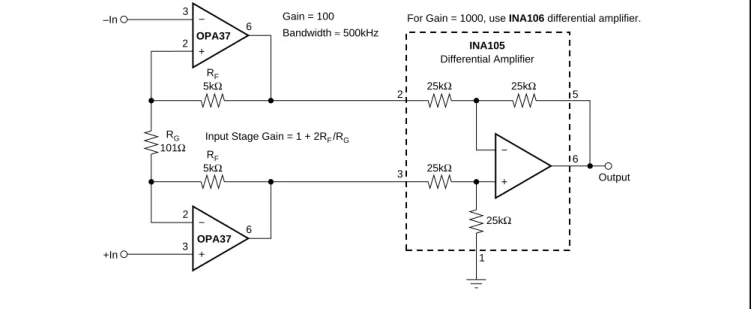
FIGURE 12. Low Noise Instrumentation Amplifier.
FIGURE 13. Hydrophone Preamplifier.
FIGURE 14. Long-Wavelength Infrared Detector Amplifier.
Output OPA37 2 3 6 OPA37 3 2 6 6 1 5 3 2 INA105 Differential Amplifier
Input Stage Gain = 1 + 2RF/RG
+In –In RG 101Ω RF 5kΩ RF 5kΩ Gain = 100 Bandwidth ≈ 500kHz
For Gain = 1000, use INA106 differential amplifier.
25kΩ 25kΩ 25kΩ 25kΩ OPA37 Output 1kΩ 2kΩ EDO 6166
Transducer Frequency Response
≈ 1kHz to 50kHz 2 3 6 1MΩ 200Ω 500pF 0.1µF Output
NOTE: Use metal film resistors and plastic film capacitor. Circuit must be well shielded to achieve low noise. Responsivity ≈ 2.5 x 10⁴V/W Output Noise ≈ 30µVrms, 0.1Hz to 10Hz Dexter 1M Thermopile Detector 100Ω 100kΩ OPA27 2 3 6 0.1µF Output 4.99kΩ D2 D1 DG188 TTL In S1 S2 9.76kΩ 500Ω Balance Trim OPA27 2 3 1 8 6 20pF 10kΩ 1kΩ 4.75kΩ Offset Trim 4.75kΩ +V Input TTL INPUT “1” “0” GAIN +1 –1
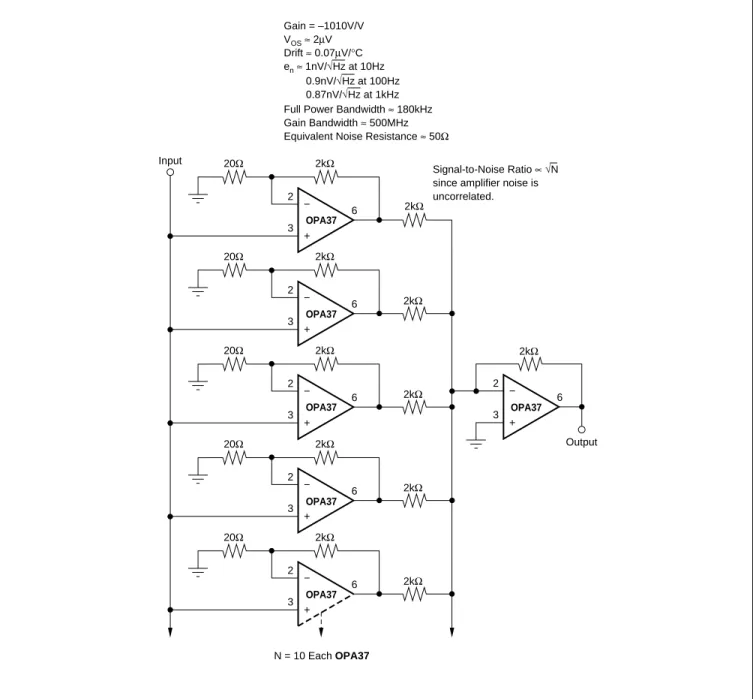
FIGURE 16. Ultra-Low Noise “N”-Stage Parallel Amplifier.
2kΩ Gain = –1010V/V VOS≈ 2µV Drift ≈ 0.07µV/°C en≈ 1nV/√Hz at 10Hz 0.9nV/√Hz at 100Hz 0.87nV/√Hz at 1kHz Full Power Bandwidth ≈ 180kHz Gain Bandwidth ≈ 500MHz Equivalent Noise Resistance ≈ 50ΩSignal-to-Noise Ratio ∝ √N since amplifier noise is uncorrelated. 2kΩ 6 2 3 20Ω 6 2 3 6 2 3 2kΩ 6 2 3 6 2 3 OPA37 OPA37 OPA37 OPA37 OPA37 6 Output 2 3 OPA37 N = 10 Each OPA37 2kΩ 2kΩ 2kΩ 2kΩ 2kΩ 20Ω 2kΩ 20Ω 2kΩ 20Ω 2kΩ 20Ω Input
FIGURE 18. High Slew Rate Unity-Gain Buffer.
FIGURE 17. Unity-Gain Buffer.
FIGURE 20. Balanced Pyroelectric Infrared Detector.
FIGURE 19. RF Detector and Video Amplifier.
OPA27 Output Input 1kΩ 2 3 6 5V 5µs RS = 50Ω +10V 0V Output –10V OPA37 Output Input 1kΩ 2 3 6 500pF 250Ω 5V 5µs RS = 50Ω +10V 0V Output –10V OPA37 Video Output 20kΩ 200Ω VIRTEC V1000 Planar Tunnel Diode 2 3 6 0.01µF 50Ω Input 200Ω RFC 500pF OPA27 Output 10kΩ 100Ω 100µF/20V Tantalum 2 3 6 + + 1 3 2 10kΩ 10kΩ 10µF/20V Siemens LHI 948 +15V OPA27 Output 0 + – 4.8V 1kΩ 2 3 Airpax Magnetic Pickup fOUT∝ RPM • N
Where N = Number of Gear Teeth 6
PACKAGING INFORMATION
Orderable Device
Status
(1)Package
Type
Package
Drawing
Pins Package
Qty
Eco Plan
(2)Lead/Ball Finish
MSL Peak Temp
(3)OPA27GP
ACTIVE
PDIP
P
8
50
TBD
Call TI
Level-NA-NA-NA
OPA27GU
ACTIVE
SOIC
D
8
100
TBD
CU NIPDAU
Level-2-220C-1 YEAR
OPA27GU/2K5
ACTIVE
SOIC
D
8
2500
TBD
CU NIPDAU
Level-2-220C-1 YEAR
OPA37GP
ACTIVE
PDIP
P
8
50
TBD
Call TI
Level-NA-NA-NA
OPA37GU
ACTIVE
SOIC
D
8
100
TBD
CU NIPDAU
Level-2-220C-1 YEAR
OPA37GU/2K5
ACTIVE
SOIC
D
8
2500
TBD
CU NIPDAU
Level-2-220C-1 YEAR
(1)
The marketing status values are defined as follows:
ACTIVE: Product device recommended for new designs.
LIFEBUY: TI has announced that the device will be discontinued, and a lifetime-buy period is in effect.
NRND: Not recommended for new designs. Device is in production to support existing customers, but TI does not recommend using this part in
a new design.
PREVIEW: Device has been announced but is not in production. Samples may or may not be available.
OBSOLETE: TI has discontinued the production of the device.
(2)
Eco
Plan
-
The
planned
eco-friendly
classification:
Pb-Free
(RoHS)
or
Green
(RoHS
&
no
Sb/Br)
-
please
check
http://www.ti.com/productcontent
for the latest availability information and additional product content details.
TBD: The Pb-Free/Green conversion plan has not been defined.
Pb-Free (RoHS): TI's terms "Lead-Free" or "Pb-Free" mean semiconductor products that are compatible with the current RoHS requirements
for all 6 substances, including the requirement that lead not exceed 0.1% by weight in homogeneous materials. Where designed to be soldered
at high temperatures, TI Pb-Free products are suitable for use in specified lead-free processes.
Green (RoHS & no Sb/Br): TI defines "Green" to mean Pb-Free (RoHS compatible), and free of Bromine (Br) and Antimony (Sb) based flame
retardants (Br or Sb do not exceed 0.1% by weight in homogeneous material)
(3)
MSL, Peak Temp. -- The Moisture Sensitivity Level rating according to the JEDEC industry standard classifications, and peak solder
temperature.
Important Information and Disclaimer:The information provided on this page represents TI's knowledge and belief as of the date that it is
provided. TI bases its knowledge and belief on information provided by third parties, and makes no representation or warranty as to the
accuracy of such information. Efforts are underway to better integrate information from third parties. TI has taken and continues to take
reasonable steps to provide representative and accurate information but may not have conducted destructive testing or chemical analysis on
incoming materials and chemicals. TI and TI suppliers consider certain information to be proprietary, and thus CAS numbers and other limited
information may not be available for release.
In no event shall TI's liability arising out of such information exceed the total purchase price of the TI part(s) at issue in this document sold by TI
to Customer on an annual basis.
PACKAGE OPTION ADDENDUM
www.ti.com
6-May-2005
MECHANICAL DATA
MPDI001A – JANUARY 1995 – REVISED JUNE 1999