THE ROLE OF TEXT MESSAGING IN CLOSE RELATIONSHIPS
Jenna Clark
A dissertation submitted to the faculty at the University of North Carolina at Chapel Hill in partial fulfillment of the requirements for the degree of Doctor of Philosophy in the Department
of Psychology and Neuroscience in the College of Arts and Sciences.
Chapel Hill 2017
Approved by: Sara Algoe
© 2017 Jenna Clark
ABSTRACT
Jenna Clark: The Role of Text Messaging in Close Relationships (Under the direction of Sara Algoe)
Supportive close relationships are integral to health and well-being. According to the interpersonal process model of intimacy (Reis & Shaver, 1988), high-quality relationships are built through everyday interactions that allow partners to demonstrate responsiveness. Social interactions in today’s world are increasingly likely to occur over technological channels such as text messaging; however, little research has investigated what role text messaging might play in close relationships.
In Study 1, 180 college undergraduates reported on the presence of four relational behaviors within their last four conversations with their most frequent texting partner. Each relational behavior was present in between 35-60% of conversations, with 88% of relational behaviors receiving positive responses from relational partners. The presence of each relational behavior within a conversation also independently and significantly predicted perceived partner responsiveness in the conversation.
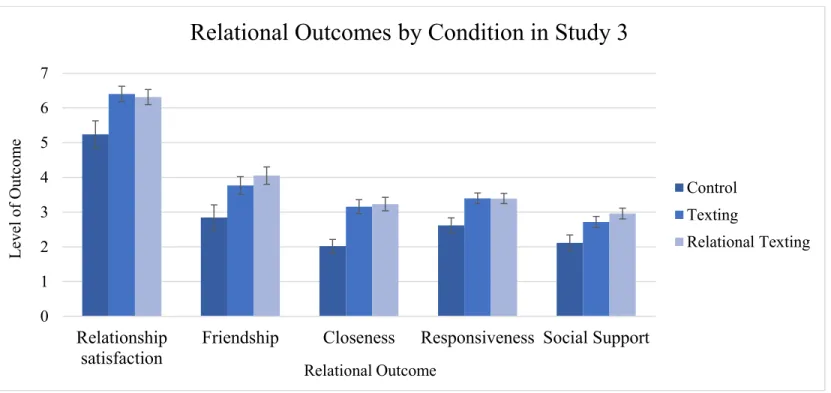
These similarities and differences raise questions about the overall relational potential of texting as a medium for establishing new relationships. In Study 3, 180 college undergraduates were randomly assigned to novel pairs, each pair then assigned to a control, daily texting, or relational texting condition for a two-week experimental period. At the end of the experiment, participants in the daily or relational texting conditions reported significantly higher levels on five markers of relationship quality than participants in the control condition, suggesting that texting provides sufficient relational value to aid the formation of close relationships.
Across three studies, this work demonstrates that text messaging can contribute to relationship growth and maintenance in ways both similar and dissimilar to face-to-face interaction. Moreover, texting can also serve as a useful interaction medium for the
ACKNOWLEDGEMENTS
I would like to thank my advisor, Sara Algoe, for her constant help and guidance through every step of this process – teaching me the meaning of social support by example! My
wonderful husband Mike has also been instrumental in making my time in graduate school happy as well as successful.
And, of course…
TABLE OF CONTENTS
LIST OF TABLES...ix
LIST OF FIGURES...x
CHAPTER 1: Study 1: Introduction...1
Technology-Mediated Communication as Similar to Face-to-Face Interaction: Relational Behaviors and Intimacy...3
The Interpersonal Process Model of Intimacy...3
Disclosure-Based Behaviors Are Key to the Growth of Intimacy...4
Social Support...4
Capitalization...5
Other Relational Behaviors Relevant to the Growth of Intimacy...6
Expressed Gratitude...6
Shared Laughter...7
Technology-Mediated Communication as Distinct from Face-to-Face Interaction: Feelings of Connection...7
The Role of Text Messaging in Relationships...9
Study 1...10
CHAPTER 2: Study 1: Method...12
Measures...13
Individual Differences...13
Relationships...13
CHAPTER 3: Study 1: Results...16
Conversation Data...16
Presence of Relational Behaviors...16
Random Effects ANOVA...17
Model 1: Sum of Relational Behaviors Model...18
Model 2: Sum of Relational Behaviors Model Plus Controls...19
Model 3: Individual Relational Behaviors Model...20
Model 4: Individual Relational Behaviors Model Plus Controls...21
CHAPTER 4: Study 1: Discussion...23
CHAPTER 5: Study 2: Introduction...24
CHAPTER 6: Study 2: Methods...28
Procedure...28
Measures...30
Relationship Demographics...30
Relationship Evaluations...30
Mediated Interactions...30
Well-Being Measures...32
CHAPTER 7: Study 2: Results...33
Partner Information...33
Random Assignment and Manipulation Checks...33
Connection, Responsiveness, and Relationship Satisfaction...34
Displacement and Stimulation...36
CHAPTER 9: Study 3: Introduction...39
CHAPTER 10: Study 3: Methods...41
Procedure...41
Experimental Manipulation and Laboratory Procedure...43
Measures...44
Presurvey...44
Laboratory Survey...44
Daily Surveys...45
Weekly and Final Surveys...45
CHAPTER 11: Study 3: Results...48
Random Assignment and Manipulation Checks...48
Effects of Condition on Relational Outcomes...50
Effect of Condition on Face-to-Face Interaction...53
Effect of Condition on Well-Being...53
CHAPTER 12: Study 3: Discussion...54
CHAPTER 13: General Discussion...57
LIST OF TABLES Table 1 - Prevalence of relational behaviors across conversations
by participant and partner...61 Table 2 - Descriptive statistics and Correlations for Relationship
variables in Study 1...62 Table 3 - Text messaging behavior over the prior three days
by condition and time point...63 Table 4 – Descriptive statistics and correlations for relationship
variables at Times 1 and 2 for Study 2...64 Table 5 - Descriptive statistics and correlations for relevant
variables in Study 3...65 Table 6 - Manipulation check variables in Study 3 for texting
LIST OF FIGURES
CHAPTER 1: STUDY 1: Introduction
Several decades’ worth of research supports the idea that intimate and satisfying
relationships are critical for our physical well-being (e.g., Uchino, Cacioppo, & Kiecolt-Glaser, 1996; Kiecolt-Glaser & Newton, 2001; Holt-Lunstad, Smith, & Layton, 2010; House, Landis, & Umberson, 1988). However, the mechanisms that underlie these effects remain under
investigation. While merely being in intimate relationships tends to provide some benefits (Gordon & Rosenthal, 1995; House, Landis, & Umberson, 1988), sufficiently troubled or low-quality relationships may actually impair health, rather than boost it (Kiecolt-Glaser & Newton, 2001). These findings suggest the importance of isolating the mechanisms through which high-quality relationships serve protective functions. Many different contenders have been proposed; Reis (2012) lists eighteen separate markers or definitions of high-quality relationships, as
different from one another as secure attachment (Mikulincer & Shaver, 2010) and self-expansion (Aron & Aron, 1997).
Many of these disparate concepts revolve around the act of self-disclosure – that we become close to our relational partners when we tell them something about ourselves that was not previously known. These disclosures may be significant, but often times they simply concern the details of our everyday lives: celebration of small triumphs or commiseration in small
However, the very nature of everyday interaction has been evolving in the last few decades with the introduction of technological media to our lives. Technology-mediated
interactions – everything from telephone conversations to video chat to simple text messaging – now represent a sizable portion of our social lives, and present both promise and problems for the creation and maintenance of high quality connections. Text messaging is a particularly relevant form of technology-mediated interaction; it is both extremely prevalent in everyday use and understudied in extant psychological literature. Moreover, it strips several channels of communication that have long been identified as important for interpersonal relationships, such as facial expression and tone of voice; these absences may well have consequences for text-based interaction (e.g., Sproull & Kiesler, 1986). To understand how relationships function in the modern world, we must understand the role that text messaging plays in maintaining and establishing closer and more high-quality relationships.
I hypothesize that text messaging may influence close relationships in ways that are both similar to and distinct from face-to-face interaction. Though previous research has not yet examined how texting contributes to relationships, texting can serve as a vehicle for relational behaviors much as face-to-face interactions do. However, its absence of important non-verbal channels may influence how successfully relational behaviors unfold over text messages Due to its technological features, texting may also have effects that face-to-face interaction does not. Allowing for the maintenance of constant contact between relational partners regardless of time or distance, it may serve as a critical method for maintaining a sense of connection with
Technology-Mediated Communication as Similar to Face-to-Face Interaction: Relational Behaviors and Intimacy
The primary similarities between technology-mediated and face-to-face interactions lie in the fact that basic social psychological processes are still likely to apply to mediated interactions (Clark, Algoe, & Green, under review). Relationships should, therefore, grow in closeness and quality in mediated contexts through the same mechanisms that apply in face-to-face
communication. Relationship science has already identified one particularly relevant model for understanding relationship growth: the interpersonal process model of intimacy.
The Interpersonal Process Model of Intimacy. The interpersonal process model of intimacy (Reis & Shaver, 1988) speaks to the question of how our everyday interactions contribute to the growth and maintenance of close relationships. In this model, one relational partner (acting in accordance with their motivations, beliefs and goals) offers a disclosure of some form of personal information. The other relational partner (similarly acting according to their motivations, beliefs, and goals) provides a response, and the first partner then reacts to this response. Hence it is not enough to study one partner’s disclosure in isolation; to fully
understand the results of any disclosure, one must pay attention to what’s happening with both partners. Considering disclosure as it occurs in real-world settings, this is a logical surmise. One can easily imagine a situation in which a disclosure is met with disgust or rejection, as compared to one where a disclosure is met with acceptance and support; these two situations will likely have very different effects on the discloser’s future decisions to share with their partner.
When a partner provides a positive and accepting reply to a disclosure, he or she
and hence the cycle repeats, building intimacy and high-quality relationships (e.g., Laurenceau, Barrett, & Pietromonaco, 1998). As such, perceived partner responsiveness is an important aspect of the process – without perceptions of a responsive partner, movement toward intimacy is likely to stall, inhibiting the growth of a closer and healthier relationship.
Disclosure-Based Behaviors Are Key to the Growth of Intimacy. According to the interpersonal process model of intimacy, each iteration of the cycle begins with a form of disclosure, or a “bid” – something that solicits a response from the partner. While this can include factual self-disclosure, emotional self-disclosure tends to be more predictive of the growth of intimacy (Laurenceau, Barrett, & Pietromonaco, 1998). Within this research, we discuss two different forms of emotional self-disclosure: social support seeking and
capitalization. These behaviors function in distinct ways across different situations, but both include sharing of self-relevant emotional information to a partner. As such, all provide opportunities for the partner to demonstrate responsiveness and build intimacy.
Social Support. Social support is a foundational concept in the scientific literature on
that requesting social support (for example, by simply mentioning that one has had a bad day) may pay dividends beyond repairing the negative state that prompted the request; it may also increase the closeness and quality of the relationship between the two parties. Indeed, research examining support provision in intimate relationships demonstrates that it contributes to
relationship quality (Collins & Feeney, 2000) so long as the provided support itself is responsive. A wealth of research on the subjective nature of social support’s benefits supports the importance of responsiveness in the process. Social support that is not responsive may not be perceived as support at all – in fact, it may backfire. For example, ‘invisible’ social support from a confederate – social support performed without the recipients’ awareness – proved more beneficial in reducing emotional reactivity in a stressful task than visible social support (Bolger & Amarel, 2007). This effect holds when invisible support is defined in a way that could easily be read as ‘responsive support’ instead: helpful support is support that puts the two partners on an equal footing, that is conversational, and that draws focus away from the problem/the partner’s limitations and difficulties (Howland & Simpson, 2010). This approach has been corroborated by other research; whether social support is visible or invisible, its emotional benefits only appear if the partner is seen as responsive (Maisel & Gable, 2009) and its health benefits are in fact fully mediated by responsiveness (Selcuk & Ong, 2013). Successful social support, then, is inextricably linked to responsiveness.
Capitalization. Capitalization is a similar process to social support – however, while
benefits of capitalization seem to rely primarily on receiving an enthusiastic response (Reis, Smith, Carmichael, Caprariello, Tsai, Rodrigues, & Maniaci, 2010). Moreover, the benefits of capitalization are not momentary – supportive responses to capitalization are associated with relational quality even months after an interaction (Gable, Gonzaga, & Strachman, 2006).
Similarly to social support, capitalization allows an individual to convey aspects of their true self – not their needs, but rather, their joys and successes – and their partner a chance to demonstrate responsiveness by actively and enthusiastically reacting. However, social support and
capitalization are independent processes that each confer their own separate benefits. In fact, responsive reactions to positive events are more strongly related to relationship quality and perceptions of available support than responsive reactions to negative events, likely due to the difficulties of providing support in negative situations (Gable, Gonzaga, & Strachman, 2006; Gable, Gosnell, Maisel, & Strachman, 2012).
Other Relational Behaviors Relevant to the Growth of Intimacy. While the
interpersonal process model of intimacy begins with disclosure, it identifies responsiveness as the key ingredient that allows for relational growth. As such, other behaviors that allow relational partners to demonstrate their responsiveness may also contribute to the growth of relationships. The expression of gratitude and the sharing of laughter may also provide opportunities for responsive interactions that bring relationship partners closer together.
Expressed Gratitude. The find-remind-and-bind theory of gratitude suggests that
gratitude is a response to a relational partner’s responsive action; this emotional response serves to help find high-quality relational partners or remind individuals of their existing high-quality partners, and then bind them closer together (Algoe, 2012). Responsiveness is a critical
predict relationship quality improvement over time for the person who hears the expression (Algoe, Fredrickson, & Gable, 2013). The positive effects of gratitude expression on the person who hears it seem to depend on perceiving responsiveness in the expresser (Algoe & Zhaoyang, 2016), and gratitude expressions can be quickly and easily conveyed via text. As such, gratitude expressions are another primary candidate for building relational closeness in texting via
responsiveness.
Shared Laughter. A small body of recent research identifies shared laughter as a
potential mechanism for relational strength and growth. Laughter that is shared with a partner (i.e., occurring simultaneously) predicts perceptions of closeness and social support, controlling for overall amounts of laughter (Kurtz & Algoe, 2015). The link between shared laughter and relational outcomes is mediated by perceived similarity (Kurtz & Algoe, 2017), which may well link to responsiveness; feeling similar to one’s partner is likely somewhat synonymous with feeling understood and validated. While this research is still preliminary, it provides another intriguing potential mechanism through which individuals may build high-quality relationships. Text-only technology-mediated communication does not allow for audible or visual signals of laughter, but humor is still a common component of text-only communication; verbal irony may be more present in text than in face-to-face conversation (Hancock, 2004). Shared laughter is difficult to gauge in text format, but may provide another route through which partners strengthen their relationships.
Technology-Mediated Communication as Distinct from Face-to-Face Interaction: Feelings of Connection
communication is that it allows users to ignore barriers of time and distance. Individuals cannot be in face-to-face proximity at all times, but mediated communications can allow for
conversations even when the two parties involved might otherwise be unable to interact. As such, the value of mediated communication may also lie in its ability to foster a sense of connection to relational partners. Connection, in this sense, represents the perception that one is able to reach and communicate with a relational partner. Connection can be thought of as related to
relationship closeness, but not synonymous – for example, one might have a friend whom one spoke to frequently but only on superficial topics (a connected but not close friend) or a friend whom one saw or spoke to rarely but on meaningful topics (a close but not connected friend.). Some research suggests that communication frequency may be more critical than communication quality in sustaining in friendships (Cummings, Lee, & Kraut, 2006). A friend whom one sees frequently and speaks to on meaningful topics (a close and connected friend), however, is likely to have more opportunities to demonstrate responsiveness and increase intimacy over time. Moreover, feeling proximate and connected to others may have benefits all its own, such as emotion regulation (Beckes & Coan, 2011).
predict the growth of a sense of connection to others. This sense of connection might represent a novel contribution to relationships that mediated communication can provide.
The Role of Text Messaging in Relationships
Text messaging provides an excellent candidate for studying both relational behaviors and the potential benefit of constant connection on relationships. Text messages lack many of the channels important to communicative use: tone of voice, facial expression, and body language are all stripped away by text-based formats. However, despite the relative paucity of the medium’s cues, it is extremely popular; college students report engaging in more text
messaging than face-to-face social interaction (Clark, Algoe & Green, unpublished.) Moreover, the limited affordances of text-based messaging allow for a stringent test: if a medium as limited as text messaging still serves relational purposes, technology-mediated communications of many types are likely to have valuable potential for the formation and maintenance of close
relationships.
As a note, “text messaging”, in this work, refers to any form of primarily text-based, instantaneous private messaging; SMS is perhaps the most recognizable form, but multiple other services such as Gchat, Facebook Messenger, WhatsApp, and others allow for these type of messages to be exchanged.
Across these three studies, I aim to clarify the role that text messaging plays in the maintenance and growth of close relationships.
Study 1
Though it is largely not represented in current psychological literature, text messaging is extremely common; a sample of undergraduates reported engaging in 12.95 hours of texting use across the previous two days (Clark, Algoe, & Green, unpublished). Though many users likely rely on text messaging for utilitarian communication, such as arranging meetings or conveying brief practical messages (e.g., “Don’t forget to pick up milk at the store”), the high volume of use suggests that more is going on. Relational behaviors are a likely candidate to explain text
messaging that goes beyond the practical, and if relational behaviors do occur over text
messaging, they should likely convey responsiveness in at least a reasonably similar fashion as they might face-to-face. Otherwise, it is difficult to imagine why users would find text messaging sufficiently rewarding as to engage in such considerable amounts of use. Nonetheless, the actual amount of relational content within text messages – and their ability to induce responsive
behavior in texting partners – are empirical questions not currently answered by any existing data. In the present study, participants will report on their text messaging history with one specific texting partner to take a cross-sectional look at the following hypotheses:
H1: Relational behaviors will be present within text messages. Specifically, I expect to see significantly greater-than-zero amounts of previously identified relational behaviors such as social support, capitalization, expressed gratitude, and shared laughter.
H2: The presence of successful relational behaviors (e.g., partner’s responses to capitalization or social support requests) in a text message conversation will be linked with higher perceptions of partner responsiveness in that conversation.
However, other factors may occlude the link between relational behaviors and perceived responsiveness in any specific conversation. Individuals who value the relational use of
technology-mediated communication also report perceiving more social support from technology-mediated communication (Clark & Green, 2013); this may indicate actually
CHAPTER 2: Study 1: Method
Due to the exploratory nature of this research, the minimum recruitment goal was 100 participants, which would allow for an 82% chance of detecting a small to medium (δ = 0.30) effect. Data were collected over one semester of subject pool participation (n = 31) and a two-week period during classes in a business school (n = 149). One hundred and eighty college undergraduates participated in this study in exchange for course credit. For the purpose of this analysis and the lack of any hypothesized difference between them, the two samples were combined. Average age in the combined sample was 19.95 years (SD = 0.92). The sample was majority male (57.54%), majority Caucasian (75%; 8.33% East Asian; 5.56% South Asian; 3.33% black; 3.89% other; 3.89% multi-racial, and majority non-Hispanic (93.89%)
Participants began the study by providing information about their relationship with their most frequent texting partner. They also provided information on certain individual differences and on demographics. Each participant then reviewed their text messaging history to provide information on their text messaging conversations with their most frequent texting partner over the last week. Conversations were defined as “exchanges of messages that were separated by a short period of time, or occurred across a longer timespan but concerned the same topic“.
responsive. Duration of the conversation was also included, measured as time between the first and last messages.
Measures1
Individual Differences. Attitudes toward texting was measured by a novel set of items written for this study. The scale initially consisted of seven items, scored on a 1-7 rating scale with endpoints of Strongly disagree and Strongly agree; items 2, 4, and 6 were reverse-scored. In analysis, the scale showed poor consistency (α = 0.70); items 2, 4, and 6 were dropped. The final four-item scale demonstrated adequate consistency (α = 0.80). The text for the retained items read as follows: “I believe that meaningful conversations can be had over texts; I use texts to support and strengthen my existing relationships; I think texting is an important part of my social life; I regularly use texts to communicate with others.”
Relationships. To better understand participants’ relationships with their texting partners, closeness and relationship satisfaction were measured. Closeness to one’s texting partner was measured by the Inclusion of Other in Self scale (IOS; Aron, Aron & Smollan, 1992). This scale depicts seven sets of overlapping circles, ranging from just touching to nearly completely overlapping, and asks participants to endorse which image most resembles a specific relationship. Relationship satisfaction was measured by a single item: “This week, my
relationship with this person is…” This item was answered on a 1-9 rating scale, with endpoints of “Terrible” and “Terrific.”
Conversation Measures. For each conversation, participants were asked to report on how many messages they sent, how many messages they received, the topic of the conversation (open-ended response), and the amount of time between the first and last message in the
conversation. This information was collected primarily to describe and characterize conversations, rather than for use in the central analyses.
Participants indicated if they had engaged in the following seven behaviors during a specific conversation. All questions began with “During this conversation, did you”: “Express gratitude to your texting partner?” (gratitude expression); “Tell your partner something about yourself they didn’t know?” (self-disclosure); “Share good news with your partner to celebrate it?” (capitalization); “Respond positively to your partner’s good news?” (capitalization
response); “Seek support from your partner?” (support request); “Provide support to your partner?” (support provision); “Share a joke or laugh with your partner?” (shared laughter). Participants also indicated if their partners had engaged in each of these 7 behaviors toward themselves, for a total of 7 participant behaviors and 7 partner behaviors. Behaviors that were present were coded as 1, while behaviors that were absent were coded as 0. This allows for a test of the prevalence of all relational behaviors in texting as specified in Hypothesis 1.
A sum variable was also coded to represent the total number of
responsiveness-generating partner behaviors within a conversation: this variable included the partner’s gratitude expression, the capitalization response, support provision, and shared laughter. These variables were explicitly chosen because they represented either positive responses to the participants’ bids (in the case of capitalization and social support) or because they represented behaviors likely to induce feelings of responsiveness (gratitude expression and shared laughter). This allows for a test of the link between relational behaviors and perceived responsiveness as specified in Hypothesis 2.
CHAPTER 3: Study 1: Results
Conversation Data
The majority of participants (83.3%) reported having engaged in four or more text conversations with their texting partner over the last week. Data were only collected for the first four text conversations participants reported, leading to a full sample of 669 conversations. The average conversation consisted of 11.53 sent messages (SD = 22.74; median = 6, mode = 2) and 11.97 received messages (SD = 23.37; median = 6, mode = 3), and continued over the course of 6.12 hours (SD = 17.97; median = 1 hour, mode = 0.5 hours). Six conversations with durations of over 1000 hours were omitted from the calculation of conversation length as outliers.
Participants tended to report that their most frequent texting partner was either a friend (50.6% of participants) or romantic partner (38.9% of participants).
Presence of Relational Behaviors
by their partners 90.0% of the time (227/252). See Table 1 for full prevalence data for all relational behaviors.
Combining across all measured relational behaviors, 86.4% (578/669) of conversations involved at least one relational behavior initiated by the participant, and 83.1% (556/669) of conversations involved at least one relational behavior initiated by the partner. The average conversation had 3.01 relational behaviors initiated by participants (SD = 2.23) and 2.92 behaviors initiated by partners (SD = 2.29).
Relational behaviors were also very common at the participant level. Only 1.1% (2/180) participants reported no relational behaviors across any of their conversations. In contrast, 41.7% (75/179) participants indicated initiating relational behaviors in all four conversations – or, perhaps more correctly, 50.7%, as only 150 participants reported having had four or more conversations). Overall, the high prevalence of multiple types of relational behaviors across conversations provides strong evidence in support of Hypothesis 1.
Random Effects ANOVA
Hypothesis 2 predicted that the presence of successful relational behaviors conducted by a participant’s relational partner would predict the participant’s perception of that partner’s responsiveness in the conversation. As the data involved multiple conversations reported on by the same participant, multi-level modeling was used to control for potential variability at the person level. An initial random effects ANOVA was conducted to examine the proportion of the variance within the outcome variable. An ICC of 0.71 indicated that 71% of the variance in perceived partner responsiveness was due to between-individual differences, while 29% of the variance was due to between-conversation differences. In other words, perceptions of
to conversation; factors within each conversation are still explaining a considerable amount of variation in perceived partner responsiveness. The average level of perceived responsiveness across all participants was 4.13 on a 1-5 scale, indicating that participants generally saw their partners as strongly responsive.
Model 1: Sum of Relational Behaviors Model
The data was analyzed with multi-level modeling, using perceived partner responsiveness after the conversation as the outcome variable. The initial model used the person-mean-centered sum of partners’ responsiveness-generating behaviors as defined above: partner capitalization response, support provision, expressed gratitude, and shared laughter. This variable essentially represents the extent to which the amount of a partner’s behaviors within one conversation deviates from the amount of a partner’s average behaviors across all their conversations. It is the main predictor of interest, providing a stringent test of the hypothesis that variability in relational behavior between conversations will be reliably positively associated with variability in
perceived responsiveness of that partner. Person-centered means for the four relational behaviors were also included in the analysis in order to control for person-level effects of
relational behaviors. This tests for the possibility that partners who tended to engage in relational behaviors more often in daily life were simply seen as more responsive overall, accounting for another potential explanation for a link between pro relational behaviors and responsiveness.
The equation for this model is specified as follows in reduced form: responsivenessij = γ00 + γ01person_number-behaviorsj + u0j + γ10number-behaviorsij + rij.
Analysis of the variance explained at each level of the model suggested that this model explained 3% of the variance between individuals and 14% of the variance between
p = 0.002) and the conversation-level sum of relational behaviors (γ10 = 0.20, t(448) = 8.39, p < 0.0001) significantly predicted perceived partner responsiveness.
Model 2: Sum of Relational Behaviors Model Plus Controls
Model 1 does not account for other variables at the person level that might influence perceptions of responsiveness in a specific conversation, as indicated by the fact it explains only 3% of the variance at the person level. To control for these factors, relationship satisfaction, closeness, and attitudes about texting were included in Model 2 as covariates at the person level, grand-mean-centered for ease of interpretability. The equation for model 2 is specified as follows in reduced form: responsivenessij = γ00 + γ01satisfactionj + γ02closenessj + γ03attitudesj +
γ04person_number-behaviorsj + u0j + γ10number-behaviorsij + rij.
Analysis of the variance explained at each level of the model suggested that this model explained 48% of the variance between individuals and 15% of the variance between
conversations.
Relationship satisfaction (γ01 = 0.25, t(156) = 7.15, p < 0.0001) and attitudes toward texting (γ03 = 0.21, t(156) = 4.74, p < 0.0001) were both significantly predictive of perceived responsiveness within a conversation; relationship closeness (γ02 = 0.05, t(156) = 1.66, p = 0.10) was not. However, both the person-level mean sum of relational behaviors (γ04 = 0.12, t(156) = 2.73, p = 0.007) and the conversation-level sum of relational behaviors (γ10 = 0.20, t(423) = 8.32, p < 0.0001) significantly predicted perceived partner responsiveness. This suggests that
factors such as relationship satisfaction. See Table 2 for full means and correlations between all relevant variables included in the model.
Model 3: Individual Relational Behaviors Model
Both Model 1 and Model 2 do not allow for differentiation between relational behaviors that contribute to responsiveness and relational behaviors that do not, or for comparison between the effects of different relational behaviors on responsiveness. To address these questions, another model was run to break down the findings of the first two, focusing specifically on the independent contribution of each relational behavior: partner capitalization response, support provision, expressed gratitude, and shared laughter.
The equation for this model follows in reduced form:
responsivenessij = γ00 + γ01person_capitalizationj + γ02person_supportj + γ03person_gratitude + γ04person_laughter + u0j + γ10capitalizationij + γ20supportij + γ30gratitudeij + γ40laughterij + rij.
Analysis of the variance explained at each level of the model suggested that model 3 explained 4% of the variance between individuals and 13% between conversations.
Considering the person-level means for relational behaviors, only partner’s shared laughter emerged as a significant predictor (γ07 = 0.55, t(168) = 2.68, p = 0.008). That is, individuals whose partners shared more laughter with them during all conversations in general were more likely to perceive higher levels of responsiveness within a given conversation, above and beyond the effects of any relational behaviors within that conversation.
Considering the conversation-level person-centered means for relational behaviors, however, each relational behavior was a significant predictor of perceived partner’s
independently and significantly contributed to perceptions of responsiveness within that conversation.
Model 4: Individual Relational Behaviors Model Plus Controls
Similar to the difference between Models 1 and 2, Model 4 consisted of Model 3 with control variables added: relationship satisfaction, attitudes toward texting, and relationship closeness.
The equation for this model follows in reduced form:
responsivenessij = γ00 + γ01satisfactionj + γ02closenessj + γ03attitudesj + γ04person_capitalizationj + γ05person_supportj + γ06person_gratitude + γ07person_laughter + u0j + γ10capitalizationij + γ20supportij + γ30gratitudeij + γ40laughterij + rij.
Analysis of the variance explained at each level of the model suggested that model 4 explained 48% of the variance between individuals and 15% between conversations.
As in Model 2, relationship satisfaction (γ01 = 0.24, t(153) = 6.98, p < 0.0001) and attitudes toward texting (γ03 = 0.21, t(153) = 4.71, p < 0.0001) were both significantly predictive of perceived responsiveness; relationship closeness (γ02 = 0.05, t(153) = 1.59, p = 0.11), on the other hand, was not.
Considering the person-level means for relational behaviors, only partner’s shared laughter emerged as a significant predictor (γ07 = 0.39, t(153) = 2.37, p = 0.02). That is,
individuals whose partners shared more laughter with them during all conversations in general were more likely to perceive higher levels of responsiveness within a given conversation, above and beyond the effects of any relational behaviors within that conversation.
CHAPTER 4: Study 1: Discussion
As both hypotheses 1 and 2 were supported, this study provides initial evidence that relational behaviors are frequent in texting – even considering only a subset of potential
everyday relational behaviors, omitting others such as offering compliments that may frequently occur on an everyday basis. This study’s findings also suggest that perceived partner
responsiveness, a building block of intimacy, can likely be established via text messaging. Moreover, it supports the theory that relational behaviors can demonstrate responsiveness in mediated settings, much as they do in face-to-face interaction (Reis & Shaver, 1988). Even taking into account relationship satisfaction and attitudes toward texting, the data support the hypothesis that meaningful connections are occurring on an everyday basis over text messaging.
It is unclear why capitalization response might have proved non-significantly associated with perceived responsiveness in Model 4, once relationship satisfaction and attitudes toward texting were accounted for. It is possible that simply asking if an individual responded positively to a capitalization attempt is not enough. Prior work on capitalization has differentiated between active (i.e., enthusiastic) and passive (i.e., quiet or muted) positivity in capitalization response, suggesting that only active positivity conveys relational benefits (Gable, Reis, Impett, & Asher, 2004). A greater level of specificity in assessing partner response to capitalization might have provided better evidence for the link between capitalization and responsiveness.
CHAPTER 5: Study 2: Introduction
The results of Study 1 document that everyday relationship behaviors do happen via text messaging – and quite frequently. They also establish that the presence of these behaviors is positively associated with meaningful variance in perceived responsiveness of the texting partner. In other words, text messaging may contribute to the growth and maintenance of close relationships in a similar fashion as face-to-face interaction. However, text messaging’s unique features may allow it to contribute to relationships in ways that are distinct from face-to-face interaction as well. The ability of texting to maintain a sense of constant availability and contact is of particular interest. Text messages can typically be answered at almost any time, with fewer barriers to access than even telephone conversations. This unprecedented accessibility is a potential benefit of text messaging that may have implications for feeling connected to one’s relational partners at all times. Experimentally manipulating participants’ use of text messaging over a short period allows for examination of the impact of text messaging on feelings of
connection.
temporarily change along with the experimental manipulation. (Note that all effects are expected to be temporary and no longer present at a later follow-up date.)
H3a: Participants who are assigned to not message a relational partner over a short period will show temporary declines in their connection to this relational partner.
H3b: Participants who are assigned to not message a relational partner over a short period will show temporary declines in their relationship satisfaction with and global perceived
responsiveness of this relational partner.
H4a: Participants who are assigned to message a relational partner more often over a short period will show temporary increases in their connection to this relational partner.
H4b: Participants who are assigned to message a relational partner more often over a short period will show temporary increases in their relationship satisfaction with and global perceived responsiveness of this relational partner.
H5: The effect of changed texting behavior on relationship satisfaction will be mediated via sense of connection and global perceived partner responsiveness.
A manipulation of text messaging quantity also allows for studying how texting might influence face-to-face interaction: as stimulation or displacement. While this question has not yet been examined with text messaging, it has been researched in the context of online interactions – similar to text messaging in that they often involve text only, stripped of visual or audible
close relationships, which in turn should drive more interaction (Katz, Rice, & Aspden, 2001; Valkenburg & Peter, 2007).
If stimulation theorists are correct, engaging in more text messaging should boost face-to-face interaction, while engaging in less text messaging might decrease face-to-face-to-face-to-face interaction. However, if displacement theorists are correct, the opposite pattern is implied: more texting will mean less interaction.
CHAPTER 6: Study 2: Methods
To study the effects of texting on relationships, participants were randomly assigned to one of three conditions: increased texting behavior, stopped texting behavior, or a control condition of usual texting behavior. These instructions were observed over a three-day experimental period.
Participants
A priori power analysis indicated that a sample size of 79 participants per condition, or 237 in total, was required to have 80% power for detecting an effect of medium size (δ = 0.5); as such, 237 participants was set as the minimum recruitment goal. Data collection continued until a previously chosen date at the end of the Fall 2016 semester; in total, 272 college undergraduates participated in this study in return for partial credit toward a course requirement. Potential participants were required to have at least one individual they texted at least once a week and to be willing to alter their texting behavior with that person, potentially including a brief cessation of contact. A majority of the sample was female (65.4% female; 33.82% male; 0.7% non-binary or otherwise described), 69.5% was white (1% Native American, 6.62% East Asian, 5.15% South Asian, 6.25% Black, 5.88% other, and 6.25% multiracial), and 9.6% was Hispanic; average age was 18.95 (SD = 1.57).
Procedure
to their texting partner. In the questionnaire, participants were asked about their general patterns of interaction with their partner: how much time they spend interacting with their partner across a wide variety of media, as well as the perceived quality of these interactions. Lastly, participants were assigned to one of the three conditions: increased texting (initiating at least one additional conversation a day beyond usual rates with their most frequent texting partner), stopped texting (no text-based private messaging allowed with their most frequent texting partner), or maintained texting (maintaining current rates of texting with their most frequent texting partner). They were also told that they could still interact with their partner across any other media, and that they were allowed (actively encouraged, in the stopped condition) to inform their partner of their participation in this experiment.
Participants were asked to abide by the experimental instructions for the next three days, beginning on the day after their participation in the lab. At the end of the experimental period, participants were sent a link to a follow-up survey including the same relational and interaction measures as the initial survey. The follow-up survey ended with a small gratitude induction aimed to help mitigate any potential deficits in closeness incurred during the experimental period.2 Of the original sample of 272 participants, 264 completed this follow-up survey. There was no difference in attrition between conditions (2 participants in the increased condition, 2 participants in the stopped condition, and 4 participants in the maintained condition
discontinued).
After an initial sample of participants was collected (n = 50), a second follow-up
reassessing measures of relationship quality and satisfaction was added to the protocol. This brief survey was completed one week after the first follow-up to determine if any hypothesized
relational consequences of the experimental manipulation were persistent. The sample size for this one-week follow-up consisted of 194 participants.
Measures3
Relationship Demographics. Participants indicated whether their most frequent texting partner was a friend, romantic partner, family member, classmate, coworker, authority figure (boss, teacher, etc.), or none of the above. They also indicated which of the three categories fit their most frequent texting partner the best: “someone I mostly see face-to-face but sometimes also text with, “someone I mostly text with but sometimes see face-to-face”, or “someone I used to see face-to-face but now mostly text with”. Lastly, participants indicated how many months and years (if applicable) they had known their partners.
Relationship Evaluations. Global perceived partner responsiveness (α = 0.79; 0.91; 0.85), closeness, and relationship satisfaction were assessed in the pre-survey and both of the follow-up surveys, using the same measures as in Study 1. However, the scale instructions were modified to refer specifically to the last three days. For example, the prompt for responsiveness now read: ”Please answer the following questions about how you felt during the last three days on a scale of 1 to 5, where 1 represents not at all and 5 represents very much”.
Connectedness to one’s partner was measured with a single item adapted from Deters and Mehl (2013), reading “Right now, I feel connected to and in touch with my texting partner” and answered on a 5-point rating scale from “very slightly” to “extremely”.
Mediated Interactions. Participants were asked to consult their smartphones to answer questions about the number of conversations they had shared with their partner over the last three
days using each of the following media: 1) face-to-face interaction; 2) private, text-based messaging (e.g., Facebook messaging, gchat, text messaging, etc.); 3) email; 4) other forms of private mediated communication (e.g., Snapchat); 5) public Facebook use (e.g., comments or wall posts); and 6) voice chat (both telephone use and Skype). For face-to-face interaction and voice chat, participants were additionally asked how many hours they had spent engaging with their partner in each medium. For text-based messaging, email, other forms of private mediated communication, and public Facebook use, participants instead provided the number of messages they had received and sent in each medium.
Across each medium, participants also reported on several behaviors that may or may not have happened over the last three days. They include whether the participant solicited social support (“I used <this medium> to ask my partner for help or reassurance in times of need”), capitalization attempts (“I shared good news with my partner over <medium> so that we could celebrate together”), and self-disclosure (“I told my partner things they didn’t know about me over <medium>”). For texting, participants also reported on shared laughter (“I’ve shared jokes or laughs with my partner over texts so we could enjoy them together.”) and expressed gratitude (“I thanked my partner over texts for the good things they’ve done for me”). These items were answered on a scale of 1 (Never) to 5 (All the time).
Well-Being Measures
Well-being was measured at the pre-survey and the follow-up at the end of the three-day experimental period. To measure happiness, participants completed the 4-item Subjective
CHAPTER 7: Study 2: Results Partner Information
Similar to Study 1, 55.2% (150/272) of the sample reported that their most frequent texting partner was a friend, while 27.6% (75/252) reported a significant other. Family members comprised the majority of the remainder (16.2%; 44/272); 3 participants reported that their texting partner was none of the above. There was no difference in partner type by condition, χ2(6) = 5.76, p > 0.05.
Fifty-eight percent (158/272) of participants reported that their texting partner was someone they primarily knew face-to-face but also texted, while 37.5% (105/272) reported that their texting partner was someone they primarily texted but also saw face-to-face. Only 4.4% (12/272) reported that their most frequent texting partner was someone they once saw face-to-face primarily but now mostly text.
The average length of reported relationships was 77.20 months (6.4 years; SD = 77.16), with a minimum of 1 month and a maximum of 258 months (21.5 years).
Random Assignment and Manipulation Checks
In order to ensure that individuals assigned to the three experimental conditions did not significantly differ prior to the manipulation, a series of ANOVAs was conducted on texting behavior by condition at time 1 (the pre-survey). Despite assumptions of random assignment, marginally significant differences were found between conditions for both the sending of texts, F(2,269) = 2.89, p = 0.06, and the receiving of texts, F(2,269) = 3.01, p = 0.05. Post-hoc tests
than had the maintained or stopped conditions at time 1. At time 2, the increased and maintained conditions sent and received more texts than the stopped condition, with no significant difference observed between the increased and maintained conditions.
However, a manipulation check that examines whether participants followed instructions – that is, whether “increased” increased and “stopped” decreased over time, relative to
“maintained” – was significant for both sending and receiving of texts, Fs(2,260) = 35.00, 32.08; ps < 0.0001; all three conditions were significantly different from one another. In other words, participants in the increased texting condition did significantly increase their texting between time 1 and time 2, participants in the maintained texting condition maintained their usual levels of texting, and participants in the stopped texting condition did significantly decrease their texting between time 1 and time 2. Since the initial level of texting behavior was significantly lower in the increased condition, the manipulation only boosted the increased condition to parity with the maintained condition, but was wholly successful in lowering the stopped condition significantly. See Table 3 for full information on texting behavior between conditions.
Interestingly, initial responsiveness, F(2,269) = 4.74, p = 0.01, and relationship
satisfaction differed between conditions, F(2,269) = 4.25, p = 0.02. Post-hoc analysis revealed that the increased texting condition was higher in initial levels of global perceived
responsiveness than the other two conditions and higher in relationship satisfaction than the stopped condition.
Connection, Responsiveness, and Relationship Satisfaction
intended outcomes, all Fs > 13.80, ps < 0.001.4 All three variables showed a similar pattern with respect to the effects of the manipulation: at time 2, the stopped texting condition was
significantly lower than the other two conditions in connection, responsiveness, and relationship satisfaction, while the increased and maintained texting conditions did not significantly differ from each other. See Figure 1 for a graphical representation of these results. See Table 4 for means and correlations for all relationship variables across time points 1 and 2. We note that by the 1-week follow-up, as anticipated, all effects had disappeared and no differences between conditions remained significant (all Fs < 1.09, ps > 0.05.), suggesting the “stop” manipulation did not damage relationships.
In order to test for mechanism, the PROCESS Macro in SAS (Hayes, 2013) was used. To investigate the effect of the manipulation itself and control for the between-condition differences in texts sent at time 1, change in texts sent between time 1 and time 2 was used as the
independent variable instead of condition assignment. In turn, change in connection between time 1 and time 2 and change in responsiveness between time 1 and time 2 were included as potential mediators5. Change in relationship satisfaction between time 1 and time 2 was used as the dependent variable. (All change variables were difference scores computed as the time 2 level of a variable minus the time 1 level.) Changes in texting behavior predicted changes in connection as well as responsiveness, and changes in connection and responsiveness predicted relationship satisfaction at time 2. There was no significant direct relationship between change in
4 Separate models were run using the sum of participants’ reported relational behaviors in texting and the sum of their reported partners’ relational behaviors at time 1 to explore whether the effects of the manipulation depended on typical use of texting; no interaction term between relational behaviors and condition on these outcomes was statistically significant at p < .05.
texting behavior and relationship satisfaction at time 2, b = -0.0013, p > 0.05. The indirect relationship through connection was significant, b = 0.003, SE = 0.001, 95% CI [0.001, 0.005], but the indirect relationship through responsiveness was not, b = 0.0003, SE = 0.0003, 95% CI [-0.000, 0.001]. In other words, decreased texting appears to influence relationship satisfaction primarily through its impact on feelings of connectedness, rather than its impact on global perceived partner responsiveness. See Figure 2 for the full mediation model.
Displacement and Stimulation
To explore the issue of media use as displacement or stimulation of face-to-face
CHAPTER 8: Study 2: Discussion
Individuals assigned to cease all text messaging with their relational partners over a three-day period reported temporary declines in sense of connection, relationship satisfaction, and global perceptions of partner responsiveness. The decline in relationship satisfaction was mediated by connection but not by global responsiveness, suggesting that at least in the short term the sense of constant connection provided by text messaging is more critical to relationship satisfaction than its availability as a medium for relational behaviors. This may be due to the fact that relational behaviors can be shifted more easily from one medium to another, while text messaging may be the most convenient medium to maintain constant contact due to its ease of use. However, the manipulation did not affect face-to-face contact or number of conversations engaged in across non-texting media, providing no evidence to support the idea that participants were changing their behavior to replace lost interactions. An alternative explanation is that the three-day experimental period is simply too short for declines in global responsiveness to add up to the broader construct of relationship satisfaction.
improvements in relationship quality, were it possible to observe increased levels of connection from increased levels of texting, connection would appear more a benefit than a requirement. However, it is possible that even without a failure of random assignment, the increase condition would not have sufficiently changed levels of texting to affect connection, responsiveness, or relationship satisfaction. Participants were only asked to engage in one more additional conversation a day, a number chosen to represent a behaviorally sustainable increase. We currently cannot know what amount of additional texting might be required to bolster relational variables, or indeed if simple increases in (generic) texting would work. The extra messages exchanged between participants and their partners might have simply been trivial or
meaningless, with no particular relational value.
CHAPTER 9: Study 3: Introduction
Studies 1 and 2 test two mechanisms through which text messaging might influence relationships: as a vehicle for relational behaviors that convey responsiveness and as a source of constant connection. Though we now know that taking these opportunities away from existing relationships can temporarily decrease relationship quality, we do not know the sum of texting’s full relational potential. Is the relational value of text messaging sufficient to serve as the primary medium to establish a new friendship?
In order to test this question, Study 3 assigns participants to novel interaction pairs and then assigns pairs to one of three conditions: a control condition which allows but not does explicitly request texting, a texting condition that requests contact every day but does not demand any particular message content, or a relational daily texting condition that explicitly requests engaging in relational behaviors over texting. Relational measures will be collected at the end of a two-week experimental period.
H6: Participants assigned to the relational daily texting condition will endorse higher levels of relationship satisfaction, friendship, closeness, perceived partner responsiveness, and social support than participants assigned to a daily texting condition.
H7: Participants assigned to the daily texting condition will in turn endorse higher levels of relationship satisfaction, friendship, closeness, perceived partner responsiveness, and social support than those assigned to the control condition.
CHAPTER 10: Study 3: Methods
One hundred and seventy college undergraduates participated in this study, either in exchange for course credit (n = 88) or in exchange for a monetary compensation of $20.00 (n = 82). A priori power calculations were conducted using Optimal Design software, estimating power for a two-level cluster-randomized trial (Spybrook et al., 2011). A minimum recruitment goal was 150 participants, which would allow for 80% power with an effect size of 0.45; a maximum recruitment goal was 330 participants, which would allow for 80% power with an effect size of 0.35. Participants were collected between October 2016 and February 2017, with recruitment ceasing in order to fit a pre-determined timeline.
Average age in the combined sample was 19.27 years (SD = 1.14). The sample was majority female (76.83%; 21.34% male, 1.83% non-binary or otherwise identified), majority Caucasian (66.26%; 9.20% East Asian; 6.75% South Asian; 11.04% black; 1.84% other; 4.91% multi-racial), and majority non-Hispanic (95.09%).
Procedure
all participants were randomly assigned in pairs (i.e., each member of the pair had the same experimental assignment) to the daily relational texting, the daily texting, or the control condition.
A two-week experimental period began the day after the laboratory session. During the experimental period, all participants completed the following measures: daily diaries assessing their use of text messaging with their experimental partners, a weekly survey assessing
interaction with the experimental partner across different media and measures of relationship quality, and a final survey identical to the weekly survey but with questions added about relational growth and well-being.6
Of these 170 participants, 164 completed the pre-survey prior to their lab session; 148 completed the weekly survey; 157 completed the final survey; and 150 completed 10 or more of the 14 daily surveys. Chi-squared analysis suggested there was no evidence of selective attrition by condition (all ps > 0.06).
However, participants who indicated they did not interact with their partner whatsoever on a given day or during a given week did not answer questions about their partner. As such, the effective sample size for the control condition was much lower, especially on measures reported in the daily and weekly surveys; participants in the control condition were significantly more likely to endorse not interacting with their partners every day, at the weekly surveys, and overall (all ps > 0.0001). For example, only 22 control participants report interacting with their partners at all during the first week of the study, and only 26 control participants interacted with their partners at all across the entire course of the study.
Experimental Manipulation and Laboratory Procedure. To establish initial rapport, participants began by engaging in the first section of the Generating Closeness Task (Aron, Melinat, Aron, Vallone, Bator, 1997) while sitting facing one another. This task includes progressive self-disclosure intended to establish closeness between strangers: each participant takes turns reading a question or task aloud and then answering first. Twenty minutes were allowed for this procedure. To ensure that participants had sufficient material to discuss for the entire timespan, three questions were added: 1) Tell your partner your name, age, year at UNC, and two of your favorite hobbies/activities; 2) Given the chance of anyone in the world, whom would you want as a dinner guest?; 3) If a crystal ball could tell you the truth about yourself, your life, the future, or anything else, what would you want to know? Participants were
instructed to discuss each question thoroughly and told to take their time; these instructions were successful in ensuring that the full twenty minutes were spent in nearly all sessions.
After completing this task, participants completed a private, online questionnaire.
Partners then received their experimental assignment, which was identical for both members of a pair, embedded within the online questionnaire.
At the end of the questionnaire, all participants were prompted to exchange phone numbers. Measures
See Table 5 for means and standard deviations of critical variables included in the presurvey, lab survey, and daily surveys.
Presurvey. In the presurvey, participants provided information on individual differences which will not be discussed due to falling outside of the scope of this paper; information on their emotional expression and well-being; information on their texting behavior and attitudes; and demographics.
Well-being was measured by the Satisfaction with Life Scale (Diener et al., 1985; α = 0.87). Participants indicated their agreement with five items on a 1 (strongly disagree) to 7 (strongly agree) scale; a sample item reads “In most ways my life is close to my ideal”.
Loneliness was measured by the UCLA-8 Loneliness Scale (Hays & DiMatteo, 1987; α = 0.79). Participants indicated how often they felt the way described in the eight items on a scale of 1(never) to 4 (often); a sample item reads: “I lack companionship.” Items 3 and 6 were reverse-scored.
Participants were also asked how many text messages they had sent and received on the day of the presurvey as well as their attitudes toward texting (measured by the same scale as Study 1; α = 0.80). Demographic measures included gender, age, race, ethnicity, and year in school.
sample item reads: “During the task, it was clear that my experimental partner and I have a lot in common.”
Daily Surveys. In the daily survey, participants were asked to consult their text
messaging history to report how many conversations they engaged in with their partner that day, as well as the number of messages sent and received in each conversation. The number of messages sent and received in each conversation were summed together to create a measure of messages sent and received each day. The daily numbers were, in turn, averaged to create a measure of average texts sent and received across each day of the study; this number represented one of two central ways in which participants’ texting quantity was measured. Participants then rated their relationship satisfaction and sense of connection with their texting partner on the same single-item scales used in study 2; however, these daily data were not used for current analyses.
Weekly and Final Surveys. In the weekly survey, participants answered questions about the amount of time they had spent interacting with their partner across different media: texting (defined as private text-based messaging, e.g. SMS, gchat, Facebook messenger, WhatsApp, etc.), face-to-face interaction, email, Facebook, and voice chat (defined as telephone use and/or Skype). For face-to-face interaction and voice chat, participants indicated how many hours they had spent in interaction with their partners and how many conversations they had engaged in. For texting, email, and Facebook, participants answered how many messages they had sent/received in lieu of the amount of hours spent in interaction. Total number of texts sent and received for the study were computed by adding the numbers reported in the weekly and final surveys together.
the same measures as in Study 2. Due to lack of relevance to study hypotheses, the majority of these measures are not considered in this document. However, relational value of texting was averaged across both the weekly and final surveys to create a single omnibus measure of interaction quality over the study period.
Emotional expressivity was measured by a series of 11 items asking the extent to which the participant had expressed the specified emotions to their texting partner over the course of the last week, ranging from 1 (very little) to 5 (very much). These 11 items were summed together in three subsets for further analysis: positive emotions (grateful, amused, proud, energized, admiration, and compassionate); negative emotions (ashamed, angry, sad, anxious, and contemptuous); and relational positive emotions (grateful/admiration/compassionate). The partner’s emotional expressivity was also measured by an identical set of items with the prompt altered to ask about the extent to which the partner had expressed the specified emotions to them over the course of the last week.
For both measures, the emotions were again summed into positive, negative, and positive relational emotions each week. The weekly and final entries were then added together to create six final variables representing the sum of all positive, negative, and positive relational emotions expressed by both the participant and their partner over the course of the study.
Satisfaction with Life Scale (α = 0.89) and the UCLA-8 Loneliness Scale (α = 0.82) a second time.
CHAPTER 11: Study 3: Results
Random Assignment and Manipulation Checks
Preliminary ANOVAs were run to check for any differences in loneliness, life
satisfaction, or attitudes toward texting between conditions prior to experimental assignment. Life satisfaction significantly differed between conditions, F(2,161) = 7.17, p = 0.001; post-hoc Tukey tests indicated that the texting condition (M = 4.54, SD = 1.32) was significantly lower than both the control condition (M = 5.21, SD = 1.04) and the relational texting condition (M = 5.23, SD = 0.84). No other significant differences were observed between conditions.
Once participant interaction began at the laboratory session, participant data could no longer be assumed to be independent – participants’ ratings of their relationships should be significantly correlated to their partners’ ratings. As such, multi-level modeling was required to account for this dependence on all further analyses. Due to the hypotheses establishing contrasts between the daily texting/texting conditions and the texting/control conditions, conditions were dummy-coded with the texting condition as the reference category for all further analysis. This approach confirmed that there was no significant difference in participants’ initial liking of/similarity to their experimental partners across condition, all ps > 0.05.
final survey) and levels of emotional expression across conditions. See Table 6 for means and standard deviations by condition for all manipulation check variables.
Participants reported a considerable amount of texting, sending 5.35 texts on the average day when texting occurred and 64.25 texts over the course of the entire study. Amount of texting was highly dependent between members of a pair, with ICCs of 0.67 for texts sent and 0.62 for texts received – in other words, about two-thirds of variance in texts sent on the average day texting can be attributed to between-pair differences rather than between-person differences. Across both texts sent and texts received on the average day of texting, individuals in the texting condition engaged in marginally more texting than the control condition, ts(66) = 2.00, 1.95; ps = 0.050, 0.056, while those in the relational texting did not. However, when looking at total texts sent and received rather than number of texts sent on the average day, both texting conditions sent and received significantly more texts than the control condition (all ps < 0.04). This was due to the fact that participants in the control condition were far less likely to text their partners on any given day than participants in either the texting condition, γ10= 9.40, t(83) = 10.11, p < 0.0001, or those in the relational texting condition, γ20 = 8.92, t(83) = 9.75, p < 0.0001. The average participant in the control condition texted their partner on only 1.27 days out of 14, compared to over 10 out of 14 for both texting conditions.
Significant dependency was also observed for the overall measures of texting quality, with an ICC of 0.29 for relational value of texts and 0.47 for meaningfulness of texts.