Mixtec Writing and Society Escritura de Ñuu Dzaui
Royal Netherlands Academy of Arts and Sciences, 2008 I
II
Mixtec Writing and Society Escritura de Ñuu Dzaui
Royal Netherlands Academy of Arts and Sciences, 2008 III
Mixtec Writing and Society
Escritura de Ñuu Dzaui
Koninklijke Nederlandse Akademie van Wetenschappen Verhandelingen, Afd. Letterkunde, Nieuwe Reeks, deel 191
Edited by Maarten E.R.G.N. Jansen and Laura N.K. van Broekhoven
Amsterdam, 2008
KNAW Press
Koninklijke NederlandseIV
© 2008 Royal Netherlands Academy of Arts and Sciences
No part of this publication may be reproduced, stored in a retrieval system or transmitted in any form or by any means, electronic, mechanical, photo-copying, recording or other-wise, without the prior written permission of the publisher.
Aksant Academic Publishers
P.O. Box 2169, 1000 CD Amsterdam, the Netherlands T +31 20 8500150
F +31 20 6656411 E [email protected] www.aksant.nl
ISBN 978-90-6984-544-9
Mixtec Writing and Society Escritura de Ñuu Dzaui
Royal Netherlands Academy of Arts and Sciences, 2008 V
Table of Contents
Maarten E.R.G.N. Jansen and Laura N.K. van Broekhoven Introduction 1
Part I Representation of Native American Peoples
Rosemary A. Joyce
Speaking For Absent Subjects. Responsibility In Archaeological Discourse 15
Franci Taylor
Discovering ‘The’ American Indian 27
Peter Verstraten
Representation as process: a film of the /cloud/ 45
Itandehui Jansen
Practicing Ñuu Sau Poetics in Independent Transnational Cinema 57
Part II Ñuu Dzaui Writing through Time
Gerardo Gutiérrez Mendoza
Four Thousand Years of Graphic Communication in the Mixteca-Tlapaneca-Nahua Region 71
Ángel Iván Rivera Guzmán
Los Inicios de la Escritura en la Mixteca 109
Javier Urcid
An Ancient Story of Creation from San Pedro Jaltepetongo 147
Maarten E.R.G.N. Jansen
Social and Religious Concepts in Ñuu Dzaui Visual Art 197
Gabina Aurora Pérez Jiménez
Leyendo los Códices en Sahin Sau 217
VI
Ronald Spores
Excavations at Yucundaa, Pueblo Viejo de Teposcolula 253
Gilda Hernández Sánchez
Feasting, Community, and Codex Style Ceramics 287
Juan José Batalla Rosado
Un Glifo de la Tradición Escrituraria Mixteca: el signo ‘cerro’con doble voluta 305
María de los Angeles Romero Frizzi
Spanish Conquest and Mesoamerican Mentality 327
Michael Swanton
Multilingualism in the Tocuij Ñudzavui Region 347
Roberto C. Santos Pérez
El Archivo Histórico de Tlaxiaco y el Papel de las Comunidades Indígenas en la Recuperación de su Historia 381
Juan Julián Caballero
The Mixtec Language in the Globalization Era. Challenges and Struggles 391
Ubaldo López García
Sa’vi, el lenguaje ceremonial 407
Hans-Jörg Witter
Koo Sau – Quetzalcoatl: Mixtec Religious Symbolism in Past and Present 423
Karlos Tachisavi
Hacia una Poética Ñuu Savi 437
Mixtec Writing and Society Escritura de Ñuu Dzaui
Royal Netherlands Academy of Arts and Sciences, 2008 1
Maarten E.R.G.N. Jansen and Laura N.K. van Broekhoven
Introduction
In 2005 the Royal Netherlands Academy of Arts and Sciences sponsored an interna-tional colloquium ‘Mixtec writing: historical development and social context’, held at its seat, the magnificent historical mansion Het Trippenhuis (Kloveniersburgwal 29), in Amsterdam. This colloquium was conceived as a forum for presenting, discussing and contextualizing the recent results of research projects concerning the culture, history and language of the Mixtec people or Ñuu Dzaui, ‘Nation of the Rain’, in Southern Mexico, particularly its original ancient writing systems and on-going literary tradi-tion. Additional support was given by the CNWS Research School of Asian, African and Amerindian Studies and the Faculty of Archaeology (Leiden University), as well as by the Leiden University Fund and the National Museum of Ethnology (Leiden). Re-searchers from different countries and backgrounds were invited, including, of course, various Mixtec scholars. Several PhD candidates and selected MA students from Leiden University attended as well.
The topic of the meeting corresponds to the core of two research programs carried out at Leiden University and financed by the Netherlands Foundation for Scientific Research (NWO): ‘Mixtec City-States: nature and development of indigenous socio-political or-ganization and ‘Sahìn Sàu, an Endangered Language of Southern Mexico’.
At present, the Mixtec language (Dzaha Dzaui) is spoken by more than 400.000 peo-ple, living in the Western part of the Mexican State of Oaxaca and neighboring areas in the States of Puebla and Guerrero, as well as in many other places where Mixtecs have migrated to in the past decades (Mexico City, the North-West of Mexico, and different areas in the USA, mainly the West coast). The Mixtec home territory, Ñuu Dzaui, is traditionally divided into three subregions:
the Mixtec Highlands (
1. Mixteca Alta), a mountainous region, generally above 2000 meters above sea level, situated in the Mid-Western part of the Mexican State of Oaxaca, originally with an extension into the Valley of Oaxaca (around the town of Cuilapan),
the Mixtec Lowlands (
2 Introduction
the Mixtec Coast (Mixteca de la Costa), hot tropical lowlands bordering on the Pa-3.
cific Ocean in the States of Oaxaca and Guerrero.
Mixtec civilization originated probably in the second millennium BC. and started an impressive development during the periods known as the ‘Late Preclassic’ (approx. 500 BC – AD 200) and the ‘Classic’ (AD 200-900) to archaeologists. During that time settle-ments became more permanent and complex. In other words, a process of urbanization and state formation took place. More and more ceremonial centers were constructed, consisting of plazas, pyramids and decorated tombs, with works of visual art, such as carved stones, paintings, and figurative ceramics (‘urns’). This development is paral-lelled in the writing system. From incidental petroglyphs and rock paintings in rock shelters at specific locales in the landscape, a tradition of inscriptions arose. First we find only a few calendrical signs, such as the ones that accompany the carving of a liz-ard on the corner of a large platform in Huamelulpan, maybe representing the names of important persons (ancestors) or significant dates, but in any case imbued with special commemorative meaning. As the ceremonial centers grow, more complex statements on stone present themselves, generally referring to enthronements of rulers, conquests, and rituals. Influences from the great Zapotec acropolis Monte Albán near the present-day city of Oaxaca are clearly manifest. Very important is the Ñuiñe style and iconography (AD 400–800), particularly well documented in the Mixteca Baja. Appropiately, many inscriptions have a religious connotation, often depictting the individuals in their nahual
aspect, i.e. in the guise of the animals that were their alter ego in nature.
After an interruption and crisis at the end of the Classic, Mixtec culture revived and reached new heights during the Postclassic (AD 900–1521). Among the hallmarks of this cultural prosperity was the production of pictorial manuscripts, basically in two forms: the screenfold book (codex) of deerskin or paper, and the painted cotton cloth (lienzo). The writing system differed notably from the earlier Ñuiñe style and iconog-raphy. It was a sophisticated and flamboyant form of pictography, showing clear influ-ences from Central Mexican artistic and semiotic conventions (which appear already fully developed and codified in the frescoes of the Classic metropolis Teotihuacan). The codices and lienzos contain long narratives about the history and religious practices of the ‘city-states’, or rather ‘village-states’ (called yuvui tayu, ‘mat and throne’, in Dzaha Dzaui), that made up the political landscape of precolonial times. The origin and ge-nealogical relationships of the ruling dynasties of these polities are referred to in detail, while occassionally the paintings record royal dramas of Shakespearean quality.
The editors 3 Recently, they proposed a new set of names for the most important manuscripts, more in accordance with their cultural and linguistic origin:
‘Codex Bodley 2858’ (
– MS. Mex. d. 1, Bodleiean Library, Oxford) becomes Codex Ñuu Tnoo – Ndisi Nuu (because its contents deal with the dynasties of these two poli-ties, also known with their Nahuatl names Tilantongo and Tlaxiaco respectively). ‘Codex Selden 3135 (
– Ms. Arch. Selden A.2, Bodleian library, Oxford) becomes Co-dex Añute (because this is clearly its place of origin, also known with its Nahuatl name: Jaltepec).
‘Codex Vindobonensis Mexicanus 1’ (Österreichische Nationalbibliothek, Vienna) –
becomes Codex Yuta Tnoho (because its contents deal with the origin of the dynas-ties from the sacred ceiba tree in Yuta Tnoho, also known with its Nahuatl name Apoala).
‘Codex Zouche-Nuttall’ (British Museum, London) becomes
– Codex Tonindeye (after
the Dzaha Dzaui term for ‘lineage history’).
‘Codex Colombino-Becker’ (Biblioteca Nacional de Antropología, Mexico City, and –
Museum für Völkerkunde, Vienna) becomes Codex Iya Nacuaa (after the calendar name of its protagonist: Lord 8 Deer)
‘
– Códice Sánchez Solís’ or ‘Codex Egerton 2895’ (British Museum, London) becomes
Codex Ñuu Ñaña (after its place of origin, also known with its Nahuatl name Cuyo-tepeji).
After the Spanish conquest (1521), the colonial administrators and missionaries in-troduced the alphabet, which became widely used to write the indigenous languages, also Dzaha Dzaui (Mixtec). The Dominican friars Antonio de los Reyes and Francisco de Alvarado published a detailed grammar and a huge vocabulary (1593). Their works are the correlate of the magnificent, but now mostly ruined convents and churches of the 16th century. The ruling families of the village-states received some official recogni-tion as rural nobility, the caciques, who were used by the Crown as a form of ‘indirect rule’. Surviving documents in Mixtec, such as testaments, lawsuits, financial reports or
doctrinas, give a good idea of the socio-political and religious situation in the colonized communities.
4 Introduction
oral literature. Critical voices caused the national education system to pay some atten-tion to the Mesoamerican languages, resulting in the publicaatten-tion of some cartillas and simple text books.
During the past decades, however, Mixtecs themselves have become increasingly in-terested in their cultural and linguistic heritage and active in studying and writing their language, as well in producing new literary and artistic works (poetry, cinema etc.).
A primary aim of the academy colloquium in Amsterdam was to review and refine our knowledge of this long-term development, particularly to identify and interpret the changes and continuities in the themes and forms of written expression and related vis-ual art. Our focus is on what type of information the Ñuu Dzaui or Mixtec nation regis-tered during the past two millennia, and how the resulting texts reflect important aspects of its society and worldview, as well as its relationships with neighboring peoples.
This study makes us engage in an intercultural encounter. On the one hand, most researchers of these topics until now have been foreign to the Mixtec world. Mixtec students and scholars, on the other, have to deal with the fact that most interpretations of their culture history are constructed within alien frameworks, and that many changes have occurred over time, which make a direct connection to past phases of their culture problematic.
To create a more profound theoretical reflection on this intercultural aspect of our research, the colloquium (August 31-September 2) was preceded by an introductory masterclass on the ‘Representation of Ancient Cultures and Indigenous Peoples’ (Au-gust 29-30).
This volume assembles most of the papers presented or circulated at both the master-class and the colloquium, in such a way that the topics and foci of the individual con-tributions connect well with each other and constitute a coherent and continuous text. Reflecting the original organization of the meeting, the first section discusses in a more general sense the issue of intercultural analysis and representation, while the second presents the development of Mixtec writing and its social context.
Part I, ‘Representation of Native American Peoples’, deals with the ways in which our data and interpretations are constructed. Often the images resulting from scholarly work reflect specific standpoints. In the case of indigenous peoples, an important problem is the colonial bias and its on-going presence in modern stereotypes and pre-understand-ings. Here historical traumas and ethical issues have epistemological implications, as discriminatory prejudices and hostile images of ‘the other’ impede intercultural com-munication.
The editors 5 One of the results of the Leiden research program is the movie El Rebozo de mi Madre
(directed by Itandehui Jansen 2005), which gives a lively portrait of present-day Mixtec society and includes several interviews in the Mixtec language. On the one hand this work may be seen as an ethnographic documentary, on the other it is a Mixtec creative product. It was shown at the masterclass and commented upon by several participants. In our experience, the visual medium, with its own particular strengths, makes a specific contribution to an interpretive enterprise, having not only an effect on the presentation of its outcome, but also on the very way research is conducted. The (re)telling of Mix-tec narratives, for example, may contribute significantly to the appreciation of cultural values as well as to the understanding of ancient texts. An earlier, shorter movie by the same director, Ocho Venado y Seis Mono (1997), has similar characteristics and offers a reconstruction of the dramatic story told by the precolonial Mixtec codices. The Mixtec script, together with a Spanish translation is included in this volume (see the contribu-tion by Gabina Aurora Pérez Jiménez).
In ‘Speaking For Absent Subjects: Responsibility In Archaeological Discourse’, Rosemary Joyce observes that most archaeologists have taken for granted the reality that their interpretations give voice to the lives of otherwise silent people in the past. The criteria that archaeologists employ to judge which interpretations are better have focused on issues of evidence and inference, whether a particular statement is plausible to practitioners of archaeological research. Many archaeologists now acknowledge that there can be additional perspectives, especially of descendant communities, but dis-cussion of the multiplicity of representations has for the most part involved a kind of compartmentalization, in which traditional archaeological representations remain most valued, and other representations directed at a ‘public’ are added on. The results may be incoherent, or may seem to open the door to complete relativism in which all representa-tions are in some sense equally good – even those that deprive descendant communities of their own history by attributing actions to supernatural, non-local, or alien agencies. Thus archaeologists have a new responsibility: to speak for the congruence of evidence and interpretation in ways that do not foreclose multiplicity but that support the recov-ery of voice by those for whom the materials we examine are the material of history.
6 Introduction
extermination of the indigenous populations of North America. The negative impact of this stereotyping within the mass media continues to negatively impact American Indian communities and children in the Twenty-first Century. American Indian children are virtually bombarded with images of their culture in terms of disenfranchised subservi-ent woman and violsubservi-ent aggressive males. Through this distorted lens there is created a negative perception of indigenous ceremony, life and worldviews. There is also created a direct interconnectedness between the mass media’s presentations and the disempow-ering ‘colonial present’ that negatively impacts indigenous communities, children, and the ability to find success. To provide some insights into the creation, perpetuation of, and damage caused by the Indian stereotype, Taylor investigates some of the origins of the term ‘Indian’ and the stereotypic ignoble savage icon, discusses how the American mass media has perpetuated this stereotype, and examines some of the ramifications of this stereotype on American Indian people today.
Peter Verstraten focuses in his ‘Representation as process: a film of the /cloud/’ on what film analysis can teach us about what is at stake in the disciplines that study the past and other cultures (archaeology and anthropology). Discussing scenes from Bram Stoker’s Dracula, Verstraten draws attention to the ‘parasitic’, even ‘vampirical’, as-pects of these sciences. Going further, he demonstrates the oscillation and connection between life and death in the meditative archaeology-focused ‘road movie’ Viaggio à Italia and observes how film, as it moves forward in time, is never only something fro-zen from the past. Nurtured by these examples, and by Fabian’s work on how anthropol-ogy constructs its object, Verstraten explores the problem of how representations of ‘the Other’ tend to remain limited to a parasitical process. The documentary El Rebozo de mi Madre also addresses this issue, in a conscious self-reflexive way. As a kind of melting pot of viewpoints of different persons from the Mixtec village, including the filmmaker and her parents, the movie follows a meandering structure, and makes use of stylistic devices such as clouds to acknowledge explicitely that there are limits to represent the life in a Mixtec village as it has been and as it is now.
In ‘Practicing Ñuu Sau Poetics in Independent Transnational Cinema’, Itandehui Jansen gives her own viewpoint on the same movie, El Rebozo de mi Madre, which she directed in the context of a Leiden research project. She provides background informa-tion about the creative process, but also about the challenges of this genre in general. In particular she analyzes the theoretical aspects and the practical consequences of the search for alternative poetics, involving the production process as well as the issues of representation, address and cultural pluriformity.
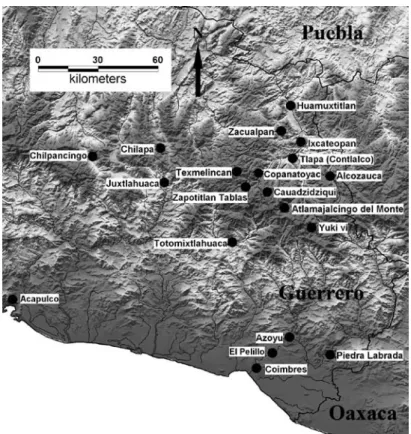
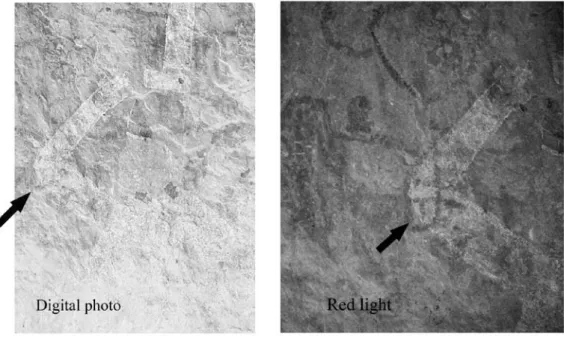
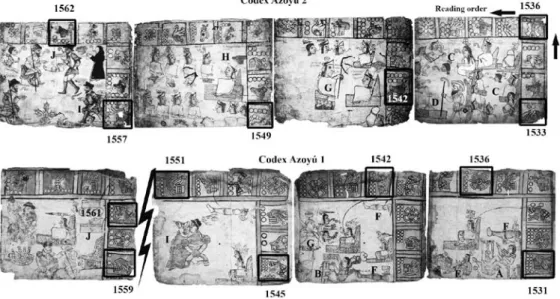
The editors 7 In a diachronic study ‘Four Thousand Years of Graphic Communication in the Mix-teca-Tlapaneca-Nahua Region’, Gerardo Gutiérrez Mendoza reviews the evolution of ancient communication systems in Eastern Guerrero, beginning with early forms of dis-semination in the Late Archaic/Early Formative period at Piedra Pinta-Totomixtlahuaca and the Cuaudzidziqui rock shelter. Evidence of Olmec style murals in this area, in which standardized codes were developed in consonance with Olmec ideology of the Gulf Coast of Mexico and Chalcatzingo, indicate the integration of Eastern Guerrero into the broader pan-Mesoamerican iconographic tradition. During the Classic/Epiclas-sic periods (AD 300-1100) – at present still difficult to define with chronological preci-sion – two writing systems appear to have merged: one related to the Zapotec script of central Oaxaca and the other to Xochicalco in the Morelos Valley. In the Postclassic and early Colonial periods, we find a fully developed system, for example in the Códices of Azoyú, which shows a closer relationship to the writing tradition of Central Mexico than to the neighboring Mixteca Alta region of Oaxaca.
Gutiérrez examines the development of communication systems in Eastern Guerrero from both a methodological and a broad cultural perspective, evaluating the ability of communication media to fulfill social goals and the needs of emerging, and later, well-developed ruling lineages. Such ‘communications’ were likely modified, resulting in rich palimpsests with multiple meanings reflecting the interests of regional rulers at various moments in history. Indeed, the main conclusion to be derived from this analy-sis may be that Mesoamerican scribes utilized the same material support, i.e. ‘channel’ of communication, over and over again, altering the ‘original’ meaning and intention of the messages. Thus, he concludes, it is the channel itself, and not the message, that transcends time.
Moving to the Mixteca Baja and Alta in the State of Oaxaca, Iván Rivera gives a detailed análisis of the early development of Mixtec writing in his paper ‘Los inicios de la escritura en la Mixteca’ (The beginnings of writing in the Mixtec region), discuss-ing in-depth the Mixtec epigraphy that antecedes the Postclassic pictorial manuscripts. Recent archaeological investigations permit a better study of the little-known graphic system from Western Oaxaca: the Ñuiñe script. Although it has not yet been deciphered completely, significant patterns in its elements show that it is a form of pictography and that the texts contain year dates, calendrical names of persons, and likely historical nar-ratives. Rivera analyzes a number of examples, clarifying the development of this form of writing between AD 400 and 800, and offering a number of innovative ideas about the themes and discourses registered in the monuments.
8 Introduction
precolonial hieroglyphic text). In addition, the quadripartite structure of the narrative and its associated trees, birds, deities, and cardinal directions, bears similarities to Mes-oamerican cosmograms, contained in various codices and other works of art.
Turning to the pictographic manuscripts, Maarten Jansen’s essay, entitled ‘Social and Religious Concepts in Ñuu Dzaui Visual Art’, uses the documentary El Rebozo de mi Madre as point of departure for the identification and discussion of some central themes in ancient Mixtec writing. Several aspects of contemporary Mixtec society and mental-ity that appear in the movie have parallels in the worldview expressed in the codices of the Postclassic and Early Colonial periods, as well as in Classic and Preclassic inscrip-tions. By focusing on the relations between the past and the present, we may gain a better understanding of the precolonial narratives and symbols, especially where con-ceptualizations of place, time, and rulership are concerned.
Gabina Aurora Pérez Jiménez presents in her contribution ‘Leyendo los Códices en Sahin Sau’ (Reading the Codices in Mixtec) some basics for deciphering and under-standing the pictorial texts in the Mixtec language. After discussing some important terms and concepts, as well as the style of the ceremonial discourse (shahu), she offers a reconstruction of a central chapter in these precolonial books, the one dealing with the biography of the great ruler Lord 8 Deer ‘Jaguar Claw’ (AD 1063-1115). Synthesiz-ing the interpretive breakthroughs that led her to this reconstruction, and stressSynthesiz-ing the coherence between distinct versions in the sources and the literary character of these accounts, she presents a short reading of the story in Sahin Sau, i.e. Mixtec as spo-ken today in Chalcatongo, with a Spanish translation. This text was originally used as script for the short documentary movie Ocho Venado y Seis Mono directed by Itandehui Jansen (1997).
Arthur Joyce, Andrew Workinger, Byron Hamann and Marc Levine explore the link between the famous narrative about Lord 8 Deer and archaeological remains in their collective paper ‘The Archaeology and Codical History of Tututepec’. The city-state of Tututepec (Yucu Dzaa) has long been known from ethnohistoric sources as a powerful Late Postclassic imperial center. Until recently, however, little has been known of the ar-chaeology of the site with its very location a subject of debate. The authors of this article discuss the founding, extent, chronology, and aspects of the internal organization and external relations of Tututepec based on the results of a regional survey, excavations, and a reanalysis of the Mixtec codices. They argue that Tututepec was founded early in the Late Postclassic period when the region was vulnerable to conquest due to political fragmentation and unrest. Indigenous historical data from three Mixtec codices narrate the founding of Tututepec as part of the heroic history of Lord 8 Deer ‘Jaguar Claw.’ According to these texts, Lord 8 Deer founded Tututepec through a creative combina-tion of tradicombina-tional Mixtec foundacombina-tion rites and a strategic alliance with a highland group linked to the Tolteca-Chichimeca. Archaeological and ethnohistoric evidence indicate that Tututepec continued to expand through the Late Postclassic, growing to 21.85 km2,
The editors 9 An equally important archaeological exploration of a Postclassic site is directed by Ronald Spores. The results of the work in 2004–2005 are reported by Spores in the chapter ‘Excavations at Yucundaa, Pueblo Viejo de Teposcolula’. It gives a preliminary overview of the layout of the urban enter and offers a first interpretation in terms of ancient Mixtec socio-economic structure. Discussing the population history of the site, attention is paid to the Early Colonial contacts with the Dominican monks, who left important traces of their presence in the form of an early monastery and church with related artefacts. This archaeological project provides a magnificent material context for the Postclassic codices. Furthermore, the ‘Pueblo Viejo’ de Teposcolula was abandoned around 1550 and refounded in the valley where the present town is still located. There it would become the administrative center (Alcaldía Mayor) for most of the Mixteca Alta during the colonial period, and the site of an important Dominican convent, where the monks produced the main grammar and vocabulary of the Mixtec language in the 16th century. The excavations have continued since this report and yielded more important finds.
The paper ‘Feasting, Community and Codex Style Ceramics’ by Gilda Hernández Sánchez connects the concerns of archaeology and iconography in an interpretive study of the decoration of codex-style ceramics, dating from the Late Postclassic period (AD 1250-1521), and found in several sites in the state of Oaxaca, as well as in the states of Puebla, Tlaxcala, Veracruz, and Mexico. The author proposes that many of these vessels were used as serving dishes in feasting, that is, ritualized banquets where food was a prime medium of social interaction and symbolic expression. The painted images may be read as abbreviated texts hinging on concepts that were meaningful in the con-text of such ceremonies. Obviously, they are related to ceremonial discourse. Showing how some of the most common depictions represent preciousness, invocation of divine forces, contact with the divinity, and piety, Hernández Sánchez demonstrates how the iconological analysis of these representations offers an opportunity to understand the nature of feasts and ceremonial discourses in ancient Mesoamerican communities.
Bringing us to the time of Mixtec-Aztec interaction, Juan José Batalla Rosado dis-cusses in his article on ‘Un Glifo de la Tradición escrituraria Mixteca: el signo ‘cerro’ con doble voluta’ (A glyph of the Mixtec writing tradition: the sign ‘mountain’ with double volute) an example of how different Mesoamerican writing systems can be dis-tinguished according to specific details in the form of certain glyphs. Characteristic of Mixtec writing, for example, is the representation of the sign for ‘mountain’, which uses a double volute to indicate ‘stone’, i.e. the stony character of the mountain. The writing systems from Central Mexico, on the contrary, use a triple volute or none at all.
con-10 Introduction
tains a number of ‘irregularities’ in its signs and images, which suggest that it was painted much later than generally supposed, maybe even as late as the middle of the 18th century. This does not detract from its value, of course, as it probably was a copy of an ancient document.
The following two chapters draw our attention to the still little explored archival trea-sures from the colonial period, especially the documents in indigenous languages and / or full of Mesoamerican concepts and terminology.
In ‘Spanish Conquest and Mesoamerican Mentality’ Angeles Romero compares the Zapotec primordial title ‘Memoria de Juquila’, probably dating from the early 17th century with the precolonial Mixtec Codex Yuta Tnoho (‘Vindobonensis’), a sacred pic-tographic text, which refers to the origin of the kingdoms and their ruling dynasties in symbolic terms according to the cyclical Mesomerican worldview. The author addresses two important questions: 1) how did the indigenous peoples of Mesoamerica see and interpret the Spanish conquest? And 2) how did the conquest influence their view on history and how is this influence manifest in indigenous colonial documents? Romero’s in-depth analysis proves that, although the actors changed the structure of the docu-ments and the worldview expressed in them did not. The Mesoamerican view on history incorporated the conquest by interpreting it as the beginning of a new age or cycle.
In another study of colonial indigenous writing, ‘Multilingualism in the Tocuij Ñudzavui Region’, Michael Swanton combines linguistic, philological and historical approaches, to document and clarify the phenomenon of long-term and wide-spread lan-guage interaction and multilingualism in the border areas between Mixtec and Ngiwa (Chochon). Examining details in the surviving sources, the author also identifies many aspects of traditional culture, social organization and daily life in indigenous communi-ties during the colonial period.
Given this richness and importance of the historical documents, the conservation and study of the colonial and republican local archives is of obvious importance to indige-nous communities and essential for the reconstruction and revalorization of local culture history. Roberto Santos Pérez describes this process in his article El Archivo Histórico de Tlaxiaco y el Papel de las Comunidades Indígenas en la Recuperación de su His-toria’ (The historical archive of Tlaxiaco and the role of the indigenous communities in the recuperation of their history), sketching the developments that enabled the pres-ervation and recent establishment of the Archivo Histórico Municipal de la Ciudad de Tlaxiaco, and emphasizing the importance of good information campaigns for involving local citizens.
The editors 11 Mixtec Language’, in l997. This intellectual community now serves as a space for meet-ings and gathermeet-ings for those who speak the same language have the same world vision and share the same history negated by others. Basically, it constitutes a forum where the establishment of norms for writing and the preservation, maintenance and development of Tu’un Savi can take place, inother words a space in which projects may be gener-ated that permit the documentation and development of the diverse knowledge of the Mixtec people, e.g. astronomy, religion, history, medicine, linguistics and literature. Notable progress has been achieved through the organization of workshops, meetings, congresses and seminars.
The combinations of signs on Postclassic ceramics studied by Hernández Sánchez seem, at least partially, be related to the use of formal discourse at ritual events. Ub-aldo López García examines precisely this phenomenon in his contribution ‘Sa’vi, el Lenguaje Ceremonial’ (Sa’vi, the ceremonial language). Describing the present-day usage of this special idiom, rich in metaphors, parallelisms, and difrasismos, during various important occasions in the village of Apoala in the Mixtec Highlands, López García identifies and analyzes a number of crucial expressions. These forms of figura-tive speech are beautiful examples of living oral literature and at the same time contain terms of crucial importance for understanding the ancient pictorial writings.
Memory is the key word of the actual transmission of the millennial culture and tradition that we find in the Mixtec Highlands. It is through the vital memory, transmit-ted by oral histories that the important representatives of Mixtec culture, such as the
curanderos, are passing on the native vision on the human being, the world and the divine. Here we find the histories of the so-called invisible religion, the central symbols that make possible the experience and inner perception of cultural identity, of society and established order, known as the ‘Mixtec world’. Living for three years in the town of Chalcatongo in the Mixtec Highlands, working with Mixtec people as a representa-tive of the Catholic Church, Hans-Jörg Witter discovered the force of the indigenous, religious oral tradition. Now, in his article ‘Koo Sau – Quetzalcoatl: Mixtec Religious Symbolism in Past and Present’, based on the theological analysis of ancient codices and the contemporary texts he collected in Chalcatongo, he describes the continuous importance of a central symbol of this culture: the Plumed Serpent. In elucidating this figure, the author also deals in detail with ritual life and the nahual experience.
The literary essay ‘Hacia una Poética Ñuu Savi’ (Toward a Ñuu Savi Poetics) by Mixtec poet Karlos Tachisavi closes this volume with his reflection on the role and situ-ation of Mixtec creative writing in the face of crises and encroaching systems of oppres-sion, stressing its great potential and vocation.
Mixtec Writing and Society Escritura de Ñuu Dzaui
Royal Netherlands Academy of Arts and Sciences, 2008 13
r
Mixtec Writing and Society Escritura de Ñuu Dzaui
Royal Netherlands Academy of Arts and Sciences, 2008 15
Rosemary A. Joyce
Speaking For Absent Subjects
Responsibility In Archaeological Discourse
Archaeologists long took for granted the reality that our interpretations give voice to the lives of people in the past who usually were not able to register their own perspectives on their lives. The criteria that archaeologists employ to judge which interpretations are better have been tightly focused on issues of evidence and inference, that is, whether a particular statement is plausible to practitioners of archaeological research.
Archaeologists worldwide began to be confronted in the last decades of the twentieth century by other interested parties, especially descendant communities, who challenged the representations offered of their predecessors. Many archaeologists did acknowledge that there could be additional perspectives, from different standpoints. But discussion of the multiplicity of representations has often involved a kind of compartmentalization, in which traditional archaeological representations remain more highly valued, and other representations directed at a ‘public’ are added on.
Critics of even such limited pluralism are quick to suggest that the results may be incoherent, as different groups use the same material as evidence of contradictory argu-ments that can no longer be decided simply by appeals to archaeological authority. The real danger exists that such an unconstrained openness of interpretation may open the door to complete relativism in which all representations are in some sense equally good – even those that deprive descendant communities of their own history by attributing actions to supernatural, non-local, or alien agencies.
In The Languages of Archaeology (Joyce 2002) I draw on the work of Mikhail Bakhtin (1981, 1984, 1986, 1990, 1993) to suggest that recognizing the plurality of actual dis-course and its historically situated nature can be allied to a serious consideration of the real world effects of representation. This, I suggest, would allow archaeological advo-cacy for representations that are true to the limits of our findings as evidence, and to the constraints our findings place on representations by others. In my view, we do not give up our own standpoint (as archaeologists) by admitting that it is not the only perspective from which to understand the significance of the materials we produce.
16 Speaking For Absent Subjects
First Theme: Giving Voice to Voiceless Others
The palaces, tombs, and historical monuments of literate elites dominate public con-ceptions of archaeology, especially the archaeology of places like Mexico and Central America. This follows directly from the way that archaeologists working in these areas represent their own work to media and, through media, to various publics.
Ironically, this representation of archaeology as the discipline that reconstructs the lives of those already dominating the discursive record obscures the fact that most ar-chaeological research works with traces of the past actions of otherwise unrecorded people (Joyce 2005). We do manage to remain focused on these other past subjects in some approaches, such as household archaeology (Robin 2003). Nonetheless, too of-ten primary emphasis is placed on what can be generalized across cases. This follows, in part, from the influence of positivist models on the archaeologies of the 1960s and 1970s, with their pursuit of the general and depreciation of the non-generalizable (Wylie 2002). But it also follows from the embedding of archaeological discourse within broad-er representations of archaeology as the pursuit of the answbroad-ers to questions of origins, rises and falls. We may object to being identified with Indiana Jones and Lara Croft, but we play off their visibility in our museum exhibitions, news press releases, and even the way we shape our professional publications.
I would thus like to propose first, that archaeologists actually have certain responsi-bilities by virtue of our position with respect to human subjects in the past for whom we may be the only present-day witnesses. The word ‘witness’ actually doesn’t quite cap-ture what I mean here; in Spanish, I would say testigo, meaning not just someone who has an authoritative basis to speak, but who does speak. We require an ethical position on representation in which we acknowledge that as archaeologists, we testify for absent subjects, with all that implies.
Second Theme: Multiple Pasts or One Past with Some Variation?
Many archaeologists do acknowledge that there can be additional perspectives, from different standpoints, on understanding the past. There are at least four different lines of argument, some even favored by positivist archaeologists, for allowing for alternative representations based on the same archaeological materials.
Rosemary A. Joyce 17 of the wider public are not interested in (cannot understand) the internal language and logics of archaeology.
Thus it becomes routine to craft additional interpretations to resonate with local, na-tional, or international publics. For example, an archaeological project may be con-cerned with the nature of state formation, only incidentally using a Classic Maya site as a case study. But the same archaeologists will present to international audiences, in lectures, news releases, and popular books, a story of the reign of kings and their succes-sion over time; and to national publics, will offer the same story, now framed as the his-tory of the nation; while for the local public, they may make the connection between the language of the monuments and local indigenous language, drawing direct connections between the words used for everyday tasks today and a reading of glyphs interpreted as an ancient ritual. But these public-oriented histories do not, normally, go so far as to turn over control of the narrative to other parties. They routinely coordinate the stories for the public with the stories of the archaeologists’ own interests, translated into another language (Joyce 2003).
A second widely, though less universally, accepted basis for alternative representa-tions comes with the acknowledgement of the existence of descendant communities with special interests in how their own ancestors are described. This has also produced a growing literature testifying to the passionate engagement of many people in produc-ing alternative narratives based on archaeological research (Colley 2002; Lilley 2000; Mathers et al. 2005; Smith and Wobst 2005; Watkins 2000). Archaeologists traditionally found it convenient to make connections with descendant communities to make the task of justifying ethnographic analogies easier (Cotjí Ren 2002). But the same archaeolo-gists may not be so comfortable with a broader claim by descendant communities to contest aspects of representations.
Thus, when Guatemalan Maya people argue that the emphasis by archaeologists and epigraphers on the warlike status of Classic Maya statecraft creates problems in the present, and suggest more balance in emphasis, there is less movement on the part of the archaeologists (Cotjí Ren 2002). Militarism, it appears, is a fact of Classic Maya life, not simply an aspect of Classic Maya political discourse. Thus for many archaeologists, descendant communities are authorized to draw connections with the past, but only with the past offered already by the archaeologists.
18 Speaking For Absent Subjects
objectionable to anyone, as long as the proponents stay in the rooms assigned them and don’t try to say that what they are doing has any significance for the ‘broader’ questions. But don’t try to suggest that women spinning and weaving cloth were recognized as contributing to the public ceremonies in which the products of their labor were used, or that their technical expertise counts as a form of craft specialization.
Finally, at least some archaeologists will propose that the same material traces, be-cause they do not of themselves define a single, unique interpretation, could support more than one archaeological discourse. This is the position most often parodied as ex-treme relativism, although to my knowledge, no actual archaeologist defends a position of potential explanations unconstrained by what Wylie (1992, 2002) calls ‘evidential constraints’. In practice, this alternative is probably better exemplified by the kinds of conflicts between different specialists interpreting the same stratigraphic profile dis-cussed by Raymond Corbey (2005).1 Everyone agrees that what faces them is all the
available evidence, but what counts as evidence, or as important evidence, varies de-pending on a complex set of factors, including personal histories and how these bias us toward believing some data more than others. In my own experience, bioarchaeologists’ responses to each other’s work provide an interesting example: when I discuss burials from Tlatilco (Joyce 2001), using the bioarchaeological determinations of age and sex by the project specialists, invariably it is others who practice physical anthropology who question those specifics, while routinely being perfectly happy to accept the arguments I am making based on burial location, treatment, and grave goods.
As my discussion of these four strategies for multiplying representations in archaeol-ogy suggests, the contemporary pluralist representational process has involved a kind of compartmentalization, with different audiences recognized as having different interests and perhaps different standards for truth claims. This process normally also presupposes that traditional archaeological representations are most valued, while other representa-tions directed at specific interest groups are added on. In other words, archaeologists continue to act as if we set the agenda, and define the really important questions, in which some others outside or within the community are (sometimes) recognized as hav-ing divergent interests.
1 During the Masterclass, Prof. Dr. Raymond Corbey (Universities of Leiden and Tilburg) presented a
Rosemary A. Joyce 19 Third Theme: Responsibility in Practice
Critics of archaeological pluralism are quick to note that the results of such diverse interpretations may be incoherent, with different data seen as evidence of apparently contradictory processes. This, I think, is where Corbey’s (2005) example of palaeoan-thropologists engaged in talking without reaching any mutual understanding fits in. The trope used for it – ‘talking past one another’ – is of critical interest to my argument. I will return to this example below. For now, notice only that it suggests that a usually covert criterion of archaeological analysis is coherence. This raises the interesting ques-tion of whether human behavior actually is, in general, coherent?
In one sense, archaeology has always assumed coherence between different actors, as a way to link similar things (objects, cultural practices) together as evidence. Thus the foundational claim of culture-historical research has always been that types of things are the residue of the practices of people who can be identified as a group. Classic Maya people are those who produce Classic Maya art. To achieve that statement, we ignore time (as ‘Classic Maya art’ changes over the multiple centuries included) and space (as each major center seems to strive to produce distinctive local ‘style’). We ignore how a style is reproduced (through inter-generational apprenticeship in crafts, with their at-tendant technical styles, and through inter-generational learning of values of beauty and the good that foster aesthetics). We seem doomed thereby to flatten out any real complexity of action, or to posit that actors in the past were significantly simpler than actors in the present.
But if we admit into our models actors more like those we recognize in the world around us – with motivations partly shared with others, and partly unique, changing with time and experience, and varying between members of different families, craft tra-ditions, social status groups, wealth classes, and the like – then we seem to risk making the interpretive project unviable, as every proposed interpretation will be by definition particularistic. The certainty enjoyed by evolutionary archaeologists can seem very at-tractive when faced with the impossibility of foreclosing so many alternative explana-tions.
I would be delighted to be able to simply say ‘that isn’t true’ when my students raise questions about the African or Chinese origins of Olmec art. It would be so much easier if they would just respect my authority. After all, I’ve actually seen these things: at best, they have seen nothing more than photographs. I’ve spent my life working as a field archaeologist, doing settlement survey, architectural and stratigraphic analysis, iden-tifying ceramic technology and morphology, and recognizing motifs and narratives in multiple media. Why doesn’t that count for something?
20 Speaking For Absent Subjects
I cannot actually credibly say these heads do not ‘represent’ African features. My stu-dents would not be asking the question if that reading were not possible, so for at least some contemporary viewers – and this has been true for more than a century – these marks represent such features. I need to identify more specifically why for me this is not the most likely, or even feasible, explanation. That response takes my students seri-ously as observers, but adds to their observations others they have been ignoring in their recognition of one set of resemblances. Viewed as only one set of human representations within the entire group of images produced at the same time, the features on Olmec heads can be seen as a stylization limited to one kind of monument. Other monuments, some arguably depictions of the same characters, show almost aquiline noses, in profile, in low relief. That the stylization that produces flatter noses and lips happens to be fitted into a ball of stone cut away to leave the features defined on the remnants of the original spherical surface leads me to suggest this set of attributes be viewed as a consequence of techniques of stone carving. It also leads me to helping my students recognize their own, uninterrogated, assumptions about realism in human representation, and confront them with other evidence of a general de-emphasis on realism in Olmec visual culture.
Fourth Theme: Speaking About Archaeological Representation
In the remainder of this paper, I want to review in general some of the arguments I made in The Languages of Archaeology (Joyce 2002). I am mindful that recourse to the spe-cialized language of Mikhail Bakhtin in that work may be seen by some as obscuring, rather than clarifying, the issues of representation and the reproduction of communities of knowledge with which the book is concerned. So first, I want to underline the reasons I have for adopting it.
Bakhtin’s framework is more than an analysis of textual production; it is fundamen-tally concerned with the ethical dimensions of action, especially those actions embodied in speech (see especially Bakhtin 1990, 1993). Through the concept of answerability or responsibility, Bakhtin (1993:2-4, 28-29) underlined that speech is always a call for a response or answer from another person. He recognized that the self only takes form through its exchanges with an Other.
His model is both eminently social, populating utterances in context with a plurality of persons, and also ethical, postulating the critical judgement by others of what the speaker or writer says. In Bakhtin’s model of truly dialogic communication, the speaker always addresses another outside himself, who is literally an Other; and he uses words that are imbued with the presence of others, so that in each exchange, there is present an I, a thou, and a preceding history of others.
Rosemary A. Joyce 21 people really ‘talk past each other’: a series of monologues that are the break down of communication. More on this example yet again below.
In his emphasis on the ethical burden of responsibility that comes with speaking for others I think Bakhtin captures well the distinction made by Peter Verstraten (this volume) between Bram Stoker’s Dracula, with its demotion of others to things as their blood is spilt, and ideal cultural representations that would respond to Johannes Fabian’s call for maintaining the presence of the other as a you, not an it, in ethnographic texts. This is precisely where Bakhtin himself positioned the human sciences, precisely the challenge he articulated for us (Bakhtin 1986: 161).
The maintenance of responsibility/answerability may seem challenging given the real potential, often realized in action, for archaeological discourse to apparently break down, seen not only in the example of palaeo-anthropology but in areal debates such as those so striking in Oaxacan archaeology. Here it is critical to emphasize that Bakhtin explicitly envisages conflictual responses as part of the range of possibilities that actu-ally may occur as a response in dialogue. This takes us back to the striking example of the way some archaeological communities appear to fail to communicate cited by Corbey (2005).
If the description of ‘people talking past each other’ in palaeo-anthropological con-ferences is literally true, then we are seeing monologues. But Willermet and Clark’s own description suggests otherwise: they say that ‘at times the differences [in precon-ceptions, assumptions, and biases] were so great as to preclude any [agreement]’ (Will-ermet and Clark 1997:1, cited in Corbey 2005). This is quite a different thing than ‘talking past each other’. It appears that what they were expecting was something like the ideal speech situation of Jürgen Habermas, in which an exchange of statements be-tween equals will inevitably lead to some agreement. Bakhtin does not see the world as coming to, or benefiting from, simple agreement (Joyce 2002: 30-31). The babble that seems distressing to Clark and Willermet is from this perspective ultimately better for archaeology than an agreement that would leave in ascendancy unquestioned ideas that may be only loosely warranted by the material under discussion.
22 Speaking For Absent Subjects
These include the harmful stereotypes that Franci Taylor (this volume) points to, and we could add a host of others from the archaeology of Mexico and Central America. To take just one – and in doing so, end by engaging with only one of the rich examples offered by Corbey (2005) – we could consider the recent pronouncements in the press to the effect that the question of ‘Olmec diffusion’ has been settled through the applica-tion of Neutron Activaapplica-tion Analysis to samples of white-slipped, incised pottery from a number of sites in Mexico. This example provides an encouraging instance from my perspective because it inadvertently called forth precisely the kinds of engagements that should help change how we talk about results from such techniques in the future.
In brief, for those unfamiliar, Jeffrey Blomster, working with Michael Glascock of the Missouri University Research Reactor, claimed that all the samples analyzed were compatible with an origin on the Gulf Coast of Mexico, perhaps at the site of San Loren-zo itself. As the first sentence of the abstract of their published report put it, ‘the first Mesoamerican civilization, the Gulf Coast Olmec, is associated with hierarchical soci-ety, monumental art, and an internally consistent ideology, expressed in a distinct style and salient iconography’ (Blomster et al. 2005:1068). The potsherds analyzed were thus viewed as evidence of an ‘internally consistent ideology’ diagnostic of ‘the first Mesoamerican civilization’. As they themselves noted, this put them on the side of the so-called ‘mother culture’ hypothesis, which holds that the Gulf Coast sites developed Olmec characteristics that spread from this center.
The MURR posted the data with an invitation to others to download them, an invita-tion accepted by James Stoltman at the University of Wisconsin. His re-presentainvita-tion of the same data, viewed from a different angle, argued that they attested to differences that in his view actually map onto different geological sources throughout Mexico, sup-porting the ‘sister culture’ model in which exchange of pottery was multi-directional (Stoltman et al. 2005). The original data were re-examined using a different statistical approach, in which more of the originally analyzed sherds could be included in identi-fied groups. For these authors, the unity discovered through INAA was the result of the general unity of the geology of the region, when measured at the elemental level. By changing focus to the mineralogical level, they argued, inclusions in the sherds could be identified with locally distinctive geological resources. Their representation of the same data showed sherds from non-local pots at every site, including San Lorenzo (described as only exporting pottery in the original analysis), and including movement of sherds between other sites (something absent from the original analysis).
Rosemary A. Joyce 23 The fault clearly is not in the method, although that is one way to read this disagree-ment. We can consider another project employing INAA as a counter-example. In this project, Jeanne Lopiparo (2005) employs INAA not to trace the international spread of a culture, state, religion, or other large-scale entity attributed the power to create pottery, apparently without the agency of any actual people. Instead, she used the same methods to examine local, small-scale distributions of workshop-specific recipes for the creation of pottery artifacts, and their movements – some longer distance – are seen as the result of social contacts between communities of potters in Honduras’ Ulua River Valley.
Why does this matter? Lopiparo could have designed the kind of research strategy as is featured in the Olmec ceramic studies, since the pottery she is concerned with, Baracoa Fine Buff, is a local version of the Fine Orange pottery that is a hallmark of the Classic Maya collapse in the western Maya lowlands. She chose not to use her data for such a purpose, and instead to pursue the local-level, human-scale implications of these archaeological materials. That choice was dictated by the dialogues she chooses to engage with, and the people from whom she seeks a response, including non-archae-ologists, notably the local population of the region where she works.
We won’t be reading articles in the New York Times about how work like this set-tles the question of the Maya collapse any time soon, although in fact we will only ever make sense of such posited political and super-political events from the ground up, from the perspective of living people who experienced history, not collapse. As Cotjí Ren (2002) notes, in current archaeological discourse:
Maya Kings are represented as agents in history for ruling a society and making war, yet such rulers appear more like autocrats rather than true leaders of a nation. We learn about rulers and their relations with other rulers, their conquests, the sacrifices made to them but we do not learn about their family relations or festivities or how they governed our people... The lives of the Kings and Spiritual Leaders, warfare, sacrifice, and rituals cannot enclose what a whole Maya society was, no society actually can be narrowed to some separate as-pects of life or individual agents.
24 Speaking For Absent Subjects References
Bakhtin, Mikhail M.
1981 The Dialogic Imagination: Four Essays. Translated by Caryl Emerson and Michael Holquist. Edited by Michael Holquist. University of Texas Press, Austin.
1984 Problems of Dostoevsky’s Poetics. Translated and edited by Caryl Emerson. University of Minnesota Press, Minneapolis.
1986 Speech Genres and Other Late Essays. Translated by Vern W. McGee. Edited by Caryl Emerson and Michael Holquist. University of Texas Press, Austin.
1990 Art and Answerability: Early Philosophical Essays by M. M. Bakhtin. Translated by Vadim Liapunov and Kenneth Brostrom. Edited by Michael Holquist and Vadim Liapunov. University of Texas Press, Austin.
1993 Toward a Philosophy of the Act. Translated by Vadim Liapunov. Edited by Vadim Liapu-nov and Michael Holquist. University of Texas Press, Austin.
Blomster, Jeffrey P., Hector Neff, and Michael D. Glascock
2005 Olmec Pottery Production and Export in Ancient Mexico Determined Through Elemen-tal Analysis. Science 307:1068-1072.
Clark, Geoffrey, and Catherine Willermet (Editors)
1997 Conceptual Issues in Modern Human Origins Research. Aldine de Gruyter, New York. Colley, Sarah.
2002 Uncovering Australia: Archaeology, Indigenous people and the Public. Smithsonian Institution Press, Washington, D.C.
Cojtí Ren, Avexnim
2002 Maya Archaeology and the Political and Cultural Identity of Contemporary Maya in Guatemala. Paper presented at the conference ‘Towards a More Ethical Mayanist Archaeol-ogy’ at the University of British Columbia, Vancouver. Electronic document http://ethical.arts. ubc.ca/Avexnim.html, accessed Nov. 13, 2004.
Corbey, Raymond
2005 Representing the Past: A Pluralist Epistemological Perspective. Paper presented at the Masterclass ‘Representation of Ancient Cultures and Indigenous Peoples’. Royal Netherlands Academy of Arts and Sciences, Amsterdam. Aug. 29-30, 2005.
Jameson, John H., Jr. (Editor)
2004 The Reconstructed Past: Reconstructions in the Public Interpretation of Archaeology and History. AltaMira Press, Walnut Creek, California.
Joyce, Rosemary A.
2001 Burying the Dead at Tlatilco: Social Memory and Social Identities. In: New Perspec-tives on Mortuary Analysis. Edited by Meredith Chesson: 12-26. Monograph 10. Archaeology Division of the American Anthropology Association, Arlington, Virginia.
2002 The Languages of Archaeology: Dialogue, Narrative, and Writing. Blackwell Press, Oxford.
2003 ‘Confessions of an Archaeological Tour Guide’. Paper presented in the session ‘Ethi-cal Interactions: National Modernities, Tourism and the Archaeologi‘Ethi-cal Imaginary’ (Lynn M. Meskell, organizer). World Archaeological Congress, Washington, D. C.
Rosemary A. Joyce 25
Lilley, Ian (Editor)
2000 Native Title and the Transformation of Archaeology in the Postcolonial World. Univer-sity of Sydney, Sydney.
Little, Barbara J. (Editor)
2002 Public Benefits of Archaeology. University Press of Florida, Gainesville. Lopiparo, Jeanne
2005 Ritual Landscape and the Heterarchical Integration of the Late to Terminal Classic Ulúa Valley. Paper presented at the Annual Meeting of the Society for American Archaeology, Salt Lake City, Utah.
Mathers, Clay, Timothy Darvill, and Barbara J. Little (Editors)
2005 Heritage of Value, Archaeology of Renown: Reshaping Archaeological Assessment and Significance. University Press of Florida, Gainesville.
Meggars, Betty J.
2005 The Origins of Olmec Civilization. Letter to the editor. Science 309:556. Merriman, Nick (Editor)
2004 Public Archaeology. Routledge, London and New York. Robin, Cynthia
2003 New Directions in Classic Maya Household Archaeology. Journal of Archaeological Research 11: 307-356.
Schmidt, Peter R., and Thomas C. Patterson (Editors)
1995 Making Alternative Histories: The Practice of Archaeology and History in Non-Western Settings. School of American Research Press, Santa Fe, New Mexico.
Smith, Claire, and H. Martin Wobst (Editors)
2005 Indigenous Archaeologies: Decolonizing Theory and Practice. Routledge, London and New York.
Stoltman, James B., Joyce Marcus, Kent V. Flannery, James H. Burton, and Robert G. Moyle 2005 Petrographic Evidence Shows that Pottery Exchange Between the Olmec and their
Neighbors was Two-way. Proceedings of the National Academy of Sciences 102 (32): 11213-11218.
Watkins, Joe
2000 Indigenous Archaeology: American Indian Values and Scientific Practice. AltaMira Press, Walnut Creek, California.
Wylie, Alison
1992 The Interplay of Evidential Constraints and Political Interests: Recent Archaeological Research on Gender. American Antiquity 57:15-35.
1995 Alternative Histories: Epistemic Disunity and Political Integrity. In Making Alternative Histories: The Practice of Archaeology and History in Non-Western Settings, edited by Peter R. Schmidt and Thomas C. Patterson, pp.255-272. School of American Research Press, Santa Fe, New Mexico.
2002 Thinking From Things: Essays in the Philosophy of Archaeology. University of Califor-nia Press, Berkeley.
Zimmerman, Larry J.
Mixtec Writing and Society Escritura de Ñuu Dzaui
Royal Netherlands Academy of Arts and Sciences, 2008 27
Franci Taylor
Discovering ‘The’ American Indian
Everybody in this country thinks they know what an Indian is, when mostly they know what the media thinks it is. And that goes for the Indian people as well as for the non-Indian people. The first thing that happens to a new immigrant who comes over here is that she sits up watching late night TV and she learns all about Indians from John Wayne movies (Paula Gunn Allen in:
Winged Words: American Indian Writers Speak).
No! I don’t feel we did anything wrong in taking this great country away from them (the Indians). There were a great number of people who needed new land, and the Indians were being selfish trying to keep it all for themselves (John Wayne – Western genre actor).
Approximately one thousand years before Columbus sailed into the Caribbean other Eu-ropeans were “discovering” the indigenous peoples of the Western Hemisphere and in-venting identities for them. Archaeological evidence indicates that a Viking voyage was apparently the first European contact with the indigenous peoples of North America, but compared to later European contact, the Viking contact was brief and did not greatly change the lives of the peoples of the Western Hemisphere.
Columbus and the colonizers that followed him were a completely different occur-rence, for they turned the indigenous world of the Western Hemisphere up-side-down. Upon arriving in the Caribbean in 1492 Columbus dubbed the peoples he encountered as “Indian”. This misnomer and the negative interpretation it created, produced a devas-tating and long-lasting negative effect on the vast and diverse civilizations of Europe’s so called, “New World.” The construction of “the Indian” stereotype was tailored to conform with European, elitist, privileged male concepts and agendas, none of which were designed to benefit the indigenous people of the Americas. This European created stereotype of American Indian identity continues to produce a negative impact on the daily lives of the first peoples of this land.
28 Discovering ‘The’ American Indian
Therefore, it must also be acknowledged that terms such as European, Amer-European1,
White, Anglo, or American also hides the vast diversity found within the dominant soci-ety and can be as problematic as terms such as Indian. Unfortunately for the indigenous peoples these terms do not hold the same negative political agency as the stereotypes imposed on marginalized peoples. Despite the imbalance found in these reductions it is also important to acknowledge that all stereotypes, be it ‘the Indian’ or ‘the Anglo’ serve to create cross-cultural dissonance that prevents productive cooperative dialog. Stereotypes and cultural homogenization compounds rather than solves the problems of cultural misunderstanding and conflicts that exist world-wide today. Therefore, and for convenience alone, within this paper the terms Amer-European, European, Anglo and white, will be used interchangeably to define the majority population of the United States, Canada and Mexico. The terms Indian, American Indian, Native American and Indigenous Peoples2 will be used interchangeably to indicate the various original
popu-lations of the Western Hemisphere and their descendents.
Much has been written about the motivation in the creation and perpetuation of the “American Indian” stereotype. (Adare, 2006; Battalle & Silet, 1980; Berkhofer, 1978; Deloria, 1999; Elliott, 1999; Huhndorf, 2001; Kirkpatrick, 1999; Mihesuah, 1996; Sted-man, 1982, etal). Most authors agree that in the early stages of colonization a primary motivation for the creation and propagation of the Indian stereotype was to create a mor-al justification for the taking of territories that were mor-already occupied and to eliminate any perceived aboriginal claim to that land. As long as there could be posed the question as to the basic humanity of Indian people there could be justification to “liberating” the land from them. If the land was not inherently owned by the indigenous residents they could, and would be categorized as the epitome of the resident, but alien, “other”. This process was first used in the Caribbean by the explorer Columbus.
Today, many contemporary scholars scoff at Columbus and question his belief that the Caribbean Island he saw were in fact the lower estuary of the River Ganges, (Mof-fitt & Sebastian 1996). Because of this monumental error it is understandable that he believed that the people he encountered were the strange and exotic peoples of India. Of course, when viewed through the lens of modern knowledge, his conclusion seems
1 Amer-European is a relatively new term first used by John Joseph Mathews (Osage) and although found predominantly in indigenous publications, it is finding increasing acceptance in a wider application. It was created to specifically indicate an imbalance of influence and power imposed by the United States govern-ment on the world along with the relationship between these progeny of Europe and the land upon which they now dwell (Weaver 1998).
Franci Taylor 29 ridicules, but his assumptions were based on the widely accepted mythology of the day. Columbus began his voyage with a firmly established, and widely accepted, precon-ceived notion of whom and what he might encounter on his journey to the west. Fanciful myths of exotic far away places that lay beyond the horizon and the strange creatures that lived there were a popular Medieval trope. This genre of fictionalized travel dialogs began in the era of Marco Polo and peaked around 1357 when John Mandeville wrote his famous fiction, The Travels of Sir John Mandeville. This fictional “journal” was also published under the title of, Mandeville’s Book of the Marvels of the World. In his books Mandeville describes to his readers numerous wildly fanciful and terrifying creatures that he claimed to have encountered on his world travels, (Moffitt & Sebastian).
Like many other European pseudo-adventurers of his day, Mandeville was an arm-chair traveller who had never ventured far beyond his sitting room or own back yard. Despite his fanciful misrepresentations and outright lies, Mandeville was wildly suc-cessful as a writer and his fictional travel accounts were soon translated into every major language of Europe, including Portuguese, which Columbus owned a copy of. In the late 15th Century Mandeville books were second only to the Bible in sales. This
popular-ity created a situation where fantasy took on greater validpopular-ity and power than realpopular-ity. As many of the first explorers to the “New World” returned home and were asked to make reports on their travels, they found that for the general population and royal courts of Europe to believe their descriptions of new lands and peoples they encountered, the re-port had to be adapted to conform to accepted stereotypes. These stereotypes held more currency than the truth and their long term, enduring detrimental impact on indigenous peoples in the Americas can not be over stated. The social and cultural consequences of this colonization process of stereotyping and “othering” is still with us today and the stereotypic Indian of myth and fiction continues to haunt contemporary indigenous peoples across the Western Hemisphere. This process may have begun prior to Colum-bus, but Hollywood, with its creation of the epic western genre, must bear significant responsibility for the commercial promotion and wide distribution of an ongoing nega-tive Indian representation throughout the twentieth century.