POR IMAGINACIÓN Y AMOR – EL PERMANECER DEL PADRE MEXICANO A DISTANCIA
FOR IMAGINATION AND LOVE – THE PERMANENCE OF THE MEXICAN FATHER WHO FATHERS AT A DISTANCE
Marta Sánchez
A dissertation submitted to the faculty of the University of North Carolina at Chapel Hill in partial fulfillment of the requirements for the degree of a doctor in philosophy in the School of Education (Culture, Curriculum and Change).
Chapel Hill 2012
ABSTRACT
MARTA SÁNCHEZ: Por imaginación y amor – el permanecer del padre mexicano a distancia
For imagination and love – the permanence of the Mexican father who fathers at a distance
(Under the direction of George W. Noblit)
Para Guadalupe A. Sánchez, un papá extraordinario, inspirador, inteligente, cariñoso y de gran capacidad de trabajar, imaginar y amar—un hombre siempre presente aun a través de la gran distancia entre el vivir y el morir.
ACKNOWLEDGEMENTS
I would like to acknowledge the support and guidance of my dissertation
supervisor, chair of my committee, and advisor, Dr. George W. Noblit, and the members of my committee, Drs. Madeleine Grumet, Deborah Eaker-Rich, Luis Urrieta, Jr., Juan F. Carrillo, Claudia G. Cervantes-Soon, and Sherick A. Hughes—a more remarkable group of people gathered to help me in this important moment is not imaginable! I want to thank Dr. Steve Knotek, whose support has affirmed my ongoing interest in Latino family life and Latino pedagogies of the home, as described by Villenas and Bernal-Delgado. Thank you, Steve, for your invitation to collaborate on your own research in this field. I also want to acknowledge the this study was funded in part by a Mellon Dissertation Fellowship and Federico Gil Dissertation Award.
I want to thank Isabel Sánchez, my mother, who has supported this and all phases of my life with unwavering kindness, generosity and love. Gracias, Mami. Thank you to my brothers and sister: Dr. Joseph A. Sánchez, Dr. Heriberto G. Sánchez, and la
profesora Patricia Izek—you are a wonderful presence in this world. You are the refracted light of Mom and Pops. Thank you for being profoundly interesting human beings and such high achievers, and for always making sure the door was open for me to follow—how ever-so-grateful I remain to have you in my life. I see you, and I think of el Compadre Chonnnn.
and who traveled with me throughout the country; to Pascual Muñoz Padilla, Oscar Flores García, María Concepción Pérez Sánchez, Veronica Hernández Campos, and so many others in México who must remain unnamed to protect the participants’ identity; to Oaxaca-based researcher and historian, Guillermo Marín Ruiz, who encouraged me to look beyond sociological factors in understanding the fathers’ stories; to Pedro Esteva for his wonderful hospitality while driving me to México City’s foremost bookstores in search of books on Mexican fathering, immigration and the family; to Dr. Teresa Chapa, UNC Librarian for Latin America, Iberia and Latina/o Studies, for connecting me to Pedro and for her help state-side. Thank you, Dr. Lyneise Williams—your friendship means so much to me. Thank you Pat Mora, amiga querida, your work and emails are water for the thirsty! Thank you Dr. Arturo Escobar for introducing me to Guillermo Bonfil Batalla. Thank you Dr. Valentin Mudimbe. Thank you Gloria Anzaldúa for writing destabilizing, decentering texts; I hope my life will be such a text.
Thank you to Valente Lozano who helped me gain entry with participants in the U.S., and to the U.S.-based Mexican entrepreneur who must remain unnamed in order to protect the identity of study participants. The extraordinary access he gave me to the work site where a large part of this study took place has made this dissertation possible.
Thank you to my sister-in-law Doris Fischer-Sánchez and my cousin Gregoria Sánchez Campos, her siblings and daughters, and to my cousin Roberto Muñoz González and his family. Their presence during my mother’s surgeries and difficult recovery allowed me to pursue the final stages of this work.
TABLE OF CONTENTS
LIST OF TABLES………..………....………..………...xv
LIST OF FIGURES………...………...……….………....xv
Chapter I INTRODUCTION,TERMS, RATIONALE AND STUDY CONTEXT……….………..1
Definition of Terms………..……….….….…...…….……….5
El norte………....….…….….………..5
Immigrant……….….……….…….….6
Illegal immigrant versus undocumented immigrant….……..…….7
Split-household……….………….……..9
Apostándole a la familia mexicana/Betting on the Mexican Family.…...10
Origins of the Study……….…………..…………11
Why Mexican Fathering?...15
The Socio-Political Context of the Study………..……....19
Competing Narratives on Mexican and other Latino Immigrants……….………20
The Nativist Moment…..…………...………22
Mutually Exclusive Places to Be…..…..……….…..24
The Fathers in México……….………..26
La narco-guerra……….………31
Intimate Terrorism: Del norte…y mexicana……….………37
II LITERATURE REVIEW: INTERSECTING FIELDS…………...…….41
The ‘Father as Provider’ Construct–A Historical View…...………….43
The Father’s Contribution……….…..….……….……….47
Immigrant Fathers Living with their Children……..………....….…48
Transnational Fatherhood…….…………...……….……….50
Child Outcomes………….…...……….54
Conclusions……….………..56
III THE RESEARCH PROCESS…….….…………...………..58
Who are They?...58
Four Fathers en el norte……....……….………60
Emilio López…….………...….…….…60
Carlos Sotomayor………..………...………….….61
Alfredo Ramírez………..………...62
Andrés Rueda………..……...64
Cinco papás en México………..……64
Jesús Pérez………..………...64
Mario Romero………..………..66
Roberto Salazar………..………68
Martín Rulfo………..……….69
Juan Pérez………..………71
Positionality, Theoretical Framework and Representation……..…..……72
Theoretical framework……….……...….…….………74
Chicana Feminism………….…...……….………74
Methodology of the Oppressed……….…...…….……….75
U.S. Third-World Feminism……....….…...…….……….78
México Profundo……...………...….…………..………..80
Data Collection and Analysis……….……….………...82
Representation and Translation………….…….…...…….84
La Malinche in the New Latino South: Translating with Angst and Glee the Gendered Experiences of Mexican Fathers……….………….………..84
La Malinche………...86
Communication/(Mis)communication….……….96
Colonizer/Colonized..…….………..………97
Traduttore/tradittori………..99
Other ways……….………..……...101
IV TESTIMONIO..……….106
Testimonio as Method………108
Testimonio: La travesía [Testmonio: The Crossing]…….……….111
Why Fathers Leave México………..……….……….………111
Es tu obligación – It is Your Obligation…….………..………..111
Section Analysis……….……….121
Burried Agony………..………..……….121
The World has a Place for Me…………..………..……….122
En ese río no hay forma de nadar [There is No Way to Swim in
that River]…….………...124
La nopalera portentosa y los nómadas involuntarios–The Portentous Cactus and the Involuntary Nomads………125
V THE FATHERS IN NORTH CAROLINA…..………...126
Sign Reading………..……….……..………...132
Meta-ideologizing………..………..132
Differential Consciousness………..………133
VI FINDINGS AND ANALYSIS..………..………135
Migration as a Strategy for and the Practice of Overcoming..…..……..135
Facing an Acute Family or Financial Crisis……..………..137
Andrés………..………138
Emilio………..……….140
Section Analysis………..……….142
Para seguir adelante [To Keep Moving Forward, to Progress]…………143
Carlos…….……….……….………144
Alfredo………..………...146
Section Analysis………..……….148
Para un mejor viir [For a Better Life]………..…...….149
Emilio………..…….149
Carlos………..….152
Andrés………..………155
Alfredo………..………...157
Working Skillfully in the New Latino South…….……….160
Emilio……….……….160
Carlos………..………...……….161
Alfredo………..…...………...163
Andrés……….………166
Section Analysis…………...…………..….………167
Conclusions………..………...168
Fathering without Borders: The Undocumented Mexican Male Immigrant Worker Status as Fathering…….……….….168
Drugs in México………..………169
Education in México………..………..170
Fathering dispositions, practices, and strategies………..………173
Dispositions…..………...173
El sacrificio…………..………...…….174
El respeto………..………...176
Empathic Stance………..……….179
Estar pendiente/Comedido [Attentive/ Accommodating]………..180
Practices………..……….183
Direct Communication…..………...183
Giving consejos………..………..186
Probing…..………...189
Strategies………..………190
Cognitive Appeal…………..………...191
Representative Parenting…………..………...193
Section Analysis…………..………197
Migration as the Practice of Everyday Life………....………….198
All the Time I’m Money………..199
Estar aquí es luchar allá………..……….201
VII AN INSIDER/OUTSIDER IN MEXICO…..………..203
Valley Girl…………..……….203
Getting There………..……….………205
Héroes de la Independencia Middle School……….….…………..209
Secundaria Niños Héroes/Niños Heroes Middle School….……..……..212
VIII THE FATHERS IN MEXICO……….………...218
Roberto Salazar…………..……….……….218
Martín Rulfo…………..……….………..221
Mario Romero………..……….………...223
Jesús Pérez………..……….………227
Juan Pérez………..……….……….232
Findings and Analysis……….238
Commonalities………..……….….239
México’s Political Economy……….……….…..239
From hacienda to mass production……….……….239
You have a retirement plan here………..………240
El momento neoliberal…………...……….……..………...241
México Profundo……….………....……….……...242
IX THE MOTHERS AND CHILDREN……...………...…….245
Las plegarias………...……….………245
X CONCLUSIONS AND IMPLICATIONS…...……..…...………254
Cross-cutting Themes………..………253
Solidaridad con el papá que migra-Solidarity with the Migrating Father………...………..254
Valorando la educación – Valueing Education…...……….256
Deseando casa y cobijo para los hijos – Desiring Home and Protection for the Children………….………..257
El trabajo seguro y renumerado – Secure and Well-Paid Work………258
La importancia de la pareja – The Importance of One’s Partner………...………...260
Final Thoughts………..……….………..261
The Women and Children…...……….261
The Myth of Progress………..…………262
APPENDIX………..…...………268
LIST OF TABLES
Table
I Cost of Farming on a Parcela (1/5 hectare, approx. 1.2 acres) in the Valley of Jalisco, 2010………..………....29 II Demographic Data for Fathers in the Study………...…..……….71
LIST OF FIGURES Figure
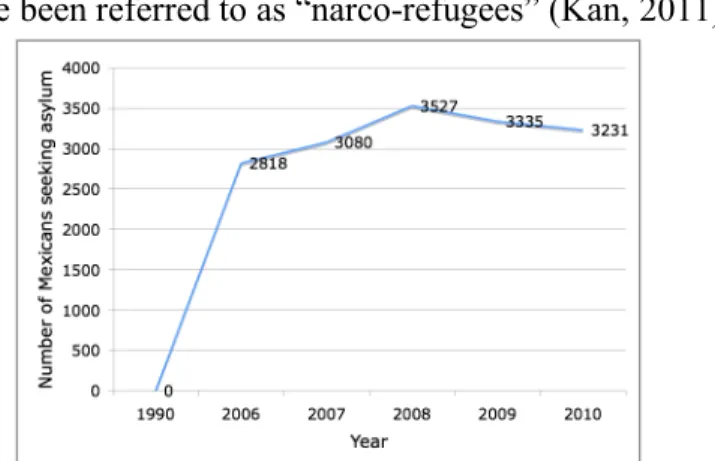
I By Rafael Barajas, or “El Fisgón” [The Snoop] from La Jornada, January 26, 2011……….………....………33 II Number of Mexican nationals requesting asylum from 2006 to 2010….39
CHAPTER 1
INTRODUCTION, TERMS, RATIONALE and STUDY CONTEXT
What would the oligarchies of the world do without hard working people? What would they do without the honest? (Field notes)
This dissertation is about Mexican immigrant fathers who live, work and father at a distance (Salazar-Parreñas, 2001) in the New Latino South (Kochhar, Suro & Tafoya, 2005) while their spouses and children remain in México. I interviewed three groups of individuals. Two of these were members of families living in split-household families (Glenn, 1983). The three groups were Mexican immigrant fathers living and working in North Carolina and whose families live in México; Mexican children and mothers residing in México and whose fathers and husbands, respectively, live and work in the United States; and Mexican fathers living in México with their spouses and children.
of the fathers. I somehow thought that these diverse actors could help me tell the ‘full and complete’ story. Of course, there is no full and complete story—a lesson of qualitative methodology—but I nonetheless gained a deeper understanding of Mexican fathering and the Mexican family through the stories told from the multiple perspectives of diverse men, women and children who form part of this study.
In the United States, the fathers who are here supporting their families in México are faring no better. Facing aggressive and racially retrogressive immigration laws and a changing economy, their movement around the communities they live and work in and their ability to send money home at the same levels as when they arrived, have been severely curtailed by a climate of citizen and police surveillance.
Shortly, after I moved to North Carolina, the U.S. Mexican immigrant population along with other immigrants and citizens, participated in massive acts of engaged
citizenship through marches in several major cities of the United States. Peacefully taking over miles and miles of urban landscapes, the marchers carried banners and signs asking for a reasoned approach to incorporating the undocumented immigrant into U.S. society. Babies in strollers guided by their moms, high school students still in uniform, fathers with toddlers propped high above on their shoulders, pregnant women, abuelos and abuelas, mariachis, labor leaders, and teachers and countless others marched and chanted, “El pueblo unido jamás será vencido” [Together, united, the people will never be
On a national level the media criticized the marchers on several fronts which included, carrying the Mexican flag instead of the American one; participating as citizens without being citizens, and for making a demand. I remember feeling a sense of pride in the undocumented population for showing the rest of us what engaged citizenship in a democracy should look like. Gálvez (2010), a New York-based researcher studying social movements among the undocumented, captured the moment this way in her observations of the political action of members of a church-based network called Asociación Tepeyac de New York,
Members of these organizations join together as immigrants and in defiance of the undocumented status many of them share. As such, they develop a mode of being, of situating oneself with respect to the state and society in the United Sates and in the broader multinational globalized sphere that neither assumes assimilation nor the seamless maintenance of ties to the homeland.
Instead, it is an activist, enfranchised identity…this
transformation has implications for notions of citizenship. While much writing on immigration assumes that citizenship is a condition that begins after the bestowal of the juridical attributes of belonging, I argue…that Mexican immigrants are engaging in political, activist activities which enhance their sense of well-being in material, lived and symbolic ways even while their juridical status remains unchanged. This kind of citizenship—broader, more performative, and more agential than the strictly juridical classification of citizens—is necessary to all other rights projects, both in the realm of formal citizenship and in other areas of social life. (p. 4).
As accurate an interpretation of the events of 2006 and 2007 that I believe Gálvez makes, unfortunately for the fathers in this study and countless other individuals in the U.S., the community the fathers work and reside in disagreed, and their wages saw a decline while media criticism and law enforcement scrutiny seemed to increase.
unauthorized spaces,’ which is the case of the Mexican father. That is, unauthorized fathering is also an ‘enfranchised and agential stance’ assumed by the Mexican fathers in this study on both sides of the border, and an important model of fathering in this
moment of persistent attempts to socially exclude them and erase them as vital members of family and community through erasure in the economic structure of México.
My conversations during participant observations and interviews with children also shed a light on the importance of the custodial parent, usually the mother for the children whose fathers were in the United States, and how she talks about the father’s physical absence. All of the children I interviewed knew that their fathers were working in the United States and said that they were working there because there was no work for them in México. When I asked the children to tell me about their families, they all included their fathers in the description, even those who admitted not speaking with him on a regular basis or having had any contact by letter or computer. I thought about Anderson’s (2006) notion of imagined communities, and I wondered if this was one way to understand the robustness the idea of “family” seemed to have with these children. Anderson introduces “imagined political community” (p.6) to discuss how the idea of “nation” is created in the minds of individuals who may or may not have any sustained contact with one another, and who have diverse experiences yet nonetheless see
Definition of Terms
El norte. “El norte,” or “North” is how many of the people that I encountered
during this study, participants and non-participants, referred to the United States. Popular culture, through music and films, reflect the ubiquity of this term among those who live or are from México and other neighbors to the south (e.g. El Norte, a film about siblings from El Salvador who journey to the United States in search of a better life). I use it interchangeably with the “United States.”
Immigrant. The term “immigrant,” when applied to Mexicans who cross the
México-U.S. border might be accurate in strictly legal terms, but viewed through a critical historic analytic becomes much more polemic. The war between the U.S. and México of 1847, which eventually would result in the loss of more than half of México’s national territory, has been widely criticized as an unjust war against a weaker neighbor to the south (Acuña [1972]2010; Zinn [1980] 2010). Places like Arizona, Texas, New México, Utah, Nevada and California are considered northern occupied México by a broad spectrum of people (e.g. Rodolfo Acuña, historian and regarded as the father of Chicano studies; political commentator Juan Andrade of the Southwest Voters
Registration Project; songwriter Dave Jacquet; critical scholar and academic, Luis Urrieta). This particular understanding of the region is appreciated by others as well. For instance, a visiting student from China and friend of mine, unsettled by what he saw as the limited vision and hypocrisy of “Free Tibet” demonstrators marching at Duke University’s campus during his studies there, said he shouted to the crowd, “Free
purpose of this section. I introduce the discussion simply to say that I agree with this critique, and when I use the word “immigrant” in this document, it is simply asß cultural shorthand to evoke the notion of states while being fully aware that many nation-states claim the authority and legitimacy of their borders on completely illegitimate and, yes, criminal actions. I also use the term “immigrant” to differentiate it from “migrant,” a term that has a very specific meaning related to visa-holding, seasonal farm laborers from other countries and to U.S. citizens who work in agricultural fields and migrate from one site to the next. However, I do use the word ‘migrate’ instead of ‘immigrate’ as
‘immigrate’ implies documentation.
Illegal immigrant versus undocumented immigrant. In 2004, the term “illegal
immigrant” was more aggressively introduced to the general public by the Associated Press (AP), a body that sets the guidelines for what constitutes appropriate speech and text forms in U.S. media. Local activists (e.g. NC ADELANTE education coalition) petitioned members of media to replace the term with “Undocumented Immigrant.” The response from media was that “illegal immigrant” was twofold: they were following AP guidelines in using this term, and the term could be shortened to “illegals,” thus saving valuable print space (G.Meyer, personal communication, 2010). Some have argued that “illegal immigrant” is the most accurate, because immigrants who enter the United States secure fake documents that allow them to work or drive here as if they were ‘legally’ documented (e.g. Newton, 2008). Following this logic then, U.S. citizens who break laws could be called “illegal citizens,” and undocumented immigrants could be “legal
a sense of the marginal. He argues that it “describes a social reality—inequality” (p. v), and explains that it has little to do with the minor civil violation of being in the United States undocumented; rather, it has to do with an imposed “social and political status” (p. v). Bacon traces one use of the word “illegals” back to Woody Guthrie, the famed singer-activist and songwriter. Through a newspaper article in a small town newspaper, Guthrie learned of a plane crash that was carrying Mexican immigrants back to the border. The newspaper article reported the names of the pilot and border patrol agent aboard the plane, but the immigrants remained nameless. Bacon writes that even the death
certificates stripped the men of their identities by simply listing in the ‘name’ field the word “Deportee.” Outraged, Guthrie wrote—“Some of us are illegal, and some are not wanted,” the line in Guthrie’s poem that catches Bacon’s attention (p. 83). Bacon wants to reinscribe the word with this meaning that evokes the lack of acceptance and
recognition of the Other as a fellow member of the community (p. 83).
fact that U.S. voters’ rights advocates raise during discussions about demanding a picture identification card at the voting booth. In México, an estimated 10 million Mexicans cannot afford such documents, and are, therefore, “undocumented” (Méndez, 2011). The discussion can be broadened; for instance, the “illegal alien” as a subject position emerges or is constructed by the adoption and implementation of restrictive U.S. immigration laws established shortly after World War I (Ngai, 2003). Globalization, as the practice of el capitalismo rapaz, or predatory capitalism, also produces the illegal subject. Through the making of massive diasporas, globalization simultaneously
criminalizes those looking for a better life (Bacon, 2008). Because México has more free trade agreements than any other country in the world, with nations as diverse as
Australia, Israel, and Germany, México will continue to face a trade imbalance that does not bode well for Mexican workers and their families, and we will see more
undocumented workers in the United States.
I believe undocumented immigrants are individuals who exercise their human right to construct a better world for themselves and their families by using migration as their primary strategy. I reject the use of the adjective “illegal” to talk about any human being; I understand Bacon’s (and Guthrie’s) expressions of solidarity, but I believe these are outsider understandings of the term and the term itself is an etic.
Split-household. The split-household family as a family structure was first
Glenn explains, this division is characterized by a reassertion of traditional gender roles with regards to family functions. Two separate physical spaces inhabited by diverse family members are established. Production and consumption are the functions of one adult family member, always male in the early Chinese experience, who travels far away to work, earn money and thus provide for his family through remittances. The family remains in the ancestral home. There, the woman and other family members engage in the tasks of reproduction, socialization and consumption. The triumphant element, though ironic given the physical absence of the adult male family member, is that the family is able to stay ‘intact’: “The family would remain an interdependent, cooperative unit, thereby fulfilling the definition of a family, despite geographical separation” (p. 39).
Apostándole a la familia mexicana [Betting on the Mexican Family]
El padre mexicano se encuentra en un momento de cambio social que en manera acelerada parece estar terminando con fuentes tradicionales de desarrollo personal y de la familia, y en el cual protagoniza y empeora la situación el cierre de espacios laborales. En algunos casos, esta realidad lo arrima a migrar a EU en condiciones precarias, tanto como son el irse sin capital y con deudas a las personas que conforman el red de traficantes de seres humanos, así como irse sin documentos para entrar a Estados Unidos o para poder trabajar ahí legalmente.
Otros padres que permanecen en México se exponen a la posibilidad del desempleo permanente o eventual, situaciones por las cuales se les dificulta sumamente el poder cumplir con las obligaciones, metas y los deseos de proveer casa, comida, atención médica, estudio, y esperanza a sus familias. Es decir, que no importa si el papá se queda en México y busca la manera de sacar a su familia adelante o si éste mismo migra a Estados Unidos para lograr la misma meta, en ambas situaciones se encuentra en un momento de acoso radical a la familia y en el cual tiene que continuamente redefinirse como padre de familia y ser laboral.
like going without money and indebted to the people who comprise human trafficking networks, and going without documents to enter the United States or to be able to work there legally.
Other fathers that stay in México expose themselves to the
possibility of permanent or temporary unemployment, situations that make it extraordinarily difficult for them to fulfill their obligations, goals and desires to provide casa, food, medical attention and hope to their families. That is, it doesn’t matter if the father stays in México and looks for ways to help his family salir adelante or if he goes to the United States to achieve the same goal; in both situations he finds himself under a moment of radical harassment of la familia and in which he constantly has to redefine himself as father and worker.] (Abelardo, father and psychologist in Mexico, during ‘member checking’).
A través de una series de entrevistas con padres de familias de los dos lados de la frontera entre México y Estados Unidos, presento aquí las experiencias de hombres mexicanos que trabajan por amor a sus familias y por vencer las condiciones que intentan a borrar a la familia como base fundamental de la sociedad mexicana y sitio de amor, esperanza y valor. [Through a series of interviews with fathers on both sides of the border between México and the United States, I present the experiences of Mexican men who work out of love for their familias and to overcome the conditions that attempt to erase the family as a foundation of Mexican society and as the site of love, hope and courage.]
Origins of the Study
“Mira, Marta, ellas son mis hijas.” [Look, Marta, they are my daughters.](Emilio López, U.S.-based father)
The ideas for this story/study began several years ago when I was having lunch at a Mexican restaurant in North Carolina, where I had moved with my family to begin my doctoral studies. Our waiter, Emilio López1, whom we had come to know from several
previous visits there, showed us a photograph of his two daughters. The wallet-sized image was of two smiling girls, with dark friendly eyes like Emilio’s and long black hair
1 All names of individuals, towns, schools, counties, and workplaces have been changed to pseudonyms to
that draped toward the front, over their shoulders. Both wore long-sleeved, loose-fitting tops that were embellished with tiny rhinestones arranged in swirling patterns along the neckline. The two girls looked like many young girls in the United States. I asked about their ages and what schools they attended. Emilio said that they were 9 and 12 and lived in México with his wife and went to school there. The living arrangement Emilio
described was not unusual. According to the Pew Hispanic Center (2011), one in five, or 20%, of all Mexican-born men ages 30-44 are in the United States. The age-range suggests that they are likely to be fathers. Mexican male migration to the U.S. has been the most prevalent pattern of México-U.S. immigration, even as the feminization of the labor force is evident in Mexican female migration rates to the U.S., that have also been quite high2.
In my own experience, throughout my childhood and into adulthood, Emilio’s story of co-parenting (Pribilsky, 2004) and fathering at a distance (Salazar-Parreñas, 2004) was familiar. One of my uncles had migrated to the United States without his family. With his earnings here and the careful management of this money by my aunt there, they were able to put their six children through higher education. Two of their sons attained doctoral degrees, one in education and the other in engineering. The other children completed their university studies and are “licenciados” or ‘licensed ones,’ a reference to their university credentials.
I also had male cousins who had embarked on the same project as my uncle, and I knew many other men and families just like Emilio and his family that were and are part of my life. I should note that this alternative way of fathering and being a family is again
changing; data from the Mexican National Survey of Occupation and Employment, 2006-2010, show that migration out of Mexico, which is overwhelmingly to the U.S. (97% of out-migration from México is to the United States), declined by 60% during the period that the idea for and the implementation of this study took place.3 This means fewer
Mexican nationals are coming to the U.S. Emilio was part of the 1990s migration wave, and his journey started when his life as a delivery truck driver in a large Mexican firm unraveled in the aftermath of a job-related accident. Mounting debt and an inability to supplement his disability income “lo arrimó” or ‘moved him toward’ a difficult decision. After a series of phone calls to his wife’s cousins in México and the United States,
Emilio, a father from the second largest city in México, found his way, first to Atlanta, and then to a town with a population of less than 10,000 in the New Latino South.4
I would hear more about Emilio López’s life, and about Carlos Sotomayor’s, Alfredo Ramirez’s, and Andrés Rueda’s, all of whom also migrated to North Carolina, and who, with the exception of Andrés, work in the same restaurant. They all gave vivid accounts of their work histories in an increasingly “neoliberalized” México and spoke of their diminishing value as workers and the resources they once could marshal to survive. Their accounts suggest that the information these fathers had for navigating tough economic circumstances came from friends, family members and acquaintances who
3 Passel & Cohn (2009) cite declining job opportunities in the U.S and stricter border enforcement on the
U.S. side for this sharp decline of out-migration from México to the U.S. On the Mexican side, economic growth within México has been cited for stemming the out-flow. Something not mentioned but perhaps also contributing to lower rates of migration to the U.S. is the intense narco-violence plaguing border towns and widely-publicized reports of the discovery of mass graves containing migrants heading north.
4Thus labeled in a now classic demographic report by Kuchar, Suro and Tafoya (2005) and published by
themselves had migrated to and found work in the United States. Seen from this perspective, there was a certain inevitability about these fathers’ presence in North Carolina.
Research on migration has focused on the macro-processes that create what are called push factors in the sending nation that send the poor, the unemployed or the underemployed, to richer nations to serve as low-wage workers, and pull factors in the receiving country that create a need or desire to migrate (e.g. Portes & Borocz, 1989). Pull factors include the lure of a stronger currency in the receiving country that makes the exchange rate attractive to migrants from countries with weaker currencies. The exchange rate was a point of consideration for two of the four fathers, but only after the decision to migrate was made. What Sassen (1995), who challenges the push-pull argument, has observed about the importance of one’s social network as being more influential than push-pull factors, was evident in the lives of these men. Sassen notes, for instance, that having ‘a cousin in New Jersey’ exerts more influence upon the decision to migrate than the exchange rate. This certainly was the case for the fathers I interviewed in North Carolina.
For the Mexican arm of the study, I traveled to México to interview fathers who work and live with their families in Mexico and found that they too had a social network of friends, family members and acquaintances who helped them navigate difficult times. The network these fathers had, however, emphasized the importance of seeking out local work opportunities, social service programs to help with the family economy, and educational opportunities for themselves as adult learners that could help them stay competitive in the ever-tightening labor market. Their social networks also warned them about the perils of migrating and leaving their families behind ‘sin la cabeza’ without ‘the head’. This resonated with some of the fathers who had themselves at one time tried their luck in the U.S. as immigrants or who had been raised at a distance by fathers who worked and lived in the U.S. Although I will not employ social network theory to
interpret my findings, certainly an early lesson for me from the fathers in this study is that the type of decisions we make about which opportunities to seize—or even perceive as being available—has a lot to do with the circumstances we face and what people whom we know or trust share with us about their own experiences.
Why Mexican Fathering?
Mexico, even with its declining rates in out-migration in the last four years, has 12.7 million Mexican-born immigrants living here, 55% of whom are undocumented (Pew Hispanic Center, 2009) and are more likely to be male and more likely to be
married (Pew Hispanic Center). At the same time that economic conditions in the United States made it favorable for Mexican immigrants to migrate across the border,
North American Free Trade Agreement (NAFTA) was introduced and institutionalized, and the neoliberalization5 (England & Ward, 2010) of the Mexican economy, a process
started in the 1980s, long before 1994, the year NAFTA took effect in México, was well underway. Although Mexico has seen a $37 billion trade surplus since NAFTA’s
inception (Williams, 2004), 47% of Mexican families continue to live in asset-based poverty6 (CIA, 2011). México’s other free trade agreements mentioned above further define México as an export-driven, import-dependent economy. The recent global collapse of financial markets revealed México’s vulnerability, when its Gross Domestic Product (GDP) plunged as the demand for exports dropped along with the value of assets (CIA, 2011). Moreover, earlier reforms did away with gains made in the Mexican
Revolution of 1910. Th death of “el campo” as an agricultural project and site of work has occurred. Between 1910 to 1934 over 100 million hectares were distributed, from which 30,000 ejidos, or parcels were formed, giving work to over three million heads of household (Warman, 2001). Article 27, folio 8201 of the Mexican Constitution,
introduced in 1934, codified the achievements of the Agrarian Reform, won in the
aftermath of the 1910 Revolution. Article 27 institutionalized the ejido system. However, in 1992, another reform was introduced, virtually ending the ejido system of collective farming and bargaining and converting small-scale farm workers into petit bourgeois
5Governments and corporations engage in processes of neoliberalization (England & Ward, 2007); this is
distinct from neoliberalism as an end state or status. This process is by free trade, privatization and deregulation, and has the potential to create “countertendencies” as policies and practices are introduced in graduated, deliberate ways that result in uneven development across temporal and spatial fields (p. 253).
6
landowners under ‘el dominio universal,’ or ‘private ownership.’ The ‘campo,’ rarely the source of any family’s sole sustenance, nonetheless, had historically provided many families with a second source of food, work and income.
Mexican economist and researcher, Ibrahim Santacruz Villaseñor (2005), notes that ‘neo-liberal governments [of México] have focused on structural reforms that have limited the ability of the Mexican economy to create jobs. By prioritizing the economic liberalization of the Mexican economy, privatizing 1,200 state-owned companies and deregulating the national legal framework, the neo-liberal model is now able function with more ease’ (Wharton School of Business, 2005).
While this may be good for transnational capital, it does not bode well for workers. Andrés, a North Carolina-based father, in talking about his job experiences in México, knows that having a job in México does not mean that one will have it for long. In his hometown in the state of Guanajuato, he worked at Galletas, a large transnational corporation manufacturing cookies and other baked goods that can be found in any Mexican supermarket both in the U.S. and México. Andrés worked there for two years and was then let go. A year or so later, he was rehired and then let go again within two years. He said this revolving door in industry is common, even at places like Galletas, where workers still can count on labor union representation. Andrés described how this practice of firing and rehiring was discontinued when an even more radical model was ushered in of, first, hiring new crews and then having an external contractor hire permanent temporary workers:
MS: Ah.
AR: Entonces este, a muchos no los dejaban hacer antigüedad. [So, they didn’t let many of them acquire seniority.]
MS: ¿Que tan seguido hacían eso? [How often did they do that?] AR: Ahorita ya, ya no lo hacen…los que tomaron planta ahí en la fábrica…se quedaron de planta ahí, ya tienen su puesto seguro…[Right now they don’t do that anymore. The ones who took a permanent position there…they stayed as permanent—de planta—employees, [and] have a secure post.]
MS: Sí. [Yes.]
AR: Ahorita ya los que van entrando nuevos es por contratistas…los contratistas cada cinco, seis meses hacen cambio, renuevan contratos, ya no los dejan hacer, antigüedad para nada, para…evitar problemas de que sindicalismo, de que antigüedades…vamos, hasta para evitar, ¿Cómo se llama?...la jubilación o pensiones. [Right now, the ones (employees) newly entering are through contractors…every five, six months they make changes, renew contracts; they don’t let them [the new hirees] acquire seniority any more for any reason at all, to…avoid problems like trade unionism, seniority…you know, to avoid even, what is it
called?...Retirement or pensions.].
Andrés’s experience as an employee in México is not uncommon. Santacruz Villaseñor (2005) comments that Mexican companies, indeed, are not interested in preserving workers’ rights. In order to diminish these, he asserts, employers have technical shutdowns, deny workers their salary, or they implement deep wage cuts and justify this by telling workers that these measures make it possible for them to keep their jobs and/or pensions. This impacts both unemployment and underemployment in México. In fact, although the Mexican unemployment rate in 2010 was estimated at 5.4%,
Diverse actors, such as the Zapatistas in Chiapas and INEGI, México’s Institute of Statistics and Geography, contest the 5.4% unemployment rate as too low of an estimate (Centro de Análisis Multidisciplinario, 2010). INEGI noted that the unemployment rate for 2005, which also hovered around 5%, should not be taken as the final determinant for the need for jobs in México, “De ahí que la desocupación… For that reason being
unemployed is not, nor tries to be, the measure that expresses how many people need to work in a given place and time, nor does it indicate how great the deficit is of labor opportunities” (Centro de Análisis Multidisciplinario, 2010, p.9). This is because the unemployment rate reflects only the numbers of the chronically unemployed and active job seekers who in a month’s time have not found employment; it does not take into account the unemployed who have given up looking for employment (Centro de Análisis Multidisciplinario, 2010).
The Socio-Political Context of the Study
observed in a letter to a friend that, “One can live magnificently in this world if one knows how to work and how to love” (Troyat, [1967] 2001, p. 158). The fathers in this study know how to work and love, and this is what enables them to reclaim the
magnificence in their lives and to author new selves as caring and loving fathers in “unauthorized” spaces. For them, work is love.
My goal is to make this magnificence and the strategies fathers use more apparent to those of us, including myself, who still operate with normative notions of family. It is, therefore, for me, a difficult story to tell. Their lives are marked by many ironies, the first of which is that the fathers in this study take extraordinary measures to be able to do ordinary things, like work, buy their children shoes, get a haircut for themselves, and feed and educate the family. It is in many ways a “bigger than life” story, with human acts that defy reason and make these men into heroes, and, on the other end of the spectrum, of intervening public discourses that vilify or demonize them or ignore them altogether. In this dissertation I attempt to faithfully represent fathers so that we see them as they represented themselves during the interviews and other fieldwork.
Competing Narratives on Mexican and other Latino Immigrants
A sea change has occurred in how Mexican immigrants such as the fathers in the U.S. arm of the study, and now more frequently other Latino immigrants, including women and entire families, are represented in the media, and by politicians, leaders and the public at large. For instance, after conducting a thematic analysis of analysis of 229 articles and 111 letters to the editor related to Latino and immigrant issues that were published in one medium-sized newspaper7 serving a North Carolina community with a
7 This data results from my review of the Greensboro Record and News, of articles and letters to the editor
recent increase in its Latino population, I found that there were mainly three public narratives that were being circulated in the media of the New Latino South. One narrative put forth the view that Latino immigrants were hardworking, family-oriented individuals who came to the United States in search of a better life for themselves and their loved ones. Incorporation, or the “degree of embeddedness immigrants achieve in the receiving society” (Korineck, Entwisle, & Jampaklay, 2005, p. 780) is also part of the narrative. In this first perspective, incorporation of immigrants into American society includes a pathway to citizenship. With policy implications that suggest full and legal incorporation, this view reasserts America’s identity as both a generous nation and a nation of
immigrants, as it is enshrined in the Statue of Liberty.
A second narrative storied immigrants as neoliberal subjects. Emphasizing
immigrants’ importance to the viability of the U.S. economy, their incorporation required that they be given temporary legal status with permission to work as the economy
dictated it. This temporary stay should be extended to males and exclude family
members, such as spouses and children. This gendered ‘temporary worker’ approach to the incorporation of immigrants is informed by neoliberal policies and practices in which the worker has limited labor rights and restricted pathways to fuller societal
incorporation. This view reasserts America’s self-understanding as one of the world’s richest countries and a global business leader.
In these two narratives, Mexican fathers are positioned as noble individuals who come here to support the family back home. A new public discourse on Mexican
immigrants and immigration was gaining traction, however. This new discourse was changing the way we as a society would begin to think and talk about Mexican immigrant fathers, and which has caused bigger problems for fathers like Emilio, Carlos, Alfredo, and Andrés. This third narrative that I found was that immigrants were viewed at best as a burden to society and pilferers of public coffers; at worst, they were positioned as thieves who had “broken into” the United States. Their incorporation requires that they be identified as lawless criminals who must be punished through a three-prong process identified by Derewicz (2010), a local immigration rights attorney, of detection, detention and deportation, thus reasserting America’s identity as a nation of laws.
The Nativist Moment
When I met Emilio, this last narrative had taken hold of the region, framing the discussion and influencing policy about how immigration and immigrants should be viewed and treated, impacting law enforcement, the general public and media (Derewicz, 2010). This view was emboldened by the application of section 287g of the Immigration and Nationality Act of 1996. Section 287g allows for Immigration and Customs
than holding centers. Investigative reports have uncovered instances of intimidation by detention center staff and of sexual assault of female detainees (Hinojosa, 2011).
A 2007 report from Lutheran Immigration and Refugee Services and the
Women’s Commission for Refugee Women and Children, shed a light on the abuses in several of these centers. The report made special mention of the T. Don Hutto Detention Center in Taylor, Texas. Hutto, like many other such centers, is operated by Corrections Center of America (CCA), a management firm that also operates for-profit prisons. The advocacy groups remarked on Hutto’s practice of separating young children from their mothers at bedtime, calling it ‘inhumane,’ and petitioned for the closing of the center, which they likened to a prison (CBS, 2007; 2009).
In México, while conducting the Mexican arm of this study, I interviewed fathers that were well-informed about recent anti-immigrant U.S. legislation and the detection and detention practices impacting Mexicans living in the United States. They expressed concern and shock about how this could happen in a country they viewed as being somewhat tolerant, even welcoming, toward Mexicans. Roberto Salazar, a father of two, expressed his disapproval of Arizona’s controversial SB 1070, a law which makes it a misdemeanor crime not to have on one’s person documents indicating a legal right to be in the U.S. At the time of the interview, the law had been passed but was to take effect in the coming weeks,
…Que quieren sacar una ley que, que todo el que anda
indocumentado allá, que no tiene sus papeles, se le va a tratar casi como a un criminal…¿Verdad? Entonces, pues no dejan de ser…conocidos de uno y amigos y todo eso, y pues uno también pide por todos ellos. Y uno ve mal esa ley…
criminal…Right? Well, they’re acquaintances of ours and friends, and all of that, and well, one also asks on all of their behalf, and we see that law as wrong.] (Roberto Salazar, a father based in México).
The county in which the U.S. arm of my study takes place has been a “model” for other counties and states for its implementation of 287g, which is similar to Arizona state law SB 1070. Officials in this region have aggressively used the law to deport individuals for minor traffic violations or for things like “fishing the Haw [river]” without a license (Derewicz, 2010, p. 41), something the law was not designed to do.
I realized that in this narrative of the burdensome, criminal immigrant, men like Emilio were completely invisible as workers, and most certainly as fathers and family men. I also knew, as anyone who had even a casual interest in the topic would have surmised, that he and others like him would increasingly become more vulnerable to being persecuted—at the same time that their humanity as fathers was rendered invisible, their presence in the U.S. was now being seen as spurious, or worse, constructed as a crime.
Mutually Exclusive Places to Be
La mayoría de las casas que hicieron los que se fueron a trabajar allá están vacías
[The majority of the houses built by those who left to work over there are empty.] (Rulfo, a father in México)
operate in a postnational realm. That is, big commerce like Ford, Monsanto, and McDonald’s sell and move in a world without borders. Laborers might find that their countries have special arrangements with receiving nations for seasonal work, such as migrant farmworkers who tend the tobacco fields and corn and cucumber crops of North Carolina. Other laborers discover that the border is permeable when there is a labor demand. Either way, labor becomes denationalized through the relocation of corporations or the displacement of the worker in his/her native country who must then migrate to work.
The latter turn is a reassertion of nationalist sentiments that are expressed through nativist discourses and movements, such as challenging birthright citizenship or
promoting and legislating English-language monolingualism in a pluralistic, democratic society such as the United States. For Mexican immigrant fathers living and working in the United States, these opposite turns of nationalism situate them in contradictory spaces and accentuate an insider/outsider status: they are both highly desirable low-wage
What the fathers in this study have shared with me ‘talks back’ to and disrupts these painfully shortsighted discourses that do not represent the full humanity of Mexican immigrant fathers or the project they embark on when they make the move to migrate to the United States, or ‘el norte,’ as everyone in this study referred to this country. Their voices stand as an alternative archive, or counterstory (Delgado & Stefancic, 1993). It was important for me to learn about what it means to father at a distance of time and space in times of social and economic exclusion.
The Fathers in México
El gobierno no lo puede ayudar, lo único que va a ser es aventarlos al otro lado, pero allá también, es lo mismo.
[The government cannot help one; the only thing they will do is throw you to the other side (the U.S.), but over there, it’s the same thing.](Carvajal de América, a father based in México).
them and left them asking how to protect their children from the violence and increased drug use among Mexican youth.
The fathers also expressed concerns about the closing of the admissions process to preparatoria, or high school, that at the time I was there, was requiring students to
‘qualify’ for a high school education. Students had to pass a middle school exit exam in order to be admitted to high school in the first round of cut-offs. Other concerns included reduced public spaces for at the university level and increasing fees even at the
elementary level; threats to rural livelihoods, an overall decrease in employment opportunities, and threats to labor rights. For instance, because of widespread age discrimination in the workplace, individuals over the age of 35 are not employable (Hawley & Solache, 2007)8. This labor practice is in violation of Article 123 of the
Mexican Constitution, which guarantees minimum employment protections to all
workers, and Article 56 of Mexican Federal Labor Law prohibiting age discrimination; it is, nonetheless, a common one (Interview data 2010-2011; Cattan, 2010; Dickerson & Mandell, 2006; Hawley & Solache, 2007; Mandell, 2006). Those who do have
employment are experiencing diminishing buying power because of the methods used to determine overall inflation rates. The rates are manipulated to reflect levels lower than actual ones. “Cifras maquilladas” (Miguel, 2011), or fixed numbers, impact the salary wage increase Mexican workers can expect as raises are pegged to inflation rates in a ‘cost of living’ calculation (Miguel, 2011).
8 U.S.-origin transnational firms also participate in age discrimination. USA Today on September 23, 2007
Living and Working in the Time of NAFTA
Solo necesita uno tener el capital.
[One only needs to have the capital] (Carvajal de América)
México has other problems that contribute not only to unemployment but also to continued migration north. As a nation rich in oil reserves, uranium, gold, silver, coffee, cacao, and other resources, México, nonetheless, has a rate of growth of its Gross Domestic Product (GDP) that ranks 16 out of 20 in Latin America, and which was reported at being 4% for 2011. This rate of growth was lower than that of the region’s poorest nation, Haiti, even before Haiti was hit by the devastating 2010 earthquake (CEPAL, 2011). At the same time that growth has been slow, in 2008, México lifted its protection of staple crops and food that feed Mexican families and sustain many farmers, farm workers and others who work the fields. The final phasing in of NAFTA in 2010 flooded the Mexican market with subsidized, cheap yellow sweet corn from the United States, “50% of which comes from genetically modified seed” (Rosenberg, 2007).
ranchero] ni las familias podemos sembrar [The seed they bring from Holland, the fertilizer, from over there in the United States, the herbicide—well, one doesn’t know anymore from where, and everything is so expensive that I [as a farmer] nor the families can farm.” (Field notes). Over dinner with him, his family and other farm families, conversation turned to a pending decision they would soon have to make about whether voting to sell the ejido [communal farmlands gained as an achievement of the Mexican Revolution of 1910] was the right decision to make in light of the diminishing returns of farming.
The economy of small-scale farming may offer better returns than ejido farming, because of its potential to fill household pantries, but the start-up costs can be steep. In the ranchería where Luisa and her husband, José Carvajal de América, live, opportunities abound for families to sublease small parcels. The Carvajal de Américas outlined the costs below, which they had recently checked, motivated by Luisa’s father, who had offered to let Luisa and José use a parcela [parcel] on his land for free. A parcela is any farmable land on an ejido that is less than 5 hectares (about 12 acres) in size. Renting or subleasing can vary in cost because of location, but the price can range from $150,000 pesos to $500,000 [the peso to dollar exchange rate at the time was 10:1]. in the part of Jalisco where Luisa and José live. For Luisa and José, the parcela was 1/5 of an hectare and was being offered to them for free for the season. There were, however, necessary expenditures awaiting them in order to be able to use the plot of land for farming: Table 1
Cost of Farming on a parcela (1/5 hectare, approx. 1.2 acres) in the Valley of Jalisco, 2010 Expenditure Amount in Mexican Pesos for 2010 (10 Mexican
Use of parcela $0
Seed for maize $1500
Fertilizer for 3 applications $9000 Herbicide for 3 applications $9000
Total $19,500
In U.S. dollars, to farm this parcela would cost $1950, which José pointed out could be recuperated in the first crop, if the weather, weeds and pests cooperated. “Solo necesita tener uno el capital” [One only needs to have the capital], he said. Luisa works 6 days a week for $50 pesos—$5 dollars—a day as a doméstica (domestic worker),
carrying out daily chores in the home of an elderly aunt. With one day’s earnings, she can buy one kilo of beans and 1 kilo of tortillas (about 2 pounds of each). For three more days of earnings, Luisa can purchase enough oatmeal, rice, pasta, two types of fruit and two types of vegetables for her entire family for almost the entire week. She is feeding her family with her earnings.
José typically earns between $500 and $600 pesos a day ($50-$60 US) as a master albañil [bricklayer or construction worker], of which he usually splits in half with an assistant (it is a common and expected practice for an albañil to work with an assistant). However, construction work is not steady in the ranchería9 or even in the nearby town.
José would have to leave for the big city to have a fixed schedule, but there he would be able to work for a large construction company with its own competitive wage scales and age-restrictive practices. He would also have to pay for extra living expenses. José explained why construction work is a stop-and-go and stop enterprise where he lives:
9
Aquí no se puede porque [trabajar continuamente] pues aquí viven del trabajo…los maestros o los que se van al norte a Estados Unidos, juntan sus ahorros, y hacen una parte de su casa, y luego ya para
uno…después hacen la otra parte, y si ellos no tienen dinero, le para uno y se queda sin trabajo, y dura hasta un mes. Gracias a Dios, también sabe uno del campo.
[You can’t do that here [have continuous work] because, well, here, people make a living from working. Teachers or those who go north, to the United States, save their money and they build one part of their house, and then you stop. Later, they build another part, and if they don’t have money, you stop, and you’re left without a job, and that can last up to a month. Thank God that I also know something about farming.] (Carvajal de América).
When there is work, however, sometimes his wage drops below the $500 pesos ($50 US) he is currently earning. In one instance, he was hired at $40 pesos per meter of work. He and his assistant could tend up to 10 meters a day, sometimes more, depending on the task. Although the agreed amount was $60 pesos per meter, José said the wage was lowered when ‘gente de otro lado’ [people from somewhere else] arrived and expressed a willingness to work for $40 pesos per meter. On the farm, he can earn about $60 pesos a day for 10 hours of work. However, when it rains, construction and farm work is scarce for everyone. As I heard Luisa and José lay out the economics of their life, and remembered that they were raising 4 children, the idea that one day they would be able to farm the parcela Luisa’s father offered them seemed very far-fetched indeed10. La narco-guerra
10In indigenous communities, the situation worsens with the introduction of genetically modified corn. In
Finally, the narco-guerra, or war on drugs, has claimed the lives of tens of thousands of Mexicans (estimates vary from 40,000 to 50,000 from December 2006 to September 2011 and recently up to 90,000). There is no popular support for what has been called “Calderón’s war,” referring to Mexican president Felipe Calderón, and what is widely perceived as a high-cost tactic for Calderón to establish broad executive power. Further suspicion arises from the fact that the war is funded by U.S. dollars through Plan Mérida, or the Mérida Initiative, which funnels money, equipment and training to the tune of $1.5 billion U.S., $1.3 billion of which was given to México and the remainder was distributed among Central American nations (Congressional Record, 2008; Ribando Seelke & Finklea, 2011). More worrisome is that the initiative gives unprecedented rights to U.S. law enforcement agents to operate freely on Mexican soil. U.S. bureaus such as the Federal Bureau of Investigation (FBI) and the Drug Enforcement Agency (DEA) have an increased and open presence operating from several offices within México, including on La Avenida Reforma in México City, a street laden with historical symbolism and meaning and which had enjoyed a privileged status as a uniquely Mexican space.
The militarization of the country is also evident. A cab driver in México City, for instance, said to me, as we drove by several tan-colored army trucks with soldiers
Calderón Hinojosa in military uniform standing in a puddle of blood. Mexican statehood is his “reward” for implementing U.S. policy to fight drug-trafficking in México. The feminine hand that applies the star to Calderón’s forehead is not the traditional Uncle Sam. Instead, it represents U.S. Secretary of State Hillary Clinton. Clinton visited with Calderón the day the caricature was made, but her early and frequent comments regarding México, that it was on the verge of becoming a “failed state,” unleashed angry remarks and high-level protest against U.S. interference in México’s internal affairs (e.g. Krauze, 2009). The inscription on the bottom of the caricature mourns the passing of indigenous rights activist in Oaxaca, Padre Samuel Ruiz, and icon of the Mexican Left, Fausto Trejo Fuentes. They were fierce critics of the narco-guerra, and their deaths coincided with but were not a result of recent drug-war related violence.
Massive protests against this U.S. funded narco-guerra have been another way to express anger and discontent. Critics highlight the narco-guerra’s high casualty rate, higher than that of Iraq or Afghanistan during the height of those wars (Martinez & Saldierna, 2010; Smith, 2011). Organizations such as No+Sangre (No More Blood) and Reporters without Borders have campaigned against this bloody war. Most recently, well-known Mexican poet, Javier Sicilia, organized several marches after his son, who was tortured and killed along with six other university students, became another narco-guerra casualty.
Proceso, a leftist magazine in México, has called the narco-guerra and related legislation that limits civil rights and liberties (e.g. indefinite detention without being charged when taken in for questioning; declaring all crime and deaths as part of the narco-guerra thus warranting no further investigation) in México ‘a U.S. invasion poco a poco,’ or little by little. A special report by journalist Jorge Carrasco Araizaga (2011) confirmed Proceso’s analysis. Carrasco Araizaga interviewed Robert Bunker, a researcher at the Strategic Studies Institute at the U.S. Army War College. Bunker’s comments were featured under the headline, ‘El imperio busca otros enemigos…en México’ [The empire seeks other enemies…in México’], and included this statement in reference to delinquency and crime in México:
…[organizaciones delictivas] son mucho más que eso. Son delincuentes insurgentes [énfasis añadido] que de facto están ganando poder vía campañas de violencia y corrupción”
Bunker adds that Washington’s “strategic considerations” have changed toward its southern border, and these changes will be reflected ‘slowly but
surely’. It doesn’t seem all that slow to me. The Obama administration announced its plans to implement in México the same counter-narcotic strategies used in Afghanistan (Brooks, 2011), which have nonetheless resulted in higher levels of poppy cultivation than when the region was under Taliban control (Healy, 2011). Early in 2011, Obama nominated Earl Anthony Wayne, who formerly served as U.S. Deputy Ambassador in Afghanistan, to be México’s new ambassador. Wayne’s nomination was confirmed by the United States senate in July of 2011 and approved by México shortly thereafter. This, combined with the fact that Bunker, a prominent researcher from a key U.S. military institution11 with a
global reach and whose purpose is to support U.S. military actions throughout the world, uses the word ‘insurgents’ to talk about cartel kingpins, suggests a
positioning of México similar to that of Iraq, Afghanistan and other middle
11 The U.S. Army War College is a very selective college that serves high-ranking military officials,
eastern countries, in which any activity not conforming to the United States’ “strategic considerations” can be constructed as insurgency and terrorism.
In México, there are some initiatives through México’s Secretary of Social Development, la Secretaria del Desarrollo Social (SEDESOL), tantamount to those offered by the Department of Health and Human Services in the United States, but these barely offset the deleterious effects of poverty and joblessness that many families continue to face. The families I interviewed in México mentioned “Oportunidades,” a relatively new program for low-income families. The families that participated in this program said a qualifying criterion was to have a child in the household who was entering secundaria [middle school]. As it was described to me by parents of middle school children, Oportunidades consists of a cash scholarship to be spent on the middle school’s child education, according to the discretion of the family. Additionally, if the family qualifies, a subsidy is given to purchase a basket of food for a family of four at a deeply discounted price on a weekly basis. Oportunidades was implemented in 2003 to address issues of social inequity and historical neglect of marginalized groups. The program combats poverty by providing opportunities for personal development through adult basic education and economic support for families living in poverty. These
opportunities are offered through the inter-institutional coordination of services at a national level.
With a broad-reaching agenda to serve
[every Mexican, without regard to the region in which he was born, the neighborhood or community in which he grew up, the income of his parents, might have the same opportunities to develop his aspirations to the fullest and improve in that way the conditions of his live, without infringing upon the opportunities of future generations.] (SEDESOL, 2010, p. 2).
Oportunidades hopes to level the playing field for many Mexican families. Although families were appreciative of this type of support, at least three parents said they would rather have a job that paid a living wage than be receiving financial and food aid (Field notes). A strong criticism of such programs in México is that they are
vulnerable to exploitation by politicians. A common practice is to engage in ‘el cohecho’ a type of political bribe that requires families to declare political party affiliation and become card-carrying members before being able to apply for this and other programs. Oportunidades has tried to mitigate this by paying families the cash scholarship and food assistance directly. Having grown up in Chicago, notorious for corruption and where the dead, the unregistered and the underage have voted, I know how devastating these
arrangements can be to communities. Although ‘el cohecho’ is punishable by law, during elections, its use becomes more prevalent. The ‘cohecho’ functions as a form of
Intimate Terrorism12
Del norte…y mexicana
I feel deep sorrow about these events. I am a U.S. citizen by birth, but I am mexicana, and México is my country, too. What is happening in the United States with Mexican immigrant families is equally troubling. For me this is “intimate terrorism” (Anzaldúa, 1987, p. 42). I do not feel safe in any setting any more, even as I live with some privilege in this country and have always been received with great warmth and genuine affection in México. There is another level in both societies where terror resides, kills and destabilizes. It operates under the logic of neoliberalism and national security and marks everyone as a suspect. It turns the body against itself (Anzaldúa) and allows a brown person—both here and there—to become ‘illegal.’ It destroys nature and
indigenous knowledge—the foundation of local economies and ways of life—and leaves children hungry and makes mothers old and fathers brave. This terror separates families, creating virtual orphans, to satisfy the needs of the market and the ideology of a broken yet politically powerful and militarily mighty, all-consuming state.
A recent report (2011), for instance, by the Applied Research Center found that 46,000 Latino parents had been deported from the U.S. from January to July of 2011; the resulting “shattered families” include 5,000 children who are now in foster care because their parents have been deported to México and other countries. Perhaps, I have been recruited into some sort of postnational space that the immigrant fathers in this study create as they father, make family and build nation from a distance, or perhaps I am redefining what it means to be an American as I claim interest in and loyalty to two
12
![Figure 1: By Rafael Barajas, or “El Fisgón” [The Snoop] from La Jornada, January 26, 2011](https://thumb-us.123doks.com/thumbv2/123dok_us/8262980.2189070/48.918.359.613.559.966/figure-rafael-barajas-fisgón-the-snoop-jornada-january.webp)