SHORT COMMUNICATION
Genetic control of functional brain network
efficiency in children
Martijn P. van den Heuvel
a,
n, Inge L.C. van Soelen
b
, Cornelis J. Stam
c
,
Ren
e S. Kahn
a
, Dorret I. Boomsma
d
, Hilleke E. Hulshoff Pol
a
a
Department of Psychiatry, Rudolf Magnus Institute of Neuroscience, University Medical Center Utrecht, Heidelberglaan
100, 3508 GA Utrecht, P.O. Box 85500, The Netherlands
b
Department of Public Health, Leiden University Medical Center, Leiden, The Netherlands
cVU University Medical Center, Department of Clinical Neurophysiology, Amsterdam, The Netherlands
d
VU University Amsterdam, Department of Biological Psychology, Amsterdam, The Netherlands
Received 18 May 2012; accepted 9 June 2012
KEYWORDS
Connectivity; fMRI; Functional connectivity; Resting state; Brain efficiency; Heritability; Graph analysis; Small-world; Genetics
Abstract
The human brain is a complex network of interconnected brain regions. In adulthood, the brain’s network was recently found to be under genetic influence. However, the extent to which genes influence the functional brain network early in development is not yet known. We report on the heritability of functional brain efficiency during early brain development. Using a twin design, young children underwent resting-state functional magnetic resonance imaging brain scans (N= 86 from 21 MZ and 22 DZ twin-pairs, age = 12 years). Functional connectivity, defined as the temporal dependency of neuronal activation patterns of anatomically separated brain regions, was explored using graph theory and its heritability was examined using structural equation modeling. Our findings suggest that ‘global efficiency of communication’ among brain regions is under genetic control (h2lambda= 42%), irrespectively of the total number of brain connections (connectivity density). In addition, no influence of genes or common environment
to local clustering (gamma) was found, suggesting a less pronounced effect of genes on local
information segregation. Thus our findings suggest that a set of genes is shaping the underlying architecture of functional brain communication during development.
&2012 Elsevier B.V. and ECNP. All rights reserved.
1.
Introduction
Brain regions continuously interact through means of
com-plex
organized
structural
and
functional
connections
(Sporns et al., 2005;
Bullmore and Sporns, 2009;
van den
Heuvel and Sporns, 2011). Functional connectivity between
www.elsevier.com/locate/euroneuro
0924-977X/$ - see front matter&2012 Elsevier B.V. and ECNP. All rights reserved. http://dx.doi.org/10.1016/j.euroneuro.2012.06.007
n
Corresponding author. Tel.: + 31 88 75 58244; fax: + 31 88 75 55443.
brain regions at the level of co-activation of spontaneous
functional MRI time-series are believed to represent
func-tional communication between brain regions (Bullmore and
Sporns, 2009;
van den Heuvel and Hulshoff Pol, 2010). A
growing number of studies have applied advanced graph
analysis techniques to resting-state fMRI data (Lynall et al.,
2010;
Fornito et al., 2011;
Liu et al., 2008;
Van den Heuvel
et al., 2008), revealing insights in the general organization
of functional brain networks. In particular, studies have
suggested that the efficiency of communication between
brain regions plays an important role in healthy cognitive
functioning (Bassett et al., 2009;
van den Heuvel et al.,
2009). Conversely, aberrant network organization has been
suggested to underlie a wide range of psychiatric and
neurological brain disorders (Stam et al., 2009;
Lynall
et al., 2010;
van den Heuvel et al., 2010).
While several structural and functional aspects of the brain
are known to be highly heritable (Brans et al., 2008;
Koten
et al., 2009;
Peper et al., 2009;
Glahn et al., 2010;
Smit et al.,
2008), to which extent genes and environmental factors
influence these functional neural networks remains largely
unknown. A recent study in adults have suggested that a large
proportion of inter-individual variance of the balance between
communication efficiency and cost of functional wiring is
attributable to additive genetic effects (Fornito et al.,
2011). As the efficiency of communication between brain
regions has been suggested to evolve during brain
develop-ment (Boersma et al., 2010), the examination of these genetic
factors during brain development is of fundamental interest.
To this end, we investigated the genetic control of functional
brain networks in young twins, aged 12 years, to obtain better
understanding of which parts of brain communication are
driven by ‘nature’ (genetics) and which are influenced by
‘nurture’ (environment), early in development.
2.
Experimental procedures
2.1.
Participants
Twin families were recruited from the Netherlands Twin Register (NTR (Boomsma et al., 2006)), and represent an epidemiologically sample from the Dutch population. Children were invited to participate in a large longitudinal twin study to explore the genetic and environmental influences on brain maturation (Peper et al., 2009). Exclusion criteria for participation included, having a pacemaker, any metal materials in the head including dental braces chronic use of medication, a known major medical or psychiatric history, and participation in special education. Written informed consents were obtained from all subjects and their parents. The study was approved by the Dutch Central Committee on Research involving Human Subjects (CCMO). Parents were financially compensated for travel expenses and the children received a small gift each. Zygosity was determined based on DNA polymorphisms. Resting-state functional magnetic resonance brain imaging (MRI) scans were obtained from the twin-pairs at age 12 years. After exclusions based on scan quality, scans from 86 children (21 MZ (9m/12f) and 22 DZ (4m/4f/8dos) pairs) could be included in the study.
2.2.
Image acquisition and processing
Resting-state functional MRI recordings were acquired (1.5T Philips Achieva, PRESTO, TE/TR= 31.1/21.1, whole brain, 4 mm isotropic voxels, 9 min). Resting-state functional MRI time-series were
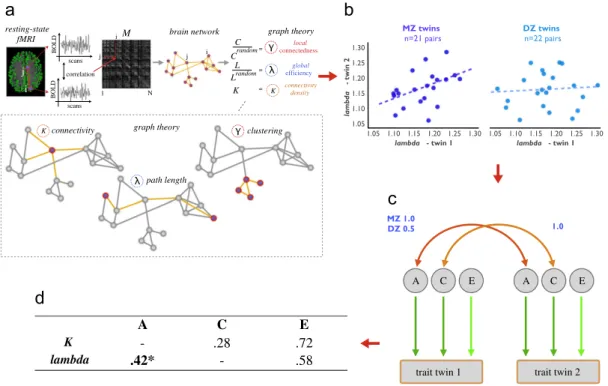
preprocessed and normalized to standard MNI space (Van den Heuvel et al., 2008). The FreeSurfer (http://surfer.nmr.mgh.har vard.edu/) software package was used for gray/white matter segmentation (Fischl et al., 2004). Functional connectivity between brain voxels was computed as the level of correlation between their spontaneous fMRI BOLD signals. For each subject, a binary func tional brain network was reconstructed on the voxel-level, with the network consisting of9000 voxels of gray matter with functional connections between those regions that showed a level of correla tion between their voxel-wise resting-state time-series higher than a set threshold (T4.4) (Figure 1a) (Van den Heuvel et al., 2008;van den Heuvel et al., 2009).
2.3.
Graph theory
Graph theory was used to examine the topology of the functional brain networks (Bullmore and Sporns, 2009; van den Heuvel and Hulshoff Pol, 2010). The level of connectivity was expressed by the number of binary connections K. Global efficiency of brain net-works, estimated by computing the normalized path lengthlambda, was computed as the average number of steps that are needed to travel from one place in the network to any of the other regions (normalized to the path length of a set of 20 random networks with an identical degree sequence). (van den Heuvel et al., 2009). As such, shorter (normalized) path lengths express higher levels of communication efficiency across the network. In addition, connec-tivity density (i.e. the number of binary connections) was exam-ined, together with the normalized clustering-coefficient gamma
computed as the ratio of closed and connected triplets around each node, averaged over all nodes in the network (normalized to the clustering coefficient of a set of random networks). As such, higher
gammavalues express the tendency of nodes in a network to be more locally connected (Bullmore and Sporns, 2009) (Figure 1a). For a mathematical and a more detailed description of these commonly used graph metrics see (van den Heuvel et al., 2009; Van den Heuvel et al., 2008).
2.4.
Genetic analysis
maximum-likelihood estimates of heritability were obtained by genetic structural equation modeling (van Soelen et al., 2012).
3.
Results
Normalized path length
lambda
MZ correlations (expressing
the level of overlap of communication efficiency between
twin pairs) were found to be higher than DZ correlations
(Table 1
and
Figure 1d). Genetic model fitting revealed a
significant heritability of
lambda
(
h
2= 42%,
p
o
.05 CI = (.05–
.73), AE model). Twin resemblance of connectivity density
K
(expressing the level of coherence in number of connections
across twin pairs) was not significantly different between
MZ and DZ pairs, suggesting no significant contributions of
genetic factors to overall brain connectivity. In addition, a
mild influence of common environment on absolute brain
connectivity was found at the trend level (
p
= .06, ns).
Normalized clustering
gamma
(expressing the level of
over-lap in local clustering) was not found to correlate across
twin pairs, suggesting that no significant influence of
genetic or common environment factors to local clustering
could be found.
4.
Discussion
The heritability of functional brain network connectivity
was examined in 12-year old monozygotic and dizygotic twin
pairs using resting-state functional Magnetic Resonance
Imaging. Our network findings suggest a significant
herit-ability of normalized path length
lambda
(
h
2lambda
= .42%),
indicating a significant contribution of brain communication
efficiency at this young age, irrespective of the total
number of brain connections (connectivity density
K
). In
addition, there were no indications of the influence of genes
Mi
N scans
BOLD
scans
BOLD
correlation
i j
brain network
1
j j
global
efficiency
local
connectedness
C Crandom
L Lrandom
K =
=
connectivity density = resting-state
fMRI
i
graph theory connectivity
path length
clustering
K
graph theory
K
trait twin 1
A C E A C E
trait twin 2
A
C
E
K
-
.28
.72
lambda
.42*
-
.58
Figure 1 (a) Individual brain networks were reconstructed as the level of correlation between fMRI time-series between all gray matter voxels. Graph metrics were computed and compared by metrics of a set of comparable random networks (set of 20
networks). (b) Twin correlation oflambda,gammaandKmetrics were computed. (c) Twin modeling; (d) ACE fit results, showing
significant genetic control oflambda.po.05.
Table 1 Estimates of means (SD) and correlations in Mono- and Dizygotic twin pairs.
All twins (N= 86) MZ twins (N= 42) (21 pairs: 9m/12f) DZ twins (N= 44) (22 pairs: 4m/4f/8dos)
Mean (s.d.) Mean (s.d.) rMZ (95% CI) Mean (s.d.) rDZ (95% CI)
Age, years 12.16 (.28) 12.08 (.18) 12.24 (.33)
Lambda 1.17 (.06) 1.17 (.05) .49(.05–.73) 1.17 (.06) .08 ( .31 .44)
K(log transformed) 891.58 (662.30) 812.93 (496.32) 06 ( 45 to .37) 966.66 (787.65) .06 ( .31 to .41)
Gamma 2.70 (1.09) 2.68 (1.08) .20 ( .03 to .59) 2.72 (1.12) .32 ( .04 to .59) n
or common environment on local clustering (as measured by
the normalized clustering coefficient
gamma
). Our findings
thus suggest the existence of a set of genes shaping the
global architecture of functional brain communication,
already early during brain development.
This study supports the notion of a significant heritability
of functional brain connectivity (Smit et al., 2008;
Glahn
et al., 2010;
Fornito et al., 2011). Extending these findings
our study now shows that this heritability is present already
early in childhood. Our findings suggest an influence of
genes on global brain efficiency, but not on the number of
brain connections, which is consistent with a recent study in
adult twins showing genetic effects to be stronger for
cost-efficiency than for other topological metrics (Fornito et al.,
2011). In contrast to the findings in adult twins (.60), our
heritability estimates are considerably lower (.42), possibly
suggesting an increase in genetic control during aging. Both
studies include, however, relative small sample sizes, which
limits the interpretation of this direct comparison.
Combin-ing the findCombin-ings from
Fornito et al. (2011)
with our current
results in a small meta-analysis confirmed the genetic
control of global brain efficiency (
p
o
.05), further
support-ing our current findsupport-ings of genetic control of global brain
efficiency.
Recent advances in brain connectomics have revealed an
efficient small-world and rich-club topology of the human
brain, an organization crucial for healthy brain function
(Bullmore and Sporns, 2009,
2012;
van den Heuvel et al.,
2009,
2012;
Fornito et al., 2011;
van den Heuvel and Sporns,
2011). Our findings now suggest that while the topology of
brain communication appears to be under genetic control,
the connectivity density
—
i.e., the number of functional
connections in the network
—
is mostly influenced by
envir-onmental factors, not directly by genetic factors.
Appar-ently, while in particular the strength of spontaneous
functional brain connectivity appears to be mainly driven
by environment, it is how these functional connections are
organized that is controlled by genetic factors. Our findings
thus suggest the existence of a distinct set of genes already
active in early brain development controlling the underlying
architecture of brain interactions, not pure (functional)
connectivity itself. Rather than controlling specific
func-tional connections between specific brain regions (Glahn
et al., 2010), these genes may control general, in particular
global,
organizational
principles
of
functional
brain
dynamics.
Recent studies have reported aberrant functional and
structural brain network efficiency in brain developmental
disorders, like schizophrenia (Collin et al., 2012;
Lynall
et al., 2010;
van den Heuvel and Kahn, 2011;
Fornito
et al., 2012), as well as in neurodegenerative neurological
diseases, such as Alzheimer’s disease (Supekar et al., 2008;
Buckner et al., 2009;
Stam et al., 2009) and Amyotrophic
Lateral Sclerosis (Verstraete et al., 2011). Reporting on
genetic control of the topology of functional brain efficiency
may therefore aid the search for finding new genetic
biomarkers of disease. Recently, imaging genetics has
become an increasingly popular approach (Tost et al.,
2011) and through candidate gene approaches and
gen-ome-wide association studies (GWAS) several genes are now
suggested to be associated with brain activity (Esslinger
et al., 2009;
Erk et al., 2011). Based on our heritability
estimates it seems to be relevant to search for genes that
are involved in the efficiency of functional brain
connectiv-ity in the human brain.
Some considerations should be taken into account when
interpreting the findings of this study. First, this study was
done in twins that were all 12 year old at the time of the
MRI measurement. Thus, while our study provides accurate
estimates of functional brain connectivity at this age, it
provides no information on younger and older children or
adults, limiting the comparison of heritability estimates to
these groups, in particular adults (Smit et al., 2008;
Fornito
et al., 2011). It does, however, provide estimates of
heritability of brain connectivity without age being a
possible factor of influencing the stability of connectivity
strength (Power et al., 2012), which is a clear advantage of
our selected approach. Second, this study was done at 1.5 T
field strength, which is known to have limited signal to noise
ratios when compared to higher field strengths. More noise
may influence the heritability estimates, which may result
in an overestimation of the contribution of unique
environ-mental factors and lower estimates for influences of genetic
factors. Thus, we cannot excluded that the estimates
reported in the current study representing a conservative
measure and underestimating the actual heritability for
efficiency of functional brain connectivity at the age of 12.
In conclusion, our findings are in support of a significant
influence of the genome on the efficiency of functional
brain connectivity in twins at 12 years of age. Our findings
suggest that the architecture of functional brain
commu-nication is, at least in part, shaped by genes active already
early in brain development.
Role of the funding source
The authors declare that the funding source had no influence on study design, interpretation of the results, neither in writing the manuscript, nor in the decision to submit the manuscript.
Contributors
MP and IS did the experiment and analyzed the data. MP, DB and HE designed the study. MP, IS, CS, RS, DB and HE wrote the manuscript.
Conflict of interest
The authors have no conflict of interest to report.
Acknowledgments
The authors gratefully acknowledge Rachel Brouwer, Caroline van Baal and Jiska Peper for fruitful discussions. MvdH was supported by a Fellowship of the Rudolf Magnus Institute of Neuroscience and by a grant of the Dutch Brain Foundation. HH and DB were supported by grants from the Netherlands Organisation for Scientific Research (NWO 51.02.060, NWO 433-09-220. HH was supported by a High Potential Grant from the University Utrecht (HH).
References
cost-efficient brain functional networks. Proc. Natl. Acad. Sci. U. S. A. 106, 11747–11752.
Boersma, M., Smit, D.J., de Bie, H.M., Van Baal, G.C., Boomsma, D.I., de Geus, E.J., Delemarre van de Waal, H.A., Stam, CJ., 2011. Network analysis of resting state EEG in the developing young brain: structure comes with maturation. Hum Brain Mapp. 32 (3), 413–425. http://dx.doi.org/10.1002/hbm.21030. Boomsma, D.I., de Geus, E.J., Vink, J.M., Stubbe, J.H., Distel, M.A.,
Hottenga, J.J., Posthuma, D., van Beijsterveldt, T.C., Hudziak, J.J., Bartels, M., Willemsen, G., 2006. Netherlands Twin Register: from twins to twin families. Twin Res. Hum. Genet. 9, 849–857. Brans, R.G., van Haren, N.E., van Baal, G.C., Schnack, H.G., Kahn,
R.S., Hulshoff Pol, H.E., 2008. Heritability of changes in brain volume over time in twin pairs discordant for schizophrenia. Arch. Gen. Psychiatry 65, 1259–1268.
Buckner, R.L., Sepulcre, J., Talukdar, T., Krienen, F.M., Liu, H., Hedden, T., Andrews-Hanna, J.R., Sperling, R.A., Johnson, K.A., 2009. Cortical hubs revealed by intrinsic functional connectivity: mapping, assessment of stability, and relation to Alzheimer’s disease. J. Neurosci. 29, 1860–1873.
Bullmore, E., Sporns, O., 2009. Complex brain networks: graph theoretical analysis of structural and functional systems. Nat. Rev. Neurosci. 10, 186–198.
Bullmore, E., Sporns, O., 2012. The economy of brain network organization. Nat. Rev. Neurosci. 13 (5), 336–349.
Collin, G., Hulshoff Pol, H.E., Haijma, S.V., Cahn, W., Kahn, R.S., van den Heuvel, M.P., 2012. Impaired cerebellar functional connectivity in schizophrenia patients and their healthy siblings. Front. Psychiatry 2, 73.
Erk, S., Meyer-Lindenberg, A., Schnell, K., Opitz von Boberfeld, C., Esslinger, C., Kirsch, P., Grimm, O., Arnold, C., Haddad, L., Witt, S.H., Cichon, S., Nothen, M.M., Rietschel, M., Walter, H., 2011. Brain function in carriers of a genome-wide supported bipolar disorder variant. Arch. Gen. Psychiatry 67, 803–811.
Esslinger, C., Walter, H., Kirsch, P., Erk, S., Schnell, K., Arnold, C., Haddad, L., Mier, D., Opitz von Boberfeld, C., Raab, K., Witt, S.H., Rietschel, M., Cichon, S., Meyer-Lindenberg, A., 2009. Neural mechanisms of a genome-wide supported psychosis variant. Science 324, 605.
Fischl, B., van der Kouwe, A., Destrieux, C., Halgren, E., Segonne, F., Salat, D.H., Busa, E., Seidman, L.J., Goldstein, J., Kennedy, D., Caviness, V., Makris, N., Rosen, B., Dale, A.M., 2004. Automatically parcellating the human cerebral cortex. Cereb. Cortex 14, 11–22.
Fornito, A., Zalesky, A., Pantelis, C., Bullmore, E.T., 2012. Schizo-phrenia, neuroimaging and connectomics. Neuroimage (epub ahead of print).
Fornito, A., Zalesky, A., Bassett, D.S., Meunier, D., Ellison-Wright, I., Yucel, M., Wood, S.J., Shaw, K., O’Connor, J., Nertney, D., Mowry, B.J., Pantelis, C., Bullmore, E.T., 2011. Genetic influ-ences on cost-efficient organization of human cortical functional networks. J. Neurosci. 31, 3261–3270.
Glahn, D.C., Winkler, A.M., Kochunov, P., Almasy, L., Duggirala, R., Carless, M.A., Curran, J.C., Olvera, R.L., Laird, A.R., Smith, S.M., Beckmann, C.F., Fox, P.T., Blangero, J., 2010. Genetic control over the resting brain. Proc. Natl. Acad. Sci. U. S. A. 107, 1223–1228. Koten Jr., J.W., Wood, G., Hagoort, P., Goebel, R., Propping, P.,
Willmes, K., Boomsma, D.I., 2009. Genetic contribution to variation in cognitive function: an FMRI study in twins. Science 323, 1737–1740.
Liu, Y., Liang, M., Zhou, Y., He, Y., Hao, Y., Song, M., Yu, C., Liu, H., Liu, Z., Jiang, T., 2008. Disrupted small-world networks in schizophrenia. Brain 131, 945.
Lynall, M.E., Bassett, D.S., Kerwin, R., McKenna, P.J., Kitzbichler, M., Muller, U., Bullmore, E., 2010. Functional connectivity and brain networks in schizophrenia. J. Neurosci. 30, 9477–9487. Peper, J.S., Schnack, H.G., Brouwer, R.M., Van Baal, G.C., Pjetri,
E., Szekely, E., van Leeuwen, M., van den Berg, S.M., Collins, D.L., Evans, A.C., Boomsma, D.I., Kahn, R.S., Hulshoff Pol, H.E., 2009. Heritability of regional and global brain structure at the onset of puberty: a magnetic resonance imaging study in 9-year-old twin pairs. Hum Brain Mapp. 30 (7), 2184–2196.
Power, J.D., Barnes, K.A., Snyder, A.Z., Schlaggar, B.L., Petersen, S.E., 2012. Spurious but systematic correlations in functional connectivity MRI networks arise from subject motion. Neuro-image 59, 2142–2154.
Smit, D.J., Stam, C.J., Posthuma, D., Boomsma, D.I., de Geus, E.J., 2008. Heritability of ‘‘small-world’’ networks in the brain: a graph theoretical analysis of resting-state EEG functional con-nectivity. Hum. Brain Mapp. 29, 1368–1378.
Sporns, O., Tononi, G., Kotter, R., 2005. The human connectome: a structural description of the human brain. PLoS Comput. Biol. 1, e42.
Stam, C.J., de Haan, W., Daffertshofer, A., Jones, B.F., Manshan-den, I., van Cappellen van Walsum, A.M., Montez, T., Verbunt, J.P., de Munck, J.C., van Dijk, B.W., Berendse, H.W., Scheltens, P., 2009. Graph theoretical analysis of magnetoencephalo-graphic functional connectivity in Alzheimer’s disease. Brain 132, 213–224.
Supekar, K., Menon, V., Rubin, D., Musen, M., Greicius, M.D., 2008. Network analysis of intrinsic functional brain connectivity in Alzheimer’s disease. PLoS Comput. Biol. 4, e1000100.
Tost, H., Bilek, E., Meyer-Lindenberg, A., 2011. Brain connectivity in psychiatric imaging genetics. Neuroimage.
van den Heuvel, M.P., Hulshoff Pol, H.E., 2010. Exploring the brain network: a review on resting-state fMRI functional connectivity. Eur. Neuropsychopharmacol. 20, 519–534.
van den Heuvel, M.P., Kahn, R.S., 2011. Abnormal brain wiring as a pathogenetic mechanism in schizophrenia. Biol. Psychiatry 70, 1107–1108.
van den Heuvel, M.P., Sporns, O., 2011. Rich-club organization of the human connectome. J. Neurosci. 31, 11.
van den Heuvel, M.P., Stam, C.J., Boersma, M., Hulshoff Pol, H.E., 2008. Small-world and scale-free organization of voxel based resting-state functional connectivity in the human brain. Neuro-image 43, 11.
van den Heuvel, M.P., Stam, C.J., Kahn, R.S., Hulshoff Pol, H.E., 2009. Efficiency of functional brain networks and intellectual performance. J. Neurosci. 29, 7619–7624.
van den Heuvel, M.P., Mandl, R.C.W., Stam, C.J., Kahn, R.S., Hulshoff Pol, H.E., 2010. Aberrant frontal and temperal network structure in schizophrenia: a graph theoretical analysis. J. Neurosci. 30, 11.
van Soelen, I.L., Brouwer, R.M., van Baal, G.C., Schnack, H.G., Peper, J.S., Collins, D.L., Evans, A.C., Kahn, R.S., Boomsma, D.I., Hulshoff Pol, H.E., 2012. Genetic influences on thinning of the cerebral cortex during development. Neuroimage 59, 3871–3880.
van den Heuvel, M.P., Kahn, R.S., Goni, J., Sporns, O., 2012. A high cost, high capacity backbone for global brain communication. Proc. Natl. Acad. Sci. U.S.A. (Epub ahead of print).