see related editorial on page x
LIVER
INTRODUCTION
Severe alcoholic hepatitis (SAH) presents within a spectrum ranging from decompensated liver disease with jaundice to life-threatening liver failure associated with a signifi cant morbidity
and early mortality that can attain 50–75% ( 1,2 ). It ranks among the most costly diseases during hospitalization ( 3 ). Th us the early detection of high-risk patients, prompt intervention, and accurate prognostic stratifi cation is crucial.
A Day-4 Lille Model Predicts Response to
Corticosteroids and Mortality in Severe Alcoholic
Hepatitis
Mauricio Garcia-Saenz-de-Sicilia , MD 1 , 9 , Chitharanjan Duvoor , MD 2 , Jose Altamirano , MD, MSc 3 , 4 , Roberta Chavez-Araujo , MD 5 , Veronica Prado , MD 4 , 6 , Ana de Lourdes Candolo-Martinelli , MD 6 , Patricia Holanda-Almeida , MD 6 ,
Bernardo Becerra-Martins-de-Oliveira , MD 6 , Simony Fernandez-de-Almeida , MD 6 , Ramón Bataller , MD, PhD 7 , 8 , Juan Caballeria , MD, PhD 4 , 6 and Andres Duarte-Rojo , MD, MSc 1 , 9
OBJECTIVES: Prednisolone therapy increases the risk of infections in patients with severe alcoholic hepatitis (SAH). We evaluated whether the use of the Lille Model at day 4 (LM4) is useful to predict response to prednisolone compared with the classic day 7 (LM7) in order to limit a futile exposure to
corticosteroids.
METHODS: We performed a retrospective analysis of a large multinational cohort of patients with SAH with
Maddrey’s discriminant function (DF) ≥32. Response to corticosteroids was assessed with LM4 and LM7, according to the validated cutoff value (CUV>0.45). Receiver operating characteristics (ROC) curves were constructed to determine the optimal CUV for LM4 and to compare accuracy between LM4, LM7, MELD (Model for End-Stage Liver Disease), and ABIC (age, bilirubin, international normalized ratio, and creatinine). Logistic regression models were constructed to predict 28- and 90-day mortality. Cox regression analysis was performed to assess long-term survival.
RESULTS: A total of 163 (62.7%) out of 260 patients received corticosteroids. The median DF for the patients
treated with corticosteroids was 64.1 (47.9–81.3). Overall 90-day mortality was 35.9%. The median LM4 and LM7 for the patients who received treatment was 0.39 (0.19–0.83) and 0.36 (0.13–0.77). LM4 was a strong independent predictor of 28-day mortality (OR 25.4, (95% confi dence interval (CI) 5.1–126.8), P <0.001). By using LM4 with a CUV>0.45, 28- and 90-day survival was signifi cantly higher for responders (90% and 76%) than non-responders (66% and 40%), P <0.001. Importantly, the area under the ROC curve for predicting mortality for LM4 was similar than the classic LM7 (0.77 vs. 0.75, respectively: P =0.558).
CONCLUSIONS: LM4 is as accurate as LM7 in predicting response to corticosteroids, as well as 28- and 90-day
mortality. Assessing the effi cacy of prednisolone at an earlier time point can avoid a more prolonged futile use of this therapy.
Am J Gastroenterol 2017; 112:306–315; doi: 10.1038/ajg.2016.539 ; published online 6 December 2016
1 Division of Gastroenterology and Hepatology, University of Arkansas for Medical Sciences , Little Rock , Arkansas , USA ; 2 Department of Internal Medicine,
University of Arkansas for Medical Sciences , Little Rock , Arkansas , USA ; 3 Vall d’Hebron Institut de Reserca , São Paulo , Brazil ; 4 Institut d’Investigacions
Biomediques August Pi I Sunyer (IDIBAPS) , São Paulo , Brazil ; 5 Hospital das Clinicas, Faculty of Medicine, University of São Paulo , São Paulo , Brazil ; 6 Liver Unit
Hospital Clinic , Barcelona , Spain ; 7 Division of Gastroenterology and Hepatology, Department of Medicine, University of North Carolina , Chapel Hill , North Carolina ,
USA ; 8 Division of Biochemistry, Department of Nutrition, University of North Carolina , Chapel Hill , North Carolina , USA ; 9 These authors contributed equally to this
work . Correspondence: Mauricio Garcia-Saenz-de-Sicilia, MD, Division of Gastroenterology and Hepatology, University of Arkansas for Medical Sciences , 4301W Markham, Slot #567, Shorey Buidling S8/68 , Little Rock , Arkansas 72205 , USA . E-mail: [email protected]
LIVER
Various prognostic models have been developed with the goal of determining which patients are at high risk of death. Maddrey’s discriminant function (DF) has been the standard surrogate for the assessment of disease severity and to guide treatment in AH. A cutoff value (CUV) ≥32 identifi es subjects with an adverse prognosis, with a mortality of 20–30% during the fi rst month aft er AH onset and up to 40% at 6 months ( 4 ). Other prognostic models that evaluate the severity of the disease at baseline, such as the MELD (Model for end-stage liver disease), ABIC (age, bilirubin, international normalized ratio, and creatinine), and Glasgow alcoholic hepatitis score (GAHS), are all useful tools to determine the patient’s outcome ( 5–7 ). However, the time neces-sary to prognosticate a therapeutic strategy and response is cru-cial in order to avoid damage from intervening too early or too late and to guide therapy in patients at high risks of short-term mortality ( 8 ).
Prednisolone continues to be the mainstay of treatment for patients with SAH, being the only treatment demonstrating mod-est improvement in survival at 28 days ( 9 ). Early improvement in liver function with corticosteroid therapy is strongly associated with a marked decrease in short-term mortality. Th is improvement can be assessed by using the Lille Model (LM), which includes a measurement of response to treatment on day 7 of corticosteroid therapy ( 10 ). Almost 40% of patients with SAH are classifi ed as non-responders to corticosteroids according to the originally vali-dated CUV>0.45, which is associated with a 6-month survival as low as 25% and dictates discontinuation of prednisolone owing to lack of therapeutic benefi t ( 11 ). However, this means that LM assessment requires at least 7 days of high-dose corticosteroids, increasing length of stay and related health-care costs. Also, non-response to corticosteroids is highly predictive of sepsis, and it is tempting to hypothesize that prednisolone treatment further increases the risk of infection ( 2,12 ). Th is indicates the need for a prediction tool that identifi es patients at high risk for complications or mortality at an earlier stage from the start of corticosteroids.
Early identifi cation of response to corticosteroid treatment is utterly important, allowing prediction of a complicated SAH course and survival and avoiding unnecessary treatment that might further aggravate prognosis. Th erefore, we aimed to evaluate LM performance at day 4 (LM4) in comparison with LM at day 7 (LM7) as an earlier predictor of response to cor-ticosteroid therapy and its performance to predict survival in patients with SAH.
METHODS
Th e present study is a retrospective analysis of a multinational cohort of patients admitted with clinically SAH from January 2010 to May 2015 at the University of Arkansas for Medical Sciences (United States); Liver Unit, Hospital Clinic, Barcelona (Spain); and Hospital das Clinicas, Faculty of Medicine Uni-versity of São Paulo (Brazil). Th e study protocol received prior approval from the corresponding Institutional Review Board. All consecutive patients aged >18 years admitted with SAH based
on a (1) DF≥32 (2), recent onset of jaundice (<12 weeks) (3), history of excessive alcohol consumption, and (4) suggestive liver chemistries were included. Data were obtained from the electronic medical records from each participating institution. Subjects without documentation of alcohol consumption of at least 40 g/day of alcohol prior to admission ( 13 ), patients with hepatocellular carcinoma, or other concomitant liver disorders were excluded.
Clinical and biological data
Demographic, clinical and biochemical data were recorded on admission: age, sex, alcohol intake (g/day), body mass index, white blood cell count, creatinine, aminotransferases (alanine aminotransferase and aspartate aminotransferase), bilirubin, albumin, prothrombin time, and international normalized ratio. Biochemical data corresponding to treatment days 4 and 7 in patients receiving corticosteroids were documented as well. Clinical complications present at admission or develop-ing durdevelop-ing hospitalization (hepatic encephalopathy, renal failure on admission, acute kidney injury [AKI] during hospitaliza-tion, bacterial infection or gastrointestinal bleeding [GIB] were recorded. Renal failure on admission was defi ned as a creatinine ≥1.5 mg/dl, as creatinine determination prior to hospitalization was not available in the majority of patients. Development of AKI during hospitalization was defi ned according to the recom-mendations of the International Club of Ascites, and we defi ned systemic infl ammatory response syndrome (SIRS) according to the American College of Chest Physicians ( 14,15 ). We paid spe-cial attention to the treatment received during hospitalization and the fi nal outcome at last follow-up visit available on elec-tronic medical records.
LIVER
Statistical analysis
Th e primary end point of our study was all-cause mortality at 90 days from hospital admission. Long-term survival was considered a secondary end point given the rate of patients expected to be lost during follow-up. Data were described as median (range) for continuous variables and number (%) for discrete variables. Mann–Whitney U -test was used to compare continuous variables, whereas χ 2 or Fisher was used to compare proportions, as appro-priate. Correlation between LM4 and LM7 was assessed with Cohen’s kappa coeffi cient. In patients treated with corticosteroids, baseline characteristics showing a P value <0.2 in 28- and 90-day mortality univariate analyses (or those with biological interest) were entered into backward stepwise multivariable logistic regres-sion models in hierarchized manner to avoid over fi tting. Th e util-ity of LM4 to predict 28-day and 90-day mortalutil-ity was evaluated by calculating the area under the receiver operating characteris-tics curve (AUROC). A model with an AUROC≥0.7 was consid-ered clinically useful, showing at least good accuracy. Sensitivity, specifi city, positive predictive values and negative predictive value of LM4 and LM7 at diff erent CUV were calculated (including CUV from Youden method to maximize accuracy). Th e accuracy of LM4, LM7, MELD, ABIC, and GAHS to predict 28- and 90-day mortality was assessed by comparing AUROCs by the method of Hanley and McNeil. Survival estimations were performed using Kaplan–Meier curves and Cox proportional hazards models for both univariate and multivariable analyses. Patients lost to follow-up were censored at the time of their last visit. In all compari-sons, a two-sided P <0.05 was considered statistically signifi cant. All analyses were performed using STATA version 12 (StataCorp, College Station, TX).
RESULTS
Patient characteristics
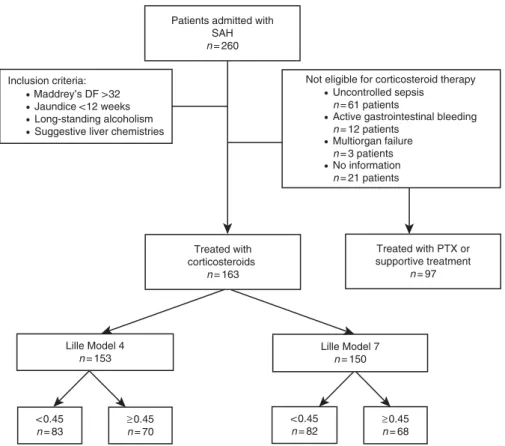
A total of 260 patients with a DF≥32 on admission (43% with biopsy-proven AH) were included, out of which 163 (62.7%) were treated with corticosteroids, whereas the remaining 97 (37.3%) were deemed not optimal candidates for corticosteroid therapy and received pentoxifylline or supportive therapy ( Figure 1 ). Among the patients who did not receive corticosteroids, 63% had uncontrolled sepsis on admission, 12.5% had active GIB, 2.5% presented multiorgan failure, and in 22.5% a clear cause could not be identifi ed. Th e main baseline characteristics, severity scores, and in-hospital complications are shown in Table 1 . Th e median age of the patients treated with corticosteroids was 48 (41–55) years, 67.5% were males, and median body mass index was 26.6 kg/m 2 (23.2–30.1). Apart from patients receiving corticoster-oids being slightly older, reporting less alcohol abuse, and having higher total bilirubin levels, there were no statistical diff erences compared with those who did not. On admission, 45 (36.3%) subjects receiving prednisolone fulfi lled criteria for SIRS, and GIB occurred in 34 (20.9%) during hospitalization, with no dif-ferences when compared with patients not treated with corticos-teroids. Hepatic encephalopathy manifested in 66 (40%) during hospitalization, and it was more frequently seen among patients
receiving corticosteroids. Renal failure on admission was docu-mented in 43 (26.4%) of the patients treated with corticosteroids, and AKI developed in 30/67 (44.8%) more as inpatients, with no diff erences between groups. Regarding severity scores at admis-sion, only DF and ABIC were found to be higher in patients with corticosteroids, with no diff erences in MELD and GAHS when compared with patients without corticosteroids. LM4 and LM7 did not diff er between patients treated or not with corticosteroids.
Predictors of 28- and 90-day mortality
Th e median follow-up for patients treated with corticosteroids was 119 days (25–474), and for patients without corticosteroids it was 60 days (11–416), P =0.01. Overall 90-day mortality was 35.9% for patients receiving corticosteroids and 36.6% for those who did not ( P =0.916). Univariate predictors of 28- and 90-day mortality are summarized in Table 2 . Among all demographic and clinical variables, only hepatic encephalopathy, GIB, and AKI predicted 28-day mortality. Older age, GIB, renal failure on admission and AKI were signifi cantly associated with 90-day mortality. As for biochemical variables, elevated creatinine and international normalized ratio were signifi cantly associated with both 28- and 90-day mortality; whereas elevated white blood cell count and bilirubin were signifi cantly associated with 28- or 90-day morta-lity, respectively. Finally, all of the AH severity scores (including LM4) were associated with 28- and 90-day mortality in patients with SAH treated with corticosteroids.
In the multivariate model, LM4 remained an independent predictor of mortality at 28 days (odds rato (OR) 25.4, (95% confi -dence interval (CI) 5.1–126.8)), P <0.001) and 90 days (OR 16.9, (95% CI 4.5–64.3), P <0.001). Among the remaining variables tested in the univariate analysis, only the presence of GIB (OR 4.7, (95% CI 1.8–13.3), P <0.003) was an independent predictor of mortality at 28 days. GIB (OR 6.3, (95% CI 2.3–17.6), P <0.001) and renal failure on admission (OR 2.5, (95% CI 1.0–6.3), P =0.032) showed to be independent predictors of mortality at 90 days in multivariable analysis.
Performance of LM4 and LM7 in predicting 28- and 90-day mortality
We were able to evaluate LM4 in 153 (94%) and LM7 in 150 (92%) of the patients who received corticosteroids. Th ere were 70 (45.8%) non-responders by LM4 and 68 (45.3%) by LM7. When classifi ed as responders or non-responders according to LM4 and LM7 score >0.45, the 28-day mortality was 8% and 10% among the former and 34% and 32% among the latter, P <0.001. At 90 days, mortality for responders according to LM4 and LM7 was 34% and 35% and for non-responders it was 60% and 58%, P <0.001.
LIVER
(95% CI 0.63–0.85), P =0.406). Notably among 7 patients who were non-responder by day 4 and became responder by day 7, 71% died. On the other hand, of the 6 patients who were respond-ers by day 4 but not by day 7, only 50% died. Operational charac-teristics of LM4 and LM7 to predict 28- and 90-day mortality are shown in Table 4 . Apart from the original CUV of 0.45, we tested a more recently proposed CUV of 0.56 in both LM4 and LM7. Notably, Youden index identifi ed 0.45 as the most accurate CUV, therefore, we kept the original 0.45 cutoff point for the remainder of analyses.
LM4 and LM7 and long-term survival
By using LM4, the 90 days and 1-year survival were signifi cantly higher for responders (<0.45) compared with non-responders (76% and 63% vs. 40% and 32%, P <0.001), for patients receiving corticosteroids, Figure 2a . Also. LM7 showed signifi cantly higher survival for responders at 90 days and 1-year (75 and 60% vs. 42 and 35%, P <0.001), Figure 2b .
On the multivariate Cox regression analysis, response by LM4 (<0.45) was associated with improved survival, with a hazard ratio (HR) 0.33 (95% CI; 0.19–0.56, P <0.001). GIB with an HR 4.3 (95% CI; 2.5–7.7, P <0.001) and renal failure on admis-sion with an HR 1.9 (95% CI; 1.1–3.2, P =0.19) were the only covariables that independently predicted decreased long-term survival.
DISCUSSION
Research interest in AH has gained momentum over the past few years. As SAH has a high mortality in the short term, the rational use of existing therapies or identifi cation of novel ones has become a priority. A recent randomized controlled trial by Th urz et al. ( 9 ) that included 1053 patients with SAH, prednisolone showed only a modest trend toward improved survival at 28 days. Its use might increase fungal and bacterial infections, increasing the mortality risk in subjects with already poor prognosis. In the case of cor-ticosteroids, rules and scores to abide to the primum non nocere principle have taken great relevance. Among the available scores to identify and prognosticate SAH, only the LM proposed by Lou-vet et al. ( 10 ) takes into account the impact of treatment upon patient survival, allowing a timely termination of corticoster-oids with the aim of preventing further complications that could negatively aff ect survival ( 10,19 ). However, calculation of the LM requires availability of biochemical data at day 7 of prednisolone therapy. Our study demonstrates that using LM4 is as accurate as the widespread LM that is currently applied on day 7 (LM7), with an agreement of 91%, and it has the potential of increasing safety through earlier termination of corticosteroids. Moreover, as shown in our AUROC analysis, LM4 can predict 28- and 90-day mortality in SAH patients receiving corticosteroids as accurately as LM7 and any of the other existing prognostic scores (i.e., Maddrey’s DF, MELD, ABIC, and GAHS). Although re-calculation
Patients admitted with SAH
n= 260
Inclusion criteria:
• Maddrey’s DF >32
• Jaundice <12 weeks
• Long-standing alcoholism
• Suggestive liver chemistries
Treated with corticosteroids
n= 163
Treated with PTX or supportive treatment
n= 97
Not eligible for corticosteroid therapy
• Uncontrolled sepsis n= 61 patients
• Active gastrointestinal bleeding n= 12 patients
• Multiorgan failure n= 3 patients
• No information n= 21 patients
Lille Model 7
n= 150 Lille Model 4
n= 153
< 0.45
n= 83
≥0.45
n= 70
< 0.45
n= 82
≥0.45
n= 68
Figure 1 . Flow chart summarizing patient selection from the three participating centers. DF, discriminant function; PTX, pentoxifylline; SAH, severe alco-holic hepatitis.
LIVER
with an intermediate risk of death. In a meta-analysis by Mathurin et al. ( 11 ), patients were classifi ed according to the percentile dis-tribution of their Lille score to avoid an arbitrary cutoff , identify-ing three patterns of response (complete, intermediate, and null) with signifi cant diff erences in the risk of death. Results suggested that corticosteroids could positively impact survival in patients with complete (LM≤0.16) and intermediate response (LM>0.16– <0.56), although novel therapies might bring further benefi t to the latter group. In contrast, null responders (LM≥0.56) have no benefi t from corticosteroids and may be considered for liver transplantation in highly selected cases, depending on age, of MELD and Maddrey’s DF at day 7 were reported to have good
predictive accuracies (AUROCs>0.80) ( 20 ), their dynamic evolu-tion (Δ MELD and Δ DF) has been reported to have less prognos-tic power in comparison to LM7 and have not been validated as tools permitting early stopping of corticosteroids ( 10 ). Th erefore, earlier application of LM would spare 3 days of corticosteroids to patients with an LM4>0.45, potentially increasing safety and decreasing health-care costs and allowing considering these sub-jects for alternative treatments, where available.
It has been proposed that the use of a single cutoff point in LM might be too restrictive and will not allow identifi cation of subjects
Table 1 . Demographic and baseline characteristics
Variables Total cohort, n =260 Corticosteroids, n =163 Without corticosteroids, n =97 P value
Age (years) a 47 (40–55) 48 (41–55) 45 (35–51.5) 0.03
Gender, male b 184 (70.7) 110 (68) 74 (76.3) 0.131
BMI (kg/m 2 ) a 26.7 (24–30.1) 26.6 (23.2–30.1) 27.3 (25–30.1) 0.39
EtOH consumption (g/day) a 120 (100–180) 100 (90–165.7) 150 (100–308) 0.024
SIRS b 90 (41.1) 45 (36.3) 45 (47.4) 0.099
Follow-up days a 95 (19–435) 119 (25–474) 60 (11–416) 0.106
90-Day mortality a 90 (36.1) 56 (35.9) 34 (36.6) 0.916
Biochemical features a
WBC (K/μ l) 9.88 (6.42–14.67) 9.76 (6.7–14.5) 10.0 (5.9–14.98) 0.917
Platelets (K/μ l) 110 (77–177) 107 (77–163) 128 (77.5–189) 0.218
PT (s) 20.6 (17.6–24.7) 21.2 (18.8–26) 20.4 (17–24.1) 0.123
INR 1.76 (1.5–2.19) 1.78 (1.56–2.16) 1.7 (1.4–2.2) 0.131
Creatinine (mg/dl) 0.92 (0.7–1.79) 0.9 (0.69–1.6) 1.0 (0.7–1.98) 0.126
Bilirubin (mg/dl) 15.1 (7.7–25.7) 19.5 (9.9–27.1) 11.2 (5.6–21.3) 0.002
AST (IU/l) 152 (103–222) 146 (105–207) 172 (97.5–248) 0.207
ALT (IU/l) 49.5 (34–77) 51 (35–75) 48 (30–79) 0.839
Albumin (g/dl) 2.5 (2.1–3.0) 2.5 (2.2–3.0) 2.6 (2.0–3.0) 0.678
Complications b
Hepatic encephalopathy 124 (47.5) 66 (40.5) 58 (59.8) 0.003
Gastrointestinal bleeding 62 (23.9) 34 (20.9) 28 (28.9) 0.143
Severity scores a
Maddrey’s DF 54.4 (42.7–78.7) 64.1 (47.9–81.3) 55 (35.4–74.9) 0.011
MELD 22.9 (18.6–29.4) 22.7 (18.8–29.3) 23.5 (18–30.3) 0.885
ABIC 7.92 (6.9–9.08) 8.02 (7.1–9.12) 7.43 (6.42–8.96) 0.016
GAHS 9 (8–10) 9 (8–10) 9 (8–10) 0.203
Lille Model 4 0.41 (0.19–0.85) 0.39 (0.19–0.83) 0.69 (0.17–0.91) 0.318
Lille Model 7 0.37 (0.12–0.77) 0.36 (0.13–0.77) 0.44 (0.11–0.87) 0.98
ABIC, age, bilirubin, international normalized ratio and creatinine; ALT, alanine aminotransferase; AST, aspartate aminotransferase; BMI, body mass index; DF, discrimi-nant function; EtOH, alcohol; GAHS, Glasgow alcoholic hepatitis score; INR, international normalized ratio; MELD, model for end-stage liver disease; PT, prothrombin time; SIRS, Systemic infl ammatory response syndrome; WBC, white blood cell count.
a Data are presented as median and interquartile range 25–75.
LIVER
comorbidities, and addiction/social profi le ( 21–23 ). However, liver transplantation for patients with SAH is still controversial and, consequently, still far from gaining universal acceptance. In our study using the CUV>0.56 to defi ne response showed an inferior agreement at 84% (κ =0.68, P <0.001) between LM4 and LM7. Such increase in the CUV did not translate into improved performance when compared with the standard 0.45 CUV, and it actually coin-cided with the CUV statistically obtained to maximize sensitivity and specifi city. Th us our results support the use of 0.45 as the only CUV when applying LM4; however, it is not sensitive enough to identify subjects with SAH who will be in need for liver transplan-tation.
Patients with SAH developing infections have a higher mor-tality, and this has also been proven to be true among those treated with corticosteroids ( 12 ). Louvet et al. ( 2 ) demon-strated that the probability of infection was lower in respond-ers (LM<0.45) than in no respondrespond-ers (LM>0.45): 11% vs. 43%, with a median time for infection development of 14 days. Th is suggests that earlier discontinuation of corticosteroids might contribute to improved outcomes in non-responders by limit-ing immunosuppression exposure. Although infections durlimit-ing index hospitalization and the presence of SIRS on admission were signifi cant predictors of 90-day mortality in our uni-variate analysis, they were not independent risk factors in the
Table 2 . Univariate analysis on predictors of 28- and 90-day mortality in patients treated with corticosteroids
Variable 28-Day status P value 90-Day status P value
Alive Death Alive Death
Age (years) a 47 (39–53) 50 (46–56) 0.07 46 (39–52) 49 (42–56) 0.031
Gender, male b 84 (70) 20 (67) 0.72 70 (65.4) 37 (34.6) 0.612
BMI (kg/m 2 ) a 26 (23.2–30.1) 27.3 (25–29.4) 0.34 26.1 (23.2–30) 27.5 (24.9–32.3) 0.144
SIRS b 36 (36) 7 (46) 0.44 13 (30.9) 29 (69) 0.325
Hepatic encepha-lopathy b
38 (32) 18 (60) 0.004 27 (44.3) 34 (55.7) 0.081
Gastrointestinal bleeding b
18 (15) 12 (40) 0.002 11 (33.3) 22 (66.7) <0.001
Renal failure b 20 (17) 18 (60) <0.001 15 (15) 23 (41.1) <0.001
AKI b 20 (39) 7 (70) 0.07 13 (43.3) 17 (56.7) 0.030
Biochemical features a
WBC (K/μ l) 9.4 (6.3–13.9) 13.0 (8.4–17.9) 0.003 9.2 (6.1–14.0) 11.0 (7.7–15.4) 0.215
Platelets (K/μ l) 111 (77–183) 124 (82–192) 0.263 109 (77–175) 112 (78–182) 0.803
INR 1.7 (1.5–2.0) 2.0 (1.6–2.5) 0.004 1.7 (1.5–1.9) 1.9 (1.6–2.5) 0.002
Creatinine (mg/dl) 0.9 (0.7–1.3) 1.8 (0.9–3.7) <0.001 0.8 (0.6–1.2) 1.4 (0.8–3.0) 0.003
Bilirubin (mg/dl) 13.9 (7.3–21.8) 22.5 (10.0–30.1) 0.08 12.7 (6.0–19.7) 22.5 (10.0–30.0) 0.045
AST (IU/l) 153 (107–208) 147 (99–234) 0.155 160 (110–216) 145 (96–241) 0.058
ALT (IU/l) 48 (34–69) 60 (38–92) 0.140 48 (32–70) 55 (36–83) 0.635
Albumin (g/dl) 2.6 (2.2–3.0) 2.5 (2.0–2.8) 0.736 2.6 (2.3–3.0) 2.3 (2.0–2.8) 0.082
Severity scores a
Maddrey’s DF 53 (39–68) 75 (58–98) 0.002 52.8 (37.6–67) 77 (55.4–108) <0.001
MELD 22 (18–25) 33 (25–40) <0.001 21.6 (17.5–24.7) 29.2 (21–37) <0.001
ABIC 7.6 (6.7–8.5) 9.6 (8.2–10.9) <0.001 7.36 (6.56–8.37) 8.74 (7.81–10–1) <0.001
GAHS 8 (8–10) 10 (8–11) 0.01 8 (7–10) 10 (9–10) 0.003
Lille Model 4 0.36 (0.15–0.72) 0.89 (0.52–0.96) <0.001 0.28 (0.13–0.65) 0.80 (0.39–0.95) <0.001
Lille Model 7 0.30 (0.09–0.62) 0.89 (0.37–0.98) <0.001 0.21 (0.08–0.59) 0.75 (0.35–0.97) <0.001
ABIC, age, bilirubin, international normalized ratio and creatinine; AKI, acute kidney injury; ALT, alanine aminotransferase; AST, aspartate aminotransferase; BMI, body mass index; DF, discriminant function; GAHS, Glasgow alcoholic hepatitis score; INR, international normalized ratio; MELD, model for end-stage liver disease; SIRS, Systemic infl ammatory response syndrome; WBC, white blood cell count.
a Data are presented as median and interquartile range 25–75.
LIVER
initially excluded owing to higher rate of complications (renal failure and infections) and mortality. However, this was mainly based on the lack of eff ective therapies for GIB. Much has changed since the initial trials, now we have eff ective treatment for most cases of upper GIB, including endoscopic band liga-tion or transjugular intrahepatic porto-systemic shunt ( 26,27 ). However, the characteristics and outcomes of patients with GIB and SAH have not been well described. Rudler et al. ( 12 ) con-ducted a retrospective analysis of 105 patients of which 47 were admitted with SAH and GIB and compared with 58 with SAH without GIB. Survival was not signifi cantly diff erent (73.9% and 69.9%), and interestingly, subjects with GIB were less prone to develop infections. Development of infection aft er starting cor-ticosteroids, LM>0.45, and high MELD score were independent risk factors of poor survival ( 12 ). Th e diagnosis of SAH might have been overestimated in that study as DF is not a diagnostic tool and liver biopsy fi ndings are not specifi c. In our study, GIB was an independent risk factor for 28- and 90-day mortality and long-term survival together with response by day 4 as assessed by LM4. We did not diff erentiate between GIB present on multivariable analysis. Louvet et al. ( 2 ) had similar fi ndings
when prospectively evaluating 254 subjects with SAH, where at fi rst glance, infection was considered a major factor contribut-ing to death, but it ended up not becontribut-ing an independent prognos-tic factor, as early response to therapy was more important for predicting both survival and infection. As part of the standard of care in all patients with SAH, we routinely obtain blood and urine (±ascitic fl uid) cultures, provide prophylactic antibiotics during bleeding, and have a low threshold to start antibiotics when early clinical signs of infection are noted (i.e., pathologi-cal urinalysis). Variations in the infections surveillance protocol during and aft er index admission among centers, as well as the lack of SIRS data during hospitalization, in our sample might explain discordant results.
European Association for the Study of Liver and American Association for the Study of Liver Disease guidelines specify that patients with SAH and recent episode of upper GIB or renal fail-ure are not ideal candidates for prednisolone treatment ( 24,25 ). Th e reason for excluding patients with recent GIB is based on clinical trials performed in 1970s and 1980s where they were
Table 3 . Accuracy of severity scores to predict 28- and 90-day mortality
Variable 28-Day mortality 90-Day mortality
AUROC 95% CI P value a AUROC 95% CI P value a
Lille Model 4 0.77 0.66–0.88 0.406 0.77 0.69–0.84 0.706
Lille Model 7 0.74 0.63–0.85 0.75 0.67–0.84
Maddrey’s DF 0.80 0.64–0.96 0.649 0.79 0.66–0.92 0.769
ABIC 0.80 0.72–0.89 0.307 0.73 0.67–0.80 0.51
MELD 0.76 0.65–0.88 0.863 0.67 0.57–0.77 0.106
GAHS 0.75 0.58–0.92 0.232 0.72 0.61–0.81 0.227
ABIC, age, bilirubin, international normalized ratio and creatinine; AUROC, area under receiver operational curve; CI, confi dence interval; DF, discriminant function; GAHS, Glasgow alcoholic hepatitis score; MELD, model for end-stage liver disease.
a Represents comparison of LM4 with the other severity scores.
Table 4 . Operational characteristics of Lille Model at days 4 and 7
Variable Time CUV Sensitivity Specifi city PPV NPV
Lille Model 4 28 days >0.45 79% 63% 34% 92%
>0.56 71% 67% 33% 90%
Lille Model 7 >0.45 71% 62% 32% 90%
>0.56 64% 68% 33% 88%
Lille Model 4 90 days >0.45 70% 69% 56% 80%
>0.56 60% 60% 72% 76%
Lille Model 7 >0.45 65% 68% 53% 78%
>0.56 55% 29% 53% 74%
LIVER
admission or during hospitalization. Th ese might suggest that the presence of GIB on admission as long as patients receive adequate treatment should not be contraindication for steroid therapy, and measures should be taken to prevent the develop-ment of GIB during hospitalization.
Presence of SIRS on admission has been shown in previous reports to be a major predictor of multiorgan failure and death in AH ( 28 ). Infections during hospitalization, especially aft er starting treatment with corticosteroids, but not on admission, are associated with higher mortality ( 2,28 ). Development of nosoco-mial infections is also associated with AKI and reduced survival; hence, the earlier application of LM will allow less exposure to corticosteroids in already high-risk population. Renal failure and
development of AKI has been linked to infections and to reduced survival in SAH ( 29 ). In our study, SIRS and infections were not associated directly with 90-day mortality. Th is might be in rela-tion to the retrospective nature of the design. However, we dem-onstrated that the presence of renal failure on admission was an independent risk factor associated with increased 90-day mortal-ity. In the present study, AKI was also a predictor of short-term mortality; however, it was not independently associated in the multivariable analysis owing to the small number of subjects with available information.
Th e present study has some limitations, including its retro-spective nature. Only 95 (58%) of the patients treated with cor-ticosteroids had a confi rmatory liver biopsy. However, our study
1.00
0.75
0.50
Sur
viv
al probability
0.25
LM4<0.45
Lille Model day 4
Lille Model day 4
P<0.001
LM4≥ 0.45
0.00
0 100 200 300 400
Number at risk LM4<0.45 = 0
LM4≥0.45 = 1 68
81
26
Time in days
1.00
0.75
0.50
Sur
viv
al probability
0.25
LM7<0.45
P<0.001
LM7≥ 0.45
0.00
0 100 200 300 400
Time in days
53
17
45
14
36 30
12
Number at risk LM7<0.45 = 0
LM7≥ 0.45 = 1 66
81
25
54
16
45
13
36 31
12
a
b
LIVER
Study Highlights
WHAT IS CURRENT KNOWLEDGE
✓
Severe alcoholic hepatitis is associated with signifi cant morbidity and early mortality that can attain 50–75%.✓
Early improvement in liver function with corticosteroidtherapy is associated with a decrease in short-term mortality.
✓
Response to corticosteroid therapy is determined by Lille Model on day 7.✓
Up to 40% of patients with alcoholic hepatitis are non-responders, increasing risk of infections with a 6-month survival as low as 25%.
WHAT IS NEW HERE
✓
Lille Model on day 4 is as good as Lille Model on day 7 to predict response to corticosteroids in patients with severe alcoholic hepatitis.✓
Lille Model on day 4 is an independent predictor of 28- and 90-day mortality.✓
Calculation of Lille Model on day 4 will allow decreased exposure to corticosteroids in non-responders.✓
This novel strategy might decrease risk of nosocomial infec-tions and health-care costs in severe alcoholic hepatitis.REFERENCES
1. Mathurin P , Lucey MR . Management of alcoholic hepatitis . J Hepatol 2012 ; 56 Suppl 1 : S39 – S45 .
2. Louvet A , Wartel F , Castel H et al. Infection in patients with severe alco-holic hepatitis treated with steroids: early response to therapy is the key factor . Gastroenterology 2009 ; 137 : 541 – 8 .
3. Liangpunsakul S . Clinical characteristics and mortality of hospitalized alcoholic hepatitis patients in the United States . J Clin Gastroenterol 2011 ; 45 : 714 – 9 .
4. Maddrey WC , Boitnott JK , Bedine MS et al. Corticosteroid therapy of alcoholic hepatitis . Gastroenterology 1978 ; 75 : 193 – 9 .
5. Dominguez M , Rincon D , Abraldes JG et al. A new scoring system for prognostic stratifi cation of patients with alcoholic hepatitis . Am J Gastro-enterol 2008 ; 103 : 2747 – 56 .
6. Dunn W , Jamil LH , Brown LS et al. MELD accurately predicts mortality in patients with alcoholic hepatitis . Hepatology 2005 ; 41 : 353 – 8 .
7. Forrest EH , Evans CD , Stewart S et al. Analysis of factors predictive of mortality in alcoholic hepatitis and derivation and validation of the Glasgow alcoholic hepatitis score . Gut 2005 ; 54 : 1174 – 9 .
8. Louvet A , Labreuche J , Artru F et al. Combining data from liver disease scoring systems better predicts outcomes of patients with alcoholic hepatitis . Gastroenterology 2015 ; 149 : 398.e8 – 406.e8 , quiz e16–e17 . 9. Th ursz MR , Richardson P , Allison M et al. Prednisolone or pentoxifylline
for alcoholic hepatitis . N Engl J Med 2015 ; 372 : 1619 – 28 .
10. Louvet A , Naveau S , Abdelnour M et al. Th e Lille model: a new tool for therapeutic strategy in patients with severe alcoholic hepatitis treated with steroids . Hepatology 2007 ; 45 : 1348 – 54 .
11. Mathurin P , O'Grady J , Carithers RL et al. Corticosteroids improve short-term survival in patients with severe alcoholic hepatitis: meta-analysis of individual patient data . Gut 2011 ; 60 : 255 – 60 .
12. Rudler M , Mouri S , Charlotte F et al. Prognosis of treated severe alcoholic hepatitis in patients with gastrointestinal bleeding . J Hepatol 2015 ; 62 : 816 – 21 .
13. Crabb DW , Bataller R , Chalasani NP et al. Standard defi nitions and com-mon data elements for clinical trials in patients with alcoholic hepatitis: recommendation from the NIAAA Alcoholic Hepatitis Consortia . Gastroenterology 2016 ; 150 : 785 – 90 .
14. Angeli P , Gines P , Wong F et al. Diagnosis and management of acute kidney injury in patients with cirrhosis: revised consensus recommendations of the International Club of Ascites . J Hepatol 2015 ; 62 : 968 – 74 .
represents a multinational cohort refl ecting the experience of three referral centers. Given the few patients who responded between day 4 and 7, we were not able to prove that patients with an earlier response show further improvement in their prog-nosis. Our results need to be further investigated and validated prospectively.
Discovering an accurate biomarker capable of identifying high-risk patients who will fail to respond to corticosteroids is of utter importance. In the absence of such a biomarker, opti-mizing the use of current available predictive models is a pri-ority in SAH. Our results showed that LM4 is as good as LM7 to determine response to corticosteroids and for prediction of 28- and 90-day mortality in patients with SAH. Th e use of LM4 instead of LM7 has various benefi ts: it would decrease exposure to corticosteroids, and spare up to 3 days of hospitalization in clinically stable patients. Th ese benefi ts should translate into a decreased risk for infections, particularly nosocomial infections, and indirectly improve outcomes in this population. Without a doubt, this strategy would save costs to health-care systems worldwide. However, prospective studies systematically study-ing the frequency and type of infections in patients with early dismissal from hospital aft er LM4 are needed, in parallel with a cost-eff ectiveness analysis.
ACKNOWLEDGMENTS
J. Altamirano wishes to express his gratitude to the Mexican National Council of Science and Technology (CONACyT, Mexico City, Mexico) for partially supporting his predoctoral stay at IDIBAPS.
CONFLICT OF INTEREST
Guarantor of the article : Mauricio Garcia-Saenz-de-Sicilia, MD.
Specifi c author contributions : Mauricio Garcia-Saenz-de-Sicilia: conception and design of the study, analysis and interpretation of the data, draft ing, critical review, and fi nal approval of the manuscript; Chitharanjan Duvoor: data collection and assem-bly and contributed with critical reviews to the manuscript; Jose Altamirano: data collection and assembly, interpretation of the data, contributed with draft ing and critical review of the manuscript, and fi nal approval; Veronica Prado, Roberta Chavez-Araujo, Ana de L. Candolo-Martinelli, Patricia Holanda-Almeida, Bernardo Becerra-Martins-de-Oliveira, and Simony Fernandez-de-Almeida: data collection and assembly of the data. Juan Caballeria and Ramon Bataller: interpretation of the data, draft ing and critical review of the manuscript for fi nal approval; Andres Duarte-Rojo: conception and design of the study, analysis and interpretation of the data, and draft ing and critical review of the manuscript for fi nal approval.
Financial support : Th is work was partially supported by the Univer-sity of Arkansas for Medical Sciences College of Medicine Clinician Scientist Program and by the National Institute on Alcohol Abuse and Alcoholism (NIAAA) (1U01AA021908-01).
Potential competing interests : MGSdS received research support
from Vital Th erapies; ADR received research support from Vital
Th erapies and research support and consulting fees from Gilead
LIVER
15. Bone RC , Balk RA , Cerra FB et al. Defi nitions for sepsis and organ failure and guidelines for the use of innovative therapies in sepsis. Th e ACCP/ SCCM Consensus Conference Committee. American College of Chest Physicians/Society of Critical Care Medicine . Chest 1992 ; 101 : 1644 – 55 . 16. Bedossa P , Poynard T , Naveau S et al. Observer variation in assessment
of liver biopsies of alcoholic patients . Alcohol Clin Exp Res 1988 ; 12 : 173 – 8 .
17. Altamirano J , Miquel R , Katoonizadeh A et al. A histologic scoring system for prognosis of patients with alcoholic hepatitis . Gastroenterology 2014 ; 146 : 1231 – 1239 ; e1231–e1236 .
18. Ramond MJ , Poynard T , Rueff B et al. A randomized trial of prednisolone in patients with severe alcoholic hepatitis . N Engl J Med 1992 ; 326 : 507 – 12 . 19. Mathurin P . Th erapeutic management of alcoholic hepatitis . Clin Res
Hepatol Gastroenterol 2015 ; 39(Suppl 1) : S41 – S45 .
20. Papastergiou V , Tsochatzis EA , Pieri G et al. Nine scoring models for short-term mortality in alcoholic hepatitis: cross-validation in a biopsy-proven cohort . Aliment Pharmacol Th er 2014 ; 39 : 721 – 32 .
21. Dureja P , Lucey MR . Th e place of liver transplantation in the treatment of severe alcoholic hepatitis . J Hepatol 2010 ; 52 : 759 – 64 .
22. Mathurin P , Moreno C , Samuel D et al. Early liver transplantation for severe alcoholic hepatitis . N Engl J Med 2011 ; 365 : 1790 – 800 .
23. Lee BP , Chen PH , Haugen C et al. Th ree-year results of a pilot program in early liver transplantation for severe alcoholic hepatitis . Ann Surg 2016 ; e-pub ahead of print .
24. European Association for the Study of Liver . EASL clinical practical guide-lines: management of alcoholic liver disease . J Hepatol 2012 ; 57 : 399 – 420 . 25. O'Shea RS , Dasarathy S , McCullough AJ et al. Alcoholic liver disease .
Hepatology 2010 ; 51 : 307 – 28 .
26. O'Brien J , Triantos C , Burroughs AK . Management of varices in patients with cirrhosis . Nat Rev Gastroenterol Hepatol 2013 ; 10 : 402 – 12 .
27. Garcia-Pagan JC , Caca K , Bureau C et al. Early use of TIPS in patients with cirrhosis and variceal bleeding . N Engl J Med 2010 ; 362 : 2370 – 9 .
28. Michelena J , Altamirano J , Abraldes JG et al. Systemic infl ammatory response and serum lipopolysaccharide levels predict multiple organ failure and death in alcoholic hepatitis . Hepatology 2015 ; 62 : 762 – 72 .
29. Altamirano J , Fagundes C , Dominguez M et al. Acute kidney injury is an early predictor of mortality for patients with alcoholic hepatitis . Clin Gastroenterol Hepatol 2012 ; 10 : 65.e3 – 71.e3 .