Automated Surveillance of Surgical Site Infections in a VA Hospital Matthew M Churpek
Abstract
Title: Automated Surveillance of Surgical-Site Infections at a Veteran's Affairs Hospital
Background: Surgical site infections (SSis) account for approximately 17% of hospital-acquired infections. These infections result in an increase in emergency room visits, outpatient visits, radiology services, home health aide services, and readmissions adding an estimated $1 billion-! 0 billion in indirect and direct medical costs each year. The CDC and the Surgical Infection Society recommend routine surveillance as a method for decreasing the rates of these infections. By monitoring SSI rates, areas of improvement can be identified and interventions can be made to reduce the incidence of SSis in the hospital. Reductions of up to 35% have been documented with the implementation of SSI surveillance
programs. Current methods of surveillance in the VA are only partially automated and are labor intensive. Automated methods of surveillance using electronic medical records have been proposed to decrease the resources involved in SSI monitoring. The VA is well-suited for this with their extensive medical records database and relatively closed system of patients.
Purpose: To construct an automated SSI surveillance system using electronic patient medical record data and validate this system by comparing its performance to the current surveillance method used at the Durham VA hospital.
Methods: In this project, we modified the methods previously described by Richard Platt to create an automated SSI surveillance system at the VA hospital in Durham, North Carolina. We used ICD-9 codes, vital signs, microbiology data, consult orders, and pharmacy records sensitive and specific for SSis to identify patients with potential infections. Logistic regression was used to create predictive models for SSis of different severity. This system was validated by comparing its performance to that of the current manual record review performed by the infection control department in the hospital on patients who underwent surgery at the Durham VA hospital from May 1 '', 2002 to Apri1301h, 2004. All
surgical-site infections met the criteria set forth by the National Nosocomial Infections Surveillance (NNlS) report. The system was evaluated using the framework set forth by the CDC Working Group for public health surveillance systems
Results: SSis occurred in 195 of7340 surgeries conducted in the study period (2.7% attack rate). Of these, 91 were superficial SSis, 45 were deep SSis, and 59 were organ/space SSis. Logistic regression models using data found to be
strongly correlated with SSI diagnoses had a sensitivity and specificity of 90.9% and 61.2% for all types ofSSis, 89.2% and 74.2% for severe SSis (deep and organ/space) and 89.5% and 74.0% for organ/space SSis, respectively.
L
Conclusions: This study demonstrates that an automated SSI surveillance system with reasonable sensitivity and specificity can be created by using data from electronic medical records. Such a system can drastically reduce the amount of labor necessary for SSI monitoring and increase the speed these complications are detected. The information technology used at the Durham VA hospital is similar to that used in other VA hospitals, so this system can be exported to other
hospitals throughout the country.
' [
Background
Surgical site infections (SSis) account for approximately 17%
ofhospital-acquired infections [1]. These infections result in an increase in emergency room
visits, outpatient visits, radiology services, home health aide services, and
readmissions [2]. The Centers for Disease Control and Prevention (CDC)
estimates that approximately 500,000 SSis occur annually in the United States
with an estimated $1 billion-$1 0 billion in indirect and direct medical costs each
year [3, 4]. The CDC and the Surgical Infection Society recommend routine
surveillance as a method for decreasing the rates of these infections. By
monitoring SSI rates, areas of improvement can be identified and interventions
can be targeted. Reductions of up to 35% have been documented with the
I
'
implementation ofSSI surveillance programs [5, 6]. The cost of surveillance has
been estimated to be only 20% of the cost of treating preventable infections.
Therefore, creating an efficient and accurate method of SSI surveillance should be
highly cost-effective [7, 8].
As the number of days surgical patients remain in the hospital decreases and the
proportion of surgeries done on an outpatient basis increases, SSis are more often
occurring after discharge from the hospital. Between 47% and 84% ofSSis occur
after discharge from the hospital, and most of these are treated on an outpatient
basis [2, 9]. Outpatient presentations complicate surveillance of SSis, as patients
to overcome this obstacle such as patient questionnaires have been shown to have poor sensitivity (15%-30%) and are also labor intensive [2].
Because of the enormous costs and patient morbidity associated with SSis, the development of an effective surveillance system is essential. The system needs to be sensitive enough to identity SSis occurring both in and out of the hospital in a timely manner without requiring increased work for hospital infection control teams. The system should also be specific in identifYing infections that meet a strict definition of a SSI, such as that proposed by the National Nosocomial Infections Surveillance System (NNIS). A baseline rate of infection would be established, and the system should be able to pick up differences in SSI rates so that proper actions can be undertaken in response to an increase in event rate [10].
Current methods of surveillance, such as patient and surgeon questionnaires, are time-consuming and often lack the sensitivity, specificity, or timeliness necessary to have a significant impact on SSI rates [I 0]. Other methods include the labor-intensive review of individual full-text patient records. Although risk of SSI for a particular patient can be estimated using the Anesthesia Society of America (ASA) score, [11, 12] a comprehensive SSI surveillance program should monitor all patients regardless of risk score. There is therefore a need for a sensitive method of SSI surveillance that is less labor intensive than conventional methods, and more timely than methods such as patient questionnaires.
Automated methods of surveillance have been proposed to decrease the resources
involved in SSI monitoring. For example, Richard Platt and colleagues at
Harvard Pilgrim Healthcare monitored pharmacy dispensing data for certain
antibiotics, SSI-related ICD-9 codes assigned at discharge, and CPT codes
specific for wound infection care to identify patients with SSis [10,13]. They
created an accurate SSI surveillance system to detect SSis in their institution.
The Veteran's Affairs hospital system has an electronic record system that is
conducive to the development and enhancement of automated SSI surveillance.
Patient records including inpatient visits, outpatient visits, pharmacy records, vital
signs, urgent care visits, and phone calls made to the network are entered and
retained electronically. As veterans are mostly or fully covered by this medical
plan, they are likely to seek their inpatient, outpatient, and antibiotic care within
the network. Also, all veteran's hospitals are linked by a common computer
system, therefore, patients that travel to different areas of the state or even country
can potentially be monitored by an effective automated surveillance system. This
would also allow a system developed at one VA hospital to be used by all VA
hospitals in the country. Potentially all veterans that undergo surgery at a
Veteran's Affairs hospital could then be monitored for a SSI.
Purpose
North Carolina. We validated this system by comparing its performance to that of the current manual record review performed by the infection control department in the hospital on a sample of surgical patients. Successful implementation of this system will increase the quality of care received by patients and will decrease medical costs by reducing the number of SSI cases in this hospital. This system can be implemented in other VA hospitals throughout the country.
Methods
Study Population
The study population consisted of all patients who underwent a surgical procedure between May 1 '1, 2002 and April301\ 2004 at the VA medical center in Durham, North Carolina (DV AMC). CPT codes for surgical procedures were used to identify these patients, as these codes are entered into an electronic database for every surgical procedure done in the hospital (see Appendix 1).
Database management and privacy assurances
The names and social security numbers of the patients were kept confidential, and this data was only used for quality control purposes as a measure of the SSI
incidence in the hospital. IRB approval was obtained (ID #00877) for this project.
Case definitions [1]
Criteria for defining a surgical site infection
Infection occurs within 30 days after the operation and involves only skin or subcutaneous tissue of the incision and at least one of the following:
1. Purulent drainage, with or without laboratory confirmation, from the superficial
mClSlOn.
2. Organisms isolated from an aseptically obtained culture of fluid or tissue from the superficial incision.
3. At least one of the following signs or symptoms of infection: pain or tenderness, localized swelling, redness, or heat and superficial incision is deliberately opened by surgeon, unless site is culture-negative.
4. Diagnosis of superficial incisional SSI by the surgeon or attending physician. Do not report the following conditions as SSI:
1. Stitch abscess (minimal intimation and discharge confined to the points of suture penetration).
2. Infection of an episiotomy or newborn circumcision site. (relevance) 3. Infected bum wound.
4. Incisional SSI that extends into the fascial and muscle layers (see deep incisional SSI).
Note: Specific criteria are used for identifying infected episiotomy and
circumcision sites and burn wounds.
Deep Incisional SSI
operation and infection involves deep soft tissues (e.g., fascial and muscle layers) of the incision and at least one of the following:
1. Purulent drainage from the deep incision but not from the organ/space component ofthe surgical site.
2. A deep incision spontaneously dehisces or is deliberately opened by a surgeon when the patient has at least one of the following signs or symptoms: fever (>38°C), localized pain, or tenderness, unless site is culture-negative.
3. An abscess or other evidence of infection involving the deep incision is found on direct examination, during reoperation, or by histopathologic or radiologic examination.
4. Diagnosis of a deep incisional SSI by a surgeon or attending physician. Notes:
I. An infection that involves both superficial and deep incision sites is recorded as deep incisional SSI.
2. Report an organ/space SSI that drains through the incision as a deep incisional SSI.
Organ/Space SSI
Infection occurs within 30 days after the operation if no implantt is left in place or within I year if implant is in place and the infection appears to be related to the operation and infection involves any part ofthe anatomy (e.g., organs or spaces), other than the incision, which was opened or manipulated during an operation and at least one of the following:
'
1. Purulent drainage from a drain that is placed through a stab woundt into the
organ/space.
2. Organisms isolated from an aseptically obtained culture of fluid or tissue in the
organ/space. What about blood?
3. An abscess or other evidence of infection involving the organ/space that is
found on direct examination, during reoperation, or by histopathologic or
radiologic examination.
4. Diagnosis of an organ/space SSI by a surgeon or attending physician.
t National Nosocomial Infection Surveillance defrnition: a nonhuman-derived implantable foreign
body (e.g., prosthetic heart valve, nonhuman vascular graft, mechanical heart, or hip prosthesis)
that is permanently placed in a patient during surgery.
:j: If the area around a stab wound becomes infected, it is not an SSI. It is considered a skin or soft
tissue infection, depending on its depth.
Conventional Identification of SSI
SSis during the study period were prospectively identified using the partially
automated surveillance system currently employed at DV AMC by the infection
control unit. The surgical cohort is established using ICD-9 codes specific for
surgeries of interest to NNIS (see Appendix 2). SSis are then identified in these
patients by electronically searching for patients who received an ICD-9 diagnosis
code of998. Once these patients are identified, their medical records are
manually reviewed from the electronic medical record database to verify that the
database maintained by another surveillance coordinator for the National Surgical
Quality Improvement Program (NSQIP) is reviewed by searching the full-text
medical records of the patients they identified. Ward rosters (SICU, MICU, CCU,
and Medicine) are also reviewed daily to identify surgical patients in the hospital.
A full-text review of their medical records is done to identify possible SSis.
Finally, the infection control team reviews the records of patients identified by
informal contacts via phone or email about possible SSis. All confirmed SSI
meet the NNIS criteria.
Automated SSI Surveillance
L
An electronic filter identified all CPT codes specific to surgical procedures that
occurred during the study period (see Appendix 2) and entered these patients into
a separate relational database via a daily file transfer protocol (ftp ). This surgical
procedure file contained the patient's social security number, CPT surgery code,
time of surgery, surgical sub-specialty performing the operation, and a text
description of the type of surgical procedure performed. Additional filters
running concurrently included all doses and times of administration of inpatient
antibiotics as well as outpatient prescriptions (Appendix 3), ICD-9 diagnosis code
associated with a surgical infection (Appendix 4), vital signs (temperature, blood
pressure, oxygen saturation), microbiology orders and results (Appendix 5),
abnormal white blood cell counts (> 1 0.0), and consult orders to the hospital
wound ostomy-continence consult nurse or to physical therapy for wound care.
the time of surgery were used, as this is the criterion used by NNIS for surgical infections occurring after most operative procedures.
Analysis
The automated system of SSI surveillance was validated by comparing the results of the conventional SSI monitoring currently used at DV AMC with that of the fully automated system. All analyses were performed in STAT A version 7.0.
All individual variables (e.g., antibiotics, ICD-9 codes, etc.) were examined for their association with a diagnosis of SSI (including individual outcomes of severe SSI and organ/space SSI). Two-sided P values were calculated using the Chi square test or Fisher's exact test for ordinal and dichotomous variables.
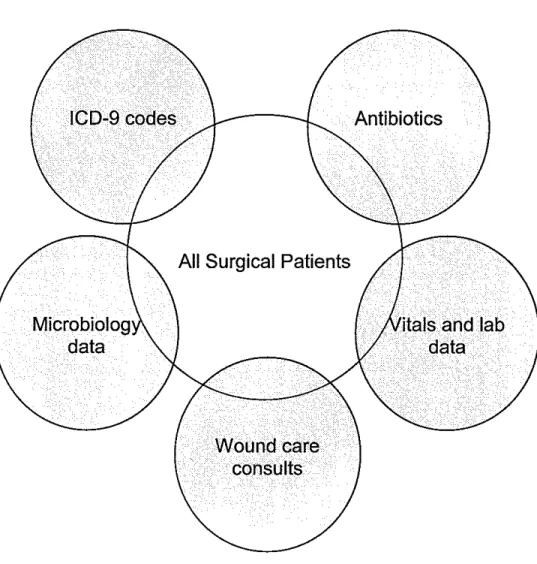
Continuous variables were compared using 2-sided Wilcoxon rank sum test or the Student's t-test. Variables that occurred in fewer than three SSI patients were discarded. We then developed composite variables within each data source (e.g., inpatient antibiotics, outpatient antibiotics, microbiology orders, microbiology results, wound consults, ICD-9 codes, and abnormal vital signs and white blood cell counts) using the factors most strongly associated with SSis to maximize the sensitivity. The groups used are found in table 1.
95% confidence intervals (CI). All covariates were checked for confounding and collinearity. If the addition of a confounding variable affected the B-coefficient of a covariate by more than I 0% it remained in the model. The groups were also analyzed separately in their ability to predict the different types of SSis. The probability term in the logistic regression models was adjusted to generate more sensitive and more specific models. Receiver operating characteristic (ROC) curves were also generated using Stata.
Evaluation of the system
The automated SSI surveillance system was evaluated according to the
recommendations made by the CDC working group for assessing public health surveillance systems for early detection of outbreaks [14]. Important
considerations included timeliness, validity, data quality, representativeness, completeness, usefulness, flexibility, acceptability, portability, stability, and cost of the system.
Results
The Cohort
Bivariable analysis
Nine groups of variable combinations were found to be strongly associated with
SSis (table 2). The results of their individual relative risks and 95% confidence
intervals for their association with SSis are shown in Table 3. ICD-9 coded
diagnoses related to SSis and antibiotic prescriptions were the strongest predictors
for detecting any type of infection.
Predictive models
An initial predictive model for all SSI was constructed using the composite ICD-9
codes, antibiotic prescriptions, all microbiology data, vital signs, and wound
consults (table 2) and had a sensitivity of91% and specificity of61 %. A more
specific model was also created with this data using logistic regression, with
resulting sensitivity of 59.9% and specificity of 89.1 %. A receiver operating
characteristic curve (ROC) was made for this logistic model, with the area under
the curve calculated to be 0.856 (Figure 2).
The same nine variables and their components were used to create the best model
for detecting severe SSis (deep SSis and organ SSis as defined by the NNIS
criteria). The resulting relative risks for the composite variables are shown in
Table 4 with 95% confidence intervals. ICD-9 coded diagnoses and antibiotic
prescriptions remained the strongest predictors of severe SSis. The most sensitive
model had a sensitivity and specificity of 89.2% and 7 4.2%, respectively and
had a sensitivity of 58.9% and a specificity of 93.9%. The ROC curve for this model is shown in Figure 3, with a calculated area under the curve of0.89.
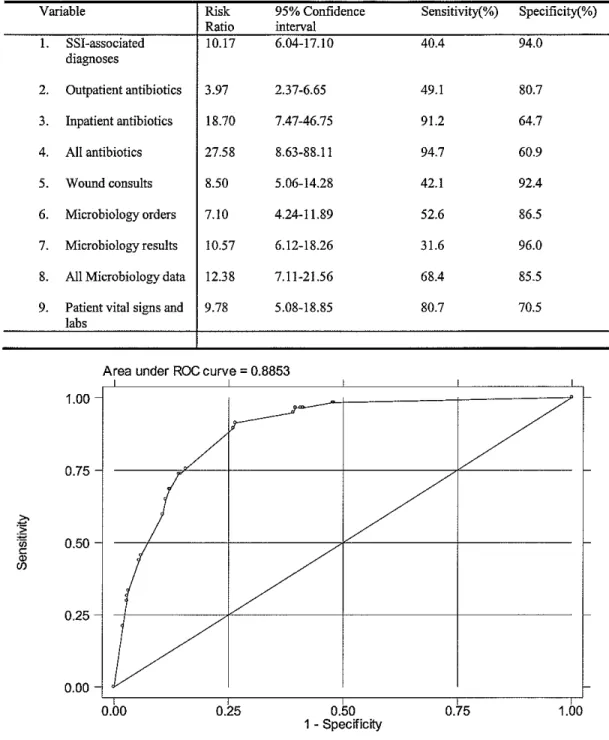
Lastly, these same nine composite variables were used to construct a predictive model for detecting organ/space SSis. The individual relative risks and 95% confidence intervals are found in Table 5. Fewer organ/space SSis were available for inclusion, and this reduced the precision of the model. ICD-9 coded diagnoses remained the strongest predictors. The most sensitive model had a sensitivity and specificity of 89.5% and 74.0%, respectively. A more specific logistic model had a sensitivity and specificity of64.9% and 88.7%, respectively. The ROC curve for this model had an area under the curve of 0.885 and is found in Figure 4.
Discussion
Conventional surveillance of SSis is a time-consuming process, and commonly used methods such as patient and surgeon surveys have poor sensitivity. Because of the importance of SSis in patient morbidity and medical costs, an effective way to monitor these infections would be beneficial. The findings in this study
demonstrate that such a system can be created with the use of data from an electronic patient medical record system. By using pharmacy data, ICD-9 codes, patient vital signs and lab values, and microbiology orders and results, a
reasonable specificity. By focusing on more severe or even organ SSis, one can increase the sensitivity and specificity of the system.
Validity
This automated surveillance system was evaluated using predictive models for different types of SSis. The results of this study show that this automated surveillance model is better at detecting more severe SSis. This should be expected as patients with more severe infections will have more contact with the healthcare system and are more likely to have tests ordered, vital signs recorded, and are more likely to receive antibiotics. As many institutions focus on more
r__
Although the surveillance system created in this study is much more sensitive than common conventional methods such as patient and surgeon surveys, it did not match the performance seen in the study done by Richard Platt and others. With their data, they could detect up to 92% of SSI with a corresponding
practices in how they diagnose, treat, and code for SSis. Finally, the frequency of the different types of SSis is not mentioned in their results. There may have been more severe or organ/space SSis in their study cohort, enhancing the accuracy of their system.
Acceptability
The acceptability for this type of system is growing rapidly as there is an increasing need for earlier disease detection that is less labor intensive than conventional methods. Also, electronic patient data is becoming increasingly available and most outpatient provider systems now capture pharmacy dispensing activity, and claims databases are available to capture information about tests and ICD-9 code diagnoses, making the development of a system similar to this easier. The model used in this study primarily utilized ICD-9 codes, pharmacy data, and microbiology test ordering that should be available at many other institutions. A model could then be created similar to this one, tailored to the institution's
specific drug, testing, and coding utilization as well as the types of infections they want to monitor. Such a system requires little maintenance and is much more sensitive than surveys and much less labor intensive than full-text patient chart review.
Timeliness
often take months for receipt and their review necessitates additional labor. Even the semi-automated system currently used at DV AMC requires manual patient record review and is heavily reliant on ICD-9 codes that can take weeks to be entered into the medical record. The automated system uses many sources of information, and some data, such as microbiology orders and results, antibiotic prescriptions, vital signs, and wound consult orders are available soon after the patient seeks medical care. The data is extracted from the core institutional database every 24 hours and file transfers can be increased in frequency as required. The system's timeliness allows infection control teams to detect SSis earlier than conventional methods, expediting interventions to decrease the burden of these complications.
Flexibility and Stability
flexibility and stability allows a syndromic surveillance system to be created for the specific needs of the institution that can change with the advent of new technology and antibiotics.
Cost
This surveillance system is also a cost-effective way to monitor SSis. The main expense of many conventional SSis is the labor involved in manually reviewing patient records. This automated method drastically reduces the amount of time needed to monitor these infections. Effort is involved in creating the system by first collecting the data, organizing it into a relational database, and then creating the best predictive model for the types of infections that are to be monitored. The created system then needs to be validated before it is implemented. Once in place, however, the automated surveillance system requires little maintenance and is much less labor intensive than conventional methods.
Improving the System
and positive-predictive value of the surveillance system can be improved. These practices will help to increase the efficiency of disease monitoring and of the health system as a whole.
Another way to improve the model would be to look at each surgical specialty separately. Physicians treating a SSI after a urologic procedure may treat the patient with a different antibiotic than would be used for a SSI occurring after a cardiac or gastrointestinal surgery. Identification of the prescribing practices of the different surgical specialties would allow a model to be created that is tailored to each procedure type. Also, different specialties may vary in their ICD-9 coding and test-ordering protocols, and the threshold for obtaining a wound care consult. These differences could allow for a unique model to be generated for each surgical specialty, creating a more accurate surveillance system. Further study needs to be done in this area.
Quality and Representativeness
The quality and amount of information available at the time of this study may not be representative of that available at other institutions due to the fully electronic medical records available in the VA system. Both inpatient and outpatient
records are contained in this system, and because of their healthcare coverage, the vast majority of Veterans who have their surgery at a VA hospital will also receive their outpatient care in the VA system. This is particularly important in the surveillance of SSis, as a significant percentage of them occur after hospital
r
discharge. It is also noteworthy to mention that the patient population at the VA
hospital is unique. The current population of Veterans seen at the VA hospital in
Durham is predominantly male, and their health needs may not represent those
seen in patient populations at other hospitals.
Portability and Completeness
As this study was done in the VA health system it has broad applicability. The
computer system used in the Durham VA is the same used across the VISN and in
most Veteran's hospitals in the United States. The surveillance system created in
this study is therefore portable and can be implemented at other VA hospitals,
giving them the ability to detect SSis with reasonable sensitivity and specificity.
Agreements have been reached with infection control chief medical officers and
information technology at three other major VA hospitals in North Carolina and
their primary care clinics to expand the developed SSI surveillance system to
Asheville, Salisbury, and Fayetteville. Approval has also been given by the chief
L
medical officer in VISN 6 to extend the surveillance system to Salem, Richmond,
Beckley, and Hampton. At this time, many infection control units in VA hospitals
around the country are under-staffed, and the ability to implement an automated
system such as this will be a boon. The number of patient records they will need
to review would be drastically reduced, freeing up their time to do other necessary
infection control duties. This surveillance method requires little maintenance,
aside from tailoring it to the specific institution's drug formulary and physician
!:::
among the VA hospitals, and patients who have surgery at one VA hospital and are treated for a complication at another can be monitored. This will improve the completeness of the data, increase the sensitivity of this surveillance system and create a cooperative synergistic relationship between area VA hospitals.
Conclusions
In conclusion, this study demonstrates the ability to create a SSI surveillance system using patient data from automated medical records. By using ICD-9 coding, pharmacy records, vital signs, lab data, and microbiology data, a system was created that was more sensitive than conventional methods such as patient
,----and surgeon surveys. This system is useful because it is not labor intensive,
~
requires little maintenance, and is flexible to the needs and practices of anAppendix 1
Surgical CPT codes Integumentary system Musculoskeletal system Respiratory system Cardiovascular system Hemic and lymphatic system Mediastinum and diaphragm Digestive system
Urinary system Male genital Female genital
Maternity Care and Delivery Endocrine system
Nervous
Eye and ocular adnexa Auditory Appendix2 11400-19499 20000-29999 30000-32999 33010-37209 38100-38999 39000-39599 40490-49999 50010-53899 54000-55980 56405-58999 59000-59899 60000-60699 61000-64999 64091-68899 69000-69979
NNIS Operative Procedure Categories
Code Operative Procedure codes
AMP Limb amputation 84.91
APPY Appendectomy 47.2, 47.91-47.99
BILl Bile duct, liver, 50.4, or pancreatic surgery 51.69-51.83, 51.99, 52.09, Description
Total or partial amputation
or disarticulation of the upper or lower limbs, including digits
Removal of appendix (not
incidental to another operative procedure)
Excision ofbile ducts or
ICD-9-CM
84.00-84.19,
47.01-47.09,
50.0,
50.21-operative procedures on the 50.61-50.69, gallbladder (except cholecystectomy), 51.31-51.63,
liver, or pancreas 51.89-51.95,
f
i
52.22-52.7, 52.95, 52.96, 52.99
CARD Cardiac surgery Open chest procedures on the 35.00-35.95,
35.98, 35 .. 99
valves or septum of heart; does not include coronary artery bypass graft, surgery on vessels, heart transplantation, or
pacemaker implantation
CBGB Coronary artery Chest procedure to 36.10-36.14,
36.19
bypass graft with perform direct
both chest and revascularization of the heart;
donor site includes obtaining suitable
incisions vein from donor site for grafting
~
CBGC Coronary artery Chest procedure to 36.15-36.17,
36.2
bypass graft with perform direct vascularization
chest incision only of the heart using, for example,
~
the internal mammary (thoracic) artery ~
I!!
CHOL Cholecystectomy Removal of gallbladder; includes 51.03, E
r
51.04, 51.21-51.24
procedures performed using the laparo-scope
COLO Colon surgery Incision, resection, or 45.00,
45.03, 45.41, 45.49, 45.50,
anastomosis of the large 45.52,
45.71-45.90,
bowel; includes large-to-small and 45.92-45.95,
46.00,
small-to-large bowel anastomosis 46.03,
46.04, 46.10-46.14,
46.43, 46.52, 46.75, 46.76,
46.91,
46.92, 46.94, 48.5-48.69 48.6-48.69
CRAN Craniotomy mcision through the skull 01.2-01.59,
02.11-02.14,
to excise, repair, or 02.91,
02.92,
explore the brain; does not 07.51-07.79,
include taps or punctures 38.01,
38.11, 38.31,
CSEC Cesarean section Obstetrical delivery by 74.0-74.2, 74.4-74.99
Cesarean section
FUSN Spinal fusion Spinal fusion and refusion 81.00-81.08,
81.30-81.39,
81.62-81.64, 84.51' 84.52
FX Open reduction of Open reduction of fracture 79.21,
79.22, 79.25, 79.26,
fracture or dislocation oflong 79.31,
79.32,
bones that requires internal 79.35,
79.36, 79.51, 79.52,
or external fixation; does 79.55,
79.56
not include placement of joint prosthesis
GAST Gastric surgery Incision or excision of 43.00, 43.3,
43.42-43.99,
stomach; includes subtotal 44.0-44.03,
44.21,
or total gastrectomy, 44.29-44.42,
44.49-44.92
vagotomy, and pyloroplasty
HER Herniorrhaphy Repair of inguinal, femoral, 53.00-53.61
umbilical, or anterior abdominal wall hernia; does not include repair of diaphragmatic or hiatal hernia or hernias at other body sites
HN Head and neck Major excision or incision of the 30.1-30.4,
surgery larynx or trachea and 40.40-40.42
radical neck dissection
HPRO Hip prosthesis Arthroplasty of hip 81.51-81.53
HYST Abdominal Removal of uterus through 68.31,
68.39, 68.4, 68.6
hysterectomy an abdominal incision
KPRO Knee prosthesis Arthroplasty of knee 81.54,
81.55
LAM Laminectomy Exploration or decompression of 03.01-03.09,
80.50, 80.51,
MAST Mastectomy 85.20-85.23,
85.50,
NEPH Nephrectomy
55.54, 55.91
PRST Prostatectomy
SB
45.51,
45.91,
46.02,
46.39,
Small bowel surgery 45.02,
46.51, 46.71-46.74,
SKGR Skin graft
86.60-86.63,
86.69,
86.91
SPLE Splenectomy
incision into vertebral structures
Excision oflesion or tissue
of breast including radical,
modified, or quadrant resection, lumpectomy, incisional biopsy, or mammoplasty
Removal of all or part of 55.02, 55.11, 55.12, the kidney with or without
removal of related structures
Suprapubic, retropubic, radical, or perineal excision of the prostate; does not include transurethral resection of the prostate
mcision or resection of
the small intestine; does
not include small-to-large
bowel anastomosis
Full and split-thickness 21.83, 27.55-27.57, skin grafts, including
flaps, of recipient and
donor sites
-L
THOR Thoracic surgery N oncardiac, nonvascular 32.3-32.9,
33.0-33.1,
chest surgery; includes 33.31-33.49,
pneumonectomy and 33.98,
33.99, 34.Dl-34.D3,
diaphragmatic or hiatal 34.1,
34.3-34.60, 34.81-34.84,
hernia repair 34.89,
34.93-34.99,
53.80-53.82
TP Organ transplant Transplantation of human 33.50-33.6,
heart, kidney, liver, lung, 37.51-37.54,
41.94, 46.97
pancreas, or spleen only; 50.51-50.59,
does not include cornea or 52.80-52.86,
bone marrow transplants 55.61-55.69
VHYS Vaginal Removal of the uterus through 68.51-68.59,
68.7
hysterectomy vagina or perineal incision ~
[
vs
Vascular surgery Operative procedures involving 38.00,Iii
Ill
38.02-38.10,
f
arteries or veins; includes aortic 38.12-38.16,
38.18,
aneurysm repair, vascular grafts, 38.30,
38.32-38.40,
and carotid, iliac, femoral, or
38.42-38.49,
popliteal artery operations; does 38.7, 38.80,
38.82-38.89,
not include coronary artery bypass 39.0-39.26,
39.28, 39.29
grafting 39.50-39.59,
39.7-39.79
VSHN Ventricular shunt Extracranial ventricular 02.2,
02.31-02.39,
shunts, including revision 02.42,
02.43
and removal of shunt
XLAP Laparotomy Nonspecific exploratory 54.11-54.19,
54.3-54.59,
procedures of the 54.71,
54.72, 54.74, 54.75
OBL Other hemic and
40.3,
lymphatic systems
41.98
OCVS Other cardiovascular
36.Dl-36.D3,
36.05-system
36.31-36.99,
37.31-37.4,
37.94-37.99,
38.52, 38.53, 38.55,
38.59, 38.60,
39.94
OENT Other ear, nose,
18.21-18.9,
mouth, pharynx
20.96-20.99, 21.1, 21.30,
21.72, 21.82,
21.89,
29.0,
OES Other endocrine system
06.2-06.99,
07.21-07.49,
OEYE Other eye
OGIT Other digestive system 42.31-42.32,
46.42, 46.50, 46.60-46.64,
46.99, 47.11-47.19,
48.41-48.49,
53.7,
54.61-54.64, 54.73,
OGU Other genitourinary system 55.53, 55.7-55.89,
56.40-56.89,
61.49, 61.92-61.99,
62.99, 64.2-64.99, 65.21-65.89, 42.01-42.19, 42.39-42.91, 46.40, 46.79-46.82, 48.0-48.1, 48.72-48.76, 53.9-54.0, 54.92-54.95 56.0-56.2, 57.12, 57.18,
~
57.19,57.21,
iii
57.22, I§
~
57.51-57.89, 58.39, 58.42-58.5, 58.91-58.99, 59.00-59.19, 59.3-59.71, 59.79,59.91,
68.29, 68.8-68.9,
70.4-70.62,
70.8,
71.5-71.9
OMS Other musculoskeletal system
77.51-77.59,77.60-79.33, 79.34, 79.59, 79.80-79.89, 80.00-80.19, 80.99, 81.40-81.49, 82.99 83.31-83.93, 84.48, 84.92-84.99
ONS Other nervous system
68.0, 68.2-69.19-69.49, 70.72-70.75, 71.01-71.09, 76.01-76.09, 76.2-76.70, 76.72, 76.74, 76.76, 76.77, 76.79-76.92, 76.94,
76.97, ~
77.00-77.39,
77.99,
t_
78.00-78.09, ~·
~ 78.20-78.79,
'
78.90-78.99,'
79.10-79.20, 79.23, 79.24, 79.27-79.30, 79.37-79.39, 79.50, 79.9-79.99, 80.40-80.49, 80.6, 80.7-81.1-81.29, 81.93-81.97, 82.01-82.91' 83.01-83.19, 84.21-84.40, 84.44,02.01-03.4-03.79,
03.98, 04.01-04.07,
05.0,
05.81-05.9,
31.91
OOB Other obstetrical procedures 74.3, 75.50, 75.52-75.62,
OPRO Other joint prosthesis
ORES Other respiratory system
31.75-31.79,
32.29, 33.92-33.93,
34.85
OSKN Other integumentary system
Appendix 3: Antibiotics
Outpatient antibiotics Amoxicillin Amoxicillin/clavulanic acid Azithromycin Ceftriaxone Cephalexin
Arthroplasty of joints other than 81.71-81.85
hip and knee
02.94-02.99, 03.1-03.29, 03.97, 04.3-04.79, 05.21-05.29, 29.92, 75.93 81.56-81.61, 30.01-30.09, 31.5-31.73, 32.09-32.22, 34.71-34.79, 85.0, 85.24, 85.25, 85.86-85.89, 85.93-85.99, 86.03-86.09, 86.4, 86.81-86.89, 86.93
b
t
f
!!I
Ciprofloxacin Clarithromycin Clindamycin Dicloxacillin Doxycycline Erythromycin Fluconazole Gentamicin Levofloxacin Metronidazole Linezolid Rifampin Vancomycin
Inpatient antibiotics Amoxicillin
Amoxicillin/clavulanic acid Ampicillin!sulbactam Azithromycin
Caspofungin Cefazolin Cefotaxime Cefoxitinsodium Ceftazidime Ceftriaxone Cefuroxime Cephalexin Ciprofloxacin Clarithromycin Clindamycin Doxycycline Erythromycin Fluconazole Gentamicin
Imipenem/cilastatin Levofloxacin Linezolid Meropenem Metronidazole Minocycline Nafcillin Neomycin Penicillin
Tobramycin Vancomycin
Appendix 4: Diagnoses assigned in hospitals, emergency departments, or outpatient settings (ICD9 codes)
998.0 Postoperative Shock 998.3 Post-op Wound Disruption 998.5 Postoperative Infection 998.51 Infected Post-op Seroma 998.59 Post-op Infection Nee 998.83 Non-Healing Surg Wnd
780.6 Fever
891.0 Op Wnd Low Leg IS Comp 891.1 Open Wnd K.nee/Leg-Comp 682.6 Cellulitis of Leg
682.9 Cellulitis Nos 998.9 Surgical Comp Nos 38.0 Streptococcal Septicemia 38.1 Staph Septicemia
38.10 Staph Septicemia Nos 38.11 Staph Aureus Septicemia 38.19 Staph Septicemia Nee 38.2 Pneumococcal Septicemia 38.3 Anaerobic Septicemia 38.4 Gram-Neg Septicemia Nee 38.40 Gram-Neg Septicemia Nos 38.41 H. injluenzae Septicemia
38.42 E. coli Septicemia
38.43 Pseudomonas Septicemia 38.44 Serratia Septicemia
38.49 Oth Gram-Neg Septicemia 38.8 Septicemia Nee
38.9 Septicemia Nos 790.7 Bacteremia
611.0 Inflam Disease of Breast 682.0 Cellulitis of Face
682.1 Cellulitis of Neck 682.2 Cellulitis of Trunk 682.3 Cellulitis of Arm 682.4 Cellulitis of Hand 682.5 Cellulitis of Buttock 682.6 Cellulitis of Leg 682.7 Cellulitis of Foot 682.8 Cellulitis, Site Nee
682.9 686.0 686.1 686.8 686.9 958.3 711.00 996.6 996.60 996.61 996.62 996.63 996.64 996.65 996.66 996.67 996.68 996.69 674.3 879.0 879.1 879.2 879.3 879.4 879.5 879.6 879.7 879.8 879.9 875.0 875.1 Cellulitis Nos Pyoderma Pyogenic Granuloma Local Skin Infection Nee Local Skin Infection Nos Posttraum Wnd Infect Nee Pyogen Arthritis-Unspec Infect/Inflam-Dev /Graft Infect Due To Device Nos Infect D/T Hrt Device Infect D/T Vase Device Infect D/T Nerv Device Infect D/T Urethral Cath Infect D/T GU Device Nee Infect D/T Joint Prosth Infect D/T Orth Dev Nee Infect D/T PD Cath Infect Due To Device Nee Oth Comp OB Surg Wound Open Wound of Breast Open Wound Breast-Comp Opn Wnd Anterior Abdomen Opn Wnd Ant Abdomen-Comp Opn Wnd Lateral Abdomen Opn Wnd Lat Abdomen-Comp Open Wound of Trunk Nee Open Wnd Trunk Nec-Comp Open Wound Site Nos Opn Wound Site Nos-Comp Open Wound-Chest/S Comp Open Wound Chest-Comp
Appendix 5: Microbiology Orders and Results
Culture orders Abdomen Blood
Bone marrow
Bronchial wash fluid Cerebrospinal fluid Feces Leg '
f--f
Nail Pelvis
Peritoneal fluid Pharynx
Pleural fluid Scalp Skin Sputum Synovial fluid Unknown Urethra Urine Vagina
Vaginal secretion Vein
Culture results Abscess
Aspirate Bone
Bronchial washes Bronchial lavage Chest fluids Exudates Fluid
Fluid unknown Hip fluid Hip fluid
Intravenous catheters Peritoneal
Pleural Swab Sensorial Tissue
References
1. National Nosocomial Infections Surveillance (NNIS) report, data summary from October !986-April1996, issued May 1996. A report from the National
Nosocomial Infections Surveillance (NNIS) System. Am J Infect Control 1996;
24: 380-8.
2. Sand K, Vineyard G, Platt R. Surgical Site Infections Occurring after Hospital Discharge. J Infect Dis 1996; 173:963-70.
3. Wong ES. Surgical site infections. In: Mayhall CG, editor. Hospital
epidemiology and infection control. 2nd ed. Philadelphia: Lippincott; 1999. p. 189-210.
4. Holtz TH, Wenzel RP. Postdischarge surveillance for nosocomial wound
infection: a brief review and commentary. Am J Infect Controll992;20:206-13.
5. Haley RW, Culver DH, White JW, eta!. The efficacy of infection surveillance
and control programs in preventing nosocomial infections in US hospitals. Am J
Med 1985; 78:3-7.
6. Haley RW. Incidence and nature of endemic and epidemic nosocomial infections.
In: Bennett N, Brachman PS, eds. Hospital infections. Boston: Little Brown,
1986:359-74.
7. Condon RE, Haley RW, Lee JT, eta!. Does infection control control infection? Arch Surg 1988; 123:250-6.
8. Olson M, Lee JT. Continuous, 10-year wound infection surveillance: results, advantages, and unanswered questions. Arch Surg 1990; 125:794--803. 9. Brown RB, Bradley S, Opitz E, Cipriani D, Pieczarka R, Sands M. Surgical
wound infections documented after hospital discharge. Am J Infect Controll987;
15: 54-8.
10. Platt R, Yokoe DS, Sands KE, eta!. Automated Methods for Surveillance of
Surgical Site Infections. Emerg Infect Dis 200 I; 7:2.
11. Mangram AJ, Horan TC, Pearson ML, Silver LC, Jarvis WL, Guideline for the prevention of surgical site infection, 1999. Infect Control Hosp Epidemioll999; 20: 247-78.
12. Haynes SR, Lawler PG. An assessment of the consistency of ASA physical status classification allocation [see comments]. Anaesthesia 1995;50: 195-9.
13. Sands K, Vineyard G, Livingston J, Christiansen C, Platt R. Efficient
identification of postdischarge surgical site infections using automated medical records. J Infect Dis 1999; 179: 434-41.
14. Buehler JW, Hopkins RS, Overage JM, Sosin DM, Tong V. Framework for evaluating public health surveillance systems for early detection of outbreaks.
ICD-9 codes
Microbiolog data
All Surgical Patients
Wound care consults
Antibiotics
itals and lab data
Table 1: Data groups used in multivariable analysis.
Variable Data Type
I. SSI-associated diagnoses ICD-9 codes
2. Outpatient antibiotics Automated pharmacy data
3. Iopatient anubiotics Automated pharmacy data
4. All anubiotics Automated pharmacy data
5. Wound consults Automated consult orders data
6. Microbiology orders Automated microbiology orders data
7. Microbiology results Automated microbiology results data
8. All microbiology data Automated microbiology data
Table 2: Variables strongly associated with SSis used in multivariable analysis.
Variable
I. SSI-associated diagnoses
Description
682.7, 682.9, 891.0, 891.1, 958.3, 998.59, 998.83, 998.31,998.32
Area under ROC curve= 0.8560
1.00
0.75
.,.
:~
~
0.50
~
c
Jl
0.25
0.00
0.00 0.25 0.50 0.75 1.00
1 - Specificity
Figure 2: Receiver operating characteristic (ROC) curve for regression model predicting all types
Table 4: Independent predictors of severe SSis.
Variable Risk 95% Confidence Sensitivity(%) Specificity(%)
Ratio interval
I. SSI-associated 14.47 9.92-21.05 49.0 94.4
diagnoses
2. Outpatient antibiotics 4.62 3.15-6.79 52.9 80.9 3. Inpatient antibiotics 16.54 8.63-31.71 90.2 65.0 4. All antibiotics 20.79 9.66-44.73 93.1 61.3 5. Wound consults 7.54 5.11-11.12 39.2 92.6 6. Microbiology orders 5.91 4.03-8.66 48.0 87.0 7. Microbiology results 12.50 8.46-18.45 35.3 96.3 8. All Microbiology data 10.04 6.74-14.95 63.7 85.8 9. Patient vital signs and 10.22 6.22-16.78 81.4 70.8
labs
Area under ROC curve= 0.8902 1.00
0.75
~ ~ 0.50
"'
c
"
(/)
0.25 0.00
0.00 0.25 0.50 0.75 1.00 1 - Specificity
Figure 3: Receiver operating characteristic (ROC) curve for regression model predicting severe types of SSis.
Table 5: Independent predictors of organ/space SSis.
Variable Risk 95% Confidence Sensitivity(%) Specificity(%)
Ratio interval
l. SSI-associated 10.17 6.04-17.10 40.4 94.0
diagnoses
2. Outpatient antibiotics 3.97 2.37-6.65 49.1 80.7 3. Inpatient antibiotics 18.70 7.47-46.75 91.2 64.7 4. All antibiotics 27.58 8.63-88.1 1 94.7 60.9 5. Wound consults 8.50 5.06-14.28 42.1 92.4 6. Microbiology orders 7.10 4.24-11.89 52.6 86.5 7. Microbiology results 10.57 6.12-18.26 31.6 96.0 8. All Microbiology data 12.38 7.11-21.56 68.4 85.5 9. Patient vital signs and 9.78 5.08-18.85 80.7 70.5
labs
Area under ROC curve = 0.8853 1.00
0.75
i
=m
c 0.50
Q)
"'
0.25
0.00
0.00 0.25 0.50 0.75
1 - Specificity
Figure 4: Receiver operating characteristic (ROC) curve for regression model predicting
organ/space types of SS!s.