Transition to Adult Health Care for Adolescents with Juvenile
Idiopathic Arthritis
By
Beth Anne Champion
A Master's paper submitted to the faculty of the University of North Carolina in partial
fulfillment of the requirements for the degree of Master of Public Health in the
Department of Leadership.
Abstract
Transition service planning has become a crucial health care service need. Technological and medical advances over the past century resulted in markedly prolonged survival for these children; an estimated 90% of children with special health care needs (CSHCN) now survive into adulthood.1 This increase in life expectancy has translated into a I 00% increase in the number of children and adolescents with special health care needs (ASHCN or CSHCN) in the past four decades.2 Consequently, experts and policymakers have underscored the need for developing transition service models to improve health and quality oflife for this population. The term transition encompasses the transfer of medical and ancillary services from pediatric to adult care, self-advocacy and independence, vocational or educational changes, and alterations in interpersonal relationships. 3"5
Discussion of issues surrounding transition to adult care for ASHCN has become increasingly prevalent in the literature over the past two decades.
However, critical appraisal of the transition literature reveals a paucity of disease-specific guidelines, validated measurements, adequate research controls, and patient centered outcomes.5 Juvenile idiopathic arthritis (JIA) is the most common rheumatic condition in children. One third of children continue to have active inflammatory disease well into their adult years and nearly 60% of patients experience persistence of some type of limitations in their activities of daily living. 6 Considering the very real possibility of continued symptoms and impaired function for these patients, investigation into their transitional care is warranted. A critical appraisal of existing literature on transition for adolescents with
Table of contents:
Page
Chapter 1: Overview of paper
Chapter 2: Background
Review of rheumatology literature
Review of ASHCN literature
Review of guidelines
4
9
16
29
Chapter 3: Focus Group Methods and Expected Results 34
Chapter 4: Survey ofRheumatologists Methods and Results 36
Chapter 5: Discussion
Summary of key findings
Limitations of study
Significance given existing literature
References
38
40
41
Chapter 1: Introduction and overview of paper
Transition service planning has become a crucial health care service need.
Technological and medical advances over the past century resulted in markedly
prolonged survival for these children; an estimated 90% of children with special
health care needs (CSHCN) now survive into adulthood.1 This increase in life
expectancy has translated into a 100% increase in the number of children and
adolescents with special health care needs (ASHCN or CSHCN) in the past four
decades.2 Consequently, experts and policymakers have underscored the need for
developing transition service models to improve health and quality of life for this
population. Navigation of the transition from child to adult-oriented services is
complex and improvements in the current system will require innovative service
models and improved care coordination between the subcultures of pediatric and
adult medicine.
The term transition encompasses the transfer of medical and ancillary
services from pediatric to adult care, self-advocacy and independence, vocational
or educational changes, and alterations in interpersonal relationships. The most
widely accepted definition was devised by the Society for Adolescent Medicine:
"the purposeful, planned movement of adolescents and young adults with chronic
physical conditions and medical conditions from child-centered to adult-oriented
health care system. "7 Discussion of issues surrounding transition to adult care for
ASHCN has become increasingly prevalent in the literature over the past two
disease-specific guidelines, validated measurements, adequate research controls,
and patient centered outcomes.5 The majority of studies investigating transition to
adult services are exploratory in nature;5 methodologically rigorous, experimental
designs are sorely needed.
The American Academy of Pediatrics, the American Academy of Family
Physicians and the American College of Physicians issued a consensus statement
in 2002 that advocates an identification of the knowledge and skills required to
provide quality transition services as a necessary first step in ensuring a successful
transition to adult -oriented health care. 8 Implicit in this suggestion is an
understanding of the transitional needs of patients. Several needs assessments
have been conducted to discover transitional needs that apply to ASHCN in
general as well as those that are unique to specific disease states. Sickle cell
anemia,9 cystic fibrosis10 and congenital heart disease11 are disease categories in
which transition to adult care has been examined. Further, studies have explored
the barriers to successful transition, risk factors for poor transition and tenants of
an ideal transition program.
Factors that impede transition have been identified by patients, parents and
providers, with some degree of overlap. Providers indicate inadequate resources 12,
lack of communication between pediatric and adult medicine, 13 parental
intrapersonal characteristics, lack of policies for transitional care, 14 and lack of
provider training in transitional care 4 as barriers to a smooth transition. Crucial
deficits that providers indicate in current practice are the lack of needed treatment
executed programs.15 The former is especially true for rheumatology patients;
many adult rheumatologists feel uncomfortable or inadequately trained to care for
adolescents or young adults with classically pediatric illnesses.16 In a recent
survey of internist and pediatric rheumatologists in the Los Angeles area, one of
the main reasons adult rheumatologists cited for their avoidance of pediatric
patients was their lack oftraining.16
Juvenile idiopathic arthritis (JIA) is the most common rheumatic
condition in children, affecting between 30 to 150 per 100,000 children and
adolescents in the United States 17. Although an 80% remission rate is frequently
cited, recent evidence indicates that the prognosis may not be so favorable17. One
third of children continue to have active inflannnatory disease well into their adult
years and nearly 60% of patients experience persistence of some type of
limitations in their activities of daily living.6 In fact, approximately 30% of
patients after 10 years of follow-up report severe functional limitations and even
20 years after disease onset, JIA patients indicate significantly greater pain and
lower vitality, perceived health and physical functioning than their case control
counterparts.17 Considering the very real possibility of continued symptoms and
impaired function for these patients, investigation into their transitional care is
warranted.
Shaw and colleagues conducted a comprehensive, nationwide series of
studies concerning juvenile idiopathic arthritis patients in the United Kingdom
that addresses an audit of available transition services,6 needs ofpatients4,
members of the British Pediatric Rheumatology Group with proposed
guidelines18. First, they advocate an individualized, developmentally appropriate
approach. They suggest that adolescents be offered the option of being seen
without their parents to encourage independence and self-advocacy to prepare
them for managing their health care on their own. Further, they underscore the
importance for adolescents to make informed decisions and express their opinions
regarding their care. They recommend an honest explanation of the patient's
condition and associated health care, including the necessity to transfer to
adult-oriented services.18
Shaw and colleagues also stress the importance of continuity of health
care providers and privacy during consultations. They suggest dedicated
adolescent waiting areas, multidisciplinary teams and increased knowledge of
adolescent development by professionals as components of transitional care that
require future attention.18 These strategies and those of other authors may be
applicable to United States populations. However, given the differences between
the United States' and United Kingdom's health care systems, a needs assessment
and JIA-specific transition guidelines must still be formulated with our unique
medical and political culture in mind.
In order to elucidate the needs of JIA patients to make a smooth, coordinated and effective transfer to adult-oriented services, a focus group of
patients in the pre and post-transitional years (ie, adolescents and young adults)
will be organized with two objectives in mind: 1. to ascertain the transitional
employ in facilitating this transition. Using the information gathered from this
focus group, a questionnaire will then be formulated to survey pediatric
rheumatologists in the United States in order to assess the feasibility of these
strategies and gain feedback for their implementation. The focus group
discussions and pediatric rheumatologist questionnaire are being designed to
answer the following research questions: 1. what are the needs of JIA patients to
make a smooth, coordinated and effective transition to adult-oriented services and
2. what strategies can health care providers employ to aid in this process?
In order to address these questions, a critical appraisal of available literature concerning transition for patients with juvenile idiopathic arthritis and
other rheumatic diseases was conducted. This review demonstrated a paucity of
available data for this patient population; therefore, the search was expanded to
include the transition literature in general. Lastly, in order to facilitate the
formulation of guidelines and strategies to aid transition to adult care for
adolescents with JIA, service recommendations were identified in the literature,
compiled and analyzed. The results of these searches will be discussed in detail in
Chapter 2: Background of transition literature and guidelines
Investigation into transition needs assessment, service models and
recommendations have been encouraged by the Division of Services for Children
with Special Health Care Needs, the Maternal and Child Health Bureau (MCHB),
the Health and Human Resources and Services Administration, professional
organizations such as the American Academy of Pediatrics (AAP), and family
organizations. Consensus statements and practice standards have been offered by
the AAP, the Society of Adolescent Medicine, the National Association of
Pediatric Nurse Practitioners and Nurses. Further, the MCHB integrated transition
planning into its objectives to improve the quality of care for children with special
health care needs. 5
However, in spite of more than two decades of interest, academic and
institutional support, analysis of the literature on transition reveals several critical
limitations. Most importantly, review of general and disease-specific literature
indicates a paucity of disease-specific guidelines, validated and reliable
measurements, experimental research designs, adequate research controls,
patient-centered outcomes and comparisons of transition models.
Review of literature on transition for adolescents with rheumatic
diseases
Transition for patients with rheumatic diseases presents several interesting
challenges. First, there is a paucity of data regarding needs and concerns of this
population of patients. Second, the majority of studies that have been done were
infrastructure may make results poorly generalizable to the United States. Lastly,
transition program design and execution will be challenging considering the
dearth of pediatric rheumatologists in the US. This paucity of providers results in
many pediatric patients with rheumatic diseases being seen by adult
rheumatologists.16 This last issue may be particularly problematic because the
predominant service models described in the transition literature are disease-based
and subspecialty-based.19 This means that adolescents are cared for largely in
tertiary settings. Not all children and adolescents have access to academic medical
centers; further, the ones that do may only be seen once or twice per year.20
Should providers at these centers be responsible for the careful care coordination
these patients need, given that they have limited contact with them? This unique
situation for children and adolescents with rheumatic diseases calls for creative
and innovative program design.
Search strategy
In order to review the literature on transition for patients with rheumatic diseases, an electronic and manual search was conducted using MEDLlNE and
the National Guideline Clearinghouse. Publication years were limited to
1980-January 2005. Keywords used were transition, rheumatology, adolescent,
pediatric, and CSHCN. Reference lists were surveyed for additional studies and
the previous search on transition for CSHCN in general was used as well. The
search yielded twelve articles: six were qualitative and descriptive studies, one
was a program outcome analysis, three were editorials and two were narrative
Results
Shaw, McDonagh and colleagues conducted a series of nationwide studies
on the part of the British Pediatric Rheumatology Group, funded by the Arthritis
Research Group. Their stated objective was to develop a transition program for
JIA patients. Through qualitative and descriptive studies, they conducted an audit
of transition services for rheumatology patients in the UK6 and a needs
assessment for transition services by organizing focus groups of adolescents and
young adults with JIA and their parents.4 Next they surveyed providers to
ascertain the perceived needs of JlA patients and to get service
recommendations.12 Then they surveyed providers to assess umnet education and
training needs for transition services.21 Lastly, they surveyed providers, JIA
patient and their families in order to rate service recommendations based on
I
feasibility and the degree to which they reflected best practices.18
The needs of JIA patients have much in common with other ASHCN.
Their needs can be categorized as those pertaining to their JIA, functional ability,
treatments, psychological health, social issues, parental issues, education,
vocation, independent living and adult relationships. Adolescents and young
adults responded that they needed education regarding the natural history oftheir
disease, likely limitations in their activities of daily living, details of their
treatment regimens, and education regarding utilization of health care resources
and how to navigate the adult system. In addition, they indicated that management of psychological ramifications of disease in adulthood was a priority in a
vocational rehabilitation and benefit entitlement were cited as key needs,
Counseling on sexual health was also indicated as an important facet of transition
' 4
services,
Providers indicated similar issues in the transition process, with a few
important additions. The actual transfer of medical care to the adult setting was of
cardinal importance. Also, the issue of self-advocacy and encouragement for
patients to take a leadership role in their health care was key. Further, care
coordination and available resources for transition were cited by providers as
crucial transitional needs. Providers also indicated several barriers encountered in
the provision of transition services. Inadequate resources in the forms of clinic
time, available staff, space, patient information and recognition of transition as a
need were cited as the most important barriers to a smooth transition to adult
12 care.
Through their survey of providers involved in transition services, Shaw
and colleagues were further to identify risk factors for difficulties.12 Family or
parent dynamics in the forms of overprotectiveness, reliance on fmancial benefits,
lack of social support and lack of education or motivation to transition were
universally accepted as being problematic during transition. Adolescent risk
factors were dependence, psychosocial maladjustment, and complex or severe
state of their arthritis. Providers reported socioeconomic factors such as low
income and low literacy as being important risk factors. Although less frequently
indicated, long disease duration, belonging to an ethnic minority and limited
Both patients and providers rated similar resources as being helpful for
transitioning adolescents with JIA. Social skills training, self-medication
programs, internet information pages, counseling hotlines and patient information
brochures were suggestions.4• 12 Peer education and mentors were also proposed
by JIA patients and providers. These recommendations echo those of patients with
other SHCN, such as HIV.22 This series of studies indicates a consensus between
patients, providers and parents on several needs, perceived barriers and suggested
resources for transitioning JIA adolescents.
Armed with this information, Shaw and colleagues next surveyed pediatric
and adult rheumatologists, ancillary health staff involved in the care of
rheumatology patients, adolescents, young adults and their parents to gain
feedback on service recommendations.18 They divided suggestions into two
I
groups: those which could be implemented soon and those that require future
research and development. Recommendations to be executed as soon as possible
reflected best practices and were deemed to be feasible by those surveyed. These
suggestions include an individualized approach that addresses medical,
psychosocial, educational and vocational needs. Providers should give adolescents
the opportunity to be seen without their parents, allow opportunities for informed
decisions and expressions and foster a sense of self-sufficiency. Continuity and
honesty regarding prognosis were emphasized as wel1.18
L
They also reported suggestions that, although they reflected best practices,
were felt by respondents to have limited feasibility in light of the current medical
well-versed in transition issues and services, dedicated adolescent waiting rooms
and appropriate physical environment, and opportunities for peer interaction and
support.18
Comparing the strategies that were deemed feasible with those that were
not reveals that feasible suggestions mainly involved doctor-patient relationships
and did not require additional fiscal or environmental development.
Recommendations with limited feasibility typically required additional resources,
training or development, such as multi-disciplinary teams and adolescent waiting
rooms. The authors speculate that respondents perceived the deficits in training
and financing of transition resources to be the main areas of contention. However,
the authors countered this argument with the assertion that small, inexpensive
changes may be made to current conditions that would better reflect what
adolescents want from a transition program. For example, in the case of
adolescent waiting rooms, Shaw and colleagues cite evidence that the most
important things to adolescents are confidentiality, phone advice, written
information, a special clinic, friendliness and magazines.18 Therefore, one would
not necessarily need to build an entirely new waiting room; provision of patient
brochures, friendly and confidential service and availability of phone advice may
go far to meeting their requests.
Little has been published concerning service models and program
outcomes, partly due to the fact that few transition programs for adolescents with
rheumatic diseases exist. Chamberlain and colleagues present their program in
physicians and ancillary care staff, the program's objectives are to provide
services that aid adolescents in self-management of their health care and
encourage adult social integration. Referrals are made, typically from general
pediatricians, and core members of the team meet the patient and their family to
design short and long-term goals. Patients are between 16 and 25 years old and
their plans are reviewed every six months by the team and each year by the key
member involved with that patient's care. The program employs care coordination
and uses an adolescent friendly environment. Home visits are made for the initial
assessment and on an as needed basis. Chamberlain and authors present several
case studies illustrating the utility of this program and discuss transition program
models23• The Young Adult Team approach falls into the category of transition
coordination model, a community-based, needs-led program that is
multi-disciplinary and employs health care professionals with an expertise in adolescent
medicine.23
Retting and Athreya published the only formal evaluation of a transition
program in JIA patients24• The program involved a structured, interdisciplinary
setting in which readiness assessments were conducted, pediatric and adult
rheumatologists were jointly involved, and post-transition service coordination
and assessments were performed. The study consisted of a convenience sample of
180 patients with rheumatic diseases, 144 who participated in a pretransition
program and 36 who participated in a transition program. Using a survey
questionnaire, they assessed program outcomes as measured by referral to an
participants referred to an adult center continued with services up to 3 years post
transition. 5 They demonstrated that early preparation for transfer and a separate
transition clinic was correlated with improved follow-up as adults.Z5
Limitations
Limitations of both the Shaw and Rettig studies involve their feasibility of
execution in the United States. For many practitioners in the US, dedicated
transition clinics require unavailable fiscal and environmental resources. Further,
willing pediatric and adult personnel to run these clinics may not be available. On
a larger scale, the British National Health Service allows for nationalization of
clinical practice. In the US, however, the patchwork of private and public health coverage creates disparate policies and constraints. Therefore, nationalization of a
transition policy or program is very difficult to execute here.
I
Moreover, the scarcity of pediatric rheumatologists in the US to staff
transition clinics interferes with the implementation of this model. The situation in
the UK is quite different. Pediatric rheumatology was only recognized in 1995.
Since the 1970s, they have organized multidisciplinary clinics that employ
pediatricians, adult rheumatologists, cardiologists, ophthamologists, and
orthopedic surgeons to care for children and adolescents with rheumatic diseases.
In this way, they have created what is felt to be a comprehensive network of care that provides locally available, tertiary services.Z6
As of the year 2000, there are 92 members of the British Pediatric
geographic area that eclipses that of the UK. In summary, the UK has a tradition of care coordination and an ample supply of sub specialists, all in a medical and
political climate that supports national guidelines. The situation in the US sharply
contrasts with that of the UK; therefore, program and policy recommendations
made by international populations may have limited feasibility in the US.
However, even though dedicated transition clinics may not be as feasible
in the US, certain service recommendations may be applicable to US populations.
Given the diversity of the US health care system and the scarcity of pediatric
rheumatologists, more than one approach to transition services seems best.
Review of ASHCN in general literature on transition
Because there is so little existing data on transition for rheumatology
patients, a critical appraisal of the general transition literature was conducted to
assess the knowledge base, the quality of available studies and to identify
limitations or deficits. Both disease-specific and general studies were included in
this synthesis, which revealed several transfer criteria, barriers to transition, and
service recommendations. Similar to the rheumatology studies, literature on other
chronic conditions indicates a lack of validated tools, accepted guidelines and
. I d . 3 5 10 27 A 'II b . h . d' . h
expenmenta es1gns. · · · s WI e apparent m t e ensumg IscussJon, t e
field of transition remains in its early stages of development, which justifies the
endeavors this study plans to undertake.
Search strategy
A literature search of the past two decades of transition studies reveals
The search was conducted via manual and electronic searches using MEDLINE,
the Cochrane Database of Systematic Reviews and the National Guideline
Clearinghouse. Keywords used were transition, transfer, programs, adolescent,
CSHCN and the MeSH terms adolescent, adult and doctor-patient relationship.
Articles in English published between 1980 and January of2005 were reviewed.
Potential studies were excluded if they were abstracts, non-published reports,
dissertations, or if the title, subject or abstract did not pertain to transition.
Reference lists of articles were also examined and yielded additional studies.
Results
Betz and colleagues conducted a recent systematic review of transition
literature published in the past two decades. 5 They conducted computerized and manual searches of works published in MEDLINE and CINAHL between 1982
and 2003, using keywords adolescent transition, transition programs, adolescent
psychology, chronic disease, life-changing events, adolescent health services, and
psychological adaptation. They also reviewed the reference lists articles and
excluded prospective studies if they were abstracts, non-published reports,
dissertations, or the substance did not pertain to the subject of transition. A total
of 43 articles were accepted and reviewed. 5 Individual articles from this list were
reviewed. In addition, three other articles published during 1982-2003 not
included by Betz and colleagues were used in this critical appraisal. In addition,
fifteen studies published during 2004-January 2005 were reviewed, resulting in 59
Participants included adolescent patients and family members, young
adults, providers, and occasionally a mixture of all groups. Adolescent and young
adults were the most common group examined, comprising twenty four studies,
thirteen studies were composed of adolescents and family members, providers
were the respondents in ten studies, six studies used patients, providers and
family, four studies used parents alone, and one study was composed of providers
and parents. The ages of participants ranged mostly from 11 to the mid-twenties,
but several studies did not specify age. Some studies included a broad age range;
for example Boyle and colleagues reported ages of participants ranging between
18 and 63 years old.10 The majority of studies did not specify the ethnicity of the
participants and demographic variables were generally limited to age, diagnosis,
and disease severity.
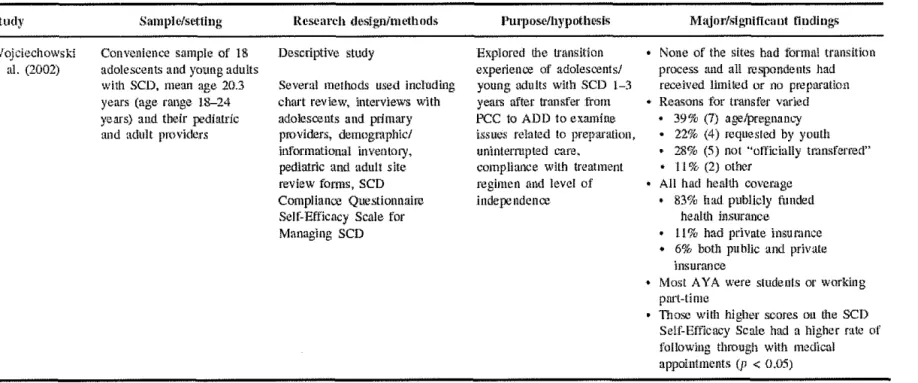
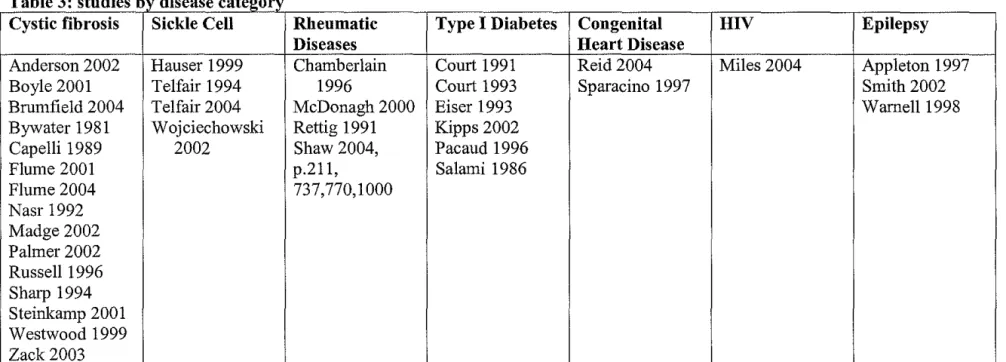
The disease group studied most often was cystic fibrosis, comprising
fifteen of the studies reviewed (see table 3). Otherwise, disease representation was
diverse; sickle cell disease, epilepsy, type 1 diabetes, rheumatic diseases, HN,
and congenital heart disease were also examined. Thirty-nine designs were
descriptive, twelve studies examined transition program outcomes, four explored
transitional tool development and three were case studies (see table 4).
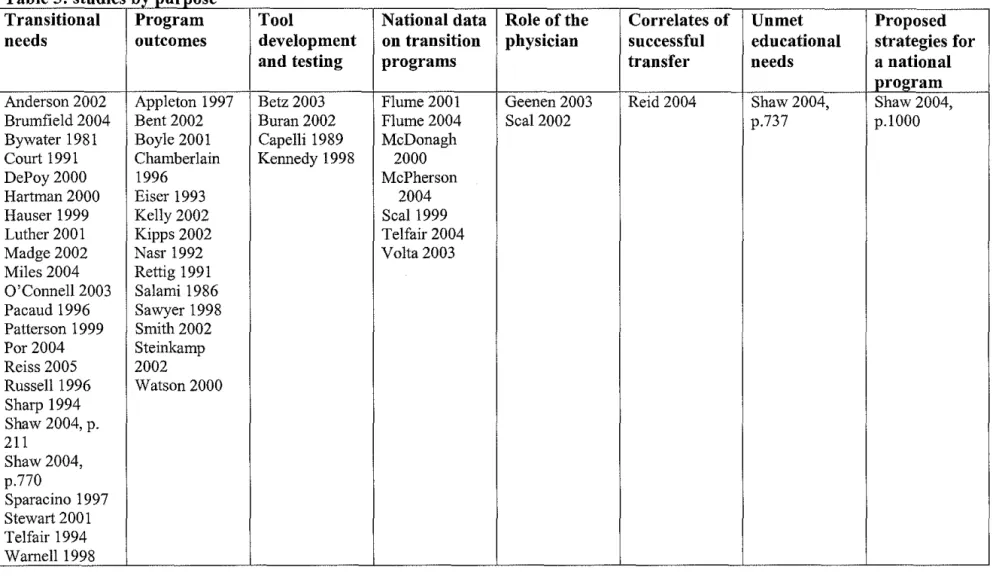
Eight major purposes were apparent in the studies reviewed. The majority
described transitional needs and experiences of youth and families, while the next
most common design was analysis of transition program outcomes. In addition, investigators reported information on tool development and testing, national data
explored the role of the physician in transition services and planning, nnmet
educational needs for transition services among providers, and strategies for a
transition program (see table 5). Three major themes emerged from analysis of
these studies: transfer criteria, barriers to transition and service recommendations.
Transfer criteria
Articles described transfer criteria as the projected ideal or actual timing
for initiating the process of transition to adult-oriented services. The ideal timing
was gathered from adolescents, young adults, families or health care providers
while the actual timing was gathered via retrospective chart review. Not
surprisingly, age was most frequently cited criterion for transition to adult
services, regardless if the information was obtained from respondents or chart
review. The most frequently reported ideal age range was between 16 and 22.5,28
Only five studies reported that transition planning was initiated before age
15 and most studies reported the actual age of transfer as being between 14.4 and
22.5 Secondary transfer criteria were also identified, namely the presence of
secondary conditions, disease status at time of transfer, marriage, pregnancy,
patients' knowledge of their condition, and administrative issues.5'29 Other issues
reported were that respondents no longer desired care within a pediatric setting or
that care was no longer offered in a pediatric setting. 22' 30
Barriers to transition
Numerous studies identified barriers to transition, using cohort surveys,
included adolescents, young adults, families and providers. Two major categories
were indicated: barriers related to interpersonal interactions during service
planning (youth, family or providers) and barriers related to service systems
(institutional policies, lack of guidelines, insurance issues). Barriers associated
with provider care were frequently cited. Physicians indicated time restrictions,
lack of transition training,28•31 discomfort in discussing sensitive issues such as
sexuality and drug abuse with adolescents, 12 the belief that transition planning
was not their responsibility,31 and difficulties associated with accessing transition
resources5 as key barriers to transition planning. Further, pediatricians reported
difficulties communicating with adult providers or locating adult subspecialists
while those in adult health care settings indicated discomfort and training
limitations with regard to caring for adults with classically childhood chronic
conditions. 5• 12
Rosen discusses the divergent cultures of pediatrics and internal medicine,
offering several explanations for the difficulties encountered when adult providers
care for young adults with SHCN.13 Care that is family based and
developmentally appropriate are tenants of high quality pediatrics. Family
members are involved in all levels of decision making and are integrated as
valued members of the treatment team. Further, pediatricians strive to make their
rapport appropriate for the age of the child or adolescent. This approach contrasts
with that of internal medicine; the family is rarely involved in decisions and
These divergent cultures and attitudes result in families feeling alienated and
young adults feeling as though their internists are treating only their disease rather
than them as a person with complex needs. Also, pediatrics embraces care
coordination while internal medicine prefers to concentrate only on medical
needs, referring anything outside this arena to social work. Young adults therefore
often feel as though the quality and number of services offered in the adult setting
is less than what they experienced during their pediatric care.13
Provider barriers were described as ways in which health care providers
interfere with transitions. Adolescent and young adults identified lack of
communication between pediatric and adult providers,4• 5• 15• 22• 30 unrealistic
expectations on the part of providers regarding patients' abilities to be self-reliant
and exclusion by providers of adolescent patients in decision making as
problematic.4• 5 Other difficulties associated with provider planning of transitions
were the timing of transition, limited educational materials and counseling by
providers, and concerns regarding the provider's amount of expertise in
adolescent care and transition planning. 6• 12 Parents indicated the blurring of roles
between themselves and providers when authority over decision making was
discussed, which created tension and concern for who was in control over health
care planning and execution.5 Pediatricians themselves reported concern and
hesitancy when transferring their patients to adult-oriented care, constituting
another facet of provider-associated barriers.5
Barriers related to inter-personal relations also pertained to parents and
dependence and unreliability as historians.28• 31 Parents themselves expressed
difficulties relinquishing control over health care decisions to the provider or
adolescent.5 Barriers related to patients concerned the maturity level and age of
the adolescent, resistance to transition and attachment to pediatric caregivers. 22• 30•
31
Adolescents themselves expressed difficulty taking ownership over their own
health care, making decisions and self-advocating . 4
System barriers are obstacles to providing transition services demonstrated
by institutional polices, insurance, and professional and training issues. Physician
respondents often cited lack of financial reimbursement, lack of clinical
guidelines, lack of institutional support and limited resources for information on
transition as being problematic.6•12•19•28•31 In a survey of various health, education
and vocation service providers in the UK, Shaw and colleagues demonstrated
pervasive and diverse system barriers to the development of a transition program,
chiefly the lack of resources in the forms of time, staff and fiscal resources.
Inadequate care coordination between service providers was also indicated.12
The paucity of transition resources was echoed by parents, who
complained that the lack of information about community services, lack of service
coordination and long waiting times to see providers constituted service barriers.Z8
Young adults and adolescents implicated uneven and discontinuous insurance
coverage as a key concem5' 15 Adolescents in particular cited the lack of
developmentally appropriate waiting areas and treatment by providers as being
. 4 5 problematic. '
Service Recommendations
The majority of studies described positive strategies for transition
planning, implications for program development and discussed differing service
models. A recommended ideal age for transfer was between 16-22 in most
studies5• 6• 10 while many indicated that discussion of transition should begin
earlier. 30 Other recommended criteria for transfer included personal choice, level
of maturity and physician decision.9•32
Many studies went further to recommend a formal process, program or
transition plan to facilitate the transfer to adult services. Logistical
recommendations included developmentally appropriate environments, assistance
with appointment keeping, written follow-up instructions, telephone availability
of providers, exchange of medical information via the Internet, and availability of
educational materials in waiting rooms.4• 6• 9• 14• 28• 32·35
From a user prospective, adolescents and young adults underscored the
importance of self-advocacy and developmentally-appropriate care as a key
component in transition planning. The main call was for education about their
chronic condition, but also they suggested that transition services provide
education and information about sexual and psychological health, navigation of
the adult-oriented health system, independent living skills, and educational and
vocational services.4' 10• 34 Seal and colleagues reveal that although the majority of
programs, only 42% of the 122 transition programs in the US reviewed offered
such a service.19
Several studies underscored the importance of self-management skills to
encourage self-sufficiency and made recommendations for transition programs
integrate this concept. Family involvement and availability of counseling services
were also recommended. Some studies suggested a mentoring program for
adolescents composed of young adults who had transitioned to adult care and
social contact and peer support was highlighted in many studies.4• 22• 36
Conclusions
Although the past two decades has demonstrated a burgeoning interest in
I
issues surrounding the transition of ASHCN, the field remains in its seminal
stages of development. This review reveals that the majority of studies were
exploratory in purpose, most utilizing descriptive or qualitative designs. Although
fourteen studies examined program outcomes, their methods were poorly
described and none used a control group. Without additional information about
the transition program or protocol, interpretation of the effects of the program
intervention on the reported outcomes is problematic. Two of these studies
employed case studies as evidence for positive program outcomes,23• 35 thereby
using anecdotal explanations when an experimental approach would better define
the relationship between intervention and outcome. Another limitation in the
L
outcomes analyses was the lack of patient-centered outcomes; most focused on
disease severity or appointment adherence rather than quality of life or functional
Few studies implemented validated and reliable tools. Information was
rarely given regarding the analysis of qualitative data, validity of interview items,
the process of data transcription and analysis or the process of determining
inter-rater reliability. 5 Questionnaires were used in twenty-eight studies and limited
information, if any, was provided regarding design or theoretical rationale.5 Few
investigators detailed methods of patient selection and convenience samples were
used more commonly than purposive ones. This tendency may have resulted in
significant selection bias.
A key limitation of most studies is that patients were recruited from the
setting in which they were receiving care. Zack and colleagues actually
interviewed CF patients during their inpatient admissions.30 Given their
surroundings, patients may have been reluctant to criticize caregivers and
therefore may have withheld critical information. Although these are rare patient
populations, steps may be taken to minimize this type of potential systematic
error, such as off-site location interviews, such as Brumfield et al.,36 or
involvement of moderators who are not directly involved in the patients' care,
such as Shaw et al. 4
Limited demographic information, particularly etbnicity, was reported,
which may denote some degree of selection bias and threatens external validity as
well. The major threat to generalizability of study results, however, is the limited
number of disease categories studied. Disease specific guidelines for cystic
fibrosis, although important in the management of that particular condition, may
patients almost exclusively from tertiary care settings may limit applicability of
results to primary care and community settings.
This last criticism, although a methodologic flaw, may not be as clinically
meaningful given that the majority of ASHCN are cared for in academic medical
centers. This is particularly true of cystic fibrosis, sickle cell disease and
congenital heart defects. However, what may be clinically important involves the
model of transition program used and the choice of care coordinator. Seal
proposed four main models of transition programs: disease-based,
adolescent-based, primary-care based and subspecialty-based. In this review, the majority of
programs were disease and subspecialty based, a finding supported by Seal's
work as well.19 If recommendations and guidelines are formed within the
subspecialty, tertiary care setting, it is questionable if they can be implemented by
a general pediatrician or community health provider. Clearly, more
community-based and primary care setting studies are needed to address this dilemma.
Directions for future research
This analysis of transition literature indicates several other research
implications as well. Foremost, the need for experimental designs and studies
wherein the interventions are randomized is compelling. Further, the use of valid
and reliable interview instruments will strengthen the knowledge base about
transition. Larger, population-based samples that represent diverse ethnic
backgrounds are needed as well. Well-designed studies with detailed reporting of
methods and procedures will also contribute to empirical evidence. Lastly,
would provide an invaluable contribution for future program development and
implementation.
Another limitation of these fmdings is the international representation that
provides feedback from many different health care and service settings. Different
infrastructures, medical and political climates limit generalizability of service
recommendations from Australia to the UK, for example. Although transition is
an international service problem, as reflected by the diversity of publications,
program and guideline development must be carried out with attention to the
unique health care setting in which it will be implemented.
Although focus on disease specific guidelines and studies that limit
samples to one condition is a limitation when surveying the transition literature as
a whole, there are pragmatic reasons why these guidelines are necessary.
I
Foremost, the needs and problems confronting ASHCN during their transition to
adult-oriented health care differ according to their condition. This case is
exemplified by studies by Boyle and colleagues, who found that the primary
concern for adolescents with cystic fibrosis transferring to internist was risk of
infection.10 On the other hand, in a study examining the concerns of adolescents and young adults with sickle cell disease, most were worried about how to pay for
their medical care and whether the adult staff would believe that they were
actually in pain during a crisis. 34 This contrast justifies exploratory needs
assessments based on disease state to elucidate unique concerns these
subpopulations of ASHCN will facilitate optimal program design and
development.
Review of Service Recommendations
Examination of service recommendations in the transition literature
reveals several pertinent themes that are repeated in both general and condition
specific studies. To compile a list of proposed transition guidelines and service
recommendations, electronic and manual searches were conducted using
MEDLINE and the National Guideline Clearinghouse. Reference lists from prior
searches of transition literature were used as well. Results are listed in table 7.
As was previously discussed, recommendations fall into several
categories: general suggestions and those relating to transfer,
self-I
advocacy/independence, education, vocation, psychological and sexual health.
Providers, parents and patients reported many of the same suggestions. There was
a consensus that transition should be started early and reflect a planned process.
An individualized approach was almost universally recommended. Some
recommended that discussions of transition should begin as early as the time of
diagnosis.3 Many emphasized discussions of transition that prepared patients and
built expectations of success. 3• 15 Most recommended that one provider should be
in charge of care coordination, although there were differing opinions regarding
who is best suited for this position. Some suggested the specialist coordinate care,
particularly studies from the UK and Australia, 18· 3740 while American authors
d · ·d 31 II . 1. . hi I 9 10 3o
Preparation of a written transition plan was supported by professional
organizationss as well as individual authors.3• 14• 35• 37 This plan should include a
needs assessment, identify services and future providers so that the necessary
referrals may be made in advances. Shaw and colleagues recommend yearly
review of this transition plan to troubleshoot and make modifications.1s A
portable, compact, written health summary was suggested by the AAP in their
consensus statements and by several authors?· 35• 37 Viner suggested construction
of a "transition map"37 that describes how and when transfer occurs in each
specialty; providers make a schedule of anticipated events in the transition
process and give it to patients during early adolescence.
The identification of a future adult provider and introductions or an
orientation was strongly recommended by professional organizations (AAP,
Society for Adolescent Medicinef· s and patients alike.10• 14' 22' 30 Adolescents with
HIV interviewed by Miles and colleagues underscored the usefulness of a friendly
face in the adult setting and recommended orientation tours prior to transfer,
preferably with a group of other adolescents.22 Respondents also emphasized the
importance of education and preparation of what to expect from adult-oriented
health care. 15• 22• 36 Many young adults reported that their transition would have
been considerably less traumatic if they had known what to expect from the adult
setting.15' 22
A great many suggestions pertained to the encouragement of
self-advocacy, self-sufficiency and the attainment of independence from the family.
informed decisions regarding their health care3• 4 were often suggested. White
recommends setting independent living and self-sufficiency of health care as the
expectation from the start, as early as the time of diagnosis. 3 Encouraging a shift
from the family to the adolescent as responsible for decision-making was
underscored as well.35'42 Telfair and colleagues suggest that adolescents should
have knowledge of past medical history and understanding of their condition, be
able to make arrangements to finance their health care, demonstrate understanding
of their disease's complications, demonstrate good self-care skills, show a
working knowledge of the medical system, and demonstrate some level of
independence from their families. They maintain that setting these expectations
and assessing whether they are fulfilled fosters a sense of self-sufficiency and
demonstrates the adolescent's readiness to transition to adult health care. 9
Many recommend the provision of patient information describing the adult
health care system and available services.14' 30• 34 Further, Viner advocates
educating adolescents about their health care rights. 37 Involvement of parents as
well as patients in education efforts was widely supported as well.10• 15• 35 In
addition to family support, peer support and mentoring programs were
proposed.Z8•42 Promotion of quality health care through using the same guidelines
for ASHCN as those designed for general adolescent preventive services3' 8 and
offering the same level of services in the adult setting as were available in
pediatrics15 were supported.
Authors disagreed regarding details of continuity of care. Although
pediatrics providers continue to see patients after transition, only in an adult
setting15. Rosen disagreed by advising against straddling both pediatric and adult
systems, warning that it conveyed mixed messages to patients and families.13
Kelly and colleagues agreed with Rosen's sentiment and went further to
recommend some type of formal event in which adolescents could say good-bye
to pediatric providers before transfer. 35 These divergent opinions illustrate that
although continuous coverage is advisable, experts disagree on the methods by
which it may be provided. Many institutional and insurance policies discourage
against pediatric providers continuing to see patients after they reach I 8 or 21,43
however, which means that Reiss' suggestion may have limited feasibility.
Recommendations were also made regarding the environment in which
transitional care is delivered. Many suggested that an adolescent-friendly
environment with magazines, internet access and music geared toward this
population may help to encourage a separation from younger children and prepare
adolescents for the adult setting.4• 22 Offering written patient information in the
form of pamphlets was also suggested.30• 37 Although dedicated adolescent waiting
rooms,4 joint clinics14 or transition clinics24 were recommended, these may not be
feasible in many areas with fiscal constraints.
Several plausible service recommendations have been made in a general
and disease-specific manner. The Society of Adolescent Medicine supports
continuing efforts to devise disease-specific guidelines to facilitate transition.44
Further, many authors support evaluation and investigation of existing programs
guidelines for implementation in the US may be devised using existing
recommendations and data on transitional needs. However, a needs assessment of
US patients may reveal additional valuable information and should be conducted.
A focus group of JIA patients, both adolescents and young adults, would provide
information regarding needs and concerns and also would be instrumental in
developing disease-specific service recommendations.
Chapter 3: Focus group methods and expected results
Focus Group Participants
Patients will be selected from pediatric and adult rheumatology clinics
from examining clinic rosters. An invitation letter will be sent to patients who
meet the inclusion criteria, which are age between 15-25 years and a diagnosis of
ITA. Patients in the adult clinic must have been seen by a pediatric rheumatologist
before transfer. There are no exclusion criteria. Interested patients will respond to
the letter and contact clinic secretaries. They are also welcome to bring their
family members to the focus group discussion. Two discussions will be conducted
with 6-10 participants in each. Written consent will be obtained from each
participant using adolescent and adult forms and the study is pending acceptance
by the Institutional Review Board at the University ofNorth Carolina at Chapel
Hill.
Focus Group Questionnaire
The focus group questionnaire was created with the objectives of
identifYing transitional needs and service recommendations (see focus group
questionnaire).
Focus Group Procedure
The procedure of the focus group will be explained to the participants and
a set of questions will be distributed to each person as a means of facilitating
discussion. Topics of interest include transitional needs and concerns, perceived
barriers, transfer to adult services, participants' opinions regarding guidelines
will be facilitated by a moderator (Beth Anne Champion) and will be audio taped.
In order to avoid embarrassment or reluctance on the part of participants, their treating physicians will not be included in the focus group discussions. Each
group will last approximately two hours and will end with a summary of the
results in order to verify, change and prioritize resulting information.
Analysis of Focus Group discussion
Audiotapes will be transcribed verbatim and themes will be identified
using methods described by Morgan.45 Transcripts will be repeatedly read,
annotated and codified to identify themes and emergent issues.
Results of Focus Group discussion
Analysis of this data revealed several themes regarding needs and service
I
recommendations. Please see accompanying focus group participantChapter 4: Questionnaire for pediatric rheumatologists methods
and expected results
Questionnaire Participants
All registered members ofthe American College of Pediatric
Rheumatologists practicing in the United States will be identified and sent
questionnaires.
Questionnaire to Pediatric Rheumatologists
The questionnaire for pediatric rheumatologists will be written based on
the focus group data from this study. The questionnaire will ask physicians to rate
each recommendation based on its ability to reflect best practices and its
feasibility, probably using a Likert scale ranging from l("not at all") to 5("very
I
much"). It will also include an open response section that allows providers to explain their responses. The questionnaire will also include a short section of
yes/no responses to certain transition services in order to get a sense of what
activities pediatric rheumatologists are currently employing. This section will also
include an open response section to allow physicians to describe any other
transition services they offer, but were not previously listed. The questionnaire
will have a very brief section asking provider characteristics as well.
Questionnaire Procedure
The survey will be piloted first to maximize validity. Self-administered
questionnaires will be mailed to all pediatric rheumatologists with a cover letter
second two months after the initial questionnaire was sent. Follow-up phone calls
may also be placed or emails if addresses are available.
Questionnaire Analysis
Responses to questionnaires will be analyzed using STAT A version 8.0.
Descriptive statistics of demographic information of providers will be presented.
Means and standard deviations for scores ofbest practices and feasibility of
service recommendations will be calculated. Bonferroni corrections will be made
in the case of multiple testing.
Results of Questionnaire
Analysis of this data will be presented in tables of provider characteristics,
means and standard deviations of ratings of services recommendations and free
response information regarding what services are currently being provided and
Chapter 5: Discussion
Summary of key findings
This study involves a unique attempt to not only elucidate crucial needs of
a rarely studied patient population, but goes further to devise guidelines based on
these needs. Although the study is in progress and preliminary data are not yet
available, it may be reasonably estimated that the focus group discussions will
reveal several distinctive needs. Most likely, respondents will describe
continuation of health insurance as a crucial necessity in their transition to
adult-oriented care, more so than when compared with international studies. In addition to their concern for insurance and financing of their health care upon their arrival
in the adult setting, respondents will likely report similar categories of transitional
needs as were described by Shaw and colleagues4 as well as for adolescents with
other special health care needs (SHCN): self-advocacy, independent living,
educational, social and vocational skills.
Respondents of the survey for pediatric rheumatologists will probably also
demonstrate similar concerns regarding insurance, financing and institutional
polices regarding transition. Similar findings to that of Shaw and colleagues18 will
probably occur with regards to opinions on best practices and feasibility; service
recommendations pertaining to provider-patient relationships that do not require
additional finances or environmental change will most likely be rated as more
feasible than those that require more resources. However, transition service
recommendations in general will most likely be rated highly for their reflection of
What will be particularly intriguing will be the response pertaining to
ongoing transition service provision aud the consensus regarding which transition
model will be ideal: subspecialty, disease or primary-care based. As was
previously stated, subspecialty aud disease-based programs are the most prevalent
in the US today. But thinking ahead to program design for patients with rheumatic
diseases, it will be fascinating to discover pediatric rheumatologists' opinions on
how to deliver services, given the scarcity of providers aud academic centers. In a
position statement discussing the referral of patients to pediatric rheumatologists
by the American College of Rheumatology, underscores the strengths of their
multidisciplinary teams at academic centers that facilitate attainment of treatment
goals in a cost effective manner. These teams offer a variety of services, including
nursing, physical aud occupational therapy, nutrition, social work aud a vast array
of other pediatric specialists such as cardiologists, dermatologists,
ophthamologists, psychiatrists aud maxillofacial surgeons.Z0
This position statement concedes that the paucity of pediatric
rheumatologists often necessitates involvement of au adult rheumatologist in this
treatment team.20 One might argue that this inclusion of au adult provider presents
the opportunity for continuous care aud facilitated transition to adult-oriented
services. However, when 45 of the 125 medical schools in the US do not have
pediatric rheumatologists on their faculties,20 a very real geographical barrier
must be addressed. Examination of the American College of Rheumatology
practice data by Mayer aud colleagues reveals that only 3% of counties in the US
pediatric nor internist rheumatologists available. Further, they determined that
only 50% of the US population under the age of eighteen lives within fifty miles
of a pediatric rheumatologist.46 The very real situation for adolescents with
rheumatic diseases who do not have access to a pediatric rheumatologist must
have an alternative; care coordination through their primary care pediatrician,
family physician or adult rheumatologist may present a viable option.
Limitations
Although focus groups provide an efficient method to collect information,
it is associated with several limitations. First, verbal reports of the respondents
may not reflect their actual behaviors and feelings, especially concerning sensitive
topics. Second, because the samples were small, they may not reflect the
characteristics of the target population. In addition, since they are volunteers, it is
not possible to assess the degree to which bias played a role in the results since we
cannot compare participants' characteristics to non-participants.
With regard to the survey of pediatric rheumatologists, the most important
limitation is that it does not reflect key stakeholders in transition policy, namely
general pediatricians, adult rheumatologists and family practitioners. Also, the use
of pre-existing information from the focus group and literature search limited the
available options or biased the responses. Lastly, a degree of unforeseeable
ambiguity in questions of surveys typically exists that cannot fully be addressed
without an extensive pilot study. The pilot study for this particular survey will
Significance of findings in the context of existing literature
The Society of Adolescent Medicine supports continued efforts to develop
disease-specific guidelines? The results from this study will contribute to the
body of knowledge surrounding transition service recommendations and will
hopefully inspire efforts to form a consensus among pediatric rheumatologists
through further research. The American College of Cardiologists issued
guidelines for adult with congenital heart defects regarding the management,
transition and training ofpractitioners.47 Hopefully, with additional investigation
regarding the optimal service delivery and program design for the transition of
adolescents with rheumatic diseases, a similar consensus among pediatric
rheumatologists and pediatricians will ensue. A randomized, prospective,
quasi-experimental trial to assess these guidelines would be a valuable first step.
In related topics, this study will likely contribute to the growing body of
literature surrounding barriers to health care for adolescents and young adults
with SHCN. Unfortunately, insuring young adults with chronic conditions has
been indicated as a serious service problem in the United States. Adolescents are
the most prevalent age group among children with special health care needs and
report the highest rates ofunmet need, especially among poor and near-poor
families.48 In spite of their compelling need for continuous health care coverage,
young adults with chronic conditions have considerably higher rates of being
uninsured compared to children. 22% of young adults with SHCN have been
health care transition is occurring at a time in which young adults are least likely
to be insured, particularly those with chronic medical conditions, which poses a
serious threat to their health. Clearly, these results will contribute to the existing
References:
1. Blum RW. Transition to adult health care: setting the stage.
J Ado/esc Health. Jull995;17(1):3-5.
2. Blum RW. Chronic illness and disability in adolescence. J
Ado/esc Health. Jul1992;13(5):364-368.
3. White PH. Transition: a future promise for children and adolescents with special health care needs and disabilities.
Rheum Dis Clin North Am. Aug 2002;28(3):687-703, viii. 4. Shaw K. User perspectives of transitional care for
adolescents with juvenile idiopathic arthritis.
Rheumatology. 2004;43:770-778.
5. Betz CL. Transition of adolescents with special health care needs: review and analysis of the literature. Issues Compr
Pediatr Nurs. Jul-Sep 2004;27(3):179-241. 6. McDonagh J. Audit of rheumatology services for
adolescents and young adults in the UK. Rheumatology. 2000;39:596-602.
7. Blum RW, Garell D, Hodgman CH, eta!. Transition from
child-centered to adult health-care systems for adolescents with chronic conditions. A position paper of the Society for Adolescent Medicine. J Ado/esc Health. Nov
1993;14(7):570-576.
8. A consensus statement on health care transitions for young adults with special health care needs. Pediatrics. Dec 2002;110(6 Pt 2):1304-1306.
9. Telfair J. Providers' perspectives and beliefs regarding transition to adult care for adolescents with sickle-cell disease. Journal of Health Care for the Poor and
Underserved. 2004;15:443-461.
10. Boyle M. Strategies for improving transition to adult cystic fibrosis care, based on patient and parent views. Pediatric
Pulmonology. 2001 ;32:428-436.
11. Reid G. Prevalence and correlates of successful transfer from pediatric to adult health care among a cohort of young adults with complex congenital heart defects. Pediatrics. 2004;113:197-205.
r
12. Shaw K. Developing a program of transitional care for adolescents with juvenile idiopathic arthritis: results of a postal survey. Rheumatology. 2004;43:211-219.
13. Rosen D. Between two worlds: bridging the cultures of child health and adult medicine. J Adolesc Health. Jul 1995; 17(1 ): 10-16.
14. Por J. Transition of care: health care professionals' view.
Journal of Nursing Management. 2004;12:354-361.
15. Reiss J. Health care transitions: youth, family and provider perspectives. Pediatrics. 2005;115:112-120.
16. Mayer M. Role of pediatric and internist rheumatologists in treating children with rheumatic diseases. Pediatrics. 2004;113:173-181.
17. Ilowite N. Current treatment of juvenile rheumatoid arthritis. Pediatrics. 2002; 109:109-115.
18. Shaw K. Transitional care for adolescents with juvenile idiopathic arthritis: a Delphi study. Rheumatology. 2004;43:1 000-1006.
19. Seal P. Trends in transition from pediatric to adult health care services for young adults with chronic conditions.
Journal of Adolescent Health. 1999;24:259-264.
20. Sandborg C. Position statement of the American College of Rheumatology regarding referral of children and
adolescents to pediatric rheumatologists. Arthritis Care and
Research. 1999;12(1):48-51.
21. McDonagh J. Unmet education and needs of rheumatology
health professionals in adolescent health and transitional care. Rheumatology. 2004;43:737-743.
22. Miles K. Transition from pediatric to adult services: experiences ofHN-positive adolescents. AIDS CARE. 2004;16(3):305-314.
23. Chamberlain M. Young adults with arthritis: meeting their transitional needs. British Journal of Rheumatology.
24. Rettig P. Adolescents with chronic disease: transition to adult health care. Arthritis Care and Research.
1991;4(4):174-180.
25. Chira P. Adolescent rheumatology transitional care: steps to bringing health policy into practice. Rheumatology.
2004;43:687-689.
26. Ansell M. Children with chronic arthritis: the management of transition to adulthood. Balliere's Clinical
Rheumatology. 1998;12(2):363-375.
27. Callahan ST, Winitzer RF, Keenan P. Transition from pediatric to adult-oriented health care: a challenge for patients with chronic disease. Curr Opin Pediatr. Aug
2001;13(4):310-316.
28. Geenen S. Understanding the role of health care providers during the transition of adolescents with disabilities and special health care needs. Journal of Adolescent Health.
2003;32:225-233.
29. Flume P. Transition programs in cystic fibrosis centers.
Pediatric Pulmonology. 2004;37:4-7.
30. Zack J. Perspectives of patients with cystic fibrosis on preventive counseling and transition to adult care. Pediatric Pulmonology. 2003;36:376-383.
31. Seal P. Transition for youth with chronic conditions: primary care physician's approaches. Pediatrics.
2002;110:1315-1321.
32. Flume P A, Anderson DL, Hardy KK, GrayS. Transition
programs in cystic fibrosis centers: perceptions of pediatric and adult program directors. Pediatr Pulmonol. Jun
2001 ;31(6):443-450.
33. Nasr S. Transition program from pediatric to adult care for cystic fibrosis patients. Journal of Adolescent Health.
1992; 13:682-685.