African American College Students’ Attitudes About HIV and AIDS:
An assessment of HIV knowledge and attitudes and current prevention strategies
By
Timica Campbell
A Master’s Paper submitted to the faculty of the University of North Carolina at Chapel Hill
in partial fulfillment of the requirements for the degree of Master of Public Health in
the Public Health Leadership Program
Chapel Hill 2013
_____________________________________ Advisor
_____________________________________ Date
_____________________________________ Second Reader
ii
Abstract
Background: Until recently, African American college students were not considered to be a high risk population for HIV. Epidemiologic data reveals that the HIV incidence and
prevalence in this group is significantly higher than that of white college students, and these numbers are rising.
Objective: To describe the HIV knowledge, attitudes and preventive or risk-taking behaviors of African American undergraduates in an attempt to better understand the causes for this increased incidence and to assess current prevention strategies.
Methods: In-depth interviews with African American undergraduate students from both
Historically Black Colleges/Universities and Traditionally White Institutions and a systematic review and critical appraisal of the literature.
Findings: The media are the most influential source of information for HIV, but not enough of this information they present is distributed to students. Despite this lack of information, students are knowledgeable on the subject, though their answers show that many of the myths and misconceptions still exist about the virus. Students recognize the need for being tested for HIV, and are able to discuss testing with close friends, but the stigma that surrounds HIV-infected individuals and HIV testing is large enough to present a barrier to testing. Among other testing barriers, the most notable were a fear of a breech in
confidentiality when seeking testing and a fear of knowing one’s HIV status. Some university policies and practices may contribute to these barriers.
Conclusion: The public health community must increase the amount of HIV knowledge
iii
Acknowledgements
I would like to first thank my mentor, research project advisor, and first reader, Dr. Sue Tolleson-Rinehart, for her guidance and support throughout this entire year as I pursued a Master’s in Public Health. What she has taught me throughout this endeavor could fill a book, but we will settle for the pages of this master’s paper. I am sure I will carry all of this knowledge with me in my career.
I would also like to thank my second reader, Dr. Cedric Bright, FACP, for donating his time and energy to reviewing my master’s paper. Since coming to the School of Medicine, he has been an unwavering source of support in my academic career. I have never heard him turn down a student who needed his help or guidance, and on behalf of everyone I would like to express my sincerest gratitude.
Finally, I would like to thank all those who helped me to get my project completed. Thank you for keeping me going, and providing me with guidance and resources to finish this work:
Stephanie Baker, PhD
Office of Special Programs:
Lisa Long Claudis Polk Rachel Quinto
iv
TABLE OF CONTENTSAbstract...ii
Acknowledgements ...iii
Table of Contents ...iv
Introduction ...1
Theoretical Perspective ...2
Methods ...4
Findings ...6
Discussion ...13
References ...18
Tables and Figures ...20
1
IntroductionIn 2011, the Centers for Disease Control (CDC) recognized “30 years of HIV/AIDS” to commemorate the successes and advances in prevention and research for HIV.1Though some progress has been made in these areas, HIV continues to be a major problem in the United States. African Americans (AAs) are overrepresented among those who suffer health
disparities in the United States, and the situation with HIV is no different, with AA’s representing a disproportionately large percentage of new HIV infections. The current focus of HIV research is to understand where these cases are coming from within the AA community, to better tailor prevention efforts. A look at the epidemiology reveals that young adults in this group are the hardest hit by the disease. Between 2001 and 2004 approximately 19,000 people under the age of 25 were diagnosed with HIV/AIDS, and 61% of those diagnosed were AA.2 Until recently black college students were not considered to be at high risk for HIV.3 Therefore, many
strategies of prevention and awareness were not directed at this population, and we have subsequently seen a rise in the number of cases arising from African American
undergraduates.3
2
Theoretical PerspectiveIn general, college students were largely ignored as a high risk group because of a study in 1990 that demonstrated a low sero-prevalence of HIV among such students; the article did call for increased prevention efforts among college students, but this did not occur.3,4 Instead, much of the focus of the research into HIV prevention and transmission explored men who have sex with men, intravenous drug abusers, and individuals living in high crime/high poverty areas.5 These groups were also targeted within the AA community – but African American college
students were not included in the efforts. The assumption may have been that students were somewhat insulated from the disease because higher learning institutions offer many attainable resources not available to the general AA community.6 The public health community has since realized that college students are a particularly vulnerable group because of high risk sexual behavior that is characteristic of the college experience.
This situation places AA students at a higher risk for two reasons. First, the higher rates of HIV in the larger African American community, particularly among young adults, places African American college students at a greater risk of contracting HIV than is true for their white counterparts;7 though these students are at universities, they are not isolated from the larger AA community. Social networks and ties to friends and neighborhoods still exist and offer sources of support to students. Second, the lack of prevention efforts targeting this group may have contributed to perceptions of their being low-risk for HIV. The current literature describes these perceptions at length.
3
sex behaviors, examinations of high-risk behaviors and HIV knowledge. Not many published articles focus on the opinions about the current interventions or the general attitudes AA college students have about HIV.
To determine what the current literature offered about AA college students’ HIV/AIDS knowledge and concerns, I conducted a limited systematic review (Appendix A). The available literature details the knowledge, behavior and risk that students have. There does not appear to be any association between the amount of knowledge students have and their sexual behaviors. Safer sex behavior was linked to the type of sexual encounter; those who were engaging in casual sex or one-night stands were more likely to use condoms than were those in longer term relationships.5,8 I also found that participants in these studies overwhelmingly felt that not enough information is provided about HIV. The literature provided a limited picture of how AA students viewed HIV.
After performing this review and examining the available literature, I conclude that there appear to be some gaps in our understanding of reasons those students engage in sexually risky behavior, and how they regard HIV. The current literature does not link students to their surrounding communities; it is important to understand that these students do not exist either in a social vacuum or tightly cocooned within their universities. Therefore, in this present
4
MethodsFor this research, I performed a focused, systematic literature review to compile and critically appraise the available studies on the topic of the opinions of HIV/AIDS in black college students. The methods and complete outcome of this review are available in Appendix A. In the review, I noted that a large number of the previous studies used surveys as the instrument of evaluation. While surveys do allow for the development of general ideas of knowledge in the area, we feel that a more in-depth approach is also warranted. The research also revealed that not many studies have attempted to understand what this group thinks about HIV/AIDS, and that kind of question is ideally suited to in-depth interviewing of members of the group of interest.
To enhance our understanding of the perceptions of and knowledge about HIV within this high-risk community, I conducted in-depth interviews to invite participants to express their insights and views of HIV/AIDS at length. The UNC IRB approved this project, after which I began recruitment. Recruitment criteria for participation in the study were that participants had to self-identify as black or African American and must be in college or recently graduated. Interviews were conducted in late May/early June, and some participants graduated in May, just prior to interview.
5
Only people who contacted me via email or phone to express interest in participation were considered. All potential participants were screened with a brief online survey to ensure they met eligibility criteria; this survey appears in Appendix B. Of the 33 that filled out the screening survey, 8 were ineligible because they did not consider themselves to be
black/African American or because they were graduate students/professionals. All who met criteria were sent invitations to be in the study (18 women and 7 men). I attempted to obtain an equal number of men and women, but only four men responded to my invitations, and the remaining spots were filled by the first women to respond to recruitment efforts.
6
FindingsSources of HIV information.
I asked participants where they felt people received information and education about HIV. The most popular response to the question was through the media. The majority of participants noted that the media (specifically through television and movies) were the way people obtained information about HIV; most also made a point of saying that HIV was not something they often heard about outside of special events. Those who did give specific examples, surprisingly, named many of the same sources in the media. Over half the women discussed a show called, “Girlfriends;” a show airing on UPN/CW network from 2000-2008 and chronicling the lives of four successful black women in their early 30s.9
Other popular examples included the recent movie, “Temptation” by Tyler Perry and the Black Entertainment Network’s (BET) “Wrap it Up” campaign. Participants also noted that they received information from friends or peers, but this information was often unreliable and full of HIV myths. The general consensus was that more shows and movies geared towards young black viewers should bring the issue up. One participant discussed how seeing the movie Temptation facilitated a discussion about HIV:
Amongst my friends, we had more discussion about it after we saw the movie. So I
think even movie portrayals and TV shows, when these topics are discussed people
do feel a little more open about talking about it then. Because it's not me, it's Judy
[the main character of the movie]. Even though I may be in the same situation, I can
speak through her character.
7
During this discussion some participants spoke about Magic Johnson. He has been widely regarded as a positive figure for HIV and for college students in general.10 Among my respondents, although one participant did express only positive views, others who brought up Mr. Johnson held mixed or negative views about his role in HIV knowledge. Those mixed and negative opinions were largely due to the perceived money or fame that they feel influenced his situation:
People don't understand the situation with Magic Johnson. They say, "Well he has
money so he can treat himself and if you don't have money then you're not going to
be able to treat yourself." (M3)
HIV Knowledge and Risk.
Participants were asked to discuss how informed they felt African American students and the African American community were about HIV. Here, I wanted to gauge their assessment of these groups’ general knowledge levels. The general consensus among respondents was that their peers had some information about HIV, but they did not consider them to be very informed. They were even more pessimistic about the broader community: most felt that the AA
community at-large was not informed about HIV.
The entire African American community I would say is more along the lines of a 4 to
5 [he rated college peers a 7]...Because when you enlarge the scale to the entire
black community, we are including individuals who not only are not college
educated, but also were around during the time when HIV and AIDS was really
becoming prevalent. And so you still have those people who were raised believing
this particular thing is a gay disease… (M3)
8
Participants gave voice to a considerable number of myths about HIV. Some of these misconceptions are well known (e.g., HIV is a “gay disease”), while others were surprising: one participant (W1) brought up the fact that she, and others at her university, believe that health care workers can alert family/parents if you are diagnosed with HIV. For a list of the
misconceptions, along with representative quotations see Table 2.
Though not specifically addressed in the interviews, the topic of the stigma that
surrounds HIV arose in the majority of them. The collective opinion was that if someone finds out that a person has HIV, that person will be shunned or made to feel like an outcast. This is, in part, attributable to the myths described above. People are afraid that they might get it by touching, and they choose not to be around someone suspected of having the disease.
I asked students to assess how aware they felt students in their respective schools were about their risk of contracting HIV/AIDs, and also to gauge the awareness of the entire AA community’s risks. I deliberately separated risk assessment from knowledge assessment because I wanted to know whether the two assessments differed and, if so, how. Participants mostly believed their peers to be very aware of their risk, as opposed to only “somewhat informed” with respect to knowledge. For the AA community, answers mainly fell between two extremes: participants either believed the community was not aware or believed that the community was very aware of HIV risks. An analysis of the pattern of answers reveals that some participants thought that knowledge and perception are equivalent. By this I mean that those who thought a group was somewhat knowledgeable about HIV also felt that the group was somewhat aware of its risk. Others felt that people were more aware of their risk of
9
HIV Testing
A large portion of the interview was devoted to feelings about HIV testing.
Overwhelmingly, participants said they did know of at least one person who received HIV testing in the past; some participants discussed their own testing, but most revealed that a friend told them about the experience. Though they had been able to discuss testing with friends, they generally felt that people were either not open to discussing getting tested or that this discussion was conditional on testing negative for HIV or STIs. One respondent discussed HIV testing and how she felt it fit into current culture:
I feel like it's becoming a very accepted part of our culture to get tested. The results
of said tests, not so much, which I think is very strange, but I think getting tested is
unfortunately a rite of passage with our generation. (W7)
Another participant talked about the only friend who had discussed being tested with her, and the circumstances surrounding that conversation:
But she confided in me [about being tested] because she doesn't stay where I stay.
She stays in another state so you know there wasn't that risk of me telling. (W4)
10
I wouldn't feel as comfortable going there [student health] because students work
there...I would feel more comfortable going where I know no students are going to
get ahold of my personal document. (W4)
Another participant who worked in the student health center of her university presented a similar perspective:
I feel like health services could maybe put it on their site: we do all STD testing and
it’s anonymous. Because a lot of student workers do work there. I noticed that when students come in, especially when they are doing STD testing, they won’t come to
my booth, just because they recognize my face from classes on campus. (W3)
Getting tested outside of the university setting was regarded as being more confidential, but there was a stigma associated with this testing. One participant put it this way:
Within the black community free clinics are, a lot of the time, viewed as being like--if
you are going to get tested, it's viewed as you being like dirty or viewed as if you're
being very promiscuous if you are going to get tested in a free clinic. (M3)
As for people fearing the test result, one participant described her own fears of testing: Just don't tell me, I don't want to know. I don’t want to know. Because even me, I
know that I'm HIV negative but at the same time when I know that I've been having
sex with somebody and I'm going to get tested I'm still scared as hell. (W5)
This participant not only presented fear; the comment also suggests the fatalism researchers have found in people’s dispositions toward many other diseases, including cancer. Many participants said their peers simply did not want to know or care to know their diagnosis.
Fatalism is the sense of lack of control over events in one’s life. A fatalistic person believes that contracting or developing a disease is based on fate or luck. Fatalists are more pessimistic about health and life.11 Those holding fatalist beliefs are less likely to participate in prevention and screening behaviors.11
11
respondents were that there should be more HIV testing drives and incentives for testing helped get more people to testing events. The way W4 analyzed the problem captured these
sentiments:
I really commend BET [Black Entertainment Television] for making it available to
college students in an environment where they feel a little more comfortable and it's
not as singled out. Whereas they say, "Okay, we are doing HIV testing today," and
you have people over here playing video games. You have people over here
playing "Dance, Dance Revolution." So, you know if you decide you're going to go
sign up, but you don't want all eyes on you it's a little more blended in.
When I asked how they would feel if a partner brought up testing, participants
unanimously stated that they would agree to be tested if a partner brought it up. In response to this question, participants also offered reasons that HIV testing is not often discussed with sexual partners. Most said that initiating the conversation about HIV testing is awkward and embarrassing, and they felt it could lead to questions about the level of trust in a relationship. Two responses are representative of how participants discussed this issue:
I think maybe the guy would accuse me of doing something that I'm not doing
because I want to go get tested or attack me because he's scared of getting tested,
himself. So I think it would automatically be a negative feedback. (W4)
It brings up embarrassment. It brings up previous sexual history that a lot of times
people don't want to talk about. (M3)
Gender.
12
If he’s like, “No, it will feel so much better without a condom,” they’re going to go ahead and do it without a condom… A lot of people [women] are submissive.
Especially when they like a guy a lot and they want him to like them back. They
think that by doing what they want is the only way to appease him. (W3)
Another participant also discussed this situation:
... Like I said guys don't want to use protection. So in an effort to please the man or
keep the man they agree when they, themselves, are probably scared of contracting
diseases. (W4)
One man did weigh in on the subject of relationship dynamics in reference to what might happen if a woman brought up HIV testing to a man:
I know guys that unfortunately would say that they got tested, but they really didn't
get tested. And it’s not that they were consciously trying to spread anything or
consciously trying to hide anything, but I feel like with guys in the black community,
it's more of a control thing. (M2)
Men did not address gender dynamics as much as did the women, but those who did discussed the gender dynamics of HIV testing. In this, they noted that women did not bring up the subject of testing, and any discussion of being tested was the result of men bringing the issue to light
With respect to gendered differences in answers beyond those previously mentioned, two subjects showed a sex division. Men held a unanimously positive view of the media’s HIV education efforts. Women’s examples of negative media imagery involved rappers and the effect that they have on black men:
...for instance you have the rapper Little Wayne. How many baby mamas does he
have? What? Ten? Maybe more. That gives guys the idea, that hey I can have sex
with anybody I want to and unprotected sex. There needs to be a positive role
model out there for them like on a condom commercial or something. Put Jay-Z on a
condom commercial... (W2).
Women were also the only ones to bring up the reliance on a partner for condom use in the discussion of reasons that people do not use condoms.
13
DiscussionThe interviews with students provided me with a great deal of information on the way African American college students view HIV/AIDS. Students’ thoughts on this issue are complex, but it is necessary to attempt understand them so we may develop prevention
strategies that work. From this research and the findings presented in the systematic review, it becomes clear to me that there are multiple influences on students. Each of these influences can have a either positive or negative affect on students’ risk behaviors, their disposition toward HIV testing and the way they perceive their own risk. Using the research as a guide, I
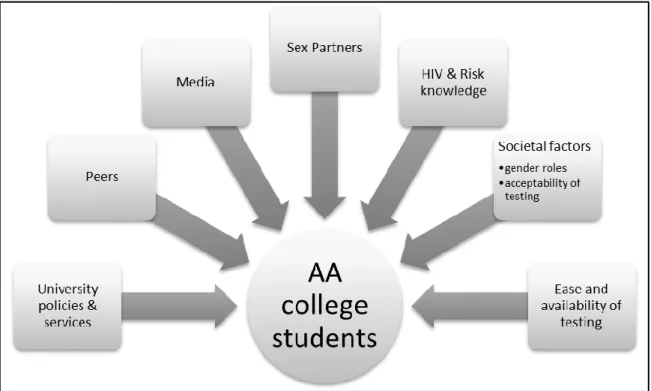
constructed a model of many of the forces that may influence students’ opinions about HIV (See Figure 1).
Students did not rate the HIV knowledge of their peers or members of the larger AA community very highly. Those interviewed demonstrated a breadth of knowledge on HIV, and rated their own knowledge higher than they did that of their peers or the broader African
American community. Individuals participating in the study had a wide range of knowledge with respect to the different areas of HIV (e.g. protection, ways to contract), but most appeared at least somewhat knowledgeable. In the systematic review, I also found studies showing that most students had high levels of HIV knowledge, but that this knowledge did not improve safe sex behaviors. In contrast to the general findings of my literature review, my interview
14
The participants in this study did not seem to have a good grasp of the meaning of risk, as demonstrated by the fact that some were confused by the very concept of HIV risk. This may help to explain the lack of association between risk and knowledge. If students are unaware of what HIV risks are or what constitutes risky behavior, it would be hard for them to curb these behaviors. College is often a time of sexual exploration and freedom; many risky behaviors are normalized. The definition public health officials apply to risky behavior (e.g. multiple partners, use of alcohol or drugs during sexual encounters) seems different than what students are qualifying as risky. One participant in my study said that in judging the health of a potential partner, men use the following logic: “She goes to school every day. She don't got HIV. She's not out here [getting money for sex]. She's not out here stripping or whatever.” This may
indicate that those in public health should do a better job of conveying high risk behaviors to the general public in what seems like “normal” rather than “deviant” life. She may “go to school every day,” but that does not make her invulnerable.
One of the main goals of my study was to understand how young adults view HIV because this is one of the major gaps in the current literature. The studies in my systematic review that addressed this had opposing results, with one showing that AA students did not have favorable attitudes towards people with HIV and the other showing the opposite.13,14 The students interviewed for this study generally held favorable attitudes toward those with HIV. Participants conveyed this through examples of hearing stories from people who are HIV
15
The stigma associated with people who are HIV-positive also permeated the topic of HIV testing. Participants emphasized that even being seen getting tested or discussing testing (outside of one’s circle of close friends) is something that remains taboo. Though participants expressed a willingness to be tested for HIV, they were still afraid of testing, to the point that some students disclosed that they had not been tested against their better judgment. These findings are similar to the stigma surrounding testing that Warren-Jeanpiere et al presented; researchers found that stigma affects students’ usage of protective services (e.g. free condoms or HIV testing on campus).15 Participants in this study echoed these findings, but also added to the discussion with comments on the role of student workers in college and university health service units, and how the presence of such student workers inhibits the use of these services. It is likely that universities allow students to work in these health centers to fulfill work-study positions or to encourage students’ interest in the health professions, but this seems also to have the unintended and detrimental effect of keeping students from accessing services intended to help them. We should examine universities’ policies governing student health services to see if they are operating in the best interests of students wishing to seek care there; one study surveying HBCU health administrators revealed that over half of the universities had no formal, written HIV prevention policies on campus.16
16
important sources of HIV/AIDS information for U.S. residents, and those who did gather information this way believed that these shows were providing truthful information.12,18
Using data from these types surveys, CBS, Viacom and KFF formed a public education initiative called KNOW HIV/AIDS. This program helped produce accurate HIV-themed shows on more than 75 popular TV programs that aired on CBS, UPN, MTV, BET, VH1 and
Showtime.19 Both the “Girlfriends” episode that participants described and the BET “Wrap it Up” campaign were supported by this initiative. Though the number of participants in this study was small, the fact that students were able to name and describe these efforts as positive sources of HIV information (years after they aired) suggests that these types of media campaigns work. The KNOW HIV/AIDS program appears still tobe functioning, but in a smaller way. They have not produced new programming, but the Wrap it Up campaign continues to operate and put on events at HBCUs and Public Service Announcements on BET. We need to direct more efforts and spending into projects like these as they have also been shown to be cost effective.20
Limitations
The small number of participants in this study and the fact that all of them have majored in the natural sciences means the data presented here may not be generalizable to the African American college student community. By recruiting from the summer program, I was able to get opinions of students from various universities in the southeastern region of the U.S. This is the area that experiences the highest incidence of HIV, particularly in the population represented by my respondents. In future studies, I would like to include a pre-test of participant HIV
knowledge and sexual habits to better interpret answers.
Conclusion
It is clear from the epidemiology of the disease that our current efforts are not
17
understand all the ways students receive information and what affects their decisions to practice safe sex or be tested for HIV. When we have done so, we can better formulate strategies for prevention. Based on this research and the information I extracted from the systematic review, I make the following recommendations: First, future studies should address the role university policies play in facilitating or hindering safe sex behaviors. Second, we need to determine how college students view risky behaviors and develop methods of prevention that incorporate these ideas. Third, methods of helping young adults (especially women) become more comfortable with discussing HIV testing and safe sex methods must be explored. Finally, more television shows and other media content should be used to promote the ideas of HIV testing and safe sex methods.21
Now, one LAST sentence that leaves them weeping and applauding, if we can…if not,
18
References1. Centers for Disease Control and Prevention. HIV/AIDS in the united states: 30 years of leadership and lessons. Centers for Disease Control and Prevention Web site.
http://www.cdc.gov/hiv/30thanniversary/. Updated 2011. Accessed 06/15, 2013.
2. Hightow-Weidman LB. Missteps, misunderstandings, and missed opportunities: HIV testing among young african americans. Sex Transm Dis. 2009;36(9):592-593. Accessed 6/18/2013 4:05:18 PM. doi: 10.1097/OLQ.0b013e3181b65c4a; 10.1097/OLQ.0b013e3181b65c4a. 3. Hightow LB, MacDonald PD, Pilcher CD, et al. The unexpected movement of the HIV epidemic in the southeastern united states: Transmission among college students. J Acquir Immune Defic Syndr. 2005;38(5):531-537.
4. Gayle HD, Keeling RP, Garcia-Tunon M, et al. Prevalence of the human immunodeficiency virus among university students. N Engl J Med. 1990;323(22):1538-1541.
http://dx.doi.org.libproxy.lib.unc.edu/10.1056/NEJM199011293232206. doi: 10.1056/NEJM199011293232206.
5. Davis C, Sloan M, MacMaster S, Kilbourne B. HIV/AIDS knowledge and sexual activity: An examination of racial differences in a college sample. Health Soc Work. 2007;32(3):211-218. Accessed 4/30/2013 6:44:49 PM.
6. Taylor SE, Jones T. African american college students' attitudes toward HIV/AIDS:
Implications for historically black colleges and universities. Challenge: A Journal of Research on African American Men. 2007;13(2):1-12. Accessed 4/29/2013 10:54:08 PM.
7. Duncan C, Miller DM, Borskey EJ, Fomby B, Dawson P, Davis L. Barriers to safer sex practices among african american college students. J Natl Med Assoc. 2002;94(11):944-951. Accessed 4/29/2013 10:54:08 PM.
8. Adefuye AS, Abiona TC, Balogun JA, Lukobo-Durrell M. HIV sexual risk behaviors and perception of risk among college students: Implications for planning interventions. BMC Public Health. 2009;9:281-2458-9-281. Accessed 4/30/2013 6:44:49 PM. doi: 10.1186/1471-2458-9-281; 10.1186/1471-2458-9-281.
9. Internet Movie Database (IMDb). Girlfriends (2000-2008). http://www.imdb.com/title/tt0247102/. Accessed 06/15, 2013.
10. Ehde DM, Ehde D, Holm J, Robbins G. The impact of magic johnson's HIV serostatus disclosure on unmarried college students' HIV knowledge, attitudes, risk perception, and sexual behavior. Journal of American college health. 1995;44(2):55; 55-58; 58. Accessed 6/20/2013 12:00:10 PM.
11. Shen L, Condit C, Wright S. The psychometric property and validation of a fatalsim scale. Psychology of Health. 2009;24(5):597-613.
19
13. Braithwaite K, Thomas V. HIV/AIDS knowledge, attitudes, and risk-behaviors among african-american and caribbean college women. International Journal for the Advancement of Counselling. 2001;23(2):115-129. Accessed 4/30/2013 6:58:20 PM. doi:
10.1023/A:1010611328452.
14. Thomas PE, Williams B, Shiloh M, et al. HIV risk behaviors and testing history in historically black college and university settings. Public Health Reports (1974-). 2008;123(Suppl 3):115-125. Accessed 4/29/2013 10:54:08 PM.
15. Warren-Jeanpiere L, Sutton M, Jones S. Historically black colleges and universities' campus culture and HIV prevention attitudes and perceptions among students. Journal of College
Student Development. 2011;52(6):740-748. Accessed 4/29/2013 10:54:08 PM.
16. Warren-Jeanpiere L, Jones S, Sutton MY. Health administrator perspectives on human immunodeficiency virus/acquired immunodeficiency syndrome prevention and services at historically black colleges and universities. Journal of American college health : J of ACH. 2011;59(4):327-329. Accessed 4/29/2013 10:54:08 PM. doi: 10.1080/07448481.2010.502202. 17. Vidanapathirana J, Abramson MJ, Forbes A, Fairley C. Mass media interventions for promoting HIV testing. Cochrane Database Syst Rev. 2005;(3)(3):CD004775. doi: 10.1002/14651858.CD004775.pub2.
18. Kaiser Health News. More U.S. residents gather health information, including HIV/AIDS information from fictional TV shows, los angeles times reports. KHN. 11/13/06 2006;Kaiser Health News' Daily Report. Available from:
www.kaiserhealthnews.org/Daily-Reports/2006/November/13/dr00041002.aspx?p=1.
19. CBS Corporation. Know HIV/AIDS wins the 2006 national public service announcement emmy award. CBS News. 10/31/06 2006;2006 Press Releases. Available from:
http://www.cbscorporation.com/news-article.php?id=19.
20. Palmgreen P, Noar S, Zimmerman R. Mass media campaigns as a tool for HIV prevention. In: Edgar T, Noar S, Freimuth V, eds. Communication perspectives on HIV/AIDS for the 21st century. Routledge; 2009:221.
20
Tables & FiguresTable 1. Participant demographics
ParticipantID
Age School type
(HBCU vs. TWI)‡
Year in college*
College major◊ Region of U.S. resided longest
W1 21 HBCU in
southeastern U.S.
2nd Natural sciences Born/raised outside of the U.S.
W2 21 HBCU in
southeastern U.S.
3rd Natural sciences Southeastern U.S.
W3 20 HBCU in
southeastern U.S.
4th Natural sciences Southeastern U.S.
W4 19 TWI in
southeastern U.S.
2nd Natural sciences Southeastern U.S.
W5 21 HBCU in
southeastern U.S.
3rd Natural sciences Southeastern U.S.
W6 23 TWI in
southeastern U.S.
4th Social sciences & Natural sciences
Northeastern U.S.
W7 23 TWI in
southeastern U.S.
4th Profession & applied sciences
Southeastern U.S.
M1 22 HBCU in
southeastern U.S.
4th Natural sciences Southeastern U.S.
M2 22 HBCU in
southeastern U.S.
4th Natural sciences Southeastern U.S.
M3 22 HBCU in
southeastern U.S.
3rd Natural sciences & Applied
sciences
Southeastern U.S.
M4 24 HBCU in
southeastern U.S.
4th Natural sciences Southeastern U.S.
‡HBCU=Historically Black College/University; TWI= Traditionally White Institution *denotes school year just completed
21
Table 2. HIV/AIDS Myths discussed by participants presented with representative
quotes
Virus misconceptions: Myths directly associated with the effects of the virus.
Because, I think, definitely in talking with a lot my friends and peers, a lot of people still think that if you have HIV that--HIV and AIDS are the same thing and that HIV leads to AIDS for sure. That it's basically a death sentence if you get it, things like that. (M3)
Looks healthy: The belief that one is able to tell if someone has HIV by physical
characteristics.
Here's another thing people think, especially in the college community, "She don't look like she got HIV. She goes to school every day. She don't got HIV” (M4)
Confidentiality of health workers: Belief that health workers are able to discuss diagnoses with others.
So I was just thinking, as soon as the nurse or whoever finds out [person has HIV] they would call the parent or guardian. Just to let them know that this person is not okay.(W1)
The virus can be contracted via touching or breathing on someone
And ignorance I think too, people not knowing enough about HIV, they think that they can get it if someone breathes on them or something (W3) Cost: Getting tested is
expensive.
I feel like most people know in general, but they might not know that you could get it for free. That it's that accessible. They might feel like I could go to the hospital, but it's going to cost me this or I don't have insurance so I can't get it… (W6)
Gay disease: HIV only affects homosexuals.
People are just [thinking] gay men. No, it's a little bit of everybody now. (W4)
*Note: some participants mentioned more than one of the above answers as there was no specific question asked about HIV myths/misconceptions.
Table 3. Percentage of young adults (age 18-29) who say they would like to have
more information about the following HIV topics
Total (%) Whites (%) Blacks (%)
How to talk with children about HIV/AIDS 52 42 68
How to prevent the spread of HIV 50 41 66
How to know who should get tested for HIV 47 39 60
Where to go to get tested for HIV 47 38 59
How to bring up the topic of getting an HIV test with
your partner 44 36 56
How to talk with a health care provider about
HIV/AIDS 38 29 56
Recreated from:
22
Figure 1. Influences on the African American college students' HIV knowledge and
Original figure rendered from the literature presented in the systematic review (see Appendix A) and information obtained from study results
Recreated from: Kaiser Family Foundation. "Pulling it Together: America Has Gone Quiet on HIV/AIDS." The Henry J. Kaiser Family Foundation. web (http://kff.org/hivaids/pulling-it-together-america-has-gone-quiet/) 1
A-i
Appendix A: A review to assess the knowledge, attitudes and behaviors of AfricanAmerican college students concerning HIV/AIDS.
I performed a limited systematic review to assess the quality and content of the available literature on the following question: What are the knowledge, attitudes and behaviors of African American college students with respect to HIV/AIDS ?
Search Strategy
On April 30, 2013 I performed a literature search in both Pubmed and the UNC Articles+ databases using the following terms: “attitudes AND HIV/AIDS AND college AND race.” The search was limited to journal articles with abstracts available in English. This search returned 276 results in UNC Articles+ database and 56 results in the Pubmed database. I reviewed the titles of the articles using the following criteria: (1) article must specifically mention
college/university students as the participants or subjects of the study and (2) the title must mention HIV/AIDS, risk behavior, or sex. After I reviewed the titles of the articles and removed duplicates from the search, 75 articles remained. I then reviewed the abstracts of these remaining articles. The criteria for inclusion during the abstract review were that (1) race must be mentioned as a part of results or analysis, (2) the method of data collection must involve surveys, focus groups, or interviews, (3) the research cannot be a literature review, systematic or otherwise. I excluded any papers that did not meet these criteria, and was left with 30 articles. Excluded studies only measured behaviors (e.g. condom use) or discussed
prevention efforts with no mention of attitude or opinion. I also excluded articles that discussed professional students’ attitudes towards patients/family members with HIV.
A-ii
In the 2001 the CDC released revised guidelines that recommended routine testing in health care settings and prevention counseling.(2) The revision also endorsed targeted testing of patients believed to be high risk by the physician (e.g. men who have sex with men); they also recommended testing patients who were seeking treatment for STIs. Many programs aimed at testing and counseling vulnerable populations were put into place after the 2001 revised guidelines were released.(3) For this reason, I decided to exclude articles published prior to 2001, as many physicians and community centers were not routinely testing or counseling patients. This excluded 8 additional articles, leaving 22 for review.
After a full text review of the remaining 21 articles, I excluded a total of eight more: two were excluded because HIV testing was the major outcome reported with no mention of attitudes, four articles assessed HIV risk behaviors but not attitudes; one study examined HIV preventive sex behavior; and another only analyzed condom usage. After all the exclusion iterations, I had 14 articles for final appraisal and review.
Results
The systematic review is an appraisal of the 14 articles that met the described criteria for inclusion. These articles represent a wide range of qualitative data collection methods, though the majority of the studies were conducted at Historically Black Colleges and Universities (HBCUs) and involved similar participant demographics. The studies assessed and reported multiple variables, but only those variables pertaining to the original research question are reported here. For the purpose of this review, I will attempt to assess the literature by
A-iii
Article Appraisal. The articles employ a divergent group of methods, frameworks and theories. I recognized the need to find a standardized way of assessing, much as one would for a critical appraisal of a randomized trial. I devised two standardized checklists and scoring systems for article appraisal; one checklist was used for articles that utilized surveys as the method of data collection and the other I used to appraise articles that used either in-depth interviews or focus groups. Parts of these devised checklists were adapted by me from the COREQ study by Tong, et al.(4) I appraised each article using the items on this checklist (see Tables 2A and 2B), and gave them a numerical score. I also expressed these scores as a percentage for comparability.
After I appraised the articles for quality using the checklists, articles’ quality scores ranged from 22.5% to 90.0% with a mean of 59.9 ±18.7%. Using the standard deviation, I created the following scoring guide for the articles: ≤41% is a poor quality article, 42-78% fair quality articles, and articles scoring ≥79% are of good quality. Two articles received a poor quality rating and were not included in further analysis. (5, 6)
HIV Knowledge, Behavior and Risk. Five articles discussed the knowledge that participants had about HIV/AIDS and any effect that this knowledge has on either risky behaviors or perceptions of risk. Most of these studies reported that students demonstrated high levels of knowledge about HIV, but this awareness was not correlated with safe sexual behaviors.(7-9) Put more simply, individuals with high knowledge about HIV/AIDS were not better at condom usage or HIV testing than were those individuals who were not very knowledgeable about HIV.
A-iv
this activity were both knowledgeable about HIV and were more likely to use condoms during this instance. (8) Foreman’s interviews also revealed a similar weighing of risks, as women discussed a stratification of the types of sexual encounters based on frequency of sex and level of commitment. Women said that they were more likely to use a condom for casual and “wham bam” encounters, than for long-term relationships. (“Wham bam” refers to instances where a man attempts to have sex with a woman with no intent of contacting her after the sexual encounter, and casual sex is when both parties have a mutual understanding that it is a non-committal act.)
One study also presented data suggesting students who were sexually active were less knowledgeable about HIV than those who chose to abstain from sex; (8) it is important to note that this study had lower power, but a higher quality assessment than did the previous studies. Another article specifically focused on how participants’ perception of their own risk for
contracting HIV correlated with sexual behavior.(10) In this study, participants regarded themselves as low-risk for contracting HIV despite engaging in risky behaviors.
A-v
education, sociology and social work, and the Davis study presumably involves students from all majors (this is not addressed in article); these college majors may select for individuals who are more likely to be accepting and non-judgmental due to the nature of the education and the diverse populations studied. It is interesting to note that women in this study with high levels of self-esteem also demonstrated positive attitudes. It is unclear from the data why students who abstain have such different beliefs and attitudes; the authors suggest that it might be that those who abstain do so because of their increased knowledge and do not wish to engage in risky behaviors. Previous studies have indicated that HIV knowledge, alone, does not influence decisions to practice abstinence and that it may be linked to a fear of contracting HIV instead. No subgroup analysis of gender was performed (due to low power), Davis’ study did include a higher proportion of women; this group has been shown to have increased HIV risk perceptions and are more likely to use abstinence as a form of safe sex.(11, 12)
A-vi
surrounding free condom distribution on campus or seeking HIV testing is so great it keeps students from using these services on campus.
Information on HIV/AIDS. HIV education and information gathering appeared in several articles. As previously stated, the majority of participants in the studies demonstrated high levels of HIV knowledge. Despite this, many did not feel that they receive enough education on the disease. (16) Two studies reported that students felt universities should be more involved with this education by making HIV education a formal part of the school’s curriculum or by providing workshops. (9, 14) Others felt that these discussions should begin earlier with better sexual education in high school or at home from parents, because current methods mainly rely on attempts to “scare students away from sex.”(17) Men in this study claimed the only sex education they received was “their fathers telling them do not get anyone pregnant so wear a condom.” One study found that students believe that television is the most effective medium for conveying HIV knowledge, but that knowledge is not often disseminated in the mass media.(14) Participants of the Hodge and Wade study felt that the images seen in the media promote risky sexual behavior and a “carefree sexual lifestyle.” (17)
Discussion
The literature review provided some explanations of HIV knowledge, behaviors, stigma and the availability of information about HIV to African American students. Many of the
participants surveyed were knowledgeable about HIV and expressed a need for more
A-vii
getting information out to students more effectively. Many universities already have faculty and staff devoted to studying the disease, and it is ironic that this research is produced at these higher education centers but not disseminated to the students who are most at risk.
Students’ attitudes towards those living with HIV cannot be clearly understood. The two articles addressing the question were not in agreement. This could suggest a wide range of opinions toward HIV within the African American college community. These results may also be a result of the limitations of the studies, as they are both small and involve different populations. In either case, we need to know more about students’ views of those with HIV, from which we can work to better tailor the messages put out to students.
Any attempts at putting out more information must also be paired with other tactics because the data presented suggests that those who do have the appropriate knowledge are not necessarily using this knowledge to change sexual behaviors. A potential reason for this pattern of pairing high knowledge and risky behaviors may be inferred from the 2007 Adepoju, et al study; in the study almost one-fifth of respondents (who were women) expressed a fear that their partners may reject them or refuse sex if they insisted on condom use. This is troubling, but gives some insight into the gender dynamics that may occur in relationships. This dynamic is echoed in other articles where women discussed their reliance on men to provide and use condoms during sexual encounters(15) and additional studies that suggest that women feel sex without condoms is regarded as being more intimate.(18, 19)
A-viii
It is also possible that the situation is a lot simpler. A respondent in the Hodge study stated that he would “rather have sex and take the risk and hope that I don't get it [HIV/AIDS] than not to have sex." Yet another respondent said "disease is not something we think about, we are young and figure we have time to fix whatever may happen.” (Hodge) If this is the case, it might be much harder to reach students with our current tactics.
A potential limitation of my review is including heterogeneous studies in the review. Though attempts were made to appraise and compile the data in a way that makes for easy comparisons, the extreme differences in the techniques of data collection and sample size reduce the overall generalizability of the results. Many of the articles included in this study have small sample sizes; this is a product of their data collection strategies. Focus groups and in-depth interviews are not typically done with hundreds of participants. Poor quality caused the exclusion of two articles from the analysis. The remaining articles were of varying degrees of quality; the biggest problems with quality occurred in most articles because authors did not fully describe the methods of data collection or analysis.
A-ix
Table 1. Description of study design, population, finding and quality of articles included in the review
Main question
of the study & study design
Study population (only includes participants used in analysis)
Location Findings Quality†
Adefuye
et al
(2009)
(10)Sexual risk behaviors and perception of HIV risk of students in a predominantly African American commuter urban university.
n=390
Ages: 17-64; ̅= 23.8
32% freshman, 22% sophomores, 25% juniors, 17% seniors 3% undisclosed
69% female
Minority-serving commuter university in the Midwest
Low perception of risk of HIV infection despite the levels of reported high risk sexual behaviors. By age, 48.1% of 20-29 year olds expressed this view and 57.9% of those under the age of 20 expressed this as well.
Alcohol use in females was associated with higher rates of inconsistent condom usage. Fair (67.5%) Survey
Adepoju
et al
(2007)
(16) Ascertain the perception of and knowledge of HIV/AIDS in freshman nursing students. n=68: 64 female, 4 male
Ages: 16-40; ̅= 17.7
All participants are first year, first semester nursing students
82% AA
HBCU in northeastern U.S.
A majority of respondents believed that were at high risk for contracting HIV, and were aware of protection methods.
Some participants expressed that partners may reject them or refuse sex if condom use was insisted (19%)
Participants felt that more education was needed about HIV.
Fair (42.5%) Survey
Adepoju
et al
(2009)
(5) Appraise knowledge level after 4 years of college education in nursing, and to ascertain whether their attitudes towards use of condoms changed. n=20
Ages: 19-44; ̅= 24.2
Attrition rate of 66%
All participants are senior nursing students
75% AA
HBCU in northeastern U.S.
In this follow up study, 60% stated they would insist on using condoms. Only 1 participant expressed fear about rejection if condom use was insisted.
Poor (30%)
Survey
HBCU= Historically Black College or University AA= African American
TWI= Traditionally White Institution
A-x
Table 1, continued. Description of study design, population, finding and quality of articles included in the review
Main question of the
study & study design
Study population (only includes participants used in analysis)
Location Findings Quality†
Braithwaite
& Thomas
(2001)
(7)What are AA and Caribbean women's attitudes toward HIV/AIDS? To what extent do sociocultural factors relate to the women's HIV/AIDS knowledge, attitudes, and risk behaviors?
n=132 Women: 70 AA +
62 Caribbean born
All single undergrads
Majors: education, sociology or social work
Mean age: 22.9
HBCU in
Washington, D.C.
Women in the study demonstrated high levels of knowledge, but this was not correlated with a decrease in risk taking behaviors.
Participants also scored high on the attitudes towards AIDS scale, indicating more positive or accepting attitudes toward people with HIV/AIDS
AA women reported lower levels of open sexual
communication than Caribbean women.
Fair (72.5%)
Survey
Brandon et
al (2010)
(13)Examined AA students’ perceived fear of having a seropositive HIV status, their general self-efficacy, and screening efficacy.
n=398, 62% female
Ages: 19-27; ̅= 24
42% seniors, 26% juniors, 17%
soph/freshman, 15% grad students
HBCU in southern U.S.
1/5 of participants expressed a fear of being tested for HIV. Those who expressed fear of screening were more likely to worry that if they were diagnosed with HIV: (1) peers would ostracize them, (2) that others would find out that they were receiving treatment, (3) friendships would end, (4) people would be afraid of them and (5) their sexual lives would end
Fair (60%)
Survey
Davis, et al
(2007)
(8)Theory of Reasoned Action (TRA) as a framework to explore HIV/AIDS-related
knowledge, attitudes, and vulnerability and the relationship to White and AA college students’ intention to adopt safer sex behaviors.
n=145; self-identified as white (91) or AA (54)
38 men, 107 women
70% ages 18-21
3 public universities in the southern U.S. (2 TWI and 1 HBCU)
No difference in the awareness of HIV/AIDS between white students and African Americans.
Students who reported being sexually active were much less knowledgeable about HIV than those abstaining from sex; sexually active students were also more prejudiced towards individuals living with HIV/AIDS.
Condom use is not correlated with HIV knowledge (with the exception of the intent to have one-night stands—those who expressed intent and used condoms had higher rates of HIV knowledge).
Fair (77.5%)
Survey
HBCU= Historically Black College or University AA= African American
TWI= Traditionally White Institution
A-xi
Table 1, continued. Description of study design, population, finding and quality of articles included in the review
Main question of the
study & study design
Study population (only includes participants used in analysis)
Location Findings Quality†
Foreman
(2003)
(18)The purpose of the study was to understand and describe the safer sex decision-making processes of a group of AA college women.
n=15 AA females
Age: 18-33 years,
̅= 22
2 had children, 4 ever pregnant
5 freshman, 3 soph, 3
juniors, 3 seniors, 1 grad
University of Texas
Women stratified different types of sexual encounters (i.e., wham bam, casual, homie-lover-friend & long-term), and with each type of encounter there was a difference in condom use and perceived susceptibility to HIV.
Women discussed the difficulty of introducing
condoms into sexual relationships. Some defined the terms "safe sex" and "protected sex" in much
different terms though these words are used interchangeably in the literature. (i.e. women
described safe sex to mean abstinence and protected sex could mean condom use or birth control use)
Fair (77.3%) Individual in-depth interviews
Hodge &
Wade
(2007)
(17)To identify the
sociocultural aspects of HBCUs that may place them at greater risk of HIV/AIDS infection.
n=37 for interviews
n=2021 for surveys
5 HBCUs in Atlanta, GA
Participants believe that the popular media promotes and normalizes risky sexual activity.
Also expressed a need to have sex/HIV education in high school and at home from parents. Men stated that the only sex education they received was getting condoms from parents or being told “not go get anyone pregnant.”
Feelings of invincibility and risk taking were also expressed by participants.
Fair (47.9%)
Qualitative interviews conducted via internet chat rooms + surveys
Hou
(2009)
(20)Compare HIV-related behaviors among black students attending HBCUs and white students attending a traditionally white institution (TWI).
n=557; 335 TWI
students 222 HBCU students
HBCU: mean age
20.42, 81.1% female
TWI: mean age
20.78, 72.5% female
TWI in
southeastern U.S + 15 HBCUs in southern U.S.
Compared with white students, black students perceived themselves at a higher risk of HIV infection.
Black students were found 8.4 times more likely to report having been tested for HIV, 3.8 times more likely to ask partner’s HIV status and 2.9 times more likely being asked of their own HIV status
Fair (67.5%)
Online surveys
HBCU= Historically Black College or University AA= African American
TWI= Traditionally White Institution
A-xii
Table 1, continued. Description of study design, population, finding and quality of articles included in the review
Main question of
the study & study design Study population (only participants used in analysis)
Location Findings Quality†
Khosrovani,
et al
(2011)
(14)The effect of
information dispersed by the media on the students' knowledge and awareness of HIV/AIDS.
n=331
58.3% female
Freshman/soph (60.3%), juniors/seniors 28.8% and grads 3.9% HBCU in southwestern U.S.
TV is most influential for conveying HIV knowledge, but most feel not enough time allotted to HIV on mass media.
Students were knowledgeable about HIV, but some still harbored some misconceptions about the spread through casual contact (i.e., kissing can spread disease). 76% of students felt that HIV education should be a part of a universities formal curriculum.
Students admit to multiple partners and not being faithful in relationships. More men than women admitted to being unfaithful. Many also admitted to intermittent use of condoms and risk taking behaviors.
Fair (62.5%)
Surveys + 10 in-depth interviews
Sutton, et al
(2011)
(9)To examine the HIV knowledge of students at HBCUs to inform and strengthen HIV prevention efforts.
n=1051
51% female
Age: 76%
18-21 years
57%
freshman/soph
19 HBCUs Most respondents were knowledgeable about HIV and
considered themselves low risk despite inconsistent condom usage and multiple partners.
Those who were more knowledgeable were more likely to ask
potential partners about past sexual history.
Students felt HIV should be taught in orientations/ workshops.
Good (90.0%)
Survey
Taylor, et al
(2007)
(6) African American college students’ attitudinal domains regarding the HIV/AIDS epidemic. n=42 Age: 18-29
61.9% female
Southern HBCU
Students expressed a fear of HIV testing, and the sentiment that they would rather not know their status.
Some participant expressed a belief that HIV is part of a conspiracy.
1/5 of students believed that HIV/AIDS was a disease of the homosexual population. Poor (22.5%) Survey (open-ended)
Warren-Jeanpiere,
et al
(2011)
(15) Examines how sociostructural factors present on HBCU campuses affect sexual decision making and HIV protective strategies. n=66 (6 focus groups held)
6 HBCUs (5 in the
southeast and 1 in the Midwest)
Sneaking: Visitation is not allowed between male/female dorms and participants expressed the need to sneak around to engage in sex.
Females rely on males to get condoms.
Stigma/lack of confidentiality: Condoms are kept in an area where staff/others see students pick them up and engage them in conversation. The family atmosphere of HBCUs is challenging to maintaining privacy
Lack of discussion on homosexuality: No acknowledgment of same-sex encounters on campus; reinforced by dorm visitation rules.
Men take advantage of the imbalanced male: female ratio
Fair (70.5%)
Focus groups
HBCU= Historically Black College or University AA= African American
TWI= Traditionally White Institution
A-xiii
Table 2A. Appraisal checklist of articles using
survey data.
◊A de fuy e A de po ju A de po ju 2 B rai th w ai te B rand on D av is H ou S utt on Ta ylor
1. Interviewer/facilitator: Who administered the surveys?
-
-
-
-
-
●
-
●
-
2. Methodological orientation and theory: Did the
researchers clarify the framework they used to explore research questions and aims? e.g. describe meaning and significance of experiences, phenomenology, content analysis
-
○
-
●
●
●
●
●
○
3. Sampling: How were participants selected? e.g.
purposive, convenience, consecutive, snowball
●
-
●
●
●
●
●
●
-
4. Criteria for participant inclusion?
-
○
●
●
○
●
-
●
●
5. Method of approach: How were participants
approached? e.g. face-to-face, telephone, mail, email
●
-
-
-
●
●
●
●
○
6. Sample size: How many participants were in the study?
●
●
●
●
●
●
●
●
○
7. Non-participation: How many people refused to participate or dropped out? How many surveys were not used in the results? Reasons?
●
-
-
-
○
-
-
-
○
8. Setting of survey: Where was the data collected? e.g.
home, clinic, workplace
●
●
-
○
●
●
●
●
-
9. Description of sample: What are the important characteristics of the sample? e.g. age, college year, sex
●
●
○
●
○
○
●
●
○
10. Survey: Were questions, prompts, guides provided by the authors? Did authors discuss how survey was developed?
○
○
-
●
●
●
●
●
-
11. Duration: What was the duration of the survey?
-
-
-
●
-
-
●
-
-
12. Software: What software, if applicable, was used to
manage the data?
●
-
-
-
-
-
-
●
-
13. Are any contradictory data taken into account or
noted?
●
-
-
●
-
●
●
-
-
14. Data and findings consistent: Was there consistency
between the data presented and the findings?
●
○
○
●
●
●
○
●
○
15. Clarity of major themes: Were major themes or findings
clearly presented?
●
○
-
●
●
●
●
●
○
16. Clarity of minor themes: Is there a description of
diverse cases or discussion of minor themes?
-
●
-
-
-
○
●
●
-
17. Does the researcher discuss the contribution the study
makes to existing knowledge or understanding?
●
○
○
●
●
●
●
●
-
18. Does the research acknowledge and address study
limitations and potential for bias?
●
○
○
●
●
●
-
●
-
19. Does the research discuss new areas of research
needed?
●
●
●
●
○
○
●
●
-
20. Method of assessing internal validity
-
-
-
●
●
●
-
●
-
◊Articles could receive one of three scores for each item:
- (dash): denotes that the article does not address the item
○ (hollow circle): denotes that the articles address the item incompletely
● (full circle): denotes that the article addresses the item completely
Score (out
of 20) 13.5 8.5 6 14.5 13 15.5 13.5 18 4.5
Percentage