Mejores Hábitos Mejor Vida:
An obesity prevention program plan and evaluation for underserved populations of Costa Rica.
By
Julie DeCoster
A Master’s Paper submitted to the faculty of the University of North Carolina at Chapel Hill
in partial fulfillment of the requirements for the degree of Master of Public Health in
the Public Health Leadership Program
Chapel Hill
2012
[Signature]
Advisor:
Date
[Signature]
Second Reader:
ABSTRACT
The burden of obesity and related non-communicable diseases (NCDs) in low- and
middle-income countries such as Costa Rica is rapidly increasing due to globalization,
urbanization, and increasingly sedentary lifestyles. NCDs are responsible for about 80% of
deaths, yet these could be prevented by modifying major risk factors such as unhealthy diets and
physical inactivity, which can lead to overweight and obesity. Mejores Hábitos Mejor Vida is a
program created for International Service Learning (ISL), a non-governmental organization that
enlists student volunteer teams, to educate underserved communities about improving nutrition
and physical activity to prevent obesity and NCDs. This paper provides a review of
community-based programs in Latin America that provide education about diet and exercise. Next, it
provides a detailed description of the program plan, including its theoretical framework, goals
and objectives, and plan for implementation. Activities for the program include curriculum
development, volunteer and staff training, community member recruitment, and patient
education. This is followed by a plan for evaluation of the program, which describes both
observational and pre-test/post-test study designs, including evaluation planning tables, and
presents the plan for dissemination. Lastly, the paper concludes with a summary of lessons
TABLE OF CONTENTS
ABSTRACT ... 2
INTRODUCTION ... 4
SYSTEMATIC REVIEW ... 8
Introduction ... 8
Methods ... 9
Summary of Programs ... 11
Analysis ... 21
Conclusion ... 24
PROGRAM PLAN ... 25
Overview ... 25
Program Context ... 26
Theoretical Framework ... 30
Goals and Objectives ... 32
Logic Model ... 33
Implementation ... 33
EVALUATION PLAN ... 38
Rationale for Evaluation ... 38
Approach to the Evaluation ... 39
Evaluation Study Design ... 41
Evaluation Methods ... 43
Evaluation Planning Tables ... 44
Dissemination Plan... 48
DISCUSSION ... 50
ACKNOWLEDGEMENTS ... 54
REFERENCES ... 55
INTRODUCTION
Chronic, non-communicable diseases, including cardiovascular disease, diabetes, and
cancer, were once thought to be problems of wealthy, industrialized nations, while infectious
diseases burdened the developing world. However, non-communicable diseases (NCDs) are
now the leading cause of death worldwide, consequentially threatening low and middle income
countries in conjunction with persistent communicable diseases. In 2008, 36 million deaths were
due to NCDs with nearly 80% occurring in low and middle income countries1. This burden is
projected to substantially increase which could have major adverse social, economic, and health
effects2, as well as exacerbate existing inequalities. Therefore, NCDs have emerged as an
important challenge and priority in global health.
Many opportunities exist to prevent and control NCDs by using concerted efforts to
address the risk factors for NCDs. Risk factors are well-known and include the following:
tobacco use; energy-dense, nutrient-poor diet; physical inactivity; and harmful consumption of
alcohol. Together these cause more than two-thirds of new cases and add to the complications of
those with existing NCDs1 ,3
. Furthermore, these risk factors lead to metabolic conditions such as
overweight and obesity which are also highly associated with development of NCDs. Risk of
cardiovascular disease, stroke, and diabetes increase steadily with increasing body mass index
(BMI), and the worldwide prevalence of obesity has doubled over the past twenty years1.
Therefore, prevention and reduction of overweight and obesity is needed immediately to halt the
morbidity and mortality trajectory of NCDs.
Prevention of obesity and related NCDs seems deceptively straightforward: eat healthy
and exercise. However, behavior change is difficult and individual choices are affected by
addition, this demographic and nutritional transition is driven by rapid urbanization,
globalization, and increasingly sedentary lifestyles 5. For example, people now consume more
sweetened beverages, vegetable oils, and animal-source foods; watch television more; have less
strenuous labor at home and work; and use more motorized transportation over walking6. Modern
food processing and distribution techniques, technology innovations, global media expansion,
global agricultural policies, and replacement of fresh markets by large supermarkets are
undoubtedly some of the sources for the changes in food consumption and physical activity
patterns, and consequent changes in body weight and body composition1, 7. Consequently,
effective prevention and management will require an integrated approach involving actions in all
sectors of society to decrease the future burden of NCDs.
One way to address the issue is through health promotion strategies with a strong focus
on primary prevention, which would empower people to avoid risk factors and create
environments that support better behavior choices. It has been well documented that unhealthy
diets and physical inactivity are the leading causes of obesity and related NCDs3. Thus, at the
international level, there have been several landmark documents recognizing the need for action
and recommending development of strategies and policy frameworks in support of changing
diets and activity levels. However, a mismatch remains between the compelling evidence of the
disease burden and concrete steps to implement effective interventions. Global health
stakeholders and national governments in low- and middle-income countries must work together
in order to balance competing priorities, allocate resources, build capacity, and implement
programs if changes are going to be made.
Latin American and Caribbean (LAC) countries are on the front line of the demographic
emerge from poverty, especially in urban areas8. The dramatic transition has occurred in less than
twenty years wherein at least one out of four adults in LAC countries are overweight 6. Certain
countries have a much higher prevalence and are rivaling the health profiles of high-income
countries like the United States. In particular, a significant upward trend is seen in Costa Rica, a
middle-income country of Central America, where over half of the population is overweight and
81% of deaths are attributed to NCDs9. In Costa Rican women aged 20-44 years, the prevalence
of obesity and overweight increased steadily from 35% in 1982 to 46% in 1996 to 60% in 200910.
Similarly, Costa Rican men have a similar trend with an increase of 22% in 1982 to 62% in
200910. Therefore, education and lifestyle interventions that address obesity and NCDs in Costa
Rica are imperative to optimize nutrition and health.
International Service Learning (ISL) is an international educational, non-governmental
organization that enlists medical and educational volunteer teams for the provision of services to
under-served populations, mainly in Latin America11. After past participation with ISL and
collaboration with their Director of International Programs, Dr. Sonia Hernandez, we developed
a program called Mejores Hábitos Mejor Vida to address obesity risk factors in underserved
areas of Costa Rica. ISL teams typically see acute cases in clinic, but many opportunities exist
to educate communities about developing better habits, notably healthy diets and increased
physical activity, to prevent NCDs. The program is an innovative approach for ISL teams to
integrate more public health, collaborate with the Ministry of Health or other organizations with
similar goals, and reduce the incidence of NCDs in areas where routine healthcare is not
available. The activities in the program include curriculum development, staff and volunteer
training, community member recruitment, and patient education. With persistence of ISL teams,
to improve nutrition and physical activity knowledge in communities and initiate one small step
towards better long-term health in Costa Rica.
The purpose of this paper is to provide a comprehensive overview of Mejores Hábitos
Mejor Vida. The first section of the paper consists of a review of the literature for similar
programs in Latin America to identify effective strategies that may help our program. The
second section is a description of the program plan including goals and objectives, theoretical
constructs, a logic model, and an implementation plan. The third section comprises a plan for
evaluation, including the rationale for evaluation, the approach to evaluation, the study design
and methods, and a plan for dissemination. Finally, the paper concludes with a discussion of the
SYSTEMATIC REVIEW
Introduction
A landmark document for NCDs called the Global Strategy on Diet, Physical Activity
and Health was released by the World Health Organization (WHO) in 2004 after consultation
with concerned stakeholders. Its recommendations included the following:
Preventive services, whereby health-care providers give advice to patients and
families about key dietary habits and physical activity combined with simple
information and skill-building as a cost-effective intervention3
International partner and nongovernmental organization involvement, whereby
organizations cooperate in and support the development, testing, and
dissemination of models for community involvement including nutrition and
physical activity education to reduce NCDs3
International Service Learning aims to meet these recommendations and uses the WHO’s
strategy as the foundation for Mejores Hábitos Mejor Vida. In designing a new program, we
must consider effective and practical interventions that will facilitate wide application and
adaption of our program to achieve better outcomes.
Studies evaluating the effectiveness of interventions to improve patient compliance show
that comprehensive programs that combine educational, behavioral, and affective components
are more successful than single-focus interventions12. Therefore, an important question to ask is:
have other organizations or agencies in Costa Rica been successful in following the WHO’s
recommendations and establishing comprehensive programs that prevent obesity and promote
The objective of this systematic review is to identify existing literature on
community-based programs in Costa Rica that promote prevention of obesity or related noncommunicable
diseases through education on diet and physical activity. After finding similar programs in the
area that have been evaluated, the goal is to identify characteristics of successful programs,
detect challenges of the programs, and incorporate the elements that have been successful.
Comparable programs should incorporate the elements that are essential to Mejores Hábitos
Mejor Vida, which include:
1. Population: adults in Costa Rica or similar Latin American countries
2. Intervention: education about healthy eating and physical activity
3. Outcome: improvement in knowledge, promotion of healthy lifestyle, reduction in
BMI and other risk factors
4. Focus on preventing overweight/obesity or related diseases of diabetes or
cardiovascular disease
Methods
Research Question: This literature review was conducted with the following research question:
What can be learned from existing programs that utilize community-based education to
encourage healthy eating and physical activity in order to prevent and reduce obesity in Costa
Rica and other Latin American countries?
Search Strategy: To identify potential programs, I conducted a systematic literature search of
electronic databases (PubMed, Embase, Global Health via EBSCO Host, and Google Scholar).
The original purpose of the search was to identify all published English- and Spanish-language
Costa Rica during the past 15 years. Considering the WHO recommendations were made about
10 years ago, the hope was to find more recent articles that may have adapted WHO strategies.
My search strategy was guided by a preliminary review of the literature and the assistance of two
research librarians at the University of North Carolina at Chapel Hill’s Health Sciences Library.
I searched the PubMed online database using the terms “Costa Rica” AND (“health
education” OR “primary prevention” OR “patient education as Topic”) AND (exercise OR diet
OR obesity OR overweight). All these terms were found in the MeSH database on PubMed.
Other MeSH terms added included “community health services,” ”preventive health services,”
and “health promotion” which did not yield different results. I then used multiple combinations
of these search terms in the other databases. Given the lack of evidence found in a preliminary
search for Costa Rica, the location was expanded to all of Central America and then Latin
America using the search terms (“Latin America” OR “Central America” OR “Costa Rica” OR
“El Salvador” OR Belize OR Guatemala OR Honduras OR Nicaragua OR Panama).
The search in PubMed only yielded 20 articles over the past 15 years with these search
terms. I reviewed the titles and relevant abstracts of the articles to look for the following
inclusion criteria:
1. The article is available in full text format in English or Spanish.
2. The program took place in a Latin American country.
3. The program participants were adults.
4. The program used an educational intervention (excluded if only collected
Only two programs in PubMed, Embase, and Global Health met the inclusion criteria. Google
Scholar yielded two additional articles. Given the low yield of recent publications in Latin
America, titles and abstracts published greater than 15 years ago were examined but proved to be
irrelevant.
No literature was identified that focused specifically on primary prevention of obesity
with diet and exercise education. However, the four research articles found served as guidance
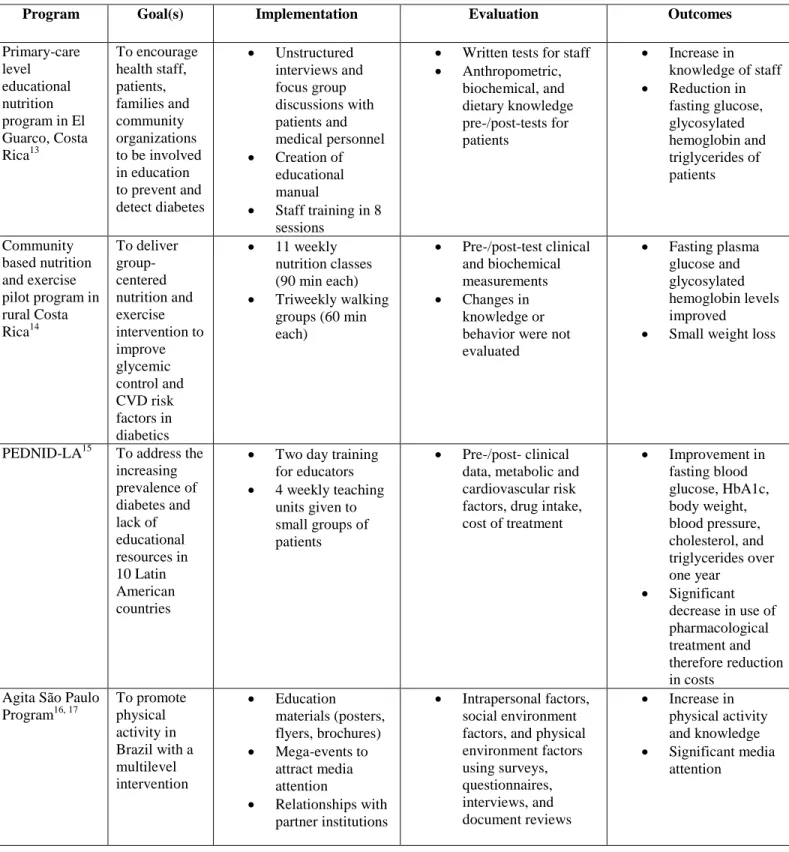
and will be discussed below, as well as in Table 1 in the Appendix.
Summary of Programs
Primary-care level educational nutrition program in El Guarco, Costa Rica
Valuing the importance of informing, motivating, and empowering individuals and their
families about control and prevention of diabetes through education, an educational program was
started in Equipos Básicos de Atención en Salud (EBAIS) in El Guarco, Cartago, Costa Rica in
1998. EBAIS are health teams that work together to deliver primary and preventive care for
individuals in the area. Each team serves about 4000 people and consists of a physician, director,
and support staff in dentistry, microbiology, social work, and nursing13. The goal of the program
was to encourage health staff, patients and their families, and community organizations to be
involved in educational processes, adapted to local conditions, to prevent and detect diabetes.
Type 2 diabetic patients between 30 and 60 years were identified who lived in the area,
regularly attended EBAIS, and were absent of chronic complications. Thirty seven patients met
these criteria. The program plan was divided into three stages. First a qualitative study of
unstructured interviews and focus group discussions 13. In addition, the patients participated in an
interview about food availability. In the second stage of the program, results of the first stage
were used to create an educational manual and training for staff who in turn trained diabetic
patients. Staff training was evaluated through a written test on topics such as disease knowledge,
nutrition, teaching methods, and community characteristics. Patient training was evaluated
before and after four months by anthropometric, biochemical, and dietary knowledge testing. In
the third stage, strategies for sustainability in the area and promotion of community participation
were incorporated into the program 13.
During the first stage, the qualitative study identified common beliefs and principle
barriers that show that existing educational programs often inadequately served the educational
demands of the population. For example, barriers identified include: lack of family support,
limited communication with health staff, incongruity of health messages received, and
recommended diets that are difficult to follow. The food availability survey showed that
assortment of fruits and vegetables were limited, despite El Guarco being an agricultural area13.
During the second stage, the educational materials were developed to respond to the
needs of health personnel, patients, and the health area. The staff manual included an overview
of the structure of the educational sessions, teaching techniques, evaluation activities, principles
of adult education, and the profile of diabetes. Topics covered about diabetes included
recommended treatments, food distribution plans, characteristics of a healthy diet, symptoms,
and prevention of complications. Staff training was delivered by the project coordinator in eight
sessions of two hours each and included participatory techniques such as performances,
demonstrations, and case discussions. Evaluation showed a significant increase in knowledge of
sessions. Only 26 patients participated in the entire course and 92% were women. There was a
statistically significant reduction in fasting glucose, glycosylated hemoglobin and triglycerides13 .
Progress was made to ensure sustainability. The health area of El Guarco incorporated the
program as part of its commitment to improve the quality of comprehensive care for diabetic
patients. Local media was used as part of the community-based outreach. A local radio station
broadcasted public announcements about diabetes and its implications, and for five months a
monthly diabetes education message was performed on television. In addition, the area had a
health fair to screen for diabetes and its risk factors in the community, and then another fair at a
farmer’s market13.
A major limitation to the study is the small sample size of 37 patients. In addition, these
patients may not reflect the majority of diabetics in the area since the study population included
mainly middle-age women receiving routine care. The participants in the study may have had
better compliance than the general El Guarco population. In addition, results may be
confounded by education and socioeconomic status. The published results of this study did not
include the patient knowledge testing which would be useful to see for ISL’s Mejores Hábitos
Mejor Vida. Another limitation is its use of only one modality, nutrition education, to address
diabetes. We know that lack of physical activity is another main cause of diabetes3 so
incorporating exercise into the program may have augmented results.
However, this primary care level program had great successes in its training and
curriculum development which will be important to incorporate in Mejores Hábitos Mejor Vida.
The project manual and training sessions were flexible and adapted to the needs and problems
more specific to the community that could potentially reduce barriers and false beliefs about
preventing and managing diabetes. In addition, the initial qualitative study analysis motivated
health workers to be actively involved in the diabetes education and led to implementation of
community activities. Furthermore, the program identified families as important to include in
education about healthy diet which will be essential for Mejores Hábitos Mejor Vida.
Community based nutrition and exercise pilot program in rural Costa Rica
Responding to the increasing prevalence of type 2 diabetes in poor, agrarian areas of
Costa Rica, a pilot program was conducted with type 2 diabetic volunteers from three small
communities surrounding Grecia in the central valley of Costa Rica. The objective was to
deliver a community-based, group-centered nutrition and exercise intervention in order to
improve glycemic control and cardiovascular risk factors among type 2 diabetics. The subjects
were recruited for the study through chart review and consultation with treating physicians, a list
of known diabetic patients in the towns generated by a local hospital, and public
announcements14.
A total of 75 subjects from the three rural towns received diabetes education in the form
of a lecture and then were randomly assigned to the intervention or control group using a
randomization list14. Subjects in the intervention group (n=40) participated in a 12-week
program that included 11 weekly nutrition classes (90 minutes each session) in centrally located
community centers. Those approved by their doctor (n=20) were also invited to participate in
60-min walking group sessions three times per week led by local volunteer community leaders.
Height, weight, blood pressure, glycosylated hemoglobin, fasting plasma glucose, and lipids
Nutrition classes were taught by three nutritionists who received instruction about the
specific curriculum and helped refine it to meet local customs. The nutrition curriculum was
presented in Spanish using demonstrations and participatory activities, and it focused on portion
control and healthier food substitutes14. The program also used peer support and goal setting to
facilitate improvement in eating behaviors. In addition, family members were encouraged to
participate in both the nutrition and exercise interventions to emphasize importance of health for
the whole family and not only the diabetic patient.
Thirty three subjects in the intervention group and 28 subjects in the control group
completed the study. Baseline clinical and demographic characteristics were reported as not
significantly different; however, after examining Table 1, the average fasting blood glucose and
lipid levels in the intervention group were slightly higher. However, this difference may not be
clinically significant. Of note, more women participated in the study—59 women yet only 16
men. Of relevance to ISL’s Mejores Hábitos Mejor Vida, the intervention group lost 1.0 +/- 2.2
kg and the control group gained 0.4 +/- 2.3 kg (p=0.028)14. In addition, fasting plasma glucose
and glycosylated hemoglobin levels improved in the intervention group. Other measure between
the groups had very small or statistically insignificant changes. Changes in knowledge or
behavior were not evaluated.
Although small improvements in risk factors were found, the study has biases that flaw
its internal validity. The subjects may not accurately reflect the source population producing
selection bias. Everyone with diabetes in the three communities may have not been contacted,
and those who were contacted and volunteered may be different, especially given the gender
imbalance. The study does not describe how many potential eligible participants were on the
program and only 9 subjects in the intervention group consistently attended at least one walking
group per week which further decreases the power of the study. Measurement bias is reduced by
using same measures in both groups at similar points in time and sending all assays to the same
laboratory; yet looking at a difference in measures over three months may not be long enough to
predict significant outcomes. In addition, important potential confounders should have been
measured such as educational levels, family history, smoking status, and alcohol consumption.
One strength of the trial is the randomization to two study arms. However, this is limited
by the lack of blinding of participants and health care providers which could contribute to
selection bias and confounding. Although blinding would be impossible in an intervention such
as this, knowing one’s group could produce differential care by providers. Also, subjects in the
control group could easily communicate with the intervention group or strive to be better at
controlling their diabetes because they know they are part of a study.
Despite the limitations, the study has strengths that could be applicable to our obesity
prevention program. The modest improvement in health indicators after three months can be
used as a starting point for evidence that a community-based program that teaches about diet and
exercise could effectively be implemented and make a difference in reducing obesity and chronic
diseases. Some participants recruited other members to continue walk groups even after the
completion of the study, contributing to the idea that peer reinforcement as well as family
involvement is important for these lifestyle changes. In addition, the group structure for teaching
about nutrition and volunteer community leader walking groups gives a relatively low cost,
feasible model for other communities14.
The Programa de Educación de Diabéticos No Insulinodependientes in América Latina
(PEDNID-LA) is an educational model program created by the Latin American Diabetes
Association (ALAD) to address the increasing prevalence of diabetes in Latin America and lack
of educational resources. The group education model was implemented simultaneously in
Argentina, Bolivia, Brazil, Chile, Colombia, Costa Rica, Cuba, Mexico, Paraguay, and Uraguay
and evaluated for effects on clinical, biochemical, therapeutic, and economic outcomes15.
A multidisciplinary group of health care professionals designed the course based on a
diabetes program at Grady Memorial Hospital by Davidson and adapted it to local conditions15.
Educators participated in an intensive two day training seminar beforehand. The course included
four weekly teaching units (90-120 minutes each) given to no more than 10 patients in a group
setting. Family members were invited to attend. During the first unit patients were taught
general diabetes concepts, trained to self-monitor glucose, and encouraged to begin active
participation in treatment by following a low-calorie diet, monitoring glucose twice daily, and
logging daily body weight. During the second unit, patients discussed the evolution of their
disease and were taught the importance of weight reduction. They were educated about diet
recommendations with the Plate Model and designed an individual meal plan. During the third
unit, patients were taught about foot care and regular physical activity. During the fourth unit,
they learned about basic rules for episodes of acute disease and about examinations and
laboratory tests needed for diabetes care15.
Education materials used during the program included the following15:
Colored flip charts to illustrate main points
Food photographs representing 100 calories each
Questionnaires to verify and evaluate patients’ knowledge
Logbooks for self-recorded data
Take-home booklets for the patients
Patients for the study were recruited if they had type 2 diabetes or a BMI>27, were less
than 65 years old, were without advanced chronic complications of diabetes, and had not
participated in a previous diabetes education course15
. The final study group included 446
patients. Clinical data, metabolic control and cardiovascular risk factors, drug intake, and cost of
pharmacological treatment was collected 6 months before, on entry, and 4, 8 , and 12 months
after the program15. Interestingly, more men participated in this study than the two Costa Rican
studies discussed above, for 36% of patients were male.
Fasting blood glucose, HbA1c, body weight, blood pressure, cholesterol, and
triglycerides had all significantly improved over one year. In addition, there was a significant
decrease in the percentage of patients taking pharmacotherapy (76% v. 48%, p<0.001). This
decrease represented a 62% reduction in annual cost of pharmacological treatment. If the cost of
daily urine glucose analysis is added back in, then a 34% reduction in costs was experienced15.
Compliance with physical activity recommendations and results of knowledge questionnaires
were not discussed.
Overall, the program presents a strong case that group education for diabetes patients in
Latin America is an effective means to produce lifestyle modifications to reduce risk factors and
chronic complications of diabetes. Although the sample size is larger than the previous
discussed studies, the study population expands a much larger area; and therefore, issues with
is difficult to assess selection bias. In addition, attendance at 12 months was only 76%, so the
high dropout rate could add to potential selection bias.
Regardless of study limitations, the PEDNID-LA described a well-planned program that
could be useful for Mejores Hábitos Mejor Vida. The education model first empowered patients
with a knowledge base, and then promptly initiated participation one’s own care with glucose
checks and a logbook. The program also created a nutrition curriculum with a positive approach
and visual messages to promote memory retention and solidify the connection between diabetes
and diet. Another strength is the multi-focus approach to reduce complications of diabetes. It
reinforced concepts and was able to troubleshoot misunderstanding with questionnaires during
the four units. And lastly, the study demonstrated that educational interventions can be
cost-effective which could result in the diminution of the socioeconomic burden of those in
developing countries.
Agita São Paulo Program for physical activity promotion
The Agita São Paulo Program is a multilevel intervention approach to promote physical
activity for the 37 million inhabitants of São Paulo, Brazil. It was created in 1996 by the Studies
Center of the Physical Fitness Research Laboratory of São Caetano do Sul (CELAFISCS) and
the São Paulo State Secretariat of Health with the purpose of increasing knowledge about the
importance of physical activity for health, as well as increasing people’s activity levels. The
main message is to adapt an active lifestyle, according to the recommendation that everyone
should perform at least 30 minutes of moderate intensity physical activity per day, on most days
In attempting to change behavior, the program uses the transtheoretical model of stages
of behavior change and prepares educational materials (posters, flyers, and brochures) targeted to
groups in the different behavior change stages16. Most funding is provided by the State Health
Secretariat with help of partner institutions and businesses. Three specific target groups of the
program are students, workers, and the elderly. The three main activities to reach these groups
are mega-events, actions carried out with partner institutions, and partnerships. Mega-events are
designed to reach at least a million people, are generally linked to cultural or seasonal events,
and often attract media coverage which further increases the awareness of having an active
lifestyle16. In addition, 300 partner institutions have ongoing activities for physical activity
promotion to reach people in their institutions and communities. Furthermore, the 300 partners
have a mission to spread the Agita São Paulo Program throughout their networks and make it
simple for potential partners to be involved. The diversity of tactics allows numerous effective
solutions to the same problem16.
The Agita São Paulo Program has increased public awareness through free media
exposure at events. The program has also been spread through multiple publications,
presentations, lectures, and workshops for the scientific community. In 2000, the Ministry of
Health used the Agita São Paulo Program to launch a national program called Agita Brasil to
promote physical activity especially for those at risk for NCDs. Many partnerships have been
formed with federal and state departments, cities, universities, and organizations through its
implementation16.
Many evaluations have been done of the Agita São Paulo Program since 1999 in effort to
measure qualitative and quantitative indicators, both in the population and in the diverse actions
intervention and evaluation strategies as intrapersonal factors (demographics, biological,
cognitive/affective), social environment factors (social climate, cultural, policies), and physical
environment factors (weather, geography, information, transport, recreation)17. Intervention
strategies were divided into short-term evaluations (immediate weeks), medium-term evaluations
(months-years), and long-term evaluation (>5 years). Difficulties with the evaluations included
convincing partners to include the evaluation process in their activities, identifying indicators
and tools for permanent evaluation for many different interventions, and the high cost of
surveys17.
The Agita São Paulo Program has been effective at promoting physical activity in large
populations of a developing country16
. The strengths are its multisectoral approach, broad use of
partners, committed stakeholders, frequent use of media, and detailed evaluation plan. The
program does not seem to involve small group interactions with professionals like the other
programs discussed above, but it makes a strong attempt at a public health intervention.
Analysis
In summary, the four programs included in this literature review provide a small glimpse
at efforts to reduce chronic diseases through exercise and nutrition education in Latin America.
They were all making efforts even before the WHO’s Global Strategy on Diet, Physical Activity,
and Health. Likely other programs exist, but there is very little published data available on
community education programs to reduce obesity. However, the programs described above give
valuable ideas to incorporate into the ISL’s obesity prevention program.
This literature review is very limited. Surprisingly, there is a gap in the literature about
Vida. No studies could be found for Costa Rica. Therefore, the search was expanded to include
all of Latin America, and even then, no published literature was found in journals regarding
primary prevention of obesity in adults. Of note, only published literature about obesity
prevention programs in children and adolescents was found, and these were primarily in a school
setting which is not related to ISL’s program. In addition, preliminary searches revealed many
research articles that surveyed populations for risk factor data or disease prevalence in Latin
America, as well as many editorials describing the increasing obesity problem in Latin America.
Nevertheless, no evidence was found regarding the effectiveness of programs that have been
initiated to prevent and reduce this problem.
Furthermore, very limited data exists as to whether diet and exercise education
interventions have been successful in controlling risk factors for NCDs in Latin America,
especially in community settings. Numerous studies have demonstrated that diet and physical
activity in a controlled environment can control risk factors14, but there are not many studies that
show progress toward NCD reduction in developing countries with this method. If rising obesity
and NCD rates are such a concern, why have studies not been published about successful or
cost-effective programs? Perhaps, there is little drive or incentives to publish results of these types of
programs.
Regardless of search limitations, strengths of the four programs provide advantageous
lessons for Mejores Hábitos Mejor Vida. Considering food availability in low-resource
communities and adapting diets to local culture is necessary13
. Incorporating family and peer
support provides reinforcement14. Consistent messages and a multi-focus approach are more
likely to invoke lifestyle change. Incorporating media messages provides more community
With exception of the Agita São Paulo Program, the programs focused on tertiary
prevention—preventing disease-related complications in diabetes patients. Nevertheless, using
group-based learning about nutrition and physical activity in communities reduced risk factors.
Many community members who encounter ISL teams do not have regular access to care, and ISL
is not present enough to monitor chronic diseases. However, reducing risk factors for diabetes
and cardiovascular disease, whether the disease is already present or absent, would produce
positive health outcomes. Furthermore, the programs were found to be cost-effective
interventions which could help create self-sustaining programs in impoverished areas.
One barrier identified for lifestyle changes was lack of family support13. A strength of all
the programs was that they encouraged family members to be part of the intervention. Family
connectedness is often emphasized in the Latino culture, and family behaviors and attitudes can
support or deter a patient’s willingness to manage their health care18. In addition, studies in the
United States among Latino populations have shown that family-oriented weight loss programs
yield better results that individual approaches18. As discussed, many intervention programs for
children exist in schools, but evidence is lacking about programs for adults. It seems logical that
children would also need to incorporate healthy habits at home with their parents in order to
prevent overweight and obesity. Including the whole family in nutrition and exercise education
will be an important goal for Mejores Hábitos Mejor Vida in order to overcome the family
support barrier.
Several weaknesses or loop holes exist in the studies analyzed as well. First, only the
primary care level program in Costa Rica published results of the patient knowledge assessed
during their community assessment. The other programs mentioned the measurement of
data; the longest time interval was one year. It would be beneficial to know whether the
educational interventions made a difference in those communities after immediate post-program
measurements. Adapting healthy eating and increasing physical activity is a lifestyle change that
needs to be long-term in order to successfully reduce NCDs. Third, the programs with
measurable data reported had very small sample sizes which decreased the power of the studies.
Conclusion
In conclusion, the three programs for Costa Rican diabetes patients and the program
about physical activity promotion in Brazil provide insight into programs that have been
successful in Latin America. The overall lesson is that allocating time and resources to
educational programs that promote physical activity and nutrition in Costa Rican communities
have the potential to be beneficial. They improve the quality of life of those with obesity-related
chronic diseases like cardiovascular disease and diabetes, by reducing risk factors and
complications. The data is limited about specifically preventing overweight and obesity, and
much more research needs to be done to enhance and spread information to current programs.
However, Mejores Hábitos Mejor Vida can use the training and curriculum descriptions provided
PROGRAM PLAN
Overview
Although a gap in the literature exists on the best way to approach the rising rates of
obesity for adults in Latin America, steps must be taken to reduce this major modifiable risk
factor—a leading cause of disability and mortality in Latin American countries. The nutrition
transition to high-energy dense foods and lifestyle transition to less physical activity are
recognized as two of the main risk factors associated with accelerated obesity rates in the area 7,
19. Therefore, International Service Learning (ISL) would like to add on a program to its existing
volunteer service with underserved populations in Costa Rica to educate communities about diet
and physical activity to prevent and control obesity and related chronic diseases.
Mejores Hábitos Mejor Vida will provide training for ISL staff and student volunteers to
assist in educating underserved communities about maintaining a healthy weight with diet and
exercise. ISL currently visits urban and rural communities in the Central Valley, Central Pacific,
Guanacaste, and South Costa Rica. Despite the continuous shift in volunteers, with continuous
resources and strategies for sustainability, the program will hopefully be expanded to other
countries of Latin America that have established relationships with ISL.
Prevention of chronic diseases will require a supportive environment created by policy
and community initiatives to address behavioral risk by promoting healthy individual choices
and providing resources. Although Costa Rica has a national healthcare system, obesity is
shifting to a disease of the poor 6, and many communities remain without access to routine care
and prevention. In addition, several programs have been established to address childhood
eating and physical activity patterns for children and adolescents, but parental and social
environment influences also encourage health behaviors 20. Therefore, Mejores Hábitos Mejor
Vida hopes to reach areas that may not otherwise receive routine healthcare to provide education
and support for families and their communities and to add to other ongoing local and national
efforts to reduce obesity and related chronic diseases.
Program Context
Program Priorities
Noncommunicable diseases (NCDs) have joined malnutrition and infectious diseases as
health problems in developing countries of Latin America. In Costa Rica, NCDs are estimated to
account for 81% of all deaths with cardiovascular disease being the largest killer. In 2008 the
estimated prevalence of obesity was 23.7%--20.4% for men and 27.1% for women; and the
estimated prevalence of being overweight was 58.3%-- 59.4% for men and 57.2% for women.
Likewise, 40.3% of the population had elevated cholesterol and 35.6% had elevated blood
pressure. Data from 1980 to 2008 showed a steady incline of mean body mass index of the
population from about 22 to 27 9.
Public health action is needed to increase overall awareness and understanding of the
influences of diet and physical activity to reduce obesity and NCDs. NGOs, such as International
Service Learning, can be used to support the Ministry of Health or government by helping in the
development and implementation process of national policies and programs to promote healthy
diets and physical activity. The World Health Organization’s summary of recommendations for
supportive programs include giving clear, consistent messages communicated through several
with health-service staff should include advice on the benefits of healthy diets and increased
physical activity combined with support to start and maintain the patient’s healthy behaviors21 .
Global, National, and Local Priorities
The World Health Organization (WHO) and associated Pan American Health
Organization (PAHO) recognize the growing burden of noncommunicable diseases that stem
from obesity. Therefore, the WHO has taken the responsibility of formulating strategies and
action plans over the past decade to reduce death and disease worldwide caused by NCDs. One
of the objectives is to promote interventions to reduce the main shared modifiable risk factors for
NCDs such as unhealthy diets and physical inactivity. The supplemental plan for this task is the
WHO’s Global Strategy on Diet, Physical Activity, and Health developed in 2004. In addition,
the WHO composed a framework to monitor and evaluate implementation in 2008.
Member States which includes Costa Rica are recommended to establish and strengthen
national policies and plans for the prevention and control of NCDs, to promote interventions to
reduce the main shared modifiable risk factors for NCDs, to promote research and partnerships
for the prevention and control of NCDs, and to evaluate progress22
. Action plans are included for
international partners who would like to work with Member States to achieve these objectives.
Therefore, ISL’s obesity prevention program in Costa Rica aligns with current global priorities.
Several health programs to address NCDs have been started in Costa Rica; however,
limited data exists as to whether these have made a difference. Since 1995, Costa Rica’s
Ministry of Health has had a National Program for Health Promotion and Protection that
encourages social participation and connects its education and mass communication
Reduction of Noncommunicable Diseases), PAHO’s main vehicle for action in prevention and
control of NCDs in Latin America and the Caribbean. One national program implemented in
2004 was the Costa Rica Da Vida al Corazon which included strategies for community
participation and improving lifestyles by health education on tobacco, healthy diet, and physical
activity24.
In addition, Costa Rica created the CARMEN NCD Policy Observatory in 2004, jointly
with Canada and Brazil, to promote the analysis and evaluation of public health policy, for little
evidence exists on the effectiveness of specific policies. The CARMEN initiative is based on the
principle of inter-sectoral, multidisciplinary community action to improve health by reducing
morbidity and mortality rates through actions focused on prevention and health promotion. The
National Executive Committee is in charge of the program with participation of the Ministry of
Health, the Ministry of Public Education, and the Costa Rican Institute on Nutrition and Health
Research and Teaching (INCIENSA) to name a few25. Therefore, there have been national efforts
to combat NCDs and support to promote healthy diets and physical activity.
In 2011, the Costa Rica Ministry of Health in collaboration with the Ministry of Sports
and Recreation presented a guideline called Plan Nacional de Actividad Física y Salud
2011-2012 to promote the increase of physical activity in the Costa Rican population to prevent
chronic diseases. The plan also includes the partnership with other organizations such as La Red
Costarricense de Actividad Física para la Salud (RECAFIS), El Instituto Costarricense del
Deporte y la Recreación (ICODER), and Organización Panamericana de la Salud (PAHO),
which each have objectives to promote active lifestyles26. As discussed in the systematic review,
plans indicate that Costa Rica has made the prevention of chronic diseases through nutrition and
exercise a priority.
The Political Environment
Costa Rica is a Democratic Republic and has long emphasized respect for human rights.
In addition, the United States is one of Costa Rica’s most important trading partners27
. Programs
that promote a decrease of NCDs are a national and global priority. Therefore, no problems are
expected from allowing students from ISL to participate in community initiatives that are
congruent with the country’s health objectives.
Program Acceptability
The program is expected to be widely accepted. ISL already has permission to provide
care to certain communities and has alliances with many churches, schools, and community
centers. Providing education about diet and physical activity is non-invasive and will follow
national guidelines. Students who are fluent in Spanish and receive cultural competence training
could assist in delivering information and leading activities.
Stakeholders
The Ministry of Health, PAHO, ISL staff, and community members are the key
stakeholders in this project.
Financial Resources
Financial resources to fund this program arise primarily from International Service
towards Mejores Hábitos Mejor Vida. In addition, any supplies such as paper hand-outs could
be printed in the USA before trips and brought with students in order to defray costs.
Technical Feasibility
Participation on clinic days can vary. With effective announcements during village triage,
many members of the community will have the opportunity to decide whether they would like to
attend an educational session. In addition, students can easily give educational handouts while
making house visits to target those who may not attend clinic days. Physical space to
accommodate workshops may become an issue, as buildings used to set up temporary clinics are
small with limited seating. Spanish interpreters or students with adequate fluency will be
necessary to teach and answer questions appropriately. With adequate personnel to lead
discussions, the flow of other clinic activities will not be interrupted.
Theoretical Framework
Risk of noncommunicable diseases among poor rural and urban Costa Ricans is indicated
by rising rates of obesity which can result from unhealthy diet and lack of exercise. Many
reasons could exist for the increased prevalence of obesity, and a health promotion program
could tackle the problem in different ways. Theoretical frameworks will lay the foundation for
our program in order to explain the dynamics of these health behaviors and how to create
appropriate interventions. An ecological perspective which focuses on the multiple levels of
influence on health behavior must be considered in order to be most effective28.
At the individual level, we will use the Health Belief Model (HBM). Health motivation
is the central focus which will be imperative in order to promote a healthy diet and exercise
problem, and benefits to taking action, as well as promoting action and building confidence to
achieve desired behaviors28. Our program will use these concepts to understand individual’s
beliefs about obesity through discussion and educational materials. Workshops or presentations
on clinic days will be used to address perceived susceptibility, barriers, and severity of disease
and to explain how diet choices and exercise can bring positive results. Handouts or brochures
will be given in clinic and during village triage to promote awareness and remind individuals of
key components of the lessons.
At the interpersonal level, Social Cognitive Theory (SCT) will be used to explore the
influence that personal interactions, the environment, and human behavior have on each other in
order to consider multiple ways to promote behavior change. In this theory, changing behavior
relies on the concepts of self-efficacy, goals, and outcome expectancies28. Workshops with ISL
groups will provide the knowledge and promote learning. Positive outcomes will be discussed
with a layout of small, achievable goals that can be built upon so that individuals are not
overwhelmed or discouraged easily. To offer modeling and reinforcements, hopefully a
community member will be identified during the first few trials who is eager to lead their village
in changing behaviors. This point person could establish community goals and monitor results as
the program progresses with each ISL group and to initiate sustainability. As new behaviors
increase, decreased burden of disease, less stress, and increased stamina should provide an
internal reward to encourage continued participation.
At the community level, Diffusion of Innovations Theory will be used to raise the priority
of healthy diet and exercise regimens by spreading new ideas and initiatives. This theory focuses
on the innovation’s advantages, compatibility, complexity, trialability, and observability28. The
any formal programs to address these health problems. After starting the program in one
community; hopefully, we will see positive outcomes to demonstrate the relative advantage.
Workshops and brochures will be designed for the specific communities and with relatively easy
language and pictures, therefore limiting the complexity. In addition, material is compatible with
the WHO’s recommendations. The attribute of trialability could be used by testing the program
in a few villages that ISL travels to before implementing the program in all traveled villages.
Since ISL visits the same villages several times a year to provide continuity, we should be able to
see changes in the community with focus groups and measuring BMI in clinics in order to
present observable results.
Goals and Objectives
Goal: Prevent and control obesity and related noncommunicable diseases of adults in
underserved communities of Costa Rica through healthy eating habits and physical activity.
Short Term Objectives
o By month 3, all program staff will be trained about teaching lessons on nutrition
and physical activity and facilitating student volunteer participation.
o In one year, 100% of ISL medical teams to Costa Rica will add the program to
their itinerary.
o In one year, 75% of adults in targeted communities will be invited to participate
during village triage days.
o In one year, 50% of adults in communities will have participated in educational
workshop at least once and demonstrate better practice and knowledge in regards
o Within one year, community members will be identified who would like to
partner with ISL to lead initiatives in their community even when no ISL trips are
scheduled.
Long Term Objectives
o In five years, at least 90% of community members will have been reached
whether via personal communication, brochures, or clinic workshops lead by ISL.
o In five years, at least 50% of community members visited by ISL teams will have
reduced the consumption of unhealthy foods and increased physical activity.
o In five years, at least 50% of returning community members will demonstrate
greater knowledge in regards to effects of obesity, nutrition, and physical activity.
o In five years, the obesity rate for adults in served Costa Rican communities will
decrease by 3%.
o Within five years, ISL will add the obesity prevention program to other country
program itineraries in Latin America.
Logic Model
See Figure 1 (Appendix) for the Mejores Hábitos Mejor Vida Logic Model
Implementation
Mejores Hábitos Mejor Vida will be implemented in both rural and urban underserved
communities of Costa Rica under its parent organization, International Service Learning. The
program has the mission of reducing the burden of weight-related disease by decreasing the
prevalence of obesity and increasing healthy eating and physical activity for all Costa Ricans.
recruitment, curriculum development, and patient education. The program will begin the
summer of 2012, and hopefully achieve sustainability and expand to other countries visited by
ISL who are facing the burden of noncommunicable diseases after one year.
Curriculum development
The main component of Mejores Hábitos Mejor Vida is volunteer-led workshops to
increase the awareness of problems stemming from obesity and to educate about primary
prevention through healthy eating and physical activity. Lessons on prevention of obesity will be
adapted from the WHO Global Strategy on Diet, Physical Activity, and Health as well as
evidence-based recommendations identified in a literature search. The Ministry of Health will be
contacted to see if existing materials on this subject matter exist.
The curriculum will aim to meet the needs of the individual communities and be
reflective of local cultures. Additionally, presentations and activities will be adjusted to
accommodate various age groups and literacy levels. Participants will have the opportunity to
express their concerns and limitations regarding diet and exercise in hopes that we can use the
feedback to further tailor our curriculum to meet the community needs and break down barriers
to achieving our objectives.
Staff and Volunteer Training
In order to ensure that staff and volunteers understand the goals of the program and are
comfortable with delivery of the interventions, a component of the program will be separate staff
and volunteer training. ISL-Costa Rica employees typically meet 2-3 times per year to discuss
upcoming plans. Before the starting date, ISL staff including physicians, team leaders, team
activities. If it is not feasible to have all the staff meet, then a detailed powerpoint will be issued
to introduce the curriculum.
Typically 6-25 student volunteers are scheduled for each ISL team trip by a team
manager in the United States. Before departing for Costa Rica, student volunteers will receive a
handout in their ISL packet with information regarding the new obesity prevention program.
Students will be trained during their orientation on the 1st or 2nd day of their ISL trip to Costa
Rica. In one hour or less, a seminar will be given to educate students on how obesity and
noncommunicable disease has become an important public health issue in Costa Rica, to instruct
what they should do on village triage days, and to introduce the curriculum and materials that
will be provided to the community. Afterwards, students will have the opportunity to sign up to
help lead workshops on scheduled clinic days with preference given to those with Spanish
fluency. At least two volunteers should be available to deliver the workshops and can rotate
between sessions if desired.
Community Member Recruitment
Community members will be recruited on village triage days. Typically students travel on
foot throughout the village on the day before clinic with an interpreter and local leader of the
community to inform the community about the free clinic and pharmacy, make home visits,
provide educational materials, and choose patients with acute illness to attend clinic. Students
also fill out a health assessment and census form for each household. In addition, students will
inform each household about the opportunity to attend a workshop on nutrition and exercise and
opportunity and its importance to their health. It will include the time and location of the
workshop.
Patient Education
An educational workshop will be provided to community members on clinic days or
Share-with-the-Community days. It will be delivered by student volunteers in the clinic waiting
room or other available space with the help of interpreters. The ISL team typically only sees 35
patients per day, but anyone is welcome to join whether or not they are waiting to be seen in
clinic. Additionally, anyone will be able to join on Share-with-the-Community Days. ISL teams
have this day 1-2 times per student trip to reach out and get to know the community apart from
clinic days. ISL teams often visit the same communities 4-5 times per year which will give
community members several opportunities to attend a workshop.
The workshop presentation will last about 45 minutes, and ideally be given once in the
morning and once in the afternoon on clinic days. The presentation will include a handout
outlining the topics discussed so that participants can share what they learn with their family and
friends. A pre- and post-test will be administered to assess knowledge. Depending on the facility
space, we may be able to cycle a powerpoint presentation with facts in the waiting room.
Resources
Resources needed to successfully implement the program include human resources,
physical resources, and monetary resources. Success in the program lies within the ability to
distribute information and educate about the importance of healthy diet and exercise to reduce
obesity. Therefore, enthusiastic staff and volunteers are the primary resource to achieve the
Physical resources include materials, facilities, and supplies. We will need a powerpoint
to train staff and student volunteers. Facilities used for clinic are donated spaces of churches,
schools, and community centers. We will need a designated space where all participants can see
and hear the lessons. Paper needed for handouts could be donated from ISL’s partnering
organizations, or the students could print out the flyers and handouts in the United States before
coming on their trip to help defray printing and paper costs. Scales and tape measurers are
already owned by ISL for clinics and can be borrowed for the workshops to measure BMIs for
participants who will not be seen as patients.
Limited monetary resources are needed apart from the established ISL budget. Continued
efforts for donations and support of ISL in general will be continued, rather than pinpointed
efforts for the obesity prevention program. Once implemented, if more interpreters are needed to
EVALUATION PLAN
Rationale for Evaluation
In response to the rising rates of obesity and noncommunicable diseases in Costa Rica,
International Service Learning planned Mejores Hábitos Mejor Vida, in an effort to educate
about nutrition and physical activity to prevent and control overweight and obesity. In order to
make effective decisions that will continuously strengthen and improve the program in a
systematic way, an evaluation plan is necessary as an integrated part of the program. Given that
reduction of noncommunicable diseases is a global and national priority and very little published
data exists on similar programs in Latin America, it will be important to confirm whether
objectives are reached and to analyze information collected which can be used to assess project
fit in similar communities.
In evaluating Mejores Hábitos Mejor Vida, we would like to determine its effectiveness
in educating community members about diet and exercise and its adaption by the community.
The program has the potential to influence health in communities visited by ISL; and therefore, it
is necessary to ensure that the activities of the program are promoting an operational health
message in a culturally appropriate manner. Barriers could exist for why members do not make
behavior changes which could be identified through evaluation.
Additionally, an evaluation will provide opportunities for feedback by important
stakeholders including program participants to promote continuous quality improvement of the
program. Since student volunteers will be disseminating the materials and lessons to community
tools necessary to promote confidence and willingness to participate in a culturally competent
manner.
Lastly, if the program is to be expanded both within Costa Rica and other Central
American countries, further funding and support will be likely and require justification.
Evaluation is necessary in order to ensure resources are not wasted on an ineffective program.
The most valuable resources in Mejores Hábitos Mejor Vida are time and people. ISL teams
have numerous responsibilities and programs and only about two days in each underserved
community. Therefore, it is essential to determine whether the program is effective, in order to
utilize time in the best way to achieve the best results.
Approach to the Evaluation
Mejores Hábitos Mejor Vida will benefit most from an internal evaluator who is more
familiar with the program, the staff, and the community members rather than an external
evaluator. Moreover, the program is in the beginning stages and has limited funding through
volunteer donations; thus, using an evaluator who understands the needs of the program will be
vital in completing a successful evaluation. In addition, an internal evaluator is more likely to
have access to organizational resources and receive more informal feedback from the project
stakeholders 29. If Mejores Hábitos Mejor Vida is disseminated to additional communities or
countries, then it may be necessary at that time to include an external evaluator who can be
detached from daily operations of the program, bring a different perspective, and contribute
professional expertise.
Concerning key skills and characteristics, the evaluator must be flexible, able to problem
program environment; teams change locations and volunteers weekly and biweekly. Therefore,
the evaluator must be able to adapt quickly to a variety of situations, bring together different
perspectives and values, and identify skills of different team members. In addition, critical skills
of an effective evaluator include the ability to listen, negotiate, analyze specific situations, and
assist in developing an evaluation process that will lead to the most useful and important
information29. Using an internal evaluator who knows the program well will be beneficial if they
are reflective in order to focus on how to make program improvements.
In the evaluation process, it is important to involve stakeholders i.e. any person or group
who has an interest in the evaluation results, those involved in running the program, and those
who are served by the program30
. For Mejores Hábitos Mejor Vida, stakeholders include ISL
administrative staff, ISL funders, ISL program consultants, ISL international team staff, ISL
student volunteers, collaborating agencies or community groups, local community leaders,
program participants, evaluators, and the public. The stakeholders are the primary users of the
evaluation results and are more likely to support the program and act on results if they are
involved in the evaluation process from the beginning30.
Stakeholders could serve as members of the evaluation team that could meet quarterly or
biannually if possible to make ongoing decisions about the evaluation. Involving many
stakeholders will help gather multiple perspectives to help determine and prioritize key
evaluation questions. In addition, using this team will help reduce staff concerns, increase the
reliability of information collected, and increase the likelihood that recommendations will be
Key questions that stakeholders may ask are: How many community members found out
about the program? How many actually participated? Did the program change the health status of
the community? How can the program be improved? Were participants and volunteers satisfied
with the program? What did student volunteers learn from the program? What parts of the
program worked well and what parts didn’t work well? Who else can we involve in our efforts?
How were resources used?
Challenges are anticipated for the evaluation process. First, program outcomes rely on
community involvement, and we are unsure of how enthused participants will be to provide
information about themselves, return to subsequent program days, or make lifestyle changes. In
addition, many community members in areas visited by ISL have very low education status
which may prove difficult in written assessments. Second, we may face difficulty in recruiting
stakeholders to meet to participate in the evaluation process. Many stakeholders live in the
United States and ISL teams are constantly changing. Third, producing quantifiable outcome
data such as weight and BMI may prove difficult if participants are lost to follow-up.
Evaluation Study Design
In order to assess the implementation of Mejores Hábitos Mejor Vida, an observational
study design will be used to gain insight from program stakeholders, including strengths and
weaknesses in the operations of the program and suggestions for improvement. Both
quantitative and qualitative data will be used to measure the progress. Opinions of the program
coordinator, program staff, volunteers, and participants will be requested by interviews, focus
groups, and surveys at various points during implementation of the program. Quantitative data
such as number of participants and material resources required will be collected at each session