Suicide Awareness, Prevention, and Intervention Education of Middle School Teachers in North Carolina
Melissa M. Walsh
University of North Carolina at Chapel Hill Undergraduate Honors Thesis
School of Education 2016
Approved by:
__________________________________________________
Dr. Meghan Walter—Thesis Advisor __________________________________________________
Dr. Dana Griffin—Thesis Second Reader __________________________________________________
Dr. Sharon Palsha—Thesis Course Professor __________________________________________________
Abstract
Suicide is the second leading cause of death for fifteen to thirty-four year olds and the third leading cause for individuals aged ten to fourteen. Research suggests that community-based trainings and overall willingness to discuss the topic of suicide leads to a decrease in suicidal behaviors and attempts in the teenage population. The majority of suicide prevention programs are targeted at the high school population, though experts suggest that earlier intervention in middle school could help in reducing the amount of youth suicide. This research attempted to gauge current attitudes towards suicide prevention in middle schools. One hundred and twenty-five middle school teachers from across the state of North Carolina were surveyed on their attitude about how important of an issue youth suicide was in their experience, the climate of their current school at addressing suicide, the amount of training they have received over the course of their career to equip them with dealing with the topic of suicide with their students, and what suggestions they had for improving teacher development on the topic. Results showed that teachers recognized that they served as important emotional supports and advocates for their students, they were not extremely confident in identifying or approaching students who may be suicidal, and they desired more professional development and training in the area of suicide prevention and intervention. This information can help to reform policy in training
administration, teachers, and pre-service teachers as it pertains to mental health in general, and to help develop suicide intervention programs.
Table of Contents
Abstract... 2
Introduction... 6
Teacher Reception to Training... 7
Lack of Knowledge... 8
Suicide in North Carolina... 9
Literature Review... 11
Suicide in the United States... 11
Suicide Prevention Programs in Schools... 12
Signs of Suicide... 14
Gatekeeper Training... 16
Methodology... 19
Research Design... 19
Instrumentation... 20
Teacher education related to suicide... 20
Teacher perception of youth suicide... 20
Teacher beliefs about school climate... 21
Teacher demographics... 21
Teachers’ additional thoughts on the topic of suicide... 22
Pilot Study... 22
Participant Recruitment... 22
Survey Distribution... 23
Results... 26
Demographics... 27
Likert Scale Questions... 30
Dialogue with individual students... 30
Identifying students with suicidal tendencies... 30
Attitude towards suicide in the middle school population... 31
Individual school climate regarding suicide... 31
Yes/No Questions... 32
Varied Quantitative Research... 34
University-based teacher programs... 34
Amount of students referred... 35
Students who received treatment...36
Qualitative Results... 37
Professional development... 38
Staff meetings... 38
Workshops...39
Frequency of trainings... 39
Independent suicide education... 40
Additional resources... 41
Improvements... 42
Personal experiences... 43
Discussion... 45
Reducing Suicide in the Middle School Population... 46
Teacher Education... 46
Implications for Education... 48
Implications for policy... 48
Implications for administration... 49
Implications for educators... 50
Implications for teacher preparation programs... 51
Strength and Limitations... 52
Implications for Future Research... 55
References... 57
Appendix A: Survey... 60
Suicide Awareness, Prevention, and Intervention Education of Middle School Teachers in North Carolina
When I was a junior in high school, I lost one of my best friends to suicide. Although the event is not that far behind me, I have grown immensely from the experience in a lot of different ways. I experienced the effects of suicide as a student, but since starting my studies in the field of education, I have begun to go back and analyze how my teachers handled the event. They were just as shocked, unsure, upset, and unprepared as the student body. In the aftermath of a suicide, it may be a natural reaction for them to say that nothing could have prepared them, or the
students, for the event.
Personally, as a pre-service teacher, I have received limited information on the
prevalence of suicide and suicidal behaviors in my university coursework thus far. While I have taken the personal responsibility to educate myself and train myself in the event I need to talk to someone about suicidal thoughts or actions, I believe that most of the general education pre-service teachers and licensed teachers feel unsure about how exactly to handle the important issue of suicide.
suicide, and familiarity with these warning signs can save lives (Rudd, 2006). Schools are supposed to support not only the education of students, but also the general wellbeing and success throughout their lives. Holistic mental health care positively impacts all facets of
students’ lives from academics to social skills and certainly to suicide prevention (Auger, 2011). While home situations, parental involvement, access to health care, and many other factors vary in the lives of adolescents, school is mandatory. Teachers can provide important interpersonal connections in the lives of students, but we cannot expect teachers to automatically know what to do if they are confronted with a student who may be contemplating suicide.
Teacher Reception to Training
Granello, and Granello, 2011, p. 31). Educating students is a strong start at combating the rising youth suicide rates, but teacher education is absolutely imperative as teachers prove to be invaluable resources for students who are struggling and for their peers who may need help intervening in the lives of their friends. Thus, further research is required to determine just how much teachers know, where they receive their baseline knowledge, how confident they feel talking to their students about suicide and their personal lives in general, and if they know where and how to refer at-risk students to mental health care professionals once identifying a student who is struggling with suicidal ideations or behaviors.
Lack of Knowledge
Suicide in North Carolina
Because of the rapid increase in the rate of suicide over the past three decades, North Carolina has made some efforts to introduce and improve mental health care education since 2000. According to the 2015 N.C. Suicide Prevention Plan (2015), suicide was ranked as the leading cause of injury death in North Carolina in 2012, and has held the position since. The plan states that out of all age groups in North Carolina, youth and young adults have the highest rates of self-inflicted injury and related visits to the emergency room. While most of these hospitalizations do not result in death, the suicidal behaviors of young adults can be indicative of successful suicides later on in life (Suicide Prevention, 2015). This is why early intervention into what the signs of suicide are, who to go to for help, and what getting help actually looks like is imperative in the middle school population.
In 1998, the North Carolina Youth Suicide Prevention Task Force team was founded in order to combat extremely high rates of youth suicide in our state. The team published a document in 2004 titled, “Saving Tomorrows Today,” which outlined North Carolina’s youth suicide prevention plan. Some of the primary goals of the documents laid out twelve years ago included the following: “Promote awareness that suicide is a public health problem that is preventable… [And] develop and implement community based suicide prevention programs,” and “implement training for recognition of at-risk behavior” (Saving Tomorrows Today, 2004, p. 14). For each of these goals, the Task Force team placed teachers as being the primary
teacher, a counselor, or a medical or mental health professional,” (wcpss.net, 2016). In Wyman’s 2008 study on gatekeeper training programs, found that secondary school staff
positively responded to trainings, showing increased communication with students about suicide, especially with teachers who already had open communication channels with students, and that teachers overall felt much more comfortable after being educated about suicide intervention. A study by Davidson and Range (1999) assessed elementary school teachers both before and after a one hour suicide prevention training module, they found that post-training, the teachers were much more likely to confront a student exhibiting suicidal ideations or warning signs. They concluded that teachers would all benefit from repeated sessions of suicide awareness and prevention sessions (Davidson, 1999).
In the 2015 N.C. Suicide Prevention Plan, there is a lot of focus about implementing training sessions for teachers in the state. There are a lot of resources listed, including the youth-centered suicide resource website, itsok2ask.com, which was developed as a direct result of the 2004 publication Saving Tomorrow Today. There are a lot of varying attitudes about how successful teachers believe they are at identifying warning signs of suicide, talking to students about mental health issues in general, and how much professional development they are getting in the area of suicide prevention.
The purpose of this thesis is trifold: 1) Gauge North Carolina teachers on their beliefs regarding preparation to understand the signs and risk factors of suicide in students, 2)
Literature Review
The purpose of this chapter is to review the literature on suicide statistics in the United States, identify common characteristics among suicide prevention programs currently being utilized in schools, and analyze the Signs of Suicide (SOS) program and gatekeeper training programs, two of the most common suicide education models.
Suicide in the United States
Suicide is a major public health problem, as outlined by the Center for Disease Control (2016). Suicide is the second leading cause of death for the fifteen to thirty-four-year-old age group and the third leading cause for individuals aged ten to fourteen (Suicide, 2015). Recent analysis released by the CDC, through researchers Curtin, Warner, and Hedegaard (2014) indicate that there has been a relatively recent spike in suicides, as the suicide rate has risen by nearly twenty-five percent since 1999 alone. Although much of suicide research has been
stratified and specialized into specific age groups, there has been an increase for every single age group from ages 10-74, regardless of gender. However, the most concerning age group that has seen a rapid increase in rates of successful suicides are females between the ages of ten and fourteen, which have increased threefold since 1999 (Curtin et al, 2014). One way the rate of suicide in the United States is analyzed is through “Years of Potential Life Lost,” which is calculated based on the average years a person would have lived if he or she had not died at a considerably premature age, such as the case with youth suicide. Every year in the United States, child and youth suicides account for 270,000 years of potential life are lost (Juhnke, 2011).
behaviors in the high school population. Kann’s (2013) Youth Risk Behavior Surveillance study assessed health-risk behaviors in twenty-one representative school districts for students in grades nine through twelve, finding 17% of students had seriously contemplated death by suicide in the past twelve months before the survey was conducted. The survey also found that 13.6% of students had made a suicide plan, and 8% of students had attempted suicide at least one time in the past twelve months. In addition, about 3% percent of students throughout the nation had actually made a suicide attempt that required treatment by a medical professional (Kann, 2013). Though suicide is typically thought to be a concern in older teenagers (Curtin et al., 2014), these results combined with the rate of completed suicide rate of the 10-14 year olds show an increased need to educate students even before middle school about recognizing the signs of suicide and being aware of the resources available to help them or their friends. With proper education and awareness, suicide is highly preventable. The youth suicide rate can be combatted through raising awareness of the issue in middle schools in the United States, and schools are beginning to pay more attention to programs that can be implemented at school-wide levels, personal interventions, and other ways to reduce stigma and bring awareness to the issue of youth suicide (Juhnke et al., 2011).
Suicide Prevention Programs in Schools
people in school such as nurses, counselors, teachers, and peers rather than at home where there may be one or two parents. Finally, students who feel connected to their schools (believe that teachers care about them, positively associate with other students, etc.) are less likely to engage in suicidal behaviors, and suicide education can help foster a connected and safe environment for the students (Lazear et al., 2003).
Kalafat (2003) outlined some of the most important components necessary to include in universal programs in order to be able to consider them comprehensive: 1) A thorough
even further through a sterile and condescending context. There are a few different programs that have been widely implemented throughout the United States, the most popular of which are the Signs of Suicide (SOS) program and gatekeeper trainings.
Signs of Suicide. Signs of Suicide (SOS) is one of the leading programs in the area of school-based education programs, and it has been widely implemented in the secondary school population (Juhnke et al., 2011). It includes a two-day program that both assesses each student’s risk for suicide and suicidal behaviors and provides education and training for students to familiarize themselves with how to intervene when a peer or the student themselves is suicidal. The first step in the program is to screen the entire student body for depression and suicide risk and to refer any students considered at risk to professionals who may need mental health care that is beyond the scope of school psychologists or counselors. After this first screening, the program proceeds with educational modules that includes teaching students to recognize signs of suicide and depression in other people, what the best response is after they identify these signs, how to be a supportive friend to someone suffering from suicidal tendencies, and how to tell an adult either with or without the friend whom has been identified as being at risk for suicide. The program also includes built-in sessions for open discussion about suicide, depression, and mental illness on the whole for students to express their concerns and ask questions about the subject. The main objectives of the SOS program are to prevent suicide attempts, increase overall knowledge about how suicide presents itself in the youth population, develop positive attitudes towards addressing suicide and depression in the student population, and increasing help-seeking behaviors on an individual level and on behalf of peers (Juhnke, 2011).
a substantial short-term impact on high school-aged students, as there was a large drop in self-reported suicide attempts in the three months after the program was implemented in schools. It also showed concrete proof of increasing student knowledge and developing more adaptive attitudes towards approaching issues of depression and suicide. However there was no proof of significant impact on reducing suicidal ideation or increasing help-seeking behaviors in the three months following the SOS program, which could be attributed to the fact that the SOS program puts an emphasis on action and intervention, schools still lack available staff to support students who may come forward with suicidal concerns (Aseltine & Demartino, 2004). The study also found after the three-month period that students were hesitant to go to staff as their primary outlet for discussing emotional problems, but continued to favor peer relationships. While speaking with peers is not discouraged, this approach alone poses a potential problem and shows the need for follow up sessions that remind students what to do if their peers present with
suicidal behaviors or ideations (Aseltine & DeMartino, 2004).
Schilling, Lawless, Buchanan, and Aseltine (2014) looked at the efficacy of Signs of Suicide in the middle school population. The program has been implemented in both middle and high schools, however the efficacy has only ever been observed in high school students. Similar to the results found by Aseltine and DeMartino (2004), middle school students were found to have a more positive response to discussing suicide and depression in the follow up after the Signs of Suicide program was implemented. Posttest scores testing the knowledge of issues surrounding suicide improved greatly from pretest scores, demonstrating that the SOS program is effectively educating students at this level. Students who took part in the SOS program also self-reported fewer suicidal ideations following the training (Schilling et al., 2014), which is
attempting suicide, or completing suicide. Thus a reduction in suicidal ideations could indicate that the Signs of Suicide program is effective to, “interrupt the progression from suicidal ideation to more active and serious stages of contemplation, planning, and attempt” (Schilling et al., 2014, 663). Unfortunately, similar to the high school population, there was no change in help-seeking behaviors after the implementation of the SOS program. However the positive change in attitude towards discussing suicide along with the decreased suicidal ideation suggests that SOS is a viable program for middle school students. While not without flaws and gaps in the design of the program, it has been proven to have some positive effects on reducing suicide in the middle school population.
if they are suicidal, the more success teachers will have in being effective communicators with the issue of youth suicide.
Gatekeeper trainings can be implemented with both school staff and with parents, as studied by Cross (2011). A study in both parent and school programs, Cross found that after one hour gatekeeper programs, both groups showed improved knowledge and attitudes towards engaging with youth who may be suicidal. However, practicing the gatekeeper skills by engaging in dialogue did not make those trained any more effective, which was unexpected. It is
significant to note that when comparing the two groups, school staff and parents were equally as comfortable or confident about intervening with youth exhibiting suicidal behaviors. Cross believed that because teachers spend more time around a higher concentration of teenagers, they would be more comfortable approaching students who may be suicidal. She determined that except for mental health professionals such as counselors and school psychologists, school faculty does not receive any special training or education about mental health or suicide prevention, so they are on equal level as parents when it comes to suicide prevention and intervention. However, the one area that parents and school personnel differed was in actually being able to refer youth who are suicidal to health care professionals, and they also reported higher rates than parents for the amount of students referred in the period of intervention post-training. This can be accounted for by the fact that teachers and school staff are typically
surrounded by more youth, but it opens up the need for designated school counselors and mental health professionals to be available for parents to make referrals to when they encounter students who may be suicidal or otherwise under emotional distress (Cross, 2011).
hundred and sixty-five teachers who completed the QPR program. After completing the training, they assessed how many school professionals were actually using the skills learned in the QPR gatekeeper training. The study concluded that the training was positive for preventing students’ suicidal behavior for both school counselors and for teachers, as both groups showed a great increase in knowledge of suicide risk factors. Both groups also reported an increase in drafting no-harm contracts with students whom they identified as possibly being at risk for suicide. School counselors did demonstrate higher suicide knowledge test scores after the follow up period of four months, and also self-reported more instances of referring possible suicidal students to outside mental health professionals than teachers did, but both groups showed an increase in this area. This suggests that gatekeeper trainings can be effective for all members of school staff, not just teachers, and will provide various avenues for students who may be suicidal to seek help. It can also help to create an inter-school dialogue and an overall stronger support system for students who are struggling with mental health issues on the whole (Reis & Cornell, 2008).
warmth and empathy, that draw in students for supportive interactions” (Wyamn et al., 2008, p.114). The teachers and faculty who had already previously questioned students about their mental health and if they were suicidal were the ones who benefitted the most from the training, and that staff who had never asked students if they were suicidal did not ask post-training either. This highlights the importance of continued professional development that encompasses open dialogue tactics and stresses the importance of addressing suicide in the youth population (Wyman et al., 2008).
Methodology
The methods section will outline the design of the survey that aimed to gauge North Carolina middle school teacher’s suicide prevention knowledge base and assess their desire for further or different suicide education methods. This section will also describe the process of randomly selecting participants to take part in the study as well as an overview of the data collection and analyses of that data.
Research Design
Instrumentation
The instrument of this study was an online survey created by the researcher designed to collect information in five different areas: 1) teacher education on suicide 2) teacher perception of youth suicide 3) teacher beliefs on school climate 4) teacher demographics 5) personal comments pertaining to the research topic (see Appendix A for completed survey). When teachers clicked the link, the initial question was a statement that outlined the parameters of the study and included detailed instructions about how to remove themselves from the study at any point. Then, they confirmed their informed consent by selecting either a “yes” or “no” option. Teacher education related to suicide. The first section of the survey was background information that addressed the amount of teacher education participants had received related to the topic of suicide. This included training or education that had occurred in a university-based teacher preparation program, professional development provided by the school system in which the participant was employed, and/or independent knowledge or training sought out by the individual teacher. If the teacher indicated they did receive training through any of these methods, they were redirected to a free-response question and asked to provide a description of the program in which they participated.
receiving adequate attention in the greater middle school community. The section concluded with two subjective questions asking how many students the teacher believed to be suicidal and that the teacher had referred to counselors at their school as well as how many of these students were confirmed to have received treatment for their mental health issues. This section of the survey also provided a free-response question that asked where teachers would look for
additional resources in a situation where they did identify a student exhibiting signs of suicidal tendencies or ideations.
Teacher beliefs about school climate. The third section of the survey was concerned with teacher beliefs about school climate and the topic of youth suicide. It included 5-point Likert-Scale questions on the same scale as the previous section asking teachers to identify whether or not school staff was open to discussing suicide prevention plans, if the teacher believed providing more suicide education would help to reduce the stigma in the middle school population, whether or not it is the school’s job to provide suicide training for the students, staff, and teachers, and if they believed their individual school would benefit from community-wide suicide prevention trainings. The final question in the section was a yes/no question about whether or not the individual teacher would like more professional development in the area of suicide prevention.
Teachers’ additional thoughts on the topic of suicide. The final section of the survey included two open-ended questions, allowing for teachers to give optional feedback as to why they chose to participate in the survey and express their personal desire for further education. The first question asked in what ways they felt their school and school district could extend the professional development of teachers in the area of suicide prevention education. The second question was a general appeal for teachers to share any other personal experiences or insights on the topic of suicide that may be helpful in the analysis of the data or general knowledge of the researcher.
Pilot Study
The survey was initially piloted with a population of middle school teachers who worked in a private school and therefore did not fit the criteria for participation in the larger scale survey. The pilot was conducted in order to ensure optimal clarity in the question design. The pilot teachers were recruited by contacting the principal of a local Catholic middle school who then distributed the survey to the staff. The participants consisted of sixteen middle school teachers. Of the sixteen, all of the teachers opened the email and started the survey. Only twelve of these teachers completed the survey from start to finish indicating a seventy-five percent response rate. The results were informative, and no changes were made to the wording of the questions as the desired results were achieved through the pilot testing. These answers were not included in the analysis of the survey that was sent to public school teachers across the state.
Participant Recruitment
those regions were randomly selected in an attempt to have 33% representation for each
respective region in order to gauge the overall attitude across the state and avoid focusing on the urban areas alone. The public domains of every single teacher from the selected schools were found through the schools websites. The surveys were then emailed for a total sample size of teachers contact as five hundred and seven teachers. The densest populations in the state are concentrated in the Piedmont areas of Raleigh-Durham-Chapel Hill and Charlotte. There is also a large population in Fayetteville, located in the Coastal Plain region, so as a result most of the teachers that participated in the survey were from these areas. However each area of the state was represented in the distribution process. While this method of participant selection attempted to be as random as possible, the final selection was limited to public school teachers that had their emails available on school websites as part of public domain. If a number was selected and that middle school did not have teacher emails available, another number was generated and that school was then included in the participant pool.
Survey Distribution
All of the teachers were contacted five times (see Appendix B), using the Dillman (2001) method for effective survey research. The results were stored in a secure file through UNC’s School of Education, and were analyzed using the Qualtrics program. The survey was emailed to a total of 507 middle school teachers across the state. This made the entire sample just over the desired sample size of n=500. Of the total population, sixty-two of these emails failed either due to incorrect listings on school websites or from firewall settings set up by individual
Following Dillman’s methodology (2001), the first contact did not contain the link to the survey, but served to alert the participants that the survey would be distributed in the coming week. Five days later, the second point of contact was made, 61 teachers started the survey, and this distribution yielded 49 completed surveys, which was the highest amount of all of the distributions. After another five days, the third point of contact was made. This distribution resulted in 43 started surveys and 32 completed surveys. One week after the third point of contact, an email informing the teachers that this was the second-to-last contact was sent, and this distribution resulted in an additional 34 started surveys and 23 finished surveys. The final distribution which was conducted one week after the fourth point of contact resulted in an additional 29 surveys that had been started, and of the 29, 16 were completed. Overall, 27% of the North Carolina teachers who received the email completed the survey from start to finish. Data Analysis
were also examined in this way. The 5-point Likert-Scale questions from the “Teacher Beliefs” section were also quantitatively analyzed. These questions included: if school staff at the participants school was open to discussing suicide prevention plans, if providing more suicide education in schools would reduce the stigma surrounding suicide among students, if it was the responsibility of schools to provide suicide education for students, if it was the responsibility of schools to provide suicide education and training for school staff, and whether or not the
participants’ school would benefit from community-wide suicide prevention trainings. There were a few questions that asked for numeric values and also yes/no questions which were quantitatively analyzed in more traditional methods using the same parameters of percentages in relation to the overall sample size, mean, and standard deviation. These questions included whether or not teachers had received formal education in the area of suicide education, if they had received personal development in the area of suicide prevention, if they had sought out education on the topic of suicide intervention, if the teacher had or ever referred a student whom they believed to be suicidal to a counselor (as well as how many students they had referred over the course of their career), and how many students that they had referred had received treatment for suicidal thoughts or tendencies. Whether or not the participant would like to receive more professional development in the area of suicide prevention was also asked and analyzed as a yes or no question as well. Teacher demographics included grade, subject, years of teaching experience, birth year, school system, and levels of degrees were similarly
quantitatively analyzed.
trainings and professional development they had received, what addition resources (within the school, community, etc.) teachers knew were available to them if they were to identify a student who exhibited signs of suicidal tendencies or ideations, the nature of advanced degrees that the participants had earned, and personal comments about what ways teachers felt their school or school district could further support the development of teachers in the area of suicide prevention and education as well as any other personal experiences or insights about suicide they wanted to share. This qualitative data helped to understand current teacher perspectives and attitude
towards suicide in general as well as suicide intervention, prevention and education in the middle school population (including both the students and teachers).
Both the quantitative and qualitative components were included in order to fully
understand the current opinions among the educators surveyed in this study. This analysis helps to most clearly understand the climate in middle schools and draw proper conclusions for possible implications from this research for pre-service teachers, teachers, counselors, administrators, schools, and school systems.
Results
The results of this study were derived from the participants that completed the survey in its entirety (n=125, 27%). The survey was not forced response, and participants could choose to omit any questions that they felt uncomfortable answering. This section will include the
Demographics
All of the participants surveyed taught middle school (grades six through eight), and 8% indicated that they taught multiple grades (“Other”). About 87% of the teachers surveyed taught one of the four core subjects—English, social studies, math, and science. The other respondents taught electives such as physical education, art, technology, and special education. Seventeen percent of respondents indicated they taught “Other.” The responses for “Other” included health, orchestra, Science, Technology, and Math (STEM), Advancement Via Individual Determination (AVID), media services, In-School Suspension (ISS), family and consumer science, English as a Second Language (ESL), instructional coach, and dance. The age of respondents ranged from age 24 to age 67, and the most responsive age group was 40-49 (30.2%). Teaching experience ranged from one year to thirty-four years, and the majority of teachers (46.30%) having taught between one and nine years. Fourteen of one hundred counties in North Carolina were
represented in this survey, with the majority of respondents coming from Cumberland County (containing Fayetteville), Wake County (containing Raleigh), and Charlotte-Mecklenburg (containing the Charlotte area). While the schools were chosen to represent North Carolina’s population equally, 42% of respondents taught in Coastal Plain (eastern), 33% were from the Piedmont (central), and 25% of the respondents taught in the Mountain region (western). All demographic information is displayed below, by percentages and number of respondents, in Table 4.1, with the exception of qualitative responses.
Table 4.1
Demographic Information
Grade Taught
6 58 47.94%
7 68 56.00%
8 70 57.85%
Other 8 6.61%
Subject Taught
English 34 28.57%
Social Studies 27 22.69%
Math 21 17.65%
Science 22 18.49%
Physical Education 8 6.72%
Chorus 0 0.00%
Band 3 2.52%
Art 3 2.52%
Technology 7 5.88%
Foreign Language 3 2.52%
Special Education 8 6.72%
Other 17 14.29%
Age
20-29 22 19.0%
30-39 26 22.4%
40-49 35 30.2%
60-69 8 6.90% Highest Degree
Bachelor's 64 53.33%
Masters 55 45.83%
PhD 1 0.83%
Years Teaching
1−9 56 46.30%
10−19 40 33.10%
20−29 24 19.80%
30−39 1 0.01%
County
Cumberland3
35 29.66%
Wake2
28 23.73%
Charlotte-Mecklenburg1 11 9.32%
Orange2
10 8.47%
Avery1
7 5.93%
Clay1
6 5.08%
New Hanover3
6 5.08%
Wayne3
6 5.08%
Swain1
3 2.54%
Columbus3
2 1.69%
Catawba1
Cherokee1
1 0.85%
Gaston1
1 0.85%
Rockingham2
1 0.85%
____________________________________________________________________________ Note: 1
Denotes Mountain (western) counties, 2
denotes Piedmont (central region), and 3 denotes Coastal Plain (eastern counties).
____________________________________________________________________________
Likert Scale Questions
Likert Scale Questions were statistically analyzed by coding the values of the responses. “Strongly agree” was given the value of five, “somewhat agree” was a four, “neither agree nor disagree” was a three, “somewhat disagree” is a two, and “strongly disagree” is was a one. A few overall conclusions can be drawn by the nature of the responses.
Dialogue with individual students. Teachers believed that they have an overall obligation to support their students emotionally (Q5 mean of 4.54, standard deviation (SD) of .68), and most of the teachers who participated felt comfortable listening to students talk about their personal lives (Q6 mean 4.05, SD of .92 and Q7 mean 4.12, SD of .82).
important to create opportunities for dialogue about suicide in my classroom.” The mean for Q10 was 3.54 with a standard deviation of 1.05.
Attitude towards suicide in the middle school population. The next block of questions assessed how important of an issue participants believed suicide was in the middle school
population. Q11 said, “Teachers have a key role in suicide prevention” and the mean of 4.07 and SD of .87 indicated a very strong response that teachers mostly agreed with this statement. Q12 stated: “Suicide is a widespread issue in the middle school population,” and had a mean of 3.61 and a SD of .99. Question 13 stated: “Suicide prevention should receive more attention in middle schools,” and received a mean of 4.23 with a SD of .87, indicated that a majority of teachers either “agreed” or “strongly” agreed with the sentiment.
would benefit from community-wide suicide prevention trainings,” in question 20, the mean response was agreeable mean of 4.02 with a SD of .87.
Table 4.2
Likert Scale Statistical Analysis
_______________________________________________________________________
Mean SD Variance Count
Q5 4.54 0.68 0.46 125
Q6 4.05 0.92 0.85 125
Q7 4.12 0.82 0.67 125
Q8 3.44 1.05 1.09 125
Q9 3.15 1.20 1.44 122
Q10 3.54 1.05 1.10 125
Q11 4.07 0.87 0.75 125
Q12 3.61 0.99 0.97 125
Q13 4.23 0.79 0.63 125
Q16 3.62 1.05 1.11 121
Q17 3.97 0.80 0.64 121
Q18 3.76 0.91 0.83 120
Q19 4.31 0.84 0.71 121
Q20 4.02 0.87 0.75 121
Yes/No Questions
number of respondents indicated yes or no, and the overall percentage in respect to sample size. Question 2 asked respondents, “In the course of your career as an educator, have you been required by your school system to have any Professional Development in the area of suicide education and/or prevention?” Out of the 132 respondents, 36% of teachers indicated “yes” whereas 63.64% of teachers responded “no.” Question 3 asked, “Has your current school provided you with any suicide prevention training.” There were 133 total respondents, and 34.59% of teachers indicated they had received suicide prevention training at their current school whereas 65.41% had not. Question 4 was concerned with personal efforts of the teachers to educate themselves on suicide in the middle school population. Q4 stated: “In the course of your adult life, have you sought any type of training or education in the area of youth suicide of your own accord (i.e. not required by your school)?” Of the 132 participants who answered the question, 15.15% responded “yes” and 84.85% responded “no.” The last yes/no question was Q20, which stated: “I would like to receive more Professional Development in the area of suicide prevention.” Of the 121 respondents who chose to answer the question, 69.42% indicated they would like to receive more professional development on suicide prevention, whereas 30.58% responded that they would not.
Table 4.3
Yes/No Questions
Question Response n %
Q2
Yes 48 36.36%
No 84 63.64%
Q3
Yes 46 34.59%
No 87 65.41%
Yes 20 15.15%
No 112 84.85%
Q20
Yes 84 69.42%
No 37 30.58%
Varied Quantitative Research
Some of the quantitative questions on the survey were neither 5-point Likert Scale nor yes/no questions. These questions inquired about the amount of suicide education the
participants had received at the university level, how many students who they believed to be suicidal the teachers had referred throughout their career, and how many of those students had received treatment.
University-based teacher programs. Question 1 asked, “In the course of your
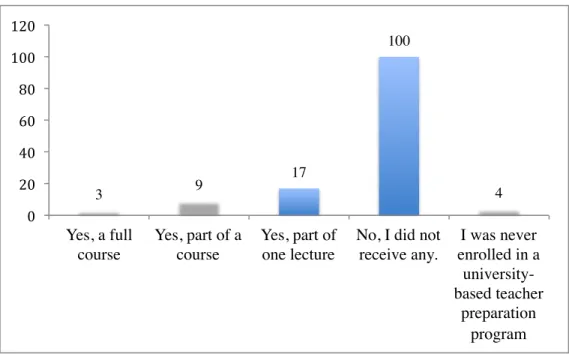
university-based teacher preparation program (at any degree level), did you receive any formal education in the area of suicide education and/or prevention?” Most of the teachers who responded that they had received suicide education reported it at the Masters level, though 53.33% of respondents indicated that the highest level of education that they received was at the Bachelor’s level. One hundred and thirty-three participants responded in total, and the responses were as follows (see Figure 4.1): 3 teachers (2.26%) indicated they had received a full course of suicide education; 9 teachers (6.77%) responded that part of one course was focused on suicide education; 17 teachers (12.78) answered that part of one lecture was focused on suicide
Question 1
Amount of students referred. If a participant responded “yes” to question 14: “Over the course of your teaching, have you ever referred a students whom you believed to be suicidal to counselors?” they were redirected to a question that asked, “If you said ‘yes,’ how many students have you referred over the course of your career?” Seventy-one teachers answered “yes” out of 125, which indicates that 56.8% of the teachers who responded had referred a student whom they believed to be suicidal. The answers were typed into a response box, and ranged from one
student to sixteen students over the course of their career. Of the seventy-one teachers who indicated they had referred a student whom they believed to be suicidal, the mean response was 3.49 students.
Table 4.4 Question 14
Number of Students Referred n
1 11
3 9
17
100
4 0
20 40 60 80 100 120
Yes, a full course
Yes, part of a course
Yes, part of one lecture
No, I did not receive any.
I was never enrolled in a
university-based teacher
2 25
3 13
4 5
5 9
6 1
7 1
9 1
10 3
15 1
16 1
Students who received treatment. Question 15 was designed to assess how many students that the teachers were aware of had received treatment for suicidal thoughts and/or tendencies over the course of their career (see Figure 4.2). Q15 was a multiple choice answer question with four possible responses: “0 students that I know of,” “1-5 students,” “5-10
Figure 4.2 Question 15
Qualitative Results
Six of the questions on the survey were designed for subjective, qualitative answers to help contextualize the quantitative answers as well as why the teachers elected to participate in the survey at all. These questions included: 1) asking teachers to describe any professional development they had received in the area of suicide prevention, intervention, and education 2) the frequency of the suicide prevention training the teacher’s current school had provided 3) if the teacher had sought any independent training for suicide intervention 4) where a teacher would go for additional resources if they were to identify a student who exhibited signs of suicidal tendencies or ideations 5) asking what ways the respondents’ school or school district could further support the development of teachers with suicide prevention education and 6) any personal experiences or insights regarding the topic of suicide that the respondent wanted to include.
30
69
18
6
0 10 20 30 40 50 60 70 80
0 students that I know of.
Professional development. Question 2 asked participants, “In the course of your career as an educator, have you been required by your school system to have any Professional
Development in the area of suicide education and/or intervention?” Of the 132 teachers who responded, 48 respondents indicated “yes” and therefore were redirected to a sub-question: “If you answered ‘yes’ to the previous question, please describe the training you received as Professional Development.” Forty-two of 48 respondents who were redirected to the question provided a written response detailing their experiences in professional development. One of the responses consisted solely of the word “Suicide,” and was not categorized with the other
answers.
Staff meetings. There were a range of answers, most of which involved the counseling staff educating the faculty at meetings on the warning signs of suicide. Thirty-one of the responses indicated that the professional development teachers had received were one-time, partial sessions during faculty meetings. One teacher responded: “During a staff meeting, the school counselors, school psychologist, and other personnel train staff members on what to look for in the classroom as an indicator for suicide. We also discuss the statistics and myths
involving suicides.” Many of these answers indicated that schools use PowerPoint presentations or videos that educated the staff about stories or situations where students presented with suicidal tendencies were not taken seriously. Administrators, school nurses, guest speakers, and
being told that as a Teacher you are to report anything a student has said concerning a suicide. Do not engage in a lengthy conversation with the student but contact the Guidance office and Administration immediately.” Another respondent stated: “We had a training consisting of what to do legally when a child mentions suicide, it was not a PD on suicide prevention.”
Workshops. Of the 42 responses that described professional development, 10 of the
respondents indicated a more in-depth workshop or training for teachers on suicide intervention, prevention, and education or otherwise just on general mental health of students. One teacher responded: “We had to participate in a Mental Health Seminar, which allowed to us to notice the typical behaviors of a child who may benefit from Mental Health.” One respondent described a program available for Wake County, which had the second-highest response rate of the counties that participated in the survey. The teacher wrote, “Wake county healthful living teachers partner with the guidance department to present several lessons on SOS (signs of suicide). We also have programs at Heritage Middle School called "Bully Busters" which also touch on the subject.”
Frequency of trainings. Question 3 asked: “Has your current school provided you with
signs of being suicidal. One teacher said, “We have had one in service training and all of the students are screened each year,” which provided information both about faculty and staff education and initiative to screen students who may show signs of suicidal tendencies or ideations. One respondent said, “I remember staff training around 2004 in the county at a different middle school. It was a 4 hour work shop.”
Independent suicide education. Question 4 asked, “In the course of your adult life, have
you sought any type of training or education in the area of youth suicide of your own accord (i.e. not required by your school)?” Of the 132 teachers who responded to this question, 20 indicated “yes” and were redirected the question, “if you answered “yes” to the previous question, please describe the training and/or education you’ve received.” Of the 20 teachers who were redirected to the follow-up question, 18 chose to elaborate on their response. The various responses ranged from spiritual direction to internet searches (see Table 4.5 below).
Table 4.5
Independent research responses.
______________________________________________________________________ Respondent Response
1 reading of various articles; listening to discussions on the topic (NPR) 2 law enforcement
3
I was a mental health counselor and the training was part of my employment requirement.
4 Internet searches for more information 5 suicide trainings
6 Religious purposes
7 Through the military as a military spouse 8 I have read by myself on the internet. 9
Training done in being a Foster Parent. Look for signs that could signal a call for help.
10 From my pastor, or personal research on the subject. 11
provide these resources, I felt I needed to go out and search information on my own.
12
I am a lateral entry teacher and spent 16 years as a child protective services social worker. I have previously attended training for suicide prevention in my social work career.
13
My husband minored in Christian Counseling, so I often read some of his resources and we discussed it a lot. I often sought information from the counselors with which I worked and have asked for more professional development for working with all mental health issues because so many of our students have been diagnosed.
14
As a Resident Assistant in college, I attended several training sessions each year.
15 Suicide Prevention Program offered through another employment agency. 16 I have done a little independent reading.
17
Independent research on contemporary articles relating to suicide detection and prevention.
18 Therapeutic foster care training required us to take a seminar on this _______________________________________________________________________
Additional resources. At the end of the second section of the survey, the participants
were asked: “If you were to identify a student who exhibits signs of suicidal tendencies or ideations, where would you go for additional resources (school, community level, etc.)?” One hundred and six teachers responded to the question, with a variety of answers. Of the 106 responses, 94 indicated that they would contact a guidance counselor, school psychologist, or school social worker first for additional resources. The second most common answer was a principal or school administrator with fifteen respondents indicating that they would look for additional resources from these sources. Other sources that were listed were hospitals, teen health clinics, medical professionals, and sheriffs. One teacher said: “I would notify my principal and guidance counselor immediately and follow any further procedures required. I would
would refer them to the guidance counselor and perform independent research regarding ways to support them within my classroom.” Other less common answers were pastors/spiritual directors or youth ministers and suicide hotlines. Three responses indicated that they would reach out to the students’ parent as well.
Improvements. Question 28 asked, “In what way or ways do you feel that your
school/school district can further support the development of teachers in the area of suicide prevention education?” Of the 79 participants who chose to respond to the question, 68 of them suggested professional development. Improvements in this area included more frequent sessions, more clarity in the information, providing an environment for teachers to discuss these situations with each other, and conversations that went beyond how to follow a protocol if a child says that they are suicidal. Several respondents requested “refreshers” throughout the year and even having pamphlets and other literature available to help gain confidence in recognizing suicidal tendencies. Some respondents indicated that schools were not addressing suicide at all. One teacher said: “I think the school system should stop sweeping the idea that children commit suicide under the rug and address the issue. There should be some classes offered to teachers in the county from certified, qualified professionals.”
Some of the responses affirmed that the teachers felt they were well-educated, but still offered advice for improvements. For example:
Other respondents stated that they did not believe addressing suicide was the responsibility of teachers. One respondent replied, “To simply help teachers recognize the signs of suicidal tendencies in students. Other than that, professional staff with training should take over.” Another teacher responded that they believed recognizing the red flags of students who may be suicidal is where the responsibility ends:
“I think suicide is important to know and understand the signs of in children, but I feel it is not always up to the teachers to be the emotional support for helping a child through this. We have an awesome school counselor that does well to handle situations like this. As a teacher, we do not need to bare the responsibility of dealing with suicide when our schedules are already jam packed with so many other responsibilities.”
Other suggestions included community-wide workshops, particularly for informing parents on what warning signs to look for in their own children. Two teachers suggested discussions with students in homerooms and mentoring programs where older students pair up with younger students to help provide support and create welcoming environments in schools.
Personal experiences. The final question of the survey asked, “Are there any other
personal experiences or insights regarding the topic of suicide that you would like to share?” Forty-seven participants provided answers, but 31 of the responses were “no,” “n/a,” “none,” or “not at this time.” Of the remaining sixteen responses, teachers shared stories about losing parents to suicide, helping their own children with mental health struggles, and general opinions about mental health care. Other responses highlighted the importance of taking students’ feelings and emotional wellbeing into account.
“I believe that mental illness as a whole is not discussed enough in our society. It is too often brushed aside as being nonsensical or even non-existent ("just in someone's head"). It is too often limited to describing those with autism, or schizophrenic, bipolar (manic depressive), sociopathic or psychopathic tendencies. However, just because some people do not experience these more obvious or extreme conditions, does not mean that their mental illness is not worth addressing, discussing, and treating. So many individuals suffer silently from chronic depression and anxiety disorders, being told that they are overreacting or "just a little sad." These conditions affect their education just as much as other illnesses. Mental health education needs to be improved overall.”
Another respondent shared that in his or her rural community there have been multiple adult suicides, but the community lacks the resources to provide workshops or support for students other than sending them to the psych ward and not providing adequate follow-up treatment.
One teacher directly critiqued the post-vention tactics of her school in response to a recent suicide:
“We have had students commit suicide recently and administration wanted us to just act like it didn't happen. Students and staff were greatly affected and it was very difficult to not open discussion with kids who had questions. I didn't feel qualified to answer their questions but felt it was better to address concerns and let them know other options were available to them.”
following protocol and having good connections with administrators and school counselors as being crucial for suicide intervention.
Discussion
Past research in the area of youth suicide education has highlighted a major gap in the area of professional development and training of teachers, particularly of the middle school population. A study that attempted to address these issues in the middle school teacher
population (and was not a direct study of the efficacy of a particular suicide education program) was not found in the literature. The purpose of this research was to assess how confident a sample of teachers in North Carolina believed they were in identifying students who may be suicidal, how schools across the state are currently developing teachers to support students who struggle with suicidal tendencies, and how much of a role teachers believe they have in
supporting students who may be considering suicide.
Personal Relationships with Students as Related to Suicide
Reducing Suicide in the Middle School Population
Forty percent of teachers strongly agreed and 18.4% of teachers agreed with the
statement that suicide is a widespread issue in the middle school population, which suggests that education about youth suicide in general is lacking, as it is the second leading cause of death for teenagers above age fourteen and the third leading cause of death for children ages 10-14. The majority of teachers also indicated that suicide prevention should receive more attention in middle schools. Most participants in the survey believed that it was the responsibility of the schools to provide education for students, and that by providing more education for students it would reduce the stigma that exists among students. This belief reinforces the findings of Lazear and colleagues (2003): that students who felt connected to their school and felt the adults in their community cared about them were significantly less likely to engage in suicidal behaviors. Teacher Education
The results of this survey suggests that overall, teachers are dissatisfied with the amount of education they are receiving in the area of youth suicide prevention and intervention. Only 36% of teachers said they had been required to attend professional development in the area of suicide education and/or prevention by their school system, but nearly 70% of teachers indicated that they would like to receive more professional development in the area of suicide prevention. Only 15% of teachers had individually sought information about suicide intervention, but most of the respondents indicated that teachers have a key role in suicide prevention.
responsibility of the school to provide proper education for teachers, and that community-wide trainings would greatly help to inform the population about youth suicide.
Most of the information and professional development that teachers had received regarding student suicide took place during part of a staff meeting at the beginning of the year, and the majority of respondents felt that this was not sufficient. The most common response in the qualitative section that asked for possible improvements was that teachers believed their schools and school districts should have trainings implemented more frequently, with common refreshers and casual dialogue to create a comfortable and supportive environment for students to express their thoughts and emotions. Aseltine and DeMartino (2004) found a strong need for follow up sessions for teachers, parents, and students to be adequately equipped to engage in dialogue and help youth who may be feeling suicidal. These survey results confirmed that in order to reduce the rate of suicide among the youth in middle schools, teachers feel the need to have complete confidence in their skills identifying and confronting students whom exhibit suicidal tendencies.
teachers in North Carolina to effectively do so, but also provides information about potential ways to improve teacher competence in the area of suicide prevention, intervention, and
education. At all levels, this study suggests that overall openness to discussing mental health in general needs to be improved.
Implications for Education
The results of this study provide implications for multiple stakeholders including policy, administration, educators, pre-service teachers, and for future research. First, implications for policy, which include more frequent and widespread education programs in the state of North Carolina and even provide basis for more policy change then outlined in the most recent 2015 N.C. Suicide Prevention Plan. Implications for administrators include creating an open and supportive environment for both students and teachers and to shift the conversation away from following protocol but rather encouraging the emotional wellbeing of their entire community. Implications for educators include advocating for more thorough trainings and professional development in their school and school systems, as well as the importance of taking an
individual responsibility to educate themselves in the area of suicide intervention and prevention. Implications for pre-service teachers and university-based teacher preparation programs includes recognizing mental health as an important part of teaching, and preparing future teachers to engage in challenging dialogue that could save lives.
Implications for policy. One of the main findings of this research is that suicide
education is inconsistent and erratic depending on multiple conditions, including what teacher preparation program educators completed, what school system educators teach in, the education provided at an individual school, and how much research an individual had completed
statistics about the growing rate of suicide in North Carolina, but the amount of variables for baseline knowledge are not discussed. A standard program for baseline knowledge needs to be established in the state to inform teachers of how important an issue youth suicide is, and help to inform them of how important their role as gatekeeper can be. Under ideal circumstance,
required trainings for staff, teachers, students, and even families should be implemented at least yearly for the school systems across North Carolina. A budget for suicide education programs needs to take the cost and efficacy of the programs into account. The budget must also allow for a plan to be developed that provides concrete steps for implementing suicide education programs in every single school system in the state. According to the 2015 N.C. Suicide Prevention Plan (2015), three of the counties with the highest suicide rates are Alexander, Stokes, and Carteret. The way that these counties implement a program may differ from Cumberland, Wake, and Mecklenburg, which are more populated and have better access to resources. All counties should have resources to attend to this life threatening challenge in the state’s middle school youth.
Implications for administration. First and foremost, school administrators have a
concern. Administrators also have a responsibility to provide follow-up to teachers who report students so that the students can have a well-informed team of advocates surrounding them to better their mental health. Administrators need to put less emphasis on “following the protocol” to legally protect themselves, and look at suicide as a widespread issue in the middle school population that can be prevented with proper education and advocacy.
Implications for educators. Implications for educators include understanding the
important roles that they possess in the lives of students and recognizing they have a
responsibility to be advocates for students who may be suicidal. In this study, most participants indicated that it is important for teachers to support their students emotionally, and that students feel comfortable coming to them with personal issues. Most teachers also identified that teachers play an important role in suicide prevention and intervention, but also expressed a lack of
confidence in their abilities to properly confront students who may be exhibiting suicidal tendencies. If teachers can recognize that they are important gatekeepers for students who need help knowing where to go for resources if they themselves or a friend is feeling suicidal, they take a stronger personal responsibility to advocate for more thorough trainings and professional development in the area of suicide intervention, prevention, and education.
need to not only teach, but also listen to student feedback in the classroom, which will help to create an inclusive and comfortable environment.
Implications for teacher preparation programs.Part of teacher preparation programs
need to include proper education about youth suicide because it is a prominent issue in the middle school population. A major component of preparing to work with students includes being prepared to deal with their holistic wellbeing. Preparation for teaching includes cultivating a background in methods for teaching particular subjects, literacy classes, child development courses, and even classes gauged at understanding exceptional children and differentiating lessons for children with disabilities. As supported by Auger (2011), holistic mental health care is greatly beneficial to the overall wellbeing and success of students, and therefore first-year teachers should be well-equipped at addressing mental health issues in their classroom. If university-based teacher preparation programs are preparing future teachers to be equipped to address the specific needs of students with learning disabilities, or have extensive classroom management plans, or how to use technology in the classroom to be the best advocates for every individual student that comes through their door, they should also equip future teachers with how to be the best mental health advocates for their students. The way a student performs on
standardized tests, or the grades they get, or even the way they behave in the classroom are all of minimal importance if a student does not feel safe or cared for and is struggling with suicidal thoughts or tendencies alone.
(2011) stated, it cannot be known when or to whom a student who is planning to commit suicide will reach out to. A first-year teacher may feel overwhelmed with the amount of work they have to complete with lesson planning and grading, but if they were properly trained to recognize the signs of suicide and how to engage in dialogue with struggling students, it would not seem like an extra responsibility. If we train teachers to view mental health care as being essential to a student’s school experience, to prioritize a student’s mental stability, to communicate with their students and help to form them as people first and then as students, we can reduce the rate of suicide. It makes logical sense to begin to emphasize the importance of open dialogue and recognizing the signs of suicide with pre-service teachers so they can go into their careers and schools confident, prepared, and with the knowledge to be trusted gatekeepers for students and advocates for improving suicide intervention and prevention trainings.
Strengths and Limitations
The strengths and limitations of this study have to be considered in order to analyze possible applications for future research in the area of teacher preparedness in the area of suicide education, prevention, and intervention. Data was collected from a self-report survey, and participants voluntarily chose to participate in the survey via email, which is both a strength and limitation. While the responses ranged from positive to negative, this method creates some bias. Participants who completed the survey in its entirety have strong opinions about the topic of youth suicide and teacher involvement, which also lead to detailed qualitative responses. The use of an electronic survey allowed for participation from populations across North Carolina,
random as a result of limited access to emails. While a relatively large sample size, this is only a small percentage of the amount of teachers in the state. The range of geographic location across the three areas of the state of North Carolina did yield diverse and relatively representative responses, versus if the data was only collected from one region, county, or city of the state.
Another strength of this study was the average amount of teaching experience found among the participants. A significant amount of participants responded from each range (1-9 years, 10-19 years, 20-29 years), which means that different attitudes based on when a teacher was initially trained and the clinical experience a teacher accumulates from teaching are represented. Only one teacher had 30-39 years of teaching experience, which could be from a lack of teachers in this experience group or a limitation of the nature of the survey being
electronic. A major limitation in the collection of data was that gender data was omitted from the survey unintentionally. If the survey were to be conducted again, gender of participants would be asked in order to sort the data in this manner and analyze gender differences.
Another limitation of this study was that only public middle school teachers were