Surviving After Hurricane Matthew: The Effect of Personal and Community Resources on the Impact of Natural Disasters on Psychological Trauma and Resiliency
By: Brianna Alexis Baker
Senior Honors Thesis Interdisciplinary Studies
UNC School of Medicine Department of Social Medicine Center for Health Equity Research
Approved:
Giselle Corbie-Smith , Thesis Advisor
Tables of Contents
Abstract………4
Introduction………..5
The Impact of Natural Disasters on Mental Health and Wellbeing of Survivors………5
Depression and Natural Disasters………7
Post-Traumatic Stress and Natural Disasters……….……..9
Theoretical Framework to Study Natural Disasters and Mental Health and Wellbeing……..…..10
Conservation of Resources Theory………11
Resilience Activation Framework……….……….13
Personal Resources………14
Community Resources and Community-level Factors………..15
Methods………..16
SAHM………16
Study Setting………..17
Study Approach and Sample………..17
Data Analysis……….19
Results………20
Mental Health……….20
Psychological Resiliency………...23
Personal Resources………26
Community Resources………...28
Personal resources and psychological resiliency………...31
Community resources and psychological resilency………...32
Community resources, Personal resources and Mental Health………..33
Conclusion……….34
References………..35
Appendices……….42
Appendix A………43
Appendix B………45
Appendix C………47
Abstract
This paper explores the effects of natural disasters in low socioeconomic communities on psychological trauma and functioning, specifically post-traumatic stress and depressive
symptoms. This research examines community level factors in relation to individual level factors that either aid or hinder psychological resilience following a natural disaster in a predominately African-American community. Although some research has been done on community resilience, little research exists examining personal resources (self-efficacy and optimism) in conjunction with community resources (economic stability, support systems) on mental health after a
hurricane. In addition, communities with a low socioeconomic status and predominately minority composition are often disregarded in mental health and disaster research. The present research draws primarily from Conservation of Resources (COR) Theory which describes human’s use and gain of resources following stressful events. Additionally, the Resilience Activation Framework will be explored to inform the results of this study. Using in-depth interviews and surveys collected from the Surviving After Hurricane Matthew (SAHM) study performed in Edgecombe County, NC, this paper provides insight into the significance of personal and community resources on mechanisms underlying psychological resiliency. The results of this study indicate a positive relationship between personal and community resources and
Introduction
It is well known that natural disasters can have a significant impact on the mental health of those affected. However, little research has been performed concerning the psychological toll of natural disasters on predominately low socioeconomic status, racial/ethnic minority
individuals and communities. Squires and Hartman (2007) found that the impacts of natural disasters are often heavily influenced by race and class. The implications of natural disasters are intensified by the racial and socioeconomic composition of the affected areas (Lindell & Prater, 2003; Murrow, 1999). Communities with more social and economic capital have been shown to recover more quickly and more effectively than those with less (Pelling 2012).
Knowing that low socioeconomic status populations are most negatively affected by natural disasters, this research aims to identify and understand the mechanisms through which this relationship functions. Personal and community resources are two mechanisms that have the ability to influence the relationship between natural disasters and psychological well-being and resilience (Brewin et al., 2000; Hobfoll, 2001). This research attempts to capture individual and community level contributors to the overall psychological wellness of surviving populations post-disaster. More specifically, this research focuses on community and personal resources as they influence the onset of post-traumatic stress and depressive symptoms in African-American individuals in low socioeconomic status communities.
The Impact of Natural Disasters on Mental Health and Wellbeing of
Survivors
nature and society. Natural disasters are directly correlated with climate change (US Geological Survey, 2017). It is hypothesized that increasing temperatures around the globe have contributed to increased duration, intensity, and frequency of natural disasters (National Geographic Society, 2018; Van Aalst, 2006). Natural disasters are estimated to cause up to 90,000 deaths annually and affect approximately 160 million people each year (World Health Organization, 2012).
This research focuses on low socioeconomic status individuals who identify as African-American/Black and have experienced a natural disaster. Some research suggests that natural disasters are actually not “natural” at all; these natural occurrences only become disastrous when intersecting with human civilization (Smith, 2006). Therefore, all natural disasters are human-made. It is no coincidence that the greatest natural disasters occur in underdeveloped regions. Natural disasters tend to most affect low socioeconomic status individuals and other vulnerable populations (Fatemi et al., 2017; Smith, 2006). This phenomenon exists due to a variety of reasons. The impact is greater on communities with poor infrastructure and low social and
economic capital as they may encounter difficulty sustaining due to the lack of resources (Kruger et al., 2015; Wang & Taylor, 2016).
As this research continues, it is important to note that these disasters are indeed
correlated with global warming and consequentially, the increased rate of natural disasters (Burton, 1997).
Due to the increasing frequency and intensity of natural disasters, researching their effects on the human experience is critical in lessening their impact. Natural disasters have various negative consequences on those affected. Survivors of these events may experience significant material and emotional loss (Benight et al., 1999; Hackbarth et al., 2012). Many lose their loved ones, jobs, houses, and belongings. Similarly, they may lose their peace of mind, sense of security, and confidence in their ability to shape their futures (Benight et al., 1999). Natural disasters result in a variety of foreign emotions and situations that survivors may not know how to effectively handle or make sense of. Sadness, anger, and hopelessness are all common emotions felt after experiencing a disaster (Kaniasty & Norris, 1993). It is important to note that these feelings may occur immediately after the occurrence or months to years later (Benight et al., 1999). Studying the impact of natural disasters on the mind and body can lead to faster recovery in future disasters. attempting to understand psychological resiliency after natural disaster may help identify protective factors within the social environment, survivor’s identity, or cognitions that may soften the impact of disasters (Benight et al., 1999; Benight & Harper, 2002; Kaniasty & Norris). Similarly, research could lead to understanding risk factors that may hinder post-disaster recovery. The present research focuses on populations with extreme disadvantage in disaster recovery by studying a racial minority and low-income sample. Provided the
Depression and Natural Disasters
Natural disasters have been positively associated with the onset of depressive symptoms and clinical depression (Norris et al., 2008; North et al., 2004; Genexi, 1993). Depression is clinically defined as a mood disorder characterized by severe feelings of dejection and despair (American Psychiatric Association, 2013; Parekh, 2017). Depression presents itself in a variety of forms. Symptoms may include, but are not limited to chronic sadness, hopelessness, fatigue, and loss of interest in activities previously enjoyed (American Psychiatric Association, 2013; NIMH, Depression Basics). Commonly paired with post-traumatic stress or Post Traumatic Stress Disorder, depression is the second most common psychological stress response to a natural disaster (Freedy et al., 1994). McFarlane and Papay (1992) found that depression was second most common disorder found in victims of an earthquake. Similarly, Kohn and colleagues (2005) found that 18.8% of participants surveyed developed major depression following 1998 category 5, Hurricane Mitch. Many research studies involving natural disasters and depression suggest a causal relationship (Genexi, 1993). In 2017, research suggested that 20-25% of those who experience a natural disaster will develop depressive symptoms (Woody et al., 2017).
The mechanisms underlying the relationship between natural disasters and the onset of depression are vast. Research has focused on a variety of pathways through which depression manifests following a natural disaster. One major theory of depression is that it is a result of stress and a response to an individual’s inability to cope with stress in a healthy manner
stressors, research shows that those with certain personal and environmental resources are better equipped to handle stress than others (Brewin et al., 2000; Freedy et al., 1994; Lowe et al., 2015). Social support and economic stability can serve as protective factors against stress and depression (Hackbarth et al., 2012; Lowe et al., 2015, Brewin et al., 2000).
According to Fundamental Cause Theory, those with more flexible resources, including education, power, money, and prestige are more likely to have positive mental health outcomes than those with less (Phelan & Link, 2013). More advantaged neighborhoods tend to have lower rates of psychiatric disorders (Blaikie et al., 2004; Ross 2000). Residents of disadvantaged neighborhoods are less likely to have possession of and access to these resources, thus,
potentially making it harder to recover from major stressors such as natural disasters (Williams & Collins, 2001).
Finally, both race and socioeconomic status have been found to be associated with
experienced and perceived stress. Research has shown that those in racial/ethnic minority groups as well as those with lower socioeconomic status experience more stress than racial majority individuals and those with more social and economic capital. Therefore it can be hypothesized that the occurrence of natural disasters most impacts racial minorities and those of low
socioeconomic status by creating additional stress on already vulnerable populations.
Post-Traumatic Stress (PTS) and Natural Disasters
cause post-traumatic stress in victims. The hypothesized reasons for this relationship vary. Some have attributed post-traumatic stress as a result of mere natural disaster exposure. One study found that the intensity of hurricane exposure served as a predictor for the intensity of post-traumatic stress symptoms (Pietrzak et al., 2012). Other studies have found that economic and material resource loss and home damage serve as indicators for potential post-traumatic stress as well (Brewin et al., 2000; Freedy et al., 1994). Finally, displacement following a natural disaster was significantly associated with the development of post-traumatic stress (Najarian et al., 2001). This finding is interesting considering African-American and low socioeconomic residents are more likely to be displaced following a natural disaster (Fussell et al., 2010).
Knowing the relationship between natural disasters and the onset of post-traumatic stress, research efforts have begun to explore protective factors and coping factors for PTS and PTSD. Brewin (2000) found that social support protected against the onset of post-traumatic stress in trauma-exposed adults. Additionally, religiosity and spirituality has been shown to protect against chronic post-traumatic stress (Hackbarth et al., 2011) The same research study also supported the idea that social support, particularly familial support can aid in coping after a natural disaster. Other studies indicate the tendency for individuals experiencing depression to also experience post-traumatic stress (Kar & Bastia, 2006). This frequent comorbidity suggests the potential for similar underlying mechanisms and protective factors for post-traumatic stress and depression onset. Similar to depression, research surrounding post-traumatic stress indicates the possibility of community and personal resources in mediating the onset, duration, and
Theoretical Framework to Study Natural Disasters and Mental Health
and Wellbeing
The present research draws from two theories: Conservation of Resources (COR) and Resilience Activation Framework (RAF). These theories lay the foundation for the analysis in this project as they are concerned with post-disaster recovery and resiliency. Both theories were used to inform the analysis of the data.
Conservation of Resources Theory
One of the most dominant theories in disaster-related mental health recovery is the
Conservation of Resources (COR) Theory. COR Theory describes how humans cope with major stress and trauma as they pertain to the actual and potential loss of resources (Hobfoll, 2001). The theory is fundamentally grounded in the assertion that individuals have an inherent desire to acquire, conserve, strengthen, and protect the things they centrally value. In order to properly self-regulate, individuals use key resources that ensure a successful and healthy conduct of social relations, behaviors, and organization (Hobfoll, 2001; Hobfoll & Lilly 1993).
Two main principles comprise this theory. The first is called the Primacy of Resource Loss, which states that losing resources is more harmful than gaining in the same amount. Meaning, a loss of a resource would be more detrimental to psychological well-being than the same gain would have been helpful. Resource Investment is the second principle in COR Theory. Resource investment is the tendency for people to invest in resources in order to protect against resource loss, to recover from lost resources, and to gain resources. From these two principles, four corollaries have been derived (Hobfoll & Lilly, 1993). They are as follows:
2. Initial resource loss will lead to resource loss in the future. 3. Initial resource gains will lead to resource gains in the future.
4. A lack of resources will inevitably lead to protective attempts to conserve the remaining resources.
Given this, COR Theory posits that psychological stress occurs in three instances, these are the three main postulates of stress onset according to the theory:
1. When there is a threat of a loss of resources 2. When there is an actual net loss of resources
3. When there is a lack of gained resources following the spending of resources
the best-fitted causal model for describing psychological reactivity to Hurricane Andrew over time.
No research exists concerning racial/ethnic variance in the application of the Conservation of Resources Theory framework when applied to post-disaster psychological distress and recovery. However, it is possible, knowing that some demographic groups are collectively more
Sue et al., 1999; Pelling, 2012). Similarly, if resources are lost, more socially and economically advantaged neighborhoods are more likely to replace those losses quicker and easier than communities with less resources. For example, racial minorities are more likely to experience discrimination when purchasing insurance thus leading to a racialized gap in insurance coverage for natural disaster recovery (Rice, 1996). Additionally, a study found that despite increased vulnerability to natural disasters such as hurricanes in particular, Black, lower-income
households were less likely to purchase flood insurance. Furthermore, when these households do seek purchase of insurance, the prices are higher than it would be for non-minority populations do to systemic discrimination of marginalized racial groups (Petrolia, Landry, & Coble, 2013). The implications of this include a higher risk for damage due to flooding associated with hurricanes and a prolonged post-disaster recovery.
Resilience Activation Framework
The Resilience Activation Framework (RAF) was developed as a foundation for understanding and examining the effect of access to social resources on the development of psychopathology and ability to adapt after a disaster both on the community and individual level. Psychological resilience is defined as the ability to recover quickly and easily from adverse experiences. Essentially, the more social resources available to an individual or community, the greater the reduction of psychopathology and capacity for positive adaptation in post-disaster recovery. It is believed that increased access to these social resources works to activate and sustain resiliency (Abramson et al., 2015).
This framework is founded upon six main principles:
1. Exposure to adversity or harm leads to loss of resources, increased stress, and psychological reactivity
3. Mechanisms of community resilience interact with those of individual resilience. 4. Access to community resources can enable individual resilience attributes
5. The activation of resilience exists within sociocultural conditions; this activation takes place within the context of individual sociocultural environments. Meaning, culture, race, ethnicity, etc. all moderates an individual’s capacity for resilience.
6. Individual attributes, community attributes, and social environments can be measured in order to test different components of the framework (Abramson et al., 2015)
The present research attempts to understand resilience cultivation through the presence of community and personal resources.
Personal Resources
Research suggests that personal resources such as self-efficacy and optimism
contribute to more positive mental health habits and coping abilities (Benight & Harper, 2002; Benight et al., 1999). Self-efficacy refers to an individual’s belief that they can a desire or perform an action. Perceived self-efficacy was found to be the single best determinant for abandoning maladaptive mental health behaviors like negative cognitions and adopting positive ones such as self-affirmation (Schwarzer, 2014). Self-efficacy has also been suggested as a predictor of distress following a natural disaster as well as a mediator between acute stress response and the development of post-traumatic stress disorder (Benight & Harper, 2002;
psychological well-being in high-risk, African-American individuals following a traumatic event (Alim et al., 2008).
Community Resources and Community-level Factors
More research has become available over the past decade concerning context,
neighborhoods, and other place-based mechanisms as they influence mental and physical health. Community resources refer to the social, economic, and health resources a community possesses (Lowe et al., 2015). These resources not only have the ability to moderate the physical and emotional impact of a natural disaster on an individual but also to aid in the recovery process once disaster strikes (Lindell & Prater, 2003; Morrow, 1999). Community factors may include the social and economic development of a community over the past five years (Kirby & Kaneda, 2005). In disaster research, community factors also include extra-community social and
economic intervention referring to the ability or the likelihood for a community to receive aid from surrounding communities (Lindell & Prater, 2003; Lowe et al., 2015; Dilley et al., 2005). More disadvantaged neighborhoods, meaning those with less community resources, extra-community aid, and socioeconomic development tend to serve as a predictor for poor mental health outcomes, particularly depression (Williams & Collins, 2001).
increase mental distress and an individual’s susceptibility of mental illness (Hobfoll, 2001; Bird et al., 2002). Economic resources in a disaster-stricken community are imperative for a timely physical and psychological recovery. Natural disasters place a financial burden on individuals and their communities. Costs such as housing damage, material losses, and suspended income hit simultaneously and unexpectedly (Squires & Hartman, 2007).
Personal resources and community resources vary across racial/ethnic groups and socioeconomic statuses (Lowe et al., 2015; Twenge & Campbell, 2002). A study found that a higher prevalence of racial minorities in a community was associated with higher neighborhood disadvantage and social disorganization as well as lower rates of socioeconomic development (Williams & Collins, 2001; Ross, 2000).
Methods
Surviving After Hurricane Matthew (SAHM)
Hurricane Matthew was a category 1 hurricane that ravaged Eastern North Carolina in October 2016 (Armstrong & US Department of Commerce, 2017). Among the affected counties was Edgecombe County, a predominately African-American, low socioeconomic status
community. The present research is part of a larger study, Surviving After Hurricane Matthew (SAHM), that sought to understand the impact of this hurricane in the management of
cardiovascular disease risks among residents affected in the aforementioned county (Corbie Smith et al., 2001; Corbie-Smith at al., 2018).
health habits, tobacco smoking, food insecurity, hurricane exposure, hurricane-related stress (socio-demographics, house-old makeup and financial strain), chronic disease management, and coping. For the present research, only qualitative data was examined for evidence of personal and community resources and the onset of depressive symptoms and post-traumatic stress following Hurricane Matthew.
Study Setting
All of the data collection occurred in Edgecombe County, North Carolina. Edgecombe county is located in the eastern part of North Carolina with a population of 54,669 (US
Department of Commerce, & NOAA, 2016). North Carolina overall is 21.5% African-American whereas Edgecombe County is 56.6% African-American- making it the predominant racial group. This county maintains a 25.7% poverty rate compared to a national average of 12.1% in 2017. Edgecombe county is no stranger to hurricanes and was struck by Hurricane Floyd, a devastating category 2 hurricane in September 1999. Many participants in this study also experienced Hurricane Floyd (US Department of Commerce, & NOAA, 2016)
Study Approach and Sample
This study used a secondary- data analysis of in-depth interviews conducted as part of SAHM. Semi-structured interviews conducted as part of SAHM provided detailed experiences of African-American Hurricane Matthew Survivors. The interviews allowed for a clear set of
objectives while providing room for elaboration and detail contingent upon the participants level of comfort and individual discretion (Wengraf, 2001).
The selection criteria included individuals who self-identified as
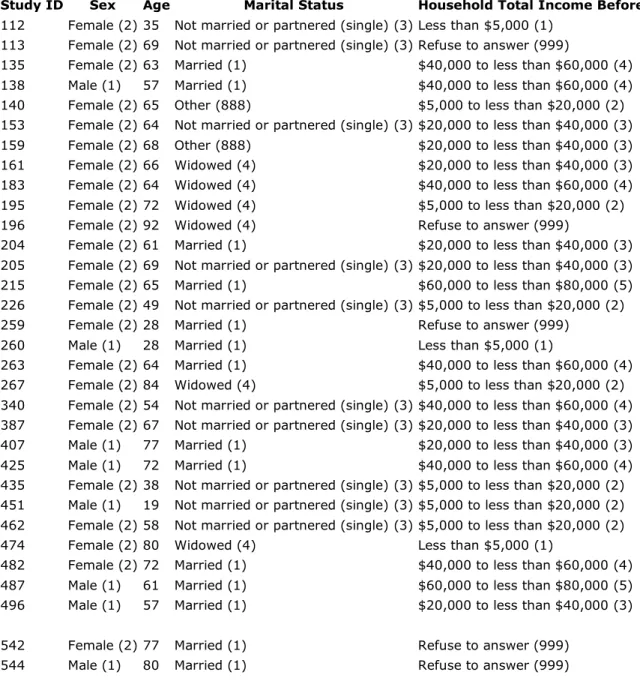
CAGE-AID inventory- a screening tool for alcohol and drug related issues. Eligibility also required a score of 33 or lower on the PCL-5 self-report measure that assesses the 20 DSM-5 symptoms of PTSD. The subjects were recruited by the research team and staff of the Center for Health Equity at UNC Chapel Hill and the partner organization, Community Enrichment Organization. The final study population consists of 32 individuals including 8 males and 24 females.
Table 1: Aggregate Participant Demographics
Study ID Sex Age Marital Status Household Total Income Before Taxes
112 Female (2) 35 Not married or partnered (single) (3) Less than $5,000 (1) 113 Female (2) 69 Not married or partnered (single) (3) Refuse to answer (999)
135 Female (2) 63 Married (1) $40,000 to less than $60,000 (4) 138 Male (1) 57 Married (1) $40,000 to less than $60,000 (4) 140 Female (2) 65 Other (888) $5,000 to less than $20,000 (2) 153 Female (2) 64 Not married or partnered (single) (3) $20,000 to less than $40,000 (3) 159 Female (2) 68 Other (888) $20,000 to less than $40,000 (3) 161 Female (2) 66 Widowed (4) $20,000 to less than $40,000 (3) 183 Female (2) 64 Widowed (4) $40,000 to less than $60,000 (4) 195 Female (2) 72 Widowed (4) $5,000 to less than $20,000 (2) 196 Female (2) 92 Widowed (4) Refuse to answer (999)
204 Female (2) 61 Married (1) $20,000 to less than $40,000 (3) 205 Female (2) 69 Not married or partnered (single) (3) $20,000 to less than $40,000 (3) 215 Female (2) 65 Married (1) $60,000 to less than $80,000 (5) 226 Female (2) 49 Not married or partnered (single) (3) $5,000 to less than $20,000 (2) 259 Female (2) 28 Married (1) Refuse to answer (999)
260 Male (1) 28 Married (1) Less than $5,000 (1)
263 Female (2) 64 Married (1) $40,000 to less than $60,000 (4) 267 Female (2) 84 Widowed (4) $5,000 to less than $20,000 (2) 340 Female (2) 54 Not married or partnered (single) (3) $40,000 to less than $60,000 (4) 387 Female (2) 67 Not married or partnered (single) (3) $20,000 to less than $40,000 (3) 407 Male (1) 77 Married (1) $20,000 to less than $40,000 (3) 425 Male (1) 72 Married (1) $40,000 to less than $60,000 (4) 435 Female (2) 38 Not married or partnered (single) (3) $5,000 to less than $20,000 (2) 451 Male (1) 19 Not married or partnered (single) (3) $5,000 to less than $20,000 (2) 462 Female (2) 58 Not married or partnered (single) (3) $5,000 to less than $20,000 (2) 474 Female (2) 80 Widowed (4) Less than $5,000 (1)
482 Female (2) 72 Married (1) $40,000 to less than $60,000 (4) 487 Male (1) 61 Married (1) $60,000 to less than $80,000 (5) 496 Male (1) 57 Married (1) $20,000 to less than $40,000 (3)
Interviews were conducted between January and April of 2018 by a trained mental health provider. The interviews sought to understand the participants’ experiences before, during, and after Hurricane Matthew. Participants were asked questions related to their mental and physical health. Most specifically, cardiovascular, stress, and emotions. Questions such as “What
emotions did you experience after the hurricane?” or “How did you manage your health conditions before and after Hurricane Matthew?” were asked. The interviews lasted 20-40 minutes each and were semi-structured. Participants provided written consent to participate and were compensated with $20 for their time. This study was approved by the Institutional Review Board (IRB) of the University of North Carolina at Chapel Hill.
Data Analysis
Each interview was audio-recorded and transcribed by a professional transcription service and reviewed by the SAHM research team to ensure data accuracy and quality. Atlas.ti 8
software was used to assist with data management and coding. The initial reading of transcripts was used primarily to identify overarching themes. A codebook (See Appendix A) was
Results
The results are presented in four sections. The first four sections are dedicated to the overall characterization of mental health, community and personal resources, and psychological
resilience as interpreted through the interviews.
Mental Health
Mental Health was defined using two codes: Depression and Post-Traumatic Stress. Depression/depressive symptomology was coded using an interpretive code which defined depression according to the American Psychiatric Association’s Diagnostic and Statistical Manual of Mental Disorders 5th Edition (DSM-5). This code was primarily characterized by feelings of fatigue, worrying, overwhelming sadness and persistently negative thoughts amongst a host of other indicators of depression. When a participant exhibited or alluded to any of these behaviors, it was coded as depressive symptomology. Participants exhibited depressive
symptoms in various ways mainly through the mention of high stress and worry about losses resulting from the hurricane. For some participants, the hurricane destroyed most of their possessions causing them great sadness and fear of the future. Participants also suffered great emotional tribulations such as the devastation of witnessing their communities burdened or the loss of sentimental items which lead to negative thoughts and worry. The overall disruption of daily life that the hurricane caused resulted in emotional turmoil for many. Displacement from their homes, relocation, loss of jobs and daily structure all contributed to feelings and behaviors associated with depression. One participant noted that the hurricane made them “lose their peace of mind” along with material losses suggesting that the disaster created both physical and mental disruption. The stress of these losses caused many individuals in the study to describe themselves as emotionally drained. Exhaustion and fatigue were common descriptors for emotions
common theme throughout the interviews; some participants, despite not experiencing any personal loss, became saddened by the situation of people in their communities and their inability to help as expressed in this quote:
Interviewer: Okay. Could you tell me what you remember from the day of and the days after Hurricane Matthew?
Participant: What I remember the days after the hurricane was dreadful. It was hurting. It was sad. It was ... Did I say depressing?
Participant: It was words that I cannot express to see and look at how much the people lost and how many was so unable really to help themselves, especially the senior
citizens and to see where they once lived and saw it at that time. Saw some of them [ ] as far as they could from the place that was destroyed. It caused me to even hang my head [ ] when I saw that they was in such despair and such hurt. Their things out on the street and really didn't know where it was going. It really brought tears to your heart or your eyes. “They were saying what are the people gonna do now?”
Participant 544, Male, 80
Overall, depression in the participants interviewed was characterized by feelings of guilt and fear, sadness and hopelessness, frustration, exhaustion and, worry.
surrounding experiencing Hurricane Matthew after Hurricane Floyd. Participants shared that Hurricane Matthew brought about unpleasant memories and feelings associated with Hurricane Floyd. One participant shared that the presence of intense rain induces anxious behavior:
Interviewer: Okay. How were you able to deal with your emotions after the hurricane? Participant: Well, I thought I had them under control pretty well. But you know, there were just times that for me that it was just unbelievable. I just could not imagine the impact that it had on the citizens, on myself, the length of time that it has taken us to recover like, you know, I thought or had hoped that we would. I actually one night had a nightmare. You know, I had heard people say a lot of times in the town meetings, "You know, I'm just tired. I'm afraid. I have nightmares about the flood." I said to myself, "You know, come on now. It can't be that devastating," until one night I honestly had a terrible dream about the flood. It was to the point that I actually ... I was with my sister at the time, and the bad rainstorm came up. Every time it rained, it does actually, even to now, when it rained very hard. We had a really, really hard downpour rain, I just be like, "Okay. Is it getting ready to happen again?"
Participant 153, Female, 64
Similarly, issues with sleep in general was mentioned more than once by participants. Restlessness when trying to sleep as well fatigue due to the inability to sleep was commonly described. Post-traumatic stress was also exhibited through the fear of another disaster occurring before properly recovering from Hurricane Matthew. Participants felt panicked, fearful, and worrisome following Hurricane Matthew suggesting the presence of post-traumatic stress. An example of such feelings is exhibited through the following quote:
Interviewer: How did you feel after the hurricane happened?
Participant: After, I felt sad for the town. I felt sad for other people. You always think, again, what if it happens again? What are you going to really do this time? Are you going to really want to continuously go through this? A lot of other people didn't have a lot of choices. Even though we were in a pretty good position, your heart still ...
Participant 482, Female, 72
Psychological Resilience
references when expressing their gratitude after Hurricane Matthew. Similarly, many spoke of religious references when asked about how they dealt with emotions after the disaster
exemplified by this quote:
Participant: Even going to church, it happened in my community and the pastor would make us aware of certain things. And I guess he would remind us of when the children went through the desert. Look at the things ... And this was nothing compared to what they went through, you know?
Participant 542, Female, 77
Religion was described as a key element of resiliency in a variety of different ways. Participants described religion as giving hope was used as a potential explanation for the occurrence of the disaster. Similarly, religion allowed the participants to view their
circumstances in a broader context. By framing the disaster as a part of a “destined process” or “God’s plan”, survivors were able to contextualize their losses and see it as bigger than
themselves. Lastly, participants to compared their losses and experiences during the hurricane to those within the Bible. This testimony serves as a great example of reference to religion when dealing with the aftermath of Hurricane Matthew.
Interviewer: What are three actions you feel would be most helpful in dealing with the effects of the hurricane?
Participant: Well, speaking from my experience ...
Participant 140, Female, 65
Additionally, humor and distraction were common methods of coping with stress and facilitating resilience. Joking with friends and family and making light of their circumstances was mentioned during the interview as seen here:
Interviewer: How were you able to deal with the ... your emotions after the hurricane? You, um, made a comment that you kind of rode around and found some other things to do. What else were you able to do?
Participant: Um ... with like, a lot of my friends, because now a lot of them are going places. But, um, I basically, besides riding around, I go to school, so that's also-... kinda another thing I gotta kinda keep my mind on.
Participant 451, Male, 19
Finally, the participants in this study mentioned looking for outside support from friends and family. Social support played an essential role in the post-disaster recovery of many
participants. Friends, family, and neighbors helped by supplying both material and emotional support through offering houses and clothes to providing reassurance, comfort, and
encouragement. Here, a participant offers ways in which she received personal support from close relationships:
Interviewer: How did Hurricane Matthew impact your family?
Participant 482, Female, 72
Personal Resources
Personal resources refer to the psychological capital that exists within the participant including optimism and self-efficacy. Optimism captured the individual’s positive thoughts and outlook on life post-disaster whereas self-efficacy was used to code for participants’ belief in their ability to change their current circumstances. Optimism and self-efficacy encouraged the participants interviewed to maintain positivity. It also motivated them to stay determined and focused throughout the course of their trials. Many participants acquired these personal resources through the encouragement of others. Having positive influences allowed them to keep their own mindsets positive as discussed through this testimony:
Interviewer: Okay. Um ... if at all, how did friends help you deal with your emotions? Participant: They're basically saying it's gonna be okay and things happen, but you know, keep your head up.
Interviewer: So kinda that emotional support. Participant: Yeah.
Participant 451, Male, 19
Self-efficacy functioned through two mechanisms. First, self-efficacy was experienced when performing altruistic deeds. Participants felt fulfilled and satisfied when able to change the circumstances of someone less fortunate than themselves. Recognizing someone else’s
happened but only that didn't happen to me, but I was able to be able to be a help to somebody else.
Participant 544, Male, 80
Second, participants experienced self-efficacy through faith and religion; religion allowed survivors to take an active part in their post-disaster recovery by following scripture and
religious teachings. This quote provides an example of how religion encouraged participants to take part in their own recovery:
Participant: Thank God for the grace that He gives you to in order to help somebody else. You still can sense and feel the loss as you ride in different areas.
Participant 544, Male, 80
While personal resources exist within the mindsets of the participants, these findings suggest that optimism and self-efficacy are fueled by social support and the belief in positive external forces. This theme is discussed more in the following sections.
Community Resources
followed by the support of the community. More specifically, churches and other religious institutions were identified multiple times as supportive entities. This quote portrays how both families and churches provided physical and emotional support:
Interviewer: If at all, how did your friends help you deal with your emotions?
Participant: Just being encouraging. Remember when I said we didn't have any clothes? A friend of ours from Rocky Mount, when she heard we didn't have anything, she met us and she brought me clothes. I was very, very thankful for that.
And just being encouraging. There were those who, even when they heard about it at my husband's church ... We couldn't go back. They just gave us money. So, they were very supportive.
Interviewer: Things you needed.
Participant: Right. They were very supportive.
Interviewer: Okay, good. And, if at all, how did family members help you deal with your emotions?
Participant: They, too, were just encouraging and very thankful. Encouraging that, "We're so thankful you're all alive. You lost somewhat in a sense, some things, but you didn't lose your life and we're thankful that you're here."
Participant 135, Female, 63
transparency of FEMA and state governments. Many wished that these larger agencies would pay more attention to them and provide their services in more effective ways.
In addition, some participants expressed the lack of knowledge surrounding resources and services offered by federal agencies. More often, survivors featured in this study were only aware of grassroots relief efforts and relied on local organizations or family, friends, and neighbors.
Financially, many participants described not having enough money to recover properly from the hurricane. Financial strain was mentioned in a variety of capacities from not having a means to get to work due to the loss of a car to using their money to cover housing repairs for themselves and others. Economic instability fueled a hostility to governmental agencies such as FEMA suggesting that participants relied on these structural supports to provide monetary resources perhaps due to the lack of finances present in the community. Evidence of this inference can be seen through this reflection:
Interviewer: How did the hurricane impact your family (Matthew)?
Participant: Oh gosh! Everybody was angry, because nobody was doing anything. They kept getting promises. We keep getting promises. We were filling out papers for
assistance. [ ] kept saying, "There's money out there. It's coming!" So, it's Sunday, Monday and Tuesday, and there's nothing. Every time you do something right now they tell you, "Oh! They make 33% too much money. They don't qualify. They don't have enough people in the household." It's always something negative.
Participant: Yes, negative feedback. Promises that are not being kept.
Interviewer: How did Hurricane Matthew impact your family in a way you didn't expect?
Participant: Well, my family, my mother and father, at their age, they are just in limbo right now because they thought by now they'd have some help and every time you turn around, they have been turned down too, just like somebody like me that might be working. They're in bad shape.
Participant 215, Female, 65
These results provide evidence for the presence of mental health issues and psychological resiliency following the occurrence of Hurricane Matthew. Depressive symptoms and post-traumatic stress were displayed through a variety of participant responses. Evidence of
psychological resiliency was supported by the various methods of effective coping. The results also support for the existence of varying levels of personal and community resources used to moderate both mental health issues and psychological resiliency which will be discussed further in the following sections.
Discussion
Through the analysis of each theme, I was able to determine various connections between them. The following subsections describe these connections in depth along with discussion on steps towards minimizing the negative effects of natural disasters on similar populations.
Personal resources and psychological resiliency
that religion helped increase personal resources, perhaps making it an instrumental part of the post-disaster recovery process. Religion served as a mechanism for acquiring personal resources. For instance, it instilled a sense of self-efficacy through active prayer and adherence to the Bible. Following religion allowed survivors to play an active role in their recovery and increased their belief in their ability to determine their circumstances. In addition, many participants described maintaining a positive attitude through their faith. Faith in God and biblical teachings created an optimistic mindset when experiencing the trials of Hurricane Matthew (See Appendix B).
Aside from religion, optimism and self-efficacy were used in a variety of ways to increase psychological resilience. Positive thinking and hope were mentioned by a few of the participants when asked about dealing with their emotions after the hurricane (See Appendix C).
Overall, increased personal resources suggested an increase in psychological resilience. The more participants talked about personal resources, the more they were able to frame their situations in a hopeful manner and effectively adapt to stressful situations.
Community resources and psychological resiliency
Support played a large role in the facilitation of psychological resilience in survivors. Personal and community support served as a safe space for vulnerability and safety. Participants often mentioned family, friends, neighbors, and local organizations providing basic items and needs after Hurricane Matthew. Allowing these basic needs to be taken care of by others lessened the burden on the survivors which provided more capacity for recovery. Many of the participants expressed gratitude for the support that they had which allowed them to maintain a positive attitude and cultivate a resilient spirit.
high rates of unemployment and poverty make it difficult to provide economic resources to its inhabitants. Social support was able to aid in the emotional distress experienced from Hurricane Matthew. However, financial strain is a significant stressor that became prominent after the disaster. While social support may have helped with lessening emotional stress and aiding psychological resilience, the stress induced by financial strain was unable to be lifted thus stifling further progress. As mentioned in the resilience activation framework, community
resources activate individual capacities for resiliency and vice versa; an imbalance of community and personal resources may hinder resiliency progress. Finally, the interviews presented a
recurring theme of lack of support from outside communities and federal and state-level organizations. This idea supports the unfortunate conclusion that many communities with minimal resources are forced to sustain themselves without much external aid. Under these circumstances, these communities’ resources will eventually be depleted as they lack the supply of additional resources for proper recovery. In the case that these communities find a way to recover, it will most likely be a prolonged process as they navigate the difficulties of securing resources through search, petition, and plea.
Community resources, personal resources and mental health
The results did not yield many suggestive results for the relationship between community and personal resources and mental health. However, it is speculated that the increase of
community and personal resources decreases an individual’s susceptibility to depression and post-traumatic stress. This idea is supported by a participant’s allusion to depression due to their inability to change their circumstances and the circumstances of others. Their lack of self-efficacy lead to sadness, frustration, and hopelessness for the future (See Appendix D).
rates of mental health issues. This is supported by the resilience activation framework which states community and individual resources enable each other in order to facilitate proper post-disaster recovery.
Limitations
While yielding useful results, this study possesses multiple limitations. The only measures of mental health used in this analysis were interpretive codes based on the DSM-5. Participants were screened for post-traumatic stress symptoms using the PCL-5 measure. In order to qualify for the research study, participants had to have scored a 33 or lower. Scores above a 33 indicated the potential presence of clinical post-traumatic stress disorder and were deemed too risky to involve in the study and were referred to clinical services . As this research attempts to understand the presence of post-traumatic stress in Hurricane Matthew survivors, eliminating participants at high risk of PTSD may have biased our results. Additionally, this study data was drawn from the larger study, Surviving After Hurricane Matthew which collected data primarily on cardiovascular disease. Future research could benefit from additional, more specified questions pertaining to psychological resilience in order to better capture the disaster-related mental health outcomes.
Conclusion
References
Abramson, D. M., Grattan, L. M., Mayer, B., Colten, C. E., Arosemena, F. A., Bedimo-Rung, A., & Lichtveld, M. (2015). The resilience activation framework: a conceptual model of how access to social resources promotes adaptation and rapid recovery in post-disaster
settings. The journal of behavioral health services & research, 42(1), 42-57.
Abramson, D. M., Grattan, L. M., Mayer, B., Colten, C. E., Arosemena, F. A., Bedimo-Rung, A., & Lichtveld, M. (2015). The resilience activation framework: a conceptual model of how access to social resources promotes adaptation and rapid recovery in post-disaster
settings. The journal of behavioral health services & research, 42(1), 42-57.
Alim, T. N., Feder, A., Graves, R. E., Wang, Y., Weaver, J., Westphal, M., ... & Mellman, T. A. (2008). Trauma, resilience, and recovery in a high-risk African-American population.
American Journal of Psychiatry, 165(12), 1566-1575.
American Psychiatric Association. (2013). Diagnostic and statistical manual of mental disorders (DSM-5®). American Psychiatric Pub.
Armstrong, T., & US Department of Commerce. (2017). Hurricane Matthew in the Carolinas: October 8, 2016. Retrieved from https://www.weather.gov/ilm/matthew
Attar, B. K., Guerra, N. G., & Tolan, P. H. (1994). Neighborhood disadvantage, stressful life events and adjustments in urban elementary-school children. Journal of Clinical Child Psychology, 23(4), 391-400.
Benight, C. C., & Harper, M. L. (2002). Coping self‐efficacy perceptions as a mediator between acute stress response and long‐term distress following natural disasters. Journal of Traumatic Stress: Official Publication of The International Society for Traumatic Stress
Benight, C. C., Swift, E., Sanger, J., Smith, A., & Zeppelin, D. (1999). Coping self‐efficacy as a mediator of distress following a natural disaster. Journal of Applied Social Psychology,
29(12), 2443-2464.
Bird, K., Hulme, D., Shepherd, A., & Moore, K. (2002). Chronic poverty and remote rural areas. Blaikie, P., Cannon, T., Davis, I., & Wisner, B. (2004). At risk: natural hazards, people's
vulnerability and disasters.
Bolin, B., & Kurtz, L. C. (2018). Race, class, ethnicity, and disaster vulnerability. In Handbook of disaster research (pp. 181-203). Springer, Cham.
Brewin, C. R., Andrews, B., & Valentine, J. D. (2000). Meta-analysis of risk factors for
posttraumatic stress disorder in trauma-exposed adults. Journal of consulting and clinical psychology, 68(5), 748.
Burton, I. (1997). Vulnerability and adaptive response in the context of climate and climate change. Climatic Change, 36(1-2), 185-196.
Chang, E. C. (1996). Cultural differences in optimism, pessimism, and coping: Predictors of subsequent adjustment in Asian American and Caucasian American college students.
Journal of Counseling Psychology, 43(1), 113.
Cohen, S., & Syme, S. L. (Eds.). (1985). Social support and health. San Diego, CA, US: Academic Press.
Coleman, J. S. (1988). Social capital in the creation of human capital. American journal of sociology, 94, S95-S120.
community—Academic partnership to address HIV in rural African American communities. Health Promotion Practice, 12(2), 293-302.
Corbie-Smith, G., Wiley-Cene, C., Bess, K., Young, T., Dave, G., Ellis, K., ... & Ede, J. (2018). Heart Matters: a study protocol for a community based randomized trial aimed at
reducing cardiovascular risk in a rural, African American community. BMC public health, 18(1), 938.
DHS. (2018,). Natural Disasters. Retrieved from https://www.dhs.gov/natural-disasters Dilley, M., Chen, R. S., Deichmann, U., Lerner-Lam, A. L., & Arnold, M. (2005). Natural
disaster hotspots: a global risk analysis.
Ekanayake, S., Prince, M., Sumathipala, A., Siribaddana, S., & Morgan, C. (2013). “We lost all we had in a second”: coping with grief and loss after a natural disaster. World Psychiatry,
12(1), 69-75.
Fatemi, F., Ardalan, A., Aguirre, B., Mansouri, N., & Mohammadfam, I. (2017). Social vulnerability indicators in disasters: Findings from a systematic review. International journal of disaster risk reduction, 22, 219-227.
Freedy, J. R., Saladin, M. E., Kilpatrick, D. G., Resnick, H. S., & Saunders, B. E. (1994). Understanding acute psychological distress following natural disaster. Journal of Traumatic Stress, 7(2), 257-273.
Ginexi, Elizabeth M., et al. "Natural disaster and depression: a prospective investigation of reactions to the 1993 midwest floods." American journal of community psychology 28.4 (2000): 495-518.
Hackbarth, M., Pavkov, T., Wetchler, J., & Flannery, M. (2012). Natural disasters: an assessment of family resiliency following Hurricane Katrina. Journal of Marital and Family
Therapy, 38(2), 340-351.
Hobfoll, S. E., & Lilly, R. S. (1993). Resource conservation as a strategy for community psychology. Journal of community psychology, 21(2), 128-148.
Hobfoll, S. E., Freedy, J., Lane, C., & Geller, P. (1990). Conservation of social resources: Social support resource theory. Journal of Social and Personal Relationships, 7(4), 465-478. Hobfoll, Stevan E. "The influence of culture, community, and the nested‐self in the stress
process: Advancing conservation of resources theory." Applied psychology 50.3 (2001): 337-421.
Jacques, M. (2003). The global hierarchy of race. The Guardian, 20(09), 2003.
Kaniasty, K., & Norris, F. H. (1993). A test of the social support deterioration model in the context of natural disaster. Journal of personality and social psychology, 64(3), 395. Kar, N., & Bastia, B. K. (2006). Post-traumatic stress disorder, depression and generalised
anxiety disorder in adolescents after a natural disaster: a study of comorbidity. Clinical Practice and Epidemiology in Mental Health, 2(1), 17.
Kirby, J. B., & Kaneda, T. (2005). Neighborhood socioeconomic disadvantage and access to health care. Journal of health and social behavior, 46(1), 15-31
developing country. International Journal of Geriatric Psychiatry: A journal of the psychiatry of late life and allied sciences, 20(9), 835-841.
Krüger, F., Bankoff, G., Cannon, T., Orlowski, B., & Schipper, E. L. F. (Eds.). (2015). Cultures and disasters: understanding cultural framings in disaster risk reduction. Routledge. Landry, C. E., & Coble, K. H. (2013). Risk preferences, risk perceptions, and flood insurance.
Land Economics, 89(2), 227-245.
Lindell, M. K., & Prater, C. S. (2003). Assessing community impacts of natural disasters.
Natural hazards review, 4(4), 176-185.
Lowe, S. R., Sampson, L., Gruebner, O., & Galea, S. (2015). Psychological resilience after Hurricane Sandy: the influence of individual-and community-level factors on mental health after a large-scale natural disaster. PloS one, 10(5), e0125761.
Mary L. Woody, Katie L. Burkhouse, Greg J. Siegle, Anastacia Y. Kudinova, Sydney P. Meadows, Brandon E. Gibb. Pupillary Response to Emotional Stimuli as a Risk Factor for Depressive Symptoms Following a Natural Disaster: The 2011 Binghamton Flood.
Clinical Psychological Science, 2017
Mayo Clinic. (2018). Post-traumatic stress disorder (PTSD). Retrieved from https://www.mayoclinic.org/diseases-conditions/post-traumatic-stress-disorder/symptoms-causes/syc-20355967
Morrow, B. H. (1999). Identifying and mapping community vulnerability. Disasters, 23(1), 1-18. Najarian, L. M., Goenjian, A. K., Pelcovitz, D., Mandel, F., & Najarian, B. (2001). The effect of
relocation after a natural disaster. Journal of traumatic stress, 14(3), 511-526.
NIMH. (Post-Traumatic Stress Disorder. Retrieved from
https://www.nimh.nih.gov/health/topics/post-traumatic-stress-disorder-ptsd/index.shtml NIMH. Depression Basics. Retrieved from
https://www.nimh.nih.gov/health/publications/depression/index.shtml
Nolen-Hoeksema, S., & Morrow, J. (1991). A prospective study of depression and posttraumatic stress symptoms after a natural disaster: the 1989 Loma Prieta Earthquake. Journal of personality and social psychology, 61(1), 115.
Norris, F. H., Stevens, S. P., Pfefferbaum, B., Wyche, K. F., & Pfefferbaum, R. L. (2008). Community resilience as a metaphor, theory, set of capacities, and strategy for disaster readiness. American journal of community psychology, 41(1-2), 127-150.
North, C. S., Kawasaki, A., Spitznagel, E. L., & Hong, B. A. (2004). The course of PTSD, major depression, substance abuse, and somatization after a natural disaster. The Journal of nervous and mental disease, 192(12), 823-829.
Nygaard, E., Hussain, A., Siqveland, J., & Heir, T. (2016). General self-efficacy and
posttraumatic stress after a natural disaster: a longitudinal study. BMC psychology, 4(1), 15.
Parekh, R. (2017). Depression. Retrieved from https://www.psychiatry.org/patients-families/depression/what-is-depression
Pelling, M. (2012). The vulnerability of cities: natural disasters and social resilience. Phelan, J. C., & Link, B. G. (2013). Fundamental cause theory. In Medical sociology on the
Pietrzak, R. H., Southwick, S. M., Tracy, M., Galea, S., & Norris, F. H. (2012). Posttraumatic stress disorder, depression, and perceived needs for psychological care in older persons affected by Hurricane Ike. Journal of affective disorders, 138(1-2), 96-103.
Rankin, B. H., & Quane, J. M. (2002). Social contexts and urban adolescent outcomes: The interrelated effects of neighborhoods, families, and peers on African-American youth.
Social Problems, 49(1), 79-100.
Rice, W. E. (1996). Race, Gender, Redlining, and the Discriminatory Access to Loans, Credit, and Insurance: An Historical and Empirical Analysis of Consumers Who Sued Lenders and Insurers in Federal and State Courts, 1950-1995. San Diego L. Rev., 33, 583.
Riley, A. R. (2018). Neighborhood disadvantage, residential segregation, and beyond—Lessons for studying structural racism and health. Journal of racial and ethnic health disparities,
5(2), 357-365.
Ritchie, H., & Roser, M. (2014). Natural Disasters. Retrieved from https://ourworldindata.org/natural-disasters
Ross, C. E. (2000). Neighborhood disadvantage and adult depression. Journal of health and social behavior, 177-187.
Schwarzer, R. (2014). Self-efficacy: Thought control of action.
Smith, N. (2006). There’s no such thing as a natural disaster. Understanding Katrina: perspectives from the social sciences, 11.
Sue, S., Fujino, D. C., Hu, L. T., Takeuchi, D. T., & Zane, N. W. (1991). Community mental health services for ethnic minority groups: A test of the cultural responsiveness hypothesis. Journal of consulting and clinical psychology, 59(4), 533.
Taylor, S. E., & Stanton, A. L. (2007). Coping resources, coping processes, and mental health.
Annu. Rev. Clin. Psychol., 3, 377-401.
US Department of Commerce, & NOAA. (2016). Hurricane Floyd. Retrieved from https://www.weather.gov/mhx/Sep161999EventReview
US Geological Survey. (2017). How can climate change affect natural disasters? Retrieved from
https://www.usgs.gov/faqs/how-can-climate-change-affect-natural-disasters-1?qt-news_science_products=0#qt-news_science_products
Van Aalst, M. K. (2006). The impacts of climate change on the risk of natural disasters.
Disasters, 30(1), 5-18.
Västfjäll, D., Peters, E., & Slovic, P. (2008). Affect, risk perception and future optimism after the tsunami disaster.
Wang, Q., & Taylor, J. E. (2016). Patterns and limitations of urban human mobility resilience under the influence of multiple types of natural disaster. PLoS one, 11(1), e0147299. Wengraf, T. (2001). Qualitative research interviewing: Biographic narrative and
semi-structured methods. Sage.
Williams, D. R., & Collins, C. (2001). Racial residential segregation: a fundamental cause of racial disparities in health. Public health reports, 116(5), 404.
World Health Organization. (2012). Natural events. Retrieved from
Appendices Appendix A: Study Codebook
Appendix B: Supplemental Religion and Psychological Resiliency Quotation Appendix C: Supplemental Positivity and Psychological Resilency Quotation
Appendix A Study Codebook
Code group Code Code type Application rule
Emotions Dealing with emotions after HM
Descriptive Use this code when a participant talks about how they dealt with the emotions after HM
Emotions Emotions after HM
Descriptive Use this code when a participant talks about the emotions they felt during/after HM
Emotions Thankful for after HM
Descriptive Use this code when a participant talks about the things they are thankful for after HM
Impacts of Hurricane Matthew
Losses from HM
Descriptive Use this code when a participant talks about the losses they experienced from HM
Stress and coping
Experienced stress
Descriptive Use this code when a participant talks about the stress experienced during or related to HM or related to health issues that happened after HM Stress and
coping
Financial Strain from HM
Descriptive Use this code when a participant talks about financial struggles related to HM
Stress and coping
Coping with stress
Descriptive Use this code when a person talks about the ways they cope with the stress experienced due to HM or health issues that happened after HM
Support Systems
Personal Support
Descriptive Use this code when a participant talks about the people and personal relationships that helped them right after the crisis and the types of support they received
Support Systems
Community Support
Descriptive Use this code when a participant talks about the local organizations (such as community groups and churches) that helped them right after the crisis and the types of support they received Support
Systems
Structural Support
Descriptive Use this code when a participant talks about the government and large relief organizations and the types of support they received
Personal Resources
Self-Esteem Descriptive Use this code when a participant talks about the sense of his or her value or worth
Personal Resources
Optimism Descriptive Use this code when a participant talks about the expectation of generally positive outcomes. Personal
Resources
Self-Efficacy Descriptive Use this code when a participant talks about their ability to meet the challenges ahead of them. When the participant talks about the extent to which they can influence their current circumstances.
Mental Health
Depressive Symptoms
Code group Code Code type Application rule
Mental Health
Post-Traumatic Stress
Appendix B
Supplemental Religion and Psychological Resiliency Quotation
Interviewer: What are three actions you feel would be most helpful in dealing with the effects of the hurricane?
Participant: Well, speaking from my experience ... Interviewer: Yes ma'am.
Participant: My reaction would ... How would I put this? How would I label this? First of all, my reaction were when you know God it makes a difference. Somebody that don't know him, if you're in a chaotic mess, they're all over the place, but by me knowing who he is and knowing what he can do it comforted me a lot.
Interviewer: Okay.
Participant: I had to have him because I live by myself, I had to have him 99.9, you know, I relent to other people, but I know he was the only one I could really count on, so other people ... I probably took this in a different way, other people, everybody react different, everybody do. Like I say, you got those chatterers, you got those ones that up there don't know nothing, they right down here, and you just got to look up and down and say, "When are you gonna come in the middle?" You know, "When you gonna think that if we all pull together we can ..." you know what? It take a whole village to raise a child, you hear me? A whole village, so if the whole village come together we could do more in positivity in a group than we could do with 10,000 negativities.
Interviewer: Yeah.
and far between, that are for you or me or anybody else, they're all for themselves, and it's so sad.
Appendix C
Supplemental Positivity and Psychological Resilency Quotation
Interviewer: How did you deal with that, with coming over here and seeing ... Having to go through and make sure there was no mold and make sure everything was okay? Seeing those big Army trucks and kind of intimidating and with no electricity. How was that? How did you deal with that?
Participant: I prayed. I thought that this, too, will pass. I never lost hope. I knew that I could come back, and I knew I hadn't lost anything.
Interviewer: So kind of a positive thinking? Participant: Yeah.
Appendix D
Supplemental Personal Resources, Community Resources, and Mental Health Quotation Interviewer : How were you able to deal with your emotions after the hurricane? Participant: I was not too emotional about that. I was not at all too emotional. I get into a little self-pity when I'm by myself, but other than that. Now, seeing other people, that did bother me. Looking at some of the elderly people, that bothered me, and saying "I lost everything," and some of these people are still not in their home today. They come in the office and they talk to me and I can't help them. I want so much, if I had the money to just say "Here, you don't have to worry about that."