Joanna
Mack
Can
Rural
Counties
Cope
With
Recreation-Induced
Development?
Western
North
Carolina's
Response
Western North Carolina is well known for its mountains and recreation opportunities. It
is promoted as the state's mountain playground, and much of the region's income is derived from tourism and recreation resorts. Historically
the region has been underdeveloped, sparsely populated, and has had large tracts of federal
land. Asheville, the area's largest city, is
one of only five cities in the region with a
population greater than 15,000. Through the
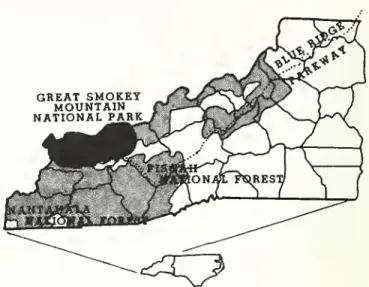
Great Smoky Mountain National Park, the Pisgah and Nantahala National Forests, and the Blue
Ridge Parkway, the federal government owns about 25% of the land area in the eighteen westernmost
counties. The major industry in the region has
been natural resource-based timbering and log-ging.
For decades before the 1960s, little growth or change was apparent in western North
Carolina. Then, between 1970 and 1980 the
aggregate population of the eighteen westernmost counties increased by 17.5%. A major cause of
growth is recreation development, especially resorts and second homes. The mountains have been a traditional summering place, but few
large-scale second home developments were built before the late 1950s. Since then, second home
subdivisions and resorts of fifty to several thousand acres have sprung up. These include retirement communities, ski resorts, and
time-sharing condominium resorts.
Recreation-related development is improving
the region's economy, but it is also bringing fundamental social changes to the region. Its
population is increasing rapidly, with retirees
as a major component of growth. Absentee land
ownership is increasing. In 1979, a twelve-county study found that 82% of privately held
acreage was owned by people from outside the
county in which the land was held (Efird and Moretz, 1980). Out-of-state residents held 45% of that amount. Another study found that the
average person buying nonfarm land in western North Carolina in 1977 lived over 400 miles from
the property purchased. The corresponding fig-ure for the state as a whole was 157 miles
(Danielson, forthcoming).
In the past the region has attracted mostly
low-wage, slow-growth industries related to textiles, furniture and paper. Current
indus-trial development is accelerating in the region
as a whole, but with a very uneven distribution. Numerous new plants are locating in counties
near the Interstate 40 and 26 corridors.
Coun-ties with poor highway access, particularly those bordering Tennessee, have gained little
new industry. Such counties generally have most of the region's federal land, have little
indus-trial base to start with, and have experienced
or will experience much of the recreation
devel-opment growth. Recreation and tourism can be
said to be their major industry.
The recreation industry has very different location requirements from factories.
Remote-ness, steep slopes, high altitudes, and prox-imity of federal lands are all assets.
Accord-ingly, resort and second home developments seek
out rural, mountainous areas. Such areas usual-ly have few public services and land use regula-tions. The lack of services and controls is
problematic, for recreation development is not
without environmental problems. These include
.SECOND HOME SUBDIVISIONS AND RESORTS
OF FIFTY TO SEVERAL THOUSAND ACRES
HAVE SPRUNG UP.
narrow dirt roads that wash out easily, stream sedimentation, greater concentrations of private wells and septic systems, and unrestrained clearing of forested areas for recreational amenities.
The lack of county ordinances, combined with fears that the region's environment and
natural beauty were being degraded, led to a
1975 state legislative proposal for regional land use planning and designation of areas of
environmental concern. The Mountain Area Management Act, which was not enacted, met with
regional opposition and is unlikely to be re-vived. Thus, any land use controls will have to come from the local level.
OVERVIEW OF THE REGION
All but one of the four counties with population increases during the last decade of 25% or more have much stronger recreation
devel-opment than industrial development. These are
Joanna Mack is a recent graduate of the
Depart-ment of City and Regional Planning, UNC-Chapel
Henderson, Watauga, Macon, and Clay Counties. Henderson County is the exception, as it has
been attracting both industrial and recreation development. Twelve other counties in the re-gion experienced 10% or more population
in-creases in the past decade.
New manufacturing plants have been attrac-ted to Buncombe, Henderson, Rutherford, and
McDowell Counties; and other more rural coun-ties, such as Mitchell and Madison, have
been seriously recruiting industry. In con-trast, the six counties with sizable federal land holdings (30% or more in national parks or forests) have not been gaining manufacturing. Much of the recreation development has occurred
in these counties, though by no means all of it.
Such development has been concentrated in
Transylvania, Haywood, Macon, Jackson, Avery and
Watauga Counties. Tryon, Highlands, Cashiers, Banner Elk, Blowing Rock, Maggie Valley and
Beech Mountain are examples of towns signifi-cantly affected by resort development. In
addi-tion, a spurt of individual home construction in
Clay, Swain and Madison Counties may be attri-buted to recreation development.
Typically, local governments in the region have three to five part-time county commis-sioners and small budgets. Only three of
twenty-three counties have FY 1982 budgets grea-ter than $11 million. Twelve county budgets are
between $5 million and $11 million, and eight counties have budgets below $5 million.
Proper-ty tax rates are usually below the state average
of $.75 per $100 valuation. County staffs are small, though some counties have professional managers or administrators. Few employ profes-sional planners, and county staff who deal with land use matters are most often the sanitarians and building inspectors. Although these person-nel are county-funded, they are responsible for
enforcing state-mandated regulations.
Little land use or other formal planning has occurred at the county level. Regional land use plans mandated by HUD's 701 program for
funding eligibility were prepared by the four
regional Councils of Governments (COGs). None
of those plans has been adopted as binding by the COG boards, which are made up of local
officials. So far the COG and state Department of Natural Resources and Community Development field office staffs have prepared whatever plans have been required by federal agencies or
re-quested by counties.
A phone survey of western county managers and planners indicated that, as of mid- 1981, few counties had subdivision and zoning ordinances
.
Only six of twenty-three counties had subdivi-sion ordinances, and three had county-wide zo-ning. Two other counties had partial or spot zoning. Subdivision ordinances were pending in
three counties, and two counties were consider-ing zonconsider-ing. The number of counties with such
GREAT SMOKEY
MOUNTAIN
NATIONAL PARK
^Z>
Generalized map of federal landholdings in western North Carolina.
ordinances has remained constant since the
mid-1970s, but the specific counties have
changed as ordinances were repealed or enacted.
Table 1 lists current ordinances and staff capacities by counties.
THE STUDY
Given their records thus far, how likely are North Carolina's western counties to adopt
land use controls? The answer depends in part
on local governments' perception of the need for
controls and their ability to enforce
ordinan-ces. To determine some of the factors affecting regional attitudes about land use regulation, interviews were conducted in six counties during summer 1981, by researchers with the Center for
Urban and Regional Studies at UNC-Chapel Hill,
with participation of the Center for Improving Mountain Living at Western Carolina University. The people interviewed
—
county commissioners,,.HOW LIKELY ARE NORTH CAROLINA'S
WESTERN COUNTIES TO ADOPT LAND USE CONTROLS?
savings and loan officials, builders, planners, sanitarians, and realtors
—
were asked questions related to growth management, major localgrowth-related problems, and land use regulation capacities.
The six counties chosen represented large
amounts of federal land ownership (Swain),
ex-tensive resort development (Avery), established industry (Haywood), large amounts of retirement home development (Transylvania) ,
long-estab-lished resort development (Polk), and mixed
(Jack-son). Table 2 gives thumbnail sketches of these
counties .
Summary of Findings
1 .
The existence of ordinances is related to size of county population, quality and amount of
development. Generally, the easternmost coun-ties are most likely to have considered or
enacted ordinances. The most western counties,
with small populations and/or large amounts of
federal land, are least likely to have
ordinan-ces. Subdivision regulation has been given more
consideration than zoning. Counties with some
form of zoning, either partial or county-wide, include Polk, Madison, Wilkes and Henderson. Counties that have considered but not adopted zoning include Jackson, Avery, Macon, Caldwell and Watauga.
2. Subdivision ordinances have been adopted in
counties where subdivision roads and services have caused problems. Zoning has been less
accepted for a number of reasons: public
oppo-sition to interfering with a property
owner's use of his land, perception that it is
not needed, concern about political favoritism
in granting variances, and distrusts about the
equity of zoning.
3. Reasons for repealing or not enforcing ordinances included: change of county
adimini-strations; protests from builders, developers and realtors; lack of an enforcement mechanism
or the means to afford one; controversy about
specific situations affected by the ordinance; and unsuitability of ordinances based on state
models. A compounding factor may be that
ordi-nances were sometimes adopted without adequate consideration of how they would be implemented.
Interview Discussion
The interviews revealed that western coun-ties are moving cautiously toward land use
regulation and land policy. A pattern of
wai-ting until the need for regulation is perceived (usually when trouble is occurring) emerged.
Most counties do not have the luxury of preven-tive measures because of limited staff and
budgets. County leaders see their role as
reading and responding to public mood and opi-nion. Many counties are too busy trying to
balance their budgets for next year to think
much about programs for guiding future growth,
despite their concern about the future.
Polk is the only study county that has
zoning and subdivision ordinances. Both Haywood and Transylvania Counties have had subdivision regulations which were repealed. In Haywood County the ordinance was never implemented.
However, Haywood County is now reconsi-dering a subdivision ordinance, largely due to
recognized septic system failures in low-lying subdivisions. County realtors and builders are
now more favorable to a subdivision ordinance partly because they want rules for
self-protection. The county planner has been working with members of the local builders' and real-tors' associations in developing the ordinance.
The proposal stresses pre-subdivision lot sale
checks for septic system suitability, with
en-forcement by the county health department through septic system permits.
Transylvania County is also taking another
look at a subdivision ordinance. Public protest
of the earlier ordinance had resulted in a
change of administration, repeal of the subdivi-sion ordinance, and repeal of the county's sedimentation and environmental impact laws at
the same time. Three of the five county commissioners in the repealing administration were realtors. The county planner is now
draf-ting another subdivision ordinance with the
support of the county commissioners' chairman and the planning board. The new proposal will be less restrictive for the "little fellow" than
...PROTEST OF THE EARLIER ORDINANCE HAD RESULTED IN A CHANGE OF ADMINISTRATION.
the previous ordinance, in order to prevent opposition. It will stress minimum road
re-quirements and lot suitability for septic and water systems. Those interviewed expect the
ordinance to pass with little trouble.
Polk County has adopted industrial and
rural residential-agricultural zoning for
por-tions of the county. Jackson County discussed zoning at one time and a public education
came to the fore. Swain County is unlikely to
consider zoning because of public animosity towards further government control of land.
Avery County seems to have studied land use
controls and zoning, but the study committee disappeared between county administrations. Transylvania County's current commissioners do
not plan to introduce zoning in the next few
years.
Haywood County is now considering zoning enabling legislation that would allow areas in the county to request zoning. The support for
this is coming from residents of one second home
subdivision who are concerned about high density residential development proposed near them. The
draft proposal calls for five residential
dis-tricts, including a mountainous, very low densi-ty district, three commercial, and two
industri-al districts. A step-by-step procedures section explains the ordinance. The county planner is
now working with the head of the homebuilders' association to include the builders' perspective and develop a proposal acceptable to most of the
developers.
Despite the scarcity of land use controls, most local leaders interviewed are in favor of zoning, if done reasonably, and subdivision regulations, principally as consumer protection devices. This opinion holds across county
com-missioners, realtors, savings and loan officers, and sanitarians. However, many say their coun-ties are not ready yet for such ordinances and predict that enactment will occur in about ten
years.
Concern was expressed about the quality of
subdivision development, and people took pains
to distinguish between developments done
care-fully and those done by "fast buck artists." Each county seems to have experienced some of the latter, but often one or more developers were cited as doing a good job. Generally, such
developers were offering more than lots, and were able to construct the development gradu-ally.
Overall, people felt that subdivision
regu-lations would be accepted before zoning, princi-pally because of problems with services in
subdivisions, such as road maintenance. Accep-tance would come through a need to protect consumers with minimum road requirements and
tests of individual lots for septic and water
TABLE
1Planning
and
Land Use
Control
Capacity
in
23 Western
Counties
Position/ Ordinance
County Allegheny Ashe Avery Buncombe Burke Caldwell Cherokee Clay Graham Haywood Henderson Jackson Macon Madison McDowell Mitchell Polk Rutherford Swain Transylvania Watauga Wilkes Yancey
R/r R/P
R/P
•= Existing
R = Repealed
* = Repealed by state request. State taking over enforcement.
P= Vending
S = Some provisions
—
less than complete geographic coverage.supply systems. Design and location considera-tions were less often mentioned. People
inter-viewed stressed the need for subdivision
ordi-nances to be sensitive to local custom. In counties where subdivision ordinances
were rescinded, the reason often given was that the standard ordinance form adopted was
inappro-priate to mountainous terrain. Another area
where ordinances should be attuned to local
custom is the practice of giving lots to
chil-dren or relatives for home sites. Such subdivi-ding should be exempt from a subdivision ordi-nance, according to many people interviewed.
Public acceptance of zoning was felt to be
far away. Many interviewees seemed pessimistic when zoning was mentioned, despite their
perso-nal view of zoning as the most accessible and
well known method of land use control. Their reaction could be attributed to anticipation of
future conflict on the matter or remembrance of
past battles. Most people interviewed defined zoning according to the usual designation of uses
—
residential, industrial, rural, etc., with provisions to restrict mobile homes. Sometalked about density zoning or incentive zoning
for industry, but most seemed unaware of
alter-native zoning approaches.
Based on the assessments of people inter-viewed, support from the county Chamber of
Commerce and realtors' and builders' associa-tions seems crucial to getting ordinances
ap-proved. These groups will support such
ordinances if they are seen as giving protection to them, to industry and to home buyers. They want to see residential investments protected, and public services such as roads and water systems installed in such a way that the area
qualifies for state maintenance.
Often, public support for ordinances comes
from homeowners seeking to stop unwanted devel-opment. In many cases these are newcomers from areas where government intervention is more
firmly established. With a few exceptions, county natives are perceived as having objec-tions to zoning. It may be that a cohesive regional attitude toward land has directed its use until recently. As more non-natives buy land and move into the area, whether seasonally
or permanently, and competition for land in-creases, regulation by custom and culture no
longer works.
RECOMMENDATIONS
The recommendations proposed here are based
on suggestions made by local leaders and are
directed toward improving the capacity of local
governments to deal with their largest growth
sector, recreation development. Capital
im-provements planning and measures aimed directly
at problems from recreation development are
recommended as first steps toward managing
growth.
1. Counties should institute capital improve-ments planning and multi-year budgeting, as
ways to estimate future service needs, costs and county revcnue-'i,
Capital improvements planning is especially important for timing major infrastructure needs
requiring large expenditures, often important in
attracting industry. Since water and sewer
availability affects where growth occurs,
exten-ding capital improvements planning to location
of lines would achieve a measure of land use
planning. More counties have staff trained in
budgeting than land use planning.
2. Local governments that face or expect to face large impacts from recreation development should adopt programs to assess those impacts
and lessen any adverse effects.
County governments now have authority to
require environmental assessments for all devel-opments greater than two acres. Estimates of the development's size; terrain suitability;
water, sewer, road and maintenance provisions; and effects on county services and transporta-tion can be required in assessments. Council of
Governments, Soil Conservation Service, and
North Carolina Department of Natural Resources and Community Development field office staff can
assist counties in evaluating assessments. Counties should consider
vacation developments based on
future service demands. This plished through a subdivision
at second homes. Requirements form of different permit fees, or service maintenance funds,
owner association provision of
minimum lot sizes.
requirements for their size and
could be
accom-ordinance directed could take the
performance bonds developer or
home-services, and
3. To supplement local regulations, counties should experiment with public-private sector
programs through lending institutions, builders'
and realtors' associations and other develop
-ment-related groups.
Lending institutions could expand criteria
for subdivision development loans to include lots' suitability for private water and sewer
systems and site construction methods. Govern-ment staff (sanitarians, building inspectors,
soil conservationists) could conduct education programs for development-related groups,
cover-ing "best practices" for construction, and state
and local requirements. Such programs could be
part of associations' meetings or special ses-sions sponsored by local technical institutes.
field office staff, and by trying alternative staffing arrangements.
Use of part-time staff through contracts with Councils of Governments, joint city-county staffs, and sharing staff among counties should be explored. In addition, building inspectors and sanitarians should meet state competency requirements
.
5. Because the region is predominantly rural,
counties should explore multi-county approaches to industrial sites, water, sewer and solid waste services, and other projects.
Such arrangements might be appropriate for
areas near county borders, providing cost
shar-ing and greater economies of scale. Regional educational institutions. Councils of Govern-ments and state field offices should publicize examples of multi-county efforts and assist interested counties in establishing joint pro-grams.
Western counties have traditionally been
without formal land use policies and development controls. Until recently such formal controls may not have been needed. However, the region's accelerating pace of development
—
particularly recreational development—
is creating a need andpressure for controls. Counties are moving cautiously toward controls with support from diverse groups, but their efforts are hampered by public opposition, lack of staff and small
budgets. A combination of capital improvements planning and a recreation subdivision ordinance
is proposed for growth management as a means of
dealing with regional institutional
con-straints.
Author's Note: This study was supported, in
part, by the Lincoln Institute of Land Policy,
Cambridge, Massachusetts.
REFERENCES
American Society of Planning Officials, et al.
1976. Subdividing Rural America: Impacts
of Recreational Lot and Second Home Devel
-opment, Executive Summary. Washington,
D.C.: U.S. Government Printing Office.
Center for Improving Mountain Living. 1981.
County Development Information. Cullowhee,
N.C.: Center for Improving Mountain Living.
Danielson, Leon. Forthcoming. The Rural Real Estate Market In North Carol iona. Raleigh,
N.C.: Department of Economics and
Busi-ness, N.C. State University.
Efird, Cathy, and Moretz, Ray. 1980. Appala
-chian Land Ownership Study, Vol IV: North Carolina. Boone, N.C.
chian Studies.
Center for
Appala-Planning and Inventory Section. 1976 and 1980.
North Carolina County and Municipal Planning Profiles. Raleigh,
N.C:
Division of Land Resources, Department of
Natural Resources and Community
Develop-ment.
Research and Planning Section. 1979. North Carolina State Government Statistical Abstract. Raleigh, N.C.
Budget and Management.
TABLE 2: THUMBNAIL SKETCHES OF CASE STUDY COUNTIES Avery County
Population (1980)
Area
Percent federal land FY 1982 budget
Property tax rate
Planning board
County manager/administrator County planner
Land use ordinances
1979 per capita income
14,
158 16% $5, $0.
No
No
No Non
$4,
409
,080 acres 451,258
47/$100
e locally initiated
546
Characteristics: Largest industry is resorts and second homes. Sugar and Beech Mountain Ski Resorts
are in Avery County, as are several other high amenity resorts. Shrubbery culture is largest agricultural crop. Currently, a taxpayers' association, organized by county natives, is fighting property assessments. Present commissioners have no plans for land use ordinances.
Haywood County Population (1980)
Area
Percent federal land
FY 1982 budget Property tax rate
Planning board
County manager/administrator County planner
Land use ordinances
1979 per capita income
46,495
347,564 acres
37%
$9,313,912 $0.69/$100
Yes Yes Yes
None locally initiated $6,768
Characteristics: County is now considering a zoning enabling ordinance which would be adopted by
community request. A subdivision ordinance may be considered after deliberation is finished on zoning. County has sizable amount of recreation development, particularly in Maggie Valley, and is
now completing its 201 study. Land use ordinances have a chance, but several powerful landowners are
opposed.
Jackson County Population (1980)
Area
Percent federal land
FY 1982 budget Property tax rate
Planning board
County manager/administrator County planner
Land use ordinances
1979 per capita income
25,811
319,744 acres
21%
$9,651,873 $0.60/$100
Yes, inactive
No. Chairman of County Commissioners serves full time in this capacity.
No No
$5,449
Polk County Population
Area
Percent federal land
FY 1982 budget Property tax rate
Planning board
County manager/administrator County planner
Land use ordinances
1979 per capita income
12,984
149,888 acres None
$2,734,078 $0.457/$100
Yes Yes No
Subdivision ordinances; zoning of some
areas .
$8,229
Characteristics: County has a number of very wealthy residents and most of the part-time residents are older and well-to-do. Tryon is center of recreation development, but some new developments are
occurring outside of Columbus. Split between Tryon and rest of county for water supply and schools, as Tryon has its own systems. County growth has been slow and steady. Resorts have been a key
industry since the late 1800s.
Swain County Population (1980)
Area
Percent federal land FY 1982 budget
Property tax rate
Planning board
County manager/administrator County planner
Land use ordinances
1979 per capita income
10,283
348,288 acres
68% (excluding Indian reservation) $1,700,000 (est.)
$0.45/$100
Yes, mostly concerned with economic development
Yes No
None locally initiated $5,705
Characteristics: Large federal park and Indian holdings have made county anti-government land use
regulation. Lack of land for industry is a worry. County has very high unemployment; many people seek work seasonally in tourist business or cut-and-sew plants.
Transylvania County Population (1980)
Area
Percent federal land
FY 1982 budget Property tax rate
County manager/administrator Planning board
County planner Land use ordinances
1979 per capita income
23,147
242,153 acres
36%
$6,811,597 $0.69/$100
Yes Yes
Part-time
None locally initiated
$6,791
Characteristics: New residents have had a large impact on county government
—
four of fivecommissioners are not native county residents. Recreation development has been largely retirement-type resorts. One large recreational project started in 1971 has caused problems, plans to readopt subdivision ordinances. County residents are debating the amount of
future county growth, spurred on by a proposal to extend Interstate 26 to the county.