The Problem of Choice in Hollywood Cold War Cinema
Nathan L. Smith
Senior Honors Thesis Program in Cultural Studies
University of North Carolina at Chapel Hill
7 April 2016
Approved:
ii
iii
Acknowledgements
The benefit of waiting until after the defense to finalize this portion is that I can now truly acknowledge my supporters and attempt to thank them in some small way for the breadth of their efforts. I especially owe three people such recognition for their contributions to the thesis and to my education more broadly. And, to them together, I must express my appreciation for a
delightfully insightful defense, which has given me much to ponder about this project and my wider interest in film.
Although I have only had the pleasure of getting to know Rick Warner this semester, he has already been wonderfully helpful. His comments are always direct, carefully developed, and highly relevant. The adept way he handles his knowledge of film, including the expectations of the discipline, is impressive and edifying. I look forward to our continued work together on film: there is much for me to learn.
To Lawrence Grossberg, whom I have known the longest, I owe a great deal of thanks. I first met him as a bleary first-year when he welcomed me into his office to discuss the Program in Cultural Studies. Ever since, he has been a force of encouragement and, in his own way, of discipline and confidence. Without him and the program, which has given me such a place to grow intellectually and politically, my undergraduate education would have been far less rich and fulfilling. Do not fear, I will keep studying the weird stuff—there should always be something new for us to discuss—and I will always hear your voice imploring me to be more contextual.
iv
strugglings and strivings to constitute a viable project and during the tireless work refining its scope. Only through our meetings and in-depth discussions was I able to develop each chapter. In the end, he provided the countless comments and refinements need to complete the thesis. Beyond this project—in a parallel and contemporary set of worries—he offered daily counsel amid the strife of graduate school applications and prepared me for the gamut of ensuing
interviews; in the final deliberations over which doctoral program to join, he was unwavering in his support. Always when I needed it most, he reassured me and instilled confidence. His pedagogical and personal commit is heartfelt, and there are few people so earnest and
1 Introduction
The cinematic preoccupation with the problem of choice that emerges especially during the Cold War period can be read against the background of the much older philosophical history of the problem. The ethical writings of Aristotle (384–322 BCE) played an early, and arguably foundational, role in that history. For Aristotle, the only endpoint to the human’s moral
development was death. In his reckoning, humans are always becoming more or less virtuous, and the direction of their moral trajectory depends in large part on the day-to-day choices that they make, which Aristotle tended to gather under the term habit. As he observes in the
Nicomachean Ethics, “moral virtue is the result of habit, and so it is that moral virtue [êthikê] got its name by a slight alteration of the term habit [ethos].”1 The biggest contribution of Aristotle to the philosophical history of choice was to imbue even the most trivial and quotidian decisions with moral significance. The Stoic philosopher Boëthius (c. 480–524) offers a second useful coordinate. In his Consolation of Philosophy, Boëthius wrestles with the question of whether God’s foreknowledge of human events forecloses the possibility of ethically meaningful choice. In other words, he asks, if a judgmental God knows from time immemorial what one has chosen, then has one, in reality, actually chosen to act in a particular way? While Aristotle had conceded that one’s ethical development was constrained by accidents of birth and cultural convention, Boëthius introduced the far more radical possibility of a systemic, totalizing foreclosure of freedom and—by extension—of the possibility of ethical action. Among other philosophers
1 Aristotle, Aristotle’s Nicomachean Ethics, trans. Robert Bartlett and Susan Collins (Chicago, London: University
of Chicago Press, 2011), 1103a16–8. Note that, in addition to moral virtue, the other component of virtue is
2
important to the problem of choice are Kant, Kierkegaard, Nietzsche, and Sartre.2 Of these, Kierkegaard (1813–1855) provides a salient point of reference for this essay. Especially in the second part of his Either/Or, Kierkegaard argues that choice and the ethical are intimately related.3 Kierkegaard goes beyond Aristotle and Boëthius in the radical nature he assigns to choosing, which, in his thought, is almost an act that generates the subject: “the I chooses itself or, more correctly, receives itself.”4 The foundation of an individual’s relation to the ethical lies primarily in the initial decision to pay deference to the ethical and in realizing the extent to which one is thereby responsible for one’s choices, which must have meaning for the individual.5 Rather than focus on the content of an individual’s choice, Kierkegaard is—at least in the first instance—concerned with demonstrating the importance of choice vis-à-vis its formal relation to the ethical: “the point [of the ethical] is not the reality of that which is chosen but the reality of choosing.”6
This necessarily brief and partial tour through intellectual history offers a suggestive vista onto Hollywood cinema in the 1960s, an era in which choiceassumed a particularly conspicuous place in ethical debates and nationalist polemics. Throughout the Cold War, patriotic jingoism identified choice as the factor that distinguished the United States from the misguided Soviet experiment; choice was something the United States had that the Soviet Union allegedly lacked.
2 Kant reads the freedom to act morally on the side of universality (in which autonomy is subject to reason). By
contrast, Sartre’s position seems comparable to that of Boëthius, except that Sartre partially inverts the conclusion of the Consolation of Philosophy. Essentially, for Sartre, one must act morally precisely because there is no God watching. This is an individual determination in the face of insufficient reason. Nietzsche emphasizes the crucial importance of the one who is self-fashioned.
3 It should be noted that the second part of Either/Or is delivered under the persona of B, who is in dialogue with A,
the persona of the first part of Either/Or.
4 Søren Kierkegaard, Either/Or, pt. 2, Kierkegaard’s Writings, ed. and trans. Howard Hong and Edna Hong, vol. 4
(Princeton: Princeton University Press, 1987), 177.
5 Kierkegaard, Either/Or, 2:166, 168. Throughout, Kierkegaard opposes the ethical and the aesthetic orders. If one
does not choose the ethical, then one is attempting to pay deference only to aesthetic considerations of action. To attempt to live a purely aesthetic life is improper.
3
This presumption, in turn, was imbued with moral significance that even Boëthius might have considered overblown. In their McCarthy and His Enemies (1954), William F. Buckley, Jr. and coauthor L. Brent Bozell, Jr. defend McCarthyism on the grounds that it helps preserve the humanizing electoral freedoms denied to those living under Communist regimes. The duo accused McCarthy’s critics of undervaluing freedom of choice in the abstract, and—what is more—of choosing their philosophical alliances lightly: “The intellectual scandal around McCarthy is primarily the frightening frivolousness of his opposition which holds that man’s choices signify nothing; that on his walks through the valley of decisions man picks and discards commitments with the abandon of Peter Pan picking daisies.”7
Consumer choice was also a routine feature of moralizing discussions of Cold War politics. On July 24, 1959, Vice President Richard Nixon participated in the Moscow-based Kitchen Debate, which coincided with the American National Exhibition in Sokolniki Park. As part of the exhibition, the United States erected an installation of a model home that was, in theory, affordable to the average worker. As Nixon extoled the modern conveniences of the simulated dwelling, Khrushchev interjected that, in the USSR, housing was a right guaranteed by the government to all, while, in the US, the poor are forced to sleep on the pavement. The
following day, the New York Times quoted Nixon’s rebuttal to Khrushchev: “Diversity, the right to choose, the fact that we have 1,000 builders building 1,000 different houses is the most
important thing.”8 For Nixon, preserving the ability for people to purchase dwelling accordant to their desires and stations in life is a higher moral good than ensuring that every citizen has shelter.
7 William Buckley, Jr. and Leo Bozell, Jr., McCarthy and His Enemies: The Record and its Meaning (Chicago:
Henry Regnery, 1954), viii.
8 Harrison Salisbury, “Nixon and Khrushchev Argue In Public As U.S. Exhibit Opens; Accuse Each Other Of
4
Hollywood films of the 1960s engage the politicized rhetoric of choice in a number of resourceful and frequently sophisticated ways. Thanks in part to Richard Hofstadter’s influential book, The Paranoid Style in American Politics (essays written from the early 1950s to the collection’s assembly in the mid-1960s), scholarship has tended to filter the philosophical
problem of choice in the 1960s through the conceptual lens of paranoia.9 From the perspective of a Cold War paranoid disposition, there is constant self-questioning: did I really choose, or were events predetermined by a systemic conspiracy? The audience likewise participates in this constant process of seeking verification by performing a commonsense assessment: characters are paranoid if other aspects of the film fail to correspond to the characters’ perceptions. This diagnostic mindset pervades criticism as well. The primary motivation becomes determining whether or not a character or a group of characters is paranoid, with paranoia understood in opposition to the diegetic reality of the film. Analyses of this sort can view the film’s depiction as reactionary, if it is meant to bolster the status quo of the US (against the USSR). Or they can decide there is a radical moment in the depiction, either because it decries the state satirically or because it presents as shameful the paranoia-inducing systems of oppression that define the subject position of at least one of the characters. Another question of assessment is that of psychosocial diagnosis. Criticism reads the paranoia of characters as evidence of the degree to which paranoid films exhibit a sort of social paranoia—the difference between the perceptual and actual “threat” of Communism. There is more involved in the problem of choice, however, than the fear of conspiracy and or the corresponding social diagnosis of paranoia.
9 Richard Hofstadter, The Paranoid Style in American Politics: And Other Essays (Cambridge: Harvard University
5
The three films considered in this essay display a range of aesthetic and philosophical investments that exceed the purview of paranoia and the kinds of analysis to which that concept normally gives rise.
Chapter 1 discusses John Frankenheimer’s The Manchurian Candidate (1962), a film that places the paranoid mindset front and center and that wears its allusions to topical events on its sleeve. Set against the backdrop of international espionage and McCarthyism, The Manchurian Candidate effectively creates the sensation that external—and perhaps sinister—forces
determine the events of the film, including the most intimate choices of the characters. This effect is achieved through the plot’s elliptical structure and Frankenheimer’s tactical
manipulation of filmic and literary genres. The collision of normally distinct generic codes within individual scenes and the disorienting elision of time between them forces the audience to speculate about the causal relationships between the key—and not-so-key—events of the plot. Given the subject matter in The Manchurian Candidate, this has the effect that the audience is invited to participate in various degrees and kinds of totalizing analysis. Each loose end is a temptation to join the characters in their paranoid speculations. While Frankenheimer’s film overtly thematizes paranoia, its ultimate interest arguably lies in probing the under-examined choices that are a routine part of film spectatorship.
6
impactful decisions. Delusional paranoia enters Dr. Strangelove as the disavowed twin of technocratic rationality, which—with consummate hypocrisy and poise—allows the military commanders to engage in the fantasy that they are not to blame for their disastrous choices.
Chapter 3 examines how Roman Polanski’s Rosemary’s Baby (1968) approaches the problem of choice from what might be called an Aristotelian perspective, focusing on the
7
Chapter 1. Redirecting Cold War Tropes: The Manchurian Candidate’s Manipulation of Genre and Critique of Televisual Politics
From being in love to hypnosis is evidently only a short step. The respects in which the two agree are obvious. There is the same humble subjection, the same compliance, the same absence of criticism, towards the hypnotist as towards the loved object.
Sigmund Freud10 I. Introduction
On the surface, the plot and dialogue of John Frankenheimer’s The Manchurian
Candidate (1962) treat the hypnotized subject as a horrifying exception to the human condition. Adapted from Richard Condon’s 1959 novel of the same name, the film tells the story of two veterans of the Korean War who were kidnapped and brainwashed during their final tour of duty, as part of an international plot to install a Communist in the White House. Haunted by recurring nightmares that appear to be fragmentary memories of the soldiers’ brainwashing and captivity, Major Bennett Marco (Frank Sinatra) suspects that another member of his platoon, Raymond Shaw (Laurence Harvey), holds the key to his cryptic dreams. Raymond—the stepson of United States Senator John Iselin (James Gregory) and the son of Communist spy Eleanor Iselin (Angela Lansbury)—has been programmed to become a subversive assassin-on-demand. Much of the film’s investigative plot is devoted to Marco’s efforts to discover the trigger that turns Raymond into a submissive drone with no memory of what he has done while under the influence of
hypnotic suggestion. Yet, for all of the horror and pathos occasioned by Raymond’s predicament,
The Manchurian Candidate delights in suggesting that, in the age of live broadcast television, his lack of agency is far from unusual.
10 Sigmund Freud, Group Psychology and the Analysis of the Ego, in his The Standard Edition of the Complete
8
One of the classic political thrillers of the Cold War era, The Manchurian Candidate
explores its grim view of mass media by taking a detour through surprising generic terrain, namely, the romantic comedy. The film follows two romance plotlines: a train encounter turned serious romance between Eugénie Rose Cheyney (Janet Leigh) and Bennett Marco and the summer love and brief marriage of Jocelyn Jordan (Leslie Parrish) and Raymond Shaw. Rosie and Marco move rapidly and perfunctorily through the stages of romantic comedy wooing, giving the impression that generic convention is fueling the flame rather than “natural” attraction. With no less expedience, the romance of Jocie and Raymond problematizes the
origins of the young couple’s mutual attraction, suggesting that aggression toward, and repressed desire for, parental authority determine their erotic yearnings. In both plotlines, love appears as something commanded by an external force, rather than as something that flourishes organically. The unfree romances of the couples are but a small-scale version of the United States electorate, as the film suggests in its treatment of the symbiosis between the media and national politics. Effective choice in politics proves impossible in the context of the deceptive storytelling of mass media, which generates spectacle by manipulating the libidinal energies of the viewing public. Thus, to the extent that the characters do not seem to choose freely even in the most intimate matters of love, let alone in matters of great national political importance, the film suggests that hypnosis is an allegory for the hapless state in which people make choices that are supposed to guarantee their freedom, but in the end have precisely the opposite effect.
II. Rosie and Marco
9
station, when Rosie posts bail for Marco, who has been arrested for assaulting Raymond’s valet (whom he recognizes as one of the parties who engineered his captivity in Manchuria). The police station scene cements their mutual attraction. Throughout the remainder of the film, we see brief scenes of them together in Rosie’s apartment. These scenes, which already feel out of place within a political thriller, appear all the more strange for the way in which they both draw on and pervert romantic comedy conventions that are so commonplace that they would usually go unremarked, thereby calling attention to the obligatory dictates of genre. The generic
determination of the romance between Rosie and Marco provides insight into the way in which
The Manchurian Candidate turns situations commonly associated with choice into ones dictated by external compulsion.
The romance of Rosie and Marco adheres to a recognizable sequence of generic scenarios associated with romantic comedy but elides the temporal duration that normally separates them from one another. By typical standards, the romantic spark should occur in the second act, with “the ‘cute meet’ between the couple-to-be, while the third act is the ‘joyous defeat’ of the obstacles to their union,” as David Bordwell puts it.11 The barriers that block romantic fulfillment are often related to the availability of the woman. Either she is already in a
relationship or she is aloof to romantic advances altogether, in a way films often code as prudery. Eventually, the woman lowers her defenses, and the two finally unite. The Manchurian
Candidate radically overturns these conventions by drastically shortening the temporal interval between “the first fumblings, inevitable misunderstandings, abrupt separations, and bursts of passion,” to use another of Bordwell’s characterizations.12 The small talk in which Rosie and
11 David Bordwell,The Way Hollywood Tells It: Story and Style in Modern Movies (Berkeley, Los Angeles,
London: University of California Press, 2006), 29.
10
Marco engage on the train turns to questions about romantic availability so quickly that it would be jarring in a typical romantic comedy.13 The film also revises the expected situation of the female love interest: Rosie is engaged but willing to dump her fiancé at the first provocation. Thus, the arc of their romance—moving from an awkward first encounter to routine domestic bliss in the span of a few scenes—creates the impression that an uncannily prompt and efficient obedience to generic expectation are responsible for the coupling of Rosie and Marco. A fait accompli, the union of Rosie and Marco has the quality of love before first sight.
To further the sense that these characters lack agency in love, the film goes out of its way to hint that Marco may have been hypnotized during his initial conversation with Rosie. The few minutes of Rosie’s initially feeble flirtations culminate in an odd exchange about her name, one that is typical of the disorienting nature of this scene. Abruptly, Marco asks, “You Arabic?”14 A couple more minutes of talk go by before Rosie suddenly repeats Marco’s question of ethnicity, which she nonsensically reframes as a question about romantic availability: “Let me put it another way: are you married?” When he also responds in the negative, what was largely a clumsy, mechanical, one-sided flirtation has somehow turned into mutual romantic interest.15 It is as if the ham-fisted banter of Rosie has, against all realistic odds, spontaneously seduced Marco. Indeed, throughout the scene, Sinatra plays his character with glassy-eyed abstraction
13 It is worth noting that the scene uses much the same dialogue as Condon’s original novel. See Richard Condon,
The Manchurian Candidate (London: Redwood Burn, 1972), 154–7. Mathew Jacobson and Gaspar González, What Have They Built You to Do: The Manchurian Candidate and Cold War America (Minneapolis, London: University of Minnesota Press, 2006), 160, likewise note this.
14 Condon, 155. This question is another line Axelrod copied over from the novel. The love interest is supposed to
have a dark complexion in the novel. Here, the question only adds to the nonsensicalness of their dialogue.
15 The abruptness of the romantic shift in their exchange is anticipated by Rosie’s insertion into the film in the scene
11
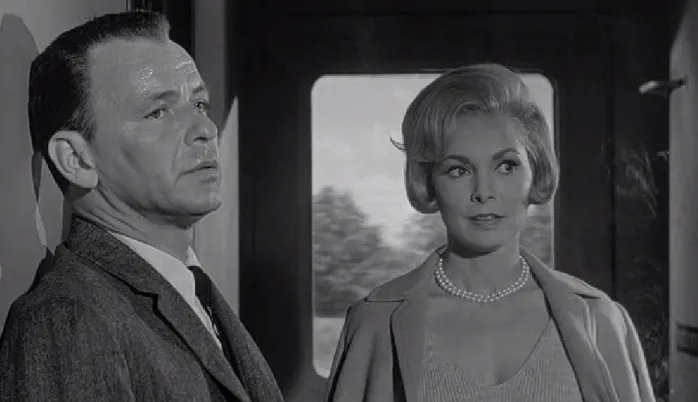
(fig. 1). For much of the scene, the dialogue’s penchant for non sequiturs and the distracted mien of Marco suggest a one-sided—or, at least, non-reciprocal—exchange, one reminiscent of the uncanny Manchurian hypnosis sequence at the beginning of the film. Another reason why the first encounter between these two characters seems bizarre is that it also plays on the espionage thriller trope that any attractive woman one might meet on a train is, more likely than not, a spy.16 If Rosie is a spy capable of hypnotizing Marco or, at least, happens to catch Marco when he is open to hypnotic suggestion, then some of her odd comments to Marco begin to make sense.17 One of Rosie’s first remarks on the train is that she was one of the Chinese laborers who laid the tracks that convey them to New York, a bizarre assertion whose tangential links to Manchuria and worker solidarity makes it seem like a Communistic hypnotic trigger. Rosie also delivers her address and phone number—53 West 54th Street, Apartment 3B; El Dorado 5-9970—in an odd way, one that recalls the halting, incantatory cadences of the hypnotist.18 Later, when the two take a cab from the police station to Rosie’s apartment, Marco volunteers her address to the taxi driver in a mechanical fashion, to her cloying commendation. It thus seems that whatever happened during the train conversation has impressed itself on Marco and conditioned him to submit to Rosie’s control.
16 In contrast to the political espionage thriller, the romantic comedy understands choice very differently. Instead of
falling in love with precisely the wrong person (and not knowing the person’s identity as an enemy agent), in a romantic comedy, one falls in love with exactly the right person (but does not know it). The film compromises this assurance, however, since it seems love does not drive either of the romance plotlines.
17 Note that, while the film gives no further evidence to suspect Rosie is an agent, in contrast to the numerous agents
the film unambiguously reveals in due course, Rosie need not be an agent for Marco to be hypnotized. All she needs to be is someone who uses the right set of triggers or catches the hypnotized subject in a compromised state. Two cases provide evidence: a bartender accidently hypnotizes Raymond to jump into a pond in Central Park, and it seems possible that Jocie unintentionally hypnotizes Raymond to marry her.
18 Her comments about being a Chinese railroad worker are part of her rather poor humor program, even clumsier
12
Figure 1. Marco, looking dazed before he connects with Rosie.
The pair continues to progress through romantic rites of passage at an alarming pace for the remainder of the film. Their exchanges in the police station and taxi occur just five scenes after their meeting on the train—on the same day, it seems.19 Their “first date,” as Rosie calls it, begins as Marco sheepishly accepts her conveyance from the twenty-fourth precinct. The cab ride to her place is even more cramped than the platform between the train cars where they first met, which contributes to the sense that the film is forcing the two ever closer to one another. Rosie wastes no time adopting a perfunctory term of endearment for Marco, referring to him as her darling. Marco, by this point, struggles to do justice to her poorly timed witticisms and her premature familiarity. Yet, by the end of the scene, he succeeds, and the courtship phase of their love plot is essentially over.
19 Or it could be the next day or so. In their cab ride, Rosie speaks of dropping Marco off at Raymond’s apartment.
13
As the analysis of these scenes suggests, the character of Rosie is key to the way that the film cites the conventions of romantic comedy by the letter while violating them in spirit. Rosie does not conform to the usual profile of the female romantic comedy lead. In the taxicab scene, Rosie announces that she has called off her wedding plans, when neither the audience nor Marco even knew she was engaged. Her sudden change of heart and the offhanded, cheery way she tells Marco about dumping her fiancé do not have the same endearing effect as they would have had if Rosie’s decision had come toward the end of the film, after she had been seen to wrestle with her divided feelings while the audience was meanwhile rooting for Marco’s eventual success. By the time the taxi scene closes with a kiss, there is the overwhelming sense—because of both Rosie’s violation of gendered generic expectations and the speed with which the two come together—that Rosie and Marco become a couple under compulsion, instead of falling in love and choosing one another organically.20
In romantic comedy, the union of the romantic pair is supposed to seem predestined, yet also be seen as freely chosen by both parties. However, the romance of Rosie and Marco, whether by generic dictate or hypnotic command, essentially eliminates romantic choice and leaves only the element of predestination. Love becomes a sort of conditioned reflex. This
20 That it is generic obligation and not genuine desire that binds Rosie and Marco together is further apparent when
14
mechanical compulsion, which appears to demand unquestioning obedience, poses the question of who or what is determining what transpires on the screen. This question looms large
throughout the film. In the romance plotline that unites Jocie and Raymond, for instance, the film reveals that Raymond’s actions are as much determined by libidinal attachment to Mrs. Iselin (and the authoritarian mystique that she embodies) as by the mysterious power of hypnosis.
III. Jocie and Raymond and Eleanor
The love plotline of Jocie and Raymond is another case of expedited and seemingly compulsory romance, but it unfolds on a much grander scale. No longer is love (and lacking choice in it) a question of two individuals, as it was with Rosie and Marco; with these two children of senatorial families, it is now also a question of dynastic fortune and controlling the country. The film repeatedly uses Jocie as a conduit for expressing Raymond’s tragic fluctuating desire to copulate with and kill his mother, compulsions that are linked to Raymond’s fetishistic relationship to authority. Jocie’s incestuously tinged interactions with her senator father mirror and foreshadow the more physically explicit intimacy of Raymond and his mother. The
15
The love of Jocie and Raymond follows a tragic course that situates the pair in a
compromised position from the outset.21 Midway through the film, Military Intelligence assigns Marco to figure out what is triggering Raymond’s hypnotic episodes and to uncover the
Communists’ plan. In the scene that follows the articulation of this counterintelligence mission, Raymond and Marco share some Christmas Eve champagne, while Raymond reminisces about his brief summertime romance with Miss Jocelyn Jordan. In gauzy flashback, Raymond recalls the chance encounter that introduced him to Jocie a few months before he enlisted to fight in Korea. This reminiscence is prefaced by a statement about how much Raymond loathes his mother. Marco responds with the quip that hearing Raymond talk of his mother is “rather like listening to Orestes gripe about Clytemnestra.” This allusion to Aeschylus’s tragic Oresteia
trilogy stresses the interrelation of the libidinal, familial, and political in the romance plotline between Raymond and Jocie.
While much of the plot’s focus will be on Raymond’s incestuous desire for his mother, the film delivers its first heavy dose of family romance through Jocie’s overinvestment in
21 Their eventual marriage can end in nothing but the death of the lovers and their parents. The feuding families are
annihilated and leave behind only the eulogizing major. In tragedy, the hero must make an impossible choice in the face of fate; often, it is the attempt, in the hero’s choice, to defy destiny that end up being its very actualizer. The mistress of fate is none other than Mrs. Iselin, Raymond’s mother: it is not the whims of the gods that drive the tragic plot but the actions of the Red Queen (and something beyond even her). In tragedy, choice is not only apparent on critical assessment (as it is in romantic comedy), but it is dramatized in the form itself, to the effect that whatever the tragic result, the plot demands the hero make a choice. Love exists in the rupture of conviction, the conviction of a choice that surely spells death for those involved. The film situates this illusory choice by weaving together Jocie and Raymond through a network of desire ripe with incestuous implications. Frankenheimer’s film diabolically uses incest to weave together the two supposedly absolutely different and opposed sides, the United States patriots and the infiltrating Communists. What unites Jocie, Raymond, Mrs. Iselin, and Sen. Jordan is a common sort of passion that, whatever its source, is perverse. Communist passion and United States patriotism are associated from the start. Jocie Jordan is “That Communist tart!” to Mrs. Iselin. And Sen. Jordan himself suffers from the confluence of a hardly leftist Republican status and the slander of being a Communist. Raymond is thought to be a heroic army soldier but is actually a brainwashed Communist plant. Raymond’s mother is, of course, both the engine behind the zealously anti-Communist campaign of her husband, Sen. John Iselin, and is working as
Raymond’s United States controller for the Communists. The film, as it does throughout, collapses the distance between the two Cold War sides. Even the so-seeming good political figure, Sen. Jordan, might need to be
16
satisfying her father’s desires. Jocie and Raymond meet for the first time on the lakeshore where both their families have summer residences. She happens to come across Raymond just after a snake has bitten him.22 As she treats Raymond’s wound, Jocie pants, “My daddy’s gonna be so pleased about this.” In Jocie’s excitement, it quickly becomes clear that meeting Raymond is only fortuitous because the delivery of a half-naked snakebite victim will arouse her father, who is “just absolutely scared tiddly about snakes in this part of the country.” Jocie then implies, in explicit reference to Freud, that her father’s fascination with serpents has a libidinal
underpinning. She seems to know her father’s (possibly homosexual) desires and hints about Sen. Jordan’s interest in Raymond: “I promise you one thing: it may be a little uncomfortable for you, but it’s gonna absolutely make his supper.” Jocie, finding that she has no handkerchief, takes off her blouse in order to wrap Raymond’s wound and exclaims, “Seriously, Daddy is going to be just thrilled about this.” Right on cue, the word “thrilled” lands just as Jocie undoes the last button to her blouse.
If the relationship of Jocie and her father mirrors the incestuous tone of Raymond’s relationship with his mother, then the political power wielded by Senator Jordan makes him a figure that can compete with Mrs. Iselin’s psychic hold on her son. Jocie takes Raymond to her house for her father to examine the wound. After he is satisfied that Raymond is not in danger, the three begin to talk. Raymond is at first appalled to learn who Sen. Jordan is: when he introduces himself, Raymond interjects, “The Communist?!” But Raymond quickly becomes interested when he hears Sen. Jordan once successfully sued his mother for defamation of
22 This scene is predicated on either extreme improbability, if the lake house is somewhere in New York, or
17
character for accusing him of harboring Communist sympathies. The senator’s success against her thus makes him exceptionally attractive to Raymond, as an alternative to his domineering mother. After hearing that his mother lost sixty-five thousand dollars because of the suit, Raymond proceeds to make an awkward, untimely request for Jocie’s hand in marriage. The Jordans, who believe he must be joking (since they have learned each other’s names only moments ago) laugh at the question. Realizing his petition has not been received in the spirit in which it was made, Raymond’s demeanor eventually lightens, and he pretends as though his proposal was in jest all along (fig. 2).
Figure 2. Raymond’s proposal elicits jovial laughter from everyone.
Raymond’s incestuous desires toward his mother are inextricably linked to his fawning deference to authority, and both impulses determine the significance of Jocie to Raymond. When Jocie and Raymond reunite later in the film, Jocie, if only inadvertently, plays the role of
18
end, Raymond goes off to serve in Korea. In the diegetic present of the film, a couple of years have passed since the two former lovers have seen one another. Seeking to make amends with Sen. Jordan, Mrs. Iselin contrives to reunite the couple she has divided. To this end, Mrs. Iselin throws a costume party and invites the Jordans. Unconsciously, Jocie dons the perfect garb for recapturing Raymond’s heart. In the scene where the two finally meet again, Jocie is initially outdoors and shot from behind, as she quietly watches Raymond sit alone in his mother’s study, staring off into space. She swings the door open to reveal herself. When she addresses Raymond, the camera cuts to a brief close-up of his twitching face, a sign that the hypnotically conditioned pathways of his psyche have been stimulated. The camera cuts to Jocie and pans down her torso to reveal the cause of Raymond’s reaction: she has come to the costume party disguised as the Queen of Diamonds. Although Jocie excuses her surreptitious attempt to see Raymond alone, her choice of costume ensures that there is a third party in the room with them. As the audience knows by now, the Queen of Diamonds is the trigger used to plunge Raymond into a hypnotic state. In an earlier scene, it is revealed that this particular card was chosen for its resemblance to Raymond’s authoritarian mother. Jocie and Raymond then disappear from the party together, and, when next we see them, the two have been wed.
19
Mrs. Iselin’s hypnotic direction. His apparently internal desires are thus steering him the same way that his mother’s external commands would. For Raymond, the external control is already inside him as the incompletely repressed desire that leads him to the honeymoon chamber with Jocie, the maternal double.
In fact, although hypnosis is used by the Communist conspiracy as a means of remote mind control, its grip on Raymond is built on the foundation of his unconscious drives.23 The film suggests that Raymond’s hypnotic reprogramming is a mild intensification of the erotically charged brainwashing imposed on him by his mother.24 In the “summer of love” flashback sequence, Raymond speaks of a breakup letter he sent to Jocie just before his enlistment, but he cannot remember whether he had any part in writing it or whether he simply signed it against his will. Thus, even before Raymond’s conditioning by the Communist agents in Manchuria, his mother had vanquished his will: “I could never beat her. I still can’t.” Contrary to what
Manchurian hypnotist Yen Lo claims—and even more disturbing—one cannot be hypnotized to
23 The condensation of these elements into the Queen of Diamonds is part of the film’s vulgar Freudianism. For
instance, just before the line from Marco in which he figures out the Queen of Diamonds is the hypnotic trigger and is connected to Raymond’s mother, the psychiatrist begins, “To cheat at solitaire is a form of regression that—” before being cut off by Marco’s revelation. The same psychiatrist ruled out the jacks and kings because they do not fit Raymond’s “psychiatric pattern.” Thus, the film exploits a surface level connection between the card and the mother. And this is not the only such connection: the solitaire game brings out another. Solitaire might seem an odd choice of mechanism, as many of the cards are facedown and will only surface if Raymond successfully wins the game, a task that may take much time and many attempts. From the point of view of the Pavlov Institute scientists who programed Raymond, then, this mechanism does not make much sense. But, for the concerns of the greater film, it serves its duty as an admirable motif. Unlike in bridge or many other card games, in solitaire, the card’s suite is, of course, irrelevant; all that matters is color. In a game of solitaire, the Queen of Diamonds is a red. And a Communist is a red. Mrs. Iselin is—again, right on the surface—the Communist queen who aims to ascend to her throne. As well as appearing throughout the film, the Queen of Diamonds also recurs in the film’s opening credits and dominates an original poster. The Red Queen is, of course, also a character in Lewis Carroll’s Through the Looking-Glass, and What Alice Found There (1871), and the film seems to invoke this bizarre world, in a way, in its operative logic of hypnosis.
24 In the logic of the film (although in a way much more subtle than many of the 1950s Cold War films), as a
20
do anything one does not want to do. In Raymond’s case, hypnosis activates murderous libidinal drives that have taken shape around the figure of his mother. Raymond does not occupy a unique place in the world of this film: infantile neuroses pave the way for the manipulation of the voting populace, an idea explored in the scenes involving the political media (see section IV).
The end of the film evacuates all sense of Raymond’s capacity for self-determination. Just prior to killing himself, Raymond foils the Communist plot to infiltrate the White House by assassinating his stepfather and mother at the Republican national convention, rather than shooting the party’s presidential nominee. The film sets up the scene as if it is a moment in which Raymond finally exercises his will to choose. Events before the convention seem to indicate that Marco has failed in his attempts to break the “hypnotic linkages” that hold Raymond in thrall. It looks as though Raymond will go through with the Communists’ plan to assassinate presidential nominee Benjamin K. Arthur (Robert Riordan), in order to propel Sen. Iselin into the White House. The audience sees Raymond carefully sight his rifle on Arthur multiple times during his acceptance speech, moving it only at the last second to shoot his parents.
But the film quickly obscures the significance of the scene in a way that suggests that Raymond’s choice may have been no choice at all. After Raymond fires, Marco barges in, already on the verge of tears. He finds Raymond in time to see him turn his rifle on himself. The report echoes at length and blends with the sound of rolling thunder as the scene fades to a shot of Marco, with Rosie in the background, staring blankly out from a window in Rosie’s
21
fractured psyche commanded or what his matricidal and step-patricidal desires required.25 Moreover, in killing is mother, he has not even escaped the directives she has implanted in him. Raymond was raised in staunchly patriotic, anti-Communist household, as we know from Mrs. Iselin’s jingoistic lectures to him about Jocie and her allegedly Communist father. So in
disobeying the mother who hypnotized him and thereby thwarting the plot, Raymond actually obeys the mother who raised him.
The only sense of freedom for Raymond seems to be his choice to commit suicide—a rather impoverished expression of agency. The film concludes with Marco’s private eulogy for Raymond, in which he speaks of “poor friendless, friendless Raymond” as one who has “freed himself at last.” Faced with such absolute determination of his agency, the only internal, spontaneous, and organic impulse available to Raymond is the choice of death.
In a way that augments the sense of external determination first explored in the case of Rosie and Marco, The Manchurian Candidate interweaves desire, authority, and international conspiracy in the romance of Jocie and Raymond. The suggestion that successful hypnosis relies on the manipulation of taboo yearnings that originate in the subject’s family life sets the stage for the suggestion that Raymond’s situation is not exactly exceptional, but rather a variation on a phenomenon perpetrated by the media and political party leaders on a mass scale.
25 That Marco, in his earlier attempt to snap Raymond out of his hypnotic conditioning, may have more crushed or
22 IV. Televisual Politics
The Manchurian Candidate explores how the manipulation of libidinal forces seems to foreclose the possibility of choice and agency at the level of the romantic couple, the nuclear family, and, finally, the national community. As is the case with action in conjugal and familial settings, the space in which political action is effected is a façade that suggests freedom, while in reality foreclosing agency. In this case, the façade in question is the product of jingoistic
adherence to ideology and the triviality of the spectacle-loving media. The film portrays the media, especially television news, as vacuous yet authoritative, vapid yet far from innocuous. Faced with misinformation and with the seductiveness of the screen, people are unable to make daily choices, let alone choose a president. While, at first, it seems Mrs. Iselin is in control of the awesome media power and can yield it to influence the political system at will, in the end, televisual politics overtakes even its seeming commander. The film implies that, at a
fundamental level, the mass media and political process censor reality in their construction of spectacle, and whatever is driving this process, it is not for long under the control of any one person or party.
23
and precision it takes to manipulate the manipulators of the electorate. The entire conspiracy to install a Communist in the White House ultimately hinges on the shock of Raymond shooting the presidential nominee as he utters the climatic phrase of his acceptance speech. As Raymond’s mother stresses, timing is of the essence. The care it takes to harness the media and, as a result, determine the political process, is evident in the way in which Mrs. Iselin entices the newspapers in the early scenes of the film, giving them just the right amount of misinformation to lure them into propagandizing the populace on her behalf. As Mrs. Iselin firmly tells her husband, “Are they saying, ‘Are there any Communists in the defense department?’ Of course not. They’re saying, ‘How many Communists are there in the defense department?’”26 Mrs. Iselin has expertly provided the reporters with just enough material to ask this leading question, but not enough to justify their apparently irresistible urge to pose it repeatedly.
The press conference in which Sen. Iselin first makes his accusations that Communists have infiltrated the Department of Defense is the most obvious testament to Mrs. Iselin’s knack for televisual manipulation. It is also the scene that most strikingly presents the cumbersome, distortive pervasiveness of the media in politics. An establishing shot shows a press conference room in which the Secretary of Defense and Maj. Marco (whom his superiors have reassigned to public relations after he confessed to experiencing repetitive nightmares about his Manchurian captivity) sit behind a table, fielding questions from the television and print reporters that pack
26 In this scene, there is also an instance of branding that the film is interested in dramatizing. The overwhelming
24
the room. The next shot is of an NBC WRC-TV 4 camera capturing the proceedings for live broadcast. The sheer number of lights and cameras in the room, the cramped, television-set-like mise-en-scène, and the whirring sound of recording cameras that plays over the whole of the scene leave no doubts that the media are invasive participants in political affairs. Fed up with the patently ignorant questions of reporters, the secretary urges Marco to end the press conference. Just as he is about to, Mrs. Iselin cues Sen. Iselin to interrupt (and thereby prolong) the
proceedings with the bold claim that he holds a list of the hundreds of Communists in the Department of Defense. While everyone else in the room is fixated on the argument that erupts between the senator and the secretary, Mrs. Iselin intently watches the television monitors to see how her husband is coming across to the nation (fig. 3).
25
very difficult to hear what Sen. Iselin is saying, and the secretary himself seems confused and ineffectual because—unlike viewers at home—he has not heard everything that the senator has said. The television crew thus presents a jumbled, chaotic event as a coherent, heroic drama in which the idiot senator plays a starring role.
Figure 3. Mrs. Iselin is pleased with live television’s deceptive presentation of the event.
26
The Manchurian Candidate sees it, choice is always-already constrained by impersonal
structures, and even when a particular individual deftly manipulates them, they continue to have a life of their own. The framework in which the film’s characters choose who they love is just as gerrymandered and prepackaged as the electoral choices of the Cold War voting public.
The film stresses this last point in its finale at the Republican national convention, an event in which Sen. Iselin receives the party’s vice presidential nomination. In a sequence of short, kinetic cuts of banner-waving and delegate-herding, the film emphasizes the frenzy of the convention, before revealing that the seeming chaos is simulated for televisual consumption and engineered by the political machine as a kitsch-laden, patriotic validation of electoral democracy and party politics. Maj. Marco and Col. Milt (Douglas Henderson)—Marco’s colleague in Military Intelligence—conduct a panicked search of the convention space in order to intercept Raymond before he completes his Communist-assigned mission. Parading convention-goers swarm them as they attempt to exit their vehicle, impeding their desperate efforts to halt the assassination. Carnival music blares as the two men rush into the hive of political delusion. Balloons, signs, hats, parade queues, Iselin-endorsing umbrellas, and a falsely bearded patriot cheaply costumed as Abraham Lincoln congeal into an excitable, brainless mass. Confetti clouds the air as pennants and pompoms wave. Throughout the scene, the setting is fractured by the juxtaposition of shots taken from odd, opposing angles. The conspicuous presence of multiple television cameras suggests that the media is reveling in a spectacle that it is also concocting.27 The seeming lack of restraint in the convention hall is ultimately brought under temporary
27 This recalls an earlier scene, which underscores the duration of the party that is United States politics. In the scene
27
control by the performance of the national anthem. Despite the urgency of their search for Raymond, even Marco and Milt must at once freeze in place and salute the flag until the anthem ends (fig. 4).28 In a sequence of tight shots that render the saluting Marco and Milt,
Frankenheimer gives the impression of a suddenly shrunken spatial reality. This visual
constriction of a space (ostensibly Madison Square Garden) that formerly appeared cavernous recalls the earlier claustrophobic scenes involving Rosie and Marco, as well as the ill-fated press conference that launched Sen. Iselin to national prominence. In all of these cases, the closeness of space creates the impression that some overarching force is controlling what transpires on screen.
Figure 4. The national anthem halts the frenzy and compels Marco and Milt to salute reluctantly.
28 The fact that Raymond uses this time to carefully and calmly unpack his rifle and assemble it highlights the
28
The end of The Manchurian Candidate leaves the viewers with little sense that the characters have experienced a genuine reality, in large part because of its relentless skepticism about their capacity to perceive reality. At the level of love and politics, the film’s characters fight a war for the sake of independence only to empower forces bent on enslaving them with their own partially willing consent. The fervor of the Cold War and the passions it arouses make all of its freedom fighters possible targets of hypnosis-like control. Existence in such a world of false and falsified choice is “Hell, hell,” as Marco exclaims in the concluding lines of the film. A total rejection of the current situation, as dramatized in Raymond’s suicide, seems to be the only escape.29 All other actions are but a capitulation to the predetermined.
Throughout the film, Frankenheimer has handled the plot in ways that seem to omit key (and mundane) portions of the narrative sequence and to subvert otherwise typical generic conventions. This works to infect the audience with the same paranoid impulse exhibited by the characters, especially Marco, as he tirelessly works to discover the secrets of the Communist plot. On a similar quest for some hidden truth, the audience must reconstruct the causal links of diegetic events and routinely speculate about what has transpired.30 But to pour through the film to find the clues—and none decisive enough to satisfy—is to fall into the same obsessional stupor the film dramatizes. Rendering this aspect palpable is The Manchurian Candidate’s final investment: it works to expose the under-examined choices—plot reconstructing, accepting
29 That total rejection is the only option is reinforced by the writing that adorns the door on the way to Raymond’s
assassination perch. The door has a simple No painted on it, suggesting that denying the situation completely may be the only way to access something true.
30This particularly comes to the fore in the way in which the final scenes of the film fail to resolve loose ends but
29
30
Chapter 2. Rationalized Strategy as Paranoid Decisional Paradigm in Dr. Strangelove or: How I Learned to Stop Worrying and Love the Bomb
Whatever account it may give of its own motivation, paranoia is characterized by placing, in practice, an extraordinary stress on the efficacy of knowledge per se—knowledge in the form of exposure. Eve Sedgwick31 I. Introduction
Stanley Kubrick’s Dr. Strangelove or: How I Learned to Stop Worrying and Love the Bomb (1964) approaches the problem of choice from a starkly different vantage point than The Manchurian Candidate.32 While the latter film has its fun with widespread anxieties about the potential of Cold War society to foreclose the possibility of choice with the unwitting help of its victims, Kubrick’s film restricts its focus to the most cataclysmic of all possible choices: the decision to drop the nuclear bomb.
As stands to reason, criticism on the film routinely addresses its attitude toward the military-industrial complex in the nuclear age. Critics—informed by the madcap series of
technological and communicative failures that animate the plot of Dr. Strangelove—have tended to present the film’s ethical stance on nuclear warfare in pragmatic terms. This approach finds some limited support in statements made by Kubrick himself. For example, in Gene Phillips’s
31 Eve Sedgwick, “Paranoid Reading and Reparative Reading,” in her Touching Feeling: Affect, Pedagogy,
Performativity (Durham: Duke University Press, 2003), 138.
32 The film is inspired by Peter George’s 1958 novel Two Hours to Doom (published in the US as Red Alert). Peter
31
1973 interview with the director, he and Kubrick discuss nuclear weapons almost entirely in terms of the insoluble problem that it poses to a human nature that has perennially failed to conquer its irrational impulses.33 In a similar vein, an essay coauthored by Alexander Walker, Sybil Taylor, and Ulrich Ruchti frames Dr. Strangelove’s critique of weapons of mass
destruction in terms of the naïve faith that its fictionalized world leaders place in the
communications technologies that repeatedly fail to do their office—and that occasionally are manipulated in order to subvert it.34 Glenn Perusek, meanwhile, contends that the film
dramatizes actors’ dispositions and changing moods as something peripheral to rationalized strategy but integral to human actions.35 What these and other writings on Dr. Strangelove have in common is that the view that the film finds dark comedy in the fact that, despite the aura of techno-rationality that surrounds it, nuclear policy will eventually be undermined by human imperfection and fail to safeguard the very people who put their faith in it. The bomb is, in other words, a pragmatist’s nightmare: a strategic problem without a solution.
33 Gene Phillips, “Stop the World: Stanley Kubrick,” in Gene Phillips (ed.), Stanley Kubrick, Interviews (Jackson:
University Press of Mississippi, 2001), 148–52. Phillips, 151, quotes Kubrick to this effect: “In Dr. Strangelove I was dealing with the inherent irrationality in man that threatens to destroy him; that irrationality is with us as strongly today, and must be conquered.”
34 Alexander Walker, Sybil Taylor, and Ulrich Ruchti, “Dr. Strangelove, or How I Learned to Stop Worrying and
Love the Bomb,” in their Stanley Kubrick, Director: A Visual Analysis (New York: W. W. Norton & Company, 1999). See also Charles Maland, “Dr. Strangelove (1964): Nightmare Comedy and the Ideology of Liberal Consensus” (American Quarterly 31.5 [1979]: 697–717), which views the film as a warning about the disavowed irrationality of the liberal consensus that serves to legitimize a nuclear strategy vulnerable to glitches and malevolent manipulation. More in harmony with the argument of this chapter is that of Thomas Nelson, “The Descent of Man: Dr. Strangelove,” in his Kubrick: Inside a Film Artist’s Maze, 2nd ed. (Bloomington: Indiana University Press, 2000), 83, which goes beyond an analysis of unanticipated error to consider Kubrick’s “interest in the aesthetic and moral implications of forms and plans.” Nelson, 87–8, also understands the nightmare comedy as uniquely effective. Unlike the satire of the typical film, Dr. Strangelove’s satire is largely non-normative, according to Nelson. Nelson contends there is no individual in Kubrick’s films that serves as a moral metric. In other words, all the characters are question, and it is unclear in what the situation ought to be improved. This elevates the satire to a level at which tensions are not resolved; instead, paradoxes and fantasies are subject to philosophical exploration.
35 Glenn Perusek, “Kubrick’s Armies: Strategy, Hierarchy, and Motive in the War Films of Stanley Kubrick,” in
32
While perfectly reasonable and convincing in their own right, these interpretations do not quite capture the full scope or sophistication of the film’s ethical critique. The force of this critique is aimed at pragmatism itself, which offers an ethical fig leaf to state rulers who profess to safeguard the planet by planning for the eventuality of its annihilation. Dr. Strangelove is relentless in its examination of the disavowed moral content of putatively rationalist forms of thought, including statistical modeling, hypothetical forecasting, and rational-actor theory, all of which are part of the military strategy that the film puts on display. The film’s comedic genius rests, in large part, in its orchestration of moments in which this repressed ethical content suddenly erupts from within the technocratic bubble of complacency—be it capitalist or Communist in persuasion—from which it was supposedly exiled. These same moments also suggest that to construe the moral imagination of Dr. Strangelove solely in terms of pragmatism is to remain within the very philosophical system that, when it comes to understanding the world’s most pressing choice, the film indicts as worse than useless.
II. Ripper the Rational
33
Although obviously a loon of the John Birch variety, Ripper is also a comic exaggeration of the hyper-rational processes that, over the course of the film, manage to destroy the world.
By the standards of Hollywood cinema of the 1960s, Ripper gives voice to familiar anxieties about the collective, wholesale foreclosure of agency. His twitching apprehensions about “Communist infiltration, Communist indoctrination, Communist subversion, and the international Communist conspiracy” are, for example, the stuff of which The Manchurian Candidate and countless other films of the era are made. Today, the character’s signature obsession with bodily fluids provides a shorthand for the sexual hysteria that fueled right-wing nationalism at the height of the Cold War (and, according to some, that continued to do so long after the resolution of the conflict). The fluoridation of water is a particularly sensitive subject for Ripper, who views it as “A foreign substance … introduced into our precious bodily fluids without the knowledge of the individual and certainly without any choice.”36 Ripper names no tangible object that has been placed off limits as a result of this putative loss of choice, but he is nevertheless convinced that the nation’s freedom is imperiled by a chemical Manchurian
candidate. Fluoride is the foreign substance that insinuates its way into the body politic via the individual bodies of its enfeebled citizens, with the consent of government forces bent on eroding American liberties.37 According to Ripper, this nefarious, government-sponsored plot is in the process of expanding, a claim that he supports by citing ongoing “studies … to fluoridate salt, flour, fruit juices, soup, sugar, milk, ice cream.”
36 Ripper’s statements allude to the circulating (but likely unsubstantiated) anecdote about the John Birch Society
that it thought fluoride was part of a Communist mind control plot, since fluoride would weaken the reasoning faculties of the populace and make them susceptible to Communist ideals they would otherwise reject.
37 This is in line with Ripper’s comments in reference to the lack of choice people had in the introduction of
34
While it is tempting to follow the lead of United States President Merkin Muffley (Peter Sellers, in one of his three roles) and dismiss Ripper as a garden-variety psychotic, the film as a whole emphasizes Ripper’s kinship to Muffley and his technocratic colleagues.38 Ripper
carefully conceives a stratagem to circumvent the president and issue Wing Attack Plan R, which will result in an unprovoked nuclear attack on the Soviets. The aim of his gambit is to force Pres. Muffley and General Buck Turgidson (George Scott)—who will be analyzing the impending attack from the Pentagon’s War Room—to authorize a massive supportive strike that will wipe the Soviets off the map before they have the opportunity to retaliate against the US. One of the more hilarious details of this plot development is that Ripper manages to usurp the president’s authority without ever technically running afoul of the protocols that govern the chain of command. Ripper pulls off this bureaucratic coup by taking advantage of recent changes to operational procedure, which he himself designed and which President Muffley naïvely approved. Although his conspiracy theories have a questionable relationship to reality, the deceptively crazy Ripper is the very embodiment of the hyper-rational order whose other members disavow him as an irrational psychotic (fig. 5).39
38 Sellers originally signed to play four roles, per the demand of Columbia Pictures, who thought Sellers largely
responsible for the success of Kubrick’s previous film, Lolita (1962). After struggling at first, Sellers apparently mastered, in ten minutes, the Texan accent required by the role of Major T. J. “King” Kong once Texan Terry Southern, who had been brought on to assist with the black comedy of the film, recorded a tape for Sellers. Slim Pickens replaced Sellers in this role, however, when Sellers sustained an ankle injury during filming, and he was deemed medically unable to sustain the ten-foot fall astride an atomic bomb demanded of Maj. Kong in the character’s parting shot. See David Hughes, “Dr Strangelove or: How I Learned to Stop Worrying and Love the Bomb (1964),” in his The Complete Kubrick (London: Virgin Publishing, 2000), 111–2; Phillips and Hill, 90–1.
39 While what he says is absurd, Ripper is a deadly serious character. The film emphasizes Ripper’s seriousness by
35
Figure 5. Ripper’s seriousness is apparent in the frequent close-ups, sometimes at severe angles. Ripper’s hyper-rationality lets him anticipate and influence the future responses of everyone from the Pentagon generals through the president. The renegade Ripper coopts their supposedly sober decision-making. Under the guise of Operation Dropkick, Ripper has his squadron fly to their fail-safe points. Once beyond this point, they will not need a second authorization to deliver their nuclear payload. Ripper then seals off Burpleson Air Force Base from all outside communication to prevent the wider military from informing Burpleson personnel that Ripper is duping them. Pretending there has been a Soviet sneak attack, he then orders Group Captain Lionel Mandrake (Sellers), an exchange officer from Her Majesty’s Royal Air Force, to transmit Wing Attack Plan R. This particular plan allows a lower echelon
36
be able to take out the Soviets on their own, once the rest of the military realizes what is happening—and Ripper helps them to this realization by calling Strategic Air Command headquarters and informing them of what he has done—they will have no choice but to commit totally to an all-out attack or else risk disastrous retaliation once the bombers appear on Soviet radar. The rationality of this plan is not lost on Gen. Turgidson, who praises it in the course of advocating the benefits of preemptive strike.
Arguably, the character of Ripper exists to undermine the facile, ideological equation of rationality and sanity. Ripper’s rationality is never depicted as antithetical to his paranoia
regarding Communist infiltration. Indeed, it is as if his delusion acts as a manipulative parasite or as Descartes’s evil demon, animating his rational faculties. Eve Sedgwick’s reflections on
paranoia provide a helpful set of tools for reconciling theoretically the counterintuitive alliance dramatized by the film.40 Drawing on the work of Silvan Tomkins, Sedgwick classifies paranoia as a strong theory of negative affects. Paranoia is “strong” because it is totalizing (or tries to be), and it is “negative” because it tirelessly seeks to anticipate—and thereby prevent—unexpected injury. These defining characteristics predispose paranoid structures of thought to tautology (or very near it), since paranoia seeks to anticipate and neutralize what it always-already knows is coming. Moreover, “discoveries” that disprove the totalizing convictions of the paranoid position are easily reconstituted as evidence that confirms them. Ripper’s delusional fantasy of a
Communist takeover exhibits just such a thoroughgoing rationalization and systematization of unrelated phenomena, both real and imagined.41 Ripper’s character thus serves to present
40 Eve Sedgwick, “Paranoid Reading and Reparative Reading,” in her Touching Feeling: Affect, Pedagogy,
Performativity.
41 Ripper works into his theory the way in which fluoride is responsible for his “profound sense of fatigue” and
37
rationality as a structure or mode of thought with no more claim to moral neutrality or fitness than paranoid delusion.
In foregrounding Ripper so early in the narrative, the film deflates the pseudoscientific objectivity of military strategy by exposing its pathological underpinnings. Ripper is the most blatant example of what the film sees as the military’s immoral investment in rationalizing the rules of engagement in nuclear war. Indeed, Ripper represents a pathological hyper-rationality that afflicts the military and civilian leadership of the US and the USSR. Not only does Ripper craft a conspiracy theory to aid in the rationalization of the decision to detonate nuclear weapons, but he is invested in the powers of rational modeling to the extent that his plan depends entirely on correctly predicting the US and USSR responses. Throughout the film, other members of the US military are shown to be no less psychopathic or delusional than Ripper (although,
admittedly, their delusions all have their own unique flavor). Arguably, the supposedly sober military comes off looking even worse than Ripper, since he at least has the courage of deeply held—if totally delusional—convictions.
III. King Kong and the Hydrogen Bomb
The question of when it is ethically justified to initiate a nuclear conflict rears its head throughout Dr. Strangelove. For Ripper, the preservation of the nation’s essence is reason enough. Once he takes this plunge, however, he effects an interesting shift in the ethical calculus of the film’s other characters, who wrestle with the quandary of being the second party to drop the bomb. Most of these characters view the prospect of being second to strike in an entirely
38
different light than they do being the first to aggress. They seem to think that being the second to wreak nuclear havoc on the world is somehow justified by the place that the decision occupies in a given sequence of events. Ripper counts on this. Knowing that the President of the United States could never countenance, under any circumstances, the abhorrent decision to strike the first blow, Ripper relieves Pres. Muffley of the ethical burden, in the faith that US government will find a way to rationalize being both first and second to drop the bomb.42 Ripper correctly anticipates that members of the Pentagon will justify this position in pragmatic terms, in arguments about self-preservation and the minimization of casualties. By exposing the
hollowness of the first-to-strike taboo, Dr. Strangelove suggests that the rationalist doctrine of mutually assured destruction is, above all else, an ethical shell game designed to deflect blame for one’s own actions onto the past and future choices of one’s adversary.
The film explores this issue most vividly in the actions of the B-52 crew who carry out Ripper’s order and, later on, in the scene in which the Soviet Premier makes an inconvenient confession about the existence of the Doomsday Machine. Thanks to the false information furnished by Ripper, B-52 Stratofortress pilot Major T. J. “King” Kong (Slim Pickens) and his crew believe that they are engaging in a retaliatory bombing of the USSR. As the faithful Texan pilot avers, “Old Ripper wouldn’t be giving us Plan R unless them Russkies had already
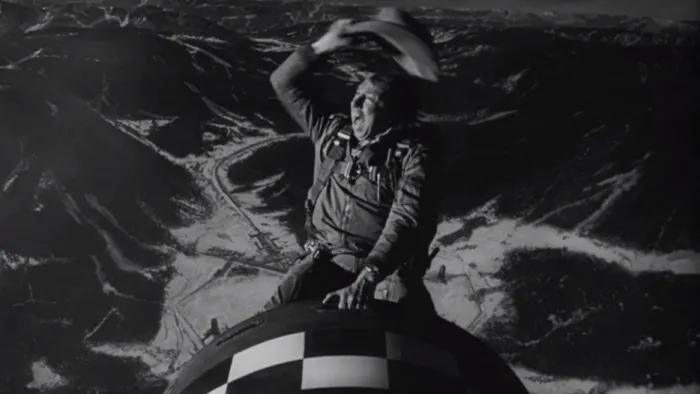
clobbered Washington and a lot of other towns with a sneak attack.” The conviction that they are the second to drop the bomb inspires the crew to overcome nearly insurmountable obstacles to their mission. The crew’s grotesque persistence in its mission is indelibly satirized in the famous shot of the cowboy-hatted Maj. Kong straddling the nuclear warhead and hee-hawing as it
42 The president hopes to avoid both the first and the second strikes—or, at least, to convince the premier not to seek
39
plummets to earth (fig. 6). The film further suggests the inhuman, mechanized resolve of the crew through the way that it presents the technological interface of their plane. As the B-52 finally approaches its target (which Maj. Kong has redesignated as the intercontinental ballistic missile complex at Kodlosk), an array fail-safes that confront the B-52’s bombardier, Lieutenant Lothar Zogg (James Earl Jones).43 As the rest of the crew goes through their automated routines, Lt. Zogg flips row after row of safety switches and priming mechanisms. Each flip of a switch affirms the determination of the crew, while paradoxically suggesting that it is the agency of the machine that governs the operations of the human hand, not the other way around. Even the musical motif associated exclusively with the crew—a rendition of the Civil War tune “Johnny Comes Marching Home”—bounces along with a pluck and persistence that seems unstoppable. Along with the other abovementioned formal elements, the ironic score of the B-52 scenes registers a critique of the ease with which the crew follows through on their unthinkable orders, content in the conviction that the initial (fictional) Soviet strike on the US has radically
reconfigured the ethics of engagement.
43 Maj. Kong decides to bomb Kodlosk instead of their assigned targets because the plane is leaking too much fuel